Screening for cognitive impairment
in late onset depression in a
Brazilian sample using the BBRC-EDU
Tânia Maria da Silva Novaretti1, Marcia Radanovic2, Ricardo Nitrini3
ABSTRACT: Depression and dementia are the most prevalent neuropsychiatric disorders in the elderly population. Alzheimer’s
disease is the leading cause of dementia in most countries, being responsible for more than half of all dementia cases. Late-onset depression is a frequent cause of cognitive decline in the elderly. Differentiating between cognitive impairment secondary to depression and incipient dementia poses a challenge in the clinical setting. Objective: To evaluate the performance of elderly depressed patients using the BBRC-Edu. Methods: We studied 25 patients with late onset depression (mean age: 73.6 y (6.6); schooling: 9.1 y (5.7)) and 30 patients with mild AD (mean age 76.6 y (5.4); schooling: 7.5 y (7.1)), who were compared to a control group of 30 healthy elderly (mean age 73.8 y (5.8); schooling: 9.1 y (5.4)) using the CERAD and BBRC-Edu batteries. Results: For the CERAD battery, depressed patients performed better than AD patients on all tasks (p<0.0001) except for Constructional Praxis (p>0.05), and performed poorer than controls on verbal fluency (animals) and Word List Recall tasks (p<0.0001). For the BBRC-Edu, depressed patients performed better than AD patients on all tasks (p<0.0001) except for Digit Span (direct order) (p=0.076) and Incidental Memory (p>0.05), and performed worse than controls on Learning (second presentation) and verbal fluency (fruits) tasks (p<0.0001). Conclusion: Overall performance on the BBRC-Edu allowed differentiation of controls and depressed patients from AD patients.
Key words: Alzheimer’s disease, CERAD, BBRC-Edu, depression, screening test, cognition, elderly.
RASTREIO DE COMPROMETIMENTO COGNITIVO NA DEPRESSÃO DE INÍCIO TARDIO EM UMA AMOSTRA BRASILEIRA USANDO O BBRC-EDU
RESUMO: Depressão e demência são os transtornos neuropsiquiátricos de maior prevalência na população idosa. A doença
de Alzheimer é a principal causa de demência na maioria os países, sendo a responsável por mais da metade dos casos de demência. Depressão de início tardio é uma causa frequente de declínio cognitivo no idoso. A diferenciação entre transtorno cognitivo secundário à depressão e demência em fase inicial é um desafio na prática clínica. Objetivo: Avaliar o desempenho de pacientes idosos deprimidos usando a Bateria Breve de Rastreio Cognitivo (BBRC-Edu). Métodos: Estudamos 25 pacientes com depressão de início tardio, (idade média 73,6 (6,6); escolaridade: 9,1 (5,7)) e 30 pacientes com DA leve (CDR=1), (idade média 76,6 (5,4); escolaridade: 7,5 (7,1)). O desempenho de ambos os grupos foi comparado a um grupo controle de 30 idosos sadios (idade média 73,8 (5,8); escolaridade: 9,1 (5,4)). Resultados: Na Bateria CERAD pacientes deprimidos tiveram desempenho melhor que pacientes com DA em todos os testes (p<0,0001) exceto para Praxia Construcional (p>0,05), e desempenho pior que os controles na fluência verbal (animais) e Recordação da Lista de Palavras (p<0,0001). Na BBRC-Edu, pacientes deprimidos tiveram melhor desempenho comparados aos pacientes com DA em todos os testes (p<0,0001) exceto para Spam de Dígitos (ordem direta) (p=0,076) e Memória Incidental (p>0,05), e tiveram desempenho pior que os controles na Aprendizagem (segunda apresentação) e na fluência verbal (frutas) (p<0,0001). Conclusão: A Bateria Breve de Rastreio Cognitivo permite a diferenciação de controles e pacientes com transtorno depressivo, de pacientes com doença de Alzheimer.
Palavras-chave: doença de Alzheimer, CERAD, BBRC-Edu, depressão, testes de rastreio, cognição, idosos.
1State University Paulista Julio de Mesquita Filho, Faculty of Sciences, Marília Campus, Department of Speech, Marília SP, Brazil. 2Behavioral and Cognitive
Neurol-ogy Unit, Department of NeurolNeurol-ogy, University Department of NeurolNeurol-ogy, University of São Paulo School of Medicine, São Paulo SP, Brazil. 3Behavioral and Cognitive
Neurology Unit, Department of Neurology, and Cognitive Disorders Reference Center (CEREDIC), Hospital das Clínicas of the University of São Paulo School of Medicine, São Paulo SP, Brazil.
INTRODUCTION
D
epression and dementia are two of the most preva-lent neuropsychiatric diseases in the elderly, yet this population is far from homogeneous in terms of cognitive decline and depressive symptoms. Major de-pressive disorder is common in the general population having an estimated lifetime prevalence of 15-17%.1Clinically signiicant depressive symptoms are present in 11-39% of older adults2-4 while cognitive impairment
is estimated to afect 17-36% of adults aged over 65 years.4-6 Elderly demented patients have shown an even
higher prevalence of depression (24%) in epidemiologi-cal studies.7
Age-related cognitive decline is usually characterized by mild impairment in a number of cognitive domains,8
typically manifested as changes in episodic memory or reduced ability to access information stored in long-term memory9,10 resulting from decreased speed of
the central processing required to encode and retrieve information.11 In this population, working memory
becomes afected12,13 while retention usually remains
preserved8,12 as does implicit memory.14 Other changes
associated with normal aging include mild deicits in language functioning (naming, verbal luency), visuo-spatial abilities, perceptual speed and executive func-tioning.15-17 Amongst patients who sufer from late-life
depression, 20-50% display deicits across a wide range of cognitive domains including processing speed,18
at-tention and executive functions19,20 as well as episodic
and working memory.21
Furthermore, the level of generalized cognitive im-pairment associated with depression can be so marked in the elderly that depression is often misdiagnosed as dementia. Indeed, 9-43% of elderly persons who have depression subsequently develop some kind of demen-tia.22 his cognitive impairment can persist despite
im-provement in depressive symptoms.2,23 However, the
true pattern of cognitive impairment in late-onset de-pression remains a matter of controversy because most studies available are modest or small in size, and cogni-tive deicits tend to difer in both nature and severity, between and within studies.24
In view of the above-mentioned interrelationship between depression and AD, diagnosing dementia in de-pressed patients, regardless of depression, poses a chal-lenge.25 he aim of this study was to evaluate the
per-formance of elderly depressed patients, healthy elderly, and patients with early stage AD using the BBRC-Edu, a screening battery fully developed by Brazilian research-ers.26 To the best of our knowledge, this is the irst study
to employ the BBRC-Edu in the assessment of depressed elderly.
METHODS
hirty patients with mild AD, 25 with depression and 30 control subjects were studied. All participants were na-tive speakers of Brazilian Portuguese, aged over 60 years, and had at least 2 years of formal education. Subjects with a past history or neurological evidence of stroke, neurodegenerative disorders, head injury, serious non-compensated medical illness, drug abuse, hearing, vi-sual or motor impairment that could have afected their cognitive performance were not included. he control group was deined as subjects living in the community, who fulilled the MOANS criteria27 and achieved normal
scores on the cognitive evaluation (corrected for age and schooling). he diagnosis of depression was determined according to the DSM-IV criteria,28 while the diagnosis
of Probable AD was based on the NINCDS-ADRA crite-ria.29 Only mild AD patients (CDR 1) were included.30
he cognitive evaluation entailed application of the Brazilian version of the Consortium to Establish a Registry for Alzheimer’s Disease Battery (CERAD).31,32
Depressive symptoms were evaluated using the Geri-atric Depression Scale (GDS),33 the Hamilton
Depres-sion Scale (HAM-D),34 and the Montgomery & Asberg
Depression Rating Scale (MADRS).35,36Functional
abili-ties were assessed using the Pfefer Functional Activi-ties Questionnaire (PFAQ).37 Depressed patients were
evaluated within one week of introducing antidepres-sant medication.
After the initial evaluation, subjects were classiied into controls, depression or mild AD. Participants were then assessed using the Brief Cognitive Battery-Edu (BBRC-Edu), which was developed in Brazil and has proven suitable for screening cognitive impairment in the Brazilian population, being less impacted by educa-tional level.26
he performance of the three groups on each task was compared using one-way ANOVA with Tukey’s post-hoc test. All statistical analyses were performed using the SPSS for Windows® 10.0.1 software, and a sig-niicance level of 0.05 was adopted.
his study was approved by the local Research Eth-ics Committee (Hospital das Clínicas – University of São Paulo School of Medicine) and all participants or their legal representatives signed an informed consent prior to enrolling on the study.
RESULTS
sample are shown in Table 1. he mean values for age and schooling level were similar across the three groups. Women predominated in the depression and AD groups. AD patients had lower scores on the PFAQ, as expected. Controls and Depression patients did not dif-fer for PFAQ scores. All groups didif-fered in GDS, HAM-D and MADRS scores, with patients from the Depression group exhibiting the highest scores while patients from
the AD group had scores between those of the Control and Depression groups.
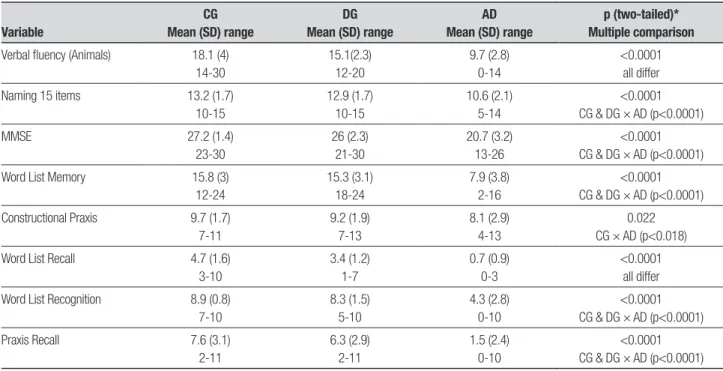
Table 2 shows performance of the three groups on the CERAD battery. Depressed patients performed bet-ter than AD patients on all tasks except for Construc-tional Praxis, but performed poorer than controls on verbal luency (animals) and Word List Recall tasks.
On the BBRC-Edu, depressed patients performed
Table 1. Demographic and clinical characteristics of the sample.
Variable
CG Mean (SD) range
DG Mean (SD) range
AD Mean (SD) range
p (two-tailed) Multiple comparison
Age 73.8 (5.8) 60-87 73.6 (6.6) 65-93 77.6 (5.4) 60-85 0.055*
Schooling 9.1 (5.4) 2-23 9.1 (5.7) 2-20 7.5 (7.1) 2-33 0.519*
Gender M 16 20 23 0.0005**
F 14 5 7 CG × DG p=0.005
CG × AD p=0.006
PFAQ 0 (0)
0-0
1.2 (2) 0-5
19.9 (5.2) 5-28
<0.0001* CG & DG × AD (p < 0.0001)
GDS 2.2 (2.6)
0-9
24.6 (4.6) 16-30
10.3 (4.5) 3-17
<0.0001* all groups differ
HAM-D 2.4 (3.9)
0-20
32.8 (5.4) 27-46
14.6 (8.3) 1-26
<0.0001* all groups differ
MADRS 2.4 (5)
0-24
36.3 (7.2) 30-51
16.5 (8.4) 2-28
<0.0001* all groups differ
CG: control group; DG: depression group; F: female; M: male; NA: not applicable; *ANOVA with Tukey’s post hoc test; **Chi-square test.
Table 2. Performance of the three groups on the CERAD battery.
Variable
CG Mean (SD) range
DG Mean (SD) range
AD Mean (SD) range
p (two-tailed)* Multiple comparison
Verbal fluency (Animals) 18.1 (4) 14-30
15.1(2.3) 12-20
9.7 (2.8) 0-14
<0.0001 all differ
Naming 15 items 13.2 (1.7) 10-15
12.9 (1.7) 10-15
10.6 (2.1) 5-14
<0.0001 CG & DG × AD (p<0.0001)
MMSE 27.2 (1.4)
23-30
26 (2.3) 21-30
20.7 (3.2) 13-26
<0.0001 CG & DG × AD (p<0.0001)
Word List Memory 15.8 (3) 12-24
15.3 (3.1) 18-24
7.9 (3.8) 2-16
<0.0001 CG & DG × AD (p<0.0001)
Constructional Praxis 9.7 (1.7) 7-11
9.2 (1.9) 7-13
8.1 (2.9) 4-13
0.022 CG × AD (p<0.018)
Word List Recall 4.7 (1.6) 3-10
3.4 (1.2) 1-7
0.7 (0.9) 0-3
<0.0001 all differ
Word List Recognition 8.9 (0.8) 7-10
8.3 (1.5) 5-10
4.3 (2.8) 0-10
<0.0001 CG & DG × AD (p<0.0001)
Praxis Recall 7.6 (3.1)
2-11
6.3 (2.9) 2-11
1.5 (2.4) 0-10
<0.0001 CG & DG × AD (p<0.0001)
better compared with AD patients on all tasks except for Digit Span (direct order) and Incidental Memory, yet performed worse than controls on Learning (sec-ond presentation), and verbal luency (fruits) tasks. For the two latter tasks, depressed patients showed an in-termediate performance compared to controls and AD patients (Table 3).
DISCUSSION
he choice of psychometric tests for use in Portuguese-speaking people classiied into well-deined groups is limited.32 It is diicult to discriminate early dementia
from depression based on clinical and neuropsycho-logical evidence37 because similar cognitive and
afec-tive problems can occur in both mild AD and “depres-sive pseudo-dementia”.39 he hallmark of AD is marked
impairment in episodic memory, which may exist years before a clinical diagnosis of dementia is established.40,41
However, semantic impairments also occur in approxi-mately 50% of patients with mild AD where semantic memory may be the most important cognitive domain for performing everyday skills.10,42
Depression is particularly associated with deicits in
executive control processes.43,44 Patients with late-onset
depression have demonstrated impairments in execu-tive functioning, processing speed, as well as episodic and semantic memory.45 Notwithstanding, few studies
in the literature on late-onset depression have investi-gated semantic memory. However, semantic memory tasks often require preserved executive function. Cat-egory luency for example, although generally regarded as a valid measure of semantic memory, relies heavily on initiation, which may be impaired in depression.45 In
ad-dition, the individual under test is required to perform this task within a set time limit, which makes process-ing speed an important factor for good performance.46
In the present study, depressed patients consistently displayed impairment in verbal luency, both for animal and fruits categories.
he presence of depression-related deicits in geriat-ric depression has been noted in episodic memory.23,47-49
Sheline et al. 200649 and Delaloyle et al. 200850 have
suggested that while slowed processing speed appears to be the core cognitive deicit in late-onset depression, it was closely followed by executive dysfunction. How-ever, these authors hold that episodic memory
impair-Table 3. Performance of the three groups on the BBRC-Edu battery.
Variable
CG Mean (SD) range
DG Mean (SD) range
AD Mean (SD) range
p (two-tailed)* Multiple comparison Digit Span Direct order 8.8 (1.7)
6-12
8.9 (1.4) 6-12
7.9 (1.9) 5-11
0.076
Reverse order 4.5 (1.5) 2-8
4.1 (1.5) 2-8
2.8 (1.6) 1-8
0.0001 CG × AD (p<0.0001)
DG × AD (p=0.004)
Learning and memory Perception/Naming 10 (0) 10-10
10 (0) 10-10
9.8 (0.3) 9-10
0.020 CG & DG × AD (p=0.037) Incidental memory 4.7 (1.4)
3-9
4.1 (1.5) 2-7
3.5 (1.7) 0-7
0.011 CG × AD (p=0.008)
Learning 1 7 (1.4)
5-10
6.7 (2) 3-10
4.6 (1.7) 1-8
<0.0001 CG & DG × AD (p<0.0001)
Learning 2 8.9 (0.9)
7-10
7.4 (1.9) 3-10
5.2 (1.3) 2-8
<0.0001 all differ Delayed recall 7.5 (1.7)
4-10
6.3 (2.3) 2-10
2.4 (2.2) 0-7
<0.0001 CG × AD (p<0.001) DG × AD (p<0.0001) Picture recognition 9.7 (0.5)
8-10
9.5 (0.8) 7-10
6.9 (2.8) 0-10
<0.0001 CG & DG × AD (p<0.0001) Verbal fluency (Fruits) 15.6 (2.4)
13-23
13 (2) 7-16
9 (2.7) 4-16
<0.0001 all differ Clock drawing 9.3 (1.6)
2-10
8.4 (2) 3-10
4.9 (2.5) 2-10
<0.0001 CG & DG × AD (p<0.0001)
ment cannot be explained solely by processing resource decreases in late-onset depression patients. Recent data suggest that the reduction in processing resources is a primary cognitive decrement in late-onset depression, which subsequently induces higher-level cognitive dei-cits.18-21,49 For instance, besides memory, impaired
lan-guage abilities in old age have been associated with a reduction in processing resources, such as processing speed, working memory span and inhibition capacity. Processing speed, which denotes the pace at which ele-mentary cognitive operations are carried out, is reduced in late-onset depression.21 Depression-related variance
on higher-order cognitive tests is also thought to be mediated by reduced working memory span, which is able to maintain or suppress the activation of long-term memory units and allocation of intentional resources. Finally, ineicient inhibitory processes permit the entry and maintenance of irrelevant information in the work-ing memory, afectwork-ing subsequent cognitive perfor-mance.50 In this study, depressed patients did not difer
from controls in cued recall memory tasks (recognition) for verbal and non-verbal stimuli, thus suggesting an impairment of self-generated retrieval strategies, which may be secondary to lower processing speed associated to executive dysfunction.
In the clinical setting, it may be diicult to diferenti-ate depression from incipient AD in patients with cogni-tive impairment. Brief cognicogni-tive tests may be helpful in assessing patients with suspected dementia in primary care facilities provided these instruments are suicient-ly accurate. By comparing the performance of controls, depressed patients and mild AD patients using a well-accepted battery (CERAD) plus a battery developed in Brazil (BBRC-Edu), we found that the latter was suitable for detecting mild cognitive impairment in depressed patients and also proved able to discriminate this group from AD patients. Further studies are warranted in or-der to establish the degree of agreement between the BBRC-Edu and other broadly used screening tests, such as the MMSE and CERAD.
REFERENCES
1. APA. Diagnostic and Statistical Manual of Mental Disorders. American Psychiatric Association: Washington, DC; 1994.
2. Steffens DC, Skoog I, Norton MC, et al. Prevalence of depression and its treatment in an elderly population: The Cache County study. Arch Gen Psychiatry 2000;57:601-607.
3. Copeland JR, Beekman AT, Braam AW, et al. Depression among older people in Europe: The EURODEP Studies. World Psychiatry 2004;3: 45-49.
4. Lee Y, Shinkai S. Correlates of cognitive impairment and depressive symptoms among older adults in Korea and Japan. Int J Geriatr Psy-chiatry 2005;20:576-586.
5. Rait G, Fletcher A, Smeeth L, et al. Prevalence of cognitive impairment: results from the MCR trial of assessment and management of older people in the community. Age Aging 2005;34:242-248.
6. Graciani A, Banegas JR, Guallar-Castillon P, Domínguez-Rojas V, Ro-dríguez-Artalejo F. Cognitive assessment of the non-demented elderly community dwellers in Spain. Dement Geriatr Cogn Disord 2006;21: 104-112.
7. Lyketsos CG, Steinberg M, Tschanz JT, Norton MC, Steffens DC, Breitner JC. Mental and behavioral disturbances in dementia: findings from the Cache Country Study on Memory in Aging. Am J Psychiatry 2000;157,708-714.
8. Petersen RC, Stevens JC, Ganguli M, Tangalos EG, Cummings JL, DeKosky ST. Practice parameter: Early detection of dementia: Mild cognitive impairment (an evidence-based review). Neurology 2001;56: 1133-1142.
9. Dixon RA, Wahlin A, Maitland SB, Hultsch DF, Hertzog C, Backman L. Episodic memory change in late adulthood: generalizability across samples and performances indices. Memory Cognit 2004;32:768-778. 10. Amieva H, Goff ML, Millet X, et al. Prodromal Alzheimer’s disease: suc-cessive emergence of the clinical symptoms. Ann Neurol 2008;64: 492-498.
11. Carlson MC, Xue QL, Zhou J, Fried LP. Executive decline and dysfunc-tion precedes declines in memory: the women’s health and aging study II. J Gerontol 2009;64A:110-117.
12. Rabinowitz JC, Craik FI. Prior retrieval effects in young and old adults. J Gerontol 1986;41:368-375.
13. Hultsch DF, Hertzog C, Small BJ, McDonald-Miszczak L, Dixon RA. Short-term longitudinal change in cognitive performance in later life. Psychol Aging 1992;7:571-584.
14. Ritchie K, Touchon J, Ledesert B, Leibovici D, Gorce AM. Establishing the limits and characteristics of normal age-related cognitive decline. Rev Epidemiol Sante Publique 1997;45:373-381.
15. Rubin EH, Storandt M, Miller JP, et al. A prospective study of cognitive function and onset of dementia in cognitively healthy elders. Arch Neurol 1998;55:395-401.
16. Salthouse T. Mechanisms of age-cognition relations in adulthood. Hills-dale, NJ: Lawrence Erlbaum Associates; 1989.
17. Schaie KW. Perceptual speed in adulthood: Cross-sectional and longi-tudinal studies. Psychol Aging 1989;4:443-453.
18. Butters MA, Whyte EM, Nebes RD, et al. The nature and determinants of neuropsychological functioning in late-life depression. Arch Gen Psy-chiatry 2004;61:587-595.
19. Lockwood KA, Alexopoulos GS, Van Gorp WG. Executive dysfunction in geriatric depression. Am J Psychiatry 2002;159:1119-1126. 20. Rapp MA, Dahlman K, Sano M, Grossman HT, Haroutunian V, Gorman
JM. Neuropsychological differences between late-onset and recurrent geriatric major depression. Am J Psychiatry 2005;162:691-698. 21. Nebes RD, Butters MA, Mulsant BH, et al. Decreased working memory
and processing speed mediate cognitive impairment in geriatric depres-sion. Psychol Med 2000; 30:679-691.
22. Stek ML, Van Exel E, Van Tilburg W, Westendorp RGJ, Beekman ATF. The prognosis of depression in old age: outcome six to eight years after clinical treatment. Aging Ment Health 2002;6:282-285.
23. Bhalla RK, Butters MA, Mulsant BH. Persistence of neuropsychological deficits in the remitted state of late-life depression. Am J Geriatr Psy-chiatry 2006;14:419-427.
24. Rose EJ, Ebmeier KP. Pattern of impaired working memory during ma-jor depression. J Affect Disord 2006;90:149-161.
25. Novaretti TMS, D’Avila Freitas MI, Mansur LL, Nitrini R, Radanovic M. Comparison of language impairment in late-onset depression and Al-zheimer’s disease. Acta Neuropsychiatr 2011;23:62-68.
26. Nitrini R, Caramelli P, Porto CS, Fichman HC, Formigoni AP. Brief cognitive battery in the diagnosis of mild Alzheimer’s disease in subjects with me-dium and high levels of education. Dement Neuropsychol 2007;1: 32-36. 27. Smith GE, Ivnik RJ. Normative neuropsychology. In: Petersen RC: Mild
Cognitive Impairment, New York: Oxford; 2003:63-88.
29. McKhann G, Drachman D, Folstein M, Katzman R, Price D, Stadian EM. Clinical diagnosis of Alzheimer’s disease: Report of the NINCDS-ADRDA Work Group under the auspices of Department of Health and Human Services Task Force on Alzheimer’s disease. Neurology 1984; 34:939-944.
30. Hodges JR, Salmon DP, Butters N. Semantic memory impairment in Alzheimer’s disease: failure of access or degraded knowledge. Neuro-psychologia 1992;30:301-14.
31. Morris JC, Heyman A, Mohs RC, et al. The Consortium to Establish a Registry for Alzheimer’s Disease (CERAD). Part I: Clinical and neuro-psychological assessment for Alzheimer’s disease. Neurology 1989;39: 1159-1165.
32. Bertoluci PHF, Okamoto IH, Brucki SMD, Siviero MO, Toniolo Neto J, Ramos LR. Applicability of the CERAD neuropsychological battery to Brazilian elderly. Arq Neuropsychiatr 2001;59:532-536.
33. Yesavage JA, Brink TL, Rose TL, et al. Development and validation of geriatric depression screening scale: a preliminary report. J Psychiatr Res 1983;17:37-49.
34. Hamilton M. A rating scale for depression. J Neurol Neurosurg Psychia-try 1960;23:56-62.
35. Montgomery AS, Asberg M. New depression scale designed to be sen-sitive to change. Br J Psychiatry 1979;134:382.
36. Moreno RA, Moreno DH. Escalas de depressão de Montgomery & Ås-berg (MADRS) e de Hamilton (HAM-D). Rev Psiq Clin 1998;25:262-272. 37. Pfeffer RI, Kurosaki TT, Harrah CH Jr, Chance JM, Filos S. Measure-ment of functional activities in older adults in the community. J Gerontol 1982;37:323-329.
38. Foldi NS, Brickman AM, Schaefer LA, Knutelska ME. Distinct serial position profiles and neuropsychological measures differentiate late life depression from normal aging and Alzheimer’s disease. Psychiatry Res 2003;120:71-84.
39. Swainson R, Hodges JR, Galton CJ, et al. Early detection and
differen-tial diagnosis of Alzheimer’s disease and depression with neuropsycho-logical tasks. Dement Geriatr Cogn Disord 2001;12:265-280. 40. Backman L, Small B, Fratiglioni L. Stability of the preclinical episodic
memory deficit in Alzheimer’s disease. Brain 2001;124: 96-102. 41. Chen P, Ratcliff G, Belle SH. Patterns of cognitive decline in
presymp-tomatic Alzheimer disease: a prospective community study. Arch Gen Psychiatry 2001;58:853-858.
42. Perry RJ, Hodges JR. Relationship between functional and neuropsy-chological performance in early Alzheimer’s disease. Alzheimer Dis As-soc Disord 2000;14:1-10.
43. Henry JD, Crawford JR. Verbal fluency performance in dementia of the Alzheimer type; a meta-analysis. Neuropsychologia 2005;42:1212-1222.
44. Henry JD, Crawford JR. A meta-analytic review of verbal fluency deficits in depression. J Clin Exp Neuropsychol 2005;27:78-101.
45. Herrmann LL, Goodwin GM, Ebmeier KP. The cognitive neuropsychol-ogy of depression in the elderly. Psychol Med 2007;37:1693-1702. 46. Norris MP, Blankenship-Reuter l, Snow-Turek AI, Finch J. Influence of
depression on verbal fluency performance. Age Cog 1995;2:206 -215. 47. Portela MJ, Marcos T, Rami L, Navarro V, Gasto C, Salamero M. Resid-ual cognitive impairment in late-life depression after a 12-month period follow-up. Int J Geriatr Psychiatry 2003;18:571-576.
48. King DA, Cox C, Lyness JM, Conwell Y, Caine ED. Quantitative and qualitative differences in the verbal learning performance of elderly depressives and healthy controls. J Int Neuropsychol Soc 2006;4: 115-126.
49. Sheline YI, Barch DM, Garcia K, et al. Cognitive function in late life de-pression: relationships to depression severity, cerebrovascular risk fac-tors and processing speed. Biol Psychiatry 2006;60:58-65.