R
E
V
IS
Ã
O
R
E
V
IE
W
* * * *
* This article was originally published by Environ Health Perspect 117:159–166 (2009). doi:10.1289/ ehp.11839 available via http:/ /dx.doi.org/ [Online 12 September 2008] and is part of the scientific collaboration between Cien Saude Colet and EHP. The authors declare they have no competing financial interests. 1 Department of Community and Preventive Medicine, Mount Sinai School of Medicine, One Gustave L. Levy Place, Box 1043, New York, NY 10029 USA. [email protected] 2 Department of Pediatrics, Mount Sinai School of Medicine.
3 Medical College of Wisconsin.
4 Department of Population Health Sciences, University of Wisconsin.
5 College of Nursing, Marquette University. 6 Interdepartmental Program in Nutritional Sciences, University of Wisconsin. 7 Marine and Freshwater Biomedical Sciences Center, University of Wisconsin-Milwaukee.
8 Department of Pediatrics, University of Wisconsin. 9 Department of Ambulatory Care and Prevention, Harvard Medical School.
Environment and Obesity in the National Children’s Study
*Ambiente e obesidade no National Children´s Study
Resumo Descrevemos a abordagem do National
Children´s Study (NCS) para entender o papel dos fatores am bientais no desenvolvim ento da obesidade. Revisamos a literatura a respeito de duas hipóteses principais no NCS que se relacio-nam a origens ambientais da obesidade e descre-vem estratégias que serão utilizadas para testar cada hipótese. Apesar de estar claro que a obesi-dade em um indivíduo é resultado de um desequi-líbrio entre consumo e gasto de energia, o contro-le da epidemia de obesidade requer o entendimento de fatores no ambiente moderno e exposições quí-micas que podem ter a capacidade de interromper a ligação entre o consumo e gasto de energia. Atra-vés da aceitação da abordagem do curso de vida a epidemiologia, o NCS será capaz de estudar as origens da obesidade da preconcepção ao final da adolescência, incluindo fatores que vão da heran-ça genética a comportamentos individuais, pas-sando pelo ambiente social, construído e natural e exposições químicas. O estudo terá poder esta-tístico suficiente para examinar as interações en-tre essas influências múltiplas, incluindo intera-ções entre gene-ambiente e gene-obesidade. Um benefício secundário importante será derivado do banco de espécime para análise futura.
Palavras-chave Bisphenol A, Ambiente
construí-do, Disruptores endócrinos, Dieta, Obesidade, Atividade física
Abstract We describe the approach taken by the
National Children’s Study (NCS) to understand-ing the role of environmental factors in the devel-opment of obesity. We review the literature with regard to the two core hypotheses in the NCS that relate to environmental origins of obesity and de-scribe strategies that will be used to test each hy-pothesis. Although it is clear that obesity in an individual results from an imbalance between en-ergy intake and expenditure, control of the obesity epidemic will require understanding of factors in the modern built environment and chemical ex-posures that may have the capacity to disrupt the link between energy intake and expenditure. Through its embrace of the life-course approach to epidemiology, the NCS will be able to study the origins of obesity from preconception through late adolescence, including factors ranging from genet-ic inheritance to individual behaviors to the so-cial, built, and natural environ-ment and chemi-cal exposures. It will have sufficient statistichemi-cal power to examine interactions among these multiple in-fluences, including gene–environment and gene– obesity interactions. A major sec-ondary benefit will derive from the banking of specimens for fu-ture analysis.
Key wordsBisphenol A, Built environment,
En-docrine disruptors, Diet, Obesity, Physical activity Leonardo Trasande 1,2
Chris Cronk 3
Maureen Durkin 4
Marianne Weiss 5
Dale Schoeller 6
Elizabeth Gall 4
Jeanne Hewitt 7
Aaron Carrel 8
Philip Landrigan 1,2
T
ra
sa
Obesity is the consequence of a chronic net positive energy balance. The prevalence of obe-sity in American children has trebled in the past 30 years1-3. In 2003–2006, 31.9% of 2- to
19-year-olds had a body mass index (BMI) > 85th per-centile for age and sex4. This great increase in
obesity portends future increases in incidence of heart disease5, diabetes6, stroke, and possibly
can-cer7 and is therefore projected to produce the first
decline in U.S. life expectancy since the Great De-pression8. The recent explosive increase in
preva-len ce of obesity reflects a com plex in terplay among a) changes in individual behaviors; b) changes in community structure, lifestyle, and the built environment; and c) pos-sibly exposures to certain synthetic chemicals, such as endocrine disruptors (EDs), that may have the capacity to disrupt energy balance.
Control of the obesity epidemic will require understanding each of these factors and the in-terplay among them. This under-standing will guide development of multipronged evidence-based strategies for obesity control. The goal of this review is to describe the approaches that the National Children’s Study (NCS) will employ to develop under-standing of the causes of obesity, especially with regard to environmental factors.
Background
Behavioral change is critical to the prevention and treatment of childhood obesity. Yet interventions against obesity that focus solely on modifying individual behavior to increase energy expendi-ture and/or reduce caloric intake in individual children have had limited success in sustaining weight loss or prevent-ing obesity9. A successful
approach to reducing obesity and its comorbid-ities must also embrace understanding of com-munity-level factors including the social, built, and natural environments. These environmental influences interact with a child’s diet, physical ac-tivity, genetic makeup, and metabolism10-12. An
example of a multipronged approach that took careful cognizance of environmental influences is the success of the state of Arkansas in reducing obesity prevalence among school-age children. A thoughtful redesign of the school environment, with changes to school dietary options, imple-mentation of universal physical education pro-grams, and reduction of access to sugary soft drinks resulted in a decline in the prevalence of overweight children from 20.8% in the 2004–2005 school year to 20.4% in 2005–200613.
Access to safe play spaces may also influence activity patterns and thus reduce risk of
obesi-ty14,15. Direct marketing to children (for example,
through television ads during child-focused pro-gramming) encourages consumption of high-fat and high-sugar content foods and is a negative environmental influence16,17.
Unique windows of vulnerability have been identified for many of the environmental expo-sures linked to obesity12. Fetal stressors such as
maternal nutritional deprivation and smoking can resu lt in in trau terin e growth restriction (IUGR) and thereby influence hypothalamic–pi-tuitary axis programming to increase future risk of obesity and diabetes10. Infants born to
wom-en with insulin-depwom-endwom-ent diabetes are at higher risk of obesity, and milder, diet-con-trolled ges-tational diabetes may also increase risk18,19.
Ma-ternal smoking during pregnancy is an indepen-dent risk factor for the development of child-hood obesity20,21. Excess gestational weight gain
has been associated with increased child adipos-ity at 3 years of age in at least one prospective cohort22. Exposure to endocrine-disrupting
chem-icals during pregnancy may enhance the risk for obesity in childhood23. Rapid weight gain during
the first year of life24 and fewer hours of sleep
during infancy25 further enhance the risk for the
development of childhood obesity.
Although previous cohort studies have con-tributed greatly to identifying many individual-level factors that contribute to the development of obesity in children and its persistence into adult-hood both in the United States and in other coun-tries11,26-38, findings from those previous
longitu-dinal studies have several limitations:
.
Previous studies have not fully capitalized on the life-course approach to chronic disease epide-miology39, an approach that embraces thecon-cept that adult disease can have its origins in early life (or even fetal) exposures. Barker and Os-mond40 promulgated this concept to account for
an association between low birth weight and adult ischemic heart disease in Britain and Wales. The concept has been adopted increasingly in the epi-demiologic approach to understanding chronic conditions41 including obesity42-44 and
neurode-generative conditions45. The application of the
S
aú
d
e C
o
le
tiv
a, 1
5
(1
):1
9
5
-2
1
0
, 2
0
1
0
have collected the scope of data depicted in this figure at multiple points in the life span.
.
Although the Centers for Children’s Envi-ronmental Health and Disease Prevention have collected data on environmental exposures to pregnant women and young children, these re-search centers have rarely focused on child weight status as an outcome47. This weakness isespe-cially relevant in light of new knowledge from animal studies, which suggest that endocrine-dis-rupting chem-icals may modulate response to dietary intake48,49, disrupt the
hypothalamic–pi-tuitary axis50, and possibly increase risk for
child-hood obesity23.
.
Although some studies have collected ge-netic data on participants and have been able to identify polym orphism s that increase risk for obesity, they have not simultaneously collected the data on environmental exposures that are necessary to examine carefully the interactions of genetic and environmental factors with diet and physical activity..
Recent studies also suggest that obesity de-velops as a chronic condition much earlier than the school-age years51. Earlier cohort studies thatwere first initiated when obesity in the preschool years was relatively infrequent are unlikely to pro-vide data on exposures in early life that are essen-tial to identify prenatal and early childhood risk factors for obesity.
.
Many previous cohorts were limited in their capacity to identify risk factors for obesity that may be unique among Hispanics, a population for which obesity prevalence is increasing espe-cially rapidly2,52..
Previous cohorts are limited in that they have not included sufficient numbers of children to draw contrasts between risk factors specific to rural and urban environments34..
Past studies have been unable to allow accu-rate assessment of the role of access to parks and other places that en courage physical activity among children living in urban areas53.S
S
S
S
Macro S
S
S
S S
Macro
Hierarchical axis
Social, built, natural environment Laws, regulations, policies (e.g., farm subsidies)
Micro
Cultural norms (e.g., body image)
Built environments (e.g., connectivity, walkability) Area deprivation (e.g.,
poverty)
Local food environment (e.g., presence of fast food)
Commercial messaging (e.g., TV ads to kids)
Weight gain
Health outcom es
Time axis
Chem ical factors (e.g.,
phthalates, BPA) Genes
Mood H PA
Appetite Metabolism
Health behaviors Energy in (diet) Energy out (physical
activity) Pre- and perinatal
factors
Figure 1. A life-course approach to childhood obesity. Abbreviations: BPA, bisphenol A; HPA, hypothalam-ic–pituitary axis. The life span is depicted horizontally, while factors are depicted at various levels
hierarchi-cally, from the individual-level factors in the lower part of the figure to the community-level factors in the upper part. Adapted from Glass and McAtee54.
T
ra
sa
Figure 2. Schedule of visits, NCS. Stars denote ultrasound assessment, while | on the timeline represents home/clinical assessments (denoted by H/C). Circles denote telephone follow-ups, and asterisk denotes components of the timeline for telephone and mail questionnaires that are still under development.
Preconception In fan cy Early childhood S Later childhood* S
H
H H H C C H C C H C
C C C
In itial visit
1st 2n d 3r d
Trim ester
Birth visit
6 12
Months
3 5 7 9 12 16 20
Years
S
Ultrasoun d assessm en t
H om e/clinical visit (H /C) Den otes telephon e follow-up
Tim elin e of telephon e/m ail question n aires still in developm en t
*
S
.
Many cohort studies were begun before the triplin g of childhood obesity prevalen ce oc-curred3,55,56 - a trend increasingly attributed tothe collective effect of community-level factors for which policy changes may be the only effec-tive means for preventing further increases in obesity prevalence9. To assess the impact of these
more recent community-level factors, new co-horts in which these risk factors exist are needed.
.
Although studies from other countries, such as the Avon Longitudinal Study of Parents and Children11,12 and the Danish National BirthCo-hort57, will provide important insights into the
etiology of childhood obe-sity, the environmental factors that contribute to obesity in American children are likely to be different, and the pool of genetic poly-morphisms that modify risk may be much different from that of European children.
Progress of the NCS
In response to increases in the prevalence of obe-sity and a number of other chronic con-ditions, the U.S. Congress, through the Children’s Health Act of 2000, authorized the National Institute of Child Health and Human Development (NICHD) “to conduct a national longitudinal study of envi-ronmental influences (including physical,
chemi-cal, biologichemi-cal, and psychosocial) on children’s health and development”58. The design of the NCS
has been extensively described elsewhere59-62. With
assistance from the staff of the National Center for Health Statistics at the Centers for Disease Control and Prevention, NCS staff developed a multistage clustered sampling approach to enroll a sample of 100,000 live births representative of all American children63. Families who are enrolled
in the study will participate in a minimum of 13 data collection encounters: at least one visit be-fore conception; two times during pregnancy; at birth; at 6, 12, and 18 months of age in early hood; at 3, 5, 7, 9, and 12 years of age in child-hood; and at 16 and 20 years of age in adolescence (Figure 2). Figure 2 depicts the timeline of visits across the complete study, and Tables 1 and 2 describe the measurements planned for precon-ception through 3 years of age for the seven Van-guard (pilot) locations. Enrollment of women will occur in 105 primary sampling units (counties or, in the case of more sparsely populated areas, clus-ters of counties) and began in January 2009.
S
aú
d
e C
o
le
tiv
a, 1
5
(1
):1
9
5
-2
1
0
, 2
0
1
0
potheses for the study, in consultation with thou-sands of scientists and representatives from com-munity groups and professional organizations. A current list of hypotheses with supporting scien-tific rationales that were accepted and refined by t h e In t er agen cy Co o r d in at in g Co m m it t ee [com-posed of senior scientists from NICHD, the National Institute of Environmental Health Sci-ences, the Centers for Disease Control and
Pre-vention, and the U.S. Environmental Protection Agency (EPA)] is available on the NCS website64.
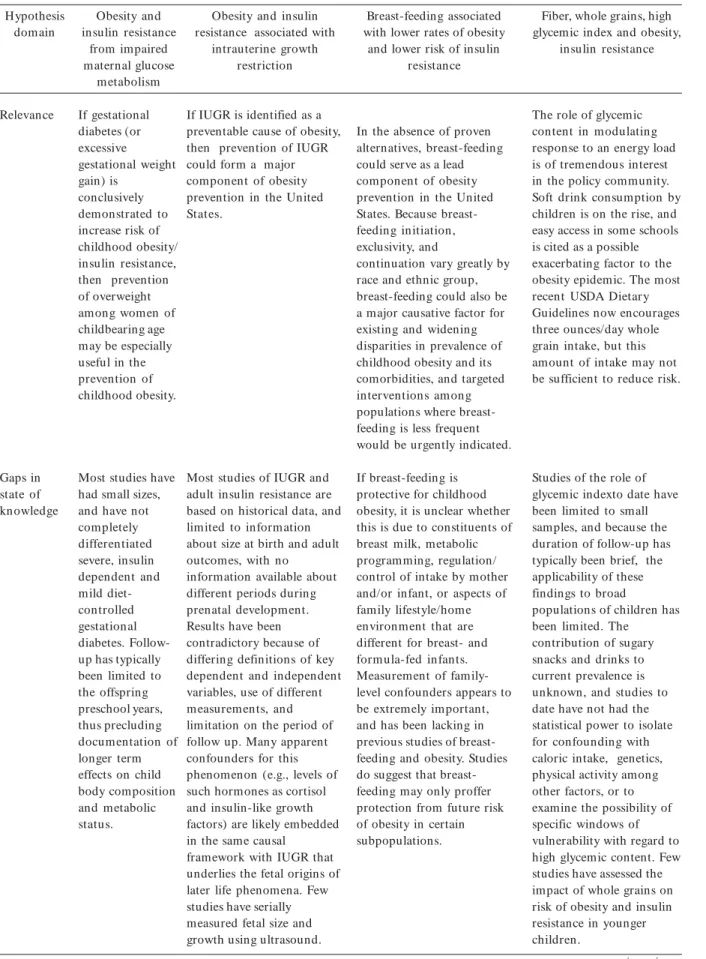
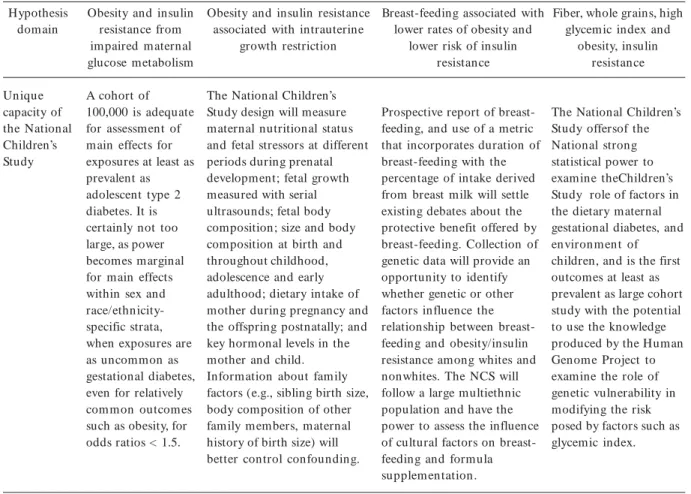
Childhood obesity is a lead focus of the NCS and is addressed in 6 of 30 core hypotheses. Table 3 presents the gaps of knowledge that remain with respect to four of these core hypotheses: obesity and insulin resistance from impaired maternal glucose metabolism; obesity and insulin resistance associated with IUGR; breast-feeding associated
Table 1. NCS proposed measurements from preconception through pregnancy.
Measurem ent
Location/type Body composition
Length/height Weight
Head circumference Arm circum ference Waist circumference Hip circumference Leg length Skin folds Ultrasound Blood pressure Bioimpedance analysis Diet
Community-based food collection Food frequency questionnaire Self-completion diary Activity measures
Activity questionnaire TV viewing
Time outdoors Activity diary Biological specimens
Vaginal swabs Blood
Urine (self-collected) Saliva (self-collected) Hair
Cord blood
Umbilical cord and placenta Mecon ium
Breast milk
Socioeconom ic/environm ental data Mother/father education/SES/ housing
Medical provider visit log Medical record/chart abstraction
Initial
Home
M
M M M
M
M
M
M M
M
M
M
Preconception Initial follow-up
M
M
M
M
First month
Phone
M
M
M
Second m onth
Phone
M
M
M
Fourth month
Phone
M
M
M
T
ra
sa
with lower rates of obesity and lower risk of in-sulin resistance and fiber; and whole grains, high glycemic index, insulin resistance, and obesity.
Table 3 also presents how the NCS will ad-dress these gaps through its design. In this
re-view, we highlight how the study will pro-vide important new knowledge with regard to two core hypotheses that link factors in the chemical and built environments with childhood obesity.
Pregnancy First
trim ester (< 14 weeks)
Home
M, F
M, F M, F M, F
M, F Ma
M, F
M, N
M
M M, F
M, F
M, F
M
First trim ester follow-up (< 14 weeks)
M M
M, F M
M
M
First trim ester ultrasound
Clinic
Ma
M
M
M
16–17 weeks
Phone
M
M
M
Second trim ester
(22–24 weeks)
Clinic
M
M M M
M M M
M
M
M
Third trim ester
(28–32 weeks)
Clinic
M
M M M
M M M
M
M M M
M
M
M
Third trim ester follow-up
Mail back
M M
M
M
M
36 weeks
Phone
M
M
M
Table 1. continuation
Measurem ent
Location/type Body composition
Length/height Weight
Head circumference Arm circum ference Waist circumference Hip circumference Leg length Skin folds Ultrasound Blood pressure Bioimpedance analysis Diet
Community-based food collection Food frequency questionnaire Self-completion diary Activity measures
Activity questionnaire TV viewing
Time outdoors Activity diary Biological specimens
Vaginal swabs Blood
Urine (self-collected) Saliva (self-collected) Hair
Cord blood
Umbilical cord and placenta Mecon ium
Breast milk
Socioeconom ic/environm ental data Mother/father education/SES/ housing
Medical provider visit log Medical record/chart abstraction
Abbreviations: F, data from father; M, data from mother; N, neighborhood level data; SES, socioeconomic status.
S
aú
d
e C
o
le
tiv
a, 1
5
(1
):1
9
5
-2
1
0
, 2
0
1
0
Obesity-Related Hypotheses of the NCS
Impact of neighborhood environment on risk of obesity and insulin resistance
Built environment features such as mixed land use, increased proximity to recreational activities and green space, as well as safety (e.g., low crime rates and perceived traffic safety for pedestrian and bicyclists) have been associated in
cross-sec-tional studies with increased physical activity65-67
and lower risk of obesity among adults68-70. Few
studies have examined the impact of the built en-vironment on younger children, and those stud-ies have focused upon circumscribed geographic areas and/or socioeconomically advantaged and ethn ically hom ogen eous com m un ities71.
De-creased access to healthy eating choices in low socio-economic status neighborhoods has been documented in at least two studies72,73. Factors
Predischarge visit
Hospital
C C C C C C
C
C
M, C
Childhood Neon ate
Birth
3 m onths
Phone
M
M
M
6 months
Home
C C C C C C
C
M
C
C
M, F
M
6-m on th follow-up
Mail back
M, F
M
M
M
9 m onths
Phone
F
M
12 m onths
Home
C C C C C C
C
C
C C
C
M
M
Table 2. NCS proposed measurements from birth through 3 years of age.
Measurem ent
Location/type Body composition
Length/height Weight
Head circumference Arm circum ference Waist circumference Hip circumference Leg length Skin folds Ultrasound Blood pressure Bioimpedance analysis Diet
Community-based food collection Food frequency questionnaire Self-completion diary Activity measures
Activity questionnaire TV viewing
Time outdoors Activity diary Biological specimens
Vaginal swabs Blood
Urine (self-collected) Saliva (self-collected) Hair
Cord blood
Umbilical cord and placenta Mecon ium
Breast milk
Socioeconom ic/environm ental data Mother/father education/SES/ housing
Medical provider visit log Medical record/chart abstraction
Delivery
Hospital
M, C M
C M
T
ra
sa
such as climate and topography have been taken into account infrequently74. The effect of after
school and summer adult organized programs on obe-sity and insulin resistance is unknown. In the absence of such programs, parents living in urban areas may instruct their children to go di-rectly home from school where indoor activities are largely limited to watching tele-vision and play-ing computer games in the security of the home.
A systematic review of previous studies of the built environment and childhood obesity identi-fied inconsistencies in measurements of the built environment across studies and cross-sectional designs as major deficits of pre-vious studies, and noted that these studies rarely studied both diet and physical activ-ity71. Because of its focus on
community characterization60, the NCS will
al-low more careful identification of those features
Childhood 18 m onths
Phone
C, N
M
F
M
24 months
Phone
M
M
30 m onths
Phone
M
M
36 m onths
Clinic
C C C C C C C C
C C
C, N C C
C C C C
C C C C
C
M, F
C C
Table 2. continuation
Measurem ent
Location/type Body composition
Length/height Weight
Head circumference Arm circum ference Waist circumference Hip circumference Leg length Skin folds Ultrasound Blood pressure Bioimpedance analysis Diet
Community-based food collection Food frequency questionnaire Self-completion diary Activity measures
Activity questionnaire TV viewing
Time outdoors Activity diary Biological specimens
Vaginal swabs Blood
Urine (self-collected) Saliva (self-collected) Hair
Cord blood
Umbilical cord and placenta Mecon ium
Breast milk
Socioeconom ic/environm ental data Mother/father education/SES/ housing
Medical provider visit log Medical record/chart abstraction
12-month follow-up
Mail back
M
C
M
M
S aú d e C o le tiv a, 1 5 (1 ):1 9 5 -2 1 0 , 2 0 1 0
Table 3. Core hypotheses of the National Children’s Study relating to obesity. Hypothesis domain Relevance Gaps in state of knowledge Obesity and insulin resistance from impaired maternal glucose m etabolism If gestational diabetes (or excessive gestational weight gain) is conclusively demonstrated to increase risk of childhood obesity/ insulin resistance, then prevention of overweight among women of childbearing age may be especially useful in the prevention of childhood obesity.
Most studies have had small sizes, and have not com pletely differentiated severe, insulin dependent and mild diet-controlled gestational diabetes. Follow-up has typically been limited to the offspring preschool years, thus precluding documentation of longer term effects on child body composition and metabolic status.
Obesity and insulin resistance associated with
intrauterine growth restriction
If IUGR is identified as a preventable cause of obesity, then prevention of IUGR could form a major component of obesity prevention in the United States.
Most studies of IUGR and adult insulin resistance are based on historical data, and limited to information about size at birth and adult outcomes, with no information available about different periods during prenatal development. Results have been contradictory because of differing definitions of key dependent and independent variables, use of different measurements, and limitation on the period of follow up. Many apparent confounders for this phenomenon (e.g., levels of such hormones as cortisol and insulin-like growth factors) are likely embedded in the same causal
framework with IUGR that underlies the fetal origins of later life phenomena. Few studies have serially measured fetal size and growth using ultrasound.
Breast-feeding associated with lower rates of obesity
and lower risk of insulin resistance
In the absence of proven alternatives, breast-feeding could serve as a lead component of obesity prevention in the United States. Because breast-feeding initiation, exclusivity, and
continuation vary greatly by race and ethnic group, breast-feeding could also be a major causative factor for existing and widening disparities in prevalence of childhood obesity and its comorbidities, and targeted interventions am ong populations where breast-feeding is less frequent would be urgently indicated.
If breast-feeding is protective for childhood obesity, it is unclear whether this is due to constituents of breast milk, metabolic programming, regulation/ control of intake by mother and/or infant, or aspects of family lifestyle/home environment that are different for breast- and form ula-fed infants. Measurement of family-level confounders appears to be extremely important, and has been lacking in previous studies of breast-feeding and obesity. Studies do suggest that breast-feeding may only proffer protection from future risk of obesity in certain subpopulations.
Fiber, whole grains, high glycemic index and obesity,
insulin resistance
The role of glycemic content in modulating response to an energy load is of tremendous interest in the policy community. Soft drink consumption by children is on the rise, and easy access in some schools is cited as a possible exacerbating factor to the obesity epidemic. The most recent USDA Dietary Guidelines now encourages three ounces/day whole grain intake, but this amount of intake may not be sufficient to reduce risk.
Studies of the role of glycemic indexto date have been limited to small samples, and because the duration of follow-up has typically been brief, the applicability of these findings to broad
populations of children has been limited. The
contribution of sugary snacks and drinks to current prevalence is unknown, and studies to date have not had the statistical power to isolate for confounding with caloric intake, genetics, physical activity among other factors, or to examine the possibility of specific windows of vulnerability with regard to high glycemic content. Few studies have assessed the impact of whole grains on risk of obesity and insulin resistance in younger children.
T
ra
sa
of neighbor-hoods that affect physical activity and diet, such as proximity to play spaces, avail-ability of healthy food stores, and neighborhood walkability.
The NCS represents a major opportunity to explore the role of specific aspects of the neigh-borhood environment at different periods in a child’s development. Access to safe play spaces near a child’s home, for example, may be especially protective against obesity during the early school years, but less so during ado-lescence. The design of the NCS capitalizes on the life-course approach and allows for separate analyses of the impact of certain factors on the development of obesity or increase in adiposity within certain time periods. Simultaneous collection of socioeconomic and genetic data as well as measures of diet and phys-ical activity (Tables 1 and 2) will permit careful distinction of the role of certain environmental risk factors during each window of vulnerability.
Table 3. continuation Hypothesis
domain
Unique capacity of the National Children’s Study
Obesity and insulin resistance from impaired maternal glucose metabolism
A cohort of 100,000 is adequate for assessment of main effects for exposures at least as prevalent as adolescent type 2 diabetes. It is certainly not too large, as power becomes marginal for main effects within sex and race/ethnicity-specific strata, when exposures are as uncommon as gestational diabetes, even for relatively common outcomes such as obesity, for odds ratios < 1.5.
Obesity and insulin resistance associated with intrauterine
growth restriction
The National Children’s Study design will measure maternal nutritional status and fetal stressors at different periods during prenatal development; fetal growth measured with serial ultrasounds; fetal body composition; size and body composition at birth and throughout childhood, adolescence and early adulthood; dietary intake of mother during pregnancy and the offspring postnatally; and key hormonal levels in the mother and child. Information about family factors (e.g., sibling birth size, body composition of other family members, maternal history of birth size) will better control confounding.
Breast-feeding associated with lower rates of obesity and
lower risk of insulin resistance
Prospective report of breast-feeding, and use of a metric that incorporates duration of breast-feeding with the percentage of intake derived from breast milk will settle existing debates about the protective benefit offered by breast-feeding. Collection of genetic data will provide an opportunity to identify whether genetic or other factors influence the relationship between breast-feeding and obesity/insulin resistance among whites and nonwhites. The NCS will follow a large multiethnic population and have the power to assess the influence of cultural factors on breast-feeding and formula supplem entation.
Fiber, whole grains, high glycemic index and
obesity, insulin resistance
The National Children’s Study offersof the National strong statistical power to examine theChildren’s Study role of factors in the dietary maternal gestational diabetes, and environm ent of children, and is the first outcomes at least as prevalent as large cohort study with the potential to use the knowledge produced by the Human Genome Project to examine the role of genetic vulnerability in modifying the risk posed by factors such as glycemic index.
Chemical environmental agents and the endocrine system
The impact of EDs on humans was first iden-tified by Herbst and Bern, who observed eight cases of clear cell adenocarcinoma of the vagina in young women who had been exposed in utero to diethylstilbestrol (DES), a synthetic estrogen prescribed to pregnant women in the 1950s, 1960s, and 1970s to prevent miscarriage75. Prenatal
ex-posure to DES has been found subsequently to induce obesity in an animal model23.
Identifica-tion of endocrine-disrupting chemicals has been limited by the lack of toxicity testing data avail-able for many chemicals in widespread use76.
Because so few chemicals have been tested for their toxicity, the possibility exists that other chem-icals besides DES influence somatic growth and obesity48,50. One potential endocrine-disrupting
S
aú
d
e C
o
le
tiv
a, 1
5
(1
):1
9
5
-2
1
0
, 2
0
1
0
ture polycarbonate resin in the coatings of food and beverage containers77. Exposure to BPA,
ph-thalates, and other EDs is widespread in Ameri-can children78, and animal studies increasingly
suggest the potential for toxicity at current levels of exposure79. In vitro studies have found that BPA
induces fibroblast differentiation into adipocytes80.
Animal studies have found that BPA affects glu-cose transport in fat cells81. BPA also disrupts
glu-cagon secretion in intact Langerhans cells at na-nomolar levels82. These studies raise the
possibil-ity that BPA could be a risk factor for the develop-ment of obesity, a question undergoing examina-tion in at least one Center for Children’s Environ-mental Health and Disease Prevention83.
Phthalates are used in a variety of per-sonal care products such as shampoos and in the syn-thesis of polyvinyl chloride84. Phthalates have been
documented consistently in animal studies to have antiandrogenic effects85-87. Cohort stud-ies have
begun to assess for potential effects in humans and suggest susceptibility at lower levels of expo-sure than those documented to have effects in an-imals. It is hypothesized that the most severe ef-fects may be associated with exposures in prenatal and early postnatal life. Decreases in anogenital distance among infant males have been associated with elevated urinary phthalate levels during preg-nancy88, and breast milk levels of monoester
ph-thalates have been associated with higher serum hormone binding globulin levels and luteinizing hormone to free testosterone ratios89. Diminished
sperm motility has been identified among exposed
men90-92, and low-molecular-weight phthalates
have been associated with increased birth weight and longer duration of gestation in at least one birth cohort83. Although few studies have analyzed
the impact of phthalate exposure on increased adiposity in children, analysis of the 1999–2002 National Health and Nutrition Examination Sur-vey has identified increases in urinary phthalate levels among men with increased waist circumfer-ence and homeostatic model assessment, a mea-sure of insulin resistance93.
Lack of accurate information on the level and timing of past exposures to EDs has been the prin-cipal limitation of most previous studies of the potential human impacts of EDs. This limitation will be directly addressed by the prospective de-sign of the NCS. In the NCS, exposures to chem-icals will be measured during pregnancy, in breast milk, and in the perinatal period before the ap-pearance of health effects. The large sample size will facilitate investigation of possible links between low-prevalence endocrine-disruptor exposures
and health outcomes, and state-of-the-art labo-ratory assessment of chemical exposures will fur-ther sharpen the study’s ability to discern effects of exposures to EDs. The large sample size will also permit study of genetic polymor-phisms and gene–environment interactions, which may un-earth individual differences in susceptibility to EDs. As new EDs are identi-fied, specimens can be withdrawn from the NCS repository to analyze their content for appropriate biomarkers to as-sess whether these EDs may be risk factors in the development of obesity94.
Conclusion
The NCS presents previously unrealized oppor-tunities for the identification of risk factors for childhood obesity, and for their subsequent elim-ination through prevention. Just as the Framing-ham Heart Study provided health care providers with hitherto novel information on risk factors for cardiovascular disease that enabled them to offer evidence-based advice to limit smoking, re-duce the intake of fatty foods, and control hyper-tension, the NCS will suggest interventions that can be used to pre-vent obesity by communities, policy makers, and child health providers. A ma-jor strength of the study is that it will be represen-tative of American children. It is anticipated, for exam-ple, that > 20,000 children in the cohort will be Hispanic, permitting examination of unique risk factors among a subgroup that has been dis-proportionately affected by the epidemic.
The hypotheses presented in this review cov-er only a small pcov-ercentage of the findings likely to emerge from the NCS. The core NCS hypotheses are dynamic, and as the study is implemented, new questions will emerge and result in modifi-cations to the study protocol. Others may be clear-ly answered through the NCS or other studies, or become outdated as the whole body of knowl-edge adjusts the direction of inquiry. For some areas of inquiry where the science is in relatively nascent stages, the major benefits to be gained from the study derive from its hypothesis-gener-ating nature. The NCS will provide a major op-portunity to confirm putative genetic links iden-tified in other studies through the study of genet-ic sequences of children and their families95. As
T
ra
sa
Of course, no observational study by itself can demonstrate causality. The NCS will identify risk factors for which causality may be suggested on the basis of strength, consistency, temporali-ty, biological gradient, and plausibility. Findings from the NCS will prompt further interventions such as randomized con-trolled trials, policy in-terventions, and other initiatives that will con-firm or refute the role of identified risk factors in the development of obesity and its associated comorbidities.
The life-course approach underlying the de-sign of the NCS may very well lead to delineating the duration and impact of environmental, be-havioral, and social exposures on risk for obesi-ty. No study will have followed women from pre-conception and subsequently followed their chil-dren at such frequent intervals early in childhood and then through adolescence and young adult-hood. The NCS will collect an array of biospeci-mens, dietary and physical activity data, and so-cial and chemical environmental factors on all 100,000 children for all proposed data collection time points, whereas other cohorts have collect-ed more limitcollect-ed data at each time point or col-lected complete data on a smaller sample.
A major challenge of the NCS will be to over-come the difficulties in measuring physical activity, diet, and anthropometry in children that have be-deviled past studies. Limitations of reliability and validity do exist with food-frequency question-naires96,97 and other instruments commonly used
to measure dietary intake, although promising al-ternatives have been developed for populations in which past instruments have not proven reliable98.
The vagaries of collecting information on physical activity by ques-tionnaire are well documented99,
but accelerometry and other measur-ing techniques are increasingly promising in their precision and
application100,101. BMI is not a perfect measure of
adiposity102, and dual-absorption X-ray
absorpti-ometry has been strongly correlated with cardio-vascular disease factors in children103.
Bioimped-ance analysis and skinfold thickness are increas-ingly used to measure adiposity104,105.
These challenges will not be easily dismissed, and the opportunity is ripe for contributions from the obesity research community to ensure that the best questionnaires and measurement approaches are utilized in an efficient and cost-effective way. At this time, the protocol has been finalized only for the seven Vanguard (pilot) lo-cations, and even for those locations only through birth. The NCS also offers major opportunities to study the validity and reliability of alterative mea-surement approaches through adjunct stud-ies in collaboration with existing study centers. These studies may use the full or a subsample of the study cohort, with the caveat that pro-posed new data collection not impose undue additional burden on study participants or additional fi-nancial burden on the study.
The NCS will also trigger ancillary and fol-low-up studies and provide the next generation of obesity researchers opportunities to apply for funding106. The NCS will make public use,
deiden-tified data sets available in accordance with fed-eral privacy regulations.
Previous cohort studies of cardiovascular risk have plowed the terrain to identify major risk factors and allow the NCS to close in on solu-tions to the epidemic of childhood obesity. How-ever, they have also demonstrated that these re-lationships are complex and temporally depen-dent, making a large longitudinal cohort study beginning in the prenatal period essential. The NCS thus offers us great hope in combating the obesity epidemic among America’s children.
Acknowledgements
S
aú
d
e C
o
le
tiv
a, 1
5
(1
):1
9
5
-2
1
0
, 2
0
1
0
Gor t m aker SL, Mu st A, Sobol AM, Pet er son K, Colditz GA, Dietz WH. Television viewing as a cause of increasing obesity among children in the United States, 1986–1990. Arch Pediatr Adolesc Med 1996;
150(4):356–362.
Lobst ein T, Dibb S. Evid en ce of a p ossible lin k between obesogenic food advertising and child over-weight. Obes Rev 2005; 6(3):203–208.
Bo S, Menato G, Gallo ML, Bardelli C, Lezo A, Si-gnorile A, Gam bino R, Cassader M, Massobrio M, Pagano G. Mild gestational hyperglycemia, the met-abolic syn drom e an d adverse n eon atal ou tcom es.
Acta Obstet Gynecol Scand 2004; 83(4):335–340.
Dabelea D, Hanson RL, Lindsay RS, Pettitt DJ, Im-peratore G, Gabir MM, Rou m ain J, Ben n ett PH , Knowler WC. Intrauterine exposure to diabetes con-veys risks for type 2 diabetes and obesity: a study of discordant sibships. Diabetes 2000; 49(12):2208–2211.
Bergmann KE, Bergmann RL, von Kries R, Böhm O, Richter R, Dudenhausen JW, Wahn U. Early deter-minants of child-hood overweight and adiposity in a birth cohort stu dy: role of breast-feedin g. Int J Obes 2003; 27:162–172.
Oken E, Levitan EB, Gillman MW. Maternal smok-in g du r-smok-in g pregn an cy an d child overweight: sys-tem atic review and m eta-analysis. Int J Obes 2008;
32:201–210.
Oken E, Taver as EM, Klein m an KP, Rich-Edwards JW, Gillman MW. Gestational weight gain and child adiposity at age 3 years. Am J Obstet Gynecol 2007;
196(4):322–322.
Newbold RR, Padilla-Ban ks E, Sn yder RJ, Phillips TM, Jeffer son WN . Develop m en t al exp osu r e t o en do-cr in e disr u ptor s an d th e obesity epidem ic.
Reprod Toxicol 2007; 23(3):290–296.
Reilly JJ, Arm stron g J, Dorosty AR, Em m ett PM, Ness A, Rogers I, Steer C, Sherriff A; Avon Longitu-din al Study of Paren ts an d Children Study Team . Early life risk factors for obesity in childhood: co-hort study. BMJ 2005; 330:1357.
Taveras EM, Rifas-Shim an SL, Oken E, Gunderson EP, Gillm an MW. Shor t sleep d u ration in in fan cy and risk of childhood overweight. Arch Pediatr Ad-olesc Med 2008; 162(4):305–311.
Berkey CS, Rockett H RH , Field AE, Gillm an MW, Frazier AL, Cam argo CA, Colditz GA. Activity, di-etary intake, and weight changes in a longitudinal st u d y of p r ead olescen t an d ad olescen t boys an d girls. Pediatrics 2000; 105:e56.
Dem er ath EW, Li J, Sun SS, Chum lea WC, Rem s-berg KE, Czer win ski SA, Town e B, Sier vogel RM. Fifty-year trends in serial body m ass index during adolescen ce in gir ls: the Fels Lon gitu din al Study.
Am J Clin Nutr 2004; 80(2):441–446.
Freedm an DS, Khan LK, Serdu la MK, Dietz WH , Srinivasan SR, Berenson GS. The relation of child-hood BMI to adu lt adiposity: the Bogalu sa H eart Study. Pediatrics 2005; 115(1):22–27.
Gordon-Larsen P, Nelson MC, Page P, Popkin BM. In equality in the built en viron m en t un derlies key health disparities in physical activity an d obesity.
Pediatrics 2006; 117(2):417–424. References
Ogden CL, Carroll MD, Curtin LR, McDowell MA, Tabak CJ, Flegal KM. Prevalence of overweight and obesity in the United States, 1999–2004. JAMA 2006;
295(13):1549–1555.
Strauss RS, Pollack HA. Epidemic increase in child-h o o d o ver weigchild-h t , 1986–1998. JA M A 2001;
286(22):2845–2848.
Troian o RP, Flegal KM, Ku czm arski RJ, Cam pbell SM, Johnson CL. Overweight prevalence and trends for children and adolescents. The National H ealth and Nutrition Exam ination Surveys, 1963 to 1991.
Arch Pediatr Adolesc Med 1995; 149(10):1085–1091.
Ogden CL, Carroll MD, Flegal KM. High body mass index for age am ong US children and adolescents, 2003–2006. JAMA 2008; 299(20):2401–2405.
Bibbins-Domingo K, Coxson P, Pletcher MJ, Light-wood J, Gold m an L. Ad olescen t over weigh t an d future adult coronary heart disease. New Engl J Med
2007; 357(23):2371–2379.
Lee JM, Okumura MJ, Freed GL, Menon RK, Davis MM. Trends in hospitalizations for diabetes among ch ildren an d you n g adu lts: Un ited States, 1993– 2004. Diabetes Care 2007; 30(12):3035–3039.
Bjørge T, Engeland A, Tverdal A, Sm ith GD. Body m ass in d ex in ad olescen ce in r elat ion t o cau se-specific m ortal-ity: a follow-up of 230,000 Norwe-gian adolescents. Am J Epidem iol 2008; 168:30–37.
O lsh an sky SJ, Passaro D, H er sh ow R, Layd en J, Carnes BA, Brody J, Hayflick L, Butler RN, Allison DB, Ludwig DS. A possible decline in life expectan-cy in the United States in the 21st century. N Engl J Med 2005; 352:1138–1145.
Su m m erbell CD, Waters E, Edm u n ds LD, Kelly S, Brown T, Cam pbell KJ. In terventions for preven t-ing obe-sity in children [Review]. Cochrane Data-base Syst Rev 2005; 3:CD001871.
Meaney MJ, Seckl JR. Glucocorticoid programming.
Ann NY Acad Sci 2004; 1032:63–84.
Mo ll PP, Bu r n s TL, Lau er RM. Th e gen et ic an d en viron m en tal sou rces of body m ass in dex vari-abilit y: th e Mu scatin e Pon d erosit y Fam ily Stu dy.
Am J Hum Genet 1991; 49(6):1243–1255.
On g KK, Nor th ston e K, Wells JC, Ru bin C, Ness AR, Golding J, Dunger DB. Earlier m other’s age at menarche predicts rapid infancy growth and child-hood obesity. PLoS Med 2007; 4(4):e132.
[Anonym ous.] Im proving individual and com m u-n ity h ealth th rou gh h ealth prom otiou-n strategies: local case study—Joseph Thom pson and the Body Mass In d ex Assessm en t Pr oject in Ar kan sas. In : Mom en t s in Lead er sh ip : Case St u d ies in Pu blic H ealth Policy and Practice (Debuono B, Gonzalez AR, and Rosenbaum S, eds). New York: Pfizer Inc.; 2007. p. 127–132.
Ewin g R, Sch m id T, Killin gswo r t h R, Zlo t A, Raudenbush S. Relationship between urban sprawl and physical activity, obesity, and m orbidity. Am J Health Promot 2003; 18(1):47–57.
Frumkin H, Frank L, Jackson R. Urban Sprawl and Public H ealth: Design in g, Plan n in g, an d Buildin g for Healthy Com m un ities. Washin gton , D.C.: Is-land Press; 2004.
1.
2.
3.
4.
5.
6.
7.
8.
9.
10.
11.
12.
13.
14.
15.
16.
17.
18.
19.
20.
21.
22.
23.
24.
25.
26.
27.
28.
T
ra
sa
Guo SS, Wu W, Chumlea WC, Roche AF. Predicting over-weight an d obesity in adu lthood from body m ass in dex valu es in childhood an d adolescen ce.
Am J Clin Nutr 2002; 76(3):653–658.
Lake JK, Power C, Cole TJ. Ch ild to adu lt body mass index in the 1958 British birth cohort: associ-ation s with paren tal obesity. Arch Dis Child 1997;
77(5):376–381.
Lauer RM, Clarke WR, Burns TL. Obesity in child-h oo d : t child-h e Mu scatin e St u d y. Z honghu a M in Gu o Xiao Er Ke Yi Xue Hui Za Zhi 1997; 38(6):432–437.
Nader PR, O’Brien M, Houts R, Bradley R, Belsky J, Cr osn oe R, Fr iedm an S, Mei Z, Su sm an EJ; Na-tional Institute of Child Health and Human Devel-opm ent Early Child Care Research Network. Iden-tifying risk for obesity in early childhood. Pediatrics
2006; 118(3):e594–601.
Nelson MC, Gordon-Larsen P, Song Y, Popkin BM. Bu ilt an d social en vir on m en t s associat ion s wit h adolescent overweight and activity. Am J Prev Med
2006; 31(2):109–117.
Parson s TJ. Fetal an d early life growth an d body m ass index from birth to early adulthood in 1958 Br it ish co h o r t : lo n git u d in al st u d y. BM J 2001;
323(7325):1331–1335.
Sier vogel RM, Wisem an d le W, Mayn ard LM, Guo SS, Chu m lea WC, Town e B. Lifetim e over weigh t status in relation to serial changes in body compo-sition an d risk factors for cardiovascu lar disease: Th e Fels Lo n git u d in al St u d y. O bes Res 2000;
8(6):422–430.
St r au ss RS, Kn igh t J. In flu en ce o f t h e h o m e en vir on - m en t on t h e d evelop m en t of obesit y in children. Pediatrics 1999; 103(6):e85.
Thom pson DR, Obarzan ek E, Fran ko DL, Barton BA, Mor r ison J, Bir o FM, Dan iels SR, St r iegel-Moore RH . Childhood overweight an d cardiovas-cular disease risk factors: The National Heart, Lung, an d Blood In stit u te Growth an d H ealth Stu dy. J Pediatr 2007; 150(1):18–25.
Ben -Shlom o Y, Ku h D. A life cou r se ap proach to chron ic disease epidem iology: con ceptual m odels, empirical chal-lenges and interdisciplinary perspec-tives. Int J Epidemiol 2002; 31:285–293.
Barker DJ, Osm ond C. Infant m ortality, childhood n utrition , an d ischaem ic heart disease in En glan d and Wales. Lancet 1986; 1(8489):1077–1081.
Lynch J, Smith GD. A life course approach to chronic disease epidemiology. Annu Rev Public Health 2005;
26(1):1–35.
Gillman MW. A life course approach to overweight and obesity. In: A Life Course Approach to Chronic Diseases Epidemiology (Kuh D, Ben-Shlomo Y, eds). Oxford, UK: Oxford University Press; 2004. Jam es SA, Fowler-Brown A, Raghunathan TE, Van Hoewyk J. Life-course socioeconom ic position and obesity in African American women: The Pitt County Study. Am J Public Health 2006; 96:554–560.
N o vak M, Ah lgr en C, H am m ar st r ö m A. A life-cou rse approach in explain in g social in equ ity in obesity am ong young adult m en and wom en. Int J Obes 2006; 30:191–200.
Landrigan PJ, Sonawane B, Butler RN, Trasande L, Callan R, Droller D. Early environmental origins of n eu r od e- gen er at ive d isease in lat er life. Environ Health Perspect 2005; 113:1230–1233.
National Research Council. Pesticides in the Diets of Infants and Children. Washington, D.C.: Nation-al Academ y Press; 1993.
Wolff MS, Britton JA, Boguski L, Hochman S, Mal-oney N, Serra N, Liu Z, Berkowitz G, Larson S, For-man J. Environmental exposures and puberty in in-nercity girls. Environ Res 2008; 107(3):393–400.
Bhathen a SJ, Velasqu ez MT. Ben eficial role of di-etary phytoestrogens in obesity and diabetes. Am J Clin Nutr 2002; 76(6):1191–1201.
En an E, Lasley B, Stewar t D, Overst reet J, Van de-voor t CA. 2, 3, 7, 8-Tetr achlorodiben zo-p-dioxin
(TCDD) modu-lates function of human luteinizing gran u losa cells via cAMP sign alin g an d early re-du ct ion of glu cose tr an spor t-in g activit y. Reprod Toxicol 1996; 10(3):191–198.
Rubin BS, Murray MK, Damassa DA, King JC, Soto AM. Perinatal exposure to low doses of bisphenol A affects body weight, patterns of estrous cyclicity, and plasma LH levels. Environ Health Perspect 2001;
109:675–680.
Kim J, Peterson KE, Scanlon KS, Fitzm aurice GM, Mu st A, Oken E, Rifas-Shim an SL, Rich-Edwards JW, Gillm an MW. Trends in overweight from 1980 through 2001 am on g preschoolaged children en -rolled in a health mainte-nance organization. Obe-sity (Silver Spring) 2006; 14(7):1107–1112.
Freedm an DS, Khan LK, Serdula MK, Ogden CL, Dietz WH. Racial and ethnic differences in secular trends for childhood BMI, weight, and height. Obe-sity (Silver Spring) 2006; 14(2):301–308.
Kipke MD, Iverson E, Moore D, Booker C, Ruelas V, Peters AL, Kaufm an F. Food an d park environ-m en t s: n eigh bor - h ood - level r isks for ch ild h ood obesity in East Los Angeles. J Adolesc Health 2007;
40(4):325–333.
Glass TA, McAt ee MJ. Beh avio r al scien ce at t h e cross-roads in pu blic health: exten din g horizon s, envisioning the future. Soc Sci Med 2006; 62(7):1650–
1671.
Kroke A, Hahn S, Buyken AE, Liese AD. A compar-ative evaluation of two different approaches to esti-m ating age at adiposity rebound. Int J Obes 2006;
30:261–266.
Wisem an d le W, Mayn ar d LM, Gu o SS, Sier vogel RM. Childhood weight, stature, and body mass ind ex am on g n ever over weigh t , ear ly on set over -weight, an d late-on set overweight groups. Pediat-rics 2000; 106(1):e14.
Olsen J, Melbye M, O lsen SF, Soren sen TIA, Aaby P, Nybo Andersen AM, . The Danish National Birth Cohort—its background, structure and aim . Scand J Public Health 2001; 29(4):300–307.
Children’s Health Act of 2000. Public Law 106–310. Br an u m AM, Co llm an GW, Cor rea A, Keim SA, Kessel W, Kim m el CA, Taxbøl D, Hansen KD, Juhl M, Schow TB, Sørensen H T, Andresen J, Mortens-en EL, OlesMortens-en AW, Søn dergaard C. Th e Natio n al Children’s Study of environm ental effects on child health an d developm en t. Environ Health Perspect
2003; 111:642–646. 30.
31.
32.
33.
34.
35.
36.
37.
38.
39.
40.
41.
42.
43.
44.
45.
46.
47.
48.
49.
50.
51.
52.
53.
54.
55.
56.
57.
S
aú
d
e C
o
le
tiv
a, 1
5
(1
):1
9
5
-2
1
0
, 2
0
1
0
Lan dr igan PJ, Trasan d e L, Thor pe LE, Gwyn n C, Lioy PJ, D’Alton ME, Lipkind HS, Swanson J, Wadh-wa PD, Clark EB, Rauh VA, Perera FP, Susser E. The Nat ion al Ch ildren’s St u dy: a 21-year prospect ive study of 100,000 American children. Pediatrics 2006;
118(5):2173–2186.
Trasande L, Landr igan PJ. The National Children’s Study: a critical national investment. Environ Health Perspect 2004; 112:A789–A790.
Tr asan d e L, Cron k CE, Leu t h n er SR, H ewit t JB, Durkin MS, McElroy JA, Anderson HA, Landrigan PJ. The National Children’s Study and the children of Wisconsin. W MJ 2006; 105(2):50–54.
Strauss W LJ, Men kedick J, Ryan L, Pivetz T, Mc-Millan N, Pierce B, Rust S. W hite Paper on Evalua-tion of Sam pling Design OpEvalua-tions for the N aEvalua-tional Children’s Study. [accessed 1 May 2007]. Available
fr om : h t t p :/ / www.n at ion alch ild ren sst u d y.gov/ re-search/an alytic_reports/upload/Executive-Sum m ar y fo ar t h e W h it e Pap ear o n Evalu at io n o f Sam - pling-Design-Options-for-the-National-Children-s-Study.pdf
NCS. Nation al Children’s Stud y Hom e Page. [ac-cessed 1 Ju ly 2008]. Available from : www.n ation al children sstud y.gov
Cervero R, Duncan M. Walking, bicycling, and ur-ban lan dscapes: eviden ce from the San Fran cisco Bay Area. Am J Public Health 2003; 93(9):1478–1483.
Ellaway A, Macintyre S, Bonnefoy X. Graffiti, green-ery, and obesity in adults: secondary analysis of Eu-ropean cross sectional survey. BMJ 2005; 331(7517):
611–612.
Li F, Fisher KJ, Brownson RC, Bosworth M. Multi-level m odellin g of bu ilt en viron m en t characteris-tics related to n eighbou rhood walkin g activity in older adults. BMJ 2005; 59(7):558–564.
Ewin g R, Brown son RC, Berr igan D. Relation ship between urban sprawl and weight of United States youth. Am J Prev Med 2006; 31(6):464–474.
Frank LD, Andresen MA, Schmid TL. Obesity rela-tionships with community design, physical activity, an d t im e sp en t in car s. A m J Prev M ed 2004;
27(2):87–96.
Lop ez R. Ur ban sp r awl an d r isk for bein g over -weight or obese. Am J Public Health 2004; 94:1574–
1579.
Papas MA, Alberg AJ, Ewing R, Helzlsouer KJ, Gary TL, Klassen AC. The built environment and
obesi-ty. Epidemiol Rev 2007; 29(1):129–143.
Galvez MP, Morlan d K, Rain es C, Kobil J, Siskin d J, Godbold J, Brenner B. Race and food store avail-ability in an inner-city neighbourhood. Public Health Nutr 2008; 11(6):624–631.
Morland K, Diez Roux AV, Wing S. Sup erm arkets, other food stores, and obesity: the Atherosclerosis Risk in Com munities Study. Am J Prev Med 2006;
30(4):333–339.
Tim perio A, Ball K, Salm on J, Roberts R, Giles-Corti B, Simmons D, Baur LA, Crawford D. Person-al, fam ily, sociPerson-al, an d environ m en tal cor relates of active com m uting to school. Am J Prev Med 2006;
30(1):45–51.
Bern H . The fragile fetus. In : Chem ically-In duced Alteration in Sexual and Functional Developm ent: Th e Wild life/ H u m an Co n n ect io n ( Co lb o r n T, Clement C, eds). Princeton, NJ: Princeton Scientif-ic Publishing; 1992. p. 9–15.
U.S. EPA. Chemical Hazard Data Availability Study: What Do We Really Know About the Safety of High Production Volum e Chem icals? Washin gton, D.C.: O ffice o f Po llu t io n Preven t io n an d Toxics, U.S. Environm ental Protection Agency; 1998.
Br ot on s J. Xen oest r ogen s r eleased fr om lacqu er coatings in food cans. Environ Health Perspect 1995;
103:608–612.
Centers for Disease Control and Prevention. Third National Report on H um an Exposure to Environ-mental Chemicals. Atlanta, GA: Centers for Disease Control and Prevention; 2005.
Vom Saal FS, Hughes C. An extensive new literature con-cerning low-dose effects of bisphenol A shows the need for a new risk assessment. Environ Health Perspect 2005; 113:926–934.
Masuno H, Kidani T, Sekiya K, Sakayama K, Shiosa-ka T, Yamamoto H, Honda K. Bisphenol A in com-bination with insulin can accelerate the conversion of 3T3-L1 fibroblasts to adipocytes. J Lipid Res 2002;
43(5):676–684.
Saku r ai K, Kawazu m a M, Adach i T, H ar igaya T, Saito Y, Hashimoto N, Mori C. Bisphenol A affects glucose transport in m ouse 3T3-F442A adipocytes.
Br J Pharmacol 2004; 141:209–214.
Alonso-Magdalena P, Laribi O, Ropero AB, Fuentes E, Ripoll C, Soria B, Nadal A. Low doses of bisphe-nol A and dieth-ylstilbestrol impair Ca2+ signals in pancreatic a-cells through a nonclassical membrane estrogen receptor within intact islets of Langerhans.
Environ Health Perspect 2005; 113:969–967.
Wolff MS, Engel SM, Berkowitz GS, Ye X, Silva MJ, Zhu C, Wetmur J, Calafat AM. Prenatal phenol and phthalate exposu res an d birth ou tcom es. Environ Health Perspect 2008; 116:1092–1097.
Sathyanarayana S. Phthalates and children’s health.
Curr Probl Pediatr Adolesc Health Care 2008; 38(2):34–
49.
Bell FP. Effects of phthalate esters on lipid metabo-lism in various tissues, cells and organelles in mam-mals. Environ Health Perspect 1982; 45:41–50.
Fisher JS. Environm ental anti-androgens and m ale reprodu ctive health: focu s on phthalates an d tes-ticu lar d ysgen esis syn d r om e. Reproduction 2004;
127(3):305–315.
Par ks LG, O st by JS, Lam b r igh t CR, Abbot t BD, Klinefelter GR, Barlow NJ, Gray Jr. LE. The plasti-cizer diethylhexyl phthalate induces malformations by decreasin g fetal testosteron e syn th esis du rin g sexu al differen tiation in the m ale r at. Toxicol Sci
2000; 58:339–349.
Swan SH , Main KM, Liu F, Stewar t SL, Kruse RL, Calafat AM , Mao CS, Red m o n JB, Ter n an d CL, Su llivan S, Teagu e JL, St u d y for Fu tu re Fam ilies Resear ch Team . D ecr ease in an ogen it al d ist an ce am ong m ale infants with prenatal phthalate expo-sure. Environ Health Perspect 2005; 113:1056–1061.
60.
61.
62.
63.
64.
65.
66.
67.
68.
69.
70.
71.
72.
73.
74.
75.
76.
77.
78.
79.
80.
81.
82.
83.
84.
85.
86.
87.
T
ra
sa
Main KM, Mortensen GK, Kaleva MM, Boisen KA, Damgaard IN, Chellakooty M, Schmidt IM, Suomi AM, Vir t an en H E, Peter sen DV, An d er sson AM, Top p ar i J, Skakkebaek N E. Hu m an b r east m ilk con -tam in ation with phthalates an d alteration s of endogenous reproductive hormones in infants three m o n t h s o f age. En viron H ealt h Perspect 2006;
114:270–276.
Du t y SM, Silva MJ, Bar r DB, Brock JW, Ryan L, Chen Z, Herrick RF, Christiani DC, Hauser R. Ph-t h alaPh-t e exp osu r e an d h u m an sem en p ar am ePh-t er s.
Epidemiology 2003; 14(3):269–277.
H auser R. The environm ent and m ale fertility: re-cen t research on em ergin g ch em icals an d sem en quality. Semin Reprod Med 2006; 24(3):156–167.
Hauser R, Meeker JD, Duty S, Silva MJ, Calafat AM. Altered sem en quality in relation to urin ary con -cen tration s of phthalate m on oester an d oxidative metabolites. Epidemiology 2006; 17(6):682–691.
Stahlhut RW, van Wijngaarden E, Dye TD, Cook S, Swan SH. Concentrations of urinary phthalate me-tabolites are associated with in creased waist cir-cu m fer en ce an d in su - lin r esist an ce in ad u lt US males. Environ Health Perspect 2007; 115:876–882.
Landrigan P, Garg A, Droller DBJ. Assessing the ef-fects of endocrine disruptors in the National Chil-dren’s Study. Environ Health Perspect 2003; 111:1678–
1682.
Lan dr igan PJ, Tr asan de L, Swan son JM. Genetics, altru-ism , and the National Children’s Study. Am J Med Genet A 2008; 146(3):294–296.
Coates RJ, Mon teilh CP. Assessm en ts of food-fre-quency questionnaires in minority populations. Am J Clin Nutr 1997; 65(suppl 4):1108S–1115S.
Teu fel NI. Develop m en t of cu ltu r ally com p eten t food-frequency questionnaires. Am J Clin Nutr 1997;
65(4 suppl): 1173S–1178S.
Yaroch A, Resnicow KEN, Davis M, Davis A, Smith M, Khan LK. Developm ent of a m odified picture-sort food fre-quency questionnaire administered to low-income, over-weight, African-American adoles-cent girls. J Am Dietetic Assoc 2000; 100(9):1050–1056.
Kohl H W, Fulton JE, Caspersen CJ. Assessm en t of physi-cal activity am ong children and adolescents: a review and synthesis. Prev Med 2000; 31(2):54–76.
Ekelund ULF, Sjöström M, Yngve A, Poor tvliet E, Nilsson A, Froberg K, Wedderkopp N, Wester terp K. Physical activity assessed by activ-ity m on itor and doubly labeled water in children. Med Sci Sports Exerc 2001; 33(2):275–281.
Jan z KF, Levy SM, Bu r n s TL, Torn er JC, Willin g MC, Warren JJ. Fatness, physical activity, and tele-vision viewing in children during the adiposity re-bound period: The Iowa Bone Development Study.
Prev Med 2002; 35(6):563–571.
Pietrobelli A, Faith MS, Allison DB, Gallagher D, Chiumello G, Heymsfield SB. Body mass index as a m easure of adiposity am ong children and adoles-cents: a validation study. J Pediatr 1998; 132(2):204–
210.
Lin dsay RS, H an son RL, Roum ain J, Ravussin E, Knowler WC, Tataranni PA. Body m ass index as a m easure of adiposity in children and adolescents: relationship to adiposity by dual energy x-ray ab-sorptiom etry and to cardiovascular risk factors. J Clin Endocrinol Metab 2001; 86:4061–4067.
Gutin B, Litaker M, Islam S, Man os T, Sm ith C, Treiber F. Body-com p osition m easu rem en t in 9-11-y-old children by dual-en ergy X-ray absorpti-ometry, skinfold-thickness measurements, and bio-im p ed an ce an alysis. A m J Clin N u t r 1996;
63(3):287–292.
Kettaneh A, Heude B, Lommez A, Borys JM, Duci-m eticre P, Ch arles MA. Reliability of bioiDuci-m p ed-ance analysis compared with other adiposity mea-surements in children: The FLVS II Study. Diabetes Metab 2005; 31(6):534–541.
Lyman WD, Barone C, Castle V, Davies HD, Stan-ton B, Pan eth N.Makin g the Nation al Children’s Stu dy a real part-n ership with academ ic Pediat-rics. J Pediatr 2005; 147(5):563–564.
Received 21 June 2008 Accepted 11 Septem ber 2008 89.
90.
91.
92.
93.
94.
95.
96.
97.
98.
99.
100.
101.
102.
103.
104.
105.