Braz J Otorhinolaryngol. 2014;80(1):86-87
www.bjorl.org.br
Brazilian Journal of
OtOrhinOlaryngOlOgy
1808-8694/$ - see front matter © 2014 associação Brasileira de Otorrinolaringologia e Cirurgia Cérvico-Facial. Published by Elsevier Editora ltda. all rights reserved.
DOi: 10.5935/1808-8694.20140016
CASE REPORT
Primary chromohifomycosis of the nasal septum
Cromohifomicose primária do septo nasal
Lídio Granato
a,*, Ísis Rocha Dias Gonçalves
a, Tomás Zecchini Barrese
b,
Carlos Kayoshi Takara
aa Department of Otorhinolaryngology, Faculdade de Ciências Médicas da Santa Casa de São Paulo, Vila Buarque, SP, Brazil b Department of Pathological Sciences, Santa Casa de São Paulo, Vila Buarque, SP, Brazil
Received 15 August 2012; accepted 31 July 2013
Please cite this article as: Granato L, Gonçalves IRD, Barrese TZ, Takara CK. Primary chromohifomycosis of the nasal septum. Braz J Otorhinolaryngol. 2014;80:86-7.
* Corresponding author.
E-mail: [email protected] (L. Granato).
Introduction
Chromohyphomycosis, also known as chromoblastomycosis, is a disease that affects body areas unprotected by clothing; the lower limbs are the most affected.1 The nasal cavity is
rarely affected by chromoblastomycotic lesions, and there have been only three cases described in this region.1-3 This
infection is caused by a variety of fungi, which display a dark green color on the surface of culture medium due to the hyphal layer, and are almost black in depth. These fungi are called Dematiaceous and have a brownish color in the histological analysis, when stained with hematoxylin-eosin (HE).4 Septal chromohyphomycosis is rare, and its diagnosis
is based on histopathological analysis and culture.5
Case report
A 52 years old male merchant , born in São Paulo, denied having been to the countryside, reported the presence of obstruction and rhinorrhea and a lesion in the left nasal cav-ity for one month. He had developed kidney failure due to
polycystic kidney disease, underwent hemodialysis for ive
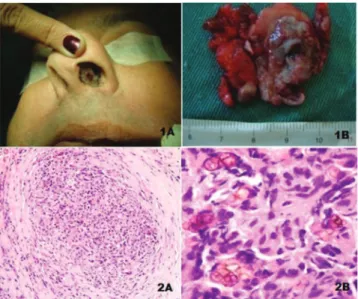
years, and underwent a kidney transplant two years before. Due to the transplant, he was immunosuppressed with tac-rolimus and corticosteroids. He had a round lesion in the anterior septal region, of granular appearance, 1.5 cm in diameter (Fig. 1A). He had similar smaller asymptomatic
lesions distributed throughout the nasal cavity and hard pal-ate. The septal lesion was excised with the mucosa through the anterior nasal cavity without complications (Fig. 1B). After removal of the largest nasal lesion, treatment was performed with antifungal agents.
Histopathological analysis with HE showed a
granuloma-tous chronic inlammatory process, with rounded brownish
colored fungi (yeasts) some with septae (Figs. 2A and 2B),
indicative of chromohyphomycosis. Speciic staining for
fungi was not necessary. Analysis of fungal growth in the culture medium demonstrated Fonsecaea pedrosoi, which is characterized by having Rhinocladiella-type sporulation, sometimes associated with the Cladosporium type.4
Discussion
Chromohyphomycosis is a granulomatous disease, whose in-fectious agents are several dark-colored fungi, most com-monly the Fonsecaea pedrosoi. They are common sapro-phytic forms found in the soil and decomposing vegetation. Trauma is the gateway for these agents. The disease pri-marily affects men, usually rural workers, and, according to Carrión,6 it occurred in 96% in their series, with a men to
Primary chromohifomycosis of the nasal septum 87
trauma in the nasal region, t the possibility of trauma due to the habit of scratching could not be dismissed.
Chromohyphomycosis, occurring primarily in regions other than the extremities, is a rare disease. Londero et al.1 in 1968 and Zaror et al.2 in 1987 isolated Fonsecaea
pe-drosoi from the septal lesion, while Nakamura et al.3
isolat-ed Phialophora verrucosa. Fonsecaea pedrosoi is the most common species in chromohyphomycosis (84%, according to Carrión).6 When examined by the dermatology service, the
present patient had lesions,only in the nasal and palate re-gions, with none on the lower limbs.
The diagnosis of dematiaceous mycosis, a term intro-duced by Symmers to represent diseases caused by pigment-ed fungi, can be made by direct examination with lactophe-nol cotton blue or by histopathology analysis, stained by HE, which demonstrates the presence of the characteristically brownish fungus inside or outside the giant cells.4 Culture in Sabouraud medium allows for the species identiication,
through the analysis of the sporulation type.4 The
differen-tial diagnosis can be made with rhinosporidiosis, leishman-iasis, and paracoccidioidomycosis5 (very rare in the nasal
cavity).
The recommended treatment for the patient after the surgical removal of lesions was itraconazole for three months. As there was no response, liposomal amphotericin B was prescribed; after one month of treatment, the patient still had fungi in the direct mycological examination, and there was no decrease in the size of the remaining lesions. Thus, oral voriconazole was prescribed. This antifungal agent is a second-generation triazole, a synthetic derivative
of luconazole, and has advantages over other antifungal
agents, especially in cases of amphotericin resistance. It was prescribed for six months at a dose of 6 mg/kg every
12 hours, resulting in signiicant clinical improvement with
complete lesion remission.
The prognosis of chromohyphomycosis is usually good, except when it affects viscera. It also depends on the pa-tient’s immune status.
Final considerations
Chromohyphomycosis in the nasal septum is a rare disease,
and it is dificult to establish its diagnosis in this site. Pa -tient immunosuppression favored lesion development.
Conlicts of interest
The authors declare no conlicts of interest.
References
1. Londero AT, Ramos CD, Fischman O. Cromoblastomicose primá-ria do nariz. O Hospital. 1968;74:323-8
2. Zaror L, Fischman O, Pereira CA, Felipe RG, Gregorio LC, Cas-telo A. A case of primary nasal chromoblastomycosis. Mykosen. 1987;30:468-71.
3. Nakamura T, Grant JA, Threlkeld R, Wible L. Primary chro-moblastomycosis of the nasal septum. Am J Clin Pathol. 1972;58:365-70.
4. Oliveira JC. Micologia Médica. Ed Control Lab; 1999.
5. Symmers WS. Chromoblastomycosis simulating rhinosporidiosis in a patient from Ceylon. J Clin Pathol. 1960;13:287-90. 6. Carrión AL. Chromoblastomycosis. Ann N Y Acad Sci.
1950;50:1255-82.
Figure 1 Clinical image of the septal lesion (1A). Lesion removed with mucosal segment (1B). HE, small increase (2A).
Chronic granulomatous inlammatory process with rounded and