Original Article
Dental students’ reports of occupational
exposures to potentially infectious biological
material in a Brazilian School of Dentistry
Estudantes de odontologia e o relato das exposições
ocupacionais a material biológico potencialmente contaminado em
uma Faculdade de Odontologia no Brasil
Camila Pinelli
1, Sabrina do Nascimento Neri
1,
Leonor de Castro Monteiro Loffredo
11 Departamento de Odontologia Social, Faculdade de Odontologia de Araraquara (FOAr), Universidade Estadual Paulista (UNESP) - Araraquara (SP), Brazil.
Study carried out at Faculdade de Odontologia de Araraquara – Araraquara (SP), Brazil.
Correspondence: Camila Pinelli – Rua Humaitá, 1680 – Centro – CEP: 14801-903 – Araraquara (SP), Brazil – Email: [email protected] Financial support: FAPESP #2011/01922-3 and 2011/01960-2.
Conflict of interests: nothing to declare. Abstract
Introduction: Occupational exposures to contaminated biological material in dental teaching settings can place students at higher risk of bloodborne infections. Methods: This cross sectional study was conducted using a self-administered questionnaire culturally adapted to Portuguese language, Brazil. In total, 173 undergraduate dental students agreed to participate in the study, answered the questionnaire, and filled in the details about their own occupational exposures. The association of these factors was analyzed by the chi-square test or Fisher’s exact test using Stata software. Results: High prevalence of occupational exposures (40%) was
observed among the participants, and 52% of the accidents were not reported to the clinical instructor. The most frequent type of accident was related to “puncture/cut/abrasion” (56%). Significant correlation was observed between number of exposures and academic year (p=0.002), age (p=0.012), gender (p=0.010), and between number of injuries in the last 6 months and academic year (p=0.003). No significant correlation was observed between number of exposures and dominant hand, use of protective
eyewear or Hepatitis B vaccination status (p>0.05). Conclusion: Additional teaching strategies need to be developed to motivate adherence to occupational post-exposure protocols regarding biological material, improving the notification of the occupational exposures that occur among dental students.
Keywords: occupational exposure; blood; body fluids; infection control; dental students.
Resumo
Introdução: A exposição ocupacional a material biológico contaminado em ambientes de ensino de odontologia pode colocar os estudantes em maior risco de infecções transmissíveis pelo sangue. Métodos: Tratou-se de um estudo transversal de avaliação, com questionário auto administrado e culturalmente adaptado para o português do Brasil. Ao total, 173 estudantes de odontologia concordaram em participar e forneceram detalhes sobre suas exposições ocupacionais. A associação de fatores foi analisada por meio do teste do qui-quadrado e/ou teste exato de Fisher, com auxílio do programa Stata. Resultados: Entre os participantes, houve alta prevalência a exposições ocupacionais (40%), e 52% dos acidentes não foram comunicados ao instrutor. O mais frequente ferimento foi do tipo “punção/ corte/ abrasão” (56%). Houve associação significativa entre “número de exposições” e “série” (p=0,002), “idade” (p=0,012) e “sexo” (p=0,010), e entre outras duas variáveis: “número de lesões nos últimos seis meses” e “série” (p=0,003). Não houve associação significativa entre o “número de exposições” e “mão dominante”, “uso de óculos de proteção” ou “estado vacinal contra o vírus da Hepatite B” (p>0,05). Conclusão: Estratégias de ensino adicionais precisam ser implementadas para motivar a adesão aos protocolos pós-exposição ocupacional a material biológico, favorecendo a notificação dos casos entre acadêmicos de odontologia.
▄
INTRODUCTIONhe working environment of dental professionals is a dangerous place for contamination by bloodborne pathogens1,2.
Special concern is related to occupational exposures, which are deined as
[...] any contact of non-intact skin, eye, mucous membrane, or parenteral contact (needlestick, cut, abrasion, instrument puncture) with blood or any other potentially infectious material (such as saliva) which occurs during the performance of diagnosis and treatment of patients, or when handling orally soiled impressions and prosthetic devices3 (p. 107).
Previous studies indicated that dental students may be more vulnerable to occupational exposures due to their lack of experience and lower manual dexterity1,3-6. Some studies have
investigated dental students’ knowledge and attitudes in relation to management of occupational exposure in Brazilian dental teaching environments6,7, and they revealed the ‘long road’ to
be traveled in relation to reporting accidents and improving post-exposure procedures to minimize the risks of infection.
In Brazil, there are approximately 200 dental schools8 preparing
students for professional life. However, little information is available on the frequency and nature of their occupational exposures6. Additionally, the high prevalence of underreporting
such injuries contributes to the lack of data and inappropriate post-exposure management9.
here is no vaccine against HIV, and AIDS is still a major public health challenge, aggravated by the possibility of co-infection of HIV and Hepatitis B and C viruses. Such diseases share the same forms of transmission, and clinical studies conducted in Brazil show that, among HIV/AIDS-infected individuals, almost 6% are positive for HBV and from 5 to 18% are positive for HCV (10).
Another important issue is related to the fact that HIV has mutated, and diagnostic tests - especially rapid tests used in the irst hours ater the accident - need to be more sensitive and speciic in order to track the current genetic diversity10. Dental
schools are faced with a big challenge in seeking better strategies to raise awareness and self-eicacy, among dental students and the entire community of teachers and counselors, to avoid the threats occupational exposures to biological material may pose.
In order to raise information on how dental students faced their occupational injuries, Stewardson et al.3 developed a
questionnaire to gather important issues on occupational exposures and dental students’ reports. Such an instrument could be a valuable tool to collect standardized information, and it can also be applied in diferent periods of time to score changes in a speciic investigated group.
Epidemiologic data are required to ind high-risk groups and develop strategies to focus on. To the best of our knowledge, there is still a lack of studies regarding occupational exposures among dental students in Brazil. herefore, the aims of the present
study were 1) to culturally adapt the original questionnaire proposed by Stewardson et al.3 so that it becomes available for
use as an instrument in such diagnosis, and 2) to investigate the occurrence and nature of occupational exposures in a Public School of Dentistry in Sao Paulo state, Brazil.
▄
METHODSCultural adaptation of the questionnaire
Translation and cultural adaptation of the original questionnaire3,
which was authorized by the main author, were based on the protocol proposed by Guillemin et al.11 and Guillemin12
which consisted of the following steps: initial translation, back translation, expert committee review, and cultural adaptation. It is important to assess the level of agreement of the results whenever a questionnaire is used as a tool. To this end, kappa statistics (κ) was applied to measure the test-retest reliability of the answers provided by a sample of the population prior to the inal application of the questionnaire.
Results showed good and excellent values for intra-examiner agreement for the majority of the variables (0.66< κ <1.00), and regular values for the variables “use of protective eyewear” and “no exposure in the last 6 months” (0.47< κ <0.58).
he inal translated instrument (Chart 1) comprised questions on personal details (age, gender, academic year, and dominant hand); vaccination status regarding Hepatitis B virus (HBV); occupational exposures (number and nature of occurrences, and possible associated factors) in regard to their last occurrence; reporting behavior, and follow-up procedures.
Application of the research instrument
A total of two hundred and twenty-eight dental students enrolled at Araraquara School of Dentistry (FOAr-UNESP) in the third, fourth and inal years (Y3, Y4, Y5) of the 5-year undergraduate dental course were asked to voluntarily complete a questionnaire in the end of their academic year, in 2011. he college under study is one of the three main Public Dental Schools in Sao Paulo state, Brazil. Approval was obtained at the local Research Ethics Committee (protocol number 05/11). All volunteers were properly informed about the survey, and the ones who agreed to participate signed an Informed Consent Form.
Data were tabulated using EPI Info 2000 sotware and
analyzed by the chi-square test or Fisher’s exact test using Stata
sotware (Stata Statistical Sotware: Release 11.0, College Station, Stata Corporation, Texas, USA) at a level of signiicance of 5%.
▄
RESULTSChart 1. Occupational exposure questionnaire culturally adapted to Brazilian Portuguese. FOAr-UNESP, 2011
Por favor, responda a todas as questões tão completamente quanto possível. A pesquisa será totalmente conidencial. A participação é totalmente voluntária, todas as respostas serão registradas e analisadas anonimamente. Muitas questões pedem para marcar com um círculo uma única opção apropriada. Outras pedem para dar respostas escritas e curtas. Ao terminar, por favor, devolva o questionário preenchido.
1 - Sou um(a) Estudante do _____Ano de Odontologia A. Terceiro
B. Quarto C. Último
2 - Tenho_____anos de idade.
3 - Sou do sexo: A. Feminino B. Masculino
4 - Sou
A. Canhoto B. Destro
5 - Eu _____uso óculos de grau ao tratar pacientes. __ A. Normalmente
B. Normalmente não.
6 - Eu _____uso lentes de contato ao tratar pacientes. __ A. Normalmente
B. Normalmente não.
Vacinação contra Hepatite (HBV)
7 - Você já completou toda a série de vacinas HBV? A. Sim, todas as três injeções.
B. Não. Recebi somente uma ou duas injeções. C. Não. Não iniciei a série de vacinas.
8 - Se você concluiu a série de vacinas HBV, de três injeções, já foi testado posteriormente para seroconversão (desenvolvimento de anticorpos ao HbsAg)?
A. Sim B. Não
C. Não se aplica pois ainda não concluí a série de 3 doses da vacina.
As questões restantes são relativas a sua exposição aos luidos corporais do paciente. Por favor, use a deinição abaixo de exposição ocupacional
ao considerar suas respostas.
Uma exposição ocupacional é deinida como qualquer contato de olhos, pele não intacta, membranas mucosas, ou contato parenteral (perfuração com agulha, corte, abrasão, perfuração com instrumento) com sangue ou qualquer outro material potencialmente infeccioso, (tal como saliva), que ocorre durante o desempenho das funções do estudante de odontologia (diagnóstico e tratamento de pacientes ou quando estiver manuseando moldes e dispositivos protéticos sujos com secreção oral).
9 - Desde o início do curso de Odontologia, quantas exposições ocupacionais você já sofreu? __________________________________________________________
10 - E nos últimos seis meses, quantas exposições ocupacionais você já sofreu? __________________________________________________________
As questões 11 a 26 são relativas unicamente a sua última exposição ocupacional. Se nunca teve uma exposição ocupacional, pare agora e devolva seu questionário.
11 - Em que Clínica ou Laboratório ocorreu sua última exposição ocupacional? _________________________
12 - Quando ocorreu a sua exposição ocupacional você estava _____? A. Sozinho
B. Sendo auxiliado C. Auxiliando outra pessoa.
13 - A que hora do dia ocorreu sua exposição ocupacional? _______________________________________
14 - Em que dia da semana ocorreu sua exposição ocupacional? ____________________________________
15 - Qual das opções abaixo descreve melhor o tipo de exposição ocupacional que você teve? Se necessário, indique mais de uma opção. A. Contato direto com a membrana mucosa.
B. Contato direto com pele não intacta.
C. Perfuração (por agulha ou outro objeto pontiagudo), corte ou abrasão. D. Aerossol/respingo sobre uma membrana mucosa.
E. Aerossol/respingo sobre pele não intacta. F. Outro---por favor descreva
_______________________________
16 - O paciente estava presente quando ocorreu sua exposição ocupacional? A. Sim
B. Não
17 - A exposição ocupacional ocorreu enquanto suas mãos estavam na boca do paciente? A. Sim
B. Não
18 - Descreva o procedimento clínico que estava sendo realizado quando ocorreu sua exposição ocupacional (isso poderia incluir limpeza do equipamento e dos instrumentais, descarte de objetos pontiagudos ou devolução de instrumentos usados).
__________________________________________________________
19 - Que tipo de equipamento de proteção individual (luvas, máscara, jalecos clínicos (branco) e Avental cirúrgico) você estava usando quando sua exposição ocupacional ocorreu?
__________________________________________________________
20 - Você informou seu instrutor clínico sobre sua exposição ocupacional? A. Sim, imediatamente.
B. Sim, no inal da sessão clínica. C. Sim, porém algum tempo após. D. Não
21 - Você teve sangue retirado para teste após sua exposição ocupacional? A. Sim
B. Não
22 - Se o sangue foi retirado, que tipo de testes diagnósticos foram realizados? __________________________________________________________
23 - Sua exposição ocupacional exigiu de você que procurasse por um tratamento? A. Sim
B. Não
24 - Se o tratamento foi necessário, que tipo foi feito e em que local? __________________________________________________________
25 - Entraram em contato com você posteriormente com relação aos resultados dos testes realizados? A. Sim
B. Não
26 - Se o paciente-fonte era conhecido, foi retirado sangue dele? A. Paciente-fonte não conhecido
B. Sim, o sangue foi retirado do paciente-fonte. C. Não, o sangue não foi retirado do paciente-fonte.
Muito Obrigado por sua participação
19 and 24 years (mean=22 years). Most of them were female (71.7%) and right-handed (93.6%).
Vaccination status and reported exposures
Although 85.5% of the students reported having been completely vaccinated against HBV, only 38.2% of them had taken the seroconversion test for Hepatitis B.
Table 1 shows the distribution of dental students’ academic years and the number of their occupational exposures since the beginning of the course. Almost 40% of the 173 respondents reported at least one occupational exposure. Students enrolled in Y4 and Y5 were among the most injured.
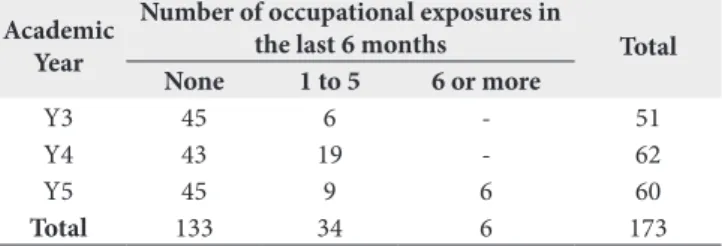
Table 2 shows the distribution of dental students’ academic years and the number of occupational exposures in the last six-month period. Y4 students were the most injured (30.6%), followed by those at Y5 (25.0%).
At the time of the accident, 57.8% of them were being assisted and 22.5% were working alone when their last occupational exposure occurred. Most accidents happened in the morning (66.2%).
he nature of the exposure included puncture (needle or other sharp object)/cut/abrasion (56.3%), followed by aerosol or spatter landing on a mucous membrane (25.4%).
In relation to the procedure that was being performed at the time of the accident, the students reported that most of their accidents occurred during dental care (62.0%) to patients.
he use of complete Personal Protective Equipment (PPE) for Standard Precautions was indicated by 70.4% of the undergraduate students and comprised clinical coat, mask, cap, protective eyewear, and gloves. However, 25.3% of the students were reckless with the use of protective eyewear, and 2.8% were not wearing any PPE at the time of the exposure.
Among the injured, most students (52.1%) did not report the occurrence to the clinical instructor. In relation to the cases reported, only 32.4% of the dental students had blood collected for exams.
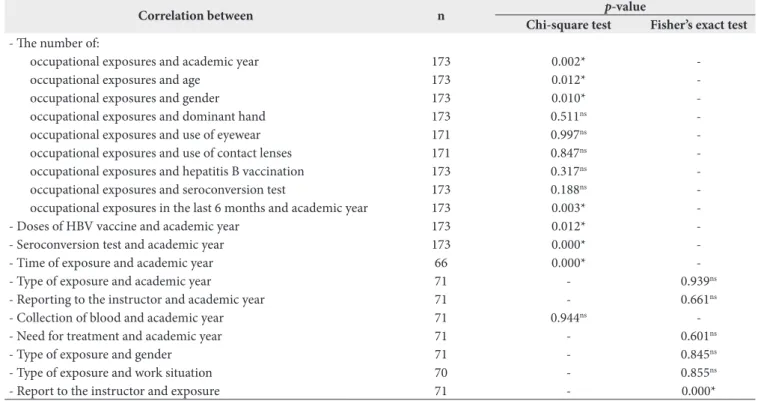
Table 3 shows that there was no signiicant correlation (p>0.05) between “number of exposures” and “dominant hand”, “use of protective eyewear/lenses”, “number of doses of Hepatitis B vaccine” or “test for seroconversion”. No signiicant correlation was also observed (p>0.05) for “type of exposure” and “academic year”, “gender”, “work situation” and “report to the clinical instructor”. here was no signiicant correlation (p>0.05) between “academic year” and “report to the clinical instructor”, “collecting blood for exams” and “need for treatment ater injury”.
Signiicant correlation was observed between “number of exposures” and “academic year” (p=0.002). he number of exposures in Y4 and Y5 students was higher than the expected. Signiicant correlation was also observed between “number
of exposures” and “age” (p=0.012). Students above the age of 25 had more injuries than expected. here was signiicant correlation between “number of exposures” and “gender” (p=0.010) considering that the number of women was higher than the expected. Signiicant correlation was found between “number of doses of Hepatitis B vaccine” and “academic year” (p=0.012); there were more vaccinated students in Y3 and Y4 than expected. here was signiicant correlation between “testing seroconversion to HBV” and “academic year” (p=0.000); fewer students than expected were tested. Signiicant correlation occurred between “number of occupational exposures in the last 6 months” and “academic year” (p=0.003), as the number of casualties in Y4 was higher than the expected. Correlation was signiicant between “hour of the day that the accident occurred” and “academic year” (p=0.000); Y4 students had more accidents in the morning than expected. In addition, the number of Y5 students injured in the aternoon was higher than the expected. Signiicant correlation was observed between “report to the clinical instructor” and “being punctured” (p=0.000); the number of students who did not report accidents caused by spatter or aerosol contact on mucous membrane was higher than the expected.
▄
DISCUSSIONhe survey achieved a response rate of 75.9%, which was similar to that reported by Myers et al.1, with 72.1% of the responses.
he fact that more students responded to the questionnaire makes data relect the reality with a higher degree of certainty.
Table 1. Distribution of dental students according to academic year and number of occupational exposures occurred since the beginning of the course. FOAr-UNESP, 2011
Academic Year
Number of occupational exposures
since the beginning of the course Total None 1 to 5 6 or more
Y3 43 8 - 51 Y4 31 29 2 62 Y5 28 24 8 60
Total 102 61 10 173
Table 2. Distribution of dental students according to academic year and number of occupational exposures occurred in the last 6-month period. FOAr-UNESP, 2011
Academic Year
Number of occupational exposures in
the last 6 months Total None 1 to 5 6 or more
Y3 45 6 - 51 Y4 43 19 - 62 Y5 45 9 6 60
Although response rate was high, it should be considered that the information collected was dependent on the individual memory and honesty of students when reporting their exposure to biological material. herefore, a reliability study was performed to ensure higher accuracy. his study showed good to excellent values of agreement for the majority of studied variables, except for the results related to “use of protective eyewear” and “number of exposures in the last six months”. Conclusions drawn from the analysis of these last two variables should be considered with certain limitations.
he analysis of the factors associated with occurrence and level of report on occupational exposures can provide educational guidance to develop protocols and procedures to reduce their prevalence3.
An instrument that could provide such information among students would be valuable in the dental teaching setting. Bear in mind that the present study culturally adapted the questionnaire to Portuguese language (Brazil). he literature shows the advantages related to the cross-cultural adaptation of a questionnaire, as it demands less time than developing a new instrument13. In the present study, the culturally adapted
questionnaire can be considered a reliable instrument and, therefore, it can be applied in future surveys.
An increased number of occupational exposures have been veriied among the present students since the beginning of the undergraduate course. A large number of participants reported at least one injury (41.1%). Y5 students were the most afected
ones. his result was expected considering that Y5 students have spent more time treating patients3. Clinical experience
does not imply better prevention of injuries among students or professionals, and decreasing fear on injuries was observed as students gained experience14.
Higher frequency was found with respect to “number of exposures in the last 6-month period” among Y4 students. Such inding agrees with a previous research3, and may have
occurred due to reckless use of PPE; students were not using them in 21 cases of reported exposure. Protective eyewear was the least commonly used equipment, which was absent in all of the 21 cases. Students should be monitored by tutors to ensure proper wearing3,15.
he most frequently reported type of injury was puncture/ cut/abrasion (56.3%), followed by spatter landing on a mucous membrane (25.4%). hese results corroborate previous literature indings1,16.
he exposures occurred mainly during clinical care (61.9%), followed by the time spent when processing instruments (26.8%). hese indings support the study by Myers et al.1, in
which 51.3% of the exposures occurred during clinical care and 23.1% during the cleaning of instruments.
In the present study, 52.1% of the 71 cases of occupational exposure were not reported to the clinical instructor, and the majority of unreported cases (23.9%) occurred due to aerosol/spatter landing on a mucous membrane. Underreporting cases is very common and it was even higher in other recent
Table 3. Number of students (n), association tests (p-value), and level of significance according to the variables analyzed. FOAr-UNESP, 2011
Correlation between n p-value
Chi-square test Fisher’s exact test
- he number of:
occupational exposures and academic year 173 0.002* -occupational exposures and age 173 0.012* -occupational exposures and gender 173 0.010* -occupational exposures and dominant hand 173 0.511ns -occupational exposures and use of eyewear 171 0.997ns -occupational exposures and use of contact lenses 171 0.847ns -occupational exposures and hepatitis B vaccination 173 0.317ns -occupational exposures and seroconversion test 173 0.188ns -occupational exposures in the last 6 months and academic year 173 0.003* -- Doses of HBV vaccine and academic year 173 0.012* -- Seroconversion test and academic year 173 0.000* -- Time of exposure and academic year 66 0.000* -- Type of exposure and academic year 71 - 0.939ns - Reporting to the instructor and academic year 71 - 0.661ns - Collection of blood and academic year 71 0.944ns -- Need for treatment and academic year 71 - 0.601ns - Type of exposure and gender 71 - 0.845ns - Type of exposure and work situation 70 - 0.855ns - Report to the instructor and exposure 71 - 0.000*
studies. A study conducted in Shiraz, Iran reported that 73.6% of the 80% injured students surveyed did not report their exposure to the instructor17. In a study conducted in China, only one of
34% of students injured reported the occurrence18.
Reasons for not reporting such incidents were probably related to the fact that the students did not take the occurrence as a signiicant health risk4,7. he literature also shows that
other reasons for the underreporting of accidents are related to individual personality traits, lack of time, or excessive paperwork related to the reporting, and also to dissatisfaction with follow-up procedures9,19. Students should pay attention to
the importance of reporting cases of occupational exposures so that they can receive proper medical treatment and follow-up3.
Studies show that the estimated risk of contracting human immunodeiciency virus (HIV) ater a percutaneous contact with infected blood is of approximately 0.3%, and also if exposure occurs through mucous membrane, chances are reduced to approximately 0.09%12. Based on these igures, the
group investigated should be well aware of the implicit risks they are exposed to, because they can acquire a potentially lethal infection.
Despite of presenting a high rate of vaccination against HBV (85.5% were vaccinated), a low percentage of Anti-HBsAg tests performed, and a high underreporting of occupational exposures, this local study probably represents the reality of many other dental schools in Brazil. he literature shows a low coverage of complete Hepatitis B vaccination among healthcare workers20
and dental students21.
Some of the students (50.3%) who reported not having been tested for seroconversion against HBV may also be at risk of acquiring HB, because vaccination failures may occur. Also, there is a considerable risk of contracting more than one disease
at the same time. Some coinfections commonly seen in people infected with HIV include HBV and/or HCV22.
More efective educational eforts can improve compliance with the prevention and management of occupational exposures. A shit in paradigm is important to ensure dental students’ understanding of better practices related to post-exposure protocols.
▄
CONCLUSION1) he present study culturally adapted a questionnaire developed in English (UK) to Portuguese (Brazil), and the results show it can be considered a reliable tool to investigate the occurrence of occupational exposures among Brazilian dental students;
2) he occurrence of exposures, as well as the underreporting of cases, presented high percentages among participants in the institution investigated. Most participants had received the complete vaccination against Hepatitis B, but half of them did not undergo the seroconversion test. Regarding the accidents, it was observed that the most frequent type of exposure was puncture/cut/abrasion, followed by aerosol/spatter landing on a mucous membrane.
Education strategies to drat a prevention policy - including closer supervision to remind dental students about the importance of using PPE and notifying the occurrences - need to be developed. A better targeting of the teaching strategies can allow for reduction in the number of accidents and increase in the reporting of cases, providing safety for undergraduate students and patients.
▄
ACKNOWLEDGEMENTShe authors wish to thank Sao Paulo Research Foundation – FAPESP (research grant number. 2011/01960-2 and 2011/01922-3) for funding this study.
▄
REFERENCES1. Myers JE, Myers R, Wheat ME, Yin MT. Dental students and bloodborne pathogens: occupational exposures, knowledge, and attitudes. J Dent Educ. 2012;76(4):479-86. PMid:22473560.
2. Wicker S, Rabenau HF. Occupational exposures to bloodborne viruses among German dental professionals and students in a clinical setting. Int Arch Occup Environ Health. 2010;83(1):77-83. http://dx.doi.org/10.1007/ s00420-009-0452-3. PMid:19626335.
3. Stewardson DA, Palenik CJ, McHugh ES, Burke FJT. Occupational exposures occurring in students in a UK dental school. Eur J Dent Educ. 2002;6(3):104-13. http://dx.doi.org/10.1034/j.1600-0579.2002.00253.x. PMid:12269865.
4. Ramos-Gomez F, Ellison J, Greenspan D, Bird W, Lowe S, Gerberding JL. Accidental exposures to blood and body fluids among health care workers in dental teaching clinics: a prospective study. J Am Dent Assoc. 1997;128(9):1253-61. http://dx.doi.org/10.14219/jada.archive.1997.0402. PMid:9297947.
5. Younai F, Murphy DC, Kotelchuck D. Occupational exposures to blood in a dental teaching environment: results of a ten-year surveillance study. J Dent Educ. 2001;65(5):436-48. PMid:11425248.
6. Machado-Carvalhais HP, Ramos-Jorge ML, Auad SM, Martins LHPM, Paiva SM, Pordeus IA. Occupational exposure to potentially infectious biological material in a dental teaching environment. J Dent Educ. 2008;72(10):1201-8. PMid:18923101.
7. Machado-Carvalhais HP, Martins TCPM, Ramos-Jorge ML, Magela-Machado L, Paiva SM, Pordeus IA. Management of occupational bloodborne exposure in a dental teaching environment. J Dent Educ. 2007;71(10):1348-55. PMid:17923713.
9. Cuny E, Hoover TE, Kirk JS. Underreporting of bloodborne exposures in a dental school clinic. J Dent Educ. 2011;75(4):544-8. PMid:21460275.
10. Sanabani SS, Pessôa R, Soares de Oliveira AC, Martinez VP, Giret MT, de Menezes Succi RC, et al. Variability of HIV-1 genomes among children and adolescents from São Paulo, Brazil. PLoS One. 2013;8(5):e62552. http:// dx.doi.org/10.1371/journal.pone.0062552. PMid:23667488.
11. Guillemin F, Bombardier C, Beaton D. Cross- cultural adaptation of health-related quality of life measures: literature review and proposed guidelines. J Clin Epidemiol. 1993;46(12):1417-32. http://dx.doi.org/10.1016/0895-4356(93)90142-N. PMid:8263569.
12. Guillemin F. Cross-cultural adaptation and validation of health status measures. Scand J Rheumatol. 1995;24(2):61-3. http://dx.doi. org/10.3109/03009749509099285. PMid:7747144.
13. Hunt SM, Alonso J, Bucquet D, Niero M, Wiklund I, McKenna S. Cross-cultural adaptation of health measures. European Group for Health Management and Quality of Life Assessment. Health Policy. 1991;19(1):33-44. http:// dx.doi.org/10.1016/0168-8510(91)90072-6. PMid:10117390.
14. Wood AJ, Nadershahi NA, Fredekind RE, Cuny EJ, Chambers DW. Student Occupational Exposure Incidence: Perception versus reality. J Dent Educ. 2006;70(10):1081-8. PMid:17021288.
15. Souza RA, Namen FM, Galan J Jr, Vieira C, Sedano HO. Infection control measures among senior dental students in Rio de Janeiro state, Brazil. J Public Health Dent. 2006;66(4):282-4. http://dx.doi.org/10.1111/j.1752-7325.2006. tb04084.x. PMid:17225826.
16. Sofola OO, Folayan MO, Denloye OO, Okeigbemen SA. Occupational exposure to bloodborne pathogens and management of exposure incidents in Nigerian dental schools. J Dent Educ. 2007;71(6):832-7. PMid:17554101.
17. Shaghaghian S, Golkari A, Pardis S, Rezayi A. Occupational exposure of shiraz dental students to patients’ blood and body fluid. J Dent. 2015;16(3):206-13. PMid:26331151.
18. Wu L, Yin YL, Song JL, Chen Y, Wu YF, Zhao L. Knowledge, attitudes and practices surrounding occupational blood-borne pathogen exposure amongst students in two Chinese dental schools. Eur J Dent Educ. 2015;16. In press. http://dx.doi.org/10.1111/eje.12162. PMid:26184829.
19. Porteous NB, Bizra E, Cothron A, Yeh CK. A survey of infection control teaching in U.S. Dental Schools. J Dent Educ. 2014;78(2):187-94. PMid:24489026.
20. Souza FO, Freitas PSP, Araújo TM, Gomes MR. Hepatitis B and Anti-HBS vaccination among health workers. Cad Saude Colet. 2015 Jun;23(2):172-9. http://dx.doi.org/10.1590/1414-462X201500020030.
21. Sacchetto MS, Barros SS, Araripe T A, Silva AM, Faustino SK, da Silva JM. Hepatitis B: knowledge, vaccine situation and seroconversion of dentistry students of a public university. Hepat Mon. 2013;13(10):e13670. PMid:24348639.
22. Oliveira SB, Merchán-Hamann E, Amorim LDAF. HIV/AIDS coinfection with the hepatitis B and C viruses in Brazil. Cad Saude Publica. 2014;30(2):433-8. PMid:24627070.