Brazilian version of the Functional Status Score for
the ICU: translation and cross-cultural adaptation
INTRODUCTION
Critically ill patients commonly develop muscle weakness and functional impairments that may persist long after discharge from the intensive care unit
(ICU).(1,2) Consequently, there is a need for objective measurement tools that
assess a patient’s ability to complete basic mobility tasks. his type of functional data may be beneicial to determining rehabilitation strategies in this setting.(3)
he use of standardized outcome measures in physical therapy has been accepted as best practice.(4) In recent years, a number of assessment tools have
been developed to assist in the evaluation of physical function in critically ill
patients.(5) Zanni et al.(6) published the Functional Status Score for the ICU
(FSS-ICU) and used this scale to describe the functional impairments of patients receiving treatment in intensive care. he FSS-ICU measures mobility tasks, including rolling, transferring from supine to sitting, transferring from sitting
Vinicius Zacarias Maldaner da Silva1,2, Jose Aires
de Araújo Neto3, Gerson Cipriano Jr.8, Mariela
Pinedo6,7, Dale M. Needham6,7, Jennifer M.
Zanni7, Fernando Silva Guimarães4,5
1. Health Sciences Program, Escola Superior de Ciências da Saúde - Brasília (DF), Brazil. 2. Hospital de Base do Distrito Federal - Brasília (DF), Brazil.
3. Hospital Santa Luzia Rede D’Or São Luiz- Brasília (DF), Brazil.
4. Postgraduate Program in Rehabilitation Science, Centro Universitário Augusto Motta - Rio de Janeiro (RJ), Brazil.
5. Department of Physical Therapy, Universidade Federal do Rio de Janeiro - Rio de Janeiro (RJ), Brazil.
6. Division of Pulmonary and Critical Care Medicine, Johns Hopkins University School of Medicine - Baltimore, MD, USA.
7. Outcomes After Critical Illness and Surgery (OACIS) Group, Johns Hopkins University - Baltimore, MD, USA.
8. Health Sciences and Technologies PhD Program, Department of Physical Therapy, Universidade de Brasília - Brasília (DF), Brazil.
Objective: he aim of the present study was to translate and cross-culturally adapt the Functional Status Score for the intensive care unit (FSS-ICU) into Brazilian Portuguese.
Methods: his study consisted of the following steps: translation (performed by two independent translators), synthesis of the initial translation, back-translation (by two independent translators who were unaware of the original FSS-ICU), and testing to evaluate the target audience’s understanding. An Expert Committee supervised all steps and was responsible for the modiications made throughout the process and the inal translated version.
Results: he testing phase included two experienced physiotherapists
Conflicts of interest: None
Submitted on May 14, 2016 Accepted on December 12, 2016
Corresponding author: Vinicius Zacarias Maldaner da Silva Universidade de Brasília
Escola Superior de Ciências da Saúde SMHN Quadra 3, Conjunto A, Bloco 1 Zip code: 70000-234 - Brasília (DF), Brazil E-mail: [email protected]
Responsible editor: Alexandre Cavalcanti Biasi
Versão brasileira da Escala de Estado Funcional em UTI:
tradução e adaptação transcultural
ABSTRACT who assessed a total of 30 critical care patients (mean FSS-ICU score = 25 ± 6). As the physiotherapists did not report any uncertainties or problems with interpretation afecting their performance, no additional adjustments were made to the Brazilian Portuguese version after the testing phase. Good interobserver reliability between the two assessors was obtained for each of the 5 FSS-ICU tasks and for the total FSS-ICU score (intraclass correlation coeicients ranged from 0.88 to 0.91).
Conclusion: he adapted version of the FSS-ICU in Brazilian Portuguese was easy to understand and apply in an intensive care unit environment.
DOI: 10.5935/0103-507X.20170006
to standing, sitting on the edge of the bed and walking. he total FSS-ICU score ranges from 0 to 35, with higher scores indicating more independent physical functioning.
A recent systematic review has shown that most assessment tools employed by health professionals to evaluate functional outcomes in the ICU were originally
developed in English.(3) herefore, research in countries
where the oicial language is not English, such as Brazil, is hampered with regard to the use of these tools, especially
when only a literal translation has been employed.(7) For
this reason, cross-cultural adaptation is an ideal choice for assessment tools available in the medical ield, as this process allows for the tool to be applied in any country, culture and language. In addition, cross-cultural adaptation facilitates the comparison of results from the
same questionnaire in diferent countries and cultures.(8)
hus, the aim of the present study was to translate and cross-culturally adapt the FSS-ICU into Brazilian Portuguese.
METHODS
Study design
he translation and cross-cultural adaptation of the FSS-ICU into Brazilian Portuguese followed the current
guidelines recommended for this type of study.(8) he
authorization for this process was obtained from the senior author of the original version, Dr. Dale M. Needham at Johns Hopkins University, Baltimore, USA. his study
received approval from the Ethics Committee of Fundação
de Ensino e Pesquisa em Ciências da Saúde (FEPECS - Brasilia-Brazil) under process number 1.338.188.
Description of the Functional Status Score for the ICU
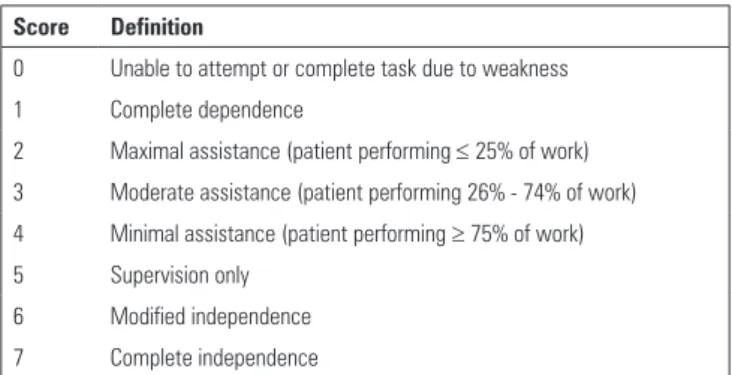
he FSS-ICU is an outcome measure assessing physical function that is speciically designed for patients in the ICU and involves ive functional tasks (rolling, supine to sit transfer, sit to stand transfer, sitting on the edge of bed and walking). Each task is evaluated using an 8-point ordinal scale ranging from 0 (not able to perform at all) to 7 (complete independence) (Table 1; the instrument, scoring details and the full Brazilian Portuguese version are freely available at www.ImproveLTO.com). his instrument has been internationally validated with a
detailed psychometric evaluation(9,10) and has been used
in other studies in the ield.(10-13) Scores on the FSS-ICU
Table 1 - Example Scale for Scoring the Functional Status Score for the ICU*
Score Definition
0 Unable to attempt or complete task due to weakness
1 Complete dependence
2 Maximal assistance (patient performing ≤ 25% of work)
3 Moderate assistance (patient performing 26% - 74% of work)
4 Minimal assistance (patient performing ≥ 75% of work) 5 Supervision only
6 Modified independence
7 Complete independence
* Full details of the Functional Status Score for the ICU administration and scoring, including a description of the scoring scales and the 5 functional tasks (rolling, transferring from supine to sitting, sitting on the edge of the bed, transferring from sitting to standing, and walking) are freely available at www.ImproveLTO.com.
scale at ICU discharge have been shown to predict post-ICU hospital length of stay and hospital discharge location.(9,10)
Translation and cross-cultural adaptation
he questionnaire and instructions were translated into Portuguese by two bilingual (Portuguese and English) translators whose native language was Brazilian Portuguese. One of the translators (T1) had experience in health terminology and was familiar with occupational issues regarding task assessments. he other translator (T2) had no experience in health care or knowledge of occupational task assessments. Both translators produced independent translations (T1 and T2).
Translation synthesis (T1 + T2)
he independently translated versions of the FSS-ICU were compared and analyzed. A consensus approach was used to resolve any diferences via meetings between the translators and coordinator. his process resulted in a consensus-based translation of the questionnaire (T1 - 2).
Back-translation to original language
Linguistics, and all four translators. he Translation Board discussed each item, searching for the best solution to address the discrepancies and the diferent translation options. Rather than focusing on indices of agreement, the Translation Board attempted to capitalize on the language expertise of its members, resolving the following types of disagreements: conceptual (referring to the conceptualization of the assessment), idiomatic (diferent linguistic expressions), semantic (diferences related to the test content), and experiential (cultural diferences). After this process, the Translation Board produced a pre-inal version of the FSS-ICU. his version was tested by two qualiied physical therapists who had received standardized training in the FSS-ICU. he assessments were performed independently, and the physical therapists were blinded to the other’s score. Patients were then screened for eligibility and asked to participate. he objective of this phase was to identify interpretation problems regarding the operational, conceptual, semantic and idiomatic equivalences of the items with the aim of enhancing the inventory as well as reviewing and modifying problematic questions. he participants constituted a convenience sample of inpatients in the cardiovascular and trauma ICUs. All patients provided written informed consent. Participants were included if they were admitted to an ICU, were more than 18 years old, had been mechanically ventilated for more than 48 hours and were expected to remain in the unit for at least four days. As the patients had to cooperate with the assessment, scores of at least 3
out of 5 using the De Jonghe comprehension criteria (open
and close your eyes; look at me; open your mouth and stick out your tongue; nod your head; raise your eyebrows when I have counted up to ive)(14) on two consecutive occasions within
a six-hour period were required as an inclusion criterion. Patients were excluded if they had physical or cognitive impairment that would prevent exercise or were admitted with a new neurological condition, such as stroke or spinal cord injury. Assessments were performed upon discharge from the ICU.
Data analysis
A 1-sample Kolmogorov-Smirnov test was used to test the normality of the data. he mean ± standard deviation of the variables was calculated.
Intraclass correlation coeicients (ICCs) were calculated to evaluate the reliability between the two evaluators. An ICC greater than 0.75 was considered to indicate good to excellent reliability.(15)
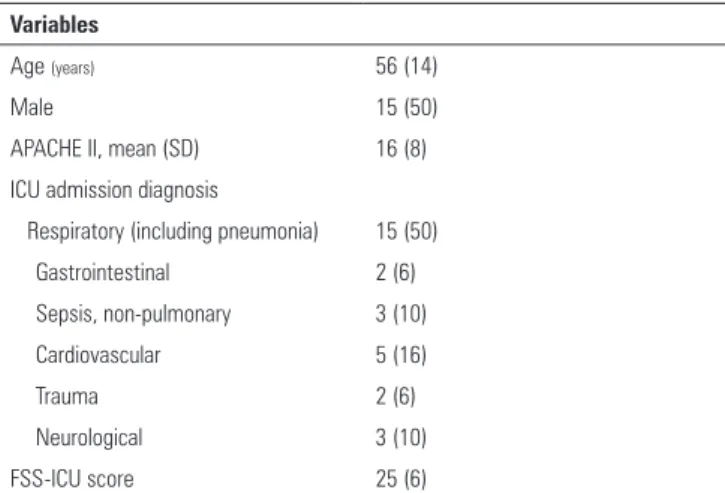
Table 2 - Characteristics of the population submitted to the pretest - Functional Status Score for the ICU - Brazilian Version (n = 30)
Variables
Age (years) 56 (14)
Male 15 (50)
APACHE II, mean (SD) 16 (8)
ICU admission diagnosis
Respiratory (including pneumonia) 15 (50)
Gastrointestinal 2 (6)
Sepsis, non-pulmonary 3 (10)
Cardiovascular 5 (16)
Trauma 2 (6)
Neurological 3 (10)
FSS-ICU score 25 (6)
ICU - intensive care unit; APACHE II - Acute Physiology and Chronic Health Evaluation II. Values are expressed as the mean (standard deviation), number (%) or mean ± standard deviation.
RESULTS
hirty patients enrolled in the present study. Table 2 displays their demographic characteristics.
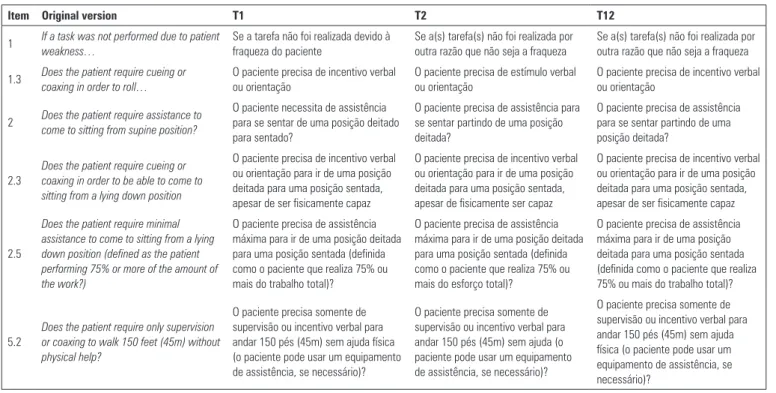
During the preparation of the T1 and T2 versions, a high degree of semantic agreement was found between the translators. For Item 1.2, which asks “Does the patient require cueing or coaxing in order to roll?”, the word “coaxing” was translated as incentivo or estímulo in these two versions;
however, the word estímulo did not remain after the board
review.
In the back-translation, diferences were found when compared to the original version. For Item 4, the phrase ‘Supine to Sit Transfers’ in the original was back-translated as ‘Transfers from supine to a seated position’. All other items are summarized in table 3. In the pretest step, the physiotherapists did not report that any uncertainties or problems with interpretation afected their performance; therefore, no additional adjustments were made to the Brazilian Portuguese version. he interobserver reliability results are shown in table 4. here was very good interobserver reliability between the two assessors for all tasks and for the total FSS-ICU score.
DISCUSSION
Table 3 - Translation by translator 1 and translator 2 and final version of the Functional Status Score for the ICU - Brazilian version
Item Original version T1 T2 T12
1 If a task was not performed due to patient
weakness…
Se a tarefa não foi realizada devido à fraqueza do paciente
Se a(s) tarefa(s) não foi realizada por outra razão que não seja a fraqueza
Se a(s) tarefa(s) não foi realizada por outra razão que não seja a fraqueza
1.3 Does the patient require cueing or
coaxing in order to roll…
O paciente precisa de incentivo verbal ou orientação
O paciente precisa de estímulo verbal ou orientação
O paciente precisa de incentivo verbal ou orientação
2 Does the patient require assistance to
come to sitting from supine position?
O paciente necessita de assistência para se sentar de uma posição deitado para sentado?
O paciente precisa de assistência para se sentar partindo de uma posição deitada?
O paciente precisa de assistência para se sentar partindo de uma posição deitada?
2.3
Does the patient require cueing or coaxing in order to be able to come to sitting from a lying down position
O paciente precisa de incentivo verbal ou orientação para ir de uma posição deitada para uma posição sentada, apesar de ser fisicamente capaz
O paciente precisa de incentivo verbal ou orientação para ir de uma posição deitada para uma posição sentada, apesar de fisicamente ser capaz
O paciente precisa de incentivo verbal ou orientação para ir de uma posição deitada para uma posição sentada, apesar de ser fisicamente capaz
2.5
Does the patient require minimal assistance to come to sitting from a lying down position (defined as the patient performing 75% or more of the amount of the work?)
O paciente precisa de assistência máxima para ir de uma posição deitada para uma posição sentada (definida como o paciente que realiza 75% ou mais do trabalho total)?
O paciente precisa de assistência máxima para ir de uma posição deitada para uma posição sentada (definida como o paciente que realiza 75% ou mais do esforço total)?
O paciente precisa de assistência máxima para ir de uma posição deitada para uma posição sentada (definida como o paciente que realiza 75% ou mais do trabalho total)?
5.2
Does the patient require only supervision or coaxing to walk 150 feet (45m) without physical help?
O paciente precisa somente de supervisão ou incentivo verbal para andar 150 pés (45m) sem ajuda física (o paciente pode usar um equipamento de assistência, se necessário)?
O paciente precisa somente de supervisão ou incentivo verbal para andar 150 pés (45m) sem ajuda (o paciente pode usar um equipamento de assistência, se necessário)?
O paciente precisa somente de supervisão ou incentivo verbal para andar 150 pés (45m) sem ajuda física (o paciente pode usar um equipamento de assistência, se necessário)?
T1 - translator 1; T2 - translator 2.
Table 4 - Intra-class correlation coefficient values of the functional tasks of the Functional Status Score for the ICU
FSS-ICU task Intra-class correlation
coefficient (95%CI)
Rolling 0.84 (0.54 - 0.94)
Supine to sit transfer 0.86 (0.68 - 0.94)
Sit to stand transfer 0.85 (0.57 - 0.94)
Sitting on the edge of bed 0.90 (0.77 - 0.96)
Walking 0.91 (0.80 - 0.94)
FSS-ICU total score 0.88 (0.73 - 0.95)
FSS-ICU - Functional Status Score for the ICU; 95%CI - 95% confidence interval.
countries should be considered to preserve the validity and reliability of assessment tools.(16)
he FSS-ICU has been used to evaluate physical
function in the ICU environment. Mehrholz et al.(12)
found that the FSS-ICU score may predict the recovery of walking ability in people with ICU-acquired weakness.
hrush et al.(11) evaluated functional status using the
FSS-ICU within 4 days of ICU admission and every two weeks until discharge. hey found that the FSS-ICU score signiicantly improved during ICU stays and that this tool may document functional improvements in ICU patients.
According to Parry et al.(5) and the recent international
validation of this instrument,(9) which included data
from Brazil, the USA and Australia, the FSS-ICU is recommended for evaluating patients in the ICU. hus, the Brazilian Portuguese version of the FSS-ICU provides Brazilian physiotherapists an important assessment tool for clinical practice and research, considering its psychometric strengths, applicability and external validity. Huang et al.(9) evaluated the internal consistency, validity,
responsiveness and minimal important diference of the FSS-ICU scale from ive international datasets, including two from Brazil. Moreover, the intrarater reliability has been assessed, identifying an intraclass correlation coeicient ≥ 0.985.(10)
he participation of diferent translators and back-translators in the early stages of the cross-cultural adaptation of the FSS-ICU was an important strategy to reduce the possibility of biases regarding the domains and items studied. Aspects of the scale that did not match with Brazilian culture underwent all relevant considerations raised by the professionals who performed the translations and back-translations.
equipment, and can be easily integrated into clinical care by physiotherapists.
CONCLUSION
he adapted version of the Functional Status Score for the Intensive Care Unit in Brazilian Portuguese proved to be easy to understand and apply clinically; however, it requires training and experience to be used in decision-making processes in the assessment of functional activities among patients in the intensive care unit.
ACKNOWLEDGMENTS
he authors are grateful to all patients who participated in this study and all coordinators and research assistants who made contributions, including Dr. Vania Oliveira, Luciana Vieira Tavernard Urache and Saint-Clair Bernardes Neto. his study received funding from the Fundação de Ensino e Pesquisa em Ciências da Saúde
(FEPECS - Brasília, Brazil) and Fundação de Apoio à Pesquisa do Distrito Federal (FAP/DF - Brasilia, Brazil).
Objetivo: Traduzir e adaptar culturalmente a Escala de Es-tado Funcional em UTI (FSS-ICU - Functional Status Score for the ICU) para o português do Brasil.
Métodos: O presente estudo consistiu das seguintes fases: tradução (realizada por dois tradutores independentes), sín-tese da tradução inicial, tradução de volta ao inglês (realizada por dois tradutores independentes não familiarizados com a FSS-ICU original) e fase de teste, para avaliar a compreensão por parte da audiência alvo. Um comitê de especialistas supervi-sionou todas as fases e foi responsável pelos ajustes ao longo do processo e pela versão inal da tradução.
Resultados: A fase de testes incluiu dois isioterapeutas experientes que avaliaram um total de 30 pacientes críticos
(escore da FSS-ICU médio de 25 ± 6). Como os isioterapeu-tas não relataram problemas com incertezas ou problemas de interpretação que afetassem seu desempenho, não foram feitos outros ajustes à versão em português brasileiro após a fase de teste. Obteve-se uma boa coniabilidade entre observadores para cada uma das cinco tarefas da FSS-ICU e entre os escores dos dois avaliadores (o coeiciente de correlação intraclasse va-riou de 0,88 a 0,91).
Conclusão: A versão adaptada da FSS-ICU para o portu-guês brasileiro comprovou ser de fácil compreensão e aplicação clínica no ambiente da unidade de terapia intensiva.
RESUMO
Descritores: Traduções; Estudos de validação; Inquéritos e questionários; Unidades de terapia intensiva
REFERENCES
1. Kress JP, Hall JB. ICU-acquired weakness and recovery from critical illness. N Engl J Med. 2014;371(3):287-8.
2. Fan E, Dowdy DW, Colantuoni E, Mendez-Tellez PA, Sevransky JE, Shanholtz C, et al. Physical complications in acute lung injury survivors: a two-year longitudinal prospective study. Crit Care Med. 2014;42(4):849-59. 3. Parry SM, Granger CL, Berney S, Jones J, Beach L, El-Ansary D, et al.
Assessment of impairment and activity limitations in the critically ill: a systematic review of measurement instruments and their clinimetric properties. Intensive Care Med. 2015;41(5):744-62.
4. Brummel NE, Balas MC, Morandi A, Ferrante LE, Gill TM, Ely EW. Understanding and reducing disability in older adults following critical illness. Crit Care Med. 2015;43(6):1265-75.
5. Parry SM, Denehy L, Beach LJ, Berney S, Williamson HC, Granger CL. Functional outcomes in ICU - what should we be using? - an observational study. Crit Care. 2015;19:127.
6. Zanni JM, Korupolu R, Fan E, Pradhan P, Janjua K, Palmer JB, et al. Rehabilitation therapy and outcomes in acute respiratory failure: an observational pilot project. J Crit Care. 2010;25(2):254-62.
7. Turci AM, Bevilaqua-Grossi D, Pinheiro CF, Bragatto MM, Chaves TC. The Brazilian Portuguese version of the revised Maastricht Upper Extremity Questionnaire (MUEQ-Br revised): translation, cross-cultural adaptation, reliability, and structural validation. BMC Musculoskelet Disord. 2015;16:41.
9. Huang M, Chan KS, Zanni JM, Parry SM, Neto SG, Neto JA, et al. Functional Status Score for the ICU: an international clinimetric analysis of validity, responsiveness, and minimal important difference. Crit Care Med. 2016;44(12):e1155-e1164. 10. Ragavan VK, Greenwood KC, Bibi K. The Functional Status Score for the
Intensive Care Unit Scale: Is It Reliable in the Intensive Care Unit? Can It Be Used to Determine Discharge Placement? Journal of Acute Care Physical Therapy. 2016;7(3):93-100.
11. Thrush A, Rozek M, Dekerlegand JL. The clinical utility of the functional status score for the intensive care unit (FSS-ICU) at a long-term acute care hospital: a prospective cohort study. Phys Ther. 2012;92(12):1536-45. 12. Mehrholz J, Muckel S, Oehmichen F, Pohl M. First results about recovery
of walking function in patients with intensive care unit-acquired muscle weakness from the General Weakness Syndrome Therapy (GymNAST) cohort study. BMJ Open. 2015;5(12):e008828.
13. Kho ME, Truong AD, Zanni JM, Ciesla ND, Brower RG, Palmer JB, et al. Neuromuscular electrical stimulation in mechanically ventilated patients: a randomized, sham-controlled pilot trial with blinded outcome assessment. J Crit Care. 2015;30(1):32-9.
14. De Jonghe B, Sharshar T, Lefaucheur JP, Authier FJ, Durand-Zaleski I, Boussarsar M, et al. Paresis acquired in the intensive care unit: a prospective multicenter study. JAMA. 2002;288(22):2859-67.