(1) Centro Universitário de Várzea Grande (UNIVAG), Cuiabá, Mato Grosso, Brasil. (2) ICET – Universidade Federal do Mato
Grosso (UFMT), Cuiabá, Mato Grosso, Brasil.
Conlict of interest: non-existent
Comparison of two newborn hearing screening protocols
with distinct reference criteria of distinct pass and failure
Comparação de dois protocolos de triagem auditiva neonatal com critérios
de referência de passa e falha distintos
Priscila de Araújo Lucas Rodrigues(1)
Taina Maiza Bilinski Nardez(1)
Mariano Martinez Espindola(2)
Keyla Cristina Costa Gomes(1)
Bruna Luana da Silva(1)
Received on: April 12, 2016 Accepted on: May 09, 2016
Mailing address:
Priscila de Araújo Lucas Rodrigues Rua Estevão de Mendonça 1134 apto 1601. Bairro Quilombo Cuiabá – MT – Brasil CEP: 78043-405
E-mail: [email protected]
ABSTRACT
Purpose: to compare two newborn hearing screening protocols with benchmarks of passes and failure
distinct.
Methods: a retrospective study. It was evaluated the records of 312 infants (s) and babies of both sexes
and up to 90 days after birth in September 2013 to September 2014 in the Neonatal Hearing Screening Service of Clinical Speech and Hearing Division School of the origin instituition. TEOAE were analyzed in two different benchmarks and they were compared.
Results: of the 312 patients evaluated, there was a greater number of male patients (53.85%), the
majo-rity of patients aged 30 days or less (65.06%) and only 6.09% had more than 60 days. The proportion of observed agreement was 43.91%, that is, both methods coincide in 43.91% of the results and the Kappa index was 0.0628, with a conidence interval of 95% (0.03 ; 0.0942) and 0.001 statistical signiicance (p = 0.001). It is observed that the value of Kappa is very low, considering that the perfect agreement is 1.00.
Conclusion: there was no statistical correlation between the protocols analyzed, there were more failures
in the NHS by step benchmark protocol 1.
Keywords: Screening; Optoacoustic Emissions; Newborn
RESUMO
Objetivo: comparar dois protocolos de triagem auditiva neonatal com critérios de referência de passa e
falha distintos.
Métodos: estudo retrospectivo. Foram avaliados os prontuários de 312 indivíduos, entre eles, RN(s) e
bebês de ambos os sexos com até 90 dias de nascidos, sendo de baixo e alto risco para a deiciência auditiva, no período de setembro de 2013 a setembro de 2014 no Serviço de Triagem Auditiva Neonatal da Clínica Escola da instituição de origem. Os prontuários consultados referem-se a RN(s) ou bebês sub-metidos à triagem auditiva neonatal por meio das Emissões Otoacústicas Evocadas Transientes (EOAT). As EOAT foram analisadas considerando tanto o critério de referência proposto por FINITZO (1998) (PROTOCOLO 1) quanto os critérios de referência vindos de fábrica no equipamento (PROTOCOLO 2), e os mesmos foram comparados. Foi realizada uma análise descritiva para caracterização da amostra.
Resultados: dos 312 indivíduos avaliados, observou-se maior número do sexo masculino (53,85%),
a maioria tinha 30 dias ou menos (65,06%) e somente 6,09% tinham mais de 60 dias. A proporção de concordância observada foi de 43,91% e o índice de Kappa foi de 0,0628, com o intervalo de coniança de 95% de (0,03; 0,0942) e uma signiicância estatística de 0,001 (p=0,001). Observa-se que o valor do Kappa é bem baixo, considerando que a concordância perfeita é de 1,00.
Conclusão: não houve concordância estatística entre os protocolos analisados, houve mais falhas na
etapa da TAN pelo critério de referência do protocolo 1.
INTRODUCTION
Through hearing the individual develops his capacity of speech and language, which, in turn, guarantees the development of his understanding and expression. Sensory deprivation affects the communication, the language, the literacy and his social and emotional development.
The Neonatal Hearing Screening (NHS) enables the early diagnosis of child hearing impairment, and should be done soon after birth or in the irst month of the newborn’s life (NB) so as to have a diagnosis in the irst three months and any intervention in up to the irst six months, reducing the impairments caused by hearing loss, and making possible the development of language very close to that of a child that can hear1.
The NHS is feasible due to its low cost, its facility and speed2.
The Joint Committee on Infant Hearing (JCIH) 3 and
the Multi-professional Committee on Auditory Health1
both suggest that the implementation of the Neonatal Hearing Screening use electroacoustic and electro-physiological measures, such as the Otoacoustic Emissions Evoked by Transient Stimulus (OAET) and the Auditory Brainstem Response (ABR).
The OAET is an objective test which evaluates the cochlear function without depending on neurological conditions of the newborn. It is a fast, noninvasive technique of easy interpretation, high speciicity and sensitiveness, performed when the baby is sleeping or quiet. An OAET is generated from a nonlinear click which stimulates the cochlea as a whole, from the basis to the top, in the frequencies from 300 to 5000 Hz, resulting in an acoustic energy, generated by contrac-tility of the outer hair cells during the active mechanism of the cochlear function that propagates to the middle ear and external ear canal, where it can be sensed4.
This test does not quantify hearing loss, but detects the presence of answers in individuals that have auditory thresholds of up to 30dB.
The ABR assesses the neuro-electrical activity in the auditory pathway, from the auditory nerve to the brain cortex, in answer to an acoustic stimulus. The reception of the auditory evoked potential is done using electrodes that are ixed on the scalp, forehead, ear lobes or mastoids. The captured neuro-electric answers are submitted to a iltering and amplifying process and, after being separated from the devices and added, can be observed as waves in the computer5.
There is no obligatory protocol deined as pass or fail criteria for the OAET, although there are some
suggestions in literature1,6-8. The equipment that
analyzes the otoacoustic emissions comes with deined pass or fail criteria, however these do not correspond to those mentioned in the literature.
The study of sensitivity and speciicity of screening protocols used in NHS services are of great impor-tance, as well as the search for deinition of a universal protocol aiming at an increase of reliability of the results obtained by services which exist worldwide. Also, a standardization of pass and failure reference criterion of these OAET, mainly for Hearing Screening, would make the comparison of the results in scientiic research easier and would increase the evidence of effectiveness of NHS services.
This research aims at comparing two different protocols of neonatal hearing screening with benchmark reference criteria of passes and failure.
METHODS
This study was initially sent for ethical consideration to Plataforma Brasil, being approved under the protocol number 38226314.3.0000.5164.
A retrospective study through the analysis of medical records was carried out, in which records were analyzed considering speciically hearing screening which occurred from September 2013 to September 2014 at the Neonatal Hearing Screening Service of the section of Speech Therapy at the School Clinic, belonging to the researcher’s institution of origin in Mato Grosso State, Brazil.
The results of the OAET of 312 individuals of both genders and ages of up to 90 days were analyzed.
The inclusion criteria were newborn(s) or babies of up to 90 days old, of both low and high risk. The exclusion criteria were: infants evaluated any time after completing 90 days of age, or who presented incon-clusive results due to lack of occlusion of the external auditory canal, or extreme noise at the moment of evaluation and non-attendance for retesting. Babies of up to three months of age were included, since, despite the national and international organs stating that the NHS must be performed before the end of the irst month of life, several infants’ parents search NHS services after this period.
analyzes the functionality of the outer hair cells and discards the possibility of hearing loss.
Two protocols were used for the analyses of the results. Protocol 1 follows the international reference criterion, 6 that considers the newborns’ response
which occurs from 3 to 6 dB above the noise (3dB in the frequency ranges of 1500Hz and 6 dB in the frequency ranges of 2000Hz, 3000Hz and 4000Hz).
Protocol 2 follows the reference criteria from factories that produce Otoread equipment, where 6 frequency ranges are tested (1.500Hz, 2000Hz, 2.500Hz, 3000Hz, 3500Hz and 4000Hz) and to pass the screening, there must be at least 3 frequencies with a sign-noise relation (S/R) of 4dB.
A comparison of the results obtained by the NB(s) and babies evaluated was done, considering both the reference criterion proposed by PROTOCOL 1 and
the reference criteria which came from factories of the Otoread equipment (PROTOCOL 2).
Finally, a descriptive analysis was carried out for the description of the sample and inferential in order to compare the results obtained by both reference criteria applied. For such a comparison the non-parametric Kappa test was used, where two groups with different qualitative results are compared to verify their concordance.
RESULTS
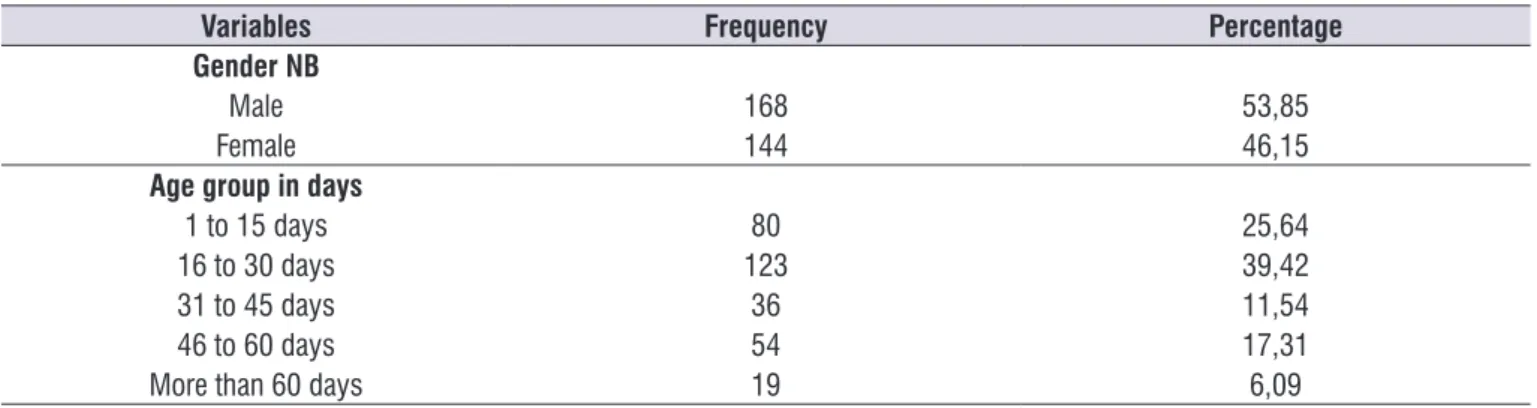
In Table 1, the characterization of the 312 individuals evaluated is presented according to the variables gender and group age in days (corrected age), at the moment of the evaluation. In this table it is observed that there is a larger number of male patients (53,85%), most of the patients were 30 days old or less (65,06%) and only 6,09% were more than 60 days old.
Table 1. Sample characterization according to gender and age group variables
Variables Frequency Percentage
Gender NB
Male 168 53,85
Female 144 46,15
Age group in days
1 to 15 days 80 25,64
16 to 30 days 123 39,42
31 to 45 days 36 11,54
46 to 60 days 54 17,31
More than 60 days 19 6,09
Legend: NB = Newborn
In Table 2 the comparison between the result obtained according to protocol 1 and 2 is presented. The values presented are given by the number of patients and respective percentage in each classiication.
In Table 2, the observed proportion of concordance was 43,91%, that is, both methods coincide on 43,91% of the results and the Kappa ratio was 0,0628, with the conidence interval of 95% of (0,03; 0,0942) and a statistic signiicance of 0,001 (p=0,001). It can be observed that the Kappa value is very low, considering that the perfect concordance is 1,00.
Table 2. Comparison of the results according to protocols 1 and 2
Result Protocol 2 Result Protocol 1 Total
Failed Passed
Failed 15 (4,81) 0 (0,00) 15 (4,81)
Passed 175 (56,09) 122 (39,10) 297 (95,19)
Thus, the great importance of introducing a universal neonatal auditory screening should be emphasized. One that is sensitive and speciic enough to avoid false positives and false negatives and that will make worldwide scientiic studies easier.
CONCLUSION
• There was no statistical concordance between the analyzed protocols.
• There were more fails in the NHS stage by the reference criteria of protocol 1.
REFERENCES
1. Lewis DR, Maroni SAM, Mendes BCA, Cruz OLM, Nobrega M. Comitê multiproissional em saúde auditiva: COMUSA. Braz J Otorhinolaryngol. 2010;76(1):121-8.
2. Ribas A, Cabral J, Gonçamves V, Gonçalves CGO, Kozlowski L. Programa de triagem auditiva neonatal: inluência do tempo de vida dos recém-nascidos na pesquisa das emissões otoacústicas transientes. Rev. CEFAC. 2013;15(4):773-7.
3. Joint Comittee on Infant Hearing. Position Statement: Principles and Guidelines for Early Hearing Detection and Intervention Programs. Pediatrics. 2007;120(4):898-921.
4. Kemp DT. Otoacustic Emissions: basic facts and applications. Audiology in practice. 1989;3:1-4.
5. Jewett DL, Williston JS. Auditory evoked far ields average from the scalp of humans. Brain.1971;94(4):681-96.
6. Finitzo T, Albright K, O’Neal J. The newborn with hearing loss: detection in the nursery. Pediatrics. 1998;102(6):1452-60.
7. Sousa LCA et al. Emissões Otoacústicas. In: Sousa LCA. et al. Eletroisiologia da audição e emissões otoacústicas. São Paulo: Editora novo conceito, 2008.
8. Côrtes-Andrade IF, Bento DV, Lewis DR. Emissões otoacústicas evocadas por estímulo transiente: protocolos de triagem auditiva neonatal. Rev. CEFAC. 2013;15(3):521-7.
9. Dantas MBS, Anjos SAL, Camboim ED, Pimentel MCR. Resultados de um programa de triagem auditiva neonatal em Maceió. Rev. Bras. Otorrinolaringol. 2009;75(1):58-63.
DISCUSSION
Of the 312 participants in this research, 53,85% were males, and 46,15% females (Table 1). According to other authors, the percentage of male newborns or babies that seek NHS service is higher, and the majority are under 30 days old9,10. The age of the
newborns that did the NHS varied from 0 to 90 days old, and the majority was less than 30 days old. These numbers are in accordance with what is recommended by national and international organs that indicate that neonatal hearing screening should be done in the irst month after birth1,3.
The literature describes some national and inter-national studies using different pass and fail criteria, indicating that there is not yet an agreement about which would be the best criteria a speech therapist should choose, using the transient evoked otoacoustic emissions in neonatal auditory screening8,11.
In this study, the number of newborn(s) or babies that failed in protocol 1 was higher than that obtained by protocol 2, and both have low concordance, as can be seen on Table 2. A possible explanation is that, as protocol 1 is more thorough, it can detect a higher number of auditory losses, avoiding false negatives. However, this same rigor might lead to an excessive number of false positive results and generate problems in the quality of the program, generating unnecessary anxiety in parents as well as increasing referral for repetition of tests of fails of OAET and creating an overload in the clinics responsible for the auditory diagnosis12,13.
Another relevant result is that the number of fails in protocol 1 is higher than the literature considers acceptable (4%) – Table 2. Maybe the protocol has low sensibility, thus generating many false-positive results. Another hypothesis for this inding is that the 1,5 KHz frequency evaluated by protocol 1 can negatively inluence the results of NHS service, for it is highly liable of fail as shown in a study 11 where it was conirmed
that the OAE register in lower frequency ranges can be disguised by noisy environments and physiological noises.
10. Maia RM, Silva MAM, Tavares PMB. Saúde auditiva dos recém-nascidos: atuação da fonoaudiologia na Estratégia Saúde da Família. Rev. CEFAC. 2012;14(2):206-14.
11. Norton SJ, Gorga MP, Widen JE, Folsom RC, Sininger Y, Cone-Wesson B et al. Identiication of neonatal hearing impairment: evaluation of transient evoked otoacoustic emission, distortion product otoacoustic emission, and auditory brain stem response test performance. Ear Hear. 2000;21:508-28.
12. Lin HC Shu MT, Lee KS, Ho GM, Fu TY, Bruna Set al. Comparison of hearing screening programs between one step with transient evoked otoacoustic emissions (TEOAE) and two steps with TEOAE and automated audtoty brainstem response. Laryngoscope. 2005;115(11):1957-62.
13. Mcpherson B Li SF, Shi BX, Tang JL, Wong By et al. Neonatal hearing screening: evaluation of tone-burst and click-evoked otoacoustic emission test criteria. Ear Hear. 2006;27:256-62.
ERRATUM
In this article, “Comparison of two newborn hearing screening protocols with distinct reference criteria of distinct pass and failure”, with DOI number: 10.1590/1982-021620161842816, published in the journal Revista Cefac, 18(4):876-880, on page 876:
Where it was:
Taína Maiza Bilinsky Nardez
Read: