Copyright © 2015 Revista Latino-Americana de Enfermagem This is an Open Access article distributed under the terms of the Creative Commons Attribution Non-Commercial License (CC BY-NC).
This license lets others distribute, remix, tweak, and build upon your work non-commercially, and although their new works must also acknowledge you and be non-commercial, they don’t have to license their derivative works on the same terms.
Corresponding Author: Hugo Tapia Martínez
Universidad Nacional Autónoma de México. Escuela Nacional de Enfer-mería y Obstetricia
Camino Viejo a Xochimilco y Viaducto Tlalpan, s/n Col. San Lorenzo Huipulco, Delegación Tlalpan CP: 14370, Ciudad de México, DF, México E-mail: [email protected]
1 Supported by Programa de Apoyo a Proyectos de Investigación e Innovación Tecnológica (PAPIIT), Mexico, process # 307811-3.
2 MSc, Associate Professor, Escuela Nacional de Enfermería y Obstetricia, Universidad Nacional Autónoma de México, Ciudad de México, Mexico. 3 PhD, Associate Professor, Escola de Enfermagem de Ribeirão Preto, Universidade de São Paulo, PAHO/WHO Collaborating Centre for Nursing
Research Development, Ribeirão Preto, SP, Brazil.
4 MSc, Full Professor, Escuela Nacional de Enfermería y Obstetricia, Universidad Nacional Autónoma de México, Ciudad de México, Mexico.
Obstetric profile of pregnant adolescents in a public hospital: risk at
beginning of labor, at delivery, postpartum, and in puerperium
1Hugo Tapia Martínez
2Marta Angélica Iossi Silva
3Iñiga Pérez Cabrera
2Araceli Jiménez Mendoza
4Objective: describe the obstetric profile of adolescents at beginning of labor, at delivery,
postpartum, and in puerperium. Method: Cross-sectional descriptive study with 85 pregnant
adolescents, selected by convenience, referred by health centers to a public hospital in Mexico
City. Risks were evaluated before, during and after delivery and in puerperium, and measured
respectively with the “Previgenes” that compose the Reproductive and Perinatal Risk Assessment
System. Results: socioeconomic status, occupation and education level had influence on the
emotionality of adolescents in relation to labor, whose obstetric risk was low for 55%, medium
for 35%, and high for 10%. Risk in labor was low for 55%, medium for 18%, and high for
27%. Risk postpartum was low for 50%, medium for 25%, and high for 25%. In puerperium,
most adolescents (90%) had low risk. Conclusion: most adolescents had low risk in the
stages evaluated. The study contributed to identify strategies to approach risk considering
the vulnerability inherent in this type of population and favored the conduct of appropriate
interventions for the respective needs.
Descriptors: Pregnancy in Adolescence; Risk Factors; Labor, Obstetric; Parturition; Postpartum
Period.
Rev. Latino-Am. Enfermagem 2015 Sept.-Oct.;23(5):829-36 DOI: 10.1590/0104-1169.0316.2621
www.eerp.usp.br/rlae
Introduction
Adolescent pregnancy remains a public health
problem worldwide. It is estimated that 14 million
adolescents (woman aged 10–19 years) give birth
around the world each year, which represents slightly
more than 10% of all births. A total of 80% of births
occur in developing countries(1). In 2010, according to
the General Census of Population and Housing, there
were 112,336,538 million inhabitants in Mexico, of
which 21,966,049 (19.5%) were adolescents aged 10–
19 years(2).
The rate of pregnancy for adolescents aged 12–19
years was 79 per thousand women(3). One in six women
who become pregnant in Mexico is an adolescent.
Mortality due to adolescent pregnancy is related to
higher maternal mortality, especially among adolescents
aged 10–14 years(4); the risk of maternal death for
adolescents is twice as high as that in the rest of women
in childbearing age, and four times as high for those
aged under 15(5).
As for morbidity rate, pregnant adolescents are
a risk group; the risks and damage that may occur
to adolescents are not only threats during pregnancy,
but also in stages subsequent to the obstetric act, i.e.,
at parturition and postpartum, even occurring to the
newborn child. For example, the Urinary Tract Infection
(UTI) factor indicates that pregnant adolescents with this
factor are more likely to have a miscarriage, presence
of uterine contractions before the term pregnancy or
preterm parturition(6).
Risk Factors (RFs) were classiied as biological,
psychological, and social; in biological RF there are, for
example, those related to uterine contractions in labor:
number of uterine contractions in 10 minutes, their
intensity and their duration during the active phase of
labor; while in the social RFs there are: socioeconomic
status, occupation or education level; and, in the
psychological RF, there is: the woman’s emotionality in
relation to labor.
Continuing with the impact that risk factors
represent to health in the adolescents’ parturition
and postpartum stages, studies have described
preterm birth and neonatal deaths as major problems
considering children of adolescent mothers. In addition,
they identiied others as toxemia, prolonged parturition
and increased incidence of cesarean in this risk group;
additionally, increased frequency of anemia, toxemia,
low-weight newborn rate, and puerperal complications
in these patients(7,8).
With regard to adolescence, it is considered a risk
factor because it is the stage of life in which physical,
psychological, social and cultural changes occur;
adolescents pass from biopsychosocial immaturity to
biological maturity irst, then reaching psychosocial
maturity as adults.
Identifying risk factors of Mexican adolescents
belonging to the peripheral areas of Mexico City – at
beginning, during and after delivery – may favor the
conduct of interventions based on their speciic needs. Thus, this study aimed to determine the obstetric proile
at beginning of labor, at delivery, postpartum, and in
puerperium of adolescents giving birth at a public
hospital in Mexico City.
Hypotheses outlined were that the obstetric proile of
adolescent at beginning of labor, at delivery, postpartum
and in puerperium is of medium and high risk.
Method
This is an observational, descriptive, and
cross-sectional study. Sample consisted of 85 pregnant
adolescents, selected by convenience, referred by
two health centers to a public hospital of the Health
Department of the Federal District, Mexico City, from
December 2011 to April 2012. Inclusion criteria were:
pregnant adolescent in the second half of pregnancy;
underwent prenatal care; entered the delivery room of
the public hospital.
The instruments used were the perinatal risk cards
called “Previgen” IV, V, VI, and VIII, which correspond to
a part of the Reproductive and Perinatal Risk Assessment
System (SERRP) [Vargas, 2003]9 of the
Maternal-Infantile Research Center of the Birth Study Group
(CIMIGEN). These instruments measure, respectively,
the risk at beginning of labor, at delivery, postpartum,
and in puerperium. Their application enables the
effective assessment of risk factors in the perinatal stage
– in order to have such risk factors eliminated, modiied,
or reduced in their ability to affect maternal health –
and also enables the indication of high-risk cases for
subsequent care. The instrument consists of 41 variables
or risk factors and is illed in by an evaluator. Based on
global marking, risks are considered as follows: green
indicates Low Risk (LR); yellow indicates Medium Risk
(MR); and red indicates High Risk (HR). Therefore, it is
a qualitative measurement on an ordinal scale.
Six undergraduate scholarship students of the
Teaching Degree Program in Nursing and Midwifery –
the project, as well as on the use and application of
the instrument – carried out the data collection after
patients had been discharged, at their houses and using
forms, through permanent communication and prior
informed consent.
All data collected were organized in databases built
on Excel program and submitted to descriptive statistics
using the Statistical Package for the Social Sciences
(SPSS) version 15.
The study met the ethical principles of beneicence and non-maleicence, truthfulness, privacy and conidentiality, highlighted in the Nursing ethical
code(10). Data collection started after approval of
the Ethics Committee of the Public Hospital, under
registration number 27676-2286-26-X. Later, we
obtained informed consents from the pregnant
adolescents through the responsible persons (mother,
father, guardian or partner) before conducting the
interviews, both for direct interviews and for illing the
instruments developed.
Results
A total of 85 study subjects (100%) completed the
instrument.
Variables at beginning of labor
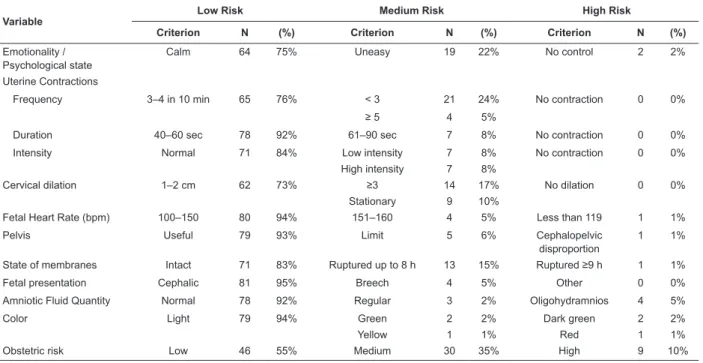
Table 1 shows that obstetric risk at this stage was
low for 55%, medium for 35%, and high for 10%.
As for emotionality, 75% of adolescents showed
calmness and only 2% did not control their emotions.
Regarding uterine contractions, the majority (76%) had
3–4 contractions in ten minutes; intensity was normal
for 84% of the adolescents; 92% of the adolescents had
40–60 seconds of duration by contraction.
Table 1 – Distribution of adolescents according to variables at beginning of labor. Mexico City, Mexico, 2012
Variable
Low Risk Medium Risk High Risk
Criterion N (%) Criterion N (%) Criterion N (%)
Emotionality / Psychological state
Calm 64 75% Uneasy 19 22% No control 2 2%
Uterine Contractions
Frequency 3–4 in 10 min 65 76% < 3 21 24% No contraction 0 0%
≥ 5 4 5%
Duration 40–60 sec 78 92% 61–90 sec 7 8% No contraction 0 0%
Intensity Normal 71 84% Low intensity 7 8% No contraction 0 0%
High intensity 7 8%
Cervical dilation 1–2 cm 62 73% ≥3 14 17% No dilation 0 0%
Stationary 9 10%
Fetal Heart Rate (bpm) 100–150 80 94% 151–160 4 5% Less than 119 1 1%
Pelvis Useful 79 93% Limit 5 6% Cephalopelvic
disproportion
1 1%
State of membranes Intact 71 83% Ruptured up to 8 h 13 15% Ruptured ≥9 h 1 1%
Fetal presentation Cephalic 81 95% Breech 4 5% Other 0 0%
Amniotic Fluid Quantity Normal 78 92% Regular 3 2% Oligohydramnios 4 5%
Color Light 79 94% Green 2 2% Dark green 2 2%
Yellow 1 1% Red 1 1%
Obstetric risk Low 46 55% Medium 30 35% High 9 10%
However, considering the other variables analyzed
– dilation of the cervix, fetal heart rate, pelvis and
state of membranes –, most had patterns within
normal limits. Importantly, 10% of the adolescents
remained stationary in relation to cervix dilation in
centimeters (cm), and, as for the state of membranes,
15% ruptured in an interval of 8 hours. With regard to
the fetus, 90% of the adolescents or more were within
normal limits and in favorable conditions at this stage
of the assessment.
Variables during labor
Regarding the risk during parturition, Table 2 shows
that it was low for 55% of the study subjects, medium
for 18%, and high for 27%.
Regarding the variables during labor, we found that those
related to the descent of the fetal presentation, labor duration,
and type of placental detachment had high risk. Of all adolescents
assessed, 16% had dificult descent, 15% experienced more
Postpartum variables
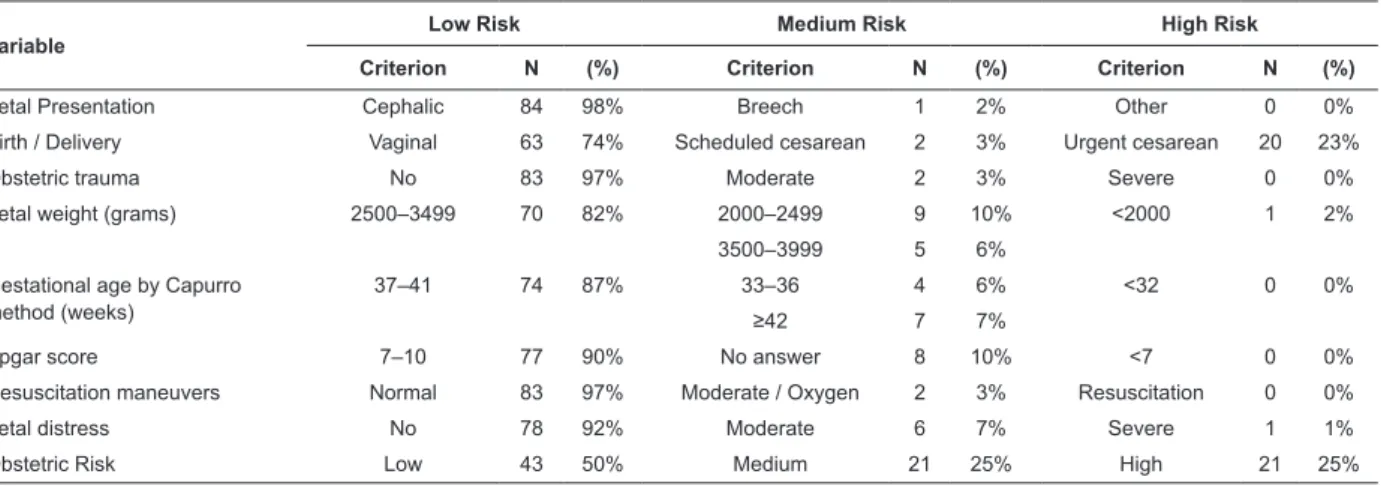
The postpartum risk was low for 50%, medium for
25%, and high for 25% (Table 3). Of 85 parturitions
attended in the delivery room, 98% had cephalic
presentation and only 2% had breech presentation.
Considering the indicators of the variable birth, we
observe that 74% were born by vaginal delivery and 26%
by cesarean section, of which 23% were emergency and
2% were scheduled. Regarding obstetric trauma, it was
absent in 97% and present in 3%. It is worth noting
that the average risk postpartum, the variables weight of
child, gestational age, and fetal distress were essential
to this result. Concerning the weight at birth, 10%
weighed from 1000 to 2499 g. According to the Capurro
scale, used to calculate gestational age in weeks, 13%
were between 33 and 42 weeks or more. Considering
the signs of fetal distress, 8% were moderate or severe. Table 2 - Distribution of adolescents according to variables during labor. Mexico City, Mexico, 2012
Variable
Low Risk Medium Risk High Risk
Criterion N % Criterion N % Criterion N %
Fetal Heart Rate (bpm) 120–150 78 93% 111–119 2 2% ≤110 2 2%
Uterine Contractions 151–159 2 2% ≥160 1 1%
Frequency (in 10 minutes) 3–4 81 96% <3 2 2% Absent 0 0%
≥5 2 2% Polysystole 0 0%
Duration (seconds) 40–60 83 97% <40 sec 2 3% Hypersystole 0 0%
Cervical Dilation (cm) 1–2 61 71% ≥3 14 16% No dilation 0 0%
Stationary 10 13%
Presentation descent Normal 61 71% Very fast 10 13% Difficult 14 16%
Blood pressure (mmHg) Syst. 100–139 79 93% 140–160 5 6% 161 or more 1 1%
Diast. 60–80 79 93% 91–109 6 7%
State of membranes Intact 54 64% Ruptured ≤8 h 30 35% Ruptured ≥9 h 1 1%
Birth Place Expulsion 63 74% Surgery room 20 24% Other 2 2%
Duration of labor 6–8 h 17 20% Less than 6 h 55 65% More than 9 h 13 15%
Placental detachment type Spontaneous 44 52% Directed 27 31% Manual 14 17%
Hemorrhage Normal 83 96% Moderate 1 2% Excessive 1 2%
Obstetric risk Low 47 55% Medium 15 18% High 23 27%
Table 3 – Distribution of adolescents according to postpartum variables. Mexico City, Mexico, 2012
Variable
Low Risk Medium Risk High Risk
Criterion N (%) Criterion N (%) Criterion N (%)
Fetal Presentation Cephalic 84 98% Breech 1 2% Other 0 0%
Birth / Delivery Vaginal 63 74% Scheduled cesarean 2 3% Urgent cesarean 20 23%
Obstetric trauma No 83 97% Moderate 2 3% Severe 0 0%
Fetal weight (grams) 2500–3499 70 82% 2000–2499 9 10% <2000 1 2%
3500–3999 5 6%
Gestational age by Capurro method (weeks)
37–41 74 87% 33–36 4 6% <32 0 0%
≥42 7 7%
Apgar score 7–10 77 90% No answer 8 10% <7 0 0%
Resuscitation maneuvers Normal 83 97% Moderate / Oxygen 2 3% Resuscitation 0 0%
Fetal distress No 78 92% Moderate 6 7% Severe 1 1%
Obstetric Risk Low 43 50% Medium 21 25% High 21 25%
Puerperium variables
Concerning the obstetric proile of the adolescents
in puerperium, risk was low for 90%, medium for 8%,
and high for 2% (Table 4).
For all variables assessed, risk was mostly low, but it was
demonstrated that maternal lactation, vital signs, temperature,
and evaluation of edema must be factors of attention.
Adolescent mothers had maternal lactation in
87% of the cases; however, 13% fed their babies with
formula milk. Results indicate that 2% had moderate
hypertension and hyperthermia. Considering the
adolescents, 92% had no edema, 7% had regional
Discussion
Risk factors indicate the probability that health
damage occurs to a person. In this study, we obtained
different risk factors for adolescents during the early
stages of labor, delivery, and in the postpartum period,
including the newborn.
Importantly, throughout the prenatal period,
delivery, postpartum period and puerperium, prenatal
control should be conducted. However, studies indicate
that pregnant adolescents attend fewer prenatal
consultations, often taking a long time to seek prenatal
care, especially in irst pregnancy(11). A study in Brazil,
in which data from 2,557 births were analyzed, showed
that adolescent mothers were, systematically, at a
disadvantage compared to other mothers, both in
relation to socioeconomic characteristics and to the care
received during gestation and delivery(12).
It was identiied that the majority of adolescents
in the different stages of the study – i.e., beginning of
labor, delivery, postpartum period and puerperium – had
parameters within normality, which may indicate the
possibility that prenatal care was adequate. However,
some risk factors were identiied, such as: medium
or high risk at birth (50%); 21% of these births were
emergencies; in 48%, placental detachment was
directed or manual; and gestational age was between
33 and 36 weeks for 6%.
In this study, about three-quarters of the
adolescents were calm during labor. However, about
one quarter was anxious or did not control their
emotions. It is known that positive experiences during
delivery contribute to reduced fear and confer greater
security to women in any subsequent deliveries. In
this sense, a study conducted in Norway showed the
association between obstetric complications and fear
of delivery(13).
Negative experiences of women during the state of
pregnancy and during delivery are associated with the
occurrence of postpartum depression and low welfare(14).
To avoid this, monitoring the adolescent properly during
pregnancy is essential, since prenatal control, and
patient history should be investigated with respect
to fear of delivery, complications and experiences in
previous deliveries. During delivery, there must be good
communication between the adolescent and the health
team, and the issue of pain control should be addressed.
The study revealed that, during labor, many
adolescents feel vulnerable with the issue of
hospitalization, have neither monitoring nor attention in
a patient manner, receive no information and support
they need; therefore, they do not feel respected as
individuals with rights and do not act as protagonists
in the birth of their children. These situations can
affect participation and interaction of adolescents
during delivery and postpartum period, in addition to
contributing to make the process of labor dificult(15).
Moreover, it should be taken into account that
this same adolescent has more potential to collaborate
and take care of herself, and that many dificulties are
based on the representations of professionals who still
see adolescence as a time of extreme inexperience,
immaturity and alienation, having no ability to decide
what would be best for them.
Thus, adolescent delivery care requires that
health services and institutions, including educational
institutions, reinterpret the role of health professionals
in the care during labor and delivery, and the form of
organization of obstetric practices in maternity wards,
ensuring humanized care, guided by the rights of clients Table 4 - Distribution of adolescents according to puerperium variables. Mexico City, Mexico, 2012
Variable Low Risk Medium Risk High Risk
Criterion N (%) Criterion N (%) Criterion N (%)
Hemorrhage Normal 83 98% Moderate 1 1% Excessive 1 1%
Blood pressure Normal 81 96% Moderate hypertension 2 2% Excessive hypertension 1 1%
Moderate hypotension 1 1%
Heart rate Normal 84 99% Moderate tachycardia 1 1% Severe tachycardia 0 0%
Temperature Normal 82 97% Hyperthermia 2 2% Severe Hyperthermia 1 1%
Uterine involution Normal 84 99% Subinvolution 1 1% Atony 0 0%
Edema No 78 92% Regional 6 7% Generalized 1 1%
Infection No 84 99% Local 1 1% Generalized 0 0%
Urinary and intestinal elimination
Yes 81 95% Difficulty 1 1% No 3 4%
Maternal lactation Yes 74 87% Formula 11 13% Other 0 0%
and based on evidence. In this study, the nurse plays
a fundamental role in changing delivery care practices,
and an important coordinating role in the implementation
of Childbirth Humanization Policy, prioritizing the
promotion of healthy labor and delivery, respecting the
physiological process, the dynamics of every birth, and
encouraging the adolescent to assume a protagonist role
during delivery(16).
Regarding obstetric trauma, it was absent in 97%
and present in 3%. Studies on traumatic delivery have
shown that women with dissociative symptoms or
negative emotions during delivery, who had previous
traumatic events, depression during pregnancy, and
little social support and health staff support, are more
likely to experience postpartum Post-Traumatic Stress
Disorder/PTSD(17). In this sense, and considering that
most adolescents in this study showed no obstetric
trauma, 3% had traumas that may also represent
injuries to the unborn child. Most injuries are mild and
self-limited, only requiring observation, yet some are
initially subclinical and can progress rapidly.
Obstetric risk at beginning of labor was low for
most adolescents. However, risk was medium or high
for 45%. Considering indicators of the variable Delivery,
we found that 74% of children were born by vaginal
delivery, while 26% were born by cesarean section, of
which 21% were urgent. With regard to type of delivery
among adolescents, the percentage of cesarean surgery
found was lower compared to the percentage of vaginal
delivery, which is in line with indings in other studies, as
dystocia of labor also tends to occur more often among
older pregnant women, being partly responsible for a
greater number of C-sections(11,12,18).
With respect to gestational age, results showed
that 87% were between 37–41 weeks and only 6%
were between 33–36 weeks, thus not conirming the
hypothesis of other studies, that the probability of
premature births would higher among adolescents. The
higher incidence of preterm birth among adolescents
was observed in several national and international
studies, given the lack of physical maturity of adolescent
pregnancy, complications during gestation, inadequate
care during the prenatal period and delivery, the number
of prenatal consultations, the type of pregnancy, and
delivery by cesarean section(11,12,19,20).
Regarding newborns from adolescent mothers,
another information widely mentioned, in addition to
prematurity, is the low birth weight. However, results
of this study differ from other researches, since the
percentages indicating the birth weight showed that
82% had 2500–3499 grams, 10% had 2000–2499
grams, 6% had 3500–3999, and 2% had less than 2000
grams. This inding conirms the data from a study that
aimed to examine aspects of gestation and delivery in
adolescents and adult women, to compare the effects
on the newborn, concluding that the probability of low
birth weight was 24% when the mother was aged 10–14
years, and 10% when the mother was aged 15–19 years,
compared to mothers aged 20–34 years. Therefore,
adolescent mothers are more likely to have a low-weight
newborn compared to older mothers(21).
We also point out that maternal age alone is not
associated with low birth weight and that adolescence
can become a risk factor for low birth weight among
single mothers, smokers, drug users, and those who
have eating disorders(21,22).
Regarding the values for blood pressure (BP)
of the population under study, 93% had 100–139 for
systolic BP, 93% had 60–80 for diastolic BP, while 6%
had 140–160 for systolic BP and 7% had 91–109 for
diastolic BP. These data make clear the importance of
controlling blood pressure and maintaining adequate
levels, because the evidence shows that preeclampsia
occurs more frequently at the extremes of reproductive
life and that there is a signiicant association among
pregnant adolescents(23).
Considering the Apgar score as an important risk
factor for morbidity and neonatal mortality, we observe
that 8% received a rating of 7–10; however, the others
provided no information concerning the Apgar score,
which prevents further discussion concerning this
aspect. Still, it is worth pointing out that low rates are
not always associated with adolescents. A recent study
showed that children who were born with Apgar score
lower than 7 represented 3.1% of newborns, and 4.1%
among adolescents, 2.6% among adult women, and
5.7% among older women, i.e., aged 35 or more(11).
Another study showed that hypoxia within ive
minutes of life was associated with the number of prenatal
consultations, and no statistically signiicant association
was found between maternal age, 10–14 and 15–19
years, and hypoxia within ive minutes of life(20).
Furthermore, considering that in Mexico the drama
of “girls-mothers” (aged under 18) who give birth to
a child is an increasing trend according to data from
UNFPA(1), its impact on health is transcendent, since
70,000 young persons die every year in developing
countries, due to issues related to early motherhood(1).
Especially among adolescents, early motherhood
who come from the poorest classes, lacking a stable
partner and with lower education level, factors that are
associated with a higher risk of maternal complications
and advance unfavorably toward maternal death(4,7). In
order to reduce the risks, and, therefore, the situations of
vulnerability, we must expand the attributes of Primary
Health Care – irst contact access, comprehensiveness,
longitudinality, coordination, family and community
counseling, and cultural competence – with the aim of
providing comprehensive care(21,24).
Conclusion
We found that most adolescents in the different
stages of the study had low risk and parameters within
normal limits. Monitoring of the pregnant adolescents’
reproductive process also showed the impact of the
prenatal care quality, evaluated the limitations in
their self-care due to lack of concern with themselves
and with their children, since they do not assess the
inherent risks nor the required care concerning the
maternal sphere. The study offered the opportunity
to identify strategies to approach risks resulting from
the vulnerability inherent to this type of population,
in which care is aimed to the couple equally, and to
identify priorities in health. A limitation of this research
was the coverage of records, mostly due to lack of
communication between evaluator and patients at time
of delivery, although the data were representative for
the context under study. Despite these limitations, we
can conclude that the study favors the recognition of risk
factors at parturition, postpartum and in puerperium; it
may enable midwives to reinterpret their participation
in the timely detection of risk factors in adolescents
and to conduct interventions not only in relation to the
biological aspect, but also to the psychosocial aspects:
reducing fear, stress, anxiety, changing hospital
routines to favor participation of the family, and
empowering the adolescents by monitoring, answering
questions, and promoting the exercise of their rights.
The results enable the outline of a general framework,
which should be considered in future studies on the
obstetric proile of pregnant adolescents, into which
other analytical and disciplinary aspects could and
should be incorporated.
Acknowledgements
The Mexico City Public Hospital for facilitating
the procedures to carry out this study. The Nurses of
the Prenatal Control Service of the Mexico City Public
Hospital for cooperating with the research team.
References
1. United Nations Population Fund. The State of
World Population 2004: The Cairo Consensus at Ten:
Population, Reproductive Health and the Global Effort to
End Poverty. , p. 76. New York: UNFPA; 2004. [acesso
20 fev 2010]. p. 76. Disponivel em: http://www.unfpa.
org/swp/2004/pdf/en_swp04.pdf
2. Instituto Nacional de Estadística, Geografía e
Informática (MX). Censo General de Población y Vivienda
2010: Tabulados del Cuestionario Básico. México; 2011.
3. Secretaria de Salud (MX). Subsecretaria de Prevención
y Programación Dirección General de Epidemiología. Perfil
epidemiológico de la población adolescente. México; 2011.
4. Oliveira Jr FC, Surita FG, Pinto e Silva JL, Cecatti
JG, Parpinelli MA, Haddad SM, et al. Severe maternal
morbidity and maternal near miss in the extremes
of reproductive age: results from a national cross-
sectional multicenter study. BMC Pregnancy Childbirth.
[Internet]. 2014 [acesso 26 jun. 2014];14:77.
Disponível em: http://www.ncbi.nlm.nih.gov/pmc/
articles/PMC3975952/?tool=pubmed
5. Ximenes-Neto FRG, Marques MS, Rocha J. Problemas
vividos por las adolescentes durante la gestación. Enferm
Global. [Internet]. 2008. [acesso 6 mar
2010];(12):1-11. Disponível em: http://bit.ly/wd8L4P
6. Tapia H, Jiménez A, Pérez I. Perfil Obstétrico
de Adolescentes Embarazadas atendidas en un
Hospital Público de la Ciudad de México. Enferm Univ.
2012;9(3):7-14.
7. Lenkiewicz NE. El embarazo en adolescentes: un
tema con variaciones polémicas. Género y Salud en
Cifras. [Internet]. 2008 [acesso 6 mar 2013];6(1):7-11.
Disponível em: http://www.facmed.unam.mx/deptos/
salud/genero/boletines/boletin%20V6-1.pdf
8. Valdés-Dacal S, Essien J, Bardales-Mitac J,
Saavedra-Moredo D, Bardales-Mitac E. Embarazo en la
Adolescencia Incidencia, Riesgos y Complicaciones. Rev
Cubana Obstet Ginecol. 2002;28(2):84-8.
9. Vargas GC. Sistema de Evaluación de Riesgo
Reproductivo y Perinatal (SRRP). Aociación Hispano
Mexicana. Centro de Investigación Materno Infantil del
Grupo de Estudios al Nacimiento (CIMI Gen); 2003.
10. Secretaría de Salud (MX). Subsecretaría de
innovación y calidad. Comisión Interinstitucional de
Enfermería. Código de ética para las enfermeras y
Secretaría de Salud-IMSS-ISSSTE, 2001. [acesso 6 mar
2013]. Disponível em: http://bit.ly/RKTtTF
11. Santos GHN, Martins MG, Sousa MS, Batalha
SJC. Impacto da idade materna sobre os resultados
perinatais e via de parto. Rev Bras Ginecol Obstet.
2009;31(7):326-34.
12. Cesar JA, Mendoza-Sassi RA, Gonzalez-Chia DA, Mano
OS, Goulart-Filha SM. Características sociodemográficas
e de assistência à gestação e ao parto no extremo sul do
Brasil. Cad Saúde Pública. 2011;27(5):985-94.
13. Størksen HT, Garthus-Niegel S, Vangen S,
Eberhard-Gran M. The impact of previous birth experiences on
maternal fear of childbirth. Acta Obstet Gynecol Scand.
2013;92(3):318-24.
14. Gausia K, Ryder D, Ali M, Fisher C, Moran A,
Koblinsky M. Obstetric complications and psychological
well-being: experiences of Bangladeshi women
during pregnancy and childbirth. J Health Popul Nutr.
2012;30(2):172-80.
15. Enderle CF, Kerber NPC, Susin LRO, Gonçalves BG.
Delivery in adolescents: qualitative factors of care. Rev
Esc Enferm USP. 2012;46(2):287-94.
16. Silva RC, Soares MC, Jardim VMR, Kerber NPC,
Meincke SMK. O discurso e a prática do parto
humanizado de adolescentes. Texto Contexto Enferm.
2013;22(3):629-36.
17. Zambaldi CF, Cantilino A, Sougey EB. Parto traumático
e transtorno de estresse pós-traumático: revisão da
literatura. J Bras Psiquiatr. 2009;58(4):252-7.
18. Metello J, Torgal M, Viana R, Martins L, Maia M, Casal
E, et al. Desfecho da gravidez nas jovens adolescentes.
Rev Bras Ginecol Obstet. 2008;30(12):620-5.
19. Bildircin FD, Kurtoglu E, Kokcu A, Isik Y, Ozkarci M,
Kuruoglu S. Comparison of perinatal outcome between
adolescent and adult pregnancies. J Matern Fetal
Neonatal Med. 2013;27(8):829-32.
20. Zaganelli FL, Ferreira FA, Lamounier JA, Colosimo
EA, Santos ASM, Zaganelli FL. Gravidez da adolescente
em hospital universitário no Espírito Santo, Brasil:
aspectos da gestação, parto e repercussões sobre o
recém-nascido. Adolesc Saude. 2013;10(1):7-16.
21. Guimarães AMDN, Bettiol H, Souza L, Gurgel
RQ, Almeida MLD, Ribeiro ERRO, et al. Is adolescent
pregnancy a risk factor for low birth weight? Rev Saúde
Pública. 2013;47(1):11-9
22. Almir de Castro Neves Filho; Álvaro Jorge M. Leite;
Zenilda Vieira Bruno; José Gomes B. Filho; Cristiana
Ferreira da Silva. Gravidez na adolescência e baixo
peso ao nascer: existe associação? Rev Paul Pediatr
2011;29(4):489-94.
23. Chen XK, Wen SW, Fleming N, Demissie K, Rhoads
GG, Walker M. Teenage pregnancy and adverse birth
outcomes: a large population based retrospective
cohorte study. Int J Epidemiol. 2007;36(2):368-73.
24. Barbaro MC, Lettiere A, Nakano AMS. Prenatal Care
for Adolescents and attributes of Primary Health Care.
Rev. Latino-Am. Enfermagem. 2014;22(1):108-14.
Received: July 22nd 2014