SUMMARY
Objective: Although considered a well-known condition, there is only one study describing the body composition among individuals with Williams-Beuren syndrome. he aim was to characterize the nutritional status in Brazilian individuals with this condition. Methods: Cross-sectional study was designed to evaluate clinical and nutritional data of 17 Brazilian patients. Z-scores for height, weight, body mass index, triceps and subscapular skinfold thickness, arm circumference, arm muscle area, arm fat area were calculated. Wilcoxon’s test was used to investigate diferences between the z-scores of the anthropometrical measures and zero. Results: Four children were considered stunted and two severely malnourished. he z-score mean value for height was –1.14 ± 1.00 (p-value = 0.004), for weight, –0.67 ± 1.19 (p-value = 0.0443), for arm circumference, –0.94 ± 1.14 (p-value = 0.0222), for triceps skinfold thickness, –0.59 ± 0.63 (p-value = 0.0042) and for arm fat area –0.67 ± 0.67 (p-value = 0.0061). Conclusion: Short stature seen in this series conirms a previous study describing this feature in a German population, which would suggest it as an intrinsic feature in Williams-Beur-en syndrome. In addition, skinfold thickness measures have not beWilliams-Beur-en previously performed in this syndrome and detected abnormalities in fat stores in this sample. Considering this method a fast and low-cost way to evaluate body composition, similar studies could be performed in other populations in order to better characterize this issue. Morbidity related with this genetics condition and informa-tion for clinical investigainforma-tion and clinical follow-up are also discussed.
Keywords: Natural history; nutritional status; body composition; Williams syndrome.
RESUMO
Antropometria e composição de massa corporal sugerem achado intrínseco da síndrome de Williams-Beuren
Objetivo: Embora a síndrome de Williams-Beuren seja bem conhecida, há apenas um estudo des-crevendo a composição corporal nesses pacientes. O objetivo foi caracterizar o estado nutricio-nal de brasileiros com síndrome de Williams. Métodos: Utilizou-se um estudo transversal com a avaliação de dados clínicos e nutricionais de 17 pacientes. Foram calculados os escores-z do peso, estatura, índice de massa corpórea, dobras cutâneas, circunferência do braço e áreas muscular e adiposa do braço. Para veriicar diferenças, foi utilizado o teste de Wilcoxon, sendo considerado signiicativo p < 0,05. Resultados: Os valores médios dos escores-z foram: –1,14 ± 1,00 (p = 0,004) para estatura, –0,67 ± 1,19 (p = 0,0443) para peso, –0,94 ± 1,14 (p = 0,0222) para a circunferência do braço, –0,59 ± 0,63 (p = 0,0042) para dobra cutânea do tríceps e –0,67 ± 0,67 (p = 0,0061) para a área gordurosa do braço. Foi observada desnutrição pregressa em quatro pacientes e crônica, em dois. Conclusão: A baixa estatura, semelhante à descrita na população alemã, parece ser intrínseca à síndrome. Esse foi o primeiro estudo que avaliou a composição corporal, utilizando as dobras cutâneas, e detectou anormalidades nas reservas de gordura. O método aqui utilizado é simples, rápido e de baixo custo, facilitando estudos similares em outras populações. Isso poderia melhor caracterizar esses aspectos na síndrome de Williams. Morbidade relacionada a essa doença e infor-mações para investigação e seguimento clinico são discutidas.
Unitermos: História natural; estado nutricional; composição corporal; síndrome de Williams. Study conducted at the
Department of Medical Genetics, Faculdade de Ciências Médicas, Universidade de Campinas (FCM–UNICAMP), Campinas, São
Paulo, SP, Brazil
Submitted on: 05/16/2011 Approved on: 09/26/2011
Correspondence to: Vera Lúcia Gil-da-Silva-Lopes Rua Tessália Vieira de Camargo, 126 CEP: 13083-887, Campinas, SP, Brazil Phone: 55 (19) 3521-8909 [email protected]
Conflict of interest: None.
©2011 Elsevier Editora Ltda. Todos os direitos reservados.
Anthropometric and body-mass composition suggests an intrinsic
feature in Williams-Beuren syndrome
ROBERTO JOSÉ NEGRÃO NOGUEIRA1, LEONARDO FERREIRA ZIMMERMAN2, YARA MARIA FRANCO MORENO3, CLÁUDIA REGINA COMPARINI4,
DANILO VILELA VIANA5, TARSIS ANTONIO PAIVA VIEIRA6, CARLOS EDUARDO STEINER7, VERA LÚCIA GIL-DA-SILVA-LOPES8 1 PhD; Assistant Physician, Universidade Estadual de Campinas (UNICAMP), Campinas, SP, Brazil
2 Physician, Saúde Medicol S.A. – Grupo Nossa Senhora de Lourdes, São Paulo, SP, Brazil 3 PhD, Professor, Universidade de Santa Catarina (USC), Florianópolis, SC, Brazil 4 Nurse, UNICAMP, Campinas, SP, Brazil
5 Physician, Universidade Federal de Mato Grosso (UFMT), Cuiabá, MT, Brazil 6 MSc, Cytogeneticist, UNICAMP, Campinas, SP, Brazil
7 PhD, Professor, UNICAMP, Campinas, SP, Brazil
INTRODUCTION
he improvement of health care along the years has been saving individuals, including those with genetic disorders, who have been experiencing an increase in their life ex-pectancy. It brings the challenge to better understand the natural history of these conditions and planning a clini-cal follow up, which is essential for pediatric care. One of the well-known genetic disorders is the Williams-Beuren syndrome (WBS), with an estimate frequency of around 1:20.0001. It is a contiguous gene syndrome, i.e., it is caused by haploinsuiciency due to microdeletions in chromo-some 7q11.23 involving the genes of elastin LIM kinase 1, and probably RFC2 and CYLN2. Diagnosis can be con-irmed by DNA analysis or luorescent in situ hybridization (FISH) technique. Most cases are de novo occurrences, but occasionally, parent-to-child transmission is observed, as an autosomal dominant trait2.
WBS is characterized by mental retardation, congeni-tal cardiac defect (mainly supravalvular aortic stenosis), outgoing personality, and typical facies usually described as “elin facies”. A stellate iris pattern is also considered a typical feature of this disorder. Hypercalcemia has been an infrequent inding and can be detected only within the irst months of life2. Other congenital abnormalities, as well as performance and growth deiciencies occur in variable degrees among afected individuals3. Although variable, short stature may occur in as many as 50% of the patients with the syndrome4-6.
here are speciic medical recommendations for man-agement of these individuals7, but knowledge about phys-iopathology still remains limited. here is only one pre-vious study describing a characteristic body composition among these patients8.In this article, we present further body composition parameters in a diferent population of WBS, which could be important for a better understand-ing of this condition and also for pediatric management.
his study reports the anthropometrical indings in a sample of individuals with the diagnosis of WBS. In order to evaluate the stature and BMI status of Brazilian WBS, patients from two German WBS populations were used to compare the indings herein exposed.
METHODS
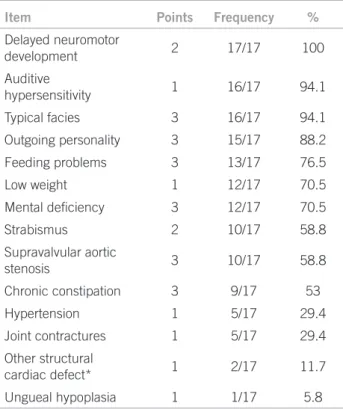
Seventeen individuals with WBS were evaluated. Diag-nosis was based on clinical criteria as shown on Table 1 and confirmed by FISH analysis (Vysis®). In fact, the Preus index is a score based on clinical observation in patients with WBS and it is an useful tool to de-termine further investigation for WBS. Typical facies were defined by the presence of periorbital fullness of subcutaneous tissues, anteverted nares, long philtrum, prominent lips, and open mouth. Individuals were considered to have the typical facies by three clinical geneticists with large experience in dysmorphology.
Outgoing personality was considered in individuals pre-senting an easy approach to strangers, a strong interest in others and a loquacious speech.
he cross-secctional study comprised the following steps: (a) identiication, brief anamnesis and karyotype with FISH, (b) clinical and nutritional evaluation with anthropometrical measures including height and weight from the subjects and parents, as well as arm circumfer-ence, triceps and subscapular skinfold thickness from the subjects.
Anthropometrical data were measured by standard methods9. Weight was measured to 0.1 kg with a digital electronic stand on scale (PL 150, Personal Line, Filizola®) and stature was measured to 0.1 cm with a stadiometer. Skinfolds were measured in triplicate by at least two trained examiners with a Lange skinfold caliper (Beta Tech Inc, Cambridge, Maryland) and arm circumference with a lexible non-stretch iberglass tape.
his article had been previously approved by the Insti-tutional Review Board of the Faculty of Medical Sciences, Universidade Estadual de Campinas (001/2004).
DATAANALYSIS
National Center for Health Statistics reference standards (NCHS)10 were used to calculate z-scores (standardized scores) for height, weight and body mass index (BMI). BMI was calculated by dividing weight (in kilograms) by height squared (in meters).
Table 1 – Main clinical findings detected in this sample based on Preus index modified by Sugayama6
Item Points Frequency %
Delayed neuromotor
development 2 17/17 100
Auditive
hypersensitivity 1 16/17 94.1
Typical facies 3 16/17 94.1
Outgoing personality 3 15/17 88.2
Feeding problems 3 13/17 76.5
Low weight 1 12/17 70.5
Mental deiciency 3 12/17 70.5
Strabismus 2 10/17 58.8
Supravalvular aortic
stenosis 3 10/17 58.8
Chronic constipation 3 9/17 53
Hypertension 1 5/17 29.4
Joint contractures 1 5/17 29.4
Other structural
cardiac defect* 1 2/17 11.7
Ungueal hypoplasia 1 1/17 5.8
Other anthropometrical data (z-scores) for triceps and subscapular skinfold thickness, arm circumference, arm muscle area, and arm fat area were calculated according to Frisancho11. Parental target range (PTR) was estimated based upon Tanner et al.12 All data were obtained with the sotware program SISCRES (provided by Moreno, AM & Marini SHVL, 2002 CIPED, FCM–UNICAMP).
STATISTICALANALYSIS
Statistics computations used he SAS System for Windows® (version 6.12; SAS Institute Inc, Cary, NC, USA). Descrip-tive data are expressed as mean ± standard deviation (SD), median, minimum and maximum values.
Wilcoxon’s test (sign rank test) for related samples was used to investigate signiicant diferences between the z-scores of the anthropometrical measures and zero.
In order to compare the stature and the BMI of Brazil-ian WBS patients with two German WBS populations13,14 z-scores were calculated based on the previously described means ± SDs and then Wilcoxon’s test was used. he sig-niicancy level was established at 0.05.
RESULTS
he sample consisted of 12 males and 5 females, with a sex ratio of 2.4:1 and ages ranging from 2.6 to 18.3 years (10.69 ± 4.19 years).
CLINICALFINDINGS
he most frequent signs were delayed neuromotor devel-opment in all cases, followed by typical facies, hyperacusia and outgoing personality in most individuals. Mental de-iciency, supravalvular aortic stenosis and strabismus were also frequent, occurring in more than 50%. On the other hand, low birth weight, hypertension, contractures and other congenital heart defects were seen in less than one third of the subjects, while nail hypoplasia was rare in this series, occurring in just one individual (Table 1).
Other reported abnormalities were recurrent pneumo-nias (6/17), recurrent otitis (2/17), and inguinal or um-bilical hernias (5/17). Hypothyroidism, cryptorchidism, obstruction of lachrymal ducts, radioulnar synostosis, and epilepsy were described in one individual each.
he nutritional features observed in the irst year of life included low birth weight (6/17), feeding problems (13/17), constipation (9/17) and poor weight gain (12/17), as shown on Table 1.
NUTRITIONALSTATUS
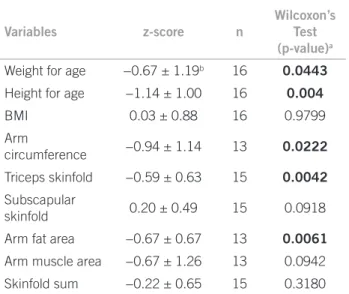
Anthropometricaldata are presented on Table 2. Regard-ing the nutritional status, four of the children were consid-ered stunted and two severely malnourished.
Some anthropometrical z-scores observed were signif-icantly lower than reference data. he z-score mean value for height was –1.14 ± 1.00 (p-value = 0.004), for weight,
‒0.67 ± 1.19 (p-value = 0.0443), for arm circumference, ‒0.94 ± 1.14 (p-value = 0.0222), for triceps skinfold thick-ness, ‒0.59 ± 0.63 (p-value = 0.0042) and for arm fat area ‒0.67 ± 0.67 (p-value = 0.0061). A signiicant de-crease in subscapular skinfold thickness (0.33 ± 0.42; p-value = 0.0078) and arm muscle area z-score values (‒1.06 ± 1.08, p-value = 0.0273) was observed when male patients were analysed separately. In relation to these pa-tients' height, thirteen of them (76.47%) were in accordance with their PTR12.
here was no diference in height (p = 0.3225) and BMI (p = 0.1046) between Brazilian and previously described German WBS patients12,13.
DISCUSSION
In this WBS population, height for age, weight for age, arm circumference, triceps skinfold thickness and arm fat area were below reference data10. Growth deficiency, which was observed in this study, occurs in 50% of the individuals with this condition4,5,15. It is mainly detected in the first few years of life4,15,16, and it is possibly re-lated to feeding difficulties, eating disorders, poor ca-loric intake, increased metabolic needs and progressive joint limitations4,15. Feeding problems were observed in 82.4%, failure to thrive in 70.6%, and constipation in 52.9%. Similar values, i.e., 71%, 81% and 43% respec-tively, were obtained from a sample of 42 patients with WBS by Morris15.
The feeding problems such as those cited below and also dental anomalies, prolonged colic and gastroesoph-ageal reflux lead to failure to thrive16,17. Part of these symptoms are also related to celiac disease, which seems
Variables z-score n
Wilcoxon’s Test
(p-value)a
Weight for age −0.67 ± 1.19b 16 0.0443
Height for age −1.14 ± 1.00 16 0.004
BMI 0.03 ± 0.88 16 0.9799
Arm
circumference −0.94 ± 1.14 13 0.0222
Triceps skinfold −0.59 ± 0.63 15 0.0042
Subscapular
skinfold 0.20 ± 0.49 15 0.0918
Arm fat area −0.67 ± 0.67 13 0.0061
Arm muscle area −0.67 ± 1.26 13 0.0942
Skinfold sum −0.22 ± 0.65 15 0.3180
BMI, body mass index (kg/m2); a p-values related to Wilcoxon’s test –
used to investigate signiicant differences (p < 0.05) between
z-scores and zero; b mean ± standard deviation.
to have a higher incidence in WBS18,19. Despite the ab-sence of the diagnosis of celiac disease in this sample, in view of the design of the present study we cannot exclude this possibility.Considering the wide spectrum of symptoms of celiac disease, and the efficacy of the dietetic treatment, the investigation of this disorder in WBS could be justified.
Although the present subjects were shorter than National Center for Health Statistics (NCHS) children, most of them (13/17; 76.5%) were found within their PTR12. Partsch et al.14, in a prospective longitudinal study in WBS, demonstrated that the adult boys’ height was correlated to their parents’ height, but the adult height of girls was only significantly correlated to their father’s height. Another study5 reports that the adult height in WBS, when compared to the target height, presented a mean deficit of 10.2 cm in female and 9.1 cm in male subjects.
These results indicate that Brazilian and German WBS patients’ mean heights are significantly similar and both are shorter than NCHS, which suggests that this feature is a consistent finding in this condition, in-dependently of the ethnic background.
The mean weight for age in this sample was signifi-cantly lower than NCHS. As mean BMI was within the normal range in this sample, weight deficit was not con-sidered a relevant finding. Similar results on BMI were observed by Kaplan et al.8 in six individuals with WBS.
Additionally, Kaplan et al.8 found, in their adoles-cents and adults sample with WBS, a similar dietary intake but a lower body fat than in healthy control sub-jects. In this paper, the authors concluded that a higher rest expenditure energy (REE) may contribute to the reduction of the total body fat stores of people with WBS. In the present study, using a different technique, we also found a reduction of the total body fat stores, but it was not possible to make the REE. Considering the lower age of the individuals involved in this study (10.69 ± 4.19 years), the high incidence of feeding prob-lems might contribute to this fact.
Decreased body fat stores (arm fat area, arm circum-ference and triceps skinfold thickness) were found in the present sample. Kaplan et al.8 by using bioelectrical impedance analysis, also reported lack of body fat in a group of six patients, when compared to control subjects.
Body composition can be estimated by skinfold thickness measurement, a low-cost, fast and standard-ized method. To the best of our knowledge, this is the first study describing skinfold thickness measurement in WBS patients. Furthermore, reference data for arm circumference, triceps and subscapular skinfold thick-ness from the general population are available. Thus, different methods could provide the same information in different populations.
CONCLUSION
Considering that both Brazilian and German WBS popu-lations showed similar stature pattern, other population studies enrolling individuals with diferent ethnic back-grounds could conirm these indings as an intrinsic feature in this condition. Similarly, additional studies of body composition using skinfold thickness could provide further information about this issue in WBS.
Nevertheless, growth deiciency on WBS could be ag-gravated due to common feeding problems during the irst ive years of life. herefore, a multiprofessional ap-proach, including early nutritional intervention and the use of concentrated formulas could be useful.
ACKNOWLEDGEMENTS
he authors wish to thank the patients, their relatives, and the Associação Brasileira de Síndrome de Williams (ABSW) in the name of its chairperson, Mrs. Juvelina Nunes, for their kind reception. his study is dedicated to her daughter. Special thanks also to Dr. Daniela Varela Luquetti and Dietitians Antonia Lenny Gomes Lazarini and Daniela Vicinansa Mônaco, for their assistance.
REFERENCES
1. Stromme P, Bjornstad PG, Ramstad K. Prevalence estimation of Williams syndrome. J Child Neurol. 2002;17(4):269-71.
2. SMM. Estudo clínico-genético e citogenética molecular pela téc-nica da hibridização in situ por fluorescência (FISH) em pacien-tes com síndrome de Williams-Beuren [thesis]. São Paulo: Uni-versidade de São Paulo; 2001.
3. Jones KL. Smith’s recognizable patterns of human malformation. 5th ed. Philadelphia: W.B. Saunders; 1997.
4. Partsch CJ, Pankau R, Blum WF, Gosch A, Wessel A. Hormonal regulation in children and adults with Williams-Beuren syn-drome. Am J Med Genet. 1994;51(3):251-7.
5. Pankau R, Partsch CJ, Gosch A, Oppermann HC, Wessel A. Statural growth in Williams-Beuren syndrome. Eur J Pediatr. 1992:151(10):751-5.
6. Preus M. The Williams syndrome: objective definition and diag-nosis. Clin Genet. 1984;25(5):422-8.
7. Síndrome de Williams-Beuren. [cited 2010 nov 10]. Available from: http://www.ncbi.nlm.nih.gov/sites/GeneTests
8. Kaplan AS, Stallings VA, Zemel BS, Green KA, Kaplan P. Body composition, energy expenditure, and energy intake in patients with Williams syndrome. J Pediatr. 1998;132(2):223-7.
9. Lohman TG. Anthropometrical Standardization Reference Man-ual. Abridged edition. Champaign: Human Kinetics Books; 1988. 10. National Center for Health Statistics. CDC growth charts: United States. [cited 2010 nov 10]. Available from: http://www.cdc.gov/ nchs/about/major/nhanes/growthcharts/datafiles.htm.
11. Frisancho AR. Anthropometric standards for the assessment of growth and nutritional status. 1st ed. Michigan: University of
Michigan Press; 1993.
12. Tanner JM, Goldstein H, Whitehouse RH. Standards for children’s height at ages 2-9 years allowing for heights of parents. Arch Dis Child. 1970;45(244):755-62.
14. Partsch CJ, Dreyer G, Gosch A, Winter M, Schneppenhein R, Wessel A, et al. Longitudinal evaluation of growth, puberty, and bone maturation in children with Williams syndrome. J Pediatr. 1999;134(1):82-9.
15. Morris CA, Demsey SA, Leonard CO, Dilts C, Blackburn BL. Natural history of Williams syndrome: physical characteristics. J Pediatr. 1988;113(2):318-26.
16. Pagon RA, Bennett FC, LaVeck B, Stewart KB, Johnson J. Williams syndrome: features in late childhood and adolescence. Pediatrics. 1987;80(1):85-91.
17. Lacroix A, Pezet M, Capel A, Bonnet D, Hennequin M, Jacob P, et al. Les syndrome de Williams-Beuren: une appproche pluridisci-plinaire. Archives de Pédiatrie. 2009;16:273-282.
18. Morris C, Mervis C Willians syndrome and related disorders. Annu Rev Genomics Genet. 2000. 1:461-84.