RUPTUREOFTHEMYOCARDIUMINAUTOPSIED MI HEARTS
REV ASSOC MED BRAS 2017; 63(9):733-735 733
IMAGE IN MEDICINE
Rupture of the myocardium in autopsied MI hearts
VALESCA BIZINOTO MONTEIRO1, BIANCA GONÇALVES SILVA TORQUATO1, GUILHERME RIBEIRO JULIANO1, BÁRBARA CECÍLIODA FONSECA1,
FLÁVIA APARECIDADE OLIVEIRA2, DANIEL FERREIRADA CUNHA3, CAMILA LOURENCINI CAVELLANI1, LUCIANO ALVES MATIASDA SILVEIRA1*,
MARA LÚCIADA FONSECA FERRAZ1, VICENTEDE PAULA ANTUNES TEIXEIRA1, EDSON LUIZ FERNANDES4
1Sector of General Pathology, Universidade Federal do Triângulo Mineiro (UFTM), Uberaba, MG, Brazil 2Sector of General Pathology, Universidade Federal de Goiás (UFG), Goiânia, GO, Brazil 3Department of Internal Medicine, UFTM, Uberaba, MG, Brazil
4In memoriam
S
UMMARYStudy conducted at Universidade Federal do Triângulo Mineiro (UFTM), Uberaba, MG, Brazil
Article received: 11/16/2016
Accepted for publication: 2/5/2017
*Correspondence:
Address: Av. Frei Paulino, 30 Uberaba, MG – Brazil Postal code: 38025-180 [email protected]
http://dx.doi.org/10.1590/1806-9282.63.09.733
Although myocardial rupture occurs in only 2% to 4% of cases of acute myo-cardial infarction (AMI), there is a high mortality rate due to acute cardio-genic shock. We present the anatomopathological findings of three cases of myocardial rupture in autopsied hearts in the last 30 years, with a diagnosis of cardiac rupture in acute myocardial infarction. In these 30 years the percentage of AMI with myocardial rupture was 0.2%. Risk factors for post-AMI myocar-dial rupture include older age, atherosclerosis, diabetes mellitus and systemic arterial hypertension.
Keywords: autopsy, cardiac rupture, cardiogenic shock, myocardial infarction.
I
NTRODUCTIONAlthough the rupture of the myocardium occurs in only 2 to 4% of the cases of acute myocardial infarction (AMI), it is associated with high mortality mainly due to the state of acute cardiogenic shock. This occurs in about 90% of the ruptures of the left ventricular free wall and in 50% of the cases with rupture of the septum, with 5 to 24% of deaths being caused by AMI.1 The
clinical/physi-cal signs and symptoms include chest pain, dyspnea, bra-dycardia and shock.2 The main risk factors for cardiac
rupture in patients not treated with thrombotic medica-tion include older age, female gender, and the concurrence of systemic arterial hypertension, smoking habit, seden-tary life style and diabetes mellitus.2
Myocardial rupture post-AMI occurs in total arterial occlusion as often as in cases with low collateral flow to the infarcted area.3 The most affected coronary arteries
are the right (46%), the left anterior descending (42%), and the left circumflex (11.53%).4 Although rupture may
involve the intraventricular septum and the papillary muscle, the free wall of the left ventricle is by far the most common.5 About 95% of cardiac ruptures occur in the
first week, with 40% of the cases within the first 24 hours post-AMI. Rupture rarely occurs after the 10th day, when
scarring has already taken place.5,6 The
anatomopatho-logical findings of three cases of rupture of the myocar-dium, as a complication of a recent AMI, are presented.
M
ETHODIn our study, three cases of myocardial rupture post-AMI were studied in individuals autopsied at the Clinical Hos-pital of the Triângulo Mineiro Federal University (Uberaba – Minas Gerais – Brazil). Our investigation includes all the cases of autopsied patients in the last 30 years, during the period from 1979 to 2009, with a diagnosis of cardiac rup-ture as a result of a recent acute myocardial infarction. The anatomopathological findings are presented, as well as the importance of carrying out the autopsies in order to con-firm the diagnosis. Our study was approved by the Research Ethics Committee of UFTM with protocol number 56433316.3.0000.5154.
R
ESULTSAutopsy indings
MONTEIRO VB ETAL.
734 REV ASSOC MED BRAS 2017; 63(9):733-735
ischemic heart disease. In the anatomopathological exam-ination, the heart weighed 310 g and the heart weight to body weight ratio was 0.57%. There had been a recent trans-mural infarction measuring about 3 cm in length in the lower third of the interventricular septum and anterior wall of the left ventricle, with rupture of the septum and conse-quent interventricular communication in the lower front portion of the septum, measuring about 1 cm in diameter. There was severe atherosclerosis in the left coronary artery and its branches, especially in the anterior descending and the circumflex branches, with a recent thrombus in the an-terior descending artery. Passive hepatic congestion (weight 1,490 g) and renal congestion (right kidney weight 140 g; left 150 g) with atherosclerosis and degenerative phenomena in the tubules were observed, as well as pulmonary (weight of the right lung 480 g; left 400 g), encephalic (weight 1,000 g) and inferior limb edema. Moderate atherosclerosis in the aorta with atheroma and fibrous plaques was also observed. Case 2: Male patient, 67 years, white, single, born in Santa Juliana (Minas Gerais), residing in Uberaba (Minas Gerais), agricultural worker, died on August 22, 1980. He presented hypertensive and ischemic heart disease. There had been a recent infarction with intracardiac thrombo-sis, affecting the lower third of the interventricular septum in its right half, apex of the left ventricle and right ven-tricle, measuring in its largest diameters about 4.5 by 3.5 cm. Rupture in the apex of the right ventricle with 0.4 cm in length and hemopericardium. Atherosclerosis was found in the left coronary, especially in the front inter-ventricular branch, calcification and recent thrombosis. The lungs were edematous.
Case 3: Male patient, 67 years, white, married, born in Ipiau (Bahia), residing in Uberaba (Minas Gerais), retired carpenter, died on August 23, 2007. The patient had dia-betes mellitus, was admitted to the emergency room in a state suggesting non-controlled asthma or chronic ob-structive lung disease. He died suddenly on the 4th day,
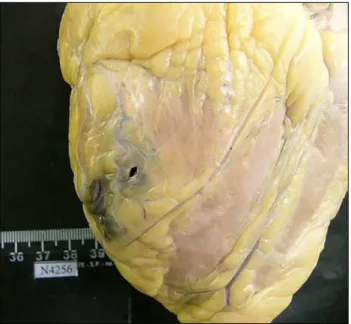
after lung function stabilization. On autopsy, hyperten-sive heart disease and ischemic heart disease were verified. There was global hypertrophy of the myocardium, espe-cially in the left ventricle, with cardiac weight of 470 g and the heart weight to body weight ratio was 0.71%. A recent infarction was observed, in accordance with the upper-posterior region of the left ventricle, next to the coronary circumflex artery, measuring about 2.0 by 1.0 cm, with a recent rupture of 0.5 cm, and consecutive hemoperi-cardium (Figure 1). There was marked atherosclerosis of the aorta, especially of the thoracic portion and its main branches. The lungs presented edema and congestion (right lung 435 g; left 494 g).
D
ISCUSSIONOur study includes all the cases of autopsied patients in the last 30 years, during the period from 1979 to 2009, with a diagnosis of cardiac rupture as a result of a recent, acute myocardial infarction. In this period, the percentage of AMI with rupture of the myocardium was 0.2%.
Risk factors for rupture of the myocardium post-AMI include older age, diabetes mellitus and systemic arte-rial hypertension. In only one case, that of the patient who developed interventricular communication, there was doubt regarding the pre-death diagnosis. Rupture of the right ventricle with hemopericardium is also rare, and, to our knowledge, has never been reported in a series of cases.5,6
Ventricular rupture post-AMI occurs in 1 to 4% of cases, and is responsible for about 5% of premature deaths after acute myocardial infarction.1 Strong suspicion and
confirmation by means of echocardiography are import-ant for the diagnosis and eventual surgical intervention, which is currently the only way of treating this condition.4-6
Although there is a worldwide trend of a lower num-ber of autopsies, this diagnostic method continues to be important as a form of quality control of the clinical di-agnosis made while the patient is alive, and the verification of the agreement of the methods. Autopsies are not only important for medical teaching, but may also help to elucidate unexpected deaths, including those of hospital-ized patients, as in the case of our series.
RUPTUREOFTHEMYOCARDIUMINAUTOPSIED MI HEARTS
REV ASSOC MED BRAS 2017; 63(9):733-735 735
A
CKNOWLEDGMENTSWe would like to thank CNPq, CAPES, FAPEMIG, and FUNEPU for their financial support.
R
ESUMORuptura do miocárdio em corações com IM autopsiados
Embora a ruptura do miocárdio ocorra em apenas 2 a 4% dos casos de infarto agudo do miocárdio (IAM), está as-sociada a alta mortalidade, principalmente em decorrên-cia do estado de choque cardiogênico agudo. São apre-sentados os achados anatomopatológicos de três casos de ruptura do miocárdio de pacientes autopsiados nos últimos 30 anos, com diagnóstico de ruptura cardíaca em decorrência de IAM. Nesse período, a porcentagem de IAM com ruptura do miocárdio foi de 0,2%. Os fatores de risco para ruptura do miocárdio pós-IAM incluem idade avançada, arteriosclerose, diabetes mellitus e
hiper-tensão arterial sistêmica.
Palavras-chave: autópsia, choque cardiogênico, infarto do miocárdio, ruptura cardíaca.
R
EFERENCES1. Figueras J, Cortadellas J, Soler-Soler J. Left ventricular free wall rupture: clinical presentation and management. Heart 2000; 83(5):499-504. 2. Birnbaum Y, Fishbein MC, Blanche C, Siegel RJ. Ventricular septal rupture
after acute myocardial infarction. N Engl J Med. 2002; 347(18):1426-32. 3. Skehan JD, Carey C, Norrel MS, de Belder M, Balcon R, Mills PG. Patterns
of coronary artery disease in post-infarction ventricular septal rupture. Br Heart J. 1989; 62(4):268-72.
4. Menon V, Webb JG, Hillis LD, Sleeper LA, Abboud R, Dzavik V, et al. Outcome and profile of ventricular septal rupture with cardiogenic shock after myocardial infarction: a report from the SHOCK Trial Registry. SHould we emergently revascularize Occluded Coronaries in cardiogenic shocK? J Am Coll Cardiol. 2000; 36(3 Suppl A):1110-6.
5. Shapira I, Isakov A, Burke M, Almog C. Cardiac rupture in patients with acute myocardial infarction. Chest. 1987; 92(2):219-23.