INFLUENCE OF GENERALIZED JOINT HYPERMOBILITY
ON TEMPOROMANDIBULAR JOINT, MASTICATION
AND DEGLUTITION: A CROSS-SECTIONAL STUDY
Influência da hipermobilidade articular generalizada
sobre a articulação teoromandibular, mastigação e deglutição:
estudo transversal
Lais Chiodelli(1), Andrielle de Bitencourt Pacheco(1), Taiane Secretti Missau(1), Ana Maria Toniolo da Silva(2), Eliane Castilhos Rodrigues Corrêa(3)
(1) Universidade Federal de Santa Maria, UFSM, Santa Maria, RS, Brasil.
(2) Departamento de Fonoaudiologia e Programa de Pós--Graduação em Distúrbios da Comunicação Humana da Universidade Federal de Santa Maria, UFSM, Santa Maria, RS, Brasil, Doutora.
(3) Departamento de Fisioterapia e Programa de Pós-Gradu-ação em Distúrbios da ComunicPós-Gradu-ação Humana da Univer-sidade Federal de Santa Maria, UFSM, Santa Maria, RS,
INTRODUCTION
Generalized joint hypermobility (GJH) is an inherited non-pathologic clinical condition; it
repre-sents an extreme variation of normal joint mobility
in most of the joints, including temporomandibular joint (TMJ)1-4.
ABSTRACT
Purpose: to evaluate the temporomandibular joint, mastication and deglutition in asymptomatic
women with and without generalized joint hypermobility and the association between these variables.
Methods: forty three volunteers were evaluated at the Speech-Language-Hearing Service of Federal
University of Santa Maria. The hypermobility was evaluated according to Beighton score and, from on the obtained scores, the volunteers were distributed into two groups: with (n=17) and without hypermobility (n=26). The temporomandibular joint was examined by Research Diagnostic Criteria for Temporomandibular Disorders and mastication and deglutition functions were assessed through myofunctionalorofacial exam. Results: the clinical evaluation of the temporomandibular joint showed
the presence of joint sounds during jaw movement (52.9%) and mouth opening deviation (76.5%) in the hypermobility group, without statistic signiicant difference. In the examination of the masticatory function, although most of the volunteers presented bilateral chewing pattern, the frequency of this pattern was signiicantly lower in the hypermobility group(p=0.05). A signiicant association (p=0.02) between the chewing and the mouth openingpatternswas veriied only in the without hypermobility group, and there was no difference between groups regarding deglutition function. Conclusion:
asymptomatic women presented evidences that the hypermobility predisposes the occurrence of mouth opening deviation and joint sounds. There was no difference in deglutition function, but it was found lower frequency of alternating bilateral chewing in the hypermobility groupcompared to without
hypermobility.
METHODS
This research is an observational,
cross-sectional controlled study with a quantitative approach. The study was part of the project
Cranio-cervical-mandibular system: diagnosis and
multi-factorial therapy. It was approved by the Research
Ethics Committee of the Federal University of Santa Maria (UFSM) under protocol number
23081.019091/2008-65, according to Resolution no. 196/1996.
The research was conducted at the Laboratory of Orofacial Motricity of the
Speech-Language-Hearing Service (SAF-UFSM) (Santa Maria, RS).
Inclusion criteria were: females, aged between 18 and 35 years, who have signed an Informed Consent Form. Exclusion criteria: tooth loss (more than two teeth - except for third molar); use of dental
prosthesis; signs of psychomotor impairment; malformations, tumors, surgery or trauma in the head and neck; prior or current speech therapy and physical therapy for orofacial motricity; symptoms of
TMJ pain, mouth breathing, and subjects who did
not complete the evaluations.
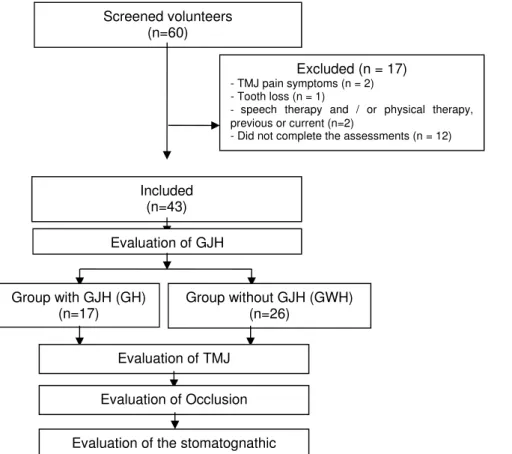
Data collection procedures occurred as shown in the low chart in Figure 1.
Women who met the inclusion criteria were
evaluated by a physical therapist and a speech
therapist, who had experience in orofacial motricity.
The physical therapist assessed the presence of GJH and TMJ, and the speech therapist performed the protocol of orofacial myofunctional assessment.
GJH was evaluated by the criteria of Carter and Wilkinson, modiied by Beighton17, comprising ive
tests, as shown in Figure 2 (Beighton Score)18.
follows that the movements of the joints are impaired in subjects with GJH, because motor coordination
depends crucially on proprioceptive feedback 1,3-6. Although there are numerous studies that
associate GJH and TMJ, there are few studies that
investigate stomatognathic functions in hypermobile individuals. It is believed that the involvement of TMJ
between hypermobile joints can affect the functions
performed by the latter, due to resulting changes in proprioception and coordination.
One of the major stomathognatic functions is
mastication, understood as a complex sensory-motor activity whereby food is crushed and ground
by means of a pattern of rhythmic movements7-12.
Aspects such as strength, time and type of mastication can be affected by changes in proprio-ception13, and changes in neuromuscular
coordi-nation may lead to mastication and deglutition disorders 7,14.
Deglutition is a complex neuromuscular action
comprising a set of coordinated motor mechanisms
whose purpose is to take intraoral contents into the
stomach 7,15. For deglutition to take place normally,
balance between the perioral, masticatory and tongue muscles is required. Any disruption of this
balance may lead to changes in deglutition16.
Knowledge of the effect of GJH on TMJ may
contribute to clinical practice, because joint insta-bility can hinder the maintenance of the results of myofunctional therapy. Given the above, the
A) passive hyperextension of ifth inger, so they are parallel to the extensor surface of the forearm; B) ability to hyperextend the knee beyond 10º; C) trunk lexion, so that the individual can place their palms on the loor without bending their knees; D) passive apposition of the thumb to the lexor surface of the forearm; E) ability to hyperextend the elbow beyond 10º.
TMJ: temporomandibular joint; GJH: Generalized joint hypermobility; GWH: Generalized group without joint hypermobility; GH: patients with generalized joint hypermobility.
Figure 1 - Flowchart of data collection
Screened volunteers (n=60)
Excluded (n = 17) - TMJ pain symptoms (n = 2) - Tooth loss (n = 1)
- speech therapy and / or physical therapy,
previous or current (n=2)
- Did not complete the assessments (n = 12)
Included (n=43)
Evaluation of GJH
Group without GJH (GWH) (n=26)
Group with GJH (GH) (n=17)
Evaluation of TMJ
Evaluation of Occlusion
the degree of agreement between the analyses was obtained by the Kappa coeficient.
The Kappa coeficient values were interpreted as no agreement (K <0), slight agreement (K = 0-0.20), fair agreement (K = 0.21 to 0.40), moderate agreement (K = 0, 41-.60), substantial agreement (K = 0.60-0.80) and almost perfect agreement (K>
0.80)21,22.
The remaining analyses were performed using software Statistica version 9.0 for Windows. Descriptive statistics were determined for all variables, and chi-square or Fisher’s exact tests were used to assess the association between: chewing pattern, presence of atypical contrac -tions during mastication and deglutition; presence of noise and mouth opening pattern, assuming a
signiicance level of 5%.
RESULTS
Forty-three volunteers met the inclusion criteria
and completed the evaluations. Twenty-six of them took part of the group without GJH (GWH) (60.5%), with a mean age and standard deviation of 23.3 ± 4.9 years; and 17 of them took part of the group with GJH (GH) (39.5%) with a mean age and standard deviation of 23.5 ± 4.4 years.
According to the assessment by the RDC/
TMD instrument, measures of range of jaw motion were within the normal range 23, and there was no
difference between groups (Table 1).
The scale ranges from zero to nine points. GJH
is observed in individuals with scores equal to or
greater than four points. Based on the scores they
had in this test, the volunteers were distributed into two groups: with GJH (GH) and without GJH (GWH).
The TMJ of the volunteers was assessed by a trained physical therapist with Axis I of the Research
Diagnostic Criteria for Temporomandibular Disorders (RDC/ TMD)19 in order to determine the
range of jaw motion and signs that could be related to GJH, such as presence of joint sounds and jaw
opening deviations.
The stomatognathic system was evaluated by
a speech therapist using the MBGR 20 protocol,
which encompasses an orofacial myofunctional
assessment. The mastication and deglutition
functions were recorded on video.
Bread rolls were offered as food for assessment of mastication. The volunteers were instructed to chew and swallow as usual, and the test was repeated three times. Then, deglutition of liquids was performed, using 200 ml of water, offered in a
transparent plastic cup.
The video recordings were analyzed by three speech therapists, and the following aspects of deglutition were taken into account: biting, crushing, chewing pattern, lip closure and atypical muscle
contractions. Analysis of deglutition focused on lip closure, lip posture, food holding behavior, atypical muscle contractions and coordination. The speech
therapists were blinded to the presence of GJH, and
The presence of joint sounds during jaw motion prevailed in GH (52.9%), compared with GWH (38.5%), but this difference was not signiicant (p = 0.56).
Table 2 shows the pattern of mouth opening evaluated in the volunteers, which showed high
prevalence of uncorrected deviation, especially in
GH, although there was no signiicant difference.
Table 1 - Mean and standard deviation of range of jaw motion in groups with and without generalized joint hypermobility
Range of motion GWH GH p
Mean (mm) SD Mean (mm) SD
Maximum unassisted opening Maximum assisted opening Right lateral excursion Left lateral excursion
Protrusion 49.5 51.5 9.4 8.9 5.8 5.5 5.5 2.2 1.8 2.0 49.9 51.7 10.5 9.0 5.8 4.3 4.5 2.2 3.1 1.9 0.50 0.62 0.21 0.64 0.95
The analysis of mastication and deglutition
showed that all volunteers presented the following
aspects: biting, crushing, lip closure, lip posture, food holding behavior and unchanged
coordi-nation. Bilateral chewing pattern predominated
in both groups, but there was a signiicantly lower frequency of this pattern in GH (p = 0.05) (Table 3). The presence of atypical muscle contractions was observed both in mastication and in deglutition, with no signiicant difference between groups (Figure 3).
Table 3 - Frequency of chewing pattern observed in the groups with and without generalized joint hypermobility
Alternating bilateral
n (%)
Simultaneous bilateral
n (%)
Unilateral preferential
n (%)
Chronic unilateral
n (%)
Total
n (%)
P
GWH GH
21 (80.8) 9 (52.9)
0 (0.0) 2 (11.8)
4 (15.4) 5 (29.4)
1 (3.8) 1 (5.9)
26 (100)
17 (100)
0.05*
GWH: Group without generalized joint hypermobility; GH: patients with generalized joint hypermobility. Chi-square test (categories were reclassiied for test purposes). * Statistically signiicant
GWH: Generalized group without joint hypermobility; GH: patients with generalized joint hypermobility * Fisher’s Exact Test.. ** Chi --square test
Table 2 - Frequency of mouth opening pattern in patients with and without generalized joint hypermobility
Straight opening n (%)
Corrected lateral deviation
n (%)
Uncorrected lateral deviation
n (%)
Total
n (%) p
GWH GH
13 (50.0) 4 (23.5)
10 (38.5)
6 (35.3) 3 (11.5)7 (41.2)
26 (100)
17 (100)
0.08
activity, force, motion, as well as time and pattern of chewing13,29,30.
As for stomatognathic functions, it is known that alternating bilateral chewing is essential for
prevention of myofunctional disorders, periodontal problems and TMD 7,10,31. In this study, although
most of the volunteers from both groups have shown this pattern, a higher and signiicant percentage of the volunteers from GH showed changes in mastication. In GWH, on the other hand, there was prevalence of alternating bilateral chewing as well as mouth opening without deviation, with signiicant association between these variables.
These results corroborate previous studies6,32, in
which hypermobile subjects had impaired proprio -ceptive feedback. Although these studies have
not investigated TMJ, it is suggested that women without GJH, in the present study, showed better
stability and neuromuscular coordination.
There was no difference between groups for the
presence of atypical contractions during mastication and deglutition. A recent study33 found that effort of
the lips and exaggerated involvement of the perioral muscles occurred more frequently in a group with TMD. This inding is corroborated by the presence of
painful symptoms. This study does not corroborate
the present research because an exclusion criterion of the study was the presence of TMJ pain.
Painful symptoms could be a confounding factor in the results, as facial pain can impair the action of
DISCUSSION
The evaluation of TMJ by the RDC/TMD
instrument showed that GJH did not inluence the range of jaw motion. However, joint sounds were present with the highest percentage in GH (52.9%). Similar results were found in a study 24 that used the
same tools to evaluate GJH and the evaluation of TMJ, namely the Beighton criteria and the RDC/ TMD, respectively.
This study24 investigated 893 subjects aged
between 20 and 60 years, 8.4% of them with GJH,
and found increased risk of cracking sounds in
hypermobile individuals (70%), although there was no TMJ pain, whether myofascial pain or arthralgia. However, other studies18,25, which also used the
Beighton criteria, found no association between
GJH and TMD.
Besides the presence of noise, deviation of mouth
opening did not differ signiicantly between groups,
but volunteers from GH had a higher percentage of uncorrected deviation. This may be indicative of disk displacement 26, and it may also result from anatomical changes such as condylar hypoplasia,
joint inlammation, lack of occlusal guides27,28, and
masticatory muscle imbalance.
Such an imbalance can occur in individuals with GJH due to joint instability associated with proprio
-ceptive deicits. The reduction of proprioception in individuals with GJH should be considered, because
it seems to affect the pattern of muscle electrical
Associations between chewing pattern,
presence of atypical contractions in mastication and deglutition, presence of noise and standard
mouth opening were analyzed. There was only one signiicant association between chewing and mouth
opening patterns in GWH (Table 4).
The kappa coeficient was used to describe the degree of agreement between the speech thera
-pists who evaluated mastication and deglutition. Such coeficient showed slight agreement (K =
0.17) for the variable atypical contractions during mastication, and fair agreement for the variables
chewing pattern (K = 0.34) and atypical contractions in deglutition (K = 0.22).
Table 4 - Association between chewing pattern and mouth opening pattern: comparison between groups with and without generalized joint hypermobility
Chewing pattern Straight opening
n (%)
Deviation on opening
n (%)
Total
n (%) p
GWH Alternating bilateral 13 (50.0) 8 (30.8) 21 (80.8) 0.02*
Other 0 (0.0) 5 (19.2) 5 (19.2)
GH Alternating bilateral 1 (5.9) 8 (47.0) 9 (52.9) 0.24
Other 3 (17.7) 5 (29.4) 8 (47.1)
asymmetry. Thus, it is suggested that these issues are investigated in future studies. These aspects, as
well as sample size, can be considered as limita -tions of this study.
The inluence of GJH on TMJ and the masticatory function justiies the importance of diagnosis and
multidisciplinary attention to this condition. Physical therapy can both prevent and treat TMD, promoting better joint stability in hypermobile individuals. Still, it is speculated that physical therapy, through the strengthening of masticatory muscles, helps maintain the results of orofacial myofunctional therapy. Further research is suggested to support the need for such treatment.
CONCLUSION
Asymptomatic women evaluated in this study showed signs that hypermobility predisposes the
occurrence of mouth opening deviation and joint
noises. There was no difference in the deglutition function, but there was a lower frequency of the alternating bilateral chewing pattern in the group with hypermobility compared with the group without
hypermobility. the masticatory muscles and hence, the
stomato-gnathic functions33.
In this study, the aspects relative to deglutition
appeared to be normal, except for the presence of atypical contractions during deglutition, which occurred in both groups, with no difference between
them. No studies, to date, have investigated
deglu-tition in patients with GJH; however, it is suggested
that atypical contractions have occurred due to an
imbalance between perioral, masticatory and tongue
muscles16, and this was not associated with GJH.
Stomatognathic functions were evaluated by three speech therapists, and the agreement between them ranged from slight to fair (K = 0.17, 0.34 and 0.22). This aspect agrees with a recent study22which
used the same protocol, and observed moderate
agreement for deglutition (K = 0.50) and almost
perfect agreement for the masticatory variables (K
= 0.94). Because it is a subjective test, the analysis
of the results obtained in myofunctional evaluation
depends on the experience and perception of each
judge; thus, training and calibration of judges is crucial.
Besides the low agreement between speech
therapist evaluations, this study did not evaluate dental occlusion and did not address aspects such as tone of masticatory muscles and facial
RESUMO
Objetivo: avaliar a articulação temporomandibular, as funções de mastigação e deglutição em mulhe-res assintomáticas com e sem hipermobilidade articular generalizada e a associação entre estas variáveis. Métodos: foram avaliadas 43 voluntárias no Serviço de Atendimento Fonoaudiológico da Universidade Federal de Santa Maria. Ahipermobilidadefoi avaliada pelo Escore de Beighton e,
a partir dos escores obtidos, as voluntárias foram distribuídas em dois grupos: com (n=17) e sem hipermobilidade (n=26). A articulação temporomandibular foi examinada pelo instrumento Critérios de Diagnóstico para Pesquisa de Desordens Temporomandibularese as funções de mastigação e deglutição foram avaliadas por meio do exame miofuncional orofacial. Resultados: a avaliação clí-nica da articulação temporomandibular demonstrou predomínio de ruídos articulares durante
movi-mentos mandibulares (52,9%) e de desvio na abertura da boca (76,5%) nas voluntárias do grupo com hipermobilidade, sem diferença signiicante entre os grupos. No exame da função mastigatória, apesar da maioria das voluntárias apresentar padrão de mastigação bilateral alternado, a frequência
desse foisigniicantemente menor no grupo com hipermobilidade (p=0,05). Foi veriicada uma asso
-ciação signiicante(p=0,02) entre o padrão de mastigação e de abertura da boca, apenas no grupo
sem hipermobilidade, e não houve diferença na deglutição entre os grupos. Conclusão:as mulheres
assintomáticas apresentaram indícios de que a hipermobilidade predispõe à ocorrência de desvio na abertura da boca e ruídos articulares. Não houve diferença na função de deglutição, porém veriicou
--se uma frequência menor de mastigação bilateral alternada no grupo com hipermobilidade em rela -ção ao sem hipermobilidade.
classe II de Angle e da desproporção esquelética
tipo classe II no aspecto miofuncional. Rev CEFAC. 2011;13(4)728-34.
16. Fernandes LFT, Kochenborger R, Woitchunas FE, Woitchunas DR. A inluência da deglutição
atípica no padrão craniofacial e na morfologia mandibular. RFO. 2010;15(1):52-7.
17. Beighton P, Solomon L, Soskolne CL. Articular
mobility in a African population. Ann Rheum Dis. 1973;(32):413-8.
18. Pasinato F, Souza JA, Corrêa ECR, Silva AMT.
Temporomandibular disorder and generalized joint hypermobility: application of diagnostic criteria. Braz. j. otorhinolaryngol, 2011;77(4):418-25.
19. Dworkin, SF, Leresche L. Research diagnostic criteria for temporomandibulardisoders: Review,
criteria, examinations and speciications,
critique. Journal of Craniomandibular Disorders. 1992;6:301-55.
20. Genaro KF, Berretin-Felix G, Rehder MIBC,
Marchesan IQ. Avaliação Miofuncional Orofacial – Protocolo MBGR. Rev CEFAC. 2009;11(2):237-55. 21. Viera AJ, Garret JM. Understanding Interobserver Agreement: The Kappa Statistic. Research Series.
2005;37(5):360-3.
22. Pacheco AB. Avaliação antroposcópica e
cefalométrica do peril e da tendência facial e
sua relação com as funções estomatognáticas [Dissertação]. Santa Maria (RS): Universidade Federal de Santa Maria; 2013.
23. Pehling J, Schiffman E, Look J, Shaefer J, Lenton P, Fricton J. Interexaminer Reliability and Clinical Validity of the Temporomandibular Index: A New Outcome Measure for Temporomandibular Disorders. J OrofacPain. 2002;16(4):296-304.
24. Hirsch C, John MT, Stang A. Association
between generalized joint hypermobility and signs
and diagnoses of temporomandibular disorders. Eur
J Oral Sci. 2008;116:525-30.
25. Sáez-Yuguero MR, Linares-Tovar E, Calvo-Guirado JL, Bermejo-Fenoll A, Rodríguez-Lozano
F. Joint hypermobility and disk displacement
conirmed by magnetic resonance imaging: A study of women with temporomandibular disorders. Oral
Surg Oral Med Oral Pathol Oral RadiolEndod.
2009;107(6):54-7.
26. Teixeira MJ, Siqueira JTT. Dores Orofaciais: diagnóstico e tratamento. São Paulo: Artes Médicas,
2012.
27. Chiodelli L, Weber P, Pasinato F, Souza JA, Corrêa ECR. Manifestações clínicas de desordem
temporomandibular e inclinação lateral da cabeça. Ter Man. 2012;10(50):383-8.
28. Figueiredo VMG, Cavalcanti AL, Farias ABL, Nascimento SR. Prevalência de sinais, sintomas
e fatores associados em portadores de disfunção
REFERENCES
Egri D, Yoshinari NH. Hipermobilidade articular
generalizada. RevBrasReumatol. 1999;39(4):231-6. 2. Marino LHC, Lamari N, Marino Júnior NW.
Hipermobilidade articular nos joelhos da criança.
ArqCiênc Saúde. 2004;11(2):2-4.
3. Cavenaghi S, Folchine ERA, Marino LHC, Lamari NM. Prevalência de hipermobilidade articular e
sintomas álgicos em trabalhadores industriais.
ArqCiênc Saúde. 2006;13(2):64-8.
4. Moraes DA, Baptista, CA, Crippa JA,
Louzada-Junior, P. Tradução e validação do The ivepartquestionnaire for identifyinghypermobility
para a língua portuguesa do Brasil.
RevBrasReumatol. 2011;51(1):53-69.
5. Grahame R. The hypermobility syndrome. Ann Rheum Dis. 1990;49:199-200.
6. Ferrell WR, Tennant N, Sturrock RD, Ashton, L, Creed G, Brydson G et al. Amelioration of
Symptoms by Enhancement of Proprioception in Patients With Joint Hypermobility Syndrome. Arthritis &Rheumatism. 2004;50(10):3323-8.
7. Marchesan IQ. Fundamentos em Fonoaudiologia: Aspectos clínicos da motricidade oral. Rio de Janeiro: Guanabara Koogan, 2005.
8. Escudeiro Santos C, Freitas O, Spadaro ACC, Mestriner-Junior W. Development of a colorimetric
system for evaluation of the masticatory eficiency. Braz Dent J. 2006;17(2):95-9.
9. van der Bilt A, Engelen L, Pereira LJ, van der Glass
HW, Abbink JH. Oral physiology and mastication.
Physiology & Behavior. 2006;89:22-7.
10. Gomes SGF, Custodio W, Moura Jufer JS, Del Bel Cury AA, Rodrigues Garcia RCM. Correlation of mastication and masticatory movements and
effect of chewing side preference. Braz Dent J.
2010;21(4):351-5.
11. Nascimento GKBO, Cunha DA, Lima LM, Moraes KJR, Pernambuco LA, Régis RMFL et al. Eletromiograia de superfície do músculo masseter
durante a mastigação: uma revisão sistemática. Rev CEFAC. 2012;14(4):725-31.
12. Ohkubo C, Morokuma M, Yoneyama Y, Matsuda
R, Lee JS. Interactions between occlusion and
human brain function activities. Journal of Oral Rehabilitation. 2013;40:119-29.
13. van der Bilt, A. Assessment of mastication
with implications for oral rehabilitation: a review.
Journalof Oral Rehabilitation. 2011;38:754-80. 14. Maciel CTV, Barbosa MH, Toldo CA, Faza
FCB, Chiappetta ALML. Disfunções Orofaciais nos
Pacientes em Tratamento Ortodôntico. Rev CEFAC.
2006;8(4)456-66.
15. Mezzomo CL, Machado PG, Pacheco AB,
31. Slavicek G, Schimmer C. Analysis of human
mastigation behavior: a new approach using planar calculations of fragmented chewing sequences. J. Stomat. Occ. Med. 2010;3(1):61-7.
32. Simpson MR. Benign Joint Hypermobility Syndrome: Evaluation, Diagnosis, and Management.
J Am Osteopath Assoc. 2006;106(9):531-6.
33. Weber P, Corrêa ECR, Bolzan GP, Ferreira FDS,
Soares JC, Silva AMT. Mastigação e deglutição em mulheres jovens com desordem temporomandibular. CoDAS. 2013;25(4):375-80.
temporomandibular. Acta. Sci. Health. Sci.
2009;31(2):159-63.
29. Pasinato F, Souza JA, Corrêa ECR, Silva AMT.
Temporomandibular disorder and generalized joint hypermobility: electromyographic analysis of the masticatory muscles. Braz J Oral Sci.
2011;10(2):146-51.
30. Gomes SGF, Custodio W, Faot F, Del BelCury
AA, Garcia RCMR. Chewing side, bite force
symmetry, and occlusal contact area of subjects
with different facial vertical patterns. Braz Oral Res. 2011;25(5):446-52.
Received on: July 07, 2014 Accepted on: September 29, 2014 Mailing address: