3 artigo 609
ORIGINAL ARTICLE
1 – Resident Physician, Irmandade da Santa Casa de Porto Alegre – ISCPA – Porto Alegre, RS, Brazil.
2 – Full Professor of Orthopedics and Traumatology, Universidade Federal de Ciências da Saúde de Porto Alegre (UFCSPA) and of the Orthopedics and Traumatology Clinic, Irmandade da Santa Casa de Porto Alegre – Porto Alegre, RS, Brazil.
3 – Professor, Universidade Federal de Ciências da Saúde de Porto Alegre – Porto Alegre, RS, Brazil.
4 – Assistant Physician, Hip Surgery Clinic, Irmandade da Santa Casa de Misericórdia de Porto Alegre – Porto Alegre, RS, Brazil. 5 – Coordinator, Physical Metallurgy Laboratory, Universidade Federal do Rio Grande do Sul – LAMEF/UFRGS – Porto Alegre, RS, Brazil.
6 – Physical Metallurgy Laboratory, Universidade Federal do Rio Grande do Sul – LAMEF/UFRGS; Master’s Degree from the Universidade Federal do Rio Grande do Sul – Porto Alegre, RS, Brazil.
7 – Master’s Degree Student in Material Sciences, Universidade Federal do Rio Grande do Sul – Porto Alegre, RS, Brazil. 8 – Assistant Physician, Hip Surgery Clinic, Irmandade da Santa Casa de Misericórdia de Porto Alegre – Porto Alegre, RS, Brazil.
Study conducted at the Physical Metallurgy Laboratory of the Universidade Federal do Rio Grande do Sul – LAMEF/UFRGS and Irmandade da Santa Casa de Misericórdia de Porto Alegre.
Correspondence: Rua Leopoldo Bier, 825/403 – Cep 90620-100, Porto Alegre, RS, Brazil – [email protected] Received for publication: 10/3/2011, accepted for publication: 2/7/2012.
comParison of Volumes occuPied by differenT inTernal
fixaTion deVices for femoral neck fracTures
Daniel Lauxen Junior1, Carlos Roberto Schwartsmann2, Marcelo Faria Silva3, Leandro de Freitas Spinelli4, Telmo Roberto Strohaecker5, Ralf Wellis de Souza6, Cinthia Gabriely Zimmer7, Leonardo Carbonera Boschin8, Ramiro Zilles Gonçalves8, Anthony Kerbes Yépez8
ABSTRACT
Objective: The objective of this paper is to measure the volume occupied by the most widely used internal fixation devices for treating femoral neck fractures, using the first 30, 40 and 50 mm of insertion of each screw as an approximation. The study aimed to observe which of these implants caused least bone aggression. Methods: Five types of cannulated screws and four types of dynamic hip screws (DHS) available on the Brazilian market were evaluated in terms of volume differences through water displacement. Results: Fixation with two cannulated screws presented significantly less volume than shown by DHS, for insertions of 30, 40 and 50 mm (p=0.01, 0.012 and 0.013,
The authors declare that there was no conflict of interest in conducting this work
This article is available online in Portuguese and English at the websites: www.rbo.org.br and www.scielo.br/rbort
Rev Bras Ortop. 2012;47(6):701-4 respectively), fixation with three screws did not show any statistically significant difference (p= 0.123, 0.08 and 0.381, respectively) and fixation with four cannulated screws presented larger volumes than shown by DHS (p=0.072, 0.161 and 0.033). Conclusions: Fixation of the femoral neck with two cannulated screws occupied less volume than DHS, with a statistically significant difference. The majority of screw combinations did not reach statistical significance, although fixation with four cannulated screws presented larger volumes on average than those occupied by DHS.
Keywords – Femoral Neck Fractures; Fractures Fixation, Internal; Hip/surgery
INTRODUCTION
Intracapsular fractures of the femoral neck correspond to approximately 50% of all hip fractures. Surgical treatment options for dislocated fractures include arthroplasty and internal fixation (the latter being the treatment of choice in younger patients). The majority of existing works do not demonstrate any great superiority between the more widely used internal fixation methods (dynamic hip screw, DHS; or multiple cannulated screws, MCS). Various meta-analyses and biomechanical works have failed to
show any difference between the two methods(1-4). It is
known that one of the main complications of surgical
treatment with these devices is avascular necrosis of
the femoral head(5).
Studies on animal models demonstrate increased blood flow in the head of the femur with the use of internal fixation, and perhaps an additional increase in this flow when the fixation device applied compression
on the fracture(6). One possible means of reducing this
702
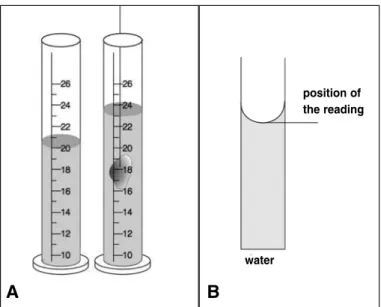
Figure 1 –(A) Representation of the system of graduated tube used to
deter-mine the volumes occupied; (B) reading position of the meniscus.
A B
Rev Bras Ortop. 2012;47(6):701-4
MATERIALS AND METHODS
Different brands of cannulated screw (MCS) and sliding screw (DHS), manufactured by three different national orthopedic materials manufacturers, were compared. The different brands were identified as A, B and C.
Given that there are different fracture lines (sub-capital, mediocervical and basocervical) and that the femoral head can vary in size, the first 30, 40 and 50 mm of each screw were arbitrarily considered, to simulate different penetration lengths of the screws inside the femoral heads. The volume occupied by the DHS was compared with that occupied by the MCS, considering two, three and four cannulated screws.
The method used to determine the volumes of the screws was difference in volume. Three measurements were performed for each volume considered, using the mean value for the purpose of the calculations. The procedure was carried out according to the following sequence: marking of the screws, considering insertion of 30, 40 and 50 mm with a GECOR-Paq-01 digital caliper, addition of water to a graduated cylinder up to a determined volume, immersion of the irregular solid to the predefined height, then determining the new volume of water in the cylinder. The volume of the solid is the difference between the final and initial volumes. Figure 1A shows the system used for the volume measurements. In this system, the volume reading should be taken from the bottom of the meniscus, as shown in Figure 1B.
The premises of variance and distributions were evaluated for the application of the mean compari-son tests. The Mann-Whitney non-parametric test was also applied, for comparison of the distributions. A level of significance of 5% was adopted for all the comparisons. The statistical calculations were carried out using the software SPSS 16.0.
RESULTS
Table 1 shows the different brands and screw sizes for the different insertion lengths (30, 40 and 50 mm) in relation to the volumes occupied. Table 2 shows the comparison between the DHS and the different screw configurations, considering the maximum and minimum volumes obtained for the screws of each manufacturer. Table 1 also shows the results of the statistical analysis of the data.
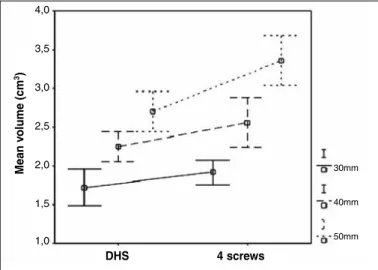
Figures 2, 3 and 4 show, in visual form, the mean values for the screw volumes, comparing DHS for two, three and four cannulated screws, respectively, observing the different insertion lengths (30, 40 and 50mm). In each case, a linear trend is observed.
In relation to the volume in cm³, it is demonstra-ted that comparison of the DHS with the volume of three cannulated screws was the only configuration in which there are no statistically significant diffe-rences; two screws occupied a smaller volume, and four screws occupied a larger volume than the DHS.
DISCUSSION
In the treatment of fractures of the femoral neck, three surgical conducts are traditionally used: internal fixation, hemiarthroplasty, and total hip arthroplasty. Osteosynthesis has the potential to offer the patient a normal hip after consolidation of the fracture.
Table 1 – Mean screw volume measurements.
Identification of the screws Volume (cm3)
30 mm 40 mm 50 mm
DHS
Brand A thread 19 1.9 2.4 2.8
Brand A thread 28 1.9 2.4 3.0
Brand B thread 25 1.7 2.2 2.6
Brand C thread 20 1.5 2.0 2.4
Cannulated screws
Brand A thread 19 0.5 0.7 0.9
Brand A thread 32 0.5 0.7 0.9
Brand B thread 32 0.5 0.7 0.9
Brand C thread 16 0.4 0.5 0.7
Brand C thread 32 0.5 0.6 0.8
position of the reading
703
Figure 2 –Comparison between the DHS and two cannulated screws.
Figure 3 –Comparison between the DHS and three cannulated screws.
Va lo r mé di o do v ol ume (cm 3) 3,5 3,0 2,5 2,0 1,5 1,0 0,5
DHS 2 screws
30mm 40mm 50mm Va lo r mé di o do v ol ume (cm 3) 3,5 3,0 2,5 2,0 1,5 1,0
DHS 3 screws
30mm
40mm
50mm
Rev Bras Ortop. 2012;47(6):701-4 COMPARISON OF VOLUMES OCCUPIED BY DIFFERENT INTERNAL FIXATIONDEVICES FOR FEMORAL NECK FRACTURES
However, it presents risks of failure and complications: pseudarthrosis, necrosis of the femoral head, etc.
Lu-Yao et al(7), in a review of 106 published studies,
concluded that the level of loss of fixation of the osteosynthesis is 16% (ranging from nine to 27%).
Tronzo(8), in a literature review, found more than 100
different implants. Currently however, for internal fixation, the choice of the majority of orthopedists is divided between the dynamic hip screw (DHS) and multiple cannulated screw (MCS).
Surprisingly, there is no randomized prospective work that compares these two methods. Neither is there a consensus on whether to use two screws, or more than two.
Krastman et al(9) concluded that for
non-disloca-ted fractures (Garden I and II), only two cannulanon-disloca-ted screws are sufficient to obtain consolidation. In the normal technique using three screws, it is recommen-ded that the screws be place perpendicular to each
other. Lagerby et al(10), analyzing 268 osteosyntheses,
concluded that the screws were correctly placed in just 151 cases (56.3%).
Parker and Blundell(3), in a meta-analysis on the
choice of synthesis material, analyzed 25 randomized studies, concluding that the majority had an insuffi-cient number of patients to enable a firm comparison
between the implants. Deneka et al(11) carried out a
biomechanical study of unstable fractures of the fe-moral neck, and reported that from a mechanical point of view, the DHS is statistically superior to three can-nulated screws in all the aspects analyzed.
Meanwhi-le, Clark et al(4) did not find differences between the
treatments. From a clinical point of view, there is a Table 2 – Comparison of the results for DHS and cannulated screws.
Size Type Minimum Maximum Mean ± SD. SEM. p
30 mm DHS 1.40 1.90 1.72 ± 0.24 0.12
0.010 2 Cannulated
screws 0.80 1.00 0.96 ± 0.09 0.04
DHS 1.40 1.90 1.72 ± 0.24 0.12
0.123 3 Cannulated
screws 1.20 1.50 1.44 ± 0.13 0.06
DHS 1.40 1.90 1.72 ± 0.24 0.12
0.072 4 Cannulated
screws 1.60 2.00 1.92 ± 0.18 0.08
40 mm DHS 2.00 2.40 2.25 ± 0.19 0.09
0.012 2 Cannulated
screws 1.00 1.40 1.28 ± 0.18 0.08
DHS 2.00 2.40 2.25 ± 0.19 0.09
0.080 3 Cannulated
screws 1.50 2.10 1.92 ± 0.27 0.12
DHS 2.00 2.40 2.25 ± 0.19 0.09
0.161 4 Cannulated
screws 2.00 2.80 2.56 ± 0.36 0.16
50 mm DHS 2.40 3.00 2.70 ± 0.26 0.13
0.013 2 Cannulated
screws 1.40 1.80 1.68 ± 0.18 0.08
DHS 2.40 3.00 2.70 ± 0.26 0.13
0.381 3 Cannulated
screws 2.10 2.70 2.52 ± 0.27 0.12
DHS 2.40 3.00 2.70 ± 0.26 0.13
0.033 4 Cannulated
screws 2.80 3.60 3.36 ± 0.36 0.16
SD = Standard deviation and SEM = Standard error of the mean.
Mean v
olume (cm
3)
Figure 4 –Comparison between the DHS and four cannulated screws.
Va lo r mé di o do v ol ume (cm 3)
DHS 4 screws
704
Rev Bras Ortop. 2012;47(6):701-4
consensus that osteosynthesis with MCS is a less in-vasive technique, with less tissue aggression, less
bleeding, and shorter hospitalization time(12-15).
Bhandari et al(16),in a study carried out among
or-thopedists, concluded that North American surge-ons tend to use cannulated screws, while European surgeons prefer DHS.
However, neither of these two methods is able to prevent the main complication associated with this fracture, which is avascular necrosis of the femoral head. This can occur in between four and
86% of cases(7,15,17-19). Therefore, all the factors that
potentially reduce the chance of osteonecrosis should be used: early surgery, anatomical reduction, stable osteosynthesis, etc. If the use of synthesis material is necessary, its use is likely to damage the debilitated circulation of the post-fracture femoral head, to a greater or lesser extent. Therefore, theoretically, a
smaller volume of intra-head synthesis material will be desirable. It was for this reason that we evaluated the volumes occupied by the DHS and the MCS in the femoral head.
CONCLUSION
There are different profiles of cannulated screws and DHS, with larger and smaller threads available on the national market. In a global comparison of all the brands and models evaluated, and in different simulations of penetration lengths of the osteosyn-thesis in the femoral head, it is observed that fixation with two cannulated screws occupies less space in the proximal fragment than the DHS, while fixation with four screws occupies more space than the DHS in the femoral head, and fixation with three screws occupies a similar volume, without statistical difference.
REFERENCES
1. Parker MJ, Stockton G. Internal fixation implants for intracapsular proximal femoral fractures in adults. Cochrane Database Syst Rev. 2001;4:CD001467. 2. Brandt E, Verdonschot N, Van Vugt A, Van Kampen A. Biomechanical analysis
of the sliding hip screw, cannulated screws and Targon(®) FN in intracapsular hip fractures in cadaver femora. Injury. 2011;42(2):183-7.
3. Parker MJ, Blundell C. Choice of implant for internal fixation of femoral neck fractures. Meta-analysis of 25 randomised trials including 4,925 patients. Acta Orthop Scand. 1998;69(2):138-43.
4. Clark DI, Crofts CE, Saleh M. Femoral neck fracture fixation. Comparison of a sliding screw with lag screws. J Bone Joint Surg Br. 1990;72(5):797-800. 5. Loizou CL, Parker MJ. Avascular necrosis after internal fixation of
intra-capsular hip fractures; a study of the outcome for 1023 patients. Injury. 2009;40(11):1143-6.
6. Swiontkowski MF, Tepic S, Rahn BA, Cordey J, Perren SM. The effect of frac-ture on femoral head blood flow. Osteonecrosis and revascularization studied in miniature swine. Acta Orthop Scand. 1993;64(2):196-202.
7. Lu-Yao GL, Keller RB, Littenberg B, Wennberg JE. Outcomes after displaced fractures of the femoral neck. A meta-analysis of one hundred and six published reports. J Bone Joint Surg Am. 1994;76(1):15-25.
8. Tronzo RG. Symposium on fractures of the hip. Special considerations in management. Orthop Clin North Am. 1974;5(3):571-83.
9. Krastman P, Van Den Bent RP, Krijnen P, Schipper IB. Two cannulated hip screws for femoral neck fractures: treatment of choice or asking for trouble? Arch Orthop Trauma Surg. 2006;126(5):297-303.
10. Lagerby M, Asplund S, Ringqvist I. Cannulated screws for fixation of femoral neck fractures. No difference between Uppsala screws and Richards screws in a randomized prospective study of 268 cases. Acta Orthop Scand. 1998;69(4):387-91.
11. Deneka DA, Simonian PT, Stankewich CJ, Eckert D, Chapman JR, Tencer AF. Biomechanical comparison of internal fixation techniques for the treatment of unstable basicervical femoral neck fractures. J Orthop Trauma. 1997;11(5):337-43. 12. Madsen JE. Treatment of displaced intracapsular hip fractures in older patients.
BMJ. 2010;340:c2810.
13. Elmerson S, Sjöstedt A, Zetterberg C. Fixation of femoral neck fracture. A randomized 2-year follow-up study of hook pins and sliding screw plate in 222 patients. Acta Orthop Scand. 1995;66(6):507-10.
14. Kuokkanen H, Korkala O, Antti-Poika I, Tolonen J, Lehtimaki MY, Silven-noinen T. Three cancellous bone screws versus a screw-angle plate in the treatment of Garden I and II fractures of the femoral neck. Acta Orthop Belg. 1991;57(1):53-7.
15. Yih-Shiunn L, Chien-Rae H, Wen-Yun L. Surgical treatment of undisplaced femoral neck fractures in the elderly. Int Orthop. 2007;31(5):677-82. 16. Bhandari M, Devereaux PJ, Swiontkowski MF, Tornetta P 3rd, Obremskey
W, Koval KJ, et al. Internal fixation compared with arthroplasty for displaced fractures of the femoral neck. A meta-analysis. J Bone Joint Surg Am. 2003;85(9):1673-81.
17. Nikopoulos KE, Papadakis SA, Kateros KT, Themistocleous GS, Vlamis JA, Papagelopoulos PJ, et al. Long-term outcome of patients with avascular ne-crosis, after internal fixation of femoral neck fractures. Injury. 2003;34(7):525-8. 18. Blomfeldt R, Törnkvist H, Ponzer S, Söderqvist A, Tidermark J. Comparison of
internal fixation with total hip replacement for displaced femoral neck fractures. Randomized, controlled trial performed at four years. J Bone Joint Surg Am. 2005;87(8):1680-8.