ORIGINAL ARTICLE
Clinical characteristics and influence of childhood trauma
on the prodrome of bipolar disorder
Mariane N. Noto,
1,2Cristiano Noto,
1,2Andre´ C. Caribe´,
3A
ˆ ngela Miranda-Scippa,
3Sandra O. Nunes,
4Ana C. Chaves,
5Denise Amino,
6Rodrigo Grassi-Oliveira,
7Christoph U. Correll,
8-11Elisa Brietzke
1,2 1Program for Recognition and Intervention in Individuals in At-Risk Mental States (PRISMA), Department of Psychiatry, Universidade Federalde Sa˜o Paulo (UNIFESP), Sa˜o Paulo, SP, Brazil.2Interdisciplinary Laboratory of Clinical Neurosciences (LINC), Department of Psychiatry, UNIFESP, Sa˜o Paulo, SP, Brazil.3Program of Mood and Anxiety Disorders (CETHA), Universidade Federal da Bahia (UFBA), Salvador, BA, Brazil.4Department of Clinical Medicine, Health Sciences Center, Universidade Estadual de Londrina (UEL), Londrina, PR, Brazil.5First Psychotic Episode Program, Department of Psychiatry, UNIFESP, Sa˜o Paulo, SP, Brazil.6Ambulato´rio Me´dico de Especialidades (AME) Dra. Jandira Masur, Sa˜o Paulo, SP, Brazil.7Developmental Cognitive Neuroscience Research Group (GNCD), Center of Studies and Research in
Trauma and Stress (NEPTE), Biomedical Research Institute (IPB), Pontificia Universidade Cato´lica do Rio Grande do Sul (PUCRS), Porto Alegre, RS, Brazil.8The Zucker Hillside Hospital, Psychiatry Research, North Shore - Long Island Jewish Health System, Glen Oaks, NY, USA. 9Albert Einstein College of Medicine, Bronx, NY, USA.10The Feinstein Institute for Medical Research, Manhasset, NY, USA.11Hofstra North
Shore LIJ School of Medicine, Hempstead, NY, USA.
Objectives:To describe the onset pattern, frequency, and severity of the signs and symptoms of the prodrome of the first hypomanic/manic episode and first depressive episode of bipolar disorder (BD) and to investigate the influence of a history of childhood maltreatment on the expression of prodromal symptoms.
Methods: Using a semi-structured interview, the Bipolar Prodrome Symptom Scale-Retrospective (BPSS-R), information regarding prodromal symptoms was assessed from patients with a DSM-IV diagnosis of BD. History of childhood maltreatment was evaluated using the Childhood Trauma Questionnaire (CTQ).
Results:Forty-three individuals with stable BD were included. On average, the prodrome of mania lasted 35.8668.7 months and was predominantly subacute or insidious, with rare acute presentations. The prodrome of depression lasted 16.6623.3 months and was also predominantly subacute or insidious, with few acute presentations. The prodromal symptoms most frequently reported prior to the first hypomanic or manic episode were mood lability, depressive mood, and impatience. A history of childhood abuse and neglect was reported by 81.4% of participants. Presence of childhood maltreatment was positively associated with prodromal symptoms, including social withdrawal, decreased functioning, and anhedonia.
Conclusions: This study provides evidence of a long-lasting, symptomatic prodrome prior to first hypomanic/manic and depressive episode in BD and suggests that a history of childhood maltreatment influences the manifestations of this prodrome.
Keywords: Bipolar disorder; mania; prodrome; childhood maltreatment; depression; early stages
Introduction
Bipolar disorder (BD) is a chronic and often severe mood disorder.1 In a large subgroup of patients, BD follows a progressive course, which can lead to structural brain damage and functional impairment.2 In recent years, staging models for BD have been proposed.3,4(A detailed
review is available elsewhere.5) According to these models, the disorder starts in the ‘‘at-risk period’’ and progresses from the first episode to chronic and, possibly, refractory stages, putatively caused by neurobiological alterations such as an increase in neurotoxic states and reduction of neurotrophic and neuroprotective factors.6,7
The progression of BD results in deterioration of clinical symptoms, cognition, and functioning, and leads to structural damage. From this perspective, prevention of BD and its early diagnosis and treatment are paramount to reducing the major economic, psychosocial, and functional impact of this disorder by delaying its onset or, perhaps, even preventing its full-blown development.8,9
Clinical experience and retrospective studies have reported that the majority of individuals with BD experience mild but identifiable symptoms during childhood and adoles-cence.10-12The symptomatic period preceding the first manic or hypomanic episode, also called the prodrome, lasts from several weeks up to many years before full BD onset,3,13and often includes sub-threshold manic symptoms, depressive symptoms, cyclothymic features, anxiety, sleep disturbances, psychotic symptoms, ADHD-like symptoms, and obsessive-compulsive symptoms.13,14A systematic review reported that irritability, aggression, sleep disorders, hyperactivity, anxiety,
Correspondence: Elisa Brietzke, Rua Pedro de Toledo, 669, 3rd floor, Vila Clementino, Sa˜o Paulo, SP, Brazil.
E-mail: [email protected]
Submitted Dec 17 2014, accepted Jan 13 2015. Associac¸a˜o Brasileira de Psiquiatria
and mood swings are common symptoms in the early phase of the BD prodrome (also called the ‘‘distal’’ prodrome).15,16 Over time, psychopathology progresses and symptoms usually became more specific and similar to those of full BD; this is called the ‘‘proximal’’ prodrome.15 A 4-year,
prospective study found that 38% of children and adolescents initially diagnosed with subsyndromal BD symptoms, and 25% of those diagnosed with BD-II, transitioned to BD-I during follow-up.17 Nevertheless, few studies have investi-gated clinical expression of the bipolar prodrome, and the vast majority of these used either unstructured questionnaires or chart-review designs. Most failed to assess the onset pattern of the disorder and symptom severity in the prodromal period.
The majority of published studies that investigated the prodromal features of BD focused on patients with BD-I.15 Although some included patients with BD-II, there is a lack of investigations focusing on prodromal symptoms in this population. One study that evaluated the prodromal period in individuals with BD-II found that they experi-enced clinically significant symptoms (predominantly depressive symptoms and anxiety) at an average of more than a decade before their first major mood episode.18 Most studies combined data from the two subtypes of BD,19 thus precluding any assessment of potential differences between them. However, identifying differ-ences in the characteristics of the prodromal period of the two BD subtypes may be useful from a prognostic perspective and to better understand the neurobiology of BD.
Environmental factors, such as childhood trauma, may influence the expression of symptoms in BD,20as well as the prodromal features of the disorder. Patients with BD exhibit higher vulnerability to traumatic events during childhood.21 In addition, BD seems to be a stress-sensitive disorder, with the first mood episode often being triggered by psychosocial stressors.21,22 Childhood
trauma also appears to impact the course of the illness, being associated with earlier illness onset, an increased number of comorbidities, and suicidal behavior.20,23 Although childhood trauma is assumed to have an important role in the early expression of symptoms in BD, to the best of our knowledge, no studies that investigated the prodromal period of this disorder have systematically evaluated the presence of childhood trauma or its influence on the prodromal manifestations of BD.
Therefore, the aim of this study was to describe the onset pattern, frequency, and severity of the signs and symptoms of the prodrome to the first depressive and the first hypomanic or manic episode of BD, using a semi-structured interview (the Bipolar Prodrome Symptom Scale-Retrospective, BPSS-R), and to compare the prodromal features of BD-I with those of BD-II. Further-more, we sought to explore the influence of demographic and clinical variables, including history of childhood maltreatment, on the expression of prodromal symptoms. We hypothesized that: a) the prodrome to the first depressive episode would be longer than the prodrome to the first manic episode; b) there would be no significant differences between BD-I and BD-II regarding the depressive
prodrome, but the hypomanic/manic prodrome would be shorter and more symptomatic in patients with BD-I; and c) a history of childhood trauma would be associated with a greater frequency of certain prodromal symptoms, as well as with a longer prodrome duration.
Methods
This study protocol was approved by the Ethics Commit-tee of Universidade Federal de Sa˜o Paulo (UNIFESP), Sa˜o Paulo, Brazil, and all individuals provided written informed consent before inclusion.
Population
Forty-three stable outpatients with BD-I or BD-II of no longer than 9 years’ duration were included. The diagnosis was established in accordance with the DSM-IV criteria, using the Structured Clinical Interview for DSM-IV Axis I Disorders (SCID-I). Clinical stability was defined as a 17-item Hamilton Depression Rating Scale (HDRS) score o 14 and a Young Mania Rating Scale (YMRS) scoreo8. The exclusion criteria were presence of neurological/organic disease, inferred mental retarda-tion, illiteracy, dementia, and current moderate or severe mood symptoms (see above).
Outcomes
The primary outcome measures were the duration of the prodrome before the first manic episode, the duration of the prodrome before the first depressive episode, and the frequency of specific prodromal symptoms. The second-ary outcomes were the frequency of childhood trauma and its relationship to prodromal patterns, as well as the influence of BD subtype (BD-I vs. BD-II) on prodromal patterns.
Assessment instruments
insidious (4 1 year in duration).11 Prodromal symptoms that emerged prior to the first depressive or manic/ hypomanic episode were systematically investigated through retrospective patient reports.
Childhood maltreatment was assessed using a translated and validated version of the Childhood Trauma Questionnaire (CTQ).26,27 This is a self-report instrument used to document history of childhood maltreatment in five domains: sexual abuse, physical abuse, emotional abuse, emotional neglect, and physi-cal neglect. The instrument consists of 28 questions and the severity of trauma is graded on a five-point Likert-type scale, from absent to severe. Childhood trauma is classified as none, low, moderate, or severe. For purposes of analysis, a history of trauma was classified dichotomously as absent (patients who experienced no or minimal trauma) or present (patients who experi-enced low, moderate, or severe trauma during child-hood and adolescence).
Depressive and manic symptom severity was assessed using the HDRS and YMRS28 respectively. Illness severity
was assessed using the Clinical Global Impressions-Severity
(CGI-S) scale, and global functioning, using the Global Assessment of Functioning (GAF) scale.
Statistical analysis
Data were tabulated and analyzed in SPSS version 20.0 for Mac. Descriptive statistics included mean and standard deviation or median and percentiles and percentage, as appropriate. Between-group differences (i.e., prodrome to first depressive vs. first hypomanic/manic episode; BD-I vs. BD-II; patients with vs. without childhood trauma) were analyzed using the chi-square and Student’s t test. All tests were two-tailed and statistical significance was set at p0.05. Due to the exploratory nature of the analyses, no adjustment for multiple testing was made.
Results
Clinical and demographic characteristics
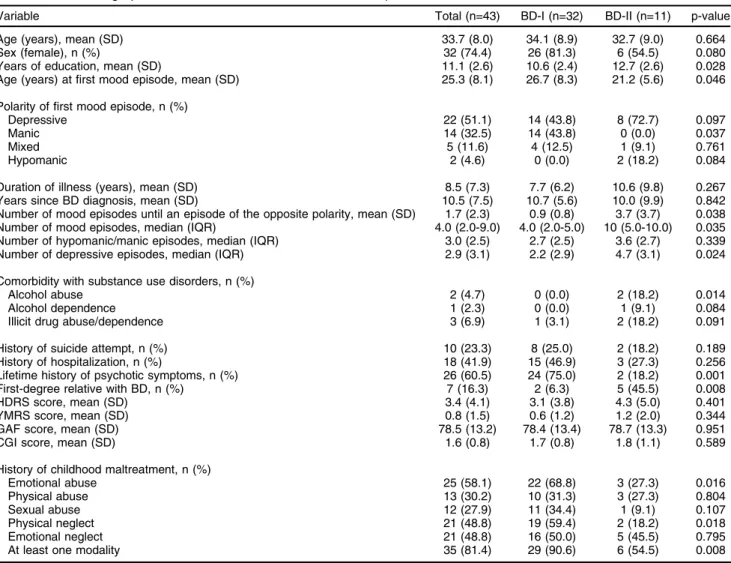
The clinical and demographic characteristics of the sample are described in Table 1. Altogether, 43 stable
Table 1 Sociodemographic and clinical characteristics of the sample
Variable Total (n=43) BD-I (n=32) BD-II (n=11) p-value
Age (years), mean (SD) 33.7 (8.0) 34.1 (8.9) 32.7 (9.0) 0.664
Sex (female), n (%) 32 (74.4) 26 (81.3) 6 (54.5) 0.080
Years of education, mean (SD) 11.1 (2.6) 10.6 (2.4) 12.7 (2.6) 0.028
Age (years) at first mood episode, mean (SD) 25.3 (8.1) 26.7 (8.3) 21.2 (5.6) 0.046
Polarity of first mood episode, n (%)
Depressive 22 (51.1) 14 (43.8) 8 (72.7) 0.097
Manic 14 (32.5) 14 (43.8) 0 (0.0) 0.037
Mixed 5 (11.6) 4 (12.5) 1 (9.1) 0.761
Hypomanic 2 (4.6) 0 (0.0) 2 (18.2) 0.084
Duration of illness (years), mean (SD) 8.5 (7.3) 7.7 (6.2) 10.6 (9.8) 0.267
Years since BD diagnosis, mean (SD) 10.5 (7.5) 10.7 (5.6) 10.0 (9.9) 0.842
Number of mood episodes until an episode of the opposite polarity, mean (SD) 1.7 (2.3) 0.9 (0.8) 3.7 (3.7) 0.038 Number of mood episodes, median (IQR) 4.0 (2.0-9.0) 4.0 (2.0-5.0) 10 (5.0-10.0) 0.035 Number of hypomanic/manic episodes, median (IQR) 3.0 (2.5) 2.7 (2.5) 3.6 (2.7) 0.339
Number of depressive episodes, median (IQR) 2.9 (3.1) 2.2 (2.9) 4.7 (3.1) 0.024
Comorbidity with substance use disorders, n (%)
Alcohol abuse 2 (4.7) 0 (0.0) 2 (18.2) 0.014
Alcohol dependence 1 (2.3) 0 (0.0) 1 (9.1) 0.084
Illicit drug abuse/dependence 3 (6.9) 1 (3.1) 2 (18.2) 0.091
History of suicide attempt, n (%) 10 (23.3) 8 (25.0) 2 (18.2) 0.189
History of hospitalization, n (%) 18 (41.9) 15 (46.9) 3 (27.3) 0.256
Lifetime history of psychotic symptoms, n (%) 26 (60.5) 24 (75.0) 2 (18.2) 0.001
First-degree relative with BD, n (%) 7 (16.3) 2 (6.3) 5 (45.5) 0.008
HDRS score, mean (SD) 3.4 (4.1) 3.1 (3.8) 4.3 (5.0) 0.401
YMRS score, mean (SD) 0.8 (1.5) 0.6 (1.2) 1.2 (2.0) 0.344
GAF score, mean (SD) 78.5 (13.2) 78.4 (13.4) 78.7 (13.3) 0.951
CGI score, mean (SD) 1.6 (0.8) 1.7 (0.8) 1.8 (1.1) 0.589
History of childhood maltreatment, n (%)
Emotional abuse 25 (58.1) 22 (68.8) 3 (27.3) 0.016
Physical abuse 13 (30.2) 10 (31.3) 3 (27.3) 0.804
Sexual abuse 12 (27.9) 11 (34.4) 1 (9.1) 0.107
Physical neglect 21 (48.8) 19 (59.4) 2 (18.2) 0.018
Emotional neglect 21 (48.8) 16 (50.0) 5 (45.5) 0.795
At least one modality 35 (81.4) 29 (90.6) 6 (54.5) 0.008
individuals (CGI-S = 1.660.8; GAF = 78.5613.2) with BD were included. The mean age was 33.766.8 years, 74.4% were females, 74.4% had BD-I, and 25.6% had BD-II, and the mean duration of illness was 3.762.3 years. When a depressive episode was the first mood episode, the average time between first depressive episode and first manic/hypomanic episode was 10.467.5 years. The mean time since diagnosis of BD, i.e., the period between the first manic or hypomanic episode and the date of the interview, was 3.762.3 years. Altogether, 60.5% of participants had experienced psy-chotic symptoms during at least one mood episode. The median total number of mood episodes was 4.0 (inter-quartile range [IQR]: 2.0-9.0). The mean number of depressive episodes was 2.963.1, and the mean number of manic episodes was 3.062.5.
Patients experienced a mean of 1.6762.3 mood episodes between an episode of one polarity until an episode of the opposite polarity.
The clinical and demographic characteristics of partici-pants with BD type I and type II are shown in Table 1. Compared to participants with BD-II, those with BD-I were older at onset of first mood episode (p = 0.046), had higher lifetime rates of psychotic symptoms (p = 0.001), and were more likely to report childhood trauma (p = 0.008), including specific modalities of trauma such as emotional abuse (0.016) and physical neglect (p = 0.018). On the other hand, BD-II patients had a higher level of educational attainment (p = 0.028), more mood episodes (p = 0.035), more depressive episodes (p = 0.024), more mood episodes until switch to the opposite polarity (p = 0.038), a higher frequency of comorbid alcohol abuse (p = 0.014), and a higher frequency of positive family history of BD (p = 0.008) compared with BD-I patients.
Duration, onset pattern, and prevalence of prodromal features prior to first hypomanic/manic vs. first depressive episode
All participants reported prodromal symptoms. On aver-age, the mania prodrome lasted 35.8668.7 months and was predominantly subacute (60.5%) or insidious (32.6%); an acute pattern (o1 month) occurred in only 7.0% of participants. The depression prodrome lasted 16.6623.3 months on average, and was also predomi-nantly subacute (66.6%) or insidious (29.6%); acute presentations were even more rare (3.8%).
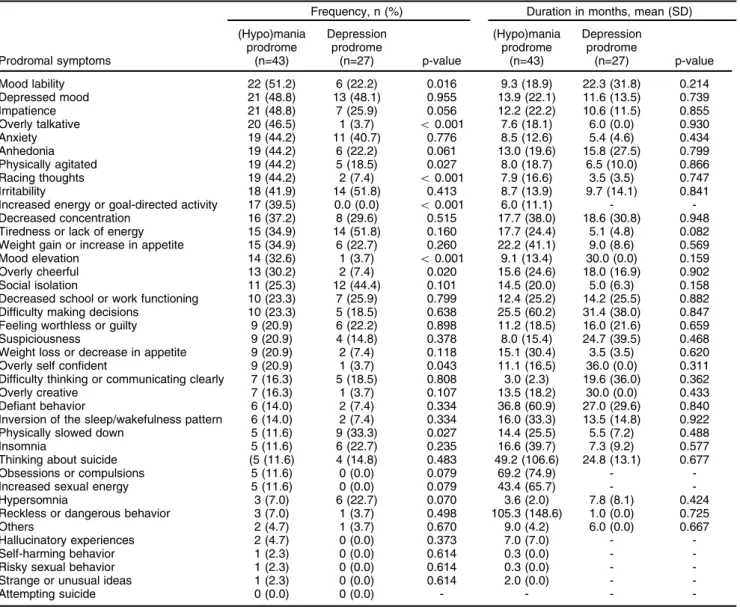
The most prevalent specific prodromal signs and symptoms are described in Table 2. The prodromal symptoms most frequently reported prior to the first hypomanic or manic episode were mood lability (51.2%), depressive mood (48.8%), and impatience (48.8%). Those most frequently reported prior to the first depres-sive episode were irritability (51.8%), tiredness or lack of energy (51.8%), and depressed mood (48.1%).
Participants experienced significant differences in the frequency of specific prodromal symptoms prior to the first hypomanic/manic and depressive episode, as shown in Table 2. Compared to the prodrome of the first depressive episode, the following symptoms were more common during the hypomania/mania prodrome: mood lability
(p = 0.016), feeling overly talkative (p o0.01), physical agitation (p = 0.02), racing thoughts (po0.01), increased energy (p o 0.01), mood elevation (p o 0.01), being overly cheerful (po0.01), and overly self-confident (po 0.01). Conversely, feeling physically slowed down (p = 0.02) was more common during the depressive prodrome. The duration of specific prodromal symptoms was similar during the depressive and the hypomanic/manic prodrome.
Duration and prevalence of prodromal features prior to first hypomanic/manic episode and first depressive episode in patients with BD type I vs. BD type II
The frequency and duration of prodromal symptoms to the first depressive and the first hypomanic/manic episode in patients with BD-I (n=32) and BD-II (n=11) are shown in Tables 3 and 4, respectively.
The duration of the depressive (p = 0.080) and hypomanic/manic (p = 0.674) prodromes was similar in patients with BD-I and BD-II. In patients with BD type I, the depressive prodrome lasted 9.88617.04 months and the hypomanic/manic prodrome lasted 33.26663.06 months, on average; in those with BD type II, the depressive prodrome lasted 31.87629.43 months, and the hypomanic/manic prodrome lasted 43.54686.35 months. Among specific prodromal symptoms, only suspiciousness differed significantly in terms of duration between the two groups, lasting longer in the depressive prodrome of BD-II compared to BD-I patients (p = 0.001). In BD type I patients, the prodromal symptoms most frequently reported prior to the first hypomanic/manic episode were mood lability (56.3%), impatience (51.3%), and insomnia (51.3%). The prodromal symptoms most frequently reported prior to the first depressive episode were depressed mood (28.1%), irritability (28.1%), and tiredness or lack of energy (28.1%).
In BD type II patients, the prodromal symptoms most frequently reported prior to the first hypomanic/manic episode were depressed mood (54.5%) and anxiety (45.4%), whereas the prodromal symptoms most fre-quently reported prior to the first depressive episode were irritability (45.5%) and tiredness or lack of energy (45.5%).
The only symptom that differed between the two groups was feeling guilty or worthless, which was more frequent in the depressive prodrome of BD-II compared to BD-I (p = 0.033).
Duration and prevalence of prodromal features in BD patients with and without a relevant history of childhood maltreatment
two groups (p = 0.68), while the prodrome to first hypomanic/manic episode was significantly longer (p = 0.04) in individuals with a history of childhood trauma.
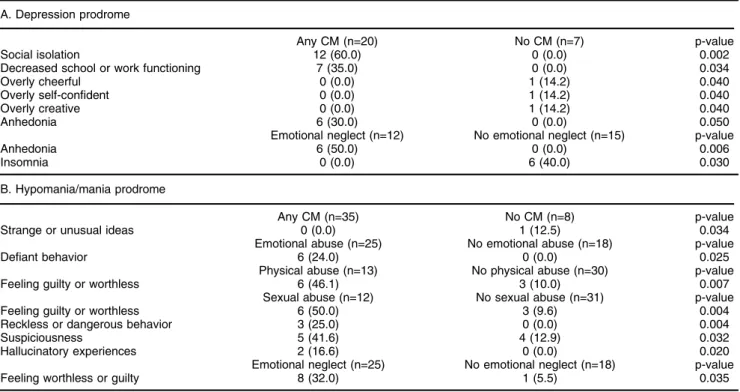
Participants with a history of childhood maltreatment had higher rates of specific prodromal symptoms preced-ing the first depressive episode compared with the group who did not report these experiences (Table 5). These symptoms included social isolation (p = 0.002), decrease in functioning (p = 0.03), and anhedonia (p = 0.05). On the other hand, individuals who did not experience trauma during childhood were more likely to report symptoms such as excessive cheerfulness or happiness (p = 0.04), feeling excessive self-confidence (p = 0.04), and increased creativity (p = 0.04) preceding the first depressive episode.
Experiencing emotional neglect during childhood was associated with increased frequencies of anhedonia (p = 0.006) and difficulty making decisions (p = 0.01) during the prodrome to the first depressive episode. Conversely,
not experiencing emotional neglect was related to more frequent insomnia (p = 0.03) in the prodrome to the first depressive episode. Regarding the first hypomanic/manic episode, strange or unusual ideas were more common as a prodromal feature in participants who had not experi-enced trauma during childhood (p = 0.034).
Individuals who reported having experienced emotional abuse in childhood reported higher rates of oppositional behavior (p = 0.02) as a part of the prodrome to the first hypomanic/manic episode than did individuals with no such history. Experiencing sexual abuse during childhood was associated with an increased frequency of several specific prodromal symptoms prior to the first hypomanic/ manic episode, including feeling guilty or worthless (p = 0.004), dangerous or reckless behavior (p = 0.004), suspiciousness (p = 0.032), and hallucinatory experiences (p = 0.02). Individuals who experienced physical abuse during childhood reported feeling worthless or guilty (p = 0.007) more often in the prodrome of the first hypomanic/ Table 2 Frequency and duration of symptoms occurring during the prodrome to first depressive vs. first hypomanic or manic episode
Frequency, n (%) Duration in months, mean (SD)
Prodromal symptoms
(Hypo)mania prodrome
(n=43)
Depression prodrome
(n=27) p-value
(Hypo)mania prodrome
(n=43)
Depression prodrome
(n=27) p-value
Mood lability 22 (51.2) 6 (22.2) 0.016 9.3 (18.9) 22.3 (31.8) 0.214
Depressed mood 21 (48.8) 13 (48.1) 0.955 13.9 (22.1) 11.6 (13.5) 0.739
Impatience 21 (48.8) 7 (25.9) 0.056 12.2 (22.2) 10.6 (11.5) 0.855
Overly talkative 20 (46.5) 1 (3.7) o0.001 7.6 (18.1) 6.0 (0.0) 0.930
Anxiety 19 (44.2) 11 (40.7) 0.776 8.5 (12.6) 5.4 (4.6) 0.434
Anhedonia 19 (44.2) 6 (22.2) 0.061 13.0 (19.6) 15.8 (27.5) 0.799
Physically agitated 19 (44.2) 5 (18.5) 0.027 8.0 (18.7) 6.5 (10.0) 0.866
Racing thoughts 19 (44.2) 2 (7.4) o0.001 7.9 (16.6) 3.5 (3.5) 0.747
Irritability 18 (41.9) 14 (51.8) 0.413 8.7 (13.9) 9.7 (14.1) 0.841
Increased energy or goal-directed activity 17 (39.5) 0.0 (0.0) o0.001 6.0 (11.1) -
-Decreased concentration 16 (37.2) 8 (29.6) 0.515 17.7 (38.0) 18.6 (30.8) 0.948
Tiredness or lack of energy 15 (34.9) 14 (51.8) 0.160 17.7 (24.4) 5.1 (4.8) 0.082
Weight gain or increase in appetite 15 (34.9) 6 (22.7) 0.260 22.2 (41.1) 9.0 (8.6) 0.569
Mood elevation 14 (32.6) 1 (3.7) o0.001 9.1 (13.4) 30.0 (0.0) 0.159
Overly cheerful 13 (30.2) 2 (7.4) 0.020 15.6 (24.6) 18.0 (16.9) 0.902
Social isolation 11 (25.3) 12 (44.4) 0.101 14.5 (20.0) 5.0 (6.3) 0.158
Decreased school or work functioning 10 (23.3) 7 (25.9) 0.799 12.4 (25.2) 14.2 (25.5) 0.882 Difficulty making decisions 10 (23.3) 5 (18.5) 0.638 25.5 (60.2) 31.4 (38.0) 0.847
Feeling worthless or guilty 9 (20.9) 6 (22.2) 0.898 11.2 (18.5) 16.0 (21.6) 0.659
Suspiciousness 9 (20.9) 4 (14.8) 0.378 8.0 (15.4) 24.7 (39.5) 0.468
Weight loss or decrease in appetite 9 (20.9) 2 (7.4) 0.118 15.1 (30.4) 3.5 (3.5) 0.620
Overly self confident 9 (20.9) 1 (3.7) 0.043 11.1 (16.5) 36.0 (0.0) 0.311
Difficulty thinking or communicating clearly 7 (16.3) 5 (18.5) 0.808 3.0 (2.3) 19.6 (36.0) 0.362
Overly creative 7 (16.3) 1 (3.7) 0.107 13.5 (18.2) 30.0 (0.0) 0.433
Defiant behavior 6 (14.0) 2 (7.4) 0.334 36.8 (60.9) 27.0 (29.6) 0.840
Inversion of the sleep/wakefulness pattern 6 (14.0) 2 (7.4) 0.334 16.0 (33.3) 13.5 (14.8) 0.922
Physically slowed down 5 (11.6) 9 (33.3) 0.027 14.4 (25.5) 5.5 (7.2) 0.488
Insomnia 5 (11.6) 6 (22.7) 0.235 16.6 (39.7) 7.3 (9.2) 0.577
Thinking about suicide (5 (11.6) 4 (14.8) 0.483 49.2 (106.6) 24.8 (13.1) 0.677
Obsessions or compulsions 5 (11.6) 0 (0.0) 0.079 69.2 (74.9) -
-Increased sexual energy 5 (11.6) 0 (0.0) 0.079 43.4 (65.7) -
-Hypersomnia 3 (7.0) 6 (22.7) 0.070 3.6 (2.0) 7.8 (8.1) 0.424
Reckless or dangerous behavior 3 (7.0) 1 (3.7) 0.498 105.3 (148.6) 1.0 (0.0) 0.725
Others 2 (4.7) 1 (3.7) 0.670 9.0 (4.2) 6.0 (0.0) 0.667
Hallucinatory experiences 2 (4.7) 0 (0.0) 0.373 7.0 (7.0) -
-Self-harming behavior 1 (2.3) 0 (0.0) 0.614 0.3 (0.0) -
-Risky sexual behavior 1 (2.3) 0 (0.0) 0.614 0.3 (0.0) -
-Strange or unusual ideas 1 (2.3) 0 (0.0) 0.614 2.0 (0.0) -
-Attempting suicide 0 (0.0) 0 (0.0) - - -
manic episode, as did those who reported experiences of emotional neglect during childhood (p = 0.03).
Discussion
The results of this study suggest that the experience of a symptomatic prodromal period before both the first manic and the first depressive episode is very frequent among individuals with BD. Generally, the prodrome was subacute or insidious, corroborating the findings of a previous study that systematically investigated the pro-dromal period of individuals with early-onset BD.11
This relatively long period of mild symptoms before the first mood episode and, specifically, before the first episode of mania is relevant, because it suggests a possibility of recognizing and trialing possible interven-tions to prevent or delay the first manic episode. Interpreted more conservatively, this finding suggests that individuals in putatively prodromal stages might at
least be protected from exposure to potentially deleterious interventions, such as administration of antidepressants or psychostimulants without mood-stabilizing agents. Sub-threshold manic symptoms and mood lability were reported significantly more frequently before the onset of the first manic episode than before the first depressive episode. This is in line with the preliminary definition of bipolar at risk (BAR) criteria proposed by Bechdolf et al.,29 which include cyclothymic features and depression, subsyndromal manic symptoms or depression, and genetic risk.
This was the first study to conduct a systematic evaluation and comparison of the prodromal period in patients with BD type I and those with BD type II. The characteristics, duration, and onset pattern of prodromal symptoms were similar in the two subtypes of BD. Our observations of the signs and symptoms of patients with BD-II were similar to those reported in a previous preliminary study that evaluated 15 patients with this disorder.18 While our findings could be interpreted to Table 3 Frequency and duration of symptoms occurring during the prodrome to first hypomanic/manic episode in patients with BD-I and BD-II
Frequency, n (%) Duration in months, mean (SD)
Prodromal symptoms BD-I (n=32) BD-II (n=11) p-value BD-I (n=32) BD-II (n=11) p-value
Mood lability 18 (56.3) 4 (36.4) 0.255 9.6 (20.2) 8.3 (14.4) 0.910
Impatience 17 (53.1) 4 (36.4) 0.337 9.6 (20.9) 23.5 (27.6) 0.273
Insomnia 17 (53.1) 4 (36.4) 0.337 16.7 (42.6) 16.2 (29.2) 0.982
Overly talkative 17 (53.1) 3 (27.3) 0.138 8.8 (19.5) 0.9 (0.1) 0.501
Physically agitated 16 (50.0) 3 (27.3) 0.190 9.1 (20.3) 2.0 (1.0) 0.560
Depressed mood 15 (46.9) 6 (54.5) 0.661 13.6 (22.7) 14.8 (23.0) 0.914
Racing thoughts 15 (46.9) 4 (36.4) 0.545 9.8 (20.7) 0.7 (0.4) 0.403
Increased energy or goal-directed activity 15 (46.9) 2 (18.2) 0.093 6.8 (11.7) 0.5 (0.6) 0.472
Anxiety 14 (43.8) 5 (45.5) 0.922 9.5 (14.2) 5.8 (7.1) 0.583
Irritability 14 (43.8) 4 (36.4) 0.668 8.7 (14.4) 8.7 (14.1) 0.998
Decreased concentration 12 (37.5) 4 (36.4) 0.946 17.9 (41.8) 17.0 (28.7) 0.966
Tiredness or lack of energy 12 (37.5) 3 (27.3) 0.539 14.4 (24.0) 28.0 (28.3) 0.412
Mood elevation 12 (37.5) 2 (18.2) 0.238 8.1 (12.9) 15.5 (20.5) 0.495
Overly cheerful 12 (37.5) 1 (9.1) 0.077 14.5 (25.3) 30.0 (20.5) 0.568
Anhedonia 10 (31.3) 4 (36.4) 0.755 11.3 (16.5) 17.2 (28.5) 0.631
Social isolation 9 (28.1) 2 (18.2) 0.514 10.5 (14.6) 33.0 (38.1) 0.556
Decreased school or work functioning 8 (25.0) 2 (18.2) 0.644 14.1 (28.3) 5.5 (0.7) 0.691
Decreased need for sleep 8 (25.0) 3 (27.3) 0.536 8.5 (16.0) 1.3 (0.5) 0.475
Overly self confident 7 (21.9) 2 (18.2) 0.795 9.8 (16.9) 15.5 (20.5) 0.700
Feeling worthless or guilty 7 (21.9) 2 (18.2) 0.795 5.0 (3.8) 33.0 (38.1) 0.489
Suspiciousness 7 (21.9) 2 (18.2) 0.795 10.1 (17.1) 0.8 (0.3) 0.483
Weight loss or decrease in appetite 6 (18.8) 1 (9.1) 0.454 16.7 (33.0) 6.0 (0.0) 0.775
Difficulty making decisions 6 (18.8) 4 (36.4) 0.233 9.2 (19.0) 50.0 (94.9) 0.455
Difficulty thinking or communicating clearly 6 (18.8) 1 (9.1) 0.454 3.3 (2.3) 1.0 (0.0) 0.398
Inversion of the sleep/wakefulness pattern 6 (18.8) 0 (0.0) 0.122 16.0 (33.3) -
-Overly creative 5 (15.6) 2 (18.2) 0.843 12.6 (19.9) 16.0 (19.7) 0.847
Defiant behavior 5 (15.6) 1 (9.1) 0.590 13.0 (19.7) 156.0 (0.0) 0.003
Thinking about suicide 4 (12.5) 1 (9.1) 0.761 1.5 (0.5) 240.0 (0.0) o0.001
Obsessions or compulsions 4 (12.5) 1 (9.1) 0.761 41.5 (48.7) 180.0 (0.0) 0.085
Increased sexual energy 4 (12.5) 1 (9.1) 0.761 54.0 (70.8) 1.0 (0.0) 0.551
Weight gain or increase in appetite 3 (9.4) 1 (9.1) 0.978 29.3 (47.3) 1.0 (0.0) 0.656
Physically slowed down 3 (9.4) 2 (18.2) 0.432 2.0 (1.0) 33.0 (38.1) 0.456
Reckless or dangerous behavior 3 (9.4) 0 (0.0) 0.292 105.3 (148.6) -
-Hypersomnia 2 (6.3) 1 (9.1) 0.750 2.5 (0.7) 6.0 (0.0) 0.154
Hallucinatory experiences 2 (6.3) 0 (0.0) 0.396 7.0 (7.0) -
-Others 1 (3.1) 1 (9.1) 0.418 12.0 (0.0) 6.0 (0.0)
-Self-harming behavior 1 (3.1) 0 (0.0) 0.553 0.2 (0.0) -
-Risky sexual behavior 1 (3.1) 0 (0.0) 0.553 0.3 (0.0) -
-Strange or unusual ideas 0 (0.0) 1 (9.1) 0.084 - 2.0 (0.0)
-Attempting suicide 0 (0.0) 0 (0.0) - - -
suggest that prodromal symptoms are not specific and showed no differences from a prognostic perspective of development of different subtypes of BD, these results are very preliminary, as the subgroups were very small and the study may have been underpowered to detect significance in numerically large differences.
In addition, we found that childhood trauma was associated with specific prodromal features prior to the first major mood episode. Previous studies that assessed the influence of this experience in BD reported that childhood trauma and maltreatment were highly prevalent and associated with triggering of bipolar manic and depressive episodes, as well as with a worse clinical course.23,30,31 Our data suggest that childhood maltreat-ment might be associated with different clinical character-istics even prior to the first major mood episode, i.e., in the prodromal phase. These differences may be explained by the influence of early stressors on the development of affective lability,22 suggesting that, in
patients with a greater burden of adverse environmental
factors, the disease might be different from a more ‘‘endogenous’’ type. Alternatively, one may postulate that those symptoms are part of a trauma-related psycho-pathology and might be found in similar rates in individuals with a history of childhood maltreatment without BD. In fact, previous studies found that experien-cing trauma during childhood is related to specific psychiatric symptoms.32 Therefore, the expression of psychopathology, including before the first mood episode, may be influenced by adverse childhood experiences.
Certain limitations need to be taken into account when interpreting the results of this study. Due to its retro-spective design, patients had to remember symptoms that were at least moderate and that might have occurred years before the interview, and a recall bias has to be taken into account. In addition, the occurrence of depressive symptoms before the first manic/hypomanic episode could be considered both as a marker of syndromal progression and as a prodromal manifestation of BD, depending on severity. Moreover, the small sample Table 4 Frequency and duration of symptoms occurring during the prodrome to first depressive episode in patients with BD-I and BD-II
Frequency, n (%) Duration in months, mean (SD)
Prodromal symptoms BD-I (n=32) BD- II (n=11) p-value BD-I (n=32) BD-II (n=11) p-value
Irritability 9 (28.1) 5 (45.5) 0.305 5.5 (7.3) 17.4 (20.8) 0.276
Tiredness or lack of energy 9 (28.1) 5 (45.5) 0.305 3.6 (2.3) 7.8 (7.1) 0.271
Depressed mood 9 (28.1) 4 (36.4) 0.305 8.1 (9.2) 19.5 (19.8) 0.175
Social isolation 8 (25.0) 4 (36.4) 0.318 6.2 (7.4) 2.7 (2.3) 0.392
Anxiety 8 (25.0) 3 (27.3) 0.266 4.0 (2.2) 9.0 (7.9) 0.394
Physically slowed down 6 (18.8) 3 (27.3) 0.318 7.0 (8.5) 2.6 (2.8) 0.436
Impatience 6 (18.8) 1 (9.1) 0.055 7.4 (8.4) 30.0 (0.0) 0.057
Decreased school or work functioning 6 (18.8) 1 (9.1) 0.129 15.6 (27.6) 6.0 (0.0) 0.759
Insomnia 5 (15.6) 1 (9.1) 0.181 8.6 (9.7) 1.0 (0.0) 0.514
Physically agitated 5 (15.6) 0 (0.0) 0.053 6.5 (10.0) -
-Decreased concentration 4 (12.5) 4 (36.4) 0.139 2.6 (2.4) 34.7 (39.0) 0.198
Hypersomnia 4 (12.5) 2 (18.2) 0.318 9.7 (9.6) 4.0 (2.8) 0.475
Difficulty thinking or communicating clearly 4 (12.5) 1 (9.1) 0.239 3.5 (2.8) 84.0 (0.0) 0.000
Thinking about suicide 4 (12.5) 0 (0.0) 0.081 24.8 (33.1) -
-Mood liability 3 (9.4) 3 (27.3) 0.181 6.0 (0.0) 38.6 (41.6) 0.246
Anhedonia 3 (9.4) 3 (27.3) 0.181 5.0 (1.7) 26.6 (39.3) 0.394
Weight gain or increase in appetite 3 (9.4) 2 (18.2) 0.296 12.0 (10.3) 4.5 (3.5) 0.416
Suspiciousness 3 (9.4) 1 (9.1) 0.292 5.0 (1.7) 84.0 (0.0) 0.001
Feeling worthless or guilty 2 (6.3) 4 (36.4) 0.033 6.0 (0.0) 21.0 (26.1) 0.487
Difficulty making decisions 2 (6.3) 3 (27.3) 0.101 3.5 (3.5) 50.0 (39.9) 0.217
Racing thoughts 2 (6.3) 0 (0.0) 0.169 3.5 (3.5) -
-Inversion of the sleep/wakefulness pattern 2 (6.3) 0 (0.0) 0.169 13.5 (14.8) -
-Hallucinatory experiences 2 (6.3) 0 (0.0) 0.130 - -
-Reckless or dangerous behavior 1 (3.1) 0 (0.0) 0.235 36.0 (0.0) -
-Defiant behavior 1 (3.1) 1 (9.1) 0.272 6.0 (0.0) 48.0 (0.0)
-Weight loss or decrease in appetite 1 (3.1) 1 (9.1) 0.272 1.0 (0.0) 6.0 (0.0)
-Decreased need for sleep 1 (3.1) 1 (9.1) 0.272 1.0 (0.0) 1.0 (0.0)
-Overly cheerful 1 (3.1) 1 (9.1) 0.272 6.0 (0.0) 30.0 (0.0)
-Overly talkative 1 (3.1) 0 (0.0) 0.235 6.0 (0.0) -
-Mood elevation 0 (0.0) 1 (9.1) 0.095 - 30.0 (0.0)
-Overly self confident 0 (0.0) 1 (9.1) 0.095 - 30.0 (0.0)
-Overly creative 0 (0.0) 1 (9.1) 0.095 - 30.0 (0.0)
-Others 0 (0.0) 1 (9.1) 0.095 - 6.0 (0.0)
-Self-harming behavior 0 (0.0) 0 (0.0) 0.130 - -
-Risky sexual behavior 0 (0.0) 0 (0.0) 0.130 - -
-Strange or unusual ideas 0 (0.0) 0 (0.0) 0.130 - -
-Attempting suicide 0 (0.0) 0 (0.0) 0.130 - -
-Obsessions or compulsions 0 (0.0) 0 (0.0) 0.130 - -
-Increased sexual energy 0 (0.0) 0 (0.0) 0.130 - -
-Increased energy or goal-directed activity 0 (0.0) 0 (0.0) 0.130 - -
size may limit the generalization of findings, and certainly reduced statistical power for our comparison between subgroups. As this is an exploratory analysis, we chose not to correct for multiple comparisons, as done by Zeschel et al.33To minimize the limitation posed by recall bias, we included only individuals who were clinically stable at the time of the study and limited the duration of illness top9 years. In addition, we assessed prodromal symptoms using a highly detailed instrument, which made it possible to differentiate traits and personality from emerging symptoms and to evaluate the severity and interference with functioning of each of the reported prodromal symptoms. Nevertheless, this was the first study to compared the prodromes of BD type I and BD type II. The similarities between their manifestations suggest an overlap of symptomatology in the early stages of both BD subtypes, with definitive differentiation only after the first manic episode. In addition, we utilized a highly reliable instrument to evaluate the history of childhood maltreatment. Although the CTQ does not assess all types of traumatic experiences that may occur during childhood and adolescence (e.g., it does not cover exposure to violence or natural disasters), it is a valid instrument to detect different modalities of abuse and neglect which are robust markers of environmental toxicity.
In summary, this study investigated the BD prodrome using a semi-structured interview, and, to our knowledge, was the first to analyze childhood trauma and its influence on the presentation of prodromal symptoms. Our results
provide evidence of a long-lasting, symptomatic prodrome in BD and suggest an influence of clinical and environ-mental variables on the expression of symptoms. This should prompt increased efforts into early recognition of BD and development of low-risk preventive interventions.
Disclosure
The authors report no conflicts of interest.
References
1 Post RM, Denicoff KD, Leverich GS, Altshuler LL, Frye MA, Suppes TM, et al. Morbidity in 258 bipolar outpatients followed for 1 year with daily prospective ratings on the NIMH life chart method. J Clin Pychiatry.2003;64:680-90; quiz 738-9.
2 Kapczinski F, Vieta E, Andreazza AC, Frey BN, Gomes FA, Tramontina J, et al. Allostatic load in bipolar disorder: implications for pathophysiology and treatment. Neurosci Biobehav Rev. 2008; 32:675-92.
3 Berk M, Conus P, Lucas N, Hallam K, Malhi GS, Dodd S, et al. Setting the stage: from prodrome to treatment resistance in bipolar disorder. Bipolar Disord. 2007;9:671-8.
4 Kapczinski F, Dias VV, Kauer-Sant’Anna M, Frey BN, Grassi-Oliveira R, Colom F, et al. Clinical implications of a staging model for bipolar disorders. Expert Rev Neurother. 2009;9:957-66.
5 Scott J, Leboyer M, Hickie I, Berk M, Kapczinski F, Frank E, et al. Clinical staging in psychiatry: a cross-cutting model of diagnosis with heuristic and practical value. Br J Psychiatry. 2013;202: 243-5.
6 Berk M, Kapczinski F, Andreazza AC, Dean OM, Giorlando F, Maes M, et al. Pathways underlying neuroprogression in bipolar disorder: focus on inflammation, oxidative stress and neurotrophic factors. Neurosci Biobehav Rev. 2011;35:804-17.
Table 5 Prodromal symptoms with significantly different frequencies in patients with vs. those without a history of childhood maltreatment
A. Depression prodrome
Any CM (n=20) No CM (n=7) p-value
Social isolation 12 (60.0) 0 (0.0) 0.002
Decreased school or work functioning 7 (35.0) 0 (0.0) 0.034
Overly cheerful 0 (0.0) 1 (14.2) 0.040
Overly self-confident 0 (0.0) 1 (14.2) 0.040
Overly creative 0 (0.0) 1 (14.2) 0.040
Anhedonia 6 (30.0) 0 (0.0) 0.050
Emotional neglect (n=12) No emotional neglect (n=15) p-value
Anhedonia 6 (50.0) 0 (0.0) 0.006
Insomnia 0 (0.0) 6 (40.0) 0.030
B. Hypomania/mania prodrome
Any CM (n=35) No CM (n=8) p-value
Strange or unusual ideas 0 (0.0) 1 (12.5) 0.034
Emotional abuse (n=25) No emotional abuse (n=18) p-value
Defiant behavior 6 (24.0) 0 (0.0) 0.025
Physical abuse (n=13) No physical abuse (n=30) p-value
Feeling guilty or worthless 6 (46.1) 3 (10.0) 0.007
Sexual abuse (n=12) No sexual abuse (n=31) p-value
Feeling guilty or worthless 6 (50.0) 3 (9.6) 0.004
Reckless or dangerous behavior 3 (25.0) 0 (0.0) 0.004
Suspiciousness 5 (41.6) 4 (12.9) 0.032
Hallucinatory experiences 2 (16.6) 0 (0.0) 0.020
Emotional neglect (n=25) No emotional neglect (n=18) p-value
Feeling worthless or guilty 8 (32.0) 1 (5.5) 0.035
Data presented as n (%). CM = childhood maltreatment.
7 Brietzke E, Mansur RB, Soczynska JK, Kapczinski F, Bressan RA, McIntyre RS. Towards a multifactorial approach for prediction of bipolar disorder in at risk populations. J Affect Disord. 2012;140:82-91. 8 McGorry PD, Hickie IB, Yung AR, Pantelis C, Jackson HJ. Clinical
staging of psychiatric disorders: a heuristic framework for choosing earlier, safer and more effective interventions. Aust N Z J Psychiatry. 2006;40:616-22.
9 Taylor M, Bressan RA, Pan Neto P, Brietzke E. Early intervention for bipolar disorder: current imperatives, future directions. Rev Bras Psiquiatr. 2011;33:s197-212.
10 Conus P, Ward J, Hallam KT, Lucas N, Macneil C, McGorry PD, et al. The proximal prodrome to first episode mania–a new target for early intervention. Bipolar Disord. 2008;10:555-65.
11 Correll CU, Penzner JB, Frederickson AM, Richter JJ, Auther AM, Smith CW, et al. Differentiation in the preonset phases of schizo-phrenia and mood disorders: evidence in support of a bipolar mania prodrome. Schizophr Bull. 2007;33:703-14.
12 Correll CU, Penzner JB, Lencz T, Auther A, Smith CW, Malhotra AK, et al. Early identification and high-risk strategies for bipolar disorder. Bipolar Disord. 2007;9:324-38.
13 Bechdolf A, Ratheesh A, Wood SJ, Tecic T, Conus P, Nelson B, et al. Rationale and first results of developing at-risk (prodromal) criteria for bipolar disorder. Curr Pharma Des. 2012;18:358-75.
14 Leopold K, Ritter P, Correll CU, Marx C, Ozgurdal S, Juckel G, et al. Risk constellations prior to the development of bipolar disorders: ratio-nale of a new risk assessment tool. J Affect Disord. 2012;136:1000-10. 15 Skjelstad DV, Malt UF, Holte A. Symptoms and signs of the initial prodrome of bipolar disorder: a systematic review. J Affect Disord. 2010;126:1-13.
16 Noto MN, de Souza Noto C, de Jesus DR, Zugman A, Mansur RB, Berberian AA, et al. Recognition of bipolar disorder type I before the first manic episode: challenges and developments. Expert Rev Neurother. 2013;13:795-806.
17 Birmaher B, Axelson D, Goldstein B, Strober M, Gill MK, Hunt J, et al. Four-year longitudinal course of children and adolescents with bipolar spectrum disorders: the Course and Outcome of Bipolar Youth (COBY) study. Am J Psychiatry. 2009;166:795-804.
18 Skjelstad DV, Malt UF, Holte A. Symptoms and behaviors prior to the first major affective episode of bipolar II disorder. An exploratory study. J Affect Disord. 2011;132:333-43.
19 Zeschel E, Correll CU, Haussleiter IS, Kruger-Ozgurdal S, Leopold K, Pfennig A, et al. The bipolar disorder prodrome revisited: Is there a symptomatic pattern? J Affect Disord. 2013;151:551-60.
20 Daruy-Filho L, Brietzke E, Lafer B, Grassi-Oliveira R. Childhood maltreatment and clinical outcomes of bipolar disorder. Acta Psy-chiatr Scand. 2011;124:427-34.
21 Brietzke E, Kauer Sant’anna M, Jackowski A, Grassi-Oliveira R, Bucker J, Zugman A, et al. Impact of childhood stress on psycho-pathology. Rev Bras Psiquiatr. 2012;34:480-8.
22 Etain B, Henry C, Bellivier F, Mathieu F, Leboyer M. Beyond genet-ics: childhood affective trauma in bipolar disorder. Bipolar Disord. 2008;10:867-76.
23 Leverich GS, Post RM. Course of bipolar illness after history of childhood trauma. Lancet. 2006;367:1040-2.
24 Pan PM, de Jesus DR, Gadelha A, Bressan RA, Correll CU, Mansur RB, et al. Translation and adaptation of the Bipolar Prodrome Symptom Scale-Retrospective – Patient Version to Brazilian Portu-guese. Trends Psychiatry Psychother. 2013;35:62-75.
25 Correll CU, Hauser M, Auther AM, Cornblatt BA. Research in people with psychosis risk syndrome: a review of the current evidence and future directions. J Child Psychol Psychiatry. 2010;51:390-431. 26 Grassi-Oliveira R, Cogo-Moreira H, Salum GA, Brietzke E, Viola TW,
Manfro GG, et al. Childhood Trauma Questionnaire (CTQ) in Brazi-lian samples of different age groups: findings from confirmatory factor analysis. PloS One. 2014;9:e87118.
27 Grassi-Oliveira R, Stein LM, Pezzi JC. [Translation and content validation of the Childhood Trauma Questionnaire into Portuguese language]. Rev Saude Publica. 2006;40:249-55.
28 Vilela JA, Crippa JA, Del-Ben CM, Loureiro SR. Reliability and validity of a Portuguese version of the Young Mania Rating Scale. Braz J Med Biol Res. 2005;38:1429-39.
29 Bechdolf A, Nelson B, Cotton SM, Chanen A, Thompson A, Kettle J, et al. A preliminary evaluation of the validity of at-risk criteria for bipolar disorders in help-seeking adolescents and young adults. J Affect Disord. 2010;127:316-20.
30 Garno JL, Goldberg JF, Ramirez PM, Ritzler BA. Impact of childhood abuse on the clinical course of bipolar disorder. Br J Psychiatry. 2005;186:121-5.
31 Leverich GS, McElroy SL, Suppes T, Keck PE Jr, Denicoff KD, Nolen WA, et al. Early physical and sexual abuse associated with an adverse course of bipolar illness. Biol Psychiatry. 2002;51: 288-97.
32 Ginzburg K, Butler LD, Giese-Davis J, Cavanaugh CE, Neri E, Koopman C, et al. Shame, guilt, and posttraumatic stress disorder in adult survivors of childhood sexual abuse at risk for human immunodeficiency virus: outcomes of a randomized clinical trial of group psychotherapy treatment. J Nerv Ment Dis. 2009;197: 536-42.