37th SESSION OF THE SUBCOMMITTEE ON PLANNING
AND PROGRAMMING OF THE EXECUTIVE COMMITTEE
Washington, D.C., USA, 26-28 March 2003
Provisional Agenda Item 11 SPP37/10 (Eng.)
23 January 2003
ORIGINAL: SPANISH
ETHNICITY AND HEALTH
In the Region of the Americas, people of indigenous and African descent make up more than 40% of the population. This important population group faces disadvantages and injustices with regard to living conditions and access to health and education services. Nevertheless, in recent years, significant headway has been made in raising awareness of the need for public policies to address the specific needs of ethnic/racial groups.
The momentum generated in the Region by the World Conference against Racism, Racial Discrimination, Xenophobia, and Related Intolerance (convened by the United Nations in August 2001) has opened up numerous opportunities for effective and coordinated action by governments and civil society. One of the objectives established under the Millennium Declaration, approved during the Fifty-fifth session of the United Nations General Assembly in September 2000, is to ensure that the Universal Declaration of Human Rights is fully respected and upheld. The Millennium Declaration also calls on Member States to spare no effort to increase respect for human rights, including minority rights, and “to take measures to ensure respect for and protection of the human rights of migrants, migrant workers and their families and to eliminate the increasing acts of racism and xenophobia in many societies.”
CONTENTS
Page
Introduction...3
Ethnic Groups in the Region...3
Importance of Recognizing the Multi-Ethnic Nature of the Population of the Americas...4
Ethnicity and Poverty...5
Ethnicity and Health: Areas in Which Ethnic Origin Has the Greatest Impact...6
Examples of Effective Programs and Policies to Address the Basic and Health Needs of Ethnic Groups...10
PAHO’s Activities with Regard to Health and Ethnicity ...12
Key Areas for Action ...14
Introduction
1. The demographic reality of the Region of the Americas is complex from the standpoint of ethnic/racial composition.1 In most countries of the Region, ethnic minorities share two characteristics: extreme vulnerability and social exclusion. Forty-three percent of the population of Latin America lives below the poverty line, and studies from various sources indicate that ethnic/racial minority groups are overrepresented among the needy. These findings offer a better understanding of ethnicity as a macro-determinant that restricts the opportunities available to certain individuals in the job market and in access to services. The evidence collected by PAHO in recent years reveals that, independent of income level, ethnic minorities have less access to services and worse health indicators.
2. This document is intended to encourage discussion among the members of the Subcommittee on Planning and Programming with regard to the incorporation of an ethnic/racial perspective into the formulation of public health policies which might then be recommended to countries whose population includes ethnic/racial minorities and with regard to the most appropriate strategies for strengthening PAHO technical cooperation in this area. To that end, the document presents an assessment of the health status and access to services of the principal ethnic/racial groups in the Region, based on information disaggregated by origin, in selected countries. It also describes the principal policy lines emanating from various international forums which provide the framework for the projects currently under way in several countries of the Region.
Ethnic Groups in the Region
3. The Region of the Americas is home to a multitude of ethnic groups, which vary from country to country. They are diverse groups with their own cultures, some of them quite significant numerically, including indigenous peoples2 (50 million) and Afro-descendants (150–200 million), who together make up almost 25% of the Region’s total population. Others are less numerous—for example, people of Indian subcontinent
1
The terms “ethnic” and “racial” are used interchangeably in this document. The Pan American Health Organization, as an integral part of the United Nations system, views the human race as a single race and considers differences between individuals to be of a cultural and symbolic nature. However, both terms are used here because in many countries a distinction is made between the two concepts, with “race” applying to people of African descent and “ethnic group” to indigenous peoples.
2
descent, who are concentrated mainly in several countries of the English-speaking Caribbean, and people of Asian descent, who live mainly in Brazil, Peru, and the United States. In addition, various countries have populations of gypsies. In the United States, Hispanics constitute a distinct group, comprising people of Hispanic descent or people who were born in some country of Latin America and whose mother tongue is Spanish, including both first- and second- generation immigrants. It is estimated that by 2020 this group will be the largest minority in the United States. At present, Hispanics number 35 million—12.5% of the country’s total population.
4. This document will focus on indigenous peoples and Afro-descendants, given their numeric importance and the fact that they constitute “minorities,” in the sense that their social and political participation is limited.
5. The three countries with the largest indigenous populations in absolute terms are Mexico, Peru, and Guatemala, which have 13 million, 11 million, and 7 million indigenous inhabitants, respectively. In Bolivia and Ecuador, the indigenous population makes up more than 40% of the total population.3 The countries of Latin America with proportions of Afro-descendant population exceeding 45% are the countries of the English-speaking Caribbean, Brazil, Colombia, Dominican Republic, Haiti, and Venezuela. Brazil, where official estimates put the number at almost 75 million, is the country in the Region with the largest population of African descent. The United States has 36 million Afro- descendants (12.9%). These last two countries have the largest concentrations of African-origin population outside of Africa.
Importance of Recognizing the Multi-Ethnic Nature of the Population of the Americas
6. For the past several decades a systematic effort has been under way to overcome racial discrimination.4 Advances in the medical sciences over the last century have made it possible to refute many of the ideas on which racism has been based. Indeed, there is now consensus in the scientific community that phenotypic variations between human beings do not constitute significant differences and that it is therefore incorrect to speak
3
A group of nine countries—Belize, Chile, El Salvador, Guyana, Honduras, Mexico, Nicaragua, Panama, and Suriname—have between 5% and 20% indigenous population. Some 14 countries have percentages of under 4%: Argentina, Brazil, Canada, Colombia, Costa Rica, French Guiana, Paraguay, Venezuela, Uruguay and several Caribbean islands.
4
of race as being biologically or genetically based. The principal differences between individuals and peoples are rooted in culture.
7. Race is a social, political, and cultural concept. The concept of ethnicity, introduced into the consideration of the issue only fairly recently, is understood to mean a shared set of myths, ancestors, religious beliefs, territory, clothing, language, and memories of a collective past that govern relations in a human community. Although, in the final analysis, the two concepts sometimes allude to the same social phenomenon, communities and social groups sometimes feel uncomfortable with such generic appellations and may prefer more specific names. In the Region of the Americas, the term “indigenous peoples” is used to refer to the descendants of the pre-Columbian peoples, in accordance with the provisions of International Labour Organization (ILO) Convention 169. Some countries continue to utilize the term “racial group” in reference to people of African descent.
8. Considerable progress has been made towards greater recognition of the Region’s ethnic wealth. There has been a shift from a social paradigm of “homogenization” to one that emphasizes tolerance of differences as an instrument for upholding human rights and recovering the cultural values that give the Region its unique profile and ensure the development of its human capital.
Ethnicity and Poverty
9. There is a marked correlation between the statistical indicators used to calculate poverty indexes disaggregated by ethnic/racial group and other indicators of human development, such as access to health services, education, or employment opportunities. The indigenous population is among the groups most likely to be poor in Latin America, “poor” meaning income of under US$ 2 per day. A study conducted in 2001 by the Inter-American Development Bank (IDB) revealed that 80% of the indigenous population in Peru was poor, compared to 50% of the non-indigenous population. In Mexico, the gap is wider still: more than 80% of the indigenous population lives below the poverty line, while only 18% of the general population falls into that category.5 A document published by the United Nation Economic Commission for Latin America and the Caribbean (ECLAC) presents similar figures for Bolivia, Guatemala, and Paraguay.6
10. It might be argued that poverty is due to structural causes and that ethnic/racial origin has no effect on socioeconomic status. However, the statistics indicate that there are differences in income distribution among the various ethnic groups within each
5
Quezada Ch. Invisible Citizens? IDB América. Washington, D.C.: IDB; July 2001. 6
socioeconomic stratum. The 1996 national household survey in Brazil found that ethnic minorities were overrepresented in the lower income brackets: in quintile I, 27.88% were of indigenous descent, 52.5% of African descent, and 13.37% of European descent.
11. The income differences between ethnic groups are not exclusive to the developing countries; they are also seen in the developed countries of the Region, such as the United States. According to data from the United States Census Bureau (1999), average per capita income in that country was US$ 14,397 for Afro-descendants, US$ 11,621 for Hispanics, and US$ 24,109 for whites.
12. Recent studies, in an attempt to respond to the question of whether economic measures are sufficient to enable minority groups to overcome their disadvantaged situation, have shown that poverty levels are linked to the complex phenomenon of social exclusion and that addressing the problem therefore requires an integrated approach, including education, health, and access to water and sanitation.
Ethnicity and Health: Areas in Which Ethnic Origin Has the Greatest Impact
13. Analysis of health conditions from the perspective of ethnic origin does not seem, a priori, appropriate, since in the biological sense, as noted above, there is but one human race. From the vantage point of current scientific thought, people who have the same health problems require the same treatments, and information on their ethnic origin is therefore irrelevant.
14. However, when the matter is looked at from a broader public health view, applying equity criteria, four areas in which ethnic origin has a significant impact on health can be discerned, namely: differentials in health status and life expectancy at birth; differential access to health care, disease prevention, and health promotion services; differentials in the attention received from health care providers; and differentials in the quality of services. Presented below is information collected from various sources with regard to the four aforementioned areas.
lower than for the general population. Life expectancy for the general population in that country is 76.9 years; for the population of African descent, the indigenous population, and whites it is, respectively, 71.8, 71, and 77.4 years.
16. Another indicator that reveals gaps in health status is infant mortality. Analysis of infant mortality by ethnic origin, for those countries for which disaggregated information is available, confirms the existence of disparities between ethnic groups. In Colombia, for example, infant mortality is between three times (for boys) and four times (for girls) higher in Chocó than in Antioquia. Male infant mortality is over 90 per 1,000 live births in Chocó, while in Antioquia it is below the national average (i.e., under 25 per 1,000).
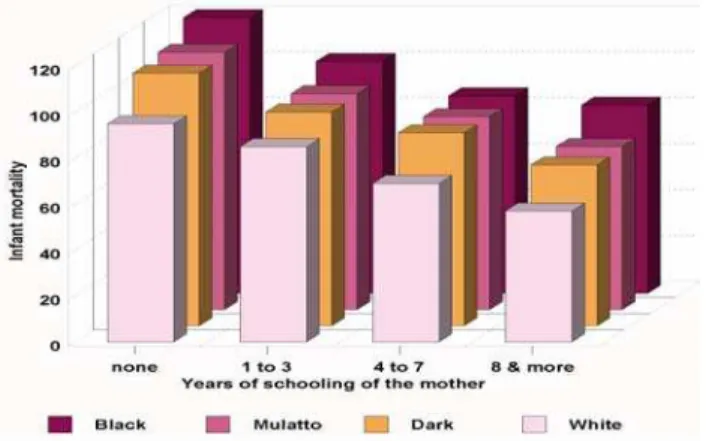
17. Many experts question whether ethnic origin is a pertinent variable and suggest that differences in infant mortality may be more closely linked to socioeconomic level. Figure 1 shows the results of cross-correlating level of schooling, as a proxy variable for living standard, with infant mortality and the race of the mother.
18. When infant mortality is compared with the mother’s years of schooling, it is observed that children of women of African descent with the highest levels of schooling (eight years and more) have the same infant mortality rates as children of white women with no schooling.
Figure 1. Infant mortality by race and years of schooling of the mother, Brazil
19. This indicates that the variable “ethnic origin” is fairly independent of socioeconomic level as measured by level of schooling.
20. If other problems having to do with mental health and violence, such as homicides and suicides, are analyzed, the data reveal that in the United States,7 for example, homicide rates are highest among Afro-descendants, both male and female. Moreover, even in the male population with higher education (13 or more years of schooling), the rate ratio between Afro-descendants and whites is approximately 11.
21. In Esmeralda, one of the provinces of Ecuador with a large population of African descent, the homicide mortality rate is 3.8 per 10,000 population, while the national rate is 1.65.8 As for the rate of suicides and self-inflicted injuries, problems acknowledged to be related to psychological disorders, a substantial difference is also observed (8.8 for Afro-descendants versus 4.8 for the general population).9 Mental health is another area in which differences between groups are evidenced. Various studies reveal that obstacles that hinder access to mental health care services may be related to segmentation in the quality of services. They may also be linked to cultural factors that make individuals reluctant to seek certain services.
22. Access to services, the quality thereof, and the types of services utilized are key indicators for measuring health inequities among ethnic groups. Ethnic groups exhibit differential behavior with respect to services which are not explained solely by economic disadvantages, since patterns within the same income quintile vary. A study conducted in the United States10 indicated that the uninsured population is distributed as follows: whites, 10.2%; Afro-descendants, 19.7%; people of Mexican descent, 36.9%; Puerto Ricans; 15.5%; and people of Cuban descent, 20.3%.
23. An example of differences in quality of care comes from a study in Guatemala which clearly showed that vaccination rates after mid-1996 dropped much more sharply among indigenous groups than among the general population. This suggests that while budgetary pressures may cause a decline in the quality of some services for the population as a whole, the decline is more pronounced in the case of services provided to ethnic minority populations (see Figure 2).
7
LaVeist, Thomas. Race, Ethnicity and Health, Maryland (USA): Jossey-Bass; 2002. 8
Indicadores básicos por región y provincia. Edición 2001. Ecuador: MinSalud, Instituto Nacional de Estadística y Censos y OPS.
9
Organización Panamericana de la Salud. Salud en las Américas., Washington D.C.: OPS; 2002. 10
Figure 2. Trends in prenatal care and tetanus vaccination in Guatemala, by ethnic origin, 1987-1999
Source: Valladares y Barillas. Inversiones en salud, equidad y pobreza: Guatemala. Banco Mundial. PNUD. OPS, 1998
24. The issue of access and how it relates to economic constraints has been studied extensively. However, the impact of ethnicity seems to extend beyond income levels. The Brazilian household survey (PNAD) of 1998 found evidence of that impact in the white and Afro-descendant populations. Among people with the greatest ability to pay, 60% of the white population in the highest quintile received care from private physicians, compared with 38% of the Afro-descendants, which meant that the high-income white population made less use of emergency services than the population of African descent. These statistics indicate that the white population with a certain income level opts to visit physicians, which presupposes certain attitudes toward care-seeking, health promotion, and prevention. Members of this group are probably more likely to protect their health better through medical check-ups and timely prevention. This finding coincides with the available information from the United States, which suggests that one of the major differences in the ability to resolve health problems is timeliness in seeking care.
compared with whites, Afro-descendants with diabetes are more likely to undergo amputations.11
26. In summary, the foregoing information demonstrates the existence of gaps that adversely affect health conditions and access to services for ethnic minorities. It also makes it clear that ethnic/racial origin is a factor whose impact transcends socioeconomic level and that minority ethnic groups are overrepresented among the “excluded.”
Examples of Effective Programs and Policies to Address the Basic and Health Needs of Ethnic Groups
27. Numerous governments and international organizations have incorporated the issue of ethnicity into their agendas, reflecting the commitments arising from the World Conference against Racism, Racial Discrimination, Xenophobia, and Related Intolerance, held in Durban (South Africa);12 the Declaration of the Millennium Summit organized by the United Nations in 2000; and the Summit of the Americas, held in Quebec (Canada) in 2001. One example is the University Diversity Project, which Brazil, with support from the IDB, implemented in late 2002 as part of the country’s efforts to further the education of ethnic groups.
28. Colombia, with support from the World Bank, has begun a process of land-titling in the framework of legislative reforms that will recognize the right of Afro-Colombian communities to their ancestral lands. Argentina has already drawn up its national plan for translating the Durban Conference commitments into action and has submitted it to the Office of the United Nations High Commissioner for Human Rights for review and comment.
29. In several countries, the World Bank and the IDB are supporting efforts to upgrade demographic and socioeconomic information systems with a view to producing disaggregated information. These initiatives are expected to have an enormous impact in the medium term. In the Region of the Americas, a number of countries incorporated disaggregated data on race/ethnicity in their 2000 population censuses, among them Argentina, Belize, Bolivia, Brazil, Chile, Costa Rica, Ecuador, Honduras, Jamaica,
11
The National Academy of Sciences. Guidance for the National Healthcare Disparities Report. Washington D.C.: Institute of Medicine of the National Academies; 2002.
12
Mexico, Paraguay, and Venezuela.13 The United States was already including such information and continues to do so. Peru is in the process of incorporating the race/ethnicity variable, while Colombia and Guatemala had already included it in their last censuses and may maintain it. The next step will be to incorporate this variable into data collection forms for national household surveys in order to complement the information with socioeconomic data. This is already being done in Argentina, Belize, Bolivia, Brazil, Chile, Ecuador, El Salvador, Guatemala, Honduras, Nicaragua, Panama, Paraguay, and Peru. In the health sector, it is also very important to introduce the ethnicity/race variable into birth, death, morbidity, and health service records, but less progress has been made in this area. However, Uruguay includes information on ethnic/racial origin in death certificates, and Brazil includes it in information on reportable diseases such as HIV/AIDS.
30. Several other changes are being seen in the health sector. In the last decade, for example, various ministries in countries of the Region (Argentina, Bolivia, Brazil, Canada, Colombia, Chile, Ecuador, El Salvador, Guatemala, Honduras, Panama, and United States) have carried out programs on the health of ethnic groups. At present, these programs are focusing on indigenous populations, but they could be expanded to encompass other ethnic groups in the near future. NGOs have played a very positive role in this area, and national and municipal governments have recognized them as valid counterparts. In Brazil, representatives of several NGOs, supported by the UNDP, are participating in a group created to follow up on the Durban Conference. The group, which is charged with drafting a plan of action at the national level, has been organized into thematic subgroups, one of which is devoted to health. PAHO is providing technical cooperation to support this work. Another example of action in the area of health is an initiative of the municipal health services of Montevideo (Uruguay), which have opened up channels for collaboration between technical personnel and the Afro-descendant community, organized through Mundo Afro, a network of NGOs with strong leadership capacity.
31. Other initiatives have focused on the development of health information systems that are sensitive to the ethnic variable (Nicaragua, Uruguay). One area in which enormous progress has been made is the development and advancement of traditional medicine, both in terms of the legal framework for its practice (Bolivia, Colombia, Ecuador, and Mexico) and in education and training in intercultural approaches for health professionals.
32. In the field of research, some of the efforts under way have won international recognition. One example is the work of the Chronic Diseases Research Center, in
13
Barbados, which for several years has been carrying out comparative studies on the prevalence of certain diseases (blindness, diabetes, and hypertension) in populations of diverse ethnic origin. This research is receiving support from the State University of New York at Stony Brook and the London School of Medicine.
33. The Government of Canada recognizes that membership in a particular ethnic group is an important health determinant which should be taken into account in the development of health programs and strategies. This is reflected in Canada’s application of a population-based health approach, which recognizes that any analysis of the health of the population should go beyond traditional simple assessments of the health situation. This approach takes into account a broad range of factors and situations related to mental and social well-being, quality of life, satisfaction with life, income, employment and working conditions, education, culture, gender, and other factors that have been shown to influence the health of subgroups of the Canadian population.
34. Canada has implemented numerous programs, policies, and research initiatives to serve the multicultural needs of Canadian society, including specific programs and divisions within the Ministry of Health devoted to the needs and interests of members of indigenous populations, such as the Inuit. The Ministry of Health invests more than Can$ 1.3 billion per year in health services for these populations. This investment complements services provided at the provincial level, such as hospital and physician care. Reducing gaps in the health status of the indigenous population is one of the long-term goals of the Canadian Government.
35. Another noteworthy initiative is “Healthy People 2010,” introduced by the Department of Health and Human Services of the United States in January 2000.14 This initiative proposes, as one of its central objectives, to reduce disparities in health conditions and access and establishes focus areas with specific objectives for infant mortality, early detection of cancer, cardiovascular disease, diabetes, HIV/AIDS, and immunization. Healthy People 2010 has strengthened the collection and analysis of statistical data disaggregated by race and ethnic group as an instrument for ensuring the initiative’s development and success.
PAHO’s Activities with Regard to Health and Ethnicity
36. PAHO has been carrying out activities in this area through its programs at Headquarters and the Representative Offices. Since 1999, two programs—Organization and Management of Health Systems and Services (HSP/HSO) and Public Policy and
14
Health (HDP/HDD)—have shared this responsibility. The work of HSP/HSO focuses on indigenous populations. Since 1993 the program has been carrying out the Health of Indigenous Peoples Initiative, which represents the response of the Region of the Americas to the International Decade of the World’s Indigenous People (1994-2004). It aims are to build capacity and forge partnerships, collaborate with Member States in the execution of national and local plans and projects, promote the formulation of development projects in priority health areas, strengthen the practice of traditional medicine and encourage its harmonization with national health systems, and produce and disseminate scientific and technical information. The goals of HSP/HSO are to enhance the available information and improve analysis of the health situation of indigenous peoples in the countries.
37. HDP/HDD, in turn, deals with the health of Afro-descendant communities in the framework of the mandates emanating from the Durban Conference. The two programs have endeavored to work together on activities relating to data collection, HIV/AIDS, and the disaggregation of statistical information. The Special Program for Health Analysis (SHA) has also been invited to participate in these efforts.
38. The PAHO Representative Offices in countries with large ethnic minority populations (Bolivia, Brazil, Colombia, Ecuador, Guatemala, Nicaragua, and Uruguay) have played an important role in the development of proposals and the design of programs, and they have cooperated actively with national focal points and civil society organizations on issues related to health and ethnicity. Particularly worthy of note is the effort of the Representative Office in Brazil to support the group of civil society representatives who prepared the first national Durban Conference follow-up document on health.
39. In addition, the Latin American Center for Perinatology and Human Development has produced a new perinatal care information collection form that asks about the mother’s ethnic/racial origin and her interest in having her newborn screened for sickle cell anemia. These modifications will not only afford benefits for mothers, but will also enhance the generation of reliable, disaggregated information and the training of health workers in how to administer the questionnaire.
41. PAHO is also coordinating its work with the Health and Human Rights staff of WHO’s Strategy Unit, with whom it prepared a document on health in a world free from discrimination. During the Durban Conference, PAHO and WHO coordinated a working group on the same topic. Finally, PAHO has participated, together with representatives of the governments of the Region, in workshops organized by the Office of the United Nations High Commissioner for Human Rights to follow up on the Plan of Action adopted by the Durban Conference. In conjunction with WHO’s Project on Indigenous Peoples, PAHO prepared a protocol that was used to seek funding from international cooperation agencies for the production of a methodological manual to guide countries in disaggregating health information by ethnic/racial group.
Key Areas for Action
42. Listed below are the areas in which the greatest consensus exists with regard to the health actions needed for reducing inequalities among ethnic groups:
• Work in coordination with ECLAC and the national institutions responsible for following up on the Millennium Summit in order to develop ethnically sensitive indicators to monitor progress toward meeting the Millennium Development Goals.
• Work with institutions responsible for collecting statistical information and with ministries of health to introduce the ethnic variable into national statistics.
• Collect and systematize successful experiences with regard to information and the organization of services to enable them to disseminate these methodologies.
• Support ministries of health in reformulating health policies, plans, and programs to make them ethnically sensitive.
• Promote the introduction of an ethnic perspective in the health plans developed as part of poverty reduction strategies in countries that are applying them.
Action by the Subcommittee on Planning and Programming
43. The Subcommittee on Planning and Programming is asked to review and comment on this document with the aim of forwarding it for consideration by the Executive Committee and generating mechanisms to guide PAHO in developing and applying health policies that are sensitive to the needs of minority ethnic groups.