119
JUXTAGLOMERULAR CELL TUMOR Case Report
International Braz J Urol
Official Journal of the Brazilian Society of Urology
Vol. 30 (2): 119-120, March - April, 2004
JUXTAGLOMERULAR CELL TUMOR AS A RARE CAUSE OF
HYPERTENSION IN ADULTS
JOSÉ L. CHAMBÔ, R. FALCI JÚNIOR, ANTONIO M. LUCON
From Division of Urology, School of Medicine, State University of São Paulo, USP, and Oswaldo Cruz German Hospital, São Paulo, Brazil
ABSTRACT
The juxtaglomerular cell tumor is a cause of secondary hypertension in adults. A 35-year-old female patient suffering from hypertension and low serum potassium had a 3 x 3 cm solid mass at the lower pole of left kidney diagnosed by abdominal sonography. Partial nephrectomy was performed and the postoperatory was uneventful. Normalization of blood pressure was observed within the first month.
Key words: kidney neoplasms; juxtaglomerular apparatus; urologic neoplasms Int Braz J Urol. 2004; 30: 119-120
INTRODUCTION
The most common cause of secondary hypertension in young adults is renovascular hypertension due to obstruction of the renal artery. Although rare, juxtaglomerular cell tumor may also be a cause of increased blood pressure. In both conditions the hypertension can be cured by surgery.
CASE REPORT
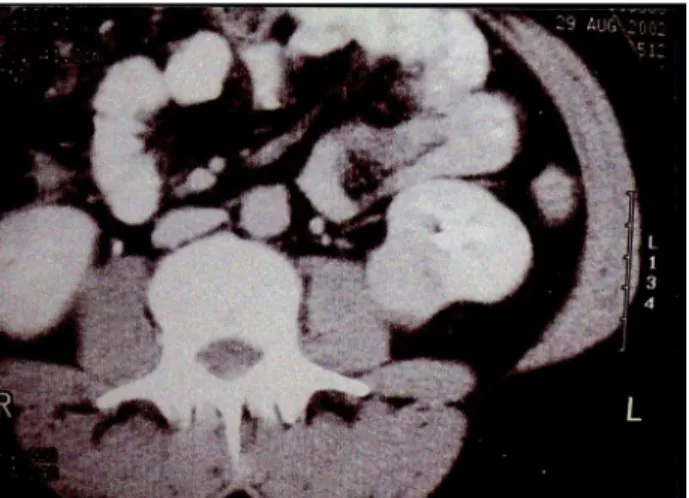
A 35-year-old Caucasian female who had been suffering from hypertension and headaches over the previous 6 months was referred to our hospital. Physical examination was normal, except for 150/100 mmHg blood pressure kept under control by the daily use of 20 mg of enalapril. Serum potassium was 3.2 mEq/L (normal 3.5 – 5.0 mEq/L). Abdominal Dop-pler sonography ruled out renal artery stenosis and identified a 3 x 3 cm solid mass at the lower pole of the left kidney. The diagnosis of renal neoplasia was suggested by computed tomography (Figure-1). Par-tial nephrectomy was performed and free surgical margins were ensured by frozen section. The
postop-erative period was uneventful and the patient was dis-charged on the fourth postoperative day. Pathologi-cal examination of the tumor showed a 3 x 2 cm mor surrounded by a thick fibrous capsule. The tu-mor consisted of round and elongated cells with nu-clei varying from round to spindled, with eosinophilic cytoplasm. Immunohistochemical staining that was positive for CD34 (Figure-2), confirmed the diagno-sis of juxtaglomerular cell tumor. Negative staining for vimentin and ck-7 ruled out clear cell carcinoma. Normalization of the blood pressure was observed within the first postoperative month. The patient has maintained normal blood pressure throughout the six-month follow-up period.
COMMENTS
120
JUXTAGLOMERULAR CELL TUMOR
adults with a peak incidence in the second and third decades, but it has also been reported in pediatric patients, particularly in teenagers (1). The most common findings are headaches, hypertension, nausea, vomiting and polyuria. Hypokalemia due to secondary aldosteronism associated with increased plasma renin activity is a common finding. Plasma renin activity may vary over time in the same patient. Thus, a single sample dosage does not rule out renin producing tumors. Renal angiography and lateralization of renin activity fails in up to half of the cases but it allows one to rule out renal artery stenosis. Renal echography or abdominal computed
tomography should be considered in cases of hypertension associated with secondary aldosteronism without renal artery obstruction (2). As in most cases fully accurate diagnosis is only possible after surgery, this tumor should be treated as a malignant solid renal mass. Treatment includes radical nephrectomy or partial nephrectomy, depending on the size and location of the tumor. Gross examination reveals a well circumscribed cortical mass confined to the kidney. Microscopically, they are composed of cells of varying size with round or spindled nuclei and eosinophilic cytoplasm. Nuclear atipia may be present in many cases. Immunohistochemistry helps to characterize major subtypes of renal cell carcinoma. In juxtaglomerular cell tumors, it is positive to actin and CD34 and negative stain for cytokeratin, chromogranin, synaptophysin, HMB-45, S-100, c-kit, CD31 and desmin (3).
REFERENCES
1. McVicar M, Carman C, Chandra M, Abbi RJ, Teichberg S, Kahn E: Hypertension secondary to re-nin-secreting juxtaglomerular cell tumor: case report and review of 38 cases. Pediatr Nephrol. 1993; 7: 404-12.
2. Haab F, Duclos JM, Guyenne T, Plouin PF, Corvol P: Renin secreting tumors: diagnosis, conservative sur-gical approach and long-term results. J Urol, 1995; 153: 1781-4.
3. Martin SA, Mynderse LA, Lager DJ, Cheville JC: Juxtaglomerular cell tumor: a clinicopathologic study of four cases and review of the literature. Am J Clin Pathol. 2001; 116: 854-63.
Received: October 10, 2003 Accepted: November 10, 2003
Correspondence address:
Dr. Renato Falci Júnior
Rua José Maria Lisboa, 1186 / 04 São Paulo, SP, 01423-001, Brazil Fax: + 55 11 3061-2463
E-mail: [email protected] Figure 1 – Computed abdominal tomography showing a 3 x 3
cm solid mass at the lower pole of the left kidney.