NOTAS PRÉVIAS
Mini moldable tunneler: a technical improvement for
hemodialysis access
Mini tunelizador moldável: um avanço técnico no acesso vascular para hemodiálise
Fabio Henrique Rossi1, Nilo Mitsuru Izukawa2, Akash Kuzhiparambil Prakasan3, Gisleno Seraim Lustosa4, Patrik Bastos
Metzger4, Fernanda Maria Angeliere4, Eduardo da Silva Jordão4, Bruno Lourenço de Almeida4
Abstract
Background: Hemodialysis access istula may involve creation of a tunnel for the accommodation of autologous vein or synthetic graft. he route and extent depend on the location of the anastomosis and istula body.Currently, the tunnelers used are rigid metallic cylindrical structures. Various sizes and conformations may be necessary.
Objective: Testing the use of a mini universal moldable tunnel maker in hemodialysis access istula surgical creation.
Methods: his is a pilot study. he tunneler developed consists of a cylindrical structure composed of stainless steel wire with a handle at the proximal end and dual interchangeable conical tip at the distal end. It is covered with a cylindrical sheath of polyethylene. Its technical surgical application and complications were studied during ten hemodialysis istula creation.
Results: Characteristics of lexibility and conformability made possible the same mini tunnel maker to be used in various types of istulas performed. he tapered distal tip with double diameter, interchangeable head, allowed the same apparatus to be used in autogenos and graft istulas surgical creation.
Conclusion: he same mini malleable tunneler was used in all istulas, regardless of the site of anastomosis and type of istula performed without complications and with excellent patency rate.
Keywords: istula; renal dialysis; surgery.
Resumo
Contexto: A confecção de fístula para hemodiálise pode envolver a criação de túnel para a acomodação do enxerto – veia autóloga ou prótese sintética. O trajeto e a extensão dependem do local escolhido para a realização das anastomoses e posicionamento do trajeto do enxerto. Na atualidade, os tunelizadores utilizados são constituídos de estruturas cilíndricas metálicas rígidas, que tornam necessário o uso de múltiplos tamanhos e conformações.
Objetivo: Testar a utilização de um único mini tunelizador universal metálico e moldável na cirurgia de confecção de fístula para hemodiálise.
Métodos: Trata-se de um estudo piloto. O tunelizador desenvolvido consiste de uma estrutura cilíndrica e modular composta de io de aço inoxidável moldável interno, com manopla em extremidade proximal e dupla ponta cônica intercambiável em extremidade distal e bainha cilíndrica externa de polietileno. O tunelizador foi utilizado em dez cirurgias de confecção de fístulas para hemodiálise em membros superiores e inferiores, e o sucesso de sua aplicabilidade e a frequência de complicações precoces foram observados.
Resultados: Suas características de maleabilidade e conformibilidade permitiram a utilização do mesmo tunelizador nos diversos tipos de fístulas realizadas. A ponta cônica distal com duplo diâmetro, intercambiável, permitiu que o mesmo aparato fosse aplicado na utilização de veia autógena ou prótese sintética. Todas as cirurgias foram seguidas de sucesso e com baixos índices de complicações precoces.
Conclusão: A versatilidade do mini tunelizador metálico maleável e moldável permitiu sua utilização em todas as fístulas realizadas, independentemente do sítio das anastomoses e o trajeto de acomodação escolhido, sem complicações e com excelente índice de perviedade. Os dados sugerem que o mini tunelizador metálico maleável moldável pode ser utilizado com segurança e vantagens nas cirurgias de confecção de fístula para hemodiálise. Sua versatilidade e baixo custo de produção podem levá-lo a substituir os tunelizadores rígidos utilizados na atualidade e apontam para estudos mais elaborados e com casuística adequada para avaliação do real valor do novo instrumento.
Palavras-chave: fístula arteriovenosa; diálise renal; cirurgia.
Study carried out at the Department of Vascular Surgery, Instituto Dante Pazzanese de Cardiologia – São Paulo (SP), Brazil.
1PhD; Assistant Vascular Surgeon, Instituto Dante Pazzanese de Cardiologia – São Paulo (SP), Brazil. 2PhD: Chief of Vascular Surgery, Instituto Dante Pazzanese de Cardiologia – São Paulo (SP), Brazil. 3Assistant Vascular Surgeon, Instituto Dante Pazzanese de Cardiologia – São Paulo (SP), Brazil. 4Vascular Surgery Resident, Instituto Dante Pazzanese de Cardiologia – São Paulo (SP), Brazil.
Mini moldable tunneler: a technical improvement for hemodialysis access - Rossi FH et al. J Vasc Bras 2011, Vol. 10, Nº 4 309
Introduction
The arteriovenous fistula surgically performed for hemodialysis may require the making of a tunnel to place the autologous vein or synthetic graft. The tun-nel route and extension depend on the fistula location. The tunnelers currently in use are rigid metallic cylin-drical structures. A set with tunnelers of,various sizes and conformations and even additional incisions may be necessary for graft placement. The available tunnel-ers can be a limiting factor for the making of such tun-nels and predispose the patient to iatrogenic lesions and complications1,2. In a previously conducted study, we
in-vestigated the advantages of using a malleable tunneler in the revascularization of ischemic limbs3.
his is a pilot study, which objective was to test the use of a universal malleable mini-tunneler in the surgical mak-ing of hemodialysis access istulas.
Method
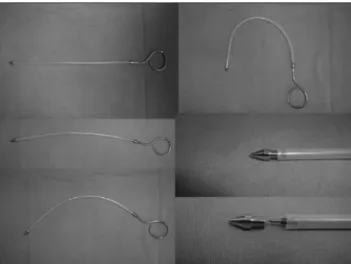
he metallic universal malleable tunneler was devel-oped in the Bioengineering Laboratory of Instituto Dante Pazzanese de Cardiologia. It consists of a hybrid and mod-ular cylindrical structure composed of: (1) an internal malleable stainless steel wire with a handle at the proximal end and dual interchangeable tapered tip at the distal end; (2) an external cylindrical sheath of transparent polyeth-ylene (Figure 1).
During the conception phase of the device, some char-acteristics were sought,, such as a metallic alloy that could ofer a balance between rigidity, lexibility and conformabil-ity to allow bending in several curved shapes, and utiliza-tion of the same tunneler, regardless of the type of istula performed. Its dual interchangeable tapered tip allows to use the same device in istulas made either of prosthesis or vein (Figure 2).
After this study was approved by the Research Ethics Committee, the universal mini-tunneler that had been developed was used in several types of fistulas performed by the principal investigator. (Figure 3) We observed the occurrences of early perioperative com-plications (30 days), as well as the fistula patency in the same time period.
Result
he initial experience with the mini-tunneler that has been designed was obtained with the following istulas
per-Figure 1. Industrial design of the mini universal tunneler.
Figure 2. Mini universal tunneler in various curvatures and dual inter-changeable tapered tip.
formed between September 2009 and November 2010 by the main author (Table 1).
he lexibility and deformation capability characteris-tics enabled to adapt and use the same mini-tunnel maker in various types of istulas. he dual interchangeable tapered tip at the distal end allowed the same device to be used in both autogenous or synthetic istulas.
Mini moldable tunneler: a technical improvement for hemodialysis access - Rossi FH et al. J Vasc Bras 2011, Vol. 10, Nº 4
310
Discussion
Hemodialysis is the type of treatment relatively well tolerated by the patient with end-stage renal failure. It is estimated that 373 patients in the United States and 171 in Europe per one million inhabitants, are on hemodyalisis4.
Around 40% of Medicare’s funding for renal disease - i.e., US$6 billion - are spent annually with these patients5.
In Brazil, according to data from DATASUS, the num-ber of patients that develop end-stage renal failure has in-creased. In 2008, 87,000 patients were on hemodialysis, which means an 87% increase over year 2000 igures.
For a patient to start a hemodyalisis treatment program, it is essential to have a working AV istula. Fistula failure and complications are the main causes of hospital admis-sion and and overall costs (in the USA, US$500,000/year) of patients in a hemodialysis program5,6.
Operative wound infection and necrosis are the most frequent early complications of access istula operations 7,8
and grat tunneling can an important factor in the occur-rence of these complications. It is widely known that the istula should be placed neither very deeply, as it can make puncture diicult, nor very supericially, which may in-crease the risk of operative wound necrosis and infection. he number of incisions and extent of surgical dissection required for grat tunneling can inluence the incidence rate
Figure 3. Examples of types of istulas performed with the same mini universal tunneler: (A) basilic vein transposition; (B) brachio-basilic 6-mm PTFE forearm loop istula; (C) straight radio-basilic, 6-mm PTFE forearm istula; (D) axillo-axillary straight 6-mm PTFE istula; (E) saphen-ous vein to supericial femoral artery istula.
of infection9. Using the device presented in this study may
reduce the number of incisions and probably the rate of in-fection. he location9, coniguration10 and material11 used
in making the access istula are factors that can afect the frequency of complications.
Indications for hemodialysis have been extended. Patients undergoing hemodyalisis are increasingly older, diabetic, immunodepressed, clinically unstable and some-times have been submitted to multiple accesses in the past, increasing the complexity of the operation. It is not uncom-mon to see grat tunneling in extra-anatomical positions, with long prosthesis and even with partial utilization of previous istulas.
In our study, new istulas were performed in two pa-tients with partial utilization of previous istulas. In the irst case, the patient developed an infected pseudoaneurysm in the middle segment of a previous basilic vein transposition. Ater local drainage, debridement and sterile isolation of the site of infection, a new 6-mm PTFE istula was performed between the remaining basilic vein segment anastomosed in the brachial artery and the axillary vein, as the patient did not have any autogenous veins in the reoperated limb.
Patient Age Fistula Complication
1 27 Brachio-basilic arteriovenous, 6-mm PTFE forearm loop istula
-2 34 Basilic vein transposition
-3 65 Saphenous vein to common femoral artery arteriovenous istula
-4 36 Basilic vein transposition
-5 70 Straight brachio-axillary arteriovenous, 6-mm PTFE istula
-6 77 Basilic vein transposition Supericial
infection of operative injury
7 25 Saphenous vein to supericial femoral artery arteriovenous istula
8 89 Axillo-axillary straight bridge arteriovenous, 8-mm PTFE istula
-9 56 Basilic vein transposition
-10 67 Saphenous vein to supericial femoral artery arteriovenous istula
Supericial hematoma
11 72 Straight radio-basilic arteriovenous, 6-mm PTFE forearm istula
Mini moldable tunneler: a technical improvement for hemodialysis access - Rossi FH et al. J Vasc Bras 2011, Vol. 10, Nº 4 311
In the second patient, a istula performed with the saphen-ous vein in the distal supericial femoral artery developed early obstruction, and a new loop istula was made with anastomosis to the ipsilateral common femoral artery.
Currently available rigid tunnelers molded in pre-de-termined curves can be of limited use or may even cause injuries to structures and organs present in the alternative istula routes.
here is no description in the literature of a malleable tunneler similar to the model presented here. Our initial ex-perience in performing istula operations for hemodialysis, using the same concept of a malleable tunneler that had been used in revascularization of ischemic lower limbs3, showed
only two cases of mild complications (supericial infection, hematoma), which were treated conservatively. hese results, combined with the universal mini-tunneler easy mainte-nance, low cost and versatility, indicates that it can replace with advantages the currently used rigid models.
Conclusion
Data from this study suggest that the metallic malleable mini-tunneler can be used with safety and advantages in is-tula operations for hemodialysis. Its versatility and low pro-duction costs may lead it to replace currently used rigid tun-nelers and indicate that further studies with larger number of cases are requiredto assess the real value of this new device.
References
1. Blumenberg RM, Gelfand ML. A simple and inexpensive tunneler for use in peripheral vascular surgery. Surgery. 1974;75(2):305-7.
2. Parsonnet V, Driller J. A tunneler for bypass vascular surgery. Arch Surg. 1973;106(2):236-7.
3. Rossi FH, Izukawa NM, Oliveira LA, et al. Tunelizador maleável moldável universal na cirurgia de revascularização do membro in-ferior isquêmico. J Vasc Bras. 2010;9(1):21-4.
4. Marx AB, Landmann J, Harder FH. Surgery for vascular access. Curr Probl Surg. 1990;27(1):1-48.
5. Feldman HI, Held PJ, Hutchinson JT, et al. Hemodialysis vascular ac-cess morbidity in the United States. Kidney Int. 1993;43(5):1091-6.
6. Aman LC, Levin NW, Smith DW. Hemodialysis access site morbid-ity. Proc Clin Dial Transplant Forum. 1980;10:277-84.
7. Dobkin JF, Miller MH, Steigbigel NH. Septicemia in patients on chronic hemodialysis. Ann Intern Med. 1978;88(1):28-33.
8. Yu VL, Goetz A, Wagener M, et al. Staphylococcus aureus nasal carriage and infection in patients on hemodialysis. Eicacy of anti-biotic prophylaxis. N Engl J Med. 1986;315(2):91-6.
9. Munda R, First MR, Alexander JW, et al. Polytetraluoroethylene graft survival in hemodialysis. JAMA. 1983;249(2):219-22.
10. Kester RC. Arteriovenous grafts for vascular access in haemodialy-sis. Br J Surg. 1979;66(1):23-8.
11. Schuman ES, Gross GF, Hayes JF, et al. Long-term patency of poly-tetraluoroethylene graft istulas. Am J Surg. 1988; 155(5):644-6.
Correspondence Fabio H Rossi Departamento de Cirurgia Vascular Instituto Dante Pazzanese de Cardiologia Av Dr. Dante Pazzanese, 500 – Ibirapuera CEP 04012-180 – São Paulo (SP), Brazil E-mail: [email protected]