350
Revista da Sociedade Brasileira de Medicina Tropical 48(3):350-353, May-Jun, 2015
http://dx.doi.org/10.1590/0037-8682-0309-2014
Short Communication
Corresponding author: Dra. Ana Lúcia Coutinho Domingues. Depto. de Medicina Clínica/Hospital das Clínicas/UFPE. Av. Prof. Moraes Rêgo s/n, Bloco A, Cidade Universitária, 50670-901 Recife, Pernambuco, Brasil.
Phone: 55 81 3271-8534; Fax: 55 81 3271-8534
e-mail: [email protected] ; [email protected]
Received 12 December 2014
Accepted 24 February 2015
Evaluation of the cytokine mannose-binding lectin
as a mediator of periportal fi brosis progression
in patients with schistosomiasis
Paula Carolina Valença Silva
[1], Adriana Vieira Gomes
[2],[3],
Georgea Gertrudes de Oliveira Mendes Cahu
[4], Maria Rosângela Cunha Duarte Coêlho
[4],[5],
Maria Tereza Cartaxo Muniz
[2],[3],[6]and Ana Lúcia Coutinho Domingues
[7][1]. Centro Acadêmico de Vitória, Universidade Federal de Pernambuco, Vitória de Santo Antão, Pernambuco, Brasil. [2]. Laboratório de Biologia Molecular, Hospital Universitário Oswaldo Cruz, Universidade de Pernambuco, Recife, Pernambuco, Brasil. [3]. Instituto de Ciências Biológicas, Universidade de Pernambuco, Recife, Pernambuco, Brasil. [4]. Setor de Virologia do Laboratório de Imunopatologia Keizo-Asami, Universidade Federal de Pernambuco, Recife, Pernambuco, Brasil. [5]. Departamento de Fisiologia e Farmacologia, Universidade Federal de Pernambuco, Recife, Pernambuco, Brasil. [6]. Faculdade de Ciências Médicas, Universidade de Pernambuco, Recife, Pernambuco, Brasil. [7].Departamento de Medicina Clínica, Universidade Federal de Pernambuco, Recife, Pernambuco, Brasil.
ABSTRACT
Introduction: We hypothesized higher mannose-binding lectin level and classic factors (i.e., age, sex, alcohol consumption,
exposure, and specifi c treatment) are associated with the severity of periportal fi brosis in schistosomiasis. Methods: This cross-sectional study involved 79 patients infected with Schistosoma mansoni with severe or mild/moderate periportal fi brosis. Serum
concentrations of mannose-binding lectin were obtained by enzyme-linked immunosorbent assay (ELISA). Results: Higher
serum level of mannose-binding lectin was signifi cantly associated with advanced periportal fi brosis. Conclusions: Mannose-binding lectin may contribute to liver pathology in schistosomiasis and may represent a risk factor for advanced periportal
fi brosis in the Brazilian population studied.
Keywords:Schistosomiasis mansoni. Periportal fi brosis. Mannose-binding lectin.
Schistosomiasis is a chronic parasitic infection caused by trematode Schistosoma spp. and is a serious public health problem in endemic countries, incurring substantial social and economic burdens. It affects more than 230 million people worldwide and is one of the neglected tropical diseases targeted for elimination by the World Health Organization(1). Approximately 6 million people are infected with Schistosoma mansoni in Brazil, mainly in the northeast region. The disease causes immense morbidity, especially in the State of Pernambuco, where schistosomiasis is continuously expanding to touristic coastal areas of the state(2).
Schistosomiasis causes periportal fi brosis (PPF) and portal
hypertension in approximately 6% of infected subjects, usually with the preservation of hepatic function(3). Some patients with schistosomiasis have a poorly regulated immune response to parasite egg antigens and consequently develop extensive hepatic PPF and subsequent hepatosplenic disease(3). The
evolution of PPF may be infl uenced by several exposure-related
factors such as local environment and behaviors (e.g., alcohol
consumption, exposure frequency, specifi c early treatment, age, and sex) as well as immunogenetic factors that lead to the
exacerbation of the host’s immune response(4).
Hepatic fibrosis depends on the actions of cytokines
including mannose-binding lectin (MBL), which has a central
regulatory role(5). The association between the immune response
of MBL and the development of hepatic fi brosis in other liver
diseases has been evaluated(5). The importance of MBL in the innate immune system is related to its multimeric structure as well as its functions as an opsonin and adaptor for the activation of mannose-binding lectin/mannose-binding protein-associated
serine protease (MBL/MASPs). Moreover, the MBL serum
level and enzyme activity of MBL/MASP-1 complex are
elevated in hepatitis C virus (HCV) patients with severe hepatic fi brosis(5). However, the contribution of MBL in patients with
varying severity of S. mansoni remains poorly understood(6). Considering the central role of MBL in the development of
severe hepatic fi brosis in other liver diseases, we determined
whether serum levels of MBL and classical factors (i.e., age,
sex, alcohol, exposure, and treatment) are associated with PPF
severity in schistosomiasis in the population of endemic areas of Northeastern Brazil.
This cross-sectional study was conducted from April to December 2013 and evaluated patients infected with S. mansoni
351 Silva PCV et al. - Schistosomiasis-related fi brosis and MBL
Outpatient Clinic of the Hospital das Clínicas/Universidade Federal de Pernambuco (CH/UFPE), a reference center for
schistosomiasis treatment. All patients lived in endemic areas of schistosomiasis in the State of Pernambuco. This study was conducted in accordance with the Declaration of Helsinki and was approved by the Ethics Committee of the CH/UFPE
(CAAE: 03161512.6.0000.5208). Informed consent was
obtained from all patients before blood sampling.
All patients infected with S. mansoni examined during the study period were included. Patients with a history of other associated liver diseases including liver cirrhosis, fatty liver disease, or hepatitis B or C, or other clinical forms of diagnosed schistosomiasis were excluded. Hepatitis B and C were excluded
on the basis of hepatitis B surface antigen (HBsAg), hepatitis B
core antibody (anti-HBc), and hepatitis C virus antibody (anti
HCV) measurements(7). Thus, 79 individuals were included and
divided into two groups: the severe group consisted of 39 patients with severe PPF and the hepatosplenic form of the disease, and the mild group consisted of 40 patients with no or mild-to-moderate
fi brosis and the hepatointestinal form of the disease. All patients
had a history of contact with contaminated water and/or had positive stool test results for S. mansoni or prior treatment for schistosomiasis.
The sociodemographic and clinical variables related to the risk factors for developing PPF included sex, age, alcohol consumption, time and site of last contact with contaminated
water, and specifi c treatment. Data were collected by using
a precoded structured questionnaire that was applied to individuals by a single investigator.
The diagnosis of the clinical form of the disease was determined on the basis of the patient’s medical history and clinical examination. In addition, upper-abdominal ultrasonography was performed by a single experienced operator using an Acuson X 150® (Siemens, Munich, Germany) with a 3.5-mHz convex transducer in order to confi rm the diagnosis and exclude other
liver diseases. PPF pattern was evaluated according to Niamey’s
classifi cation(8) as follows: A, absence of fi brosis; B, dubious;
C, peripheral; D, central; E, advanced; and F, very advanced
fi brosis.
Serum MBL levels were measured using the commercial Human MBL Quantikine® ELISA Kit (R&D Systems, Minneapolis, MN, USA) according to manufacturer’s instructions.
The results are expressed in pg/mL based on standard curves
(limit of detection: 0.029ng/mL). The Cutoff of 881ng/mL was
derived from the average serum levels of MBL in the severe group. The Kruskal-Wallis test was used to compare the serum levels of MBL between groups. Variables showing p < 0.20 in the univariate analysis were entered into non-conditional logistic regression
analysis. Odds ratios (ORs) and 95% confi dence intervals (CIs)
were calculated using the fibrosis pattern as the dependent variable and the selected factors as independent variables. The
level of signifi cance was set at p < 0.05. Epi Info version 3.5.5. (CDC, Atlanta, GA, USA) was used for all statistical analyses.
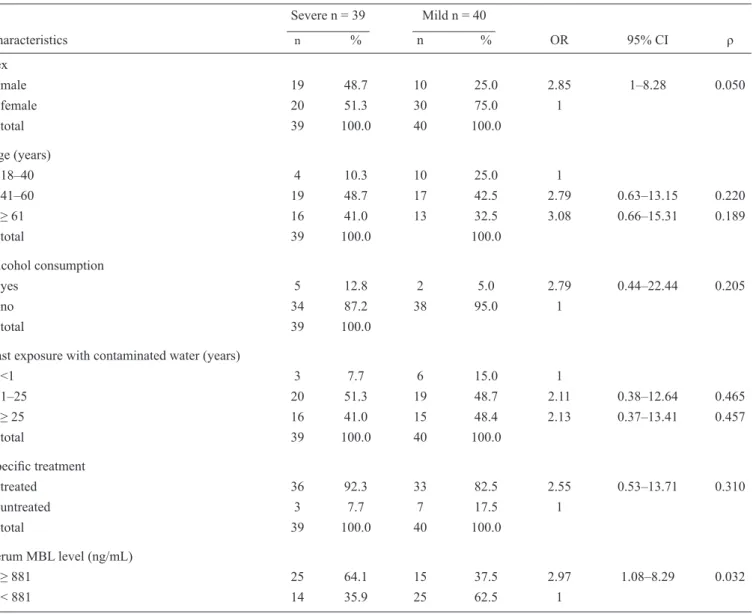
The associations of sociodemographic and clinical variables with PPF severity are shown in Table 1. The mean ± SD age of the patients was 54 ± 13 years. The patients were predominantly
women. Male sex tended to be associated with severe PPF
(OR = 2.85; 95% CI: 1.80-8.18; p = 0.050) with borderline signifi cance. Moreover, higher serum MBL level was signifi cantly
associated with severe PPF (OR = 2.97; 95% CI: 1.08-8.29;
p = 0.032). Median serum MBL level differed signifi cantly
between the mild and severe PPF groups (867.62 vs. 874.04ng/
mL, respectively p = 0.003).
The fi nal logistic regression model included age and alcohol
consumption along with serum MBL level. Only serum MBL
level was signifi cantly associated with severe PPF after adjusting
for confounding factors (p = 0.012, Table 2). As this association
was inverse, serum MBL level may be a protective factor against severe PPF.
The relationship between MBL and hepatic fi brosis in other
hepatic diseases remains controversial(5). The present study
evaluated the infl uences of serum MBL level, age, sex, alcohol,
exposure, and treatment on PPF severity in schistosomiasis. However, the classic factors studied were not associated with PPF severity. Thus, immunogenetic factors appear to be more important when predicting PPF severity.
PPF is a well-known multifactorial manifestation caused by complex interactions between genetic and environmental factors(9). However, the classic factors should be considered when evaluating the role of MBL in PPF.
Serum MBL levels were signifi cantly higher in the severe
PPF group than the mild PPF group; this result is concordant with recent data indicating increased complement activation and activity of the MBL/MASP-1 complex in HCV-induced hepatic
fi brosis(5) (10) (11), thus corroborating the proinfl ammatory role of
MBL in chronic disease.
Hepatitis C virus patients have higher MBL levels than controls and are associated with more severe hepatitis(5) (10) (12) (13). Brown et al.(5) investigated the infl uence of MBL level in patients with chronic HCV infection, non-HCV liver disease, and healthy controls from the Trent HCV cohort study in the UK(14) (15); they analyzed 147 infected patients and 111 healthy controls, and
found MBL levels were signifi cantly higher in HCV patients with severe fi brosis than that in patients with mild fi brosis and controls. However, MBL levels did not differ signifi cantly
between HCV and non-HCV liver disease patients.
Most studies that compared the distribution of MBL levels with
respect to the severity of fi brosis report no signifi cant association(11).
Pedroso et al(12) compared 102 Euro–Brazilian patients with moderate and severe chronic hepatitis C with sex- and age-matched HCV-seronegative healthy controls and found overall circulating levels of MBL did not differ significantly between groups. However, it is important to note that the exclusion of patients
with no or little fi brosis from that study may have weakened the
association between disease progression and MBL concentration. El Saadany et al.(13) studied 80 Egyptian patients with chronic
HCV infection with different patterns of hepatic fi brosis and 20
control subjects; they found MBL levels tended to be higher in
352
Rev Soc Bras Med Trop 48(3):350-353, May-Jun, 2015
TABLE 1 - Associations of sociodemographic and clinical variables with periportal fi brosis severity in patients with schistosomiasis in
Pernambuco, Brazil.
Severe n = 39 Mild n = 40
Characteristics n % n % OR 95% CI ρ
Sex
male 19 48.7 10 25.0 2.85 1–8.28 0.050
female 20 51.3 30 75.0 1
total 39 100.0 40 100.0
Age (years)
18–40 4 10.3 10 25.0 1
41–60 19 48.7 17 42.5 2.79 0.63–13.15 0.220
≥ 61 16 41.0 13 32.5 3.08 0.66–15.31 0.189
total 39 100.0 100.0
Alcohol consumption
yes 5 12.8 2 5.0 2.79 0.44–22.44 0.205
no 34 87.2 38 95.0 1
total 39 100.0
Last exposure with contaminated water (years)
˂1 3 7.7 6 15.0 1
1–25 20 51.3 19 48.7 2.11 0.38–12.64 0.465
≥ 25 16 41.0 15 48.4 2.13 0.37–13.41 0.457
total 39 100.0 40 100.0
Specifi c treatment
treated 36 92.3 33 82.5 2.55 0.53–13.71 0.310
untreated 3 7.7 7 17.5 1
total 39 100.0 40 100.0
Serum MBL level (ng/mL)
≥ 881 25 64.1 15 37.5 2.97 1.08–8.29 0.032
< 881 14 35.9 25 62.5 1
OR: odds ratio; CI: confi dence interval; MBL: mannose-binding lectin.
TABLE 2 - Risk factors for severe periportal fi brosis.
Variable Adjusted OR 95% CI pa
Age (years)
18-40 1
41-60 2.35 0.57–9.54 0.231
≥ 61 2.67 0.63–11.30 0.181
Alcohol consumption
yes 1
no 0.20 0.03–1.28 0.091
Serum MBL level concentration (ng/mL)
≥ 881 1
< 881 0.280 0.10–0.75 0.012
353
Thus, the present fi nding suggesting high serum MBL levels
play an important role in the severity of PPF corroborates other
studies reporting similar fi ndings(5)(12). Therefore, further larger
studies analyzing the association between MBL expression and
disease outcomes are required to corroborate the present fi ndings and confi rm the profi brotic activity of MBL. Furthermore, the infl uences of MBL and other classic factors on the severity of immune fi brosis in schistosomiasis warrant a large cohort study with PPF monitoring in order to confi rm this association
in different ethnicities as well as clarify the roles of other environmental risk factors and immunogenetic factors in the evolution of this disease.
In conclusion, MBL may contribute to liver pathology in schistosomiasis and may be a risk factor for PPF severity in the Brazilian population. Moreover, it could be used to predict the severity of advanced PPF in schistosomiasis and thus the severity of liver pathology.
1. Vos T, Flaxman AD, Naghavi M, Lozano R, Michaud C, Ezzati
M, et al. Years lived with disability (YLDs) for 1160 sequelae of
289 diseases and injuries 1990-2010: a systematic analysis for the Global Burden of Disease Study 2010. Lancet 2012; 380:2163-2196. 2. Silva PCV, Domingues ALC. Aspectos epidemiológicos da
esquistossomose hepatoesplênica no estado de Pernambuco, Brasil. Epidemiol Serv Saude 2011; 20:327-336.
3. Colley DG, Bustinduy AL, Secor WE, King CH. Human schistosomiasis. Lancet 2014; 383:2253-2264.
4. Pinot MA, Fulford AJ, Kabatereine NB, Ouma JH, Booth M, Dunne DW. Analysis of complex patterns of human exposure and immunity to Schistosoma mansoni: the infl uence of age, sex,
ethnicity and IgE. PLoS Negl Trop Dis 2010; 4:1-10.
REFERENCES
The authors declare that there is no confl ict of interest.
CONFLICT OF INTEREST
5. Brown KS, Keogh MJ, Tagiuri N, Grainge MJ, Presanis JS, Ryder
SD, et al. Severe fi brosis in hepatitis C virus-infected patients is
associated with increased activity of the mannan-binding lectin
(MBL)/MBL-associated serine protease 1 (MASP-1) complex.
Clin Exp Immunol 2007; 147:90-98.
6. Antony JS, Ojurongbe O, Van TH, Ouf EA, Engleitner T, Akindele AA, et al. Mannose-Binding Lectin and Susceptibility to Schistosomiasis. J Infect Dis 2013; 207:1675-1678.
7. Ministério da Saúde. Secretaria de Vigilância em Saúde. Departamento de DST, Aids e Hepatites Virais. Protocolo clínico e diretrizes terapêuticas para hepatite viral C e coinfecções. Brasília: Ministério da Saúde; 2010.
8. Richter J, Domingues AL, Barata CH, Prata AR, Lambertucci JR. Report of the second satellite symposium on ultrasound in schistosomiasis. Mem Inst Oswaldo Cruz 2001; 96:151-156. 9. Silva PCV, Leal TV, Domingues ALC. Treatment and education
reduce the severity of schistosomiasis periportal fi brosis. Rev Soc
Med Trop 2013; 46:472-477.
10. Gangadharan B, Antrobus R, Dwek RA, Zitzmann N. Novel serum
biomarker candidates for liver fi brosis in hepatitis C patients.
Clin Chem 2007; 53:1792-1799.
11. Lee IN, Chen CH, Sheu JC, Lee HS, Huang GT, Chen DS,
et al. Identifi cation of complement C3a as a candidate biomarker
in human chronic hepatitis C and HCV related hepatocellular carcinoma using a proteomics approach. Proteomics 2006; 6:2865-2873.
12. Pedroso MLA, Boldt ABW, Pereira-Ferrari L, Steffensen R, Strauss E, Jensenius JC, et al. Mannan-binding lectin MBL2 gene polymorphism in chronic hepatitis C: association with the severity
of liver fi brosis and response to interferon therapy. Clin Exp
Immunol 2008; 152:258-264.
13. El Saadany SA, Ziada DH, Farrag W, Hazaa S. Fibrosis severity
and mannan-binding lectin (MBL)/MBL-associated serine protease 1 (MASP-1) complex in HCV-infected patients. Arab J
Gastroenterol 2011; 12:68-73.
14. Mohsen AH, Trent HCV Study Group. The epidemiology of hepatitis C in a UK health regional population of 5·12 million. Gut 2001; 48:707-713.
15. Ryder SD, Irving WL, Jones DA, Neal KR, Underwood JC.
Progression of hepatic fi brosis in patients with hepatitis C: