PSA Levels of 4.0 – 10 ng/ml and Negative Digital Rectal
Examination. Antibiotic Therapy versus Immediate Prostate
Biopsy
Avraham Shtricker, Shai Shei, Avi Ringel, Gabriel Gillon
Department of Urology, Tel Aviv Central Consulting Clinic, Clalit Healthcare Services, Tel Aviv,
Israel
ABSTRACT
Purpose: The management of mildly elevated (4.0-10.0 ng/ml) prostate speciic antigen (PSA) is uncertain. Immediate prostate biopsy, antibiotic treatment, or short term monitoring PSA level for 1-3 months is still in controversy.
Materials and Methods: We conducted a retrospective chart review of patients in a large community practice (2003 - 2007) who had PSA levels between 4.0-10 ng/mL without any further evidence of infection. Data was gathered regarding patient’s age, whether standard antibiotic therapy (10-14 days of oloxacin or ciproloxacin) had been administered before the second PSA measurement, results of a second PSA test performed at 1- to 2-month intervals, whether a prostate biopsy was performed and its result.
Results: One-hundred and thirty-ive men met the study inclusion criteria with 65 (48.1%) having received antibiotics (group 1); the PSA levels decreased in 39 (60%) of which, sixteen underwent a biopsy which demonstrated prostate cancer in 4 (25%). Twenty-six (40%) patients of group 1 exhibited no decrease in PSA levels; seventeen of them underwent a biopsy that demonstrated cancer in 2 (12%). The other 70 (51.9%) patients were not treated with antibiotics (group 2); the PSA levels decreased in 42 (60%) of which, thirteen underwent a biopsy which demonstrated prostate cancer in 4 (31%). In the other 28 (40%) patients of group 2 there was no demonstrated decrease in PSA, nineteen of these subjects underwent a biopsy that demonstrated cancer in 8 (42%).
Conclusions: There appears to be no advantage for administration of antibacterial therapy with initial PSA levels between 4-10 ng/mL without overt evidence of inlammation.
Key words: PSA; digital rectal examination; antibiotics; biopsy
Int Braz J Urol. 2009; 35: 551-8
INTRODUCTION
The prostate-speciic antigen (PSA) level is considered one of the most prevalent cancer markers in current clinical practice. Its high sensitivity but low speciicity have led to controversy in regards to the recommended management of patients with mild PSA elevation whose digital rectal examination (DRE) is
be the most sound, given that unproven sub clinical prostatitis, and not malignancy, leads to the majority of cases of spurious PSA elevation (1-7).
In an effort to achieve a more effective indication for dealing with PSA elevation in the community, we conducted a retrospective study for evaluating the effect of antibiotics on PSA levels in patients who have a negative DRE yet possess an initially mild PSA elevation (4.0-10 ng/mL) and negative clinical and laboratory signs of prostate or urinary infection. Moreover, can the antibiotic therapy contribute to obviate unnecessary prostate biopsy.
MATERIALS AND METHODS
We conducted a retrospective electronic chart review of all the patients seen in our service between 2003-2007 who had PSA levels between 4.0-10 ng/ mL, a negative digital rectal examination (DRE) and no clinical or laboratory signs of urinary infections (negative urine culture and negative urine sediment). The data collected included the patient’s age, whether standard antibiotic therapy (10-14 days of oloxacin or ciproloxacin) had been given before the second PSA measurement, based on the urologist’s own decision, the results of the second PSA test that was done after a 1- to 2-month interval, whether a TRUS (transrectal ultrasound) guided prostate biopsy was eventually performed (mostly when a PSA decrease was less than 10%) and, if so, the result. The 10-core biopsy was performed based on the urologist’s decision rely -ing on his or her own PSA judgment requir-ing PSA adjustment (age related, race related, density, velocity, etc.). Cases that involved events that might falsely elevate the PSA result (e.g., urinary tract infection, urinary retention) were excluded from the study. All the specimens were analyzed in authorized laborato -ries within our catchments’ area (using Immulite 2000 analyzer third generation PSA).
Analysis of data [age, PSA changes, anti -biotics therapy, biopsy result (presence of cancer)] was carried out using SPSS 10.0 statistical analysis software (SPSS Inc., Chicago, IL, USA). Distributions of continuous variables were assessed for normality using the Kolmogorov-Smirnov test (cutoff at p < 0.01). Continuous variables were described using
mean ± standard deviation. Categorical variables were described using frequency distributions and were presented as frequency (%). The Student’s-t-test for independent samples was used to compare PSA eleva -tion prior to and following antibiotic therapy. Change from baseline antibiotic therapy was also compared by antibiotic therapy. Multivariate logistic regression analysis was used to model detected prostate cancer. All tests were two-sided and considered signiicant at p < 0.05.
RESULTS
A total of 135 men met the study inclusion criteria within the study period. Their average age was 66.48 ± 8.32 years, the average initial PSA level was 6.28 ± 1.59 ng/mL, the average second PSA level was 5.68 ± 1.77 ng/mL, and the average difference between the two tests was 0.60 ± 1.71 ng/mL. Sixty-ive of these patients (48.1%) underwent prostate biopsy: the pathologic indings were prostate cancer in 18 (28%), chronic inlammation (based on massive lymphocyte iniltration or giant cell granuloma) in 13 (20%), and benign prostatic hyperplasia (BPH) in the remaining 32 (52%).
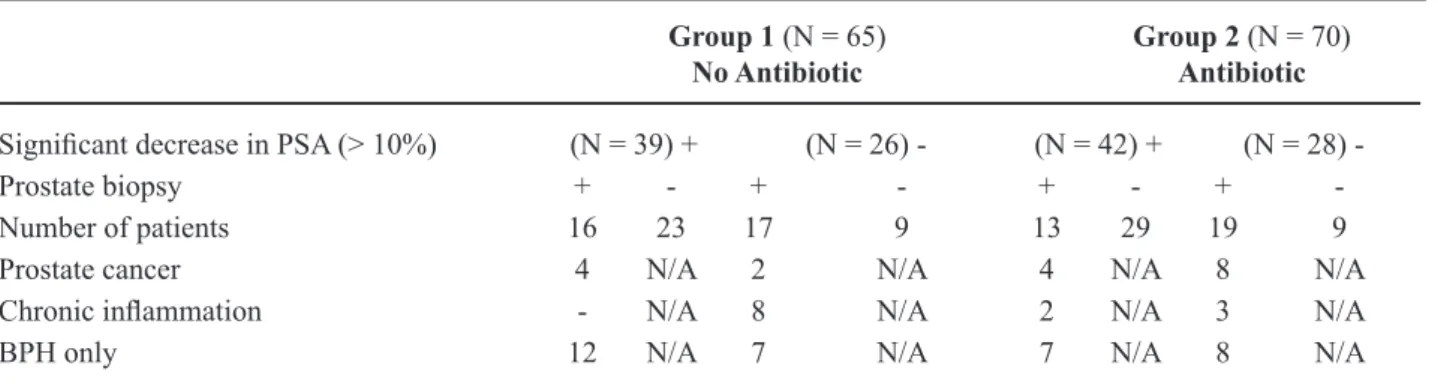
Sixty-ive of the 135 patients (48.1%) were treated with antibiotics (group 1): the PSA levels decreased in 39 (60%) of them, sixteen underwent a biopsy, which demonstrated prostate cancer in 4 (25%), and BPH in the rest. In 26 (40%) patients of group 1 no decrease in PSA levels were exhibited, seventeen of them underwent biopsies which dem -onstrated cancer in 2 (12%), chronic inlammation in 8 (47%) and BPH in the rest .The other 70 (51.9%) patients were not treated with antibiotics (group 2): the PSA levels decreased in 42 (60%) of them, thir -teen underwent a biopsy which demonstrated prostate cancer in 4 (31%),chronic inlammation in 2(15.4%) and BPH in the rest. In 28 (40%) patients of group 2 there was no decrease in PSA, nineteen of them underwent a biopsy which demonstrated cancer in 8 (42%), chronic inlammation in 3(15.7%) and BPH in the rest (p value for each parameter between the groups revealed a level > 0.05).
-Table 1 – Results of PSA changes and prostate biopsies in 135 patients.
Group 1 (N = 65) No Antibiotic
Group 2 (N = 70) Antibiotic
Signiicant decrease in PSA (> 10%) (N = 39) + (N = 26) - (N = 42) + (N = 28)
-Prostate biopsy + - + - + - +
-Number of patients 16 23 17 9 13 29 19 9
Prostate cancer 4 N/A 2 N/A 4 N/A 8 N/A
Chronic inlammation - N/A 8 N/A 2 N/A 3 N/A
BPH only 12 N/A 7 N/A 7 N/A 8 N/A
+: afirmative, -: negative; BPH: benign prostatic hyperplasia PSA: prostate-speciic antigen age decrease of 14.1%, the average initial PSA level
in group 2 was 6.26, the average second PSA level was 5.95, an average decrease of 4.95% (p = 0.08).
Multivariate analysis (described in the methods ) of age, PSA changes, antibiotics therapy and biopsy results (presence of cancer) revealed no signiicant difference between the study groups (P Value > 0.05 in all categories). Table-1 shows the distribution of diagnoses and performance of biopsies for each subgroup.
COMMENTS
The results of this chart review failed to show any advantage for Random quinolone antibi -otic treatment while dealing with initial PSA levels between 4-10 ng/mL with no signs or symptoms of infection. A decrease in PSA after antibiotic therapy does not rule out prostate cancer and conversely, a lack of decrease does not exclude it. Therefore, the antibiotics therapy does not contribute to obviate un -necessary prostate biopsy.
The use of antibiotics is prevalent among some of the urologists who intended to reduce PSA elevation presumably caused by an inlammatory process.
It has previously been suggested that all patients should receive empiric antibiotic therapy for prostatitis or inlammation after their irst el -evated PSA result and before recommending a biopsy (1,2,4,6-8). There is, however, a mean variation of
4-10 ng/mL), subsequently followed by the decision of whether or not to carry out a biopsy. Bozeman et al. reported that when serum PSA had normalized with treatment there was no longer an indication for transrectal ultrasound-guided biopsy in almost half of their 95 patients diagnosed with elevated PSA and chronic inlammation, suggesting that chronic prostatitis is an important cause of elevated PSA and that when identiied, treatment can decrease the percent of negative biopsies (7). On the other hand, Habermacher et al. (11) noted that almost all cases of asymptomatic prostatitis are not caused by bacteria, thus eliminating the need for antibacterial therapy. We had far fewer cases with histologic evidence for chronic prostatitis in our study (20%) than had been reported by other authors (7,11). This may explain why prompt administration of antibacterial therapy was not helpful in our series. Any elevation of PSA, be it spurious or true, should be an indication for repeat PSA testing, but we advocate withholding antibiotics until a bacterial cause has been identiied.
The inluence of inlammatory foci on total and free PSA concentrations remains a controversial issue (2). Ozen et al. (3) claim that benign prostatic hyperplasia (BPH) and BPH with prostatitis appear to be more frequent causes of PSA elevation. A recent editorial by Scardino criticized the unjustiied use of antibiotics in a group of patients similar to ours and emphasized the various inherent disadvantages associated with this approach, such as cost, toxicity, and the promotion of resistant bacterial species de-velopment that exposed the patient to more resistant and aggressive sepsis should a biopsy eventually be done. Screening PSA management was not inlu -enced by antibacterial therapy, thereby preventing 35% of what would have been unnecessary biopsies (5).
There appears to be no advantage for an-tibacterial therapy for decreasing initial PSA levels between 4-10 ng/mL.
Our study is limited by being retrospective, relatively small and dealing with heterogeneous co-morbidities in both groups with only about half undergoing a biopsy, yet the number of participants enrolled from one clinic using a sole laboratory im -proves its signiicance that enables us to shed another light on the above-mentioned debate.
CONFLICT OF INTEREST
None declared.
REFERENCES
1. Bulbul MA, Wazzan W, Hijaz A, Shaar A: The effect of antibiotics on elevated serum prostate speciic antigen in patients with urinary symptoms and negative digital rectal examination: a pilot study. J Med Liban. 2002; 50: 23-5.
2. Lorente JA, Arango O, Bielsa O, Cortadellas R, Ge -labert-Mas A: Effect of antibiotic treatment on serum PSA and percent free PSA levels in patients with biochemical criteria for prostate biopsy and previous lower urinary tract infections. Int J Biol Markers. 2002; 17: 84-9.
3. Ozen H, Aygün C, Ergen A, Sözen S, Aki FT, Uygur MC: Combined use of prostate-speciic antigen deriva -tives decreases the number of unnecessary biopsies to detect prostate cancer. Am J Clin Oncol. 2001; 24: 610-3.
4. Erol H, Beder N, Caliskan T, Dündar M, Unsal A, Culhaci N: Can the effect of antibiotherapy and anti-in -lammatory therapy on serum PSA levels discriminate between benign and malign prostatic pathologies? Urol Int. 2006; 76: 20-6.
5. Scardino PT: The responsible use of antibiotics for an elevated PSA level. Nat Clin Pract Urol. 2007; 4: 1. 6. Kaygisiz O, Ugurlu O, Kosan M, Inal G, Oztürk
B, Cetinkaya M: Effects of antibacterial therapy on PSA change in the presence and absence of prostatic inlammation in patients with PSA levels between 4 and 10 ng/mL. Prostate Cancer Prostatic Dis. 2006; 9: 235-8.
7. Bozeman CB, Carver BS, Eastham JA, Venable DD: Treatment of chronic prostatitis lowers serum prostate speciic antigen. J Urol. 2002; 167: 1723-6.
8. Okada K, Kojima M, Naya Y, Kamoi K, Yokoyama K, Takamatsu T, et al.: Correlation of histological inlammation in needle biopsy specimens with serum prostate- speciic antigen levels in men with negative biopsy for prostate cancer. Urology. 2000; 55: 892-8. 9. Ornstein DK, Smith DS, Rao GS, Basler JW, Ratliff
TL, Catalona WJ: Biological variation of total, free and percent free serum prostate speciic antigen levels in screening volunteers. J Urol. 1997; 157: 2179-82. 10. Schatteman PH, Hoekx L, Wyndaele JJ, Jeuris W, Van
without prostatic malignancy or clinical prostatitis: correlation with total serum PSA and PSA density. Eur Urol. 2000; 37: 404-12.
11. Habermacher GM, Chason JT, Schaeffer AJ: Prosta -titis/chronic pelvic pain syndrome. Annu Rev Med. 2006; 57: 195-206.
Accepted after revision: May 18, 2009
Correspondence address:
Dr. Avraham Shtricker 10 Rav Ashi Street Tel Aviv, 69395 Israel Fax: + 972 3 5260218
E-mail: [email protected]
EDITORIAL COMMENT
The diagnostic eficacy of the PSA test is a matter of general concern, especially in men both with indolent disease and PSA levels less than 10 ng/ml. Also, randomized controlled trials regarding the prognostic utility of this value are currently un -derway (1, 2). As the authors stated, prostate biopsy is a procedure that brings about potential morbidity and occasionally septic complications to patients (3). Yet, the false positive rates are high in the mentioned PSA range, and in these cases are thus managed with various approaches (1,2). In the current study, the authors evaluated the eficacy and outcome of an approach, antimicrobial intervention followed by a reassessment of PSA. Although this approach is not strongly recommended in current clinical practice (4), it has been introduced in the previously reported literature.
The authors retrospectively examined the inluence of antimicrobials on serum PSA levels in 145 patients with negative DRE and PSA between 4.0 and 10.0 ng/ml. Sixty-ive patients (45%) were treated with antimicrobials, and PSA levels thereaf -ter decreased in 39 (60%). Thirty-three men (50%) underwent biopsy, and 6 (9%) and 8 (12%) were histologically diagnosed with prostate cancer and
chronic prostatitis, respectively. The remaining 80 patients were managed without antibiotics. The PSA level decreased in 42 (52%) of them one month after the irst measurement. Thirty-two of these untreated men (40%) received biopsy, and 12 (15%) and 5 (6%) patients were diagnosed as having prostate cancer and chronic prostatitis, respectively. Multivariate analyses showed the absence of non-speciic age-dependent factors regarding the diagnostic results. Antimicrobial treatment did not have an inluence on the PSA level and biopsy indication. Thus, the authors concluded no advantage of antimicrobial therapy for men with the initial PSA levels between 4 and 10 ng/ml, and recommended the recalculation of the serum PSA level one month after the irst measurement.
to have non-bacterial prostatitis, and it is undeniable that this is relevant to the elevated PSA level. Further studies on precise histopathological indings such as the presence of bacterial or non-bacterial inlamma -tion are warranted as well as feasible interval for the PSA reassessment.
REFERENCES
1. Schröder FH: Screening for prostate cancer (PC)--an update on recent indings of the European Randomized Study of Screening for Prostate Cancer (ERSPC). Urol Oncol. 2008; 26: 533-41.
2. Grubb RL 3rd, Pinsky PF, Greenlee RT, Izmirlian G, Miller AB, Hickey TP, et al.: Prostate cancer screening
EDITORIAL COMMENT
Prostate cancer detection is dificult due to the limited speciicity of PSA test. PSA elevation can be due to prostate cancer, benign prostate enlarge -ment, asymptomatic prostatitis or a combination of factors. A common practice is to prescribe an empiric course of antibiotics and then recheck a PSA level with the belief that a lower PSA is reassuring.
Shtricker et al. performed a retrospective review of men with PSA 4-10 ng/mL and no clini -cal indication of prostatitis. A ten to fourteen day course of luroquinolone antibiotic was prescribed in some patients. Some patients had a prostate biopsy performed. The authors concluded that antibiotic treatment was not useful based on their analysis of biopsy results. The conclusions, which can be drawn from this retrospective non-randomized comparison
of potentially heterogeneous groups, are limited by methodological laws. Of the study population, only 48% received antibiotic treatment and only 48% were ultimately biopsied. The criteria for which patients received antibiotic treatment and prostate biopsy were not described. Others might ind fault with a 2-week course of antibiotic treatment, as traditionally 3 to 4 weeks is prescribed for prostatitis due to limited antibiotic penetration into the prostate.
Growing evidence does seem to suggest that the traditional practice of antibiotic treatment for mod-erate PSA elevation (4 to 10 ng/mL) is not justiied. A recent report found that in men whose PSA normalized to less than 4.0 ng/mL after antibiotic (a group often given the option of avoiding biopsy) there was still a 29% prevalence of prostate cancer (1). The necessity
in the Prostate, Lung, Colorectal and Ovarian cancer screening trial: update on indings from the initial four rounds of screening in a randomized trial. BJU Int. 2008; 102: 1524-30.
3. Puig J, Darnell A, Bermúdez P, Malet A, Serrate G, Baré M, Prats J: Transrectal ultrasound-guided pros -tate biopsy: is antibiotic prophylaxis necessary? Eur Radiol. 2006; 16: 939-43.
4. Scardino PT: The responsible use of antibiotics for an elevated PSA level. Nat Clin Pract Urol. 2007; 4: 1. 5. Schatteman PH, Hoekx L, Wyndaele JJ, Jeuris W, Van
Marck E: Inlammation in prostate biopsies of men without prostatic malignancy or clinical prostatitis: correlation with total serum PSA and PSA density. Eur Urol. 2000; 37: 404-12.
of prostate biopsy should be based on repeating PSA to conirm PSA elevation, risk stratiication using PSA data (PSA velocity, age normal PSA, free PSA), and the implications of inding prostate cancer in the individual patient involved.
REFERENCE
1. Baltaci S, Süer E, Haliloðlu AH, Gokce MI, Elhan AH, Bedük Y: Effectiveness of antibiotics given to asymptomatic men for an increased prostate speciic antigen. J Urol. 2009; 181: 128-32.
Dr. Kenneth G. Nepple &
Dr. Terry L. Wahls
Department of Urology University of Iowa Iowa City, Iowa, USA E-mail: [email protected]EDITORIAL COMMENT
In a retrospective cohort study the authors evaluated whether or not to perform, an immediate prostate biopsy or to treat patients with initial PSAinitial PSA levels between 4-10 ng/mL with antibiotics and mo- with antibiotics and mo -nitor the PSA level for 1-3 months. This represents an important and controversial topic with not enough recent data to make clear recommendations. �hile�hile prostatic inflammation has been associated with increased PSA levels, antibiotics have no effect on nonbacterial prostatitis. PSA levels vary spontane -ously, rising and falling at an average of 15% from week to week. A rise of < 20-46% from one year to the next is more likely to be the result of biological variation than cancer (ref 9 in the article).
Is PSA elevation produced by asymptomatic bacterial prostatitis, which is an uncommon condi -tion? There is no evidence to support it. As there have been no randomized trials to show that antibiotics are more likely to lower PSA levels than a placebo, the study by Shtricker et al. included a control group, which strengthens their conclusion that antibiotic therapy does not contribute to obviate unnecessary prostate biopsies. This conclusion should be followed in routine practice.
Dr. Arnauld Villers
Service d’Urologie Hôpital Claude-Huriez Lille, France E-mail: [email protected]EDITORIAL COMMENT
PSA variability continues to plague prostate cancer screening. Eastham et al. previously examined this issue using blood samples from the Polyp Preven -tion Trial (1). In men with a PSA level > 2.5 or > 4.0 ng/mL on one test, the PSA “normalized” below these thresholds at the next measurement in 26% and 30%,
respectively. This led the authors to recommend repeat PSA measurements to further evaluate an abnormal result before proceeding to more invasive testing (i.e. prostate biopsy).
given the prevalence of subclinical prostatitis. Indeed, Simardi et al. (2) showed a direct relationship be -tween mean PSA levels and the percentage of inlam -mation on prostate biopsy (p = 0.02). Nevertheless, this practice is controversial due to the potential side effects of antibiotics.
Several prospective studies have evaluated the utility of empiric antibiotics with conlicting results (3-5). One positive study was reported by Serretta et al. (5) including 99 men with a PSA > 4 ng/mL and normal DRE, all of whom underwent repeat PSA measurement and prostate biopsy after a course of antibiotics. The prostate cancer detection rate was 20% in men whose PSA decreased with an -tibiotics, compared to 40% in those whose PSA did not decrease (p = 0.02) (4). Furthermore, no prostate cancers were identiied among men with an initial PSA less than 10 ng/mL which decreased by > 50%, nor in any participant whose PSA decreased by > 70% with antibiotics regardless of the initial PSA level.
Despite the retrospective, non-randomized nature of the current study by Shtricker and col -leagues, it adds to the growing literature showing that PSA may spontaneously decrease over time without antibiotics. It also demonstrates that a reduction in PSA by more than 10% following antibiotics does not rule out prostate cancer.
Nevertheless, it remains possible that empiric antibiotics may help improve the speciicity of PSA testing in speciic patient subgroups. Prospective randomized studies are underway which should help to shed additional light on this issue. In the meantime, patients presenting with an elevated PSA should be evaluated for signs or symptoms of prostatitis. If
empiric antibiotics are given and the PSA does not decrease to baseline, it may be beneicial to wait several weeks before performing prostate biopsy to allow time for the intestinal lora to normalize. At the time of biopsy, patients who received prior antibiotics should be counseled about the risk of infection and instructed to seek prompt medical attention if fever or other symptoms develop.
REFERENCES
1. Eastham JA, Riedel E, Scardino PT, Shike M, Fleisher M, Schatzkin A, et al.: Variation of serum prostate-speciic antigen levels: an evaluation of year-to-year luctuations. JAMA. 2003; 289: 2695-700.
2. Simardi LH, Tobias-Machado M, Kappaz GT, Taschner Goldenstein P, Potts JM, Wroclawski ER: Inluence of asymptomatic histologic prostatitis in serum prostate-speciic antigen: a prospective study. Urology. 2004; 64: 1098-101.
3. Bulbul MA, Wazzan W, Hijaz A, Shaar A: The effect of antibiotics on elevated serum prostate speciic antigen in patients with urinary symptoms and negative digital rectal examination: a pilot study. J Med Liban. 2002; 50: 23-5.
4. Kobayashi M, Nukui A, Morita T: Serum PSA and per -cent free PSA value changes after antibiotic treatment. A diagnostic method in prostate cancer suspects with asymptomatic prostatitis. Urol Int. 2008; 80: 186-92. 5. Serretta V, Catanese A, Daricello G, Liotta R, Allegro
R, Martorana A, et al.: PSA reduction (after antibiot -ics) permits to avoid or postpone prostate biopsy in selected patients. Prostate Cancer Prostatic Dis. 2008; 11: 148-52.