I
NTRODUCTIONChronic kidney disease (CKD) in chil-dhood is the common end of several systemic or primarily renal or urologic diseases, which can be congenital or ac-quired, and occur in early or late chil-dhood.1 Treatment is proposed accor-ding to the stage of the disease. Patients usually search for medical care in an ad-vanced stage, when dialysis techniques [peritoneal dialysis (PD) or hemodialy-sis (HD)] often become essential for life maintenance.
Peritoneal dialysis is one of the treatment alternatives and provides the following ad-vantages to patients: better biochemical con-trol; better control of uremia, anemia, and hypertension; preservation of residual renal function; fewer restrictions regarding nu-trition and fluid intake; less need for blood transfusions; maintenance of children/ado-lescents in their social environment; and gre-ater compatibility with school life.2
Despite all those advantages, PD may represent a risk for patients if so-me essential requireso-ments to its success are not met, such as minimally adequa-te housing conditions, antisepsis of the room destined to PD, motivation, and mastering of the technique by the family members responsible for the process or aiding with it.
Peritonitis has a significant impact on pe-diatric patients regarding the longevity of the therapeutic modality3, and accounts for the most frequent complication of continuous ambulatory peritoneal dialysis (CAPD) or of automated peritoneal dialysis (APD).4,5
One of the first signs of peritonitis is the alteration in color and aspect of the fluid drained that changes from clear and thin to cloudy and thick. In addition, there are
Submitted on: 10/08/2009 Accepted on: 12/26/2009
Corresponding author: Sarah Silva Abrahão Av. Alfredo Balena, 110, B Santa Efi gênia
Belo Horizonte – MG CEP: 30130-100
We declare no confl ict of interest.
Authors
Sarah Silva Abrahão1 Janete Ricas2
Darly Fernando Andrade3 Fátima Chagas Pompeu4 Leila Chamahum5 Tâmara Miguel Araújo6 José Maria Penido Silva7 Cristiane Nahas8
Eleonora Moreira Lima7
1Coordination of the
SUS/Con-vênios/Particulares Sector of the Hospital das Clínicas of UFMG
2Pediatric of Uiversidade Federal
de São João del Rey, Dean of-fi ce of UFSJ
3Directorial board of Gaus
Estatística e Mercado
4Social Welfare Work of the
Section of Nephrology and Hemodialysis of the Hospital das Clínicas of UFMG
5Section of Nephrology and
Hemodialysis of the Hospital das Clínicas of UFMG
6Coordination of the Section of
Nephrology and Hemodialysis of the Hospital das Clínicas of UFMG
7Section of Nephrology and
Hemodialysis of the Hospital das Clínicas of UFMG
8Section of Nephrology of
FHEMIG
Hospital das Clínicas of Univer-sidade Federal de Minas Gerais (HC/UFMG)
Risk factors for peritonitis and hospitalizations
A
BSTRACTIntroduction: This study assessed 30 chil-dren and adolescents with chronic kid-ney disease on dialysis, cared for at the Hospital das Clínicas of UFMG, aiming at determining the risk factors for the fre-quency of peritonitis and hospitalizations.
Method: Descriptive study using the SPSS (Statistical Package for Social Science) software, version 13.0. The following variables were assessed as risk factors for a higher frequency of peritonitis and hospitalizations: low educational level; low family income; inadequate level of information; inadequate hand antisepsis during PD; and lack of a sink in the dialy-sis room. Results: The odds ratio values were within the 95% confidence intervals, and, in some cases, were smaller than 1, indicating the possibility of a negative as-sociation between some independent vari-ables and the varivari-ables studied, but with
no statistically significant difference.
Con-clusion: No statistical significance was observed for the variables studied, despite the tendency towards that.
Keywords: peritoneal dialysis, peritonitis, risk factors, hospitalization.
NAPRTCS annual report 9, which revised data collec-ted up to January 2003 and deteccollec-ted 3,385 episodes of peritonitis in 4.395 @[checar com autor]@ years of follow-up, yielding an annual rate of 0.77 episo-des per patient per year (one infection for every 15.6 patients/month).
HOSPITALIZATION
Three hospitalizations or more per year was defi-ned as an inadequate condition, that is, a high fre-quency of hospitalizations. Less than three hospi-talizations per year was defined as an adequate or acceptable condition, that is, a low frequency of hospitalizations.
QUALITYOF PD PRACTICE
The quality of PD practice, represented by the mean of the evaluations performed by the nurse researcher and by the nurses of the Pediatric Nephrology Unit of the HC/UFMG, responsible for the training and follow-up of the caregivers and children/adolescents, was assessed based on theoretical and practice know-ledge. Participative assessment was performed aiming at minimizing possible personal interpretations that could lead to overvalue or undervalue.
• The quality of PD practice was considered adequate or inadequate. It was considered adequate when the caregiver correctly followed the steps of the technique, with no modification, in accordance wi-th wi-the training received and wi-the instructions provided during regular home visits, such as:
a) choice and use of equipment and materials; b) hand antisepsis;
c) way of warming the dialysis fluid for infusion; d) use of facial mask during PD;
e) products used for antisepsis of the dialysis catheter;
f) destination of the effluent (drained fluid, dialysis product).
Data were collected through an interview with the caregiver (the mother in 80% of the cases) and obser-vation of the technique during dialysis practice, both on the occasion of home visit by the nurse researcher. A ho-me visit guide and a questionnaire with closed and open questions were used.
The following aspects were considered for classifying the group studied:
• High and low educational level, low correspon-ding to four or less years of schooling;
• High or low per capita income, low corresponding to one minimum wage or less per person (value of March 2006 in Brazilian currency, R$ 300.00);
fever, abdominal pain, malaise, nausea, vomiting, and a reduction in appetite. When treated early, peritonitis has a good outcome.
Approximately 50% to 60% of the episodes of peri-tonitis in children are caused by Gram-positive bacteria, and 20% to 30% by Gram-negative bacteria. Fungi cau-se 2% to 5% of the infections.3
Staphylococcus aureus and Staphylococcus epidermi-dis are the most common agents of peritonitis. Peritonitis is confirmed by use of laboratory findings through leu-kocyte count in the peritoneal effluent greater than 100 cells/mm3 with at least 50% of polymorphonuclear neu-trophils. The drainage bag with the cloudy fluid should be sent to the laboratory for Gram staining, cultures, leu-kocyte differential count (leuleu-kocytes and red blood cells), in addition to search and culture for fungi, in cases of suspected fungal infection.6
The overall incidence of peritonitis in patients on CAPD during the 1980s and early 1990s was, on avera-ge, 1.1 to 1.3 episode per year in the United States. The introduction of the dual-bag system and the Y system re-duced that incidence to approximately one episode every 24 months.7 The peritonitis rate in patients on CAPD in the United States is currently comparable to that repor-ted in patients undergoing APD.8
The treatment of peritonitis includes intraperitoneal antibiotic therapy at each exchange or only at the noc-turnal exchange, which makes the treatment easier and reduces the risk of new infections.6
This study aimed at determining the risk factors for peritonitis and hospitalizations in children/adolescents undergoing PD at the Pediatric Nephrology Unit of the Hospital das Clínicas of the Universidade Federal de Minas Gerais (HC/UFMG).
M
ETHODThe study comprised all children/adolescents with CKD cared for at the Pediatric Nephrology Unit of the Hospital das Clínicas da Universidade Federal de Minas Gerais (HC/UFMG), who were using or had already used PD as renal replacement therapy, from May 2004 to March 2006.
D
EFINITIONSPERITONITIS
• The condition of the dialysis site was considered favorable or unfavorable, and lack of a sink in the dialy-sis room was the most specific indicator of unfavorable condition;
• Adequate or inadequate hand antisepsis, and ina-dequate antisepsis occurred when hand washing (dura-tion and number of times) required for antisepsis was not in accordance with the recommendations for the dialysis modality (CAPD or APD);
• Assessment of the caregiver’s knowledge about the dialysis technique and related items according to the following questions:
1 – What do you know about peritoneal dialysis? What is it for?
2 – What were the instructions provided?
3 – What care procedures require permanent attention?
4 – What should be the aspect of the drained fluid? 5 – When should medical aid be sought?
6 – If you were to instruct anybody, what would you say? (detailed description)
The criteria for classifying the answers were based on the theoretical and practical knowledge of the nurse rese-archer and specialists (advisers and nurses of the Pediatric Nephrology Unit of the HC/UFMG) about PD practice, about CKD and related issues, and the instruction pro-vided to caregivers. The answers to the questions were classified as follows: a) unsatisfactory: the interviewee did not understand the question, provided a superficial, wrong, or non pertinent answer; and b) satisfactory: de-tailed and explanatory answer.
STATISTICALANALYSIS
Based on the data bank created, tables of frequency were built with odds ratio calculation for the propo-sed crossings and confidence interval for each result found. The confidence interval used was 95%.
The SPSS (Statistical Package for Social Science) sof-tware, version 13.0, was used.
ETHICALASPECTS
This study was approved by the Committee on Ethics of the UFMG and the parents and guardians of the children/adolescents provided written informed consent.
R
ESULTSThis study comprised 30 children/adolescents, 15 (50%) of the female sex, and mean age of 8.2 ± 4 years (1 to 16.5 years). The patients were on renal replace-ment therapy for 2.8 ± 2.2 years (0.4 to 9.7 years).
HOSPITALIZATIONSAND RELATED GENERAL COMPLICATIONS Hospitalization was reported by 23 (77%) caregivers. Twelve patients (40%) were hospitalized three or more times per year, and 11 (37%) were hospitalized only once. Only seven (23%) patients were never hospitalized.
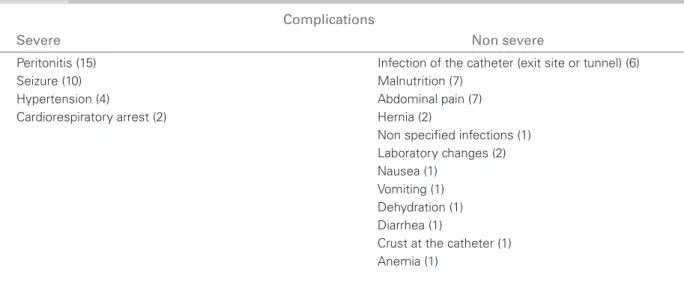
According to the interviewees, the hospitalizations were due to several complications and to catheter ex-change or repositioning. Table 1 shows the complica-tions leading to hospitalizacomplica-tions and their frequency dis-tribution classified according to severity.
PERITONITIS
The most common causative agents of peritonitis in the patients studied were Staphylococcus aureus
and Staphylococcus epidermidis, and, in some ca-ses, Enterococcus sp. Peritonitis was reported by 15 (50%) caregivers at the frequency shown in Figure 1.
ASSOCIATIONSBETWEENTHEVARIABLESSTUDIED
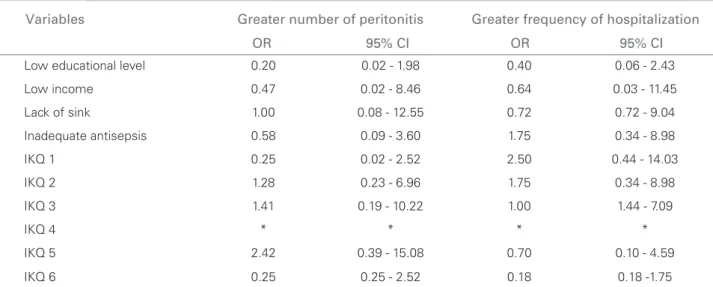
Based on data collected and the classification of the sample studied, possible associations were sought between the frequency of peritonitis and hospitali-zations and the variables shown in Table 2 by using odds ratio calculation. The confidence interval used was 95%. The OR values were within the limits of the confidence intervals, and, in some cases, they were smaller than 1, indicating the possibility of a negative association between some independent variables and the variables studied, although with no statistically significant difference.
The possibility of association between the quality of the dialysis technique, the frequency of peritonitis (OR = 1.90 and CI = 0.38 – 9.59) and the frequency of hospita-lizations (OR = 1.60 and CI = 0.35 – 7.30) was assessed and is shown in Table 3. Although the OR was > 1, in-dicating the possibility of a positive association between the independent variable and the variable studied in both cases, no statistically significant difference was observed.
The results shown in tables 2 and 3 did not eviden-ce the preseneviden-ce of a risk factor among the variables studied.
D
ISCUSSIONHOSPITALIZATIONSAND PERITONITIS
Data of the USRDS10 have reported infection, mainly peritonitis, as the most frequent initial cause of hos-pitalization for PD children, while the NAPRTCS11 records have identified peritonitis as the major cause for changing dialysis technique.
CAPD and APD, and it is also of great significance for hospitalization, catheter loss, malnutrition, peritoneal membrane failure, change in dialysis technique, and, eventually, death.4,10,12,13,14,15
Other dialysis complications, such as infections, es-pecially infections of the peritoneal catheter exit site and tunnel, have been reported by six (20%) caregivers, being usually associated with poor hygiene, manipula-tion by patients and/or colonizamanipula-tion by bacteria of their own skin, predisposing to peritonitis.
Peritonitis is still the major factor of morbidity and mortality of PD patients. The occurrence of peritonitis may indicate a flaw in the procedure and/or lack of com-mitment from the caregiver to the patient, in addition
to resulting in hospitalization and time spent away from home and family. Despite all that, with the advances in the treatments of peritonitis and changes in medical ma-nagement, those patients have been benefited, and the treatment can be performed at home, with the use of an-tibiotics in dialysis bags during the procedure.
In the present study, of the 23 (77%) reports of hos-pitalization, 15 (65%) related to hospitalization for trea-ting peritonitis. Despite the elevated number of episodes of peritonitis, its incidence has decreased over the years in the patients cared for at HC/UFMG, which may be explained by the intensification of home visits performed by the team responsible for training for PD, and also by the conversion from the CAPD to APD technique.
Table 1 COMPLICATIONS RELATED TO PERITONEAL DIALYSIS THAT CAUSED HOSPITALIZATION, REPORTED BY THE CAREGIVERS
Complications
Severe Non severe
Peritonitis (15) Infection of the catheter (exit site or tunnel) (6)
Seizure (10) Malnutrition (7)
Hypertension (4) Abdominal pain (7)
Cardiorespiratory arrest (2) Hernia (2)
Non specifi ed infections (1) Laboratory changes (2) Nausea (1)
Vomiting (1) Dehydration (1) Diarrhea (1)
Crust at the catheter (1) Anemia (1)
*(number of reports for the respective complications informed).
COMPLICATIONS RELATED TO PERITONEAL DIALYSIS THAT CAUSED HOSPITALIZATION, REPORTED BY THE CAREGIVERS Table 1
Figure 1. Report of frequency of peritonitis.
more than twice
10 33%
once or twice 5 17%
Table 3 QUALITY OF DIALYSIS TECHNIQUE VS. FREQUENCY OF PERITONITIS, AND QUALITY OF DIALYSIS TECHNIQUE VS. FREQUENCY OF HOSPITALIZATION
Quality of the technique
Condition Inadequate Adequate Total
Higher number of peritonitis 38.9% 25.0% 33.3%
Lower number of peritonitis 61.1% 75.0% 66.7%
Total 100.0% 100.0% 100.0%
High frequency of hospitalizations 44.4% 33.3% 40.0%
Low frequency of hospitalizations 55.6% 66.7% 60.0%
Total 100.0% 100.0% 100.0%
Table 2 ODDSRATIO AND CONFIDENCE INTERVAL OF THE VARIABLES STUDIED AND ASSOCIATION WITH FREQUENCY OF PERITONITIS AND OF HOSPITALIZATION
Variables Greater number of peritonitis Greater frequency of hospitalization
OR 95% CI OR 95% CI
Low educational level 0.20 0.02 - 1.98 0.40 0.06 - 2.43
Low income 0.47 0.02 - 8.46 0.64 0.03 - 11.45
Lack of sink 1.00 0.08 - 12.55 0.72 0.72 - 9.04
Inadequate antisepsis 0.58 0.09 - 3.60 1.75 0.34 - 8.98
IKQ 1 0.25 0.02 - 2.52 2.50 0.44 - 14.03
IKQ 2 1.28 0.23 - 6.96 1.75 0.34 - 8.98
IKQ 3 1.41 0.19 - 10.22 1.00 1.44 - 7.09
IKQ 4 * * * *
IKQ 5 2.42 0.39 - 15.08 0.70 0.10 - 4.59
IKQ 6 0.25 0.25 - 2.52 0.18 0.18 -1.75
OR = odds ratio; CI = 95% confi dence interval; IKQ.: inadequate knowledge relating to the corresponding question.
The observations number equals 30. *Correspond to 30 adequate answers (100%) to the question proposed.
ODDSRATIOIO AND CONFIDENCE INTERVAL OF THE VARIABLES STUDIED AND ASSOCIATION WITH FREQUENCY OF PERITONITIS AND CONFIDENCE INTERVAL OF THE VARIABLES STUDIED AND ASSOCIATION WITH FREQUENCY OF PERITONITIS
AND OF HOSPITALIZATION Table 2
QUALITY OF DIALYSIS TECHNIQUE VS. FREQUENCY OF PERITONITIS, AND QUALITY OF DIALYSIS TECHNIQUE VS. FREQUENCY OF HOSPITALIZATION
Table 3
Table 3 OF HOSPITALIZATION
The reports of peritonitis informed by caregivers cor-responded to patients who were on dialysis treatment for at least 1.4 year and a maximum of 9.7 years.
The short time on dialysis may have accounted for the lack of peritonitis of six (40%) patients among 15 (50%) in that condition. Those six patients were on dialysis for slightly over three months. In addition, the short dialysis time, change to another therapeutic modality, or renal transplantation may have contributed to the lack of peri-tonitis in nine patients. Those data suggest an association between peritonitis and PD time.
DISCUSSIONOFTHE STATISTICAL RESULTS
The possibility of an association between the varia-bles studied, by using the OR calculation and the
confidence interval of their values to evaluate their statistical significance, was assessed.
No association between the variables tested was ob-served, probably due to the sample size (30 patients).
Multicenter studies, including all the pediatric po-pulation on DP in the State of Minas Gerais or even in Brazil, may be able to confirm the associations of not only those but also other variables related to that type of treatment for CKD. Thus, more information may be provided for improving renal replacement therapies and the quality of life of that population.
EDUCATIONALLEVELOFTHEMAJORCAREGIVER
care, and also to improve the understanding of the rules and instructions provided, indispensable for treatment.
A low educational level did not interfere with the fre-quency of peritonitis and hospitalizations, a fact possibly explained by the reduced size of the sample studied (30 patients).
PERCAPITAINCOME
The per capita income of the families studied was lower than one minimum wage per person in 28 (93%) cases, indicating a low socioeconomic profile in most patients with CKD on dialysis cared for at the Pediatric Nephrology Unit of the HC/UFMG.
In accordance with the low per capita income, we observed that 13 (43%) homes visited were under cons-truction. The household conditions were often poor, ina-dequate for the patient’s treatment, lacking enough room for the necessary equipment.
PRESENCEOFASINKINTHEDIALYSISROOM
In our study, the lack of a sink in the dialysis room did not prove to be a risk factor for peritonitis and hospitalizations. That may be explained not only by the small sample size (30 patients), but also by the re-duced number of dialysis rooms without a sink (3/30 = 10%).
HANDANTISEPSIS
Peritoneal dialysis requires the use of a product ade-quate and sufficient for antisepsis of the hands and peritoneal catheter. The duration and frequency of the antisepsis depends on the dialysis modality used.
The duration and frequency of hand antisepsis, ac-cording to the type of dialysis modality, recommended during the training conducted by the nurses, have funda-mental importance for dialysis practice, and, when not properly performed, they jeopardize the procedure.
A tendency towards a reduction in the frequency of hospitalization is observed when hand antisepsis is ade-quate; however, in this study, that variable did not favor the reduction in the number of episodes of peritonitis, a situation probably concealed by other forms of contami-nation at least as important as that.
CAREGIVER’SKNOWLEDGE
Although with no statistical significance, the follo-wing was observed:
• Inadequate knowledge, assessed through ques-tions 1 and 2 (table 2), tends to be a risk factor for a grea-ter frequency of hospitalizations, suggesting the probable
need for retraining primary basic knowledge, aiming at contributing to the reduction in hospitalizations and a possible improvement in performing the procedure.
• Inadequate knowledge, assessed through questions 2, 3, and 5 (table 2), was characterized by the following: when the caregiver did not understand the question; did not know or forgot the instructions; did not have an appropriate notion of which care procedures required permanent attention regarding the patient and dialysis; did not know when to seek for medical aid. Those si-tuations tend to increase the incidence of complications and be a risk factor for peritonitis. Those findings may suggest that the caregiver was not paying enough atten-tion to important issues for minimizing the occurrence of complications.
• Regarding knowledge assessed through question 4 (table 2), all 30 caregivers knew the aspect the drai-ned fluid should have, and responded properly to the question. That topic is highly emphasized by the caring team, as it may indicate possible flaws in the caregiver’s PD practice, in addition to be, when altered, a sign of peritonitis.
• Contrary to what was expected, for knowledge assessed through question 6 (table 2), that is, the ques-tion that asked for a detailed descripques-tion of the PD tech-nique, no association was observed with peritonitis and hospitalization.
Those findings were possible through home visits, which should be frequent and represent one of the tools used not only by the primary health care in programs of family health, but also by the specialized care, represen-ted in this study by HC/UFMG.
The home visits and the contact with patients and fa-milies inspire confidence and commitment. Good intra- and extra-hospital relations are some essential tools for caring for patients with CKD.
Home visit is a door to the knowledge of reality, and may represent a form of inviting the patient and his/her family to work their material and cultural possibilities in their own favor, improving compliance and reducing complications.
C
ONCLUSIONstrict obedience to the instructions provided about PD practice; commitment and involvement of the fa-mily and especially of the caregiver. Those variables may even contribute to the reduction in the num-ber of clinical intercurrent findings and consequent hospitalizations.
R
EFERENCES1. Lima EM, Diniz JSS. Insuficiência Renal Crônica. In: Leão E, Viana MB, editores. Pediatria Ambulatorial. 3ª ed. Belo Horizonte: Coopmed, 1998, pp. 535-44. 2. Lima EM. Complicações da Insuficiência Renal Crônica.
In: Silva ACS et al. Manual de Urgências em Pediatria. Rio de Janeiro: Medsi; 2003. p.324-339.
3. Warady BA, Schaefer FS. Peritonitis. In: Warady BA, Schaefer FS, Fine RN, Alexander SR, editors. Pediatrics Dialysis. Dordrecht, Kluwer Academic Publishers; 2004. p. 395-413.
4. Tranaeus A. Peritonitis in pediatrics continuous pe-ritoneal dialysis. In: Fine RN, Alexander S. (eds.). CAPD/CCPD in Children. Norwell: Kluwer Academic Publishers; 1998. p. 301-47.
5. Warady BA, Sullivan EK, Alexander SR. Lessons from the dialysis patient database: a report of the North American Pediatric Renal Transplant Cooperative Study. Kidney Int. 1996; 49:S68-71.
6. Barros E, Manfro RC, Thomé FS et al. Nefrologia: Rotinas, Diagnóstico e Tratamento. 2 ed. Porto Alegre: Artes Médicas Sul Ltda, 1999.
7. Monteon F, Correa-Rotter R, Paniagua R et al.
Prevention of peritonitis with disconnect systems in CAPD: a randomized controlled trial. The Mexican Nephrology Collaborative Study Group. Kidney Int 1998; 54:2123-38.
8. Leehey DJ, Lentino, JR. Peritonite e Infecção do Local de Saída. In: Daurgidas JT, Blake PG, Ing TS. Manual de Diálise. 3ª ed. Rio de Janeiro: Medsi; 2003. p: 385-408. 9. North American Pediatric Renal Transplant Cooperative
Study (NAPRTCS) 2003 Annual Report Rockville: EMMES Corporation, 2003.
10. U. S. Renal Data System. USRDS 2003 Annual Data Report: Atlas of End-stage Renal Disease in the United States. National Institutes of Health, National Institutes of Diabetes Digestive and Kidney Disease, Bethesda, MD (online at <www.usrds.org>).
11. Neu A, M HO PL, MCDonald RA, Warady BA. Chronic dialysis in children and adolescents. The 2001 NAPRTCS annual report. Pediatr Nephrol. 2002; 17: 656-63. 12. Barreti P, Montelli AC, Cunha MLRS et al. Atualização
em diálise: Tratamento atual das peritonites em diálise peritoneal ambulatorial contínua. J Bras Nefrol. 2001; 23(2): 114-20.
13. Davies SJ, Phillips L, Griffiths AM et al. What really happens to people on long-term peritoneal dialysis? Kidney Int. 1998; 54:2007-2217.
14. Prasad N, Prasad KN, Grupta A et al. Continuous peri-toneal dialysis in children: a single-centre experience in a developing country. Pediatr Nephrol. 2006;21:403-7. 15. Teitelbaum I, Burkart J. Peritoneal Dialysis. Am J