ORIGINAL
RES
EAR
CH
Correspondence to: Dirceu Costa – Rua Vergueiro, 235/249, Liberdade – CEP: 01504-001 – São Paulo (SP), Brasil – E-mail: [email protected]
Presentation: Nov. 2012 – Accepted for publication: Feb. 2014 – Financing source: National Counsel of Technological and Scientific Development (CNPq), Process n. 305559/2011-7 and Process n. 479256/2011-0 – Conflict of interests: nothing to declare – Approval at the Ethics Committee n. 384767/2011.
ABSTRACT | Chronic obstructive pulmonary disease
(COPD) is related to a low body mass index (BMI), reduced functional capacity and reduced bone density, thus justify-ing the importance of evaluatjustify-ing all of these parameters in the patients with the disease. This is a cross-sectional study, with sample consisting of 20 patients who performed mea-surement of body composition by bioelectrical impedance, evaluation of functional capacity by the distance traveled in the Incremental Shuttle Walk Test (ISWT) and assessment of severity of obstruction by spirometry. Significant differences were found between the travelled and scheduled distance in the ISWT (p<0.01), positive correlations between muscle mass and distance walked in ISWT (r=0.54 with p=0.01), with FEV1 (r=0.488 with p=0.02), FEV1 and bone mass (r=0.497 with p=0.02) and distance traveled with FEV1 (r=0,541 with p=0.01). The correlations found in this study, besides con-firming the hypothesis that the severity of the obstruction presented by the change in the lung parenchyma in pa-tients with COPD is related to changes in body composition and functional capacity reduction, also highlight the correla-tion with bone mass.
Keywords | Body Mass Index; Pulmonary Disease, Chronic Obstructive/physiopathology; Exercise Tolerance.
Assessment of body composition, functional
capacity and pulmonary function in patients with
Chronic Obstructive Pulmonary Disease
Avaliação da composição corporal, capacidade funcional e
função pulmonar em pacientes com Doença Pulmonar Obstrutiva Crônica
Evaluación de la composición corporal, la capacidad funcional y la
función pulmonar en pacientes con Enfermedad Pulmonar Obstructiva Crónica
Fernanda Dultra Dias1, Evelim Leal de Freitas Dantas Gomes1, Roberto Stirbulov2, Vera Lúcia Santos Alves2, Dirceu Costa1
Study conducted in the Laboratory of Respiratory Functional Evaluation (LARESP), Universidade Nove de Julho (UNINOVE) – São Paulo (SP), Brazil.
1Graduate Program in Rehabilitation Sciences by UNINOVE – São Paulo (SP), Brazil. 2Graduate Program at Santa Casa de Misericórdia de São Paulo – São Paulo (SP), Brazil.
RESUMO | A doença pulmonar obstrutiva crônica (DPOC)
está relacionada a um baixo índice de massa corporal (IMC), à redução da capacidade funcional e à redução da densidade óssea, justificando assim a importância de se avaliar todos es-ses parâmetros nos pacientes portadores da doença. Trata-se de um estudo transversal, com amostra composta por 20 pacientes, que realizaram medida de composição corporal por bioimpedância, avaliação da capacidade funcional pela distância percorrida no Incremental Shuttle Walk Test (ISWT) e avaliação da gravidade da obstrução pela espirometria. Foram encontradas diferenças significantes entre a distância percor-rida e prevista do ISWT (p<0,01), correlações positivas entre massa muscular e distância percorrida no ISWT (r=0,54 com p=0,01), com VEF1 (r=0,488 com p=0,02), VEF1 e massa óssea (r=0,497 com p=0,02) e distância percorrida com VEF1 (r=0,541 com p=0,01). As correlações encontradas neste estudo, além de confirmarem a hipótese de que a gravidade da obstrução apresentada pela alteração no parênquima pulmonar nos pacientes com DPOC está relacionada com as alterações na composição corporal e com a redução da capacidade funcio-nal, evidenciam também a correlação com a massa óssea.
INTRODUCTION
Chronic obstructive pulmonary disease (COPD) is a disease that affects primarily the lungs, but it also has significant systemic consequences that lead to the intolerance to physical exercises and activities of daily life. This systemic compromise has been re-lated to survival and general status of patients with the disease1,2.
Dyspnea generated by changes in lung paren-chyma leads patients to chronic sedentary life-style. This cycle of dyspnea and sedentary lifestyle promotes peripheral muscular hypotrophy and reduced aerobic capacity, thus resulting in more intense ventilatory demand for dynamic activi-ties and closing the cycle called dyspnea-sedentary lifestyle-dyspnea3,4.
Common characteristics in patients with COPD, such as low body mass index (BMI), history of smoking, age, inactivity, systemic inlammation and systemic cor-ticorteroids are important risk factors for osteoporosis. he severity of COPD is related to the loss of vertebral bone mineral density5.
Killian et al.6 irst described the importance of this musculoskeletal change in the physical ability of pa-tients with COPD, once papa-tients complained about muscle without necessarily complaining about dyspnea during physical activity.
Diferent studies5,7 relate the severity of COPD with low BMI and with bone density, among other factors, associated with the presence of vertebral frac-tures. However, there are a few studies relating the functional capacity, by means of ield tests, with body composition, especially with the use of reliable meth-ods, such as electric bioimpedance. Studies that prove the correlation of these measures are important, once
the evaluation of body composition requires special-ized devices that are not accessible, while ield tests are easy to perform and apply.
Based on that, the objective of this study was to verify if there is a relationship between the different items of body composition, such as functional ca-pacity and the severity of the condition in patients with COPD.
METHODOLOGY
his cross-sectional study was approved by the Ethics Committee of UNINOVE (protocol n. 384767/2011), and the sample was comprised of 20 patients di-agnosed with COPD in outpatient follow-up, coming from the pneumology outpatient clinic of
Santa Casa de Misericórdia de São Paulo (AME) “Dr.
Geraldo Bourrol”.
Patients from both genders were included, aged more than 40 years old and diagnosed with COPD according to criteria from the Global Initiative for Chronic Obstructive Lung Disease (GOLD). hey should be clinically stable, without presenting picture of disease exacerbation in the past 30 days, and they could not be part of any program involving physical activity concomitantly.
Patients with severe comorbidities, such as pre-vious heart disease, orthopedic conditions in upper and lower limbs, motor or visual sequelae from neu-rological disease that might interfere with the abil-ity to perform physical exercises, uncontrolled arte-rial hypertension, associated pulmonary disease and those that did not agree to participate in this study were excluded.
RESUMEN | La enfermedad pulmonar obstructiva crónica
(EPOC) está relacionada con un bajo índice de masa corporal (IMC), reducción de la capacidad funcional y reducción de la densidad ósea, justificando así la importancia de evaluar todos estos parámetros en pacientes con la enfermedad. Este es un estudio transversal, con una muestra de 20 pacientes, que se sometieron a la medición de la composición corporal por bioim-pedancia, la evaluación de la capacidad funcional por la distan-cia recorrida en el Incremental Shuttle Walk Test (ISWT) y la eva-luación de la gravedad de la obstrucción por la espirometría. Se encontraron diferencias significativas entre la distancia recorri-da y prevista del ISWT (p<0,01), correlaciones positivas entre la
masa muscular y la distancia en el ISWT (r=0,54 con p=0,01), con FEV1 (r=0,488 con p=0,02 ), FEV1 y la masa ósea (r=0,497 con p=0,02) y la distancia recorrida con el FEV1 (r=0,541 con p=0,01) . Las correlaciones encontradas en este estudio, además de confirmar la hipótesis de que la gravedad de la obstrucción presentada por los cambios en el parénquima pulmonar en pa-cientes con EPOC se asocia con cambios en la composición corporal y la reducción de la capacidad funcional, evidencian también la correlación con la masa ósea.
Procedures
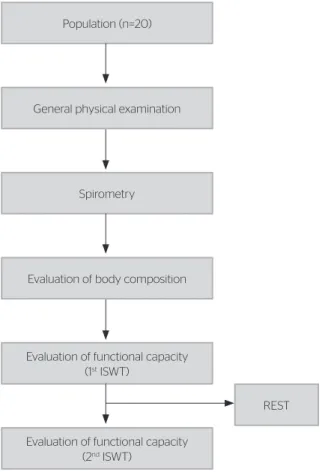
Data about past and current history of the disease were collected, and a general physical examination was con-ducted to ensure the impossibility of exacerbation. Afterwards, the assessment of the severity of obstruction, body composition and functional capacity was conducted according to the following lowchart (Figure 1).
Spirometry
All of the patients were submitted to spirometric evalu-ation to classify the severity of obstruction, and the fol-lowing pulmonary volumes, capacities and lows were registered: Slow Vital Capacity (VC), Forced Vital Capacity (FVC) and its derivations, such as Forced Expiratory Volume in one second (FEV1) and the ra-tios (FEV1/FVC and FEV1/VC). he test consisted of maximal inspiratory and expiratory maneuvers, which were conducted in the device, until it was possible to register three reproducible maneuvers according to the recommendations8. All of the tests were conducted in a climatized environment, by means of previously cali-brated PFT KoKo® spirometer. he used reference val-ues were in accordance with Pereira et al.9.
Incremental Shuttle Walk Test
he Incremental Shuttle Walk Test (ISWT), which aims at assessing the functional capacity of the pa-tient, was conducted by a trained evaluator in a 10 meter long corridor with two cones placed 0.5 meter from the end of the route (in order to minimize abrupt direction changes) and with the support of a beeping sound device, that guided the test. he beginning of the test was indicated by a triple beep. Afterwards, this device emitted a single beep in regular intervals, which warned when the subject should leave one ex-tremity of the route to the other, before a new beep was emitted. Each new cycle initiated by a beep pre-sented incremented speed standardized by Singh10. he explanation for the patients was standardized and demonstrated before each test. Each patient was advised to walk at a constant pace, aiming to go around the cone and continuing to walk until feel-ing unable to maintain the necessary speed to reach the other extremity of the route before the next beep, without being extremely out of breath. During the whole test, data concerning heart rate (HR), periph-eral oxygen saturation (SpO2), blood pressure (BP), respiratory frequency (RF), sensation of dyspnea and lower limb fatigue by the Borg scale were monitored. hese data were written down every new stage of the test. Oxygen supplementation could be performed in case the patient presented with desaturation below 80%. he test was performed twice, according to the recommendations by Singh10, with the objective of eliminating possible learning efects. Between each performed test, a 15-minute break was given to the patient in order for him or her to recover, so that his or her vital signs could return to basal levels10.
Body composition
he body composition of patients was assessed by means of an electrical bioimpedance balance, from Tanita™ BIA (foot to foot). Patients were instruct-ed to respect the following instructions: not to eat or drink 4 hours before the test; not to ingest cafeine or alcohol 12 hours prior to the test; not to perform physical activities 6 hours before the test; and urinate 30 minutes before the test.
he measuring electrode was located on the feet platform, and reading was performed by the direct contact with the skin, which had been previously cleaned with 70% alcohol. he patient was advised to
Figure 1. Experimental procedure Population (n=20)
General physical examination
Spirometry
Evaluation of body composition
Evaluation of functional capacity (1st ISWT)
Evaluation of functional capacity (2nd ISWT)
REST
stand on the scale on orthostatic position for the time established by the device. Body composition calcula-tions were provided automatically by the scale itself, based on the data inserted by the evaluator about height, sex and age of each patient. Comparison data to what was expected for the sex were provided by the manufacturer11.
Statistical analysis
After submission to the Kolmogorov Smirnov (KS) test, non-parametric data of the predicted value and the obtained one were analyzed by the non-paired t-test and the Wilcoxon test. For the correlation of parametric data, the Pearson correlation was used, and for non-parametric variables, the Spearman cor-relation was used. Relevant results were those pre-senting 5% signiicance level (p≤0.05). he software Minitab 14 was used.
he sample power was calculated in 90%. By as-suming a 0.05 alpha error, based on a study that de-termines the clinically signiicant diference for the Incremental Shuttle Walking Test in 78.7 meters, and the standard-deviation being calculated by a 98.59 meter pilot-study, the considered sample num-ber was not lower than 16.
RESULTS
Results were organized in tables, for each variable, by mean and standard-deviation, or interquartile inter-val according to the nature of the analyzed data.
It is Worth to mention that in the previous evalu-ation conducted with the patients, no case of clinical picture exacerbation was detected, because they were all stable to be included in the proposed protocol. Anthropometric and spirometric data of the studied sample are presented in Table 1.
During the ISWT, initial and final measures were registered referring to the percentage of HR, SpO2, as well as the report of dyspnea and lower extremity fatigue, by the Borg scale, and also BP. According to the results of Table 2, none of these variables presented any clinical or statistically sig-nificant changes.
he non-paired t-test was applied for the predict-ed and the courspredict-ed distance in ISWT, and a signii-cant diference with p<0.01 was found.
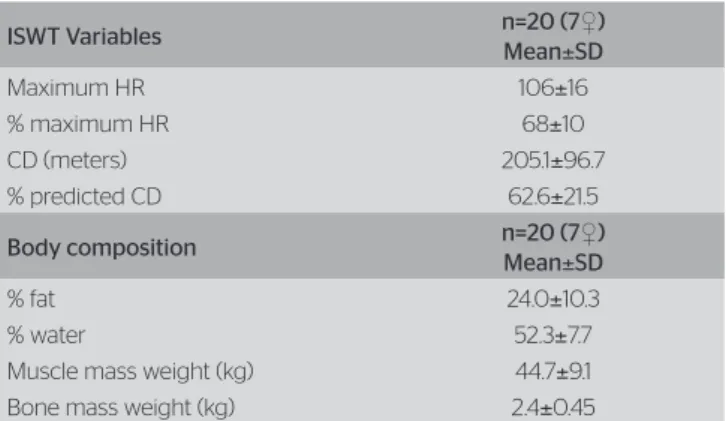
he results of the test and the results of body com-position, obtained by bioimpedance, are also found in Table 2, in mean and standard-deviation of the following variables: fat percentage, water percentage, muscle mass weight and bone mass weight.
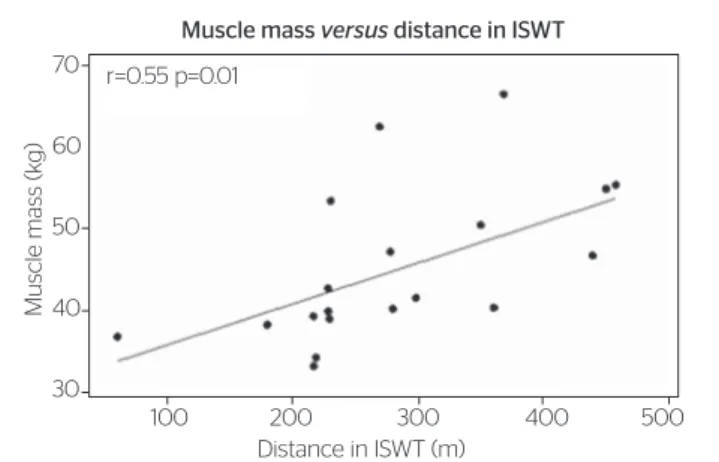
he distance coursed in ISWT presented moderate correlation with muscle mass (as presented in Figure 2).
he distance coursed in ISWT also presented sim-ilar positive correlation with FEV1 (r=0.54; p=0.01),
FEV1 also presented correlation with thin and bone mass, as illustrated in Figures 3 and 4.
DISCUSSION
According to literature, patients with COPD have reduced physical abilities1-4, which have been as-sessed by means of the coursed distance in ISWT, in comparison to predicted values for each individual
Table 1. Mean and standard-deviation of the anthropometric (age, weight, height and body mass index) and spirometric variables (in liters and percentage of the predicted value)
Anthropometric variables n=20 (7♀)
Mean±SD
Age (years) 65.9±5.4
Weight (kg) 63.69±17.9
Height (m) 1.62±0.1
BMI (kg/m2) 24.1±5.8
Spirometric variables n=20 (7♀)
Mean±SD
FVC (L) 3.08±0.8
FVC (% predicted) 86.5±22.1
FEV1 (L) 1.53±0.69
FEV1 (% predicted) 57.1±20.9 FEV1/FVC (L) 0.53±0.1 FEV1/FVC (% predicted) 67.0±16.5
BMI: Body mass index; FVC: Forced Vital Capacity; FEV1: Forced Expiratory Volume in one second; FEV1/FVC: Ratio FEV1/FVC, % predicted: percentage of the predicted value; ♀: women; SD: standard deviation
Table 2. Means and standard-deviation of the Incremental Shuttle Walk Test and body composition
ISWT Variables n=20 (7♀)
Mean±SD
Maximum HR 106±16
% maximum HR 68±10
CD (meters) 205.1±96.7 % predicted CD 62.6±21.5
Body composition n=20 (7♀)
Mean±SD
% fat 24.0±10.3
% water 52.3±7.7
Muscle mass weight (kg) 44.7±9.1 Bone mass weight (kg) 2.4±0.45
ISWT: Incremental Shuttle Walk Test; HR: heart rate; %: percentage; CD: coursed distance;
Bone mass versus FEV
1
FEV
1
(I)
Bone Mass (kg) 3.0
2.5
2.0
1.5
1.0
0.5
2.0 2.4 2.8 3.2 3.6 r=0.50 p=0.02
Figura 4. Correlation between forced expiratory volume in one second and bone mass
Muscle mass versus distance in ISWT
Muscle mass (k
g)
Distance in ISWT (m) 70
60
50
40
30
100 200 300 400 500
r=0.55 p=0.01
Figure 2. Correlation between coursed distance in the Incremental Shuttle Walk Test and muscle mass weight
Muscle mass versus FEV 1
FEV
1
(I)
Muscle mass (kg) 3.0
2.5
2.0
1.5
1.0
0.5
30 40 50 60 70
r=0.49 p=0.02
Figure 3. Correlation between muscle mass and forced expiratory volume in one second
according to age, weight, height and gender12. his is in accordance with our indings, which also revealed signiicant diference between the coursed distance by the patients with COPD and the predicted dis-tance in ISWT. hese physical ability results have been considered to be essentially important to ex-press the functional capacity of patients with COPD, according to literature7,13,14.
With regard to body composition, even though Pelegrino et al.15 stated that the reduced muscle mass is correlated to worse physical performance in relation to the presented fatigue, not being directly related to the reduced coursed distance in ield tests, indings from other studies in literature showed up to 60% variation in the 12-minute walk test16, and positive signiicant correlation between muscle mass and the result of the 6-minute walk test17. With these ind-ings, with our results we could conirm the correlation between muscle mass and the distance coursed also in ISWT, besides the correlation between pulmonary function and bone mass, which was not explored in that context in literature.
he correlation we found between FEV1 and the coursed distance in ISWT is in accordance with the deconditioning concept, which is related to this population, since the lack of muscle use, especially peripheral muscles, due to the intense dyspnea pre-sented by these patients during physical activities, leads them to present with muscle atrophy. he more severe the patient (lower FEV1), the lower the func-tional capacity due to the lower muscle recruitment during activities of daily life. his inding is in ac-cordance with the review by Nasis et al.7, who also explained the lack of use of peripheral muscles as the cause of reduced muscle mass.
Besides this direct relationship between muscle mass and physical performance, which is well documented, especially among athletes, it is important to consider the possible correlations between the decreased pulmo-nary function and bone mass changes, especially in this population of patients with COPD, who are also elders. he level of pulmonary obstruction, demonstrated by the decreased FEV1, is also associated with the risk of osteoporosis, since Kjensli18 has detected that the num-ber of vertebral deformities is twice as high among women with COPD, GOLD III, in comparison to those who presented with GOLD II. By using the bio-impedance we could observe that the bone mass weight was correlated with the severity of the disease, observed by the decreased FEV1.
Even though the bone mass evaluation did not earn much attention from patients with COPD, these results are important especially because all of the patients in the sample had been on corticoids for at least ten years. he most severe cases used higher doses, for longer pe-riods of time, and the predisposition to osteoporosis ISWT: Incremental Shuttle Walk Test FEV1 : forced expiratory volume in one second
and fractures are related to the use of corticosteroids, as explored by Vestergaard19.
It is important to consider some limitations in this study, especially the absence of a Control Group. However, the found results not only conirmed previous indings in literature, but they also called the attention to other aspects besides pulmonary function, as its relation-ship with the compromised physical performance, partic-ularly with body composition. herefore, they can subsi-dize treatment programs, especially of Cardiorespiratory and Musculoskeletal Physical herapy, therefore, the lower the ability for exercise presented in ield tests, the higher the severity of the disease and the higher the risk of fractures and bone deformities. herefore, the pre-scription of physical exercise should approach not only deconditioning, but protective and guidance activities. In some situations, a multiprofessional approach, such as the nutritional program for gaining thin mass, is also valid.
CONCLUSION
he correlations found in this study conirm the hy-pothesis that the severity of the obstruction presented by changes in the lung parenchyma in patients with COPD is related to changes in body composition and to the reduced functional capacity. Particularly, it is im-portant to consider the importance of assessing other aspects besides the pulmonary function of patients with COPD, especially the correlation of pulmonary func-tion and bone mass.
REFERENCES
1. Wouters EF. Local and systemic inflammation in chronic obstructive pulmonary disease. Proc Am Thorac Soc. 2005;2(1):26-33.
2. Halpin DMG, Tashkin DP. Defining disease modification in chronic obstructive pulmonary disease. COPD. 2009;6(3):211-25.
3. Dourados V, Tanni SE, Vale AS, Faganello MM, Sanchez FF, Godoy I. Systemic manifestations in chronic obstructive pulmonary disease. J Bras Pneumol. 2006;32(2):161-71.
4. Glaab T, Vogelmeier C, Buhl RR. Outcome measures in chronic obstructive pulmonary disease (COPD): strengths and limitations. Respir Res. 2010;11(79):2-11.
5. Kiyokawa Hr, Muro S, Oguma T, Sato S, Tanabe N, Takahashi T, et al. Impact of COPD exacerbations on osteoporosis assessed by chest CT scan. COPD. 2012;9(3):235-42.
6. Killian KJ, Leblanc P, Martin DH, Summers E, Jones NL, Campbell EJ. Exercise capacity and ventilatory, circulatory, and symptom limitation in patients with chronic airflow limitation. Am Rev Respir Dis. 1992;146(4):935-40.
7. Nasis I, Kortianou EA, Clini E, Koulouris NG, Vogiatzis I. Efect of rehabilitative exercise training on peripheral muscle remodelling in patients with COPD: targeting beyond the lungs. Curr Drug Targets. 2013;14(2):262-73.
8. Coates AL. Re: Coates AL, Graham BL, McFadden RG, McParland C, Provencher S, Road J. Spirometry in primary case. Can Respir J. 2013;20:13-22. Can Respir J. 2013:20(2);122.
9. Pereira CAC, Barreto SP, Simöes JG, Pereira FWL, Gerstler JG, Nakatani J. Valores de referência para a espirometria em uma amostra da população brasileira adulta. J. Pneumol. 1992;18(1):10-22.
10. Singh SJ, Jones PW, Evans R, Morgan MD. Minimum clinically important improvement for the incremental shuttle walking test. Thorax 2008;63(9):775-7.
11. Kyle UG, Bosaeus I, De Lorenzo AD, Deurenberg P, Elia M, Manuel Gómez J, et al. Bioelectrical impedance analysis-part II: utilization in clinical practice. Clin Nutr. 2004;23(6):1430-53.
12. Dourado VZ, Vidotto MC, Guerra RL. Equações de referência para os testes de caminhada de campo em adultos saudáveis. J Bras Pneumol. 2011;37(5):607-14.
13. Hallin R, Janson C, Arnardottir RH, Olsson R, Emtner M, Branth S, et al. Relation between physical capacity, nutritional status and systemic inflammation in COPD. Clin Respir J. 2011;5(3):136-42.
14. Mangueira NM, Viega IL, Mangueira MAMM, Pinheiro NA, Maria do Costa MRSR. Correlação entre parâmetros clínicos e qualidade de vida relacionada à saúde em mulheres com DPOC. J Bras Pneumol. 2009;35(3):248-55.
15. Pelegrino NR, Lucheta PA, Sanchez FF, Faganello MM, Renata Ferrari R, Godoy I. Influência da massa magra corporal nas repercussões cardiopulmonares durante o teste de caminhada de seis minutos em pacientes com DPOC. J Bras Pneumol. 2009;35(1):20-6.
16. Schols AM, Mostert R, Soeters PB, Wouters EF. Body composition and exercise performance in patients with chronic obstructive pulmonary disease. Thorax. 1991;46(10):695-9.
17. Ischaki E, Papatheodorou G, Gaki E, Papa I, Koulouris N, Loukides S. Body mass and fat-free mass indices in COPD: relation with variables expressing disease severity. Chest. 2007;132(1):164-9.
18. Kjensli A, Falch JA, Ryg M, Blenk T, Armbrecht G, Diep LM et al. High prevalence of vertebral deformities in COPD patients: relationship to disease severity. Eur Respir J. 2009;33(5):1018-24.