Synthesis and Biological Evaluation of
3-Alkyl-1,5-Diaryl-1
H
-Pyrazoles as Rigid
Analogues of Combretastatin A-4 with Potent
Antiproliferative Activity
Qile Xu1, Huan Qi2, Maolin Sun1, Daiying Zuo2, Xuewei Jiang2, Zhiyong Wen1, Zhiwei Wang1, Yingliang Wu2*, Weige Zhang1*
1Department Key Laboratory of Structure-Based Drug Design and Discovery Ministry of Education, Shenyang Pharmaceutical University, Shenyang, China,2Department of Pharmacology, Shenyang Pharmaceutical University, Shenyang, China
*[email protected](YW);[email protected](WZ)
Abstract
A series of novel 3-alkyl-1,5-diaryl-1H-pyrazoles were synthesized as combretastatin A-4 (CA-4) analogues and evaluated for antiproliferative activity against three human cancer cell lines (SGC-7901, A549 and HT-1080). Most of the target compounds displayed moder-ate to potent antiproliferative activity, and7kwas found to be the most potent compound. Structure-activity relationships indicated that compounds with a trimethoxyphenyl A-ring at the N-1 position of the pyrazole skeleton were more potent than those with the A-ring at the C-5 position. Tubulin polymerization and immunostaining experiments revealed that7k po-tently inhibited tubulin polymerization and disrupted tubulin microtubule dynamics in a man-ner similar to CA-4. Computational modelling demonstrated that the binding of7kto the colchicine binding site on microtubules may involve a similar mode as CA-4.
Introduction
Microtubules are an essential component of the cytoskeleton and have many cellular functions, including regulation of motility, cell division, organelle transport, maintenance of cell mor-phology and signal transduction [1]. Their importance in mitosis and cell division make micro-tubules an obvious and important target for the design and development of antitumour drugs [2]. Microtubule-targeting agents can be grouped into two classes: those that inhibit the poly-merization process (microtubule destabilising agents) and those that promote the polymeriza-tion of tubulin (microtubule stabilising agents) [3]. Both classes disrupt microtubule/tubulin dynamics by binding to the protein tubulin, anα,β-heterodimer that forms the core of the mi-crotubule and arrests cells during mitosis, leading to cell death. There are at least four charac-terised binding sites on tubulin: the taxane site, the laulimalide site, the vinca site and the colchicine site [4]. Many compounds that bind tubulin, such as paclitaxel, vinblastine and eri-bulin, are in clinical use for chemotherapy, and these drugs act by binding to the taxane site or
a11111
OPEN ACCESS
Citation:Xu Q, Qi H, Sun M, Zuo D, Jiang X, Wen Z, et al. (2015) Synthesis and Biological Evaluation of 3-Alkyl-1,5-Diaryl-1H-Pyrazoles as Rigid Analogues of Combretastatin A-4 with Potent Antiproliferative Activity. PLoS ONE 10(6): e0128710. doi:10.1371/ journal.pone.0128710
Academic Editor:Mohammad Shahid, Aligarh Muslim University, INDIA
Received:December 17, 2014
Accepted:April 29, 2015
Published:June 10, 2015
Copyright:© 2015 Xu et al. This is an open access article distributed under the terms of theCreative Commons Attribution License, which permits unrestricted use, distribution, and reproduction in any medium, provided the original author and source are credited.
Data Availability Statement:All relevant data are within the paper and its Supporting Information files.
the vinca site. While there are no clinically approved anticancer agents that bind to the colchi-cine site on tubulin, a number of effective inhibitors of tubulin are currently being investigated in clinical studies [5].
Combretastatin A-4 (CA-4,1) is one of the most effective inhibitors of tubulin found to bind to the colchicine site and whose impressive vascular disrupting activity leads to its clinical development [6]. CA-4 (1) was first isolated by Pettit et al. from the bark of the South African willow treeCombretum caffrumin 1989 [7], and it exhibits potent antiproliferative activity against a broad spectrum of human cancer lines, including those that show multidrug resis-tance [8]. Unfortunately, thecisdouble bond of1readily isomerizes to the more stabletrans
isomer under external stimuli, such as light or heat, resulting in complete loss of cytotoxicity [9]. Therefore, to retain the appropriate configuration of the two adjacent aryl groups required for bioactivity, researchers have synthesized a wide variety ofcis-restricted analogues of1 [4,10,11]. Structure-activity relationship (SAR) studies indicated that the common key struc-tural feature of these analogues was twocis-orientated aromatic rings, the A-ring and B-ring, with the A-ring preferred as a 3,4,5-trimethoxy-substituted phenyl group and the B-ring pre-ferred as ap-methoxy-substituted phenyl group [12].
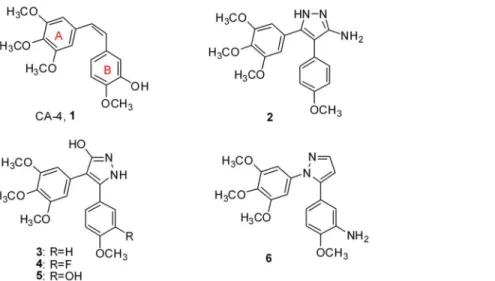
To date, a variety of five-membered heterocyclic analogues of1, such as oxazoles [13], isoxa-zoles [14], imidazoles and triazoles [15,16], have been reported ascis-restricted, biologically ac-tive analogues of CA-4. Because pyrazoles play an important role among biologically acac-tive heterocyclics [17–19], several pyrazole-based CA-4 analogues (Fig 1) such as 3-substituted-4,5-diaryl-pyrazoles (2,3,4and5) and 1,5-diaryl-pyrazole (6) were synthesized and evaluated [15,20,21]. Herein, we present the synthesis and antiproliferative activity of 4-(un)substituted-3-alkyl-1,5-diaryl-pyrazoles (7a-s) with the A-ring on the 1-position and 3-methyl-1,5-diaryl-pyrazoles (8a-i) with the A-ring on the 5-position, as analogues of combretastatin A-4 (Fig 2). The representative compounds7iand7kwere investigated for their inhibition of tubulin poly-merization. In addition, computational modelling studies have been performed to understand the interaction between tubulin and the most active inhibitor7k.
Results and Discussion
Chemistry
The synthesis of target pyrazole derivatives7a-swere performed according toFig 3. 3,4,5-Tri-methoxy-benzoic acid (9) was treated with concentrated nitric acid in acetic acid at 40°C to yield 1,2,3-trimethoxy-5-nitrobenzene (10), which was then reduced to amine11with hydrazine, fer-ric chloride hexahydrate and activated carbon in methanol at 65°C [22,23]. 3,4,5-Trimethoxy-phenylhydrazine hydrochloride (12) was prepared from11viadiazotization with sodium nitrite, followed by reduction with stannous chloride dihydrate [24]. Compounds14a-gwere prepared
viaa Claisen condensation between13a-gand ethyl acetate, ethyl propionate or ethyl butanoate in the presence of sodium [25]. After that compounds14b,14h,14iwere nitrated to give com-pounds14j-l. Subsequently, target compounds7a-hand7p-qwere prepared in excellent yield by treating 1-benzoylacetone14with compound12and sodium acetate trihydrate in ethanol under reflux [26]. Dealkylation of compounds7fand7gwith titanium tetrachloride afforded, respec-tively the phenol derivatives,7jand7i[27]. Reduction of the nitro group of7h,7pand7qin a mixture of hydrazine hydrate, ferric chloride hexahydrate and activated carbon in methanol pro-vided the corresponding7k,7rand7s. Finally,7iwas formylated according to the Vilsmeier-Haack protocol with phosphorus oxychloride and dimethylformamide, and the resulting alde-hyde7lwas reduced to the alcohol7musing sodium borohydride in methanol at room tempera-ture [28]. A mixture of7hand NBS in CCl4was stirred at room temperature to give7nfollowed by reduction of the nitro group to form the desired compound7o[29].
data collection and analysis, decision to publish, or preparation of the manuscript.
The target compounds8a-iwere prepared as shown inFig 4. 3,4,5-Trimethoxyphenyl-etha-none (15) [30]. The synthesis of16,18and8a-iwas accomplished according to the chemistry described above with the corresponding starting materials.
Biological activities
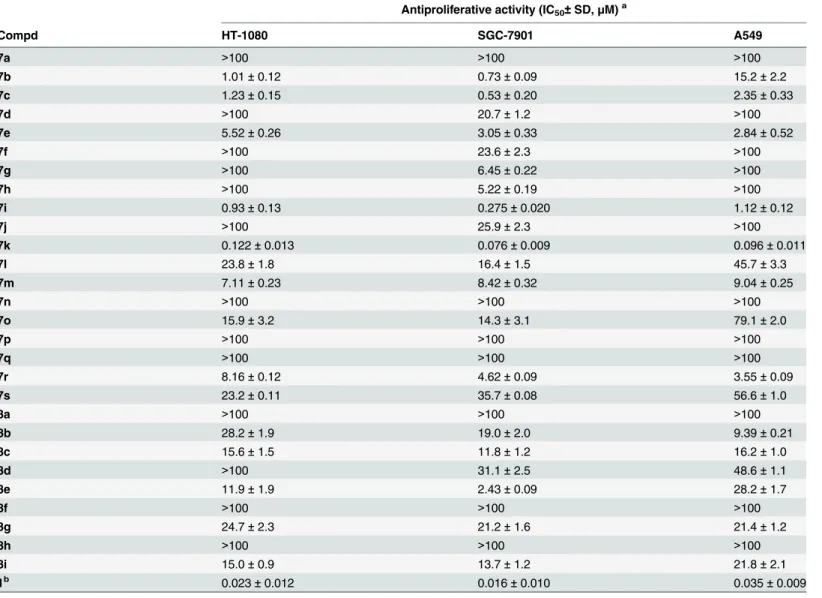
In vitro antiproliferative activities. All of the target compounds,7a-sand8a-i, along with the positive control, CA-4 (1), were evaluated for their antiproliferative activity against three human cancer cell lines: fibrosarcoma cell line HT-1080, gastric adenocarcinoma cell line SGC-7901 and pulmonary adenocarcinoma cell line A549. The majority of synthesized com-pounds displayed antiproliferative activity with IC50values in the sub-micromolar to micro-molar range. The IC50values of the compounds are shown inTable 1.
Fig 2. Structures of the synthesized pyrazole derivatives.
doi:10.1371/journal.pone.0128710.g002
Fig 1. Structures of CA-4 and some pyrazole derivatives.
As given inTable 1, compound7kexhibited the most potent antiproliferative activity, with IC50values between 0.076 and 0.12μM against the three cancer cell lines. CA-4 (1), the positive control, gave IC50values of 0.016–0.035μM. Compounds7b,7cand7ialso significantly inhib-ited the growth of two or three cell lines at sub-micromolar concentrations. A comparison of the IC50values for7a-kand8a-irevealed that compounds with a trimethoxyphenyl A-ring at
Fig 3. Reagents and conditions.(a) HNO3, AcOH, 40°C, 2 h; (b) NH2NH2H2O, FeCl3, activated carbon, MeOH, reflux, 1 h; (c) i) NaNO2, HCl, H2O, 0–4°C;
ii) SnCl22H2O, HCl; (d) I) ethyl acetate, Na, reflux, 1 h; II) ethyl propionate, Na, reflux, 1h; III) ethyl butanoate, Na, reflux, 1 h; (e) KNO3, H2SO4, 0°C, 3 h; (f)
12, NaOAc, EtOH, reflux, 2 h; (g) POCl3, DMF, 0–60°C, 3 h; (h) NaBH4, MeOH, r.t., 2 h; (i) NBS, CCl4, 1.5 h.
doi:10.1371/journal.pone.0128710.g003
Fig 4. Reagents and conditions.(a) MeLi, THF, -20°C, 3 h; (b) ethyl acetate, Na, reflux, 1 h; (c) i) NaNO2,
HCl, H2O, 0–4°C; ii) SnCl22H2O, HCl; (d)16, NaOAc, EtOH, reflux, 2 h.
the N-1 position of the pyrazole skeleton were more potent than those with the A-ring at the C-5 position. With the A-ring tethered to the N-1 position of the pyrazole ring, analogues monosubstituted at theparaposition of the B-ring (7b,7cand7d) were found to have slightly increased activity compared to the unsubstituted compound (7a). To study the effect of disub-stitution on the B-ring, alkoxy, amino and hydroxy groups were introduced in theparaand
metapositions (7e-k). Interestingly, the 3-amino-4-methoxy-substituted compound7k exhib-ited the most potent antiproliferative activity; however, the 3-hydroxy-4-methoxy-substituted compound7i, which most closely resembles CA-4 (1), displayed only moderate activity. Fur-thermore, introduction of a formyl (7l), hydroxymethyl (7m) or bromo (7o) group at the C-4 position of the pyrazole skeleton resulted in reduced activity compared to the corresponding compounds (7iand7k). Additionally, replacement of the methyl group (7k) with an ethyl (7r) or a propyl group (7s) at C-3 position of the pyrazole ring tended to great reduce the activity. Table 1. Antiproliferative activity of compounds 7a-s, 8a-i and CA-4 (1).
Antiproliferative activity (IC50±SD,μM)a
Compd HT-1080 SGC-7901 A549
7a >100 >100 >100
7b 1.01±0.12 0.73±0.09 15.2±2.2
7c 1.23±0.15 0.53±0.20 2.35±0.33
7d >100 20.7±1.2 >100
7e 5.52±0.26 3.05±0.33 2.84±0.52
7f >100 23.6±2.3 >100
7g >100 6.45±0.22 >100
7h >100 5.22±0.19 >100
7i 0.93±0.13 0.275±0.020 1.12±0.12
7j >100 25.9±2.3 >100
7k 0.122±0.013 0.076±0.009 0.096±0.011
7l 23.8±1.8 16.4±1.5 45.7±3.3
7m 7.11±0.23 8.42±0.32 9.04±0.25
7n >100 >100 >100
7o 15.9±3.2 14.3±3.1 79.1±2.0
7p >100 >100 >100
7q >100 >100 >100
7r 8.16±0.12 4.62±0.09 3.55±0.09
7s 23.2±0.11 35.7±0.08 56.6±1.0
8a >100 >100 >100
8b 28.2±1.9 19.0±2.0 9.39±0.21
8c 15.6±1.5 11.8±1.2 16.2±1.0
8d >100 31.1±2.5 48.6±1.1
8e 11.9±1.9 2.43±0.09 28.2±1.7
8f >100 >100 >100
8g 24.7±2.3 21.2±1.6 21.4±1.2
8h >100 >100 >100
8i 15.0±0.9 13.7±1.2 21.8±2.1
1b 0.023±0.012 0.016±0.010 0.035±0.009
aIC
50: Concentration of the compound (μM) producing 50% cell growth inhibition after 72 h of drug exposure, as determined by the MTT assay. Each
experiment was carried out in triplicate.bUsed as a positive control.
These data indicate that a large group (such as an ethyl or a propyl group) at C-3 position of the pyrazole skeleton was not tolerated in this series.
Inhibition of tubulin polymerization activity. To investigate whether the antiprolifera-tive activity of the target compounds was related to their interaction with tubulin, the most ac-tive compound7kand the moderately active7iwere evaluated for their inhibition of tubulin polymerization in a cell-free in vitro assay. The assay used the polymerization suppressor1as a positive control. As shown inFig 5, compounds7iand7k, as well as1, inhibited tubulin poly-merization in a dose-dependent manner. Compound7k(IC50= 1.7μM) was slightly less active than the reference compound1(IC50= 0.9μM). Compound7i, which exhibited less antiproli-ferative activity than7k, also showed lower potency as an inhibitor of tubulin polymerization (IC50= 2.5μM). An excellent correlation was observed between the antiproliferative activity and the inhibition of tubulin polymerization for7iand7k, indicating that the molecular target of this series of combretastatin A-4 analogues was most likely tubulin.
Immunofluorenscence studies. To demonstrate the effect of inhibition of tubulin poly-merization in cells, we investigated microtubule structure and distribution in cultured HT-1080 and SGC-7901 cells. Microtubules were labelled using the indirect immuno-fluorescence method and were analysed by fluorescence microscopy. Cells treated with DMSO (control cells) stained with a tubulin monoclonal antibody demonstrated a well-organised microtubule network throughout the cells (Figs6and7). In contrast, cells treated with1and7k(at their re-spective 2-fold IC50concentrations, respectively) showed a disruption of the tubulin network and the appearance of a bundle at a pole of the cell (Figs6and7). Taken together, these results confirm that tubulin is the molecular target of compound7k. Comparing the tubulin inhibition with the corresponding antiproliferative activity revealed a correlation, and it also suggests that tubulin is the target for this series of combretastatin A-4 analogues.
Molecular modelling
To further expand the understanding of our experimental findings, molecular modelling stud-ies on7kand1were conducted using CDOCKER within the Discovery Studio 3.0 programme package. Compounds7kand1were docked into the colchicine binding site of tubulin (PDB ID: 1SA0). In the CDOCKER protocol run results, we report the energy as a score, so the higher (more positive) value indicates a more favorable binding. The“-CDOCKER Interaction Ener-gy”are 48.63 and 46.83 kcal/mol for CA-4 and7krespectively. The binding energies correlate with the experimental IC50values of CA-4 and7k. These studies also showed that7k, the most active compound, can occupy the colchicine binding site of tubulin, as can1(Fig 8A). Indeed, the trimethoxyphenyl moiety in the A-rings of1and7kwas buried in theβsubunit binding cavity. The thiol group of Cysβ241 formed a hydrogen bond with the oxygen atom of thepara
methoxy group, and formed another hydrogen bond to the oxygen atom of themetamethoxy group (Fig 8B). Several amino acids ofβ-tubulin formed hydrophobic interactions with the tri-methoxyphenyl moiety of7k. The methoxy oxygen atom in ring B of7kformed a hydrogen bond with the main chain nitrogen atom of Valα181. Additionally, there is direct bond be-tween compound7kand the Alaβ250 residue. Thus, the results of this docking study are in good agreement with the potent antiproliferative activity of7kand its ability to inhibit tubulin polymerization.
Conclusions
relationships indicated that compounds with a 3,4,5-trimethoxyphenyl A-ring at the N-1 posi-tion of the pyrazole skeleton were more potent than those with the A-ring at the C-5 posiposi-tion. Among the synthesized compounds,7kshowed the most potent antiproliferative activity against SGC-7901 cells with an IC50value of 0.076μM. Consistent with its antiproliferative activity,7k also exhibited potent antitubulin activity (IC50= 1.7μM), similar to that of CA-4 (1). In addition,
7kalso strongly affected cell morphology and microtubule networking comparable to CA-4 (1). Molecular docking analysis of the binding conformation of7kinto the tubulin colchicine binding site showed hydrogen bonds and hydrophobic interactions with protein residues, which may be responsible for the antitubulin polymerization and antiproliferative activities. These results may be helpful for the future design of structurally related tubulin inhibitors.
Experimental Section
Synthesis
Unless otherwise noted, all of the materials were obtained from commercially available sources and were used without purification. The progress of reactions was monitored by TLC using Fig 5. Dose-response effects of CA-4 (1), 7i and 7k on the inhibition of tubulin polymerization.Purified bovine tubulin and GTP were mixed in a 96-well plate. The reaction was initiated by warming the solution from 4°C to 37°C. DMSO was used as a vehicle control. The effect on the assembly of tubulin was monitored using a plate reader at 1 min intervals for 90 min at 37°C.
doi:10.1371/journal.pone.0128710.g005
Fig 6. Immunostaining of tubulin assembly in HT-1080 cells.HT-1080 cells were treated with7k
(0.18μM) for 48 h (scale bar = 10μm). The left, middle and right panels represent tubulin assembly stained
with FITC, DAPI and a merge of the corresponding left and middle panels, respectively. Images were taken using a confocal microscope.
silica gel plates (250μm, F-254) under UV light. The purification of products was performed using column chromatography (60 Å, 200–300 mesh, Qingdao Ocean Chemicals) or thin layer chromatography on silica gel plates (0.25 mm layer, Qingdao Ocean Chemicals) with the desig-nated solvents. Melting points were measured on a hot stage microscope (X-4, Beijing Taike Ltd.) and are uncorrected. Mass spectra (MS) were measured on an Agilent 1100-sl mass spec-trometer with an electrospray ionisation source. NMR spectra were recorded on a Bruker AVANCE 400 (1H, 400 MHz;13C, 100 MHz) in CDCl3(S1 File). Chemical shifts are expressed
Fig 7. Immunostaining of tubulin assembly in SGC-7901 cells.SGC-7901 cells were treated with7k
(0.14μM) for 48 h (scale bar = 10μm). The left, middle and right panels represent the tubulin assembly
stained with FITC, DAPI and a merge of the corresponding left and middle panels, respectively. Images were taken using a confocal microscope.
doi:10.1371/journal.pone.0128710.g007
Fig 8. (A) tubulin is displayed as a flat ribbon withα-tubulin coloured lavender andβ-tubulin coloured cyan. Superimposition of the presumptive conformation of active7k(pink model) with that of1(green model). The structures were docked into the colchicine binding site of tubulin (PDB ID: 1SA0). (B) the amino acids of tubulin within 5.0Åof colchicine are shown as lines models. Hydrogen bonds (distance:<3.5Å) are shown as dotted line.
as parts per million downfield from tetramethylsilane. Splitting patterns have been designated as follows: s (singlet), d (doublet), dd (doublet of doublets), t (triplet) and m (multiplet).
1,2,3-Trimethoxy-5-nitrobenzene (10). A flask immersed in a room temperature oil bath was charged with9(50 g, 0.235 mol) and acetic acid (150 mL) and heated to 40°C. Over a 10 min period, HNO3(70%, 33 mL) was added dropwise with stirring. The deep orange solution was stirred for an additional 120 min. The reaction was quenched upon addition of 200 g of ice. A yellow precipitate formed, which was filtered and washed with H2O. The crude product was recrystallized from methanol to give pure10.Yield: 66%.
3,4,5-Trimethoxyaniline (11). A mixture of 1,2,3-trimethoxy-5-nitrobenzene10(32.7 g, 0.153 mol), activated carbon (3.27 g, 50–200 mesh, Fisher Scientific Co.), ferric chloride hexa-hydrate (3.27 g) and methanol (250 mL) was refluxed for 10 min with stirring. Hydrazine hy-drate (80%, 65 mL) was added over 30 min to the boiling solution. The mixture was stirred under reflux for an additional 1 h, cooled and evaporated. The resulting slurry was dissolved in dichloromethane (250 mL), washed with water (2 × 100 mL) and dried (Na2SO4). Evaporation of the solvent gave amine11, which was used without further purification. Yield: 95%.
1-(3,4,5-Trimethoxyphenyl)butane-1,3-dione (16). Methyl-lithium (1.3M in diethyl ether, 39.8 mL, 51.8 mmol) was added dropwise to a solution of 3,4,5-trimethoxybenzoic acid9 (5 g, 23.6 mmol) in anhydrous THF (50 mL) at -20°C under a nitrogen atmosphere. The mix-ture was stirred at -20°C for 1 h, warmed to room temperamix-ture and stirred for an additional 3 h. The solvent was removed, and the residue was dissolved in excess CH2Cl2. The solution was washed with H2SO4(0.1N, 80 mL) and deionised water (3 × 30 mL), dried over anhydrous Na2SO4, filtered and dried under vacuum. The product15was used without further purifica-tion. Yield: 91%. A mixture of 3,4,5-trimethoxyacetophenone15(4.5 g, 21.4 mmol) in freshly purified anhydrous ethyl acetate (50 mL) was added to sodium sand (0.99 g, 42.8 mmol) under a nitrogen atmosphere. The mixture was stirred, and upon the initiation of an exothermic reac-tion, the remainder of the ketone solution was added dropwise at such a rate as to maintain re-fluxing. Stirring and refluxing were continued for another 120 min. The reaction mixture was diluted with water (100 mL) and extracted with ethyl acetate (3 × 100 mL). The combined or-ganic phases were washed with water, dried over Na2SO4, filtered and concentrated under vac-uum. The crude product was purified by chromatography on silica gel to afford the desired16. Yield: 90%; white solid; m.p. 86–87°C;1H-NMR (400 MHz, CDCl
3):δ2.20 (3H, s), 3.93 (9H, s), 6.12 (1H, s), 7.13 (2H, s), minor tautomer inter alia 2.29 (3H, s), 3.93 (9H, s), 4.07 (2H, s), 7.22 (2H, s).
1-Phenylbutane-1,3-dione (14a). This compound was obtained from acetophenone13a by following the procedure described above for 16. Yield: 87%; yellow solid; m.p. 53–54°C; 1H-NMR (400 MHz, CDCl
3):δ2.20 (3H, s), 6.18 (1H, s), 7.44–7.52 (3H, m), 7.87–7.88 (2H, d,
J= 7.26 Hz), 16.15 (1H, s), minor tautomer inter alia 2.30 (3H, s), 4.10 (2H, s), 7.44–7.52 (3H, m), 7.93–7.95 (2H, d,J= 7.26 Hz).
1-(4-Methoxyphenyl)butane-1,3-dione (14b). This compound was obtained from 1-(4-methoxyphenyl)ethanone13bby following the procedure described above for16. Yield: 88%; orange-red solid; m.p. 49–50°C;1H-NMR (400 MHz, CDCl
3):δ2.17 (3H, s), 3.86 (3H, s), 6.11 (1H, s), 6.94 (2H, d,J= 8.37 Hz), 7.86 (2H, d,J= 8.37Hz), minor tautomer inter alia 2.28 (3H, s), 3.86 (3H, s) 4.04 (2H, s), 6.94 (2H, d,J= 8.37 Hz).
1-P-tolylbutane-1,3-dione (14c). This compound was obtained from 1-p-tolylethanone 13cby following the procedure described above for16. Yield: 83%; yellow solid; m.p. 54–55°C; 1H-NMR (400 MHz, CDCl
1-(4-Fluorophenyl)butane-1,3-dione (14d). This compound was obtained from 1-(4-fluorophenyl)ethanone13dby following the procedure described above for 16. Yield: 79%; orange-red solid; m.p. 47–48°C;1H-NMR (400 MHz, CDCl
3):δ2.19 (3H, s), 6.13 (1H, s), 7.10–7.15 (2H, m), 7.86–7.92 (2H, m), 16.15 (1H, s), minor tautomer inter alia 2.30 (3H, s), 4.08 (2H, s), 7.10–7.15 (2H, m), 7.94–8.02 (2H, m).
1-(3-Fluoro-4-methoxyphenyl)butane-1,3-dione (14e). This compound was obtained from 1-(3-fluoro-4-methoxyphenyl) ethanone13eby following the procedure described above for16. Yield: 78%; pale yellow solid; m.p. 107–108°C;1H-NMR (400 MHz, CDCl3):δ2.18 (3H, s), 3.95 (3H, s), 6.08 (1H, s), 6.97–7.02 (1H, m), 7.61–7.68 (2H, m), minor tautomer inter alia 2.29 (3H, s), 3.95 (3H, s), 4.04 (2H, s), 6.97–7.02 (1H, m), 7.61–7.68 (2H, m).
1-(4-(Allyloxy)-3-methoxyphenyl)butane-1,3-dione (14f). To a solution of 1-(4-hy-droxy-3-methoxyphenyl)ethanone (0.20 g, 1.22 mmol) in dry acetone (20 mL) was added an-hydrous K2CO3(0.67 g, 4.88 mmol) over 10 min, followed by addition of allyl bromide (0.17 g, 1.34 mmol), and the mixture was stirred under reflux for an additional 3 h. The mixture was cooled and evaporated, and the resulting slurry was dissolved in dichloromethane (30 mL), washed with water (2 × 15 mL), and dried over Na2SO4. Evaporation of the solvent gave13fas colourless oil. The intermediate14fwas obtained from 1-(4-(allyloxy)-3-methoxyphenyl)-ethanone13fby following the procedure described above for16. Yield: 73%; pale yellow solid; m.p. 51–52°C;1H-NMR (400 MHz, CDCl
3):δ2.16 (3H, s), 3.92 (3H, s), 4.67 (2H, d,J= 5.19 Hz), 5.32 (1H, d,J= 10.52 Hz), 5.43 (1H, d,J= 16.50 Hz), 6.03–6.12 (2H, m), 6.88 (1H, d,
J= 8.34 Hz), 7.45–7.52 (2H, m), 16.25 (1H, s), minor tautomer inter alia 2.28 (3H, s), 3.93 (3H, s), 4.05 (2H, s), 4.67 (2H, d,J= 5.19 Hz), 5.32 (1H, d,J= 10.52 Hz), 5.43 (1H, d,J= 16.50 Hz), 6.03–6.12 (1H, m), 6.88 (1H, d,J= 8.34 Hz), 7.45–7.52 (2H, m).
1-(3-(Allyloxy)-4-methoxyphenyl)butane-1,3-dione (14g). This compound was obtained from 1-(3-hydroxy-4-methoxyphenyl) ethanone by following the procedure described above for14f. Yield: 75%; orange-red solid; m.p. 59–60°C;1H-NMR (400 MHz, CDCl3):δ2.17 (3H, s), 3.93 (3H, s), 4.67 (2H, d,J= 5.02 Hz), 5.32 (1H, d,J= 10.32 Hz), 5.43 (1H, d,J= 16.56 Hz), 6.06–6.14 (2H, m), 6.90 (1H, d,J= 8.27 Hz), 7.47–7.59 (2H, m), minor tautomer inter alia 2.29 (3H, s), 3.93 (3H, s), 4.04 (2H, s) 4.67 (2H, d,J= 5.02 Hz), 5.32 (1H, d,J= 10.32 Hz), 5.43 (1H, d,J= 16.56 Hz), 6.06–6.14 (1H, m), 6.90 (1H, d,J= 8.27 Hz), 7.47–7.59 (2H, m).
1-(4-Methoxy-3-nitrophenyl)butane-1,3-dione (14j). 1-(4-Methoxyphenyl)butane-1,3-dione (5.56 g, 0.192 mol) was dissolved in 100 mL of coned. sulfuric acid at laboratory tem-perature and the solution cooled to 0°C. A solid of KNO3(3.27 g, 0.101 mol) was sollowly added with 20 min. The deep orange solution was stirred for an additional 160 min. The reac-tion was quenched upon addireac-tion of 200 g of ice. A yellow precipitate formed, which was fil-tered and washed with H2O. The crude product was recrystallized from methanol to give pure
14j.Yield: 85%; brown solid; m.p. 109–110°C;1H-NMR (400 MHz, CDCl
3):δ2.21 (3H, s), 4.04 (3H, s), 6.14 (1H, s), 7.16 (1H, d,J= 8.76 Hz), 8.10 (1H, d,J= 8.76 Hz), 8.36 (1H, s), 16.06 (1H, s).
3-Methyl-5-phenyl-1-(3,4,5-trimethoxyphenyl)-1H-pyrazole (7a). (3,4,5-Trimethoxy-phenyl)hydrazine hydrochloride (0.14 g, 0.617 mmol), 1-benzoylacetone (0.10 g, 0.617 mmol) and NaOAc (0.05 g, 0.074 mmol) were combined in EtOH (50 mL). The reaction was refluxed for 1 h, cooled to room temperature concentrated in vacuo. The resulting slurry was dissolved in dichloromethane (50 mL), washed with water (2 × 30 mL), dried over Na2SO4, filtered and concentrated under vacuum. The crude product was purified by chromatography on silica gel to afford the desired 5-phenyl-1-(3,4,5-trimethoxyphenyl)- 3-methyl-1H-pyrazole7a. Yield: 74%; yellow solid; m.p. 77–78°C;1H-NMR (400 MHz, CDCl
CDCl3):δ13.5, 56.0 (2C), 60.9, 102.7 (2C), 107.6, 128.2, 128.4 (2C), 128.7 (2C), 130.8, 135.6, 137.0, 143.8, 149.2, 153.0 (2C); ESI-MS: m/z = 325.1[M+H]+, 649.3[2M+H]+, 671.3 [2M+Na]+.
3-Methyl-5-(4-methoxyphenyl)-1-(3,4,5-trimethoxy-phenyl)-1H-pyrazole (7b). The title compound was obtained according to the procedure described above for7a. Yield: 76%; pale yellow solid; m.p. 118–119°C;1H-NMR (400 MHz, CDCl
3):δ2.42 (3H, s), 3.70 (6H, s), 3.80 (3H, s), 3.83 (3H, s), 6.27 (1H, s), 6.52 (2H, s), 6.85 (2H, d,J= 8.60 Hz), 7.18 (2H, d,
J= 8.60 Hz);13C-NMR (100 MHz, CDCl
3):δ13.6, 55.3, 56.0 (2C), 61.0, 102.9 (2C), 107.0, 113.8 (2C), 123.2, 129.9 (2C), 135.9, 136.9, 143.6, 149.2, 153.0 (2C), 159.5; ESI-MS: m/z = 355.1 [M+H]+, 731.3 [2M+Na]+.
3-Methyl-5-(4-methylphenyl)-1-(3,4,5-trimethoxy-phenyl)-1H-pyrazole (7c). The title compound was obtained according to the procedure described above for7a. Yield: 79%; brown liquid;1H-NMR (400 MHz, CDCl3):δ2.33 (3H, s), 2.38 (3H, s), 3.67 (6H, s), 3.83 (3H, s), 6.27 (1H, s), 6.50 (2H, s), 7.11 (2H, d,J= 8.28 Hz), 7.14 (2H, d,J= 8.28 Hz);13C-NMR (100 MHz, CDCl3):δ13.5, 21.1, 56.0 (2C), 60.9, 102.8 (2C), 107.3, 127.9, 128.5 (2C), 129.0 (2C), 135.9, 137.0, 138.0, 143.8, 149.1, 153.0 (2C); ESI-MS: m/z = 339.2 [M+H]+, 677.3 [2M+H]+, 699.3 [2M+Na]+.
3-Methyl-5-(4-fluorophenyl)-1-(3,4,5-trimethoxyphenyl)-1H-pyrazole (7d). The title compound was obtained according to the procedure described above for7a. Yield: 83%; yellow solid; m.p. 104–105°C;1H-NMR (400 MHz, CDCl
3):δ2.38 (3H, s), 3.69 (6H, s), 3.83 (3H, s), 6.28 (1H, s), 6.47 (2H, s), 6.98–7.04 (2H, m), 7.21–7.25 (2H, m);13C-NMR (100 MHz, CDCl3):
δ13.4, 56.1 (2C), 61.0, 102.9 (2C), 107.6, 115.5 (2C, d,J= 21.9 Hz), 126.7, 130.5 (2C, d,J= 8.3 Hz), 135.3, 137.3, 142.8, 149.2, 153.2 (2C), 161.6 (d,J= 249.0 Hz); ESI-MS: m/z = 343.1 [M +H]+, 707.3 [2M+Na]+.
3-Methyl-5-(3-fluoro-4-methoxyphenyl)-1-(3,4,5-trimethoxyphenyl)-1H-pyrazole (7e). The title compound was obtained according to the procedure described above for7a. Yield: 78%; brown solid; m.p. 86–87°C;1H-NMR (400 MHz, CDCl3):δ2.38 (3H, s), 3.71 (6H, s), 3.84 (3H, s), 3.88 (3H, s), 6.27 (1H, s), 6.50 (2H, s), 6.86–6.90 (1H, m), 6.93–6.95 (1H, m), 7.00–7.03 (1H, m);13C-NMR (100 MHz, CDCl3):δ13.5, 56.1 (2C), 56.2, 60.9, 103.0 (2C), 107.3, 113.1, 116.3 (d,J= 19.54 Hz), 123.5 (d,J= 6.73 Hz), 124.7 (d,J= 3.56 Hz), 135.7, 137.3, 142.3, 147.5 (d,J= 10.23 Hz), 149.2, 151.6 (d,J= 246.92 Hz), 153.2 (2C); ESI-MS: m/z = 373.2 [M+H]+, 745.3 [2M+H]+.
3-Methyl-5-(4-allyloxy-3-methoxyphenyl)-1-(3,4,5-trimethoxyphenyl)-1H-pyrazole (7f). The title compound was obtained according to the procedure described above for7a. Yield: 80%; white solid; m.p. 78–79°C;1H-NMR (400 MHz, CDCl3):δ2.42 (3H, s), 3.70 (9H, d,
J= 2.26 Hz), 3.83 (3H, s), 4.60–4.62 (2H, m), 5.28–5.31 (1H, m), 5.37–5.42 (1H, m), 6.01–6.12 (1H, m), 6.31 (1H, s), 6.54 (2H, s), 6.73 (1H, s), 6.82 (2H, s);13C-NMR (100 MHz, CDCl3):δ 12.9, 55.9, 56.3 (2C), 61.0, 69.8, 103.3 (2C), 107.1, 112.1, 113.1, 118.3, 120.9, 121.5, 122.1, 132.7, 133.9, 137.8, 144.5, 148.6, 149.2, 153.3 (2C); ESI-MS: m/z = 411.2 [M+H]+, 821.4 [2M+H]+, 843.4 [2M+Na]+.
3-Methyl-5-(3-allyloxy-4-methoxyphenyl)-1-(3,4,5-trimethoxyphenyl)-1H-pyrazole (7g). The title compound was obtained according to the procedure described above for7a. Yield: 85%; brown solid; m.p. 79–80°C;1H-NMR (400 MHz, CDCl3):δ2.42 (3H, s), 3.72 (6H, s), 3.85 (3H, s), 3.90 (3H, s), 4.45 (2H, d,J= 5.37 Hz), 5.20–5.23 (1H, m), 5.26–5.30 (1H, m), 5.88–5.97 (1H, m), 6.29 (1H, s), 6.53 (2H, s), 6.74 (1H, d,J= 1.80 Hz), 6.84 (1H, d,J= 8.18 Hz), 6.89 (1H, dd,J= 8.18 Hz,J= 1.80 Hz);13C-NMR (100 MHz, CDCl
3):δ13.4, 56.0, 56.1 (2C), 60.9, 69.8, 103.0 (2C), 107.0, 111.4, 114.0, 118.0, 121.7, 122.9, 132.8, 135.6, 137.2, 143.7, 147.6, 149.1, 149.5, 153.1 (2C); ESI-MS: m/z = 411.2 [M+H]+, 821.4 [2M+H]+, 843.4 [2M+Na]+.
75%; yellow solid; m.p. 145–146°C;1H-NMR (400 MHz, CDCl
3):δ2.41 (3H, s), 3.75 (6H, s), 3.86 (3H, s), 3.97 (3H, s), 6.37 (1H, s), 6.52 (2H, s), 7.01 (1H, d,J= 8.82 Hz), 7.33 (1H, dd,
J= 8.82 Hz,J= 2.26 Hz), 7.86(1H, d,J= 2.26Hz);13C-NMR (100 MHz, CDCl
3):δ13.3, 56.3 (2C), 56.7, 61.0, 103.3 (2C), 107.6, 113.5, 122.8, 125.5, 133.9, 134.8, 137.9, 139.4, 141.2, 149.3, 152.6, 153.4 (2C); ESI-MS: m/z = 400.1 [M+H]+, 422.1 [M+Na]+, 799.3 [2M+H]+, 821.3 [2M+Na]+.
3-Methyl-5-(3-hydroxy-4-methoxyphenyl)-1-(3,4,5-trimethoxyphenyl)-1H-pyrazole (7i). TiCl4(0.5 mL) was added to a solution of7g(0.2 g, 0.49 mmol) in CH2Cl2(20 mL) and the reaction mixture was stirred for 0.5 h at -20°C. The reaction mixture was warmed to room temperature and concentrated in vacuo. The resulting slurry was dissolved in dichloromethane (30 mL), washed with water (2 × 15 mL), dried over Na2SO4, filtered and concentrated under vacuum. The crude product was purified by chromatography on silica gel to give7i. Yield: 93%; pale yellow solid; m.p. 130–131°C;1H-NMR (400 MHz, CDCl
3):δ2.37 (3H, s), 3.69 (6H, s), 3.82 (3H, s), 3.86 (3H, s), 6.23 (1H, s), 6.52 (2H, s), 6.68 (1H, dd,J= 8.32 Hz,J= 2.00 Hz), 6.76 (1H, d,J= 8.32 Hz), 6.87 (1H, d,J= 2.00 Hz);13C-NMR (100 MHz, CDCl
3):δ13.5, 56.0, 56.1 (2C), 60.9, 103.0 (2C), 107.2, 110.5, 115.0, 120.7, 123.8, 135.7, 137.1, 143.6, 145.5, 146.7, 149.1, 153.0 (2C); ESI-MS: m/z = 371.2 [M+H]+, 741.3 [2M+H]+, 763.3 [2M+Na]+.
3-Methyl-5-(4-hydroxy-3-methoxyphenyl)-1-(3,4,5-trimethoxyphenyl)-1H-pyrazole (7j). The title compound was obtained according to the procedure described above for7i. Yield: 91%; white solid; m.p. 197–198°C;1H-NMR (400 MHz, CDCl3):δ2.40 (3H, s), 3.71 (9H, s), 3.82 (3H, s), 6.28 (1H, s), 6.53 (2H, s), 6.68 (1H, d,J= 1.61 Hz), 6.81 (1H, dd,J= 8.28 Hz,
J= 1.61 Hz), 6.87 (1H, d,J= 8.28 Hz);13C-NMR (100 MHz, CDCl3):δ13.5, 55.9, 56.2 (2C), 61.0, 103.0 (2C), 107.0, 111.3, 114.5, 122.1, 122.4, 135.6, 137.2, 143.9, 145.9, 146.3, 149.1, 153.1 (2C); ESI-MS: m/z = 371.2 [M+H]+, 741.3 [2M+H]+, 763.3 [2M+Na]+.
3-Methyl-5-(3-amino-4-methoxyphenyl)-1-(3,4,5-trimethoxyphenyl)-1H-pyrazole (7k). The title compound was obtained according to the procedure described above for11. Yield: 95%; pale yellow solid; m.p. 129–130°C;1H-NMR (400 MHz, CDCl
3):δ2.36 (3H, s), 3.70 (6H, s), 3.82 (3H, s), 3.83 (3H, s), 3.91 (2H, s), 6.21 (1H, s), 6.54 (2H, s), 6.58 (1H, dd,
J= 8.28 Hz,J= 1.94 Hz), 6.65 (1H, d,J= 1.94 Hz), 6.69 (1H, d,J= 8.28 Hz);13C-NMR (100 MHz, CDCl3):δ13.5, 55.5, 56.0 (2C), 60.9, 102.7 (2C), 107.1, 110.0, 114.9, 119.0, 123.5, 136.0, 136.1, 136.8, 144.0, 147.2, 149.0, 152.9 (2C); ESI-MS: m/z = 370.1 [M+H]+, 739.3 [2M+H]+, 761.3 [2M+Na]+.
4-Formyl-3-methyl-5-(3-hydroxy-4-methoxyphenyl)-1-(3,4,5-trimethoxyphenyl)-1H -pyrazole (7l). DMF (8 mL) was cooled in an ice bath, and POCl3(1 mL, 10.8 mmol) was added dropwise over 10 min. The mixture was stirred for 30 min at 0°C, followed by dropwise addition of a solution of7i(0.06 g, 0.17 mmol) in DMF (2 mL) over 15 min. The ice bath was removed, and the mixture was stirred at 60°C for 3 h. The reaction was quenched upon addi-tion of 30 g of ice. The resulting mixture was extracted with EtOAc (3 × 30 mL), and the ex-tracts were dried over Na2SO4, concentrated in vacuo and purified by chromatography on silica gel to afford the desired7l. Yield: 81%; pale yellow solid; m.p. 97–98°C;1H-NMR (400 MHz, CDCl3):δ2.61 (3H, s), 3.68 (6H, s), 3.82 (3H, s), 3.92 (3H, s), 6.49 (2H, s), 6.80 (1H, dd,
J= 8.39 Hz,J= 1.94 Hz), 6.87–6.89 (2H, m), 9.75 (1H, s);13C-NMR (100 MHz, CDCl3):δ12.7, 55.1 (3C), 60.0, 101.8 (2C), 109.7, 115.4, 118.7, 119.5, 121.6, 133.3, 136.6, 144.9, 146.9, 147.8, 150.0, 152.1 (2C), 185.4; ESI-MS: m/z = 399.1 [M+H]+, 421.1 [M+Na]+, 699.3 [2M+H]+, 761.3 [2M+Na]+.
slurry was dissolved in dichloromethane (40 mL), washed with water (2 × 20 mL), dried over Na2SO4, filtered and concentrated under vacuum. The crude product was purified by chroma-tography on silica gel to afford the desired7m. Yield: 96%; white solid; m.p. 166–167°C; 1H-NMR (400 MHz, CDCl
3):δ2.44 (3H, s), 3.67 (6H, s), 3.80 (3H, s), 3.91 (3H, s), 4.52 (2H, s), 6.46 (2H, s), 6.75 (1H, d,J= 7.70 Hz), 6.83 (1H, d,J= 7.70Hz), 6.88 (1H, s);13C-NMR (100 MHz, CDCl3):δ11.8, 55.0, 56.0 (2C), 58.4, 60.9, 102.5 (2C), 110.6, 116.1, 118.5, 122.1, 123.1, 135.6, 136.9, 142.0, 145.6, 146.9, 148.8, 153.0 (2C); ESI-MS: m/z = 401.1 [M+H]+, 801.2 [2M +H]+, 823.2 [2M+Na]+.
4-Bromo-3-methyl-5-(4-methoxy-3-nitrophenyl)-1-(3,4,5-trimethoxyphenyl)-1H -pyra-zole (7n). A mixture of7h(0.08 g, 0.20 mmol) and NBS (0.04 g, 0.02 mmol) in CCl4(4 mL) was stirred at room temperature for 1.5 h. The progress of the reaction was monitored by thin layer chromatography (TLC). The by-product succinimide was filtered and washed with CCl4 (5 mL). The filtrate was washed with water (2 × 10 mL) and dried over MgSO4. The solvent was removed under reduced pressure. The crude product was purified by chromatography on silica gel to afford the desired7n. Yield: 88%; pale yellow solid; m.p. 182–183°C;1H-NMR (400 MHz, CDCl3):δ2.39 (3H, s), 3.71 (6H, s), 3.83 (3H, s), 3.99 (3H, s), 6.44 (2H, s), 7.08 (1H, d,
J= 8.62 Hz), 7.41 (1H, dd,J= 8.62 Hz,J= 2.36 Hz), 7.92 (1H, d,J= 2.36 Hz);13C-NMR (100 MHz, CDCl3):δ11.3, 55.3 (2C), 55.7, 60.0, 96.2, 102.0 (2C), 112.6, 120.1, 126.0, 133.5, 134.3, 137.0, 137.4, 138.4, 147.4, 152.0, 152.4 (2C); ESI-MS: m/z = 478.1 [M+H]+.
4-Bromo-3-methyl-5-(3-amino-4-methoxyphenyl)-1-(3,4,5-trimethoxyphenyl)-1H -pyr-azole (7o). The title compound was obtained according to the procedure described above for 11. Yield: 92%; yellow solid; m.p. 128–129°C;1H-NMR (400 MHz, CDCl3):δ2.36 (3H, s), 3.67 (6H, s), 3.81 (3H, s), 3.85 (3H, s), 6.47 (2H, s), 6.66 (1H, d,J= 8.60 Hz), 6.71 (1H, s), 6.77 (1H, d,J= 8.60 Hz);13C-NMR (100 MHz, CDCl3):δ12.5, 55.5, 56.0 (2C), 60.9, 96.6, 102.1 (2C), 110.1, 115.9, 120.4, 121.9, 135.8, 136.2, 136.9, 141.1, 147.6, 148.0, 152.9 (2C); ESI-MS: m/ z = 448.1 [M+H]+, 470.1 [M+Na]+.
3-Ethyl-5-(4-methoxy-3-nitrophenyl)-1-(3,4,5-trimethoxyphenyl)-1H-pyrazole (7p). The title compound was obtained according to the procedure described above for7a. Yield: 85%; yellow solid; m.p. 151–152°C;1H-NMR (400 MHz, CDCl
3):δ1.34 (3H, t), 2.75 (2H, q), 3.73 (6H, s), 3.84 (3H, s), 3.96 (3H, s), 6.38 (1H, s), 6.50 (2H, s), 7.00 (1H, d,J= 8.85 Hz), 7.31 (1H, dd,J= 8.85 Hz,J= 2.21 Hz), 7.86(1H, d,J= 2.21Hz);13C-NMR (100 MHz, CDCl
3):δ 12.8, 20.4, 55.2 (2C), 55.7, 60.0, 102.4 (2C), 105.1, 112.4, 122.2, 124.5, 132.9, 134.3, 136.7, 138.4, 139.9, 151.4, 152.4 (2C), 154.5; ESI-MS: m/z = 414.1 [M+H]+, 827.3 [2M+H]+.
3-Propyl-5-(4-methoxy-3-nitrophenyl)-1-(3,4,5-trimethoxyphenyl)-1H-pyrazole (7q). The title compound was obtained according to the procedure described above for7a. Yield: 75%; yellow solid; m.p. 149–150°C;1H-NMR (400 MHz, CDCl3):δ1.03 (3H, t), 1.69–1.78 (2H, m), 2.69 (2H, t), 3.72 (6H, s), 3.84 (3H, s), 3.95 (3H, s), 6.36 (1H, s), 6.50 (2H, s), 7.00 (1H, d,
J= 11.05 Hz), 7.31 (1H, dd,J= 11.05 Hz,J= 2.37 Hz), 7.84(1H, d,J= 2.37Hz);13C-NMR (100 MHz, CDCl3):δ13.0, 21.8, 29.2, 55.2 (2C), 55.7, 60.0, 102.4 (2C), 105.6, 112.4, 122.2, 124.5, 132.9, 134.3, 136.7, 138.4, 139.8, 151.4, 152.4 (2C), 153.2; ESI-MS: m/z = 428.1 [M+H]+.
3-Ethyl-5-(3-amino-4-methoxyphenyl)-1-(3,4,5-trimethoxyphenyl)-1H-pyrazole (7r). The title compound was obtained according to the procedure described above for11. Yield: 95%; pale yellow solid; m.p. 114–115°C;1H-NMR (400 MHz, CDCl
3):δ1.32 (3H, t), 2.74 (2H, q), 3.70 (6H, s), 3.82 (3H, s), 3.84 (3H, s), 6.24 (1H, s), 6.54 (2H, s), 6.58 (1H, dd,J= 8.37 Hz,
J= 2.05 Hz), 6.64 (1H, d,J= 2.05 Hz), 6.69 (1H, d,J= 8.37 Hz);13C-NMR (100 MHz, CDCl 3):
3-Propyl-5-(3-amino-4-methoxyphenyl)-1-(3,4,5-trimethoxyphenyl)-1H-pyrazole (7s). The title compound was obtained according to the procedure described above for11. Yield: 90%; pale yellow solid; m.p. 125–126°C;1H-NMR (400 MHz, CDCl
3):δ1.03 (3H, t), 1.64–1.80(2H, m), 2.68 (2H, t), 3.69 (6H, s), 3.82 (3H, s), 3.83 (3H, s), 4.35 (2H, s), 6.23 (1H, s), 6.54 (2H, s), 6.58 (1H, dd,J= 8.30 Hz,J= 2.10 Hz), 6.64 (1H, d,J= 2.10 Hz), 6.69 (1H, d,
J= 8.30 Hz);13C-NMR (100 MHz, CDCl3):δ14.1, 22.9, 30.4, 55.5, 56.1 (2C), 61.0, 102.8 (2C), 106.0, 110.1, 115.0, 119.1, 123.7, 136.0, 136.1, 136.8, 143.8, 147.2, 152.9 (2C), 153.8; ESI-MS: m/z = 398.1 [M+H]+.
3-Methyl-1-phenyl-5-(3,4,5-trimethoxyphenyl)-1H-pyrazole (8a). The title compound was obtained according to the procedure described above for7a. Yield: 74%; yellow solid; m. p. 88–89°C;1H-NMR (400 MHz, CDCl
3):δ2.38 (3H, s), 3.63 (6H, s), 3.84 (3H, s), 6.32 (1H, s), 6.40 (2H, s), 7.27–7.52 (5H, m);13C-NMR (100 MHz, CDCl3):δ13.4, 55.9 (2C), 60.8, 105.8 (2C), 106.0, 107.2, 125.5 (2C), 127.5, 128.9 (2C), 138.0, 139.8, 143.8, 149.1, 153.0 (2C); ESI-MS: m/z = 325. 1 [M+H]+.
3-Methyl-1-(4-methoxyphenyl)-5-(3,4,5-trimethoxy-phenyl)-1H-pyrazole (8b). The title compound was obtained according to the procedure described above for7a. Yield: 78%; brown solid; m.p. 67–68°C;1H-NMR (400 MHz, CDCl
3):δ2.41 (3H, s), 3.67 (6H, s), 3.80 (3H, s), 3.85 (3H, s), 6.31 (1H, s), 6.42 (2H, s), 6.88 (2H, d,J= 8.60 Hz), 7.24 (2H, d,J= 8.60 Hz); 13C-NMR (100 MHz, CDCl
3):δ13.5, 55.5, 55.9 (2C), 60.9, 105.9 (2C), 106.6, 114.0 (2C), 125.8, 126.9 (2C), 133.2, 137.9, 143.7, 148.8, 153.0 (2C), 158.8; ESI-MS: m/z = 355.1 [M+H]+, 731.3 [2M+Na]+.
3-Methyl-1-(4-methylphenyl)-5-(3,4,5-trimethoxy-phenyl)-1H-pyrazole (8c). The title compound was obtained according to the procedure described above for7a. Yield: 73%; yellow solid; m.p. 70–71°C;1H-NMR (400 MHz, CDCl3):δ2.33 (3H, s), 2.37 (3H, s), 3.64 (6H, s), 3.84 (3H, s), 6.29 (1H, s), 6.40 (2H, s), 7.14 (4H, m);13C-NMR (100 MHz, CDCl
3):δ12.5, 20.0, 54.9 (2C), 59.9, 105.0 (2C), 105.9, 124.3 (2C), 124.9, 128.4 (2C), 136.2, 136.7, 136.9, 142.6, 148.0, 151.9 (2C); ESI-MS: m/z = 339.2 [M+H]+.
3-Methyl-1-(2-methyl-5-nitrophenyl)-5-(3,4,5-trimethoxyphenyl)-1H-pyrazole (8d). The title compound was obtained according to the procedure described above for7a. Yield: 71%; pale yellow solid; m.p. 102–103°C;1H-NMR (400 MHz, CDCl3):δ2.09 (3H, s), 2.39 (3H, s), 3.63 (6H, s), 3.81 (3H, s), 6.33 (2H, s), 6.39 (1H, s), 7.42 (1H, d,J= 8.44 Hz), 8.17 (1H, dd,
J= 8.44 Hz,J= 2.36 Hz), 8.23 (1H, d,J= 2.36 Hz);13C-NMR (100 MHz, CDCl3):δ12.4, 17.1, 55.0 (2C), 59.9, 104.2 (2C), 105.3, 122.6, 122.7, 130.8, 137.5, 138.8, 138.9, 143.1, 144.5, 145.5, 149.0, 152.3 (2C); ESI-MS: m/z = 384.2 [M+H]+, 406.1 [M+Na]+, 422.1 [M+K]+, 789.3 [2M +Na]+.
3-Methyl-1-(5-amino-2-methylphenyl)-5-(3,4,5-trimethoxyphenyl)-1H-pyrazole (8e). The title compound was obtained according to the procedure described above for11. Yield: 90%; pale yellow solid; m.p. 69–70°C;1H-NMR (400 MHz, CDCl3):δ1.78 (3H, s), 2.37 (3H,s), 3.64 (6H, s), 3.82 (3H, s), 6.34 (1H, s), 6.43 (2H, s), 6.68 (2H, m), 6.98 (1H, d,J= 8.37 Hz); 13C-NMR (100 MHz, CDCl
3):δ13.5, 16.5, 55.9 (2C), 60.9, 104.8 (2C), 104.9, 115.3, 116.5, 125.6, 126.0, 131.5, 137.8, 140.3, 144.2, 148.9, 152.9 (2C); ESI-MS: m/z = 354.2 [M+H]+.
3-Methyl-1-(4-methoxy-3-nitrophenyl)-5-(3,4,5-trimethoxyphenyl)-1H-pyrazole (8f). The title compound was obtained according to the procedure described above for7a. Yield: 78%; pale yellow solid; m.p. 118–119°C;1H-NMR (400 MHz, CDCl3):δ2.37 (3H, s), 3.73 (6H, s), 3.87 (3H, s), 3.97 (3H, s), 6.31 (1H, s), 6.43 (2H, s),7.02 (1H, d,J= 8.79 Hz), 7.41 (1H, dd,
3-Methyl-1-(3-amino-4-methoxyphenyl)-5-(3,4,5-trimethoxyphenyl)-1H-pyrazole (8g). The title compound was obtained according to the procedure described above for11. Yield: 89%; white solid; m.p. 56–57°C;1H-NMR (400 MHz, CDCl
3):δ2.35 (3H, s), 3.68 (6H, s), 3.82 (3H, s), 3.84 (3H, s), 3.96 (2H, s), 6.27 (1H, s), 6.45 (2H, s), 6.54 (1H, dd,J= 8.52 Hz,
J= 2.16 Hz), 6.68 (1H, d,J= 8.52 Hz), 6.80 (1H, d,J= 2.16 Hz);13C-NMR (100 MHz, CDCl 3):δ 13.4, 55.7, 55.9 (2C), 60.8, 105.8 (2C), 106.4, 109.9, 112.4, 115.7, 126.0, 133.6, 136.3, 137.8, 143.5, 146.6, 148.6, 152.9 (2C); ESI-MS: m/z = 370.1 [M+H]+, 739.3 [2M+H]+, 761.3 [2M+Na]+.
3-Methyl-1-(3-allyloxy-4-methoxyphenyl)-5-(3,4,5-trimethoxyphenyl)-1H-pyrazole (8h). The title compound was obtained according to the procedure described above for7a. Yield: 77%; brown solid; m.p. 98–99°C;1H-NMR (400 MHz, CDCl3):δ2.40 (3H, s), 3.68 (6H, s), 3.85 (3H, s), 3.87(3H, s), 4.50 (2H, d,J= 5.07 Hz), 5.18–5.21 (1H, m), 5.27–5.32 (1H, m), 5.90–6.00 (1H, m), 6.31 (1H, s), 6.42 (2H, s), 6.81–6.87 (3H, m);13C-NMR (100 MHz, CDCl3):
δ13.5, 56.0 (2C), 56.2, 60.9, 69.9, 106.0 (2C), 106.8, 111.2, 111.3, 118.1 (2C), 126.0, 132.6, 133.2, 137.9, 143.6, 147.9, 148.7, 148.9, 153.0 (2C).
3-Methyl-1-(3-hydroxy-4-methoxyphenyl)-5-(3,4,5-trimethoxyphenyl)-1H-pyrazole (8i). The title compound was obtained according to the procedure described above for7i. Yield: 90%; grey solid; m.p. 167–168°C;1H-NMR (400 MHz, CDCl
3):δ2.36 (3H, s), 3.66 (6H, s), 3.80 (3H, s), 3.84 (3H, s), 6.29 (1H, s), 6.44 (2H, s), 6.67 (1H, dd,J= 8.59 Hz,J= 2.26 Hz), 6.72 (1H, d,J= 8.59 Hz), 6.99 (1H, d,J= 2.26 Hz);13C-NMR (100 MHz, CDCl
3):δ13.4, 56.0 (3C), 60.9, 105.9 (2C), 106.5, 110.5, 113.1, 117.4, 125.8, 133.4, 137.9, 143.8, 146.1, 146.6, 148.8, 152.9 (2C); ESI-MS: m/z = 371.2 [M+H]+, 741.3 [2M+H]+, 763.3 [2M+Na]+.
Biology
Cell line and culture conditions. Pulmonary adenocarcinoma cell lines (A549) and gas-tric adenocarcinoma cell lines (SGC-7901) were provided as gifts (purchased from the Cell Re-source Center of Shanghai Institutes for Biological Sciences) from the China-Japan Research Institute of Medical and Pharmaceutical Sciences, Shenyang Pharmaceutical University. Fibro-sarcoma cell lines (HT-1080) were purchased from the Cell Resource Center of Shanghai Insti-tutes for Biological Sciences. All cells were maintained in DMEM containing 1% antibiotics (100 units of penicillin and 10 mg streptomycin per mL in 0.9% normal saline) and 10% foetal bovine serum in a humidified atmosphere containing 5% CO2at 37°C.
MTT assay. Antiproliferative activities of CA-4 and the target compounds were measured using a colourimetric assay using 3-(4,5-dimethylthiazol-2yl-)-2,5-diphenyltetrazolium bro-mide (MTT). Approximately 3 × 10⁴cells were seeded in a 96-well plate. After 24 h of incuba-tion at 37°C, cells were exposed to compounds of differing concentraincuba-tions (0.0008μg/mL, 0.004μg/mL, 0.02μg/mL, 0.10μg/mL, 0.50μg/mL, 2.5μg/mL, 12.5μg/mL, 62.5μg/mL) for 72 h. After treatment, cells were washed with 1X PBS followed by addition of 100μL of 0.05% MTT reagent to each well, followed by incubation for 4 h at 37°C. After incubation, the super-natant from each well was carefully removed and the formazan crystals were dissolved in 100μL of DMSO. The colour density was measured spectrophotometrically at 490 nm using a microplate reader (SpectraMax Plus384, Molecular Devices Corp., USA). The percentage of cell growth inhibition was calculated as follow: inhibition ratio % = (Acontrol—Atreated) / Acontrol × 100%. The 50% inhibitory concentration (IC50) was defined as the concentration that re-duced the absorbance of the untreated wells by 50% of the vehicle in the MTT assay.
EGTA, 1 mM GTP, 20% (v/v) glycerol) and added to wells on a 96-well plate containing the designated concentration of drugs or vehicle. Samples were mixed well, and tubulin assembly was monitored (emission wavelength: 450 nm; excitation wavelength: 360 nm) at 1 min inter-vals for 90 min at 37°C using a plate reader (FASCalibur, BD Biosciences, USA). IC50values were calculated at 80 min using SPSS software in three experiments.
Immunostaining of tubulin assembly and DAPI nuclear staining. Immunostaining was performed to detect microtubule-associated tubulin protein after exposure to CA-4 and compound7k. The SGC-7901 and HT-1080 cells were seeded at a density of 1 × 10⁴per well on a 24-well plate and grown for 24 h. Cells were treated with vehicle or 2-fold IC50 concen-trations of CA-4 or7kfor 48 h. The control and treated cells were fixed in acetone:methanol (1:1) for 30 min at -20°C, washed with 1X PBS, incubated for 30 min in 1X PBS containing 2% BSA, and then 0.1% Triton X-100. The primary tubulin antibody (Cell Signaling Technol-ogy, MA, USA) was diluted (1:100) with 2% BSA in 1X PBS and incubated overnight at 4°C. The cells were washed with 1X PBS to remove unbound primary antibody, and then cells were incubated for 3 h at 37°C with FITC-conjugated anti-mouse secondary antibody diluted 1:1000 with 2% BSA in PBS. The cells were washed with 1X PBS to remove unbound second-ary antibody, the nucleus was stained with 4,6-diamino-2-phenolindole dihydrochloride (DAPI), and immunofluorescence was detected using an Olympus inverted fluorescence microscope.
Docking study
The initial coordinates for tubulin were taken from the crystal structure of tubulin in complex with colchicine (PDB ID: 1SA0) obtained from the Protein Data Bank. Molecular docking was performed using the Discovery Studio 3.0 software package’s CDOCKER protocol with the de-fault settings. The protein was prepared by removing all of the ions and substructures present and then adding hydrogen atoms. In the docking process, the active site was defined along with the CA-4 (1) complex. Compound7kwas docked into the active site and the docking simula-tions were performed using the Discovery studio 3.0 programme.
Supporting Information
S1 File. Contents:1H and13C NMR spectra of all target compounds and representative in-termediates.Supporting Information include the NMR (1H and13C) spectra of the synthesized pyrazole derivatives and representative intermediates.
(PDF)
Acknowledgments
This work was supported by the Programme for Innovative Research Team of the Ministry of Education and the Programme for Liaoning Innovative Research Team in University.
Author Contributions
Conceived and designed the experiments: WZ YW. Performed the experiments: QX HQ XJ MS. Analyzed the data: QX DZ Z. Wen. Contributed reagents/materials/analysis tools: Z. Wang. Wrote the paper: QX. Helped analyze the data: HQ.
References
1. Jordan MA, Wilson L (2004) Microtubules as a target for anticancer drugs. Nat Rev Cancer 4: 253–
2. Dumontet C, Jordan MA (2010) Microtubule-binding agents: a dynamic field of cancer therapeutics. Nat Rev Drug Discov 9: 790–803. doi:10.1038/nrd3253PMID:20885410
3. Amos LA (2004) Microtubule structure and its stabilization. Org Biomol Chem 2: 2153–2160. PMID: 15280946
4. Lu Y, Chen JJ, Xiao M, Li W, Miller DD (2012) An overview of tubulin inhibitors that interact with the col-chicine binding site. Pharm Res 29: 2943–2971. doi:10.1007/s11095-012-0828-zPMID:22814904 5. Kanthou C, Tozer GM (2009) Microtubule depolymerizing vascular disrupting agents: Novel therapeutic
agents for oncology and other pathologies. Int J Exp Pathol 90: 284–294. doi:10.1111/j.1365-2613.
2009.00651.xPMID:19563611
6. Tron GC, Pirali T, Sorba G, Pagliai F, Busacca S, Genazzani AA (2006) Medicinal chemistry of combre-tastatin A4: present and future directions. J Med Chem 49: 3033–3044. PMID:16722619
7. Pettit GR, Singh SB, Hamel E, Lin CM, Alberts DS, Garcia-Kendall D (1989) Isolation and structure of the strong cellgrowth and tubulin inhibitor combretastatin A-4. Experientia 45: 209–211. PMID:2920809 8. McGown AT, Fox BW (1990) Differential cytotoxicity of Combretastatins A1 and A4 in two
daunorubi-cin-resistant P388 cell lines. Cancer Chem Pharm 26: 79–81.
9. Pettit GR, Toki BE, Herald DL, Boyd MR, Hamel E, Pettit RK, et al. (1999) Antineoplastic agents. 410. Asymmetric hydroxylation of trans-combretastatin A-4. J Med Chem 42: 1459–1465. PMID:10212132 10. Lee L, Davis R, Vanderham J, Hills P, Mackay H, Brown T, et al. (2008)
1,2,3,4-Tetrahydro-2-thioxopyr-imidine analogs of combretastatin-A4. Eur J Med Chem 43: 2011–2015. doi:10.1016/j.ejmech.2007.
11.030PMID:18226429
11. Blanch NM, Chabot GG, Quentin L, Scherman D, Bourg S, Dauzonne D (2012) In vitro and in vivo bio-logical evaluation of new 4,5-disubstituted 1,2,3-triazoles as cis-constrained analogs of combretastatin A4. Eur J Med Chem 54: 22–32. doi:10.1016/j.ejmech.2012.04.017PMID:22647220
12. Tron GC, Pagliai F, Del GE, Genazzani AA, Sorba G (2005) Synthesis and cytotoxic evaluation of com-bretafurazans. J Med Chem 48: 3260–3268. PMID:15857132
13. Biersack B, Effenberger K, Knauer S, Ocker M, Schobert R (2010) Ru(h6-arene) complexes of combre-tastatin-analogous oxazoles with enhanced anti-tumoral impact. Eur J Med Chem 45: 4890–4896. doi:
10.1016/j.ejmech.2010.07.061PMID:20727621
14. Kaffy J, Pontikis R, Carrez D, Croisy A, Monneret C, Florent JC (2006) Isoxazole-type derivatives relat-ed to combretastatin A-4, synthesis and biological evaluation. Bioorg Mrelat-ed Chem 14: 4067–4077.
PMID:16510288
15. Wang L, Woods KW, Li Q, Barr KJ, McCroskey RW, Hannick SM, et al. (2002) Potent, orally active het-erocycle-based combretastatin A-4 analogues: synthesis, structure-activity relationship, pharmacoki-netics, and in vivo antitumor activity evaluation. J Med Chem 45: 1697–1711. PMID:11931625 16. Zhang Q, Peng Y, Wang XI, Keenan SM, Arora S, Welsh WJ (2007) Highly potent triazole-based
tubu-lin polymerization inhibitors. J Med Chem 50: 749–754. PMID:17249649
17. Kumara V, Kaur K, Gupta GK, Sharmac AK (2013) Pyrazole containing natural products: Synthetic pre-view and biological significance. Eur J Med Chem 69: 735–753. doi:10.1016/j.ejmech.2013.08.053
PMID:24099993
18. Liu JJ, Zhao M, Zhang X, Zhao X, Zhu HL (2013) Pyrazole Derivatives as Antitumor, Anti-Inflammatory and Antibacterial Agents. Mini-Reviews in Med Chem 10: 1957–1966.
19. Li M; Zhao BX (2014) Progress of the synthesis of condensed pyrazole derivatives (from 2010 to mid-2013). Eur J Med Chem 85: 311–340. doi:10.1016/j.ejmech.2014.07.102PMID:25104650 20. Tsyganov DV, Konyushkin LD, Karmanova IB, Firgang SI, Strelenko YA, Semenova MN, et al. (2013)
cis-Restricted 3-aminopyrazole analogues of combretastatins: synthesis from plant polyalkoxyben-zenes and biological evaluation in the cytotoxicity and phenotypic sea urchin embryo assays. J Nat Prod 76: 1485–1491. doi:10.1021/np400310mPMID:23924236
21. Burja B, Cimbora-Zovko T, Tomic S, Jelušic T, Kocevar M, Polanc S, et al. (2010) Pyrazolone-fused combretastatins and their precursors: synthesis, cytotoxicity, antitubulin activity and molecular model-ing studies. Bioorg Med Chem 18: 2375–2387. doi:10.1016/j.bmc.2010.03.006PMID:20338766 22. Gong JX, Huang K, Wang F, Yang L, Feng Y, Li H, et al. (2009) Preparation of two sets of
5,6,7-trioxy-genated dihydroflavonol derivatives as free radical scavengers and neuronal cell protectors to oxidative damage. Bioorg Med Chem 17: 3414–3425. doi:10.1016/j.bmc.2009.03.032PMID:19362850 23. Clive DLJ, Angoh G, Bennett SM (1987) Radical spirocyclization: synthesis of an appropriately
oxygen-ated spiro compound reloxygen-ated to the antitumor antibiotic Fredericamycin A. J Org Chem 52: 1339–1342. 24. Ferlin MG, Marzano C, Via LD, Chilin A, Zagotto G, Guiotto A, et al. (2005) New water soluble
pyrrolo-quinoline derivatives as new potential anticancer agents. Bioorg Med Chem Lett 13: 4733–4739.
25. Fehnel EA (1958) Quinoline analogs of podophyllotoxin. I. preliminary experiments. syntheses of some 4-phenylquinoline derivatives. J Org Chem 23: 432–434.
26. Genin MJ, Biles C, Keiser BJ, Poppe SM, Swaney SM, Tarpley WG, et al. (2000) Novel 1,5-diphenyl-pyrazole nonnucleoside HIV-1 reverse transcriptase inhibitors with enhanced activity versus the dela-virdine-resistant P236L mutant: lead identification and SAR of 3- and 4-substituted derivatives. J Med Chem 43: 1034–1040. PMID:10715167
27. Kadam SM, Nayak SK, Banerji A (1992) Low-valent titanium: a new approach to deprotection of allyl and benzyl groups. Tetrahedron Lett 33: 5129–5132.
28. Frey RR, Curtin ML, Albert DH, Glaser KB, Pease LJ, Soni NB, et al. (2008) 7-Aminopyrazolo[1,5- a] py-rimidines as potent multitargeted receptor tyrosine kinase inhibitors. J Med Chem 51: 3777–3787. doi:
10.1021/jm701397kPMID:18557606
29. Zhao ZG, Wang ZX (2007) Halogenation of pyrazoles using N-Halosuccinimides in CCl4 and in water. Synth Commun 37: 137–147.