Abstract
Larger, and deeper, root systems of new maize varieties, compared to older varieties, are thought to have enabled improved acquisition of soil resources and, consequently, greater grain yields. To compare the spatial distributions of the root systems of new and old maize varieties and their relationships with spatial variations in soil concentrations of available ni-trogen (N), phosphorus (P) and potassium (K), two years of field experiments were per-formed using six Chinese maize varieties released in different eras. Vertical distributions of roots, and available N, P and K in the 0–60 cm soil profile were determined in excavated soil monoliths at silking and maturity. The results demonstrated that new maize varieties had larger root dry weight, higher grain yield and greater nutrient accumulation than older varie-ties. All varieties had similar total root length and vertical root distribution at silking, but newer varieties maintained greater total root length and had more roots in the 30–60 cm soil layers at maturity. The spatial variation of soil mineral N (Nmin) in each soil horizon was
larg-er than that of Olsen-P and ammonium-acetate-extractable K, and was invlarg-ersely correlated with root length density (RLD), especially in the 0–20 cm soil layer. It was concluded that greater acquisition of mineral nutrients and higher yields of newer varieties were associated with greater total root length at maturity. The negative relationship between RLD and soil Nminat harvest for all varieties suggests the importance of the spatial distribution of the root
system for N uptake by maize.
Introduction
The development of new varieties, together with improved management practices, has played an important role in increasing grain yields of maize [1]. New maize varieties invest greater biomass in their root systems than older varieties, which can facilitate the acquisition of soil OPEN ACCESS
Citation:Ning P, Li S, White PJ, Li C (2015) Maize Varieties Released in Different Eras Have Similar Root Length Density Distributions in the Soil, Which Are Negatively Correlated with Local Concentrations of Soil Mineral Nitrogen. PLoS ONE 10(3): e0121892. doi:10.1371/journal.pone.0121892
Academic Editor:John Schiefelbein, University of Michigan, UNITED STATES
Received:October 29, 2014
Accepted:February 4, 2015
Published:March 23, 2015
Copyright:© 2015 Ning et al. This is an open access article distributed under the terms of the
Creative Commons Attribution License, which permits unrestricted use, distribution, and reproduction in any medium, provided the original author and source are credited.
Data Availability Statement:All relevant data are within the paper and its Supporting Information files.
resources and, thereby, support greater shoot biomass and increase crop yield [2,3]. However, the effective acquisition of water and nutrients by a root system depends not only on its size but also on its length/biomass quotient and the three-dimensional distribution of roots in the soil [4–8]. It has yet to be determined whether the larger biomass of new maize varieties equates with greater total length of the root system and whether there are any differences in root length density (RLD) in the soil volume between older maize varieties and new ones with greater yields.
Widely extended lateral roots and branching angles are important for the acquisition of mineral nutrients. The optimal lateral root branching density in the maize root system depends on the relative availability of nitrate and P [4,8–11]. In a field experiment with ten maize culti-vars, root length densities and nitrate depletion in the subsoil were positively correlated at sub-soil layer [12], possibly because nitrate can be leached into the deep sub-soil layer in the wet season, and deeper roots are beneficial for the acquisition of nitrate at depth [9,13,14]. Maize root sys-tems display great plasticity in their response to soil nitrate distribution, and lateral roots can proliferate in deep nitrate-rich soil horizons in the wet season, even at the reproductive stage [14]. A steep and deep root system allows maize to acquire water at depth, as well as leached ni-trate [9]. Hammer et al. [15] modeled the relationship between root architecture and grain yield of maize released in U.S. Corn Belt and concluded that changes in root system architec-ture and water caparchitec-ture through breeding have had a direct effect on biomass accumulation and historical yield trends. Apparently, the deeper roots of more recent varieties enable plants to ac-cess water in deep soil horizons and, thereby, reduce risks of drought stress [6,15]. However, whether newer maize varieties have steeper and deeper root systems than older ones still needs to be determined.
Increased nutrient uptake by plants can be achieved through the proliferation of roots in re-gions of the soil where nutrients are present, and thorough the acceleration of nutrient move-ment in the soil solution to the root surface [16,17]. The majority of the nitrogen (N), phosphorus (P) and potassium (K) acquired by plants is delivered to the root surface by mass flow of the soil solution and diffusion in the rhizosphere [17,18]. The mass flow of water and dissolved solutes to the root surface is determined by differences in water potential, soil hy-draulic conductivity and shoot transpiration [19,20]. Nitrate is present at high concentrations in the soil solution and has a large diffusion coefficient. By contrast, phosphate has a low solu-bility and low diffusion coefficient in soil solutions. Although K can be present at high concen-trations in soil solutions, it is often strongly adsorbed to the soil matrix [16,21,22]. Nitrate is often assumed to move to the root surface largely by mass flow of the soil solution, while K and P are delivered mainly by diffusion [17,18]. Because of the large differences in effective diffu-sion coefficients of nitrate, K and P in the soil, the calculated slope of the depletion curve of P in the rhizosphere is very steep, while that of nitrate is very gentle, and that of K is in the middle [18]. It is, therefore, predicted that on the single root basis, the gradient in nitrate concentration at the root surface relative to that in the bulk soil solution will be less than that of P and K [18]. Under the field condition, however, the spatial variations of soil available nutrients in different soil horizons and especially their relationship with root length density of maize are still unknown.
The objectives of the present work are (1) to compare the changes in root spatial distribu-tion in the soil profile under field-grown maize released in different eras; and (2) to clarify the spatial variations of the concentrations of soil available N, P and K in different soil horizons and their relationship with root length distribution of maize grown under field conditions. To address these questions, field experiments were performed in two years using six Chinese maize varieties released in different eras. Vertical root distribution, expressed as RLD, in the 0–60 cm soil profile of excavated soil monoliths, was measured at silking and at maturity and design, data collection and analysis, decision to
publish, or preparation of the manuscript.
were: CaCl2extractable mineral N (Nmin) 8.0 and 7.7 mg kg−1, pH (H2O) 8.0 and 7.9, Olsen-P
7.6 and 7.1 mg kg−1, NH
4OAc extractable K 86.3 and 97.6 mg kg−1, and organic matter 10.5
and 7.3 g kg−1, respectively. A few days before plowing and sowing, the field was irrigated suffi-ciently with a sprinkler in both years.
Six Chinese maize varieties released in the last 60 years were used in 2009: Baimaya (BMY) and Jinhuanghou (JHH), two open-pollinated varieties released in the 1950s; Zhongdan 2 (ZD2) and Tangkang 5 (TK5), two hybrids released in the 1970s; Nongda 108 (ND108) and Zhengdan 958 (ZD958), two currently popular hybrids. They show early senescing, intermedi-ate senescing and stay green traits, respectively. New varieties (ND108 and ZD958) had larger total leaf area and longer green leaf duration, took up more N, P and K, had higher grain yield and nutrient use efficiency than old varieties (BMY and JHH) [23]. In 2008, only Baimaya, Zhongdan 2, Tangkang 5 and Zhengdan 958 were studied. Seeds were sown on 8 May 2008 and 20 May 2009. The plots were over-seeded (two seeds in each point) with hand planters and then thinned at the seedling stage to a stand of 60,000 plants ha−1. The experiments employed a randomized block design with three replicates, and each plot was 6 m long and 4.8 m wide. The distances between rows and plants within rows were 60 cm and 28 cm, respectively. Border plots were included at the sides of the experimental field. Amounts and times of fertilizer appli-cations are shown inTable 1. Weed growth in plots was controlled using herbicides (atrazine and acetochlor) and removal by hand. Precipitation during maize growing season was 55.5, 112.1, 156.6, 212.9, and 70.7 mm from May to September in 2008 and 11.0, 39.2, 74.7, 26.5, and 65.0 mm in 2009. The total amount of rainfall during the maize growing season was 608 mm and 216 mm in 2008 and 2009, respectively. In addition, 43 mm of irrigation were applied on 2 July 2009 to avoid water shortage when plants were at elongation stage in the experiment.
Table 1. Fertilizer applications in 2008 and 2009.
Year Base fertilizer V8 V12 Silking Total (kg ha−1)
N P2O5 K2O N N P2O5 K2O N P2O5 K2O N P2O5 K2O
2008 68 90 80 50 0 45 0 60 0 40 178 135 120
2009 60 135 80 100 40 0 40 0 0 0 200 135 120
N, P and K fertilizers were applied as urea, superphosphate and potassium chloride, respectively. Applications were made prior to sowing (base fertilizer), when the eighth leaf had emerged (V8), when the twelfth leaf had emerged and the ligule was visible (V12) and at silking. At V8, V12 and at the silking stage, fertilizers were applied as top dressing.
Plant and soil sampling
The maize varieties used in this study differed in the duration of their phenological stages. Plants were harvested at silking (64 days after sowing, DAS, for BMY and JHH, 68 DAS for ZD2 and TK5, and 71 DAS for ND108 and ZD958) and at physiological maturity (111 DAS for BMY, JHH and ZD2, 116 DAS for TK5, and 130 DAS for ND108 and ZD958) in 2009, when over 50% of the plants showed a visible black layer at the kernel base. In 2008, plants were only harvested at silking. At harvest, five consecutive shoots were cut at the stem base, and two whole root systems were excavated within a soil volume of 50 cm (length) × 28 cm (width) × 40 cm (depth). Soil was removed from roots by gently washing and the use of a banister brush. The harvested shoot and root samples were chopped to a fine consistency, dried to a constant weight at 60°C, and ground into fine powders. Samples of ground, dried plant tissue were used to determine the total N content by a modified Kjeldahl digestion method [24]. The remaining digests were used for analyses of total P content (molybdovanadate method) by automated col-orimetry [25] and total K content by flame photometry [26].
To study the spatial distribution of roots in the soil profile, a monolith method was employed [27]. Monoliths were excavated at silking in 2008 and at silking and maturity in 2009. One plant root system in each plot was excavated and, consequently, there were three replicates for each variety at each time point. This might be a minimal number of replicates considering the likely variation in root system architecture [28], but monolith excavation is both time consuming and labor intensive. This method was chosen because it reveals the actual distribution of roots in the soil volume and this can be compared directly with the local properties of the soil in the vicinity of these roots. Soil cubes with 10 cm edges (1000 cm3) were dug one by one in a soil volume of 60 cm (length) × 30 (width) cm to a depth of 60 cm. The total number of soil cubes sampled under each plant was 108. The soil of each cube of a monolith was crushed, and all of the visible roots in each soil cube were removed by hand in the field and placed in individual plastic bags labeled with the spatial coordinates. These roots were washed free of soil after transfer to the lab-oratory and then frozen at -20°C until the measurement of root length as described by Peng et al. [29]. The relative growth angles of shoot-borne roots of different maize varieties were esti-mated from the proportion of the root length in each soil cube excavated along the middle of the row for each soil horizon under plants at silking and at maturity in 2009.
After removing roots, the soil of each monolith cube was passed through a 3 mm sieve in the field. A portion of the sieved soil of each cube was then placed in a plastic bag labeled with the spatial coordinates and stored in the ice box. The bagged soil samples were extracted imme-diately after transfer to the laboratory with 0.01 mol L−1CaCl
2solutions and analyzed for soil
Nmin(sum of NH4+-N and NO3—N) by continuous flow analysis (TRAACS 2000, Bran and
Luebbe, Norderstedt, Germany) [30]. The remaining soil samples were then air-dried and ex-tracted with 0.5 mol L−1NaHCO
3for 0.5 h and then P concentration was analyzed
colorimetri-cally according to the method described by Murphy and Riley [31]. The K concentration was analyzed following extraction with 1 mol L−1NH
4OAc by flame photometry according to the
method described by Walker and Barber [26].
Statistical analysis
Data from each harvest were analyzed separately by analysis of variance (ANOVA) using the SAS package 9.1 (SAS Institute, Cary, NC). Kriging interpolation was performed using Surfer 7.0 software (Golden Software, Inc. 2000) in the contour maps (Figs.1,2,3, and4;S1 Fig.). The relationships between Nminand RLD (Fig. 5) were best fitted using SigmaPlot statistical
Olsen-P and NH4OAc-K in the soil volume beneath plants of different varieties and differences
in the coefficient of variation (CV) in root length density, Nmin, Olsen-P and NH4OAc-K at a
particular soil horizon (Fig. 6), in specific root length (S2 Fig.), in the percentage root length at particular locations in the soil below plants of different varieties (S4 Fig.) at a particular harvest were tested using PROC ANOVA. The least significant difference (LSD) was used to determine differences in means at aP<0.05 level of probability. The relationships between root length
and grain yield or plant nutrient content at maturity (S3 Fig.) were determined using SigmaPlot statistical software (SigmaPlot 10.0, USA).
Fig 1. Two dimensional distribution of root length density (RLD, cm/3000 cm3) of different maize varieties at silking (the upper six panels) and maturity (the bottom six panels) in 2009.The roots were sampled in a soil volume of 60 cm (length, distance between rows of plants) × 30 cm (width, distance between plants within a row) × 60 cm (depth). Each 10×10 cm2area was the projection of average RLD in the three 10×10×10 cm3soil cubes across the width of the monolith. Maize varieties are indicated at the top right side and total root length per plant (m) in the whole 60×30×60 cm3soil volume at
both harvests are indicated at bottom right side in each panel, respectively. Data are mean values from 3 replicates of each genotype.
doi:10.1371/journal.pone.0121892.g001
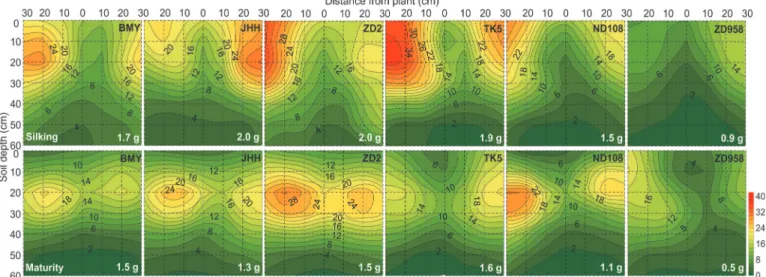
Fig 2. Two dimensional distribution of soil mineral nitrogen concentration (Nmin, mg/kg) of different maize varieties at silking (the upper six
panels) and maturity (the bottom six panels) in 2009.The Nminwas sampled in a soil volume of 60 cm (length)× 30 cm (width) × 60 cm (depth).Each
10×10 cm2area was the projection of average N
minin the three 10×10×10 cm3soil cubes across the width of the monolith. Maize varieties are indicated at
the top right side and total soil residual mineral nitrogen content (g) in the whole 60×30×60 cm3soil volume are indicated at the bottom right side in each
panel, respectively. Data are mean values from 3 replicates of each genotype.
Results
Plant growth and nutrients uptake
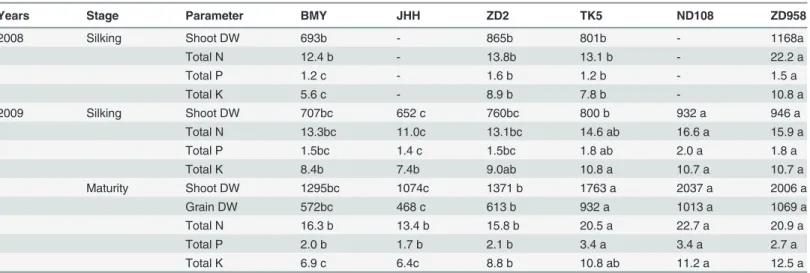
New maize varieties (ND108 and ZD958) had accumulated more dry weight (DW) and nutri-ents (N, P and K) in their shoots than older varieties at silking (Table 2). Differences in shoot DW and plant nutrient content between the new and older varieties increased between silking and maturity. In 2009, the percentage increase in shoot DW between silking and maturity was
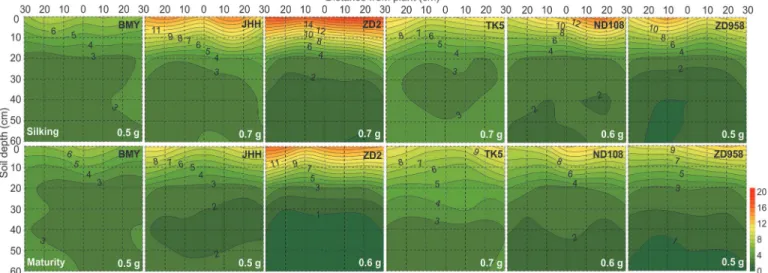
Fig 3. Two dimensional distribution of soil Olsen-P concentration (mg/kg) of different maize varieties at silking (the upper six panels) and maturity (the bottom six panels) in 2009.The Olsen-P was sampled in a soil volume of 60 cm (length)×30 cm (width)× 60 cm (depth). Each 10×10 cm2area was the projection of average Olsen-P in the three 10×10×10 cm3soil cubes across the width of the monolith. Maize varieties are indicated at the top right side and
total soil residual Olsen-P content (g) in the whole 60×30×60 cm3soil volume at both harvests are indicated at the bottom right side in each panel,
respectively. Data are mean values from 3 replicates of each genotype.
doi:10.1371/journal.pone.0121892.g003
Fig 4. Two dimensional distribution of soil NH4OAc extractable K concentration (mg/kg) of different maize varieties at silking (the upper six
panels) and maturity (the bottom six panels) in 2009.The NH4OAc extractable K was sampled in a soil volume of 60 cm (length)× 30 cm (width) × 60 cm
(depth). Each 10×10 cm2area was the projection of average NH
4OAc extractable K in the three 10×10×10 cm3soil cubes across the width of the monolith.
Maize varieties are indicated at the top right side and total soil residual NH4OAc extractable K content (g) in the whole 60×30×60 cm3soil volume are
indicated at the bottom right side in each panel, respectively. Data are mean values from 3 replicates of each genotype.
83%, 65%, 119% and 112% for two older varieties BMY, JHH, and two new ones ND108 and ZD958, respectively. Similar changes can be observed for plant nutrient content. Because of their larger shoot DW, the new varieties had greater grain yield than the older varieties (Table 2).
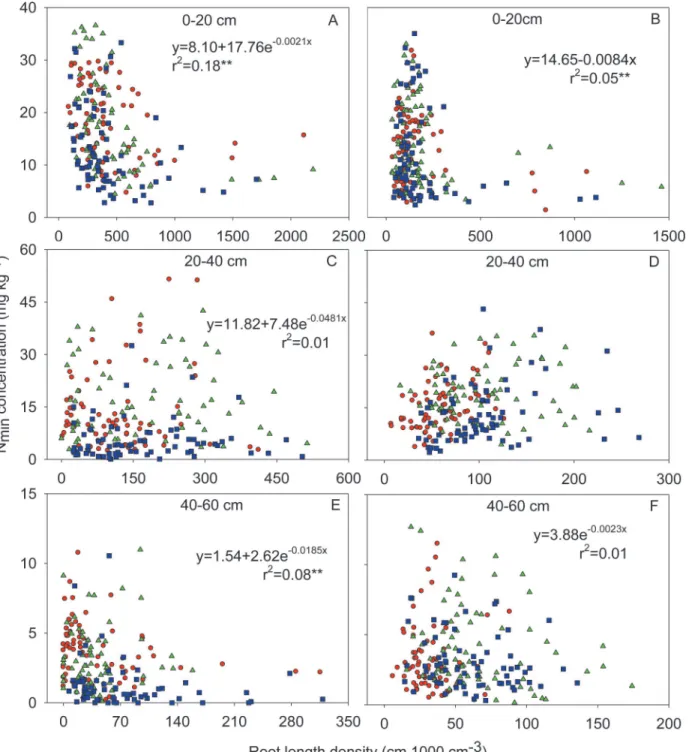
Fig 5. Relationships between soil Nminconcentration and root length density in the 0–20 cm (A and B), 20–40 cm (C and D) and 40–60 cm (E and F)
soil horizons at silking (A, C and E) and at maturity (B, D and F) in 2009.Each panel includes data from 216 cubes of soil, each of 1000 cm3, under six maize varieties of BMY and JHH in 1950s (red circles), ZD2 and TK5 in 1970s (green triangles) and ND108 and ZD958 in 1990s (blue squares).** Significance at 0.01 probability level.
Root spatial distribution in the 0
–
60 cm soil profile
The distribution of roots of different maize varieties in a soil volume of 60 cm (length) × 30 cm (width) × 60 cm (depth) was investigated at silking in 2008 and at silking and maturity in 2009. These distributions are presented as projected two dimensional RLD across the width of a monolith (Fig. 1;S1 Fig.). The majority of the total root length of all maize varieties was present in the topsoil (0–30 cm) at both silking and maturity. In 2009, for example, over 80% of the total root length of all maize varieties was present in the 0–30 cm soil horizon at silking and 65–89% at maturity. The RLD in the next horizons (30–60 cm) decreased with increasing soil
Table 2. Shoot and grain dry weight (DW; g m−2) and total N, P and K contents (g m−2) of different maize varieties at silking in 2008 and at silking
and maturity in 2009.
Years Stage Parameter BMY JHH ZD2 TK5 ND108 ZD958
2008 Silking Shoot DW 693b - 865b 801b - 1168a
Total N 12.4 b - 13.8b 13.1 b - 22.2 a
Total P 1.2 c - 1.6 b 1.2 b - 1.5 a
Total K 5.6 c - 8.9 b 7.8 b - 10.8 a
2009 Silking Shoot DW 707bc 652 c 760bc 800 b 932 a 946 a
Total N 13.3bc 11.0c 13.1bc 14.6 ab 16.6 a 15.9 a
Total P 1.5bc 1.4 c 1.5bc 1.8 ab 2.0 a 1.8 a
Total K 8.4b 7.4b 9.0ab 10.8 a 10.7 a 10.7 a
Maturity Shoot DW 1295bc 1074c 1371 b 1763 a 2037 a 2006 a
Grain DW 572bc 468 c 613 b 932 a 1013 a 1069 a
Total N 16.3 b 13.4 b 15.8 b 20.5 a 22.7 a 20.9 a
Total P 2.0 b 1.7 b 2.1 b 3.4 a 3.4 a 2.7 a
Total K 6.9 c 6.4c 8.8 b 10.8 ab 11.2 a 12.5 a
BMY and JHH are early senescing varieties released in the 1950s; ZD2 and TK5 are two intermediate senescing hybrids released in the 1970s; ND108 and ZD958 are two currently popular stay-green hybrids. Values in rows followed by different letters represent significant differences between varieties (P<0.05) at a particular harvest. Values are means of three replications.
doi:10.1371/journal.pone.0121892.t002
Table 3. Total root length, root DW and soil available nutrient content (Soil Nmin, Olsen-P and NH4OAc-K) in a soil volume of 60×30×60 cm3
(length × width × depth) under different maize varieties at silking in 2008 and at silking and maturity in 2009.
Years Stage Parameters BMY JHH ZD2 TK5 ND108 ZD958
2008 Silking Root length (mplant−1) 263 a - 242 a 312 a - 302 a
Root DW (gplant−1) 9.5 b - 11.7 ab 14.4 ab - 17.2 a
2009 Silking Root length (mplant−1) 246 ab 189 b 278 a 275 ab 286 a 216 ab
Root DW (gplant−1) 7.2 b 6.5 b 7.4 b 9.8 ab 11.0 a 12.6 a
Soil Nmin(g) 1. 7 a 2.0 a 2.0 a 1.9 a 1.5 ab 0.9 b
Soil Olsen-P (g) 0.5 a 0.7 a 0.7 a 0.7 a 0.6 a 0.5 a
Soil NH4OAc-K(g) 11.3 a 10.7 a 10.6 a 11.7 a 8.9 a 9.9 a
Maturity Root length (mplant−1) 87c 96 c 114 b 123 ab 128a 122 ab
Root DW (gplant−1) 4.1 b 4.0 b 5.4 b 9.2 a 8.8 a 9.0 a
Soil Nmin(g) 1.5 a 1.3 ab 1.5 a 1.6 a 1.1 ab 0.7 b
Soil Olsen-P (g) 0.5 a 0.5 a 0.6 a 0.7 a 0.6 a 0.5 a
Soil NH4OAc-K(g) 11.1a 9.4 ab 9.8 ab 8.7 b 8.8 b 8.9 b
Values followed by different letters in rows represent significant differences among varieties (P<0.05) at a particular harvest. Values are means of
three replications.
depth for all maize varieties (Fig. 1;S1 Fig.). RLD in deeper 30–60 cm soil horizons was similar among all varieties at silking. However, new varieties had greater RLD in the same soil horizon than the older varieties and thus higher total root length at maturity (Fig. 1), because of a less decrease in total root length in older varieties after silking. Horizontally, RLD was greatest in the soil directly under the base of the stem and decreased with increasing distance from the stem base in the top 0–20 cm horizon.
Root DWs of new varieties (ND108 and ZD958) were larger than those of older varieties at silking and the relative difference in root DW between the new and older varieties increased after silking (Table 3). In 2009, the percentage decrease in root DW between silking and matu-rity was 43%, 39%, 20% and 27% for BMY, JHH, ND108 and ZD958, respectively (Table 3). In contrast to root DW, the total root length of new varieties did not differ significantly from that of older varieties at silking, this was consistent with the results that new varieties had lower spe-cific root length (the ratio of root length to root DW, m g−1) than older ones at silking and ma-turity, showing a higher proportion of thicker roots in new varieties (S2 Fig.). However, new varieties had significantly greater total root length than the oldest varieties at maturity (Table 3), especially in the 0–30 cm soil horizon (Fig. 1). Positive relationships were observed between total root length and plant N, P and K contents at maturity and grain yield (S3 Fig.). The growth angles of shoot-borne roots were not determined directly in this study. Howev-er, to assess whether new varieties had steeper roots than older varieties, the proportion of the root length in each soil cube excavated along the middle of the row was determined for each soil horizon for plants at silking and at maturity (S4 Fig.). Similar proportions of the total root length in soil cubes located at the same distance from the stem axis in all soil horizons sug-gested that there were no differences among the maize varieties studied here in growth angles of shoot-borne roots.
Spatial distribution of soil available N, P and K in the 0
–
60 cm soil profile
The soil mineral nitrogen (Nmin) concentration (Fig. 2;S1 Fig.), Olsen-P (Fig. 3;S1 Fig.) andNH4OAc extractable K (Fig. 4;S1 Fig.) were greatest in the top soil and decreased with
increas-ing soil depth, regardless of whether they were assessed at silkincreas-ing or maturity.
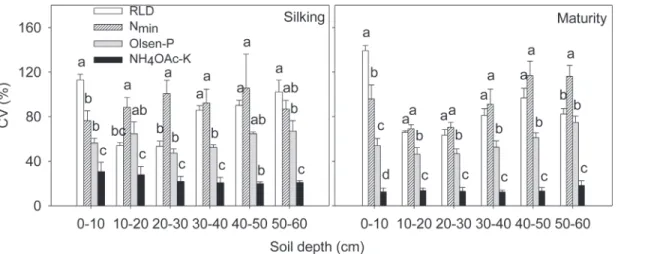
Fig 6. Coefficients of variation (CV, %) of root length density (RDL), soil Nmin, Olsen-P and NH4OAc-K concentration in each 10 cm soil horizon in
excavated 60 cm (length) × 30 cm (width) × 60 cm (depth) soil monoliths at silking and maturity in 2009.Each column represents data of each 10 cm horizon from 108 soil monoliths (10×10×10 cm3), which was the product of 18 soil monoliths for each variety in a soil horizon times six maize varieties. Data
are mean values from 3 replicates of each soil horizon. Different letters above the columns of each soil horizon indicate significant differences in coefficients of variation for RDL, Nmin, Olsen-P and NH4OAc-K (P<0.05).
There was a negative relationship between soil Nminconcentration and RLD both at silking
and maturity, and soil Nminwas significantly lower where RLD was highest, especially under
the plant stem axis in the 0–20 cm horizon in both years (Figs.1,2,5;S1 Fig.). In 2009, the total Nminin the soil when new varieties (ND108 and ZD958) were grown was less than that in
the soil when older varieties were grown at both silking and maturity (Fig. 2). This was consis-tent with the greater N accumulation of new varieties (Table 2). Furthermore, soil Nmin
con-centration in the 0–10 cm horizon was dramatically reduced at maturity compared with that at silking in 2009 (Fig. 2).
In contrast to the data for Nmin, there was no obvious relationship between RLD and either
Olsen-P or NH4OAc extractable K in the soil profile for any maize variety at any harvest (Figs.
2,3, and4;S1 Fig.). The horizontal variation of Olsen-P and NH4OAc extractable K in each
soil layer was also less than that of RLD and soil Nmin(Fig. 6). The horizontal variation
(ex-pressed as coefficients of variation, CV, %) was greatest for RLD (53.4%–113.0%) and soil Nmin
(76.4%–105.6%) and least for NH4OAc extractable K (19.9%–30.7%) (Fig. 6). Despite greater P
and K accumulation in new varieties than older varieties (Table 2), there were no differences between varieties in the total Olsen-P and NH4OAc extractable K remaining in the soil after
their cultivation (Table 3).
Discussion
New maize varieties had the similar root total length and vertical
distribution but accumulated more nutrients at silking compared with the
old ones
Since the maize varieties used in this study differed in the duration of their phenological stages, they were harvested different times after sowing at silking and maturity. However, the larger shoot DW and grain yield of new varieties compared with old ones are because of not only a longer growth season in the new varieties, but also larger total leaf area and longer green leaf duration (stay-green) [1,23,32,33]. Although new varieties take up more N, P and K after silk-ing than old varieties, large amounts of N, P and K accumulated pre-silksilk-ing are remobilized and exported from vegetative tissues in all varieties during grain filling. The export of N, P and K from leaves is similar in all these varieties [23].
Despite having a larger root DW (Table 3; [2]), new maize varieties had similar total root lengths and vertical root distributions to older varieties at silking (Table 3;Fig. 1;S1 Fig.), when the root system of maize is largest [14], indicating that new varieties had higher propor-tion of thicker roots than older ones (S2 Fig.; [34]). Thicker roots have several advantages: in-creased root lengths or growth rates, inin-creased water transport [35,36] and root penetration index [37], and improved lodging resistance [38]. Agricultural top soils are rich in the macro-and micro-elements necessary for plant growth, which comes from long-term fertilizer applica-tions, mineralization of organic matter, and degradation of plant residues in the 0–30 cm soil horizon [39]. It is therefore reasonable for the root system of maize to proliferate in the top soil to access the soil mineral nutrients to meet plant demand.
especially of roots in the top (0–30 cm) soil horizon, after silking (Fig. 1;S1 Fig.). New varieties had a greater post-silking demand for mineral nutrients than older varieties, and the delayed root mortality or vigorous growth of new roots of new varieties could improve post-silking up-take of nutrients (Table 2). Stay-green leaves of new varieties allow more carbohydrate alloca-tion to roots and have a positive effect on root growth, which in turn promotes nutrient uptake [54], thereby, supports higher grain yield. Indeed, the acquisition of mineral nutrients and grain yields were positively related with the total root length at maturity (S3 Fig.).
Lateral roots constitute the majority of the total root length [29] and are responsible for the acquisition of mineral nutrients [12,55]. The relationship between root length and distance from the plant shoot axis along the middle row was used to assess the root growth angle at silk-ing and maturity. The same horizontal root length distribution among varieties in all soil hori-zons suggested similar growth angles of shoot-borne roots (S4 Fig.). However, it is possible that the relatively large size of soil cubes used in the present study might not distinguish small dif-ferences in root length distribution and, thus, small difdif-ferences in root growth angles among varieties. The shoot-borne roots angles could be directly measured by protractor or phenotyped by shovelomics with visual score method [56]. Compared to them, we, to some extent, missed precision by comparing root length distribution.
The experiments reported here were conducted with the same plant density. It is known that the size of the maize root system is reduced with increasing plant density [15,57]. Further experiments are required to determine whether root growth angle of maize plants changes when they were grown at higher plant densities. It has been reported that maize leaf orientation is sensitive to plant density, and this has been interpreted as a shade avoidance reaction con-trolled by the red:far-red ratio of light within the canopy [58]. Plant root systems might have similar architectural responses to increased root competition as planting density is increased.
Variation in N
minwas larger than variation in available P and K in
soil monoliths
There was a significantly negative relationship between RLD and soil Nminconcentration in
the top 0–20 cm horizons both at silking and maturity (Figs.1,2,5;S1 Fig.). This observation suggests that the size and spatial distribution of the root system in the soil profile is important, not only for the uptake of nutrients with low mobility in the soil, such as P and K, but also for nitrate uptake, despite the greater mobility of nitrate in the soil compared to those of phosphate and K. Interestingly, the net accumulation of N by maize plants of all varieties from silking to maturity exceeded the reduction of soil Nminin whole soil profile during the same period
is allocated below-ground, of which the estimates of rhizodeposition can comprise up to 40% in annual plants. Carbon rhizodeposition by growing roots enhances the microbial turnover of soil organic carbon in the rhizosphere [59]. Differing from the bulk soil, where microbial growth is C-limited, microbial growth in the rhizosphere is N-limited, which increases micro-bial demand for N [59,60]. Considering the dynamics of root and microbial turnover, the plant root have repeated opportunity to compete for N for its longer life-spans (order of weeks to months), while the turnover of microbial biomass in the rhizosphere is rapid (order of hours to days) [60].
On the single root basis, reduction of the nitrate concentration at the root surface is less than that of P and K [16,18]. On the root zone basis under the present field condition, howev-er, neither the Olsen-P nor the NH4OAc extractable K was reduced as dramatically as Nminin
volumes of the soil with high RLD (Figs.1,2,3, and4;S1 Fig.). As a consequence, the spatial variation of soil Nminin each soil horizon was larger than that of Olsen-P and NH4OAc
ex-tractable K in the soil (Fig. 6). This might be related to the relatively large size of the soil cubes removed from the soil monoliths, if the depletion of Olsen-P and NH4OAc extractable K in the
soil was restricted to a smaller volume of soil surrounding the root than the depletion of Nmin.
Alternatively, uptake of N relative to its supply might have been greater than that of P and K. All maize varieties accumulated more N than P or K.
Conclusion
Despite having larger total root DW, new maize varieties (ND108 and ZD958) had similar total root length, root vertical distribution in the 0–60 cm soil profile and root growth angles to older maize varieties at silking when grown under the experimental conditions described here. Thus, the greater nutrient accumulation and grain yield of new maize varieties was not predi-cated based on greater total root length than older varieties at silking. It is, perhaps, related to the regulation of nutrient uptake capacity of the root by plant demand. Nevertheless, since most of the soil resources are distributed in the topsoil, the proliferation of roots in the topsoil before silking and the maintenance of roots in the topsoil after silking ensure that new maize varieties take up sufficient soil resources to support their greater nutrient demand and higher grain yield than older varieties. Larger root DW in new maize varieties is also beneficial for lodging resistance at high plant density [1,61]. Although nitrate is relative mobile in the soil, both horizontally and vertically, a negative relationship between RLD and soil Nmin
concentra-tion was observed in the top 0–20 cm horizon for all varieties and the variaconcentra-tion in soil Nmin
concentration was greater than that of Olsen-P and NH4OAc extractable K throughout the soil
profile, suggesting that root spatial distribution in the soil is important for N uptake by maize. Because of relative larger variation in the field conditions compared with that under the con-trolled conditions, it is better to have more replicates for experiments carried in the field. Fu-ture studies are required to determine the physicochemical changes in the rhizosphere as a consequence of root activity. Root growth and/or turnover after silking must be an important factor influencing the rhizosphere processes.
Supporting Information
S1 Fig. Two dimensional distribution of root length density (cm/3000 cm3), soil mineral ni-trogen concentration (mg/kg), soil Olsen-P concentration (mg/kg) and soil NH4OAc ex-tractable K concentration (mg/kg) of different maize varieties sampled at silking in 2008. Root length density, soil mineral nitrogen concentration, soil Olsen-P concentration and soil NH4OAc extractable K concentration were shown in row from the top to bottom respectively,
S3 Fig. Relationships between total root length and grain yield (A), plant N content (B), plant P content (C) and plant K content (D) in maize varieties (●BMY,JHH,▲ZD2,4 TK5,■ND108 and□ZD958) at maturity in 2009.andrepresent significance at 0.05 and
0.01 probability level, respectively. (TIF)
S4 Fig. Percentage of root length of six maize varieties in 1000 cm3cubes in the middle row of each soil horizon n from an excavated 60 cm (length) × 30 cm (width) × 60 cm (depth) soil monolith at silking (A-F) and maturity (G-L) in 2009.Different letters above the bars in-dicate significant differences between maize varieties in a 1000 cm3cube (P<0.05). Data are
mean values from 3 replicates of each genotype. Error bars denote the standard deviation. (TIF)
Author Contributions
Conceived and designed the experiments: CL. Performed the experiments: PN SL. Analyzed the data: PN SL CL. Contributed reagents/materials/analysis tools: CL. Wrote the paper: PN SL PJW CL.
References
1. Duvick DN. The contribution of breeding to yield advances in maize (Zea maysL.). Adv Agron. 2005; 86: 83–145.
2. Echarte L, Rothstein S, Tollenaar M. The response of leaf photosynthesis and dry matter accumulation to nitrogen supply in an older and a newer maize hybrid. Crop Sci. 2008; 48: 656–665.
3. Ning P, Liao CS, Li S, Yu P, Zhang Y, Li XX, et al. Maize cob plus husks mimics the grain sink to stimu-late nutrient uptake by roots. Field Crops Res. 2012; 130: 38–45.
4. Lynch JP. Root architecture and plant productivity. Plant Physiol. 1995; 109: 7–13. PMID:12228579
5. Linkohr BI, Williamson LC, Fitter AH, Leyser HMO. Nitrate and phosphate availability and distribution have different effects on root system architecture ofArabidopsis. Plant J. 2002; 29: 751–760. PMID:
12148533
6. Dunbabin VM, Diggle AJ, Rengel Z. Is there an optimal root architecture for nitrate capture in leaching environments? Plant Cell Environ. 2003; 26: 835–844. PMID:12803611
7. Zhu JM, Kaeppler SM, Lynch JP. Topsoil foraging and phosphorus acquisition efficiency in maize. Funct Plant Biol. 2005; 32: 749–762.
8. White PJ, George TS, Gregory PJ, Bengough AG, Hallett PD, McKenzie BM, et al. Matching roots to their environment. Ann Bot. 2013; 112: 207–222. doi:10.1093/aob/mct123PMID:23821619
10. Postma JA, Dathe A, Lynch J. The optimal lateral root branching density for maize depends on nitrogen and phosphorus availability. Plant Physiol. 2014; 166: 590–602. doi:10.1104/pp.113.233916PMID:
24850860
11. White PJ, Broadley MR, Greenwood DJ, Hammond JP. Proceedings of the International Fertilizer Soci-ety 568. Genetic modifications to improve phosphorus acquisition by roots. IFS, York, UK. ISBN 0853102058.
12. Wiesler F, Horst WJ. Root growth and nitrate utilization of maize cultivars under field conditions. Plant Soil. 1994; 163: 267–277.
13. Ju XT, Xing GX, Chen XP, Zhang SL, Zhang LJ, Liu XJ, et al. Reducing environmental risk by improving N management in intensive Chinese agricultural systems. Proc Natl Acad Sci USA. 2009; 106: 3041–
3046. doi:10.1073/pnas.0813417106PMID:19223587
14. Peng Y, Li X, Li C. Temporal and spatial profiling of root growth revealed novel response of maize roots under various nitrogen supplies in the field. PLoS ONE. 2012; 7(5): e37726. doi:10.1371/journal.pone. 0037726PMID:22624062
15. Hammer GL, Dong Z, McLean G, Doherty A, Messina C, Schussler J, et al. Can changes in canopy and/or root system architecture explain historical maize yield trends in the US corn belt? Crop Sci. 2009; 49: 299–312.
16. Jungk AO. Dynamics of nutrient movement at the soil-root interface. In: Waisel Y, Eshel A, Kafkafi U, editors, Plant roots: the hidden half. New York, Marcel Dekker inc.; 2002. pp. 587–616.
17. White PJ, George TS, Dupuy LX, Karley AJ, Valentine TA, Wiesel L, et al. Root traits for infertile soils. Front Plant Sci. 2013; 4: 193. doi:10.3389/fpls.2013.00193PMID:23781228
18. Barber SA. Soil Nutrient Bioavailability. 2nd ed. New York, Wiley; 1995.
19. Chapman N, Miller AJ, Lindsey K, Whalley WR. Roots, water, and nutrient acquisition: let’s get physi-cal. Trends Plant Sci. 2012; 17: 701–710. doi:10.1016/j.tplants.2012.08.001PMID:22947614
20. Marschner P, Rengel Z. Nutrient availability in soil. In: Marschner P, editors. Marschner’s mineral nutri-tion of higher plants. 3rd ed. London, UK: Academic Press; 2012. pp. 315–330.
21. Hinsinger P. Bioavailability of soil inorganic P in the rhizosphere as affected by root-induced chemical changes: a review. Plant Soil. 2001; 237: 173–195.
22. Lambers H, Chapin FS, Pons TL. Plant physiological ecology. 2nd ed. New York, Springer; 2008. 23. Ning P, Li S, Yu P, Zhang Z, Li CJ. Post-silking accumulation and partitioning of dry matter, nitrogen,
phosphorus and potassium in maize varieties differing in leaf longevity. Field Crops Res. 2013; 144: 19–27.
24. Nelson DW, Somers LE. Determination of total nitrogen in plant material. Agron J. 1973; 65: 109–112. 25. Soon YK, Kalra YP. A comparison of plant tissue digestion methods for nitrogen and phosphorus
analy-ses. Can J Soil Sci. 1995; 75: 243–245.
26. Walker JM, Barber SA. Absorption of potassium and rubidium from the soil by corn roots. Plant Soil. 1962; 17(2): 243–259.
27. Böhm W. Methods of studying root systems. Berlin, New York: Springer-Verlag; 1979. pp. 61–76. 28. Adu MO, Chatot A, Wiesel L, Bennett MJ, Broadley MR, White PJ, et al. A scanner system for high
reso-lution quantification of variation in root growth dynamics ofBrassica rapagenotypes. J Exp Bot. 2014; 65: 2039–2048. doi:10.1093/jxb/eru048PMID:24604732
29. Peng YF, Niu JF, Peng ZP, Zhang FS, Li CJ. Shoot growth potential drives N uptake in maize plants and correlates with root growth in the soil. Field Crops Res. 2010; 115: 85–93.
30. Houba VJG, Novozamsky I, Huybregts AWM, Van der Lee JJ. Comparison of soil extractions by 0.01 M CaCl2, by EUF and by some conventional extraction procedures. Plant Soil. 1986; 96: 433–437.
31. Murphy J, Riley JP. A modified single solution method for the determination of phosphate in natural wa-ters. Anal Chim Acta. 1962; 27: 31–36.
32. Li S, Peng YF, Yu P, Zhang Y, Fang Z, Li CJ. Accumulation and distribution of dry matter and potassium in maize varieties released in different years. Plant Nutr Fert Sci. 2011; 17: 325–332 (in Chinese). 33. Ciampitti IA, Vyn TJ. Physiological perspectives of changes over time in maize yield dependency on
ni-trogen uptake and associated nini-trogen efficiencies: A review. Field Crops Res. 2012; 133: 48–67. 34. Chen X, Zhang J, Chen Y, Li Q, Chen F, Yuan L, et al. Changes in root size and distribution in relation
to nitrogen accumulation during maize breeding in China. Plant Soil. 2014; 374(1–2): 121–130. 35. Kato Y, Abe J, Kamoshita A, Yamagishi J. Genotypic variation in root growth angle in rice (Oryza sativa
42. Cooper HD, Clarkson DT. Cycling of amino-nitrogen and other nutrients between shoots and roots in cereals-a possible mechanism integrating shoot and root in the regulation of nutrient uptake. J Exp Bot. 1989; 40: 753–762.
43. Imsande J, Touraine B. N demand and the regulation of nitrate uptake. Plant Physiol. 1994; 105: 3–7. PMID:12232181
44. Marschner H, Kirkby EA, Engels C. Effect of mineral nutritional status on shoot-root partitioning of photo-assimilates and cycling of mineral nutrients. J Exp Bot. 1996; 47: 1255–1263. doi:10.1093/jxb/ 47.Special_Issue.1255PMID:21245257
45. Yan HF, Shang AX, Peng YF, Yu P, Li CJ. Covering middle leaves and ears reveals differential regula-tory roles of vegetative and reproductive organs in root growth and nitrogen uptake in maize. Crop Sci. 2011; 51: 265–272.
46. Donald CM. The breeding of crop ideotype. Euphytica. 1968; 17: 385–403.
47. Robinson D, Linehan DJ, Caul S. What limits nitrate uptake from soil? Plant Cell Environ. 1991; 14: 77–85.
48. Hodge A. The plastic plant: root responses to heterogeneous supplies of nutrients. New Phytol. 2004; 162: 9–24.
49. Malamy JE. Intrinsic and environmental response pathways that regulate root system architecture. Plant Cell Environ. 2005; 28: 67–77. PMID:16021787
50. Nibau C, Gibbs DJ, Coates JC. Branching out in new directions: the control of root architecture by later-al root formation. New Phytol. 2008; 179: 595–614. doi:10.1111/j.1469-8137.2008.02472.xPMID:
18452506
51. Drew MC, Saker LR, Ashley TW. Nutrient supply and the growth of the seminal root system in barley. I. The effect of nitrate concentration on the growth of axes and laterals. J Exp Bot. 1973; 83:1189–1202. 52. Forde BG, Walch-Liu P. Nitrate and glutamate as environmental cues for behavioral responses in plant
roots. Plant Cell Environ. 2009; 32: 682–693. doi:10.1111/j.1365-3040.2008.01927.xPMID:
19143987
53. Yu P, Li XX, Yuan LX, Li CJ. A novel morphological response of maize (Zea maysL.) adult roots to het-erogeneous nitrate supply revealed by a split-root experiment. Physiol Plant. 2014; 150: 133–144. doi:
10.1111/ppl.12075PMID:23724916
54. Borrell A, Hammer G, Oosterom E. Stay-green: a consequence of the balance between supply and de-mand for nitrogen during grain filling? Ann Appl Biol. 2001; 138: 91–95.
55. Sullivan WM, Jiang ZC, Hull RJ. Root morphology and its relationship with nitrate uptake in Kentucky bluegrass. Crop Sci. 2000; 40: 765–772.
56. Trachsel S, Kaeppler SM, Brown KM, Lynch JP. Shovelomics: high throughput phenotyping of maize (Zea maysL.) root architecture in the field. Plant Soil. 2011; 341(1–2): 75–87.
57. Yan Y, Liao C, Zhang F, Li C. The causal relationship of the decreased shoot and root growth of maize plants under higher plant density. Plant Nutr Fert Sci. 2010; 16: 257–265 (in Chinese).
58. Maddonni GA, Otegui ME, Cirilo AG. Plant population density, row spacing and hybrid effects on maize canopy architecture and light attenuation. Field Crops Res. 2001; 71: 183–193.
59. Neumann G, Roemheld V. Rhizosphere chemistry in relation to plant nutrition. In: Marschner P, editors. Marschner’s mineral nutrition of higher plants. 3rd ed. London, UK: Academic Press; 2012. pp. 347–
60. Paterson E. Importance of rhizodeposition in the coupling of plant and microbial productivity. Eur J Soil Sci. 2003; 54(4): 741–750.