Fascicle VI – Food Technology (2016), 40(2), 119-134
ORIGINAL RESEARCH PAPER
ANTIMICROBIAL ACTIVITY OF HERBS AGAINST YERSINIA
ENTEROCOLITICA AND MIXED MICROFLORA
SHILPA SHARMA, RAVINDER KAUSHIK*, POOJA SHARMA, REETIKA SHARMA, ANJU THAPA, INDUMATHI KP
School of Bioengineering and Food Technology, Shoolini University, Solan, Himachal Pradesh, India, 173229
*
Corresponding author: [email protected]
Received on 16th June 2016
Revised on 19th October 2016
The present study aimed at developing herbal medicine against food borne pathogens, therefore the antimicrobial activity of four herbs viz. Arjuna (bark), Ashwagandha (roots), Puthkanda (leaves) and Shalampanja (roots) was checked. Aqueous, ethanolic and petroleum ether extracts of each herb were extracted and their antimicrobial activity against mixed microflora and against Yersinia enterocolitica was determined. Tetracycline and gentamicin were used as reference antibiotics. Arjuna extracts showed the highest antimicrobial potential against mixed population and Yersinia enterocolitica in comparison to Ashwagandha, Puthkanda and Shalampanja extracts. The antimicrobial activity of Arjuna aqueous extract was lower compared to gentamicin, but comparable to tetracycline. The minimum inhibitory concentration and minimum bactericidal concentration of aqueous extract of Arjuna showed the lowest values indicating that it is more effective in lower concentration of use. The antimicrobial activity of herbs showed the following trend Arjuna > Puthkanda > Shalampanja > Ashwagandha.
Keywords: herbs, antimicrobial activity, Minimum inhibitory concentration
Introduction
Medicinal Plants have antibacterial activity against Pathogens causing Urinary Tract Infections (Sharma et al., 2009). Plants are rich in a wide variety of secondary metabolites, such as tannins, terpenoids, alkaloids, and flavonoids, which have been found in vitro to have antimicrobial properties (Cowan, 1999). These herbs and spices are common part of food for flavor, color, aroma, taste and also to enhance shelf life. Some of the common herbs viz. Arjuna, Ashwagandha, Puthkanda and Shalampanja were tested for antimicrobial activity. The herbs showing antimicrobial activity may be used for extending shelf life of food.
These phytochemicals work with nutrients and fibers to form an integrated part of the defense system against various diseases and stress conditions (Pascalineet al., 2011). Extracts of plants contain a variety of bioactive compounds which may inhibit the growth of some pathogenic microorganisms (Zarringhalam et al., 2013).
Terminalia Arjuna (common name: Arjuna) is a tree and its bark and leaves are used
for medicinal treatments in Ayurveda and is traditionally renowned as a cardiac stimulant. Arjuna bark exerted significant hypolipidaemic activity, produced inotropic and hypotensive effects and increased coronary artery flow to protect against heart diseases (Dwivedi, 2007). Antimicrobial efficacy of Arjuna bark extracts was demonstrated on clinical isolates of fifteen bacterial and six fungal species which were multi-drug resistant (Singh et al., 2008). Arjuna acetonic extract was able to cause death of Staphylococcus aureus, however, suppressed the growth
Escherchia coli, Acinetobacter sp, Proteus mirabilis, and Candida albicans (Aneja
et al., 2012).
Withania somnifera (commmonly known as Aswagandha) is one of the most
valuable plants in the traditional Indian medicine. The ethnopharmacological properties of the plant include adaptogenic, anti-sedative and anti-convulsion activities, and the plant is used to treat various neurological disorders, geriatric debilities, arthritis, stress and behavior-related problems (Sangwan et al., 2004). Methanolic extracts of the whole Withania somnifera plant are effective against different pathogenic bacteria such as Escherichia coli, Pseudomonas aeruginosa,
Staphylococcus aureus,Streptococcus mutans and Candida albicans, they have also
been found to have significant antibacterial properties (Jovanovicand Simic, 2000).
Withania somnifera is traditionally used as a therapeutic agent for diarrhea,
dyspepsia and gastrointestinal disorders (Acharyya et al., 2009)
Achyranthes aspera (commonly known as Puthkanda) is a perennial herb growing
up to three meters and belongs to the family Amaranthaceae. Puthkanda is an important medicinal herb found throughout India. Almost all parts of the plant are used in traditional systems of medicines (Mukherjee, 2008). It is also useful to treat cough, renal dropsy, fistula, scrofula, skin rash, nasal, infection, chronic malaria, impotence, fever, asthma, piles and snake bites. The alcoholic extracts have been reported to have wound healing and antioxidant activities. Methanol extracts showed complete inhibition on Bacillus, significant inhibition on citrobacter, moderate inhibition on Escherichia coli. Chloroform extract showed complete inhibition on
Bacillus, moderate inhibition on Citrobacter and Escherichia coli (Tahiliani et al.,
2000).
Dactylorhiza hatagirea (commonly known as Shalampanja) belongs to the family
Orchidaceae. The plant is native and near endemic to Indian Himalayan region
Rhizomatous part of Shalampanja showed antimicrobial potential against all Gram positiveand Gram negative bacteria, but its aerial part showedlimited resistance against bacteria. This plant can be a potential source for evolving newer antimicrobial compounds for treating dysentery caused by E. coli (Ranpal, 2009). Therefore, the present study was carried out to determine the antimicrobial activity of herb extracts against the mixed population of microorganisms and Yersinia
enterocolitica for encouragementanddevelopment of herbal medicines against food
borne pathogens.
Materials and Methods
Materials
Collection of Herbs
Herbs viz. Arjuna (bark), Ashwagandha (roots), Puthkanda (leaves) and Shalampanja (roots) were collected from local market, Solan, Himachal Pradesh, India.
Bacterial culture
Pathogenic strain of Yersinia enterocolitica (MTCC No. 4858) was obtained from the Institute of Microbial Technology (IMTECH), Chandigarh, India. For mixed microflora, samples were collected from Sewage Water Treatment Plant, Shoolini University, Solan which was predominated by E. coli.
Chemicals and Solvents
Yersinia agar media, Yersinia broth, MRS agar, MRS broth, M17 agar and M17 broth were procured from HiMedia Chemicals Limited (Mumbai, India). Ethyl alcohol and petroleum ether were procured from Jiangsu Huaxi International (MO, USA) and Renkem (New Delhi, India), respectively. Dimethylsulphoxide (DMSO) was procured from Fisher Scientific (Mumbai, India). Barium chloride and sulphuric acid required to make McFarland solution was procured from HiMedia Chemicals Limited (Mumbai, India).
Processing of herbs and preparation of herb extracts
All four herbs were cleaned and washed properly with potable water, thoroughly washed with distilled water and kept for drying in sunlight for 2 days and kept in hot air oven at temperature of 45 °C for 6 h. The dried herbs were then powdered in a Falling Number Mill (Model 3100, Sweden) and packed in polyethylene bags and stored in airtight containers at refrigeration temperature (4-7 °C) till further analysis.
Aqueous extraction
The aqueous extracts of four herbs viz. Arjuna, Ashwagandha, Puthkanda and Shalampanja were prepared by dispersing 15 g of herb powders in 150 ml of distilled water in a 250 ml conical glass flask and boiled at 100 °C in water bath for 6 h and then filtered through Whatman no.1 filter paper. The filtrates obtained were then dried in Petri plates at 100 °C on water bath by evaporation and stored in air tight glass vials at refrigeration temperature (4°C) for further study (Sharma et al., 2016).
The ethanolic and petroleum ether extracts of herbs were prepared by dispersing 15 g of herb powders in 150 ml of ethanol and petroleum ether, respectively and kept at 27 °C for 2 days in a shaking water bath (Eppendorf India Limited, Chandigarh, India) and then filtered through Whatman no. 1 filter paper. The filtrates obtained were then allowed to evaporate in refrigerator at 4°C to get dried extract and stored in air tight glass vials at refrigeration temperature (4°C) for further study (Sharma et al., 2016).
Percent extract
The percent extract of herb was determined using the method of Sultana et al. (2009). The percentage of dried extract obtained after extraction and drying was calculated according to equation 1.
Percent extract = Weight of dried extract Weight of dried plant material
×100 (1)
Standardization of extracts concentrations used by antimicrobial test
During preliminary analysis, different concentration (5, 10, 15, 20 25 and 30 mg/ml) of dried extracts (aqueous, ethanol and petroleum ether) of herbs viz. Arjuna,
Ashwagandha, Puthkanda and Shalampanja were dissolved in DMSO and their antimicrobial potential was determined using agar well diffusion assay and disc diffusion assay. Concentrations below 20 mg/ml showed a low zone of inhibition; increasing the concentration over 20 mg/ml resulted in rather similar zones of inhibition. Therefore, 20 mg/ml herb extract was considered for further antimicrobial tests (Sharma et al., 2016).
Activity index
The activity index was determined by measuring the inhibition zone of aqueous, ethanol, petroleum ether extract of herbs viz Arjuna, Ashwagandha, Puthkanda and Shalampanja and compared to the zone of inhibition of standard antibiotics references, namely tetracycline and gentamicin. The activity index was determined according to equation 2.
Activity index = Inhibition zone of the sample Inhibition zone of the standard
(2)
Antimicrobial activity
The effect of herb extracts on Yersinia enterocolitica was determined by agar well diffusion assay and disc diffusion assay as described by Kaushik et al. (2016). Minimum inhibitory concentration (MIC)
Theminimum inhibitory concentration of different herb extracts for antimicrobial potential was determined by method as described bySingariya et al. (2011). MIC values were determined by using various concentrations of the stock 15, 7.5, 3.75, 1.875, 0.938, 0.469, 0.234, 0.117, 0.059 and 0.029 mg/ml was assayed against test pathogens.
Minimum bactericidal concentration (MBC)
highest dilution that yielded no single bacterial colony was taken as the Minimum Bactericidal Concentration.
Statistical Analysis
The statistical analysis was carried out as per Kaushik et al. (2013). Data are presented as mean ± SEM (n=3), linear regression analysis and 95 % confidence intervals were calculated using Microsoft Excel 2007 (Microsoft Corp., Redmond, WA). Data was subjected to a single way analysis of variance (ANOVA) to calculate the Critical Difference value.
Results and discussion
Percent extract
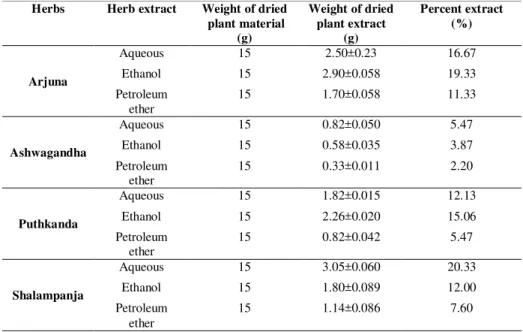
The percent extract obtained from 4 herbs viz. Arjuna, Shalampanja, Ashwagandha andPuthkanda in three different media viz. aqueous, ethanolic and petroleum ether was determined and values are presented in Table 1. It was observed that the ethanolic extract of Shalampunja showed the highest percentage of extract and the lowest in petroleum ether extract of Ashwagandha.
Table 1. Percentage extracts obtained from herbs
Herbs Herb extract Weight of dried plant material
(g)
Weight of dried plant extract
(g)
Percent extract (%)
Arjuna
Aqueous 15 2.50±0.23 16.67
Ethanol 15 2.90±0.058 19.33
Petroleum ether
15 1.70±0.058 11.33
Ashwagandha
Aqueous 15 0.82±0.050 5.47
Ethanol 15 0.58±0.035 3.87
Petroleum ether
15 0.33±0.011 2.20
Puthkanda
Aqueous 15 1.82±0.015 12.13
Ethanol 15 2.26±0.020 15.06
Petroleum ether
15 0.82±0.042 5.47
Shalampanja
Aqueous 15 3.05±0.060 20.33
Ethanol 15 1.80±0.089 12.00
Petroleum ether
15 1.14±0.086 7.60
Data are presented as mean ±SD (n=3)
The trend was the same but the values were higher in comparison to our values. However, no reports were found regarding the percentage yield of Puthkanda and Shalampanja. Hsu et al. (2006) reported that the differences in the extract yields from herbs might be ascribed to the different availability of extractable components, resulting from the varied chemical composition of plants and their solubility in different solvents.
Antimicrobial activity of herb extracts on the mixed population of microorganisms The antimicrobial activity of Arjuna, Ashwagandha, Puthkanda andShalampanja extracts was determined by using disc and agar well diffusion assay against the mixed population of microorganisms and the results are presented in Table 2. Antibiotic gentamicin showed a significantly (p<0.05) higher zone of inhibition in comparison to tetracycline and aqueous, ethanol, petroleum ether extracts of all herb extracts, respectively. Aqueous extracts of Arjuna, Ashwagandha and Shalampanja showed a significantly higher (p<0.05) zone of inhibition than petroleum ether and ethanol extracts; however, there was no significant difference (p>0.05) between the petroleum ether and ethanol extracts, whereas petroleum ether extracts of Puthkanda showed the significantly higher zone of inhibition in comparison to aqueous and ethanol extracts. The activity index of gentamicin was lower in comparison to tetracycline in all four herb extracts, which indicate that gentamicin is superior to tetracycline in antimicrobial effects. It was observed that agar well diffusion assay showed a higher zone of inhibition in comparison to disc diffusion assay.
No report was found having antimicrobial activity against the mixed flora of microorganisms. However, there are several studies reported that present herbs as showing antimicrobial activity against coliform bacteria by Arjuna (Samy et al., 1998), Ashwagandha (Sundaram et al., 2011; Alam et al., 2012), Puthkanda (Dash
et al., 2013; Beaulah et al., 2011) and Shatavari (Ranpal, 2009). It was found that
the growth of both gram-positive and gram-negative food borne bacteria can be inhibited by the antimicrobial activity of some herbs (Nascimento et al., 2000). It was reported that the microbes collected from different geographic areas with different climatic conditions showed different antimicrobial activities (Ejechi and Akpomedaye, 2005). Herbs are commonly used as antimicrobial agents in foods. Some of the natural compounds found in herbs possess antimicrobial activities (Indu
et al., 2006).
Antimicrobial activity of herb extracts against Yersinia enterocolitica
The antimicrobial activity ofArjuna, Ashwagandha, Puthkanda andShalampanja extracts was determined by using the disc diffusion and agar well assay against
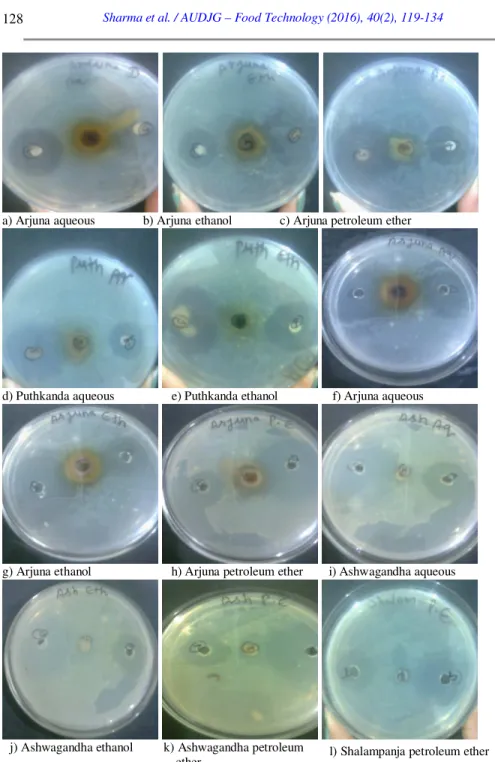
Yersinia enterocolitica and the results are presented in Table 3 and Figure 1.
negative against Yersinia enterocolitica. All the extracts of Ashwagandha showed no antimicrobial activity against Yersinia enterocolitica. Only petroleum ether extract of Shalampanja showed antimicrobial activity whereas aqueous and ethanolic extract showed no antimicrobial activity against Yersinia enterocolitica. The zone of inhibition of petroleum ether extract of Shalampanja was significantly lower (p<0.05) than both gentamicin and tetracycline. Both gentamicin and tetracycline showed a significantly higher (p<0.05) zone of inhibition against Yersinia
enterocolitica in comparison to all three extracts of Puthkanda. Both aqueous and
ethanolic extracts showed no significant difference (p>0.05) in zone of inhibition against Yersinia enterocolitica. The petroleum ether extract of Puthkanda showed no zone of inhibition against Yersinia enterocolitica. The activity index of gentamicin was lower in comparison to tetracycline in all three herb extracts, which indicate that gentamicin is superior to tetracycline in antimicrobial effects. It was observed that disc diffusion and agar well assay showed the same trend, however agar well diffusion assay showed a higher zone of inhibition in comparison to disc diffusion assay.
The herbs used in the present study were not reported earlier with antimicrobial activity against Yersinia enterocolictica. However, they showed antimicrobial activity against other bacteria discussed in earlier sections.
Dwivedi et al. (2013) determined that the ethanolic extracts obtained from Arjuna bark inhibited the growth of microbes and zones of inhibition were visible. The total activity of the extracts against each pathogen was also evaluated. The activity of the leaf alkaloid was found to be the highest against Enterobacteraerogens. Debnath et al. (2013) studied that water and methanolic extracts of Arjuna bark produced a significant zone of inhibition against twenty-two test bacteria including eight uropathogens. Bhattacharyya and Jha (2011) studied the antagonistic activity of the crude extract against five clinically significant anti-dermatophytic fungi i.e.,
Trichophyton mentagrophytes, Trichophyton rubrum, Trichophyton tonsurans,
Microsporum gypseum and Microsporum fulvum using the agar cup diffusion
method. The methanol extract was the most effective against Trichophyton
tonsurans (zone of inhibition 25 mm) and the least effective against Microsporum.
gypseum (zone of inhibition 3 mm). Ramya et al. (2008) determined the
a) Arjuna aqueous b) Arjuna ethanol c) Arjuna petroleum ether
d) Puthkanda aqueous e) Puthkanda ethanol f) Arjuna aqueous
g) Arjuna ethanol h) Arjuna petroleum ether i) Ashwagandha aqueous
j) Ashwagandha ethanol k) Ashwagandha petroleum
ether l) Shalampanja petroleum ether
Figure 1. Photographic representation of disc diffusion assay: effect of Arjuna extracts (a,
b, c) and Puthkanda extracts (d, e) against Yersinia enterocolitica; Agar well diffusion assay showing the effect of Arjuna extracts (f, g, h) Ashwagandha extracts(i, j, k) and
Alam et al. (2012) determined the antibacterial activity of Ashwagandha using the agar well diffusion method against five pathogenic Gram-negative bacteria viz.
Escherichia coli, Salmonella typhi, Citrobacterfreundii, Pseudomonas aeruginosa
and Klebsiella pneumoniae. The leaf extracts displayed the highest activity against
Salmonella typhi, whereas the lowest activity was against Klebsiella pneumoniae.
Singariya et al. (2011) reported that Chloroform extract of calyx of Ashwagandha showed the highest activity against Bacillus subtilis. Srinu et al. (2012)tested the methanolicand aqueous extracts of Ashwagandha for antimicrobial activity against
Pseudomonas aeroginosa, Bacillus cereus, Escherichia coli, Salmonella typhi,
Staphylococcus aureus and Klebsiella pneumoneae. Methonalic extracts of
Ashwagandha showed good antibacterial activity when compared to aqueous extracts. Pujari and Gandhi (2012) studied the antibacterial activity of ethanolic, chloroform and aqueous extracts of Ashwagandha roots against three clinically isolated bacterial pathogens viz. Staphylococcus aureus, Salmonella typhi and
Shigella dysenteriae. The crude ethanol root extract was more effective in inhibiting
pathogens as compared to chloroform and aqueous root extracts. The results obtained in the study indicates that the ethanol extract of Ashwagandha roots might be exploited as natural drug for the treatment of several infectious diseases caused by these pathogens.
Sinha (2012) reported that methanolic extract better inhibited the growth of
Pseudomonasaeruginosa, Escherichia coli and Staphylococcusaureus than those of
aqueous extract. Sundaram et al. (2011) reported that the alcoholic and ethyl acetate extracts of Ashwagandha showed antibacterial activity against clinically isolated bacterial pathogens i.e. Staphylococcus aureus, Escherichia coli, Pseudomonas
aeruginosa and Bacillus subtilis causing ear infection in humans.
Ranpal (2009) determined the antibacterial activity of petrol ether, chloroform, methanol and aqueous extracts of Shalampanja‘s rhizome and aerial part against five bacteria.
Dash et al. (2013) reported that the methanol and ethyl acetate extracts of Puthkanda showed antimicrobial activity against the pathogenic Bacillus subtilis, Escherichia
coli and Klebsiella pneumoniae. Beaulah et al. (2011)determined the antibacterial
activity of different extracts of root, stem, and leaf of Puthkanda against
Staphylococcus aureus a gram positive bacterium and Escherichia coli a gram
negative bacterium. All of the extracts exhibited different antioxidant and antibacterial activities. The antioxidant and antibacterial activities were compared to the positive control ascorbic acid and gentamycin. Patil and Sharma (2013) reported that methanol extract showed the complete inhibition on Bacillus, negligible on
Escherichia coli and no inhibition on Citrobactor klebsiella and Proteus organism.
Methanol extract showed complete inhibition on Bacillus, significant inhibition on citrobactor, moderate inhibition on Escherichia coli, negligible inhibition on
Klebsiella and no inhibition on Proteus spp. Chloroform extract showed complete
inhibition on bacillus, moderate on citrobactor and Escherichia coli, negligible on
Geetha et al. (2010)reported the antibacterial activity of Puthkandaextract against five bacterial species viz. Corynebacterium sp., Staphyloccocus aureus, Klebsiella
sp., Vibrio sp. and Escherichia coli. It was found that the antibacterial activity of the ethanol extract (75 µg/ml) was shown to be maximum against Enterobacter
aerogens (19 mm) followed by Staphyloccocus aureus (14 mm), Klebsiella sp. (11
mm), Corynebacterium sp. (9 mm) and Vibrio sp. (7 mm). The other solvent (hexane and aqueous) extracts of A. aspera exhibited moderate antibacterial activity compared to ethanol extract. Srivastav et al. (2011) reported that ethanol and chloroform extracts of seeds of Puthkandashow mild to moderate antibiotic activity against Bacillus subtilis, Escherichia coli and Pseudomonas aeruginosa.
Minimum inhibitory concentration and minimum bactericidal concentration Minimum inhibitory concentration (MIC) and minimum bactericidal concentration (MBC) of all the herb extracts (aqueous, ethanol and petroleum ether) of herbs viz.
arujna, Ashwagandha, Puthkanda and Shalampanja were determined against
Yersinia enterocolitica. MIC and MBC values were only recorded for those herb
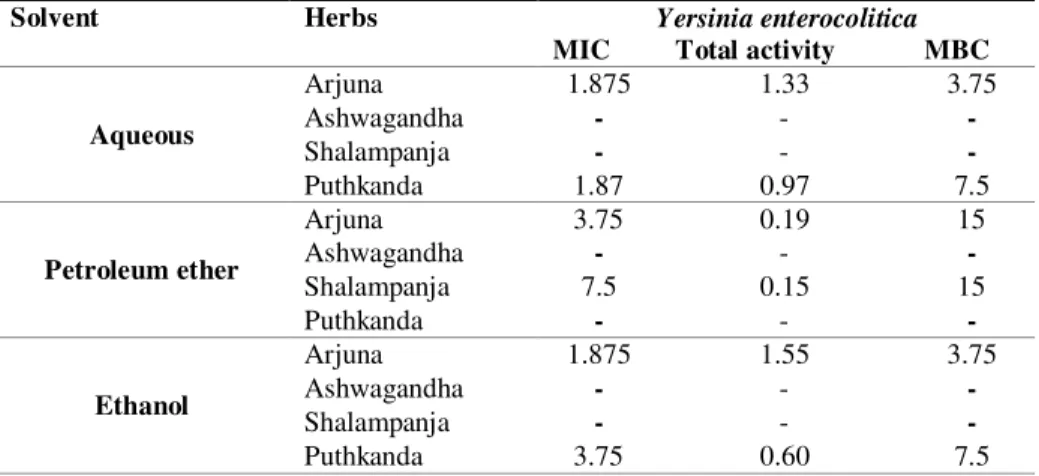
extracts which show activity in the disc diffusion assay. Results were shown in Table 4. MIC and MBC for aqueous and ethanol extracts of Arjuna were ranged between 1.875-3.75 mg/ml, whereas the values for petroleum ether extracts were between 3.75-15mg/ml. MIC and MBC values range for Puthkanda aqueous extracts between 1.875-7.5mg/ml and ethanol extracts between 3.75-7.5mg/ml whereas petroleum ether extracts of Puthkanda didn’t show MIC and MBC values. MIC and MBC values for petroleum ether extract of Shalampanja ranged between 7.5-15mg/ml, whereas aqueous and ethanolic extract did not show any MIC and MBC. All extracts of Ashwagandha showed no MIC and MBC values. The lowest MIC and MBC values were recorded for aqueous Arjuna extracts.
Dey et al. (2010) reported that methanolextracts of Arjuna showed the lowest MIC
values against all the tested microorganisms except for Pseudomonas as compared to ethanolic extract.
Kumar et al. (2014) reported that ethanol extracts of Arjuna showed the lowest MIC values against the selected microorganisms i.e. Escherichia coli, Klebsiella
pneumoniae, Enterobacter, Pseudomonas aeruginosa and Protues vulgaris
compared to aqueous extracts.
Singariya et al. (2011) reported excellent antibacterial activities of chloroform extracts of Ashwagandhadue to its low MIC and MBC values. MBC values were found higher than the MIC values of the extracts against the tested microorganisms, indicating the bacteriostatic effects of the extracts.
Ranwan and Yadav (2012) reported that hexane extract of root, stem, leaves and seeds of Puthkanda showed the lowest MIC values against the selected strains i.e.
Bacillus cereus, Staphylococcus aureus, Proteus mirabilis, Pseudomonas
aeruginosa,Escherichia coli compared to ethanol, methanol and aqueous extracts.
Table 4. Minimum inhibitory concentration and minimum bactericidal concentration of herb extracts against Yersinia enterocolitica
Solvent Herbs Yersinia enterocolitica
MIC Total activity MBC
Aqueous
Arjuna 1.875 1.33 3.75
Ashwagandha - - -
Shalampanja - - -
Puthkanda 1.87 0.97 7.5
Petroleum ether
Arjuna 3.75 0.19 15
Ashwagandha - - -
Shalampanja 7.5 0.15 15
Puthkanda - - -
Ethanol
Arjuna 1.875 1.55 3.75
Ashwagandha - - -
Shalampanja - - -
Puthkanda 3.75 0.60 7.5
Data are presented as mean (n=3)
Conclusions
The effect of herb extracts on the growth of mixed microbial population and Yersinia
enterocolitica was determined by agar well and disc diffusion assays. Results
showed that the Arjuna had the most potent inhibitory effect on the growth of mixed microbial population and Yersinia enterocolitica. It was observed that aqueous extracts of each herb showed higher antimicrobial potential in comparison with their ethanolic and petroleum ether extracts, respectively. The lowest values of the Minimum Inhibitory Concentration and Minimum Bactericidal Concentration were recorded for Arjuna. The Ashwagandha did not show any MIC and MBC values. It can be concluded that, out of four investigated herbs, Arjuna has the highest antimicrobial potential against Yersinia enterocolictica. Therefore it can be recommended that Arjuna may be used for treatment against Yersinia enterocolictica.
Acknowledgements
The authors acknowledged the School of Bioengineering and Food Technology, Shoolini University, Solan, India for providing all chemicals, glassware and instruments.
References
Acharyya, S., Patra, A., Bag, P.K. 2009. Evaluation of the antimicrobial activity of some medicinal plants against enteric bacteria with particular reference to multi-drug resistant Vibrio cholerae. Tropical Journal of Pharmaceutical Research, 8, 231–237.
properties and antibacterial activities. BMC Complementary and Alternative Medicine,
12, 1-8.
Aneja, K.R., Sharma, C., Joshi, R. 2012. Antimicrobial activity of Terminalia Arjuna Wight and Arn: an ethnomedicinal plant against pathogens causing ear infection. Brazilian Journal of Otorhinolaryngology,78, 68-74.
Badola, H.K. 2002. Endangered Medicinal plant in Himachal Pradesh. Current Science, 83, 797-798.
Badola, H.K., Aitken, S. 2003. The Himalayas of India: A treasury of medicinal plant under siege. Biodiversity, 4, 3-13.
Beaulah, A.G., Sadiq, M.A., Santhi, J.R. 2011. Antioxidant and antibacterial activity of Achyranthes aspera- an in vitro study. Der Pharma Chemica, 3, 255-262.
Bhattacharyya, P.N., Jha, D.K. 2011. Antidermatophytic and antioxidant activity of Terminalia Arjuna (roxb.) Wight and Arn. Bark. International Journal of Pharmaceutical and Biological Archive, 2, 973-979.
Cowan, M.M. 1999. Plant products as antimicrobial agents. Clinical Microbiological Review,
12, 564-582.
Dash, B.K., Sen, M.K., Alam, M.K. 2013. In vitro inhibitory activity of Achyranthes aspera L. seed against some test bacteria. American Journal of Life Science,1, 113-116. Debnath, S., Dey, D., Hazra, S., Ghosh, S., Ray, R., Hazra, B. 2013. Antibacterial and
antifungal activity of Terminalia Arjuna Wight and Arn. bark against multi-drug resistant clinical isolates. Journal of Coastal Life Medicine, 1, 315-321.
Dey, S.K., Banerjee, D., Chattapadhyay, S., Karmakar, K.B. 2010. Antimicrobial activities of some medicinal plants of west Bengal. International Journal of Pharma and Biosciences, 1, 1-9.
Dhanani, T., Shah, S., Gajbhiye, N.A., Kumar S. 2013. Effect of extraction methods on yield, phytochemical constituents and antioxidant activity of Withania somnifera. Arabian Journal of Chemistry, http://dx.doi.org/10.1016 /j.arabjc.2013.02.015.
Dwivedi, D., Sengar, N., Gharia, A.K. 2013. Antimicrobial activity of alkaloids extracted from Terminalia arjuna against several microbes. Journal of Chemical and Chemical Sciences, 3, 235-239.
Dwivedi, S. 2007. Terminalia Arjuna wight Arn. A useful drug for cardiovascular disorder. Journal of Ethnopharmacology, 114, 114-129.
Ejechi, B.O., Akpomedaye, D.E. 2005. Activity of essential oil and phenolic acid extracts of pepperfruit (Dennetia tripetala G. Barker; Anonaceae) against some food-borne microorganisms. African Journal of Biotechnology,4, 258-261.
Geetha, K., Narayanan, K.R., Murugesan, A.G. 2010. Antimicrobial efficiency of Achyranthes aspera L. against selected pathogenic organisms. Journal of Bioscience Research,1, 187-190.
Hsu, B., Coupar, I.M., Ng, K. 2006. Antioxidant activity of hot water extract from the fruit of the Doum palm, Hyphaene thebaica. Food Chemistry, 98, 317–328.
Jovanovic, S.V., Simic, M.G. 2000. Antioxidants in nutrition. Annals of New York Academic Science,899, 326–334.
Kaushik, R., Sharma, N., Swami, N., Sihag, M., Goyal, A., Chawla, P., Kumar, A., Pawar, A. 2013. Physico-chemical properties, extraction and characterization of gluten from different Indian wheat cultivars. Research and Review Journal of Crop Science and Technology,2, 37-42.
Kaushik, R., Sachdeva, B., Arora, S. 2016. Effect of calcium and vitamin D2 fortification on
quality characteristics of dahi. International Journal of Dairy Technology,69, 1-8. Kumar, R.M.R., Jagadeesan, M.G., Rajendran, P., Arunagirinathan, N. 2014. Antibacterial
activity of bark extracts of Terminalia Arjuna (Roxb.) against extended spectrum lactamase producing multi drug resistant bacteria from urinary tract infections. Research Journal Recent Science,3,28-33.
Mukherjee, P.K. 2008. Quality control of herbal drugs. Business Horizon Pharmaceutical Publishers. 13.
Nascimento, G.F., Juliana, L., Paulo, C.F., Giuliana, L.S. 2000. Antibacterial activity of plant extracts and phytochemcicals on antibiotic resistant bacteria. Brazilian Journal of Microbiology,31, 247-256.
Pascaline, J., Charles, M., Lukhoba, C., George, O. 2011. Phytochemical constituents of some medicinal plants used by the Nandis of South Nandi district, Kenya. Journal of Animal Plant Science,9, 1201-1210.
Patil, U., Sharma, M.C. 2013. Studies on antibacterial effect of Acyranthes aspera on multi drug resistant clinical isolates. International Journal of Research in Ayurveda Pharmacy,
4, 262-265.
Pujari, S.A., Gandhi, M.B. 2012. Studies on effect of root extracts of Withania somnifera on some clinically isolated bacterial pathogens. Journal of Environmental Research Development, 7, 1032-1035.
Ramya, S., Kalaivani, T., Rajasekaran, C., Jepachanderamohan, P., Alaguchamy, N., Kalayansundaram, M., Jayakumararaj, R. 2008. Antimicrobial activity of aqueous extracts of bark, root, leaves and fruits of Terminalia Arjuna Wight. Ethnobotanical Leaflets,12, 1192-1197.
Ranpal S. 2009. An Assessment of Status and Antibacterial Properties of Dactylorhiza hatagirea in Annapurna Conservation Area (A case study of Paplekharka, Lete VDC, Mustang). B. Sc. Forestry Research Thesis Submitted to Tribhuvan University, Institute of Forestry, Pokhara, Nepal. I Tribhuvan University Institute of Forestry, 3.
Ranwan, S., Yadav, J.P. 2012. Seasonal variation in antibacterial activity of different parts of Acyranthes aspera against some bacteria. International Journal of Medicinal Aromatic Plants, 2, 369-375.
Samant, S.S., Joshi, H.C. 2005. Plant Diversity and Conservation status of Nanda Devi National Park and comparisons with Highland National Park of Indian Himalayan region. International Journal of Biochemical Cell Biology,1, 65-73.
Samy, R.P., Ignacimuthu, S., Sen, A. 1998. Screening of 34 Indian Medicinal plants for antibacterial properties. Journal of Ethnppharmacology,62, 173-181.
Sharma, A., Chandraker, S., Patel, V.K., Ramteke, P. 2009. Antibacterial activity of Medicinal Plants against pathogens causing complicated Urinary tract infections. Indian Journal of Pharmaceutical Science,71, 136-139.
Sharma, S., Kaushik, R., Sharma, S., Chouhan, P., Kumar, N., Sharma, P., Sharma, R. 2016. Effect of herb extracts on growth of probiotic cultures. Indian Journal Dairy Science, 69, 328-335.
Singariya, P., Mourya, K.K., Kumar, P. 2011. Antimicrobial activity of the crude extracts of Withania somnifera and Cenchrus setigerus In-vitro.Pharmacognosy Journal,4, 60-65. Singh, D.V., Gupta, M.M., Kumar, T.R.S., Saikia, D., Khanuja, S.P.S. 2008. Antibacterial
principles from the bark of Terminalia Arjuna. Current Science.94, 27-29.
Sinha, S.N. 2012. Screening of antioxidant and antibacterial activities of various extracts of Withania somnifera. InternationalJournal of Pharmacology and Therapeutics, 2, 36-42. Srinu, B., Kumar, V., Rao, L.V., Kalakumar, B., Rao, T.M., Reddy A.G. 2012. Screening of antimicrobial activity of Withania somnifera and Aloe vera plant extracts against food borne pathogens. Journal of Chemical Pharmacy Research,4, 4800-4803.
Srivastav, S.P., Singh, G., Mishra, K., Jha, K., Khosa, R.L. 2011. Achyranthes aspera-An important medicinal plant: A review. Journal of Natural Product and Plant Resources,
1, 1-14.
Sultana, B., Anwar, F., Ashraf, M. 2009. Effect of extraction solvent/technique on the antioxidant activity of selected medicinal plant extracts. Molecules, 14: 2167-2180. Sundaram, S., Dwivedi, P., Purwar, S. 2011. In-vitro evaluation of antibacterial activities of
crude extracts of Withania somnifera to bacterial pathogens. Asian Journal of Biotechnology,3, 194-199.
Tahiliani, P., Kar, A. 2000 Achyranthes aspera elevates thyroid hormone levels and decreases hepatic lipid peroxidation in male rats. Journal of Ethnopharmacol, 71, 527-532.