ISSN 0100-879X
BIOMEDICAL SCIENCES
AND
CLINICAL INVESTIGATION
www.bjournal.com.br
www.bjournal.com.br
Volume 44 (12) 1194-1298 December 2011
Institutional Sponsors
The Brazilian Journal of Medical and Biological Research is partially financed by
Faculdade de Medicina de Ribeirão Preto Campus
Ribeirão Preto
Ex plor e H igh - Pe r for m a n ce M S Or bit r a p Te ch n ology I n Pr ot e om ics & M e t a bolom ics
analit icaw eb.com .br S C I E N T I F I C
Braz J Med Biol Res, December 2011, Volume 44(12) 1209-1214
doi:
Production of L1 protein from different types of HPV in
Pichia
pastoris
using an integrative vector
10.1590/S0100-879X2011007500141
Production of L1 protein from different types
of HPV in
Pichia pastoris
using an
integrative vector
E.C. Coimbra
1,
F.B. Gomes
1,
J.F. Campos
1, M. D’arc
1, J.C. Carvalho
1,
F.C. Mariz
1, A.L.S. Jesus
1, R.C. Stocco
2, W. Beçak
2and A.C. Freitas
11Laboratório de Estudos Moleculares e Terapia Experimental, Departamento de Genética, Centro de Ciências Biológicas, Universidade Federal de Pernambuco, Recife, PE, Brasil 2Laboratório de Genética, Instituto Butantan, São Paulo, SP, Brasil
Abstract
Human papillomavirus (HPV) infection is the most common sexually transmitted disease in the world and is related to the etiology of cervical cancer. The most common high-risk HPV types are 16 and 18; however, the second most prevalent type in the Midwestern region of Brazil is HPV-33. New vaccine strategies against HPV have shown that virus-like particles (VLP)
of the major capsid protein (L1) induce efficient production of antibodies, which confer protection against the same viral type.
The methylotrophic yeast Pichia pastoris is an efficient and inexpensive expression system for the production of high levels of
heterologous proteins stably using a wild-type gene in combination with an integrative vector. It was recently demonstrated that
P. pastoris can produce the HPV-16 L1 protein by using an episomal vector associated with the optimized L1 gene. However, the use of an episomal vector is not appropriate for protein production on an industrial scale. In the present study, the vectors were integrated into the Pichia genome and the results were positive for L1 gene transcription and protein production, both intracellularly and in the extracellular environment. Despite the great potential forexpression bythe P. pastoris system, our results suggest a low yield of L1 recombinant protein, which, however, does not make this system unworkable. The achievement of stable clones containing the expression cassettes integrated in the genome may permitoptimizations that couldenable the establishment of a platform for the production of VLP-based vaccines.
Key words: Human papillomavirus; Cervical cancer; Pichia pastoris; L1
Introduction
Correspondence: A.C. Freitas, LEMTE, Departamento de Genética, CCB, UFPE, Av. Prof. Moraes Rego, 1235, 50670-901 Recife, PE, Brasil. E-mail: [email protected]
Received June 6, 2011. Accepted October 10, 2011. Available online October 28, 2011. Published November 28, 2011. Human papillomavirus (HPV) infection is the most
common sexually transmitted disease in the world and is related to the etiology of cervical cancer. Approximately 500,000 new cases of cancer are diagnosed each year, with a mortality rate of 50% (1). Latin America, Sub-Saharan Africa and Asia (South and Southeast) arethe regions with the highest incidence (2). Among more than 120 types, 16 and 18 are the most prevalent HPV types responsible for 70% of cervical cancer cases (3). However, the prevalence of HPV types found in cervical cancer shows geographical variations worldwide (4). In Brazil, HPV type 16 is also the most frequent, but there are regional variations regarding the second most frequent type. In the Northeast and Midwest, HPV types 31 and 33 have the higher incidence (5), while in
other regions such as the Southeast, HPV-18 is the second most frequent type among cervical cancer cases (6).
Studies indicate that vaccines based on virus-like particles (VLP), built with the L1 capsid protein, are more effective against infection because they induce high neutral-izing antibody titers directed at conformational epitopes of this protein, which composes 90% of the capsid structure (7). VLP can be obtained through the production of HPV L1 protein in heterologous expression systems using mam-malian cells (8), plants (9), bacteria (10), insect cells (11), and yeast (12).
The methylotrophic yeast Pichia pastoris is an efficient
1210 E.C. Coimbra et al.
have been produced in this yeast (13), including those used as subunit vaccines against viruses, such as the surface antigen of hepatitis B and glycoprotein D of bovine herpes virus (14). P. pastoris is the second most used system for heterologous expression after the bacteria Escherichia coli
(15). Several factors contribute to this fact: the system uses the inducible AOX1 promoter, which encodes the alcohol oxidase 1 gene. The promoter is repressed by glucose and strongly induced by methanol. The possibility to improve
post-translational modifications typically associated with
higher eukaryotes and required for the biological activity of proteins (16) as well as the easy adaptation to large-scale fermentation, reaching levels of expression that are not often obtained with other cell types, are remarkable advantages of this system (17).
The viability of P. pastoris for HPV-16 L1 protein produc-tion using an episomal vector associated with the optimized L1 gene has been recently demonstrated (18). However, the use of an episomal vector is not appropriate for large-scale industrial protein production. Since the expression system based on an episomal vector is not ideal for industrial-scale production (19,20) and the expression system based on P.
pastoris yeast cells has been used successfully to express
different heterologous genes using an integrative vector, and without codon optimization (16), the aim of the pres-ent study was to evaluate the viability of expression of the wild-type L1 gene from different human papillomavirus types (types 16, 18, and 33) in P. pastoris cells using an integrative vector.
Material and Methods
Cloning of the L1 gene of HPV-16, -18 and -33 in expression vectors
The pBR322H16 and pBR322H18 plasmids containing the complete genome of HPV-16 and -18, respectively, were used for PCR of the L1 gene. The HPV-33 L1 gene
was amplified from a clinical sample. The primers were
constructed on the basis of the known gene sequences of L1 of HPV-16, -18 and -33, deposited in databases (GenBank accession Nos. gi: 27752860, gi: 194272988 and gi: 333049, respectively). The consensus sequence for translation in yeast (Kozak sequence) was added to the forward primer sequences as well as the restriction sites in the 5’ end for insertion into the pPICZA vector (KpnI for the primer sequence of HPV-16 and BstBI for the primer
sequences of HPV-18 and -33) and pPICZαA vector (KpnI for the primer sequence of HPV-16). In the forward primer
for insertion of the HPV-16 L1 gene in the pPICZαA vector
it was not necessary to add the Kozak sequence because of the presence of the secretion factor in this vector. The expression vectors were obtained with the EasySelect™
P. pastoris expression kit, Invitrogen (USA). The reverse
primers included a restriction site for SalI (HPV-16 primer sequence) and XhoI (HPV-18 and -33 primer sequences).
The stop codon of the L1 gene was removed in order to promote the link of the poly-histidine (6xHis) tag present in the vectors (Table 1).
The clones in E. coli TOP 10 were obtained by transfor-mation with CaCl2 (22) and selected on low salt LB medium
(1% tryptone, 0.5% yeast extract, 0.5% NaCl, 2% agar) with Zeocin
™
(due to the presence of the Sh ble gene in the vectors that confers resistance to this antibiotic).Recombinants were confirmed by PCR, restriction enzyme
digestion and sequencing.
Transformation of P. pastoris
The pPICZL1H16, pPICZL1H18, pPICZL1H33, and
pPICZαL1H16 constructs were linearized with the SacI enzyme to transform the P. pastoris X-33 strain by electropo-ration (according to the Eppendorf multiporator protocol).
P. pastoris X-33 was also transformed with empty vectors
(pPICZA and pPICZαA) for negative control tests. Aliquots
of 50, 100, and 200 mL were spread on YPDS plates (1% yeast extract, 2% peptone, 2% glucose, 1 M sorbitol, 2% agar) containing 100 µg/mL Zeocin for incubation at 30°C for 2-3 days. Clones were detected by colony PCR using the conditions and primers provided in the EasySelect™
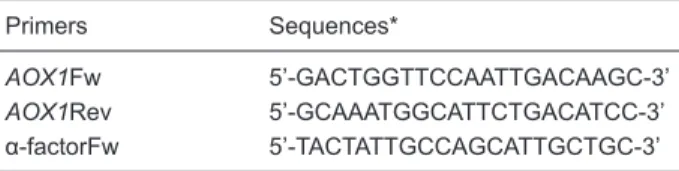
P. pastoris expression kit. The primers used for detection
anneal in the flanking regions of the insert (AOX1 and α-factor) and are reportedin Table 2.
Induction of L1 gene expression in P. pastoris cells
The selected clones were induced together with the
positive control strains of the intracellular
(GS115/β-galactosidase) and extracellular (GS115/albumin) expres-sion provided by the EasySelect™ P. pastoris expression kit. The colonies were inoculated in BMGY medium (1% yeast extract, 2% peptone, 100 mM potassium phosphate,
Table 1. Primers for amplification of the L1 gene of HPV-16, -18
and -33.
Primers Sequences*
H16Fw 5’-GGTACCTCACAATAATGTCTCTTTGGCTGC-3’
H16Rev 5’-GTCGACGAGCTTACGTTTTTTGC-3’
H18Fw 5’-GATTCGAAAAAAATGTGCCACGGGTCC-3’
H18Rev 5’-GTCCCTCGAGTTCCTGGCACGTACACG-3’
H33Fw 5’-GATTCGAAAAAATGTCCGTGTGGCGGCCTAG-3’
H33Rev 5’-TCCCTCGAGTTTTTAACCTTTTTGCG-3’
H16αFw 5’-GGTACCCTTTGGCTGCCT-3’
H16αRev 5’-GTCGACCAGCTTACGTTTTTTGCG-3’
pH 6.0, 1.34% yeast nitrogen base (YNB), 4 x 10⁻⁵% biotin, and 1% glycerol) to obtain biomass over a period of 16-24 h at 28-30°C. After growth reached an absorbance at 600 nmof 10-20, medium with glycerol was removed by centrifugation and BMMY was added (1% yeast extract, 2% peptone, 100 mM potassium phosphate, pH 6.0, 1.34% YNB, 4 x 10⁻⁵% biotin, and 0.5% methanol). During the subsequent 24 h (until 96 h) methanol (inducer of the AOX1 promoter) was added
to achieve a final concentration of 1-2%. Forty clones with the pPICZαL1H16 construction and the pPICZαA only (used
as a negative control) were induced in a deep-well plate with 1 mL BMMY medium for 72 h for analysis of extracellular expression. The clones of intracellular expression (approxi-mately 90), as well as the negative control (with the pPICZA only), were induced under the conditions described earlier
in 500-mL flasks containing 50 mL medium. For subsequent
analysis of L1 gene expression, samples were taken from cultures every 24 h, including aliquots of supernatants and pellets stored at -80°C.
Transcriptional analysis of the L1 gene
Total RNA was extracted from recombinant clones (X33/ pPICZL1H16, X33/pPICZL1H18, X33/pPICZL1H33, and
X33/pPICZαL1H16) by the acid-phenol method (24). The
cDNA of the three types of HPVs was synthesized using the IMPROM-II™ Reverse Transcription System from Promega (USA). The presence of heterologous gene mRNA in Pichia
was detected by RT-PCR with primers that anneal in the internal sequence of the L1 genes (Table 3), amplifying a region of 500 bp.
Detection of L1 protein
L1 protein production was determined by Coomassie- stained SDS-PAGE (12.5%) and by dot blot immunoassay. The intracellular proteins were obtained by lysis with glass beads and the supernatant for analysis of extracellular ex-pression was obtained by centrifugation of the induced
cul-ture. The samples were quantified by the Bradford method
(25) and subjected to a dot blot protocol that consisted of protein ligation (0.9 µg) to a nitrocellulose membrane for 1 h, wash with 1X PBS (50 mM potassium
phosphate, 150 mM NaCl, pH 7.2) for 5 min, blocking with 2.5% milk for 40 min addition of alkalane phosphatase-conjugated anti-6xHis antibody (Sigma, USA) diluted 1:10,000 in 5% milk for incubation at 37°C for 1 h, three washes with 1X PBS-0.05% Tween (10 min each), and development with NTB/BCIP (Sigma).
Results
Cloning of the L1 gene for expression in
P. pastoris
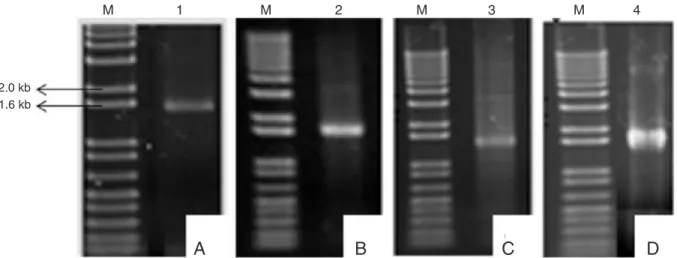
The identity ofpPICZL1H16, pPICZL1H18,
pPICZL1H33, and pPICZαL1H16 constructs was confirmed
by PCR (Figure 1). The integration of these expression cas-settes into the Pichia genome was confirmed with primers,
which anneal to flanking regions of the cloning site in the
vector. The results show that constructs were successfully inserted in the expression system and that the expression cassettes were integrated into the Pichia genome (Figure
2A). The pattern of amplification shows that clones with the
Muts and Mut+ phenotypes were obtained due to
double-crossover events (replacements) and single-double-crossover events (insertions) that can occur in gene insertions at the AOX1
locus, respectively.
L1 gene expression in P. pastoris cells
Transcription analysis by RT-PCR. After induction of
L1 gene expression in all clones tested, total RNA was
extracted for cDNA synthesis and subsequent amplification
by RT-PCR. The result was the expected fragment of 500
bp (Figure 2B), confirming the transcription of the L1 gene
of the three HPV types in P. pastoris cells.
Analysis of L1 protein expression. The total lysate of
the clones induced after 96 h for intracellular expression and the supernatants of the clones for extracellular
expres-sion were subjected to SDS-PAGE (approximately 40 μg)
to determine the integrity of the proteins. It was not pos-sible to identify the L1 heterologous protein in the protein
profile of the two extracts. The efficiency of induction of the expression system was confirmed by the use of Pichia
control strains that express heterologous proteins such as
Table 2. Primers for the detection of recombinant Pichia clones.
Primers Sequences*
AOX1Fw 5’-GACTGGTTCCAATTGACAAGC-3’
AOX1Rev 5’-GCAAATGGCATTCTGACATCC-3’
α-factorFw 5’-TACTATTGCCAGCATTGCTGC-3’
*The sequences of primers are available on EasySelect Pichia
Expression Kit Manual (23).
Table 3. Primers for RT-PCR.
Primers Sequences* Nucleotide position
H16Fw_int 5’-GGTCCATTAGGTGTGGG-3’ 634-659 H16Rev_int 5’-AGCTGTCGCCATATGGTTCTG-3’ 1111-1133 H18Fw_int 5’-ATGGTAGATACTGGATATGGTGC-3’ 781-804 H18Rev_int 5’-CTGCTATACTGCTTAAATTTGGTAG-3’ 1255-1280 H33Fw_int 5’-GGAACATTGGGGTAAAGGTGTTGC-3’ 500-524 H33Rev_int 5’-CCACAGTAACAAATACCTGATTGCC-3’ 975-1000
1212 E.C. Coimbra et al.
the beta-galactosidase (intracellular) and the human serum albumin (HSA) (extracellular).
L1 protein production in P. pastoris was detected by dot blot assay using an antibody against the poly-His tag. The lysates of the intracellular expression clones showed
specific reactions due to the presence of L1, as shown in
Figure 3A.
The dot blot used to evaluate the extracellular expression of the HPV-16 L1 protein was based on the screening of many induced clones in a deep-well plate for detection of
the more efficient. After pre-selection, two clones (15 and
20) that showed intense reactions, as well as the strain
used as negative control, were induced in shake flasks. The culture supernatants quantified by the Bradford method
Figure 1. Confirmation of the intra- and extracellular constructs for L1 expression by PCR. A, Amplification of the HPV-16 L1 gene (1.5 kb) cloned in the pPICZα vector. B, C, and D, HPV-16 (1.5 kb), HPV-18 (1.7 kb), and HPV-33 (1.5 kb) L1 genes, respectively, cloned in the pPICZ vector. On all gels, we used the molecular weight marker 1 kb plus (lane M; Invitrogen).
Figure 2. PCR detection and RT-PCR of Pichia
recombinant colonies. A, PCR with primers that anneal in the AOX1 region, amplifying a frag-ment of 325 bp (in addition to the gene) and in the alpha secretion factor region, amplifying a fragment of 299 bp (in addition to the gene) in
pPICZA and pPICZα vectors, respectively. Lane 1, 1 kb plus molecular weight marker (Invitro-gen); lane 2, amplicon obtained fromthe X33/ pPICZL1H18 recombinant (1700 + 325 = 2025 bp); lane 3, an amplicon obtained fromthe X33/ pPICZL1H33 recombinant (1500 + 325 = 1825 bp) and an amplicon that refers to the AOX1
gene (2200 bp) of P. pastoris from its Mut+ phe-notype; lane 4, amplicon obtained fromthe X33/ pPICZL1H16 recombinant (1500 + 325 = 1825 bp); lane 5, amplicon obtained fromthe X33/
pPICZαL1H16 recombinant (1500 + 299 = 1799
bp); lane 6, negative control (without DNA). B, Representative RT-PCR of clones. Lane 1, lambda HindIII molecular weight marker (Invitro-gen); lanes 2 and 3, X33/pPICZL1H33 and X33/ pPICZL1H18 clones, respectively; lane 4, X33/ pPICZL1H16 clone; lane 5, X33/pPICZαL1H16
for standardization of the samples were submitted to a new dot blot,
where specific reactions were
observed for clones evaluated
with anti-6xHis antibody, confirm -ing the presence of the L1 protein in the extracellular environment (Figure 3B).
Discussion
The aim of this study was to evaluate the possibility of express-ing the L1 gene of different HPV types (16, 18, and 33) in P. pastoris
yeast cells for the production of the L1 major capsid protein using integrative vectors.
Some reports have shown that gene codon optimization can improve the expression levels in
P. pastoris compared to wild-type
gene expression (26,27). How-ever, according to Higgins and Cregg (28), there is a 50-75% probability that the P. pastoris
system will produce foreign proteins at a reasonable level without the need of optimization. Since 1984 different pro-teins have been well expressed in P. pastoris and several studies have demonstrated the strong and intrinsic Pichia
ability to express heterologous genes without optimizations (14,29,30).
Bazan et al. (18) demonstrated that, using the episomal vector, the production of the HPV-16 L1 protein in P. pastoris
was only possible after codon optimization of the L1 gene. It is known that for large-scale production episomal vectors would not be advantageous since the transformed yeast can lose these vectors after successive mitotic divisions because they are not integrated into the genome and thus can be lost in the absence of selection pressure. The need of antibiotics for the maintenance of these clones raises the costs of production and may disagree with the rules imposed by regulatory agencies (31). Thus, to be able to produce the L1 protein on an industrial scale (vaccine production) it is important to obtain stable clones expressing the L1 gene and a manner to do this is to use integrative vectors. In addition, the use of an integrative vector may favor the integration
of more than one copy of the heterologous gene, which in many cases increases protein production (32).
The present data allow us to conclude that, although preliminary, the P. pastoris expression system is suitable for the L1 protein production from different HPV types. The use of integrative vectors and the consequent stability of clones make this heterologous expression system a potential tool that can be subjected to optimization parameters (use of a bioreactor and/or codon-optimization of the L1 gene) in order to achieve higher levels of the L1 protein and thus establish-ing a platform for the production of VLP-based vaccine.
Acknowledgments
We thank the aid offered by the Laboratory of Im-munopathology Keizo Asami (LIKA) to carry out part of the experiments, the Aggeu Magalhães Research Center (FIOCRUZ, PE) for the sequencing of samples in the present study, and Dr. Oswaldo Pompílio de Melo Neto (FIOCRUZ, PE), as well as his staff, for their help with discussions of the experiments. Research supported by FACEPE/ PPSUS-2008 (#APQ-1373-4.00/08) and CAPES.
References
1. Kwak K, Yemelyanova A, Roden RB. Prevention of cancer by prophylactic human papillomavirus vaccines. Curr Opin Immunol 2011; 23: 244-251.
2. Parkin DM, Bray F, Ferlay J, Pisani P. Global cancer
statis-tics, 2002. CA Cancer J Clin 2005; 55: 74-108.
3. WHO (World Health Organization). Viral cancers. http:// www.who.int/vaccine_research/diseases/viral_cancers/en/ index3.html. Accessed May 21, 2011.
Figure 3. Dot blot for the detection of intracellular and extracellular production of the L1 pro-tein. The samples were standardized to an amount of 0.9 µg, which was applied to a
nitrocel-lulose membrane. The specific reactions with the lysates of clones, shown in A by H16, H18 and H33 and in B by clones 15 and 20, confirm the presence of the L1 protein of the three
1214 E.C. Coimbra et al.
4. Bosch FX, Manos MM, Munoz N, Sherman M, Jansen AM, Peto J, et al. Prevalence of human papillomavirus in cervi-cal cancer: a worldwide perspective. International biologicervi-cal study on cervical cancer (IBSCC) Study Group. J Natl Can-cer Inst 1995; 87: 796-802.
5. Baldez da Silva MF, Chagas BS, Guimaraes V, Katz LM, Felix PM, Miranda PM, et al. HPV31 and HPV33 incidence in cervical samples from women in Recife, Brazil. Genet Mol Res 2009; 8: 1437-1443.
6. Goncalves MA, Massad E, Burattini MN, Villa LL. Relation-ship between human papillomavirus (HPV) genotyping and genital neoplasia in HIV-positive patients of Santos City, São Paulo, Brazil. Int J STD AIDS 1999; 10: 803-807.
7. Da Silva DM, Eiben GL, Fausch SC, Wakabayashi MT, Rudolf MP, Velders MP, et al. Cervical cancer vaccines: emerging concepts and developments. J Cell Physiol 2001; 186: 169-182.
8. Nakauchi M, Kariwa H, Kon Y, Yoshii K, Maeda A, Takashima I. Analysis of severe acute respiratory syndrome coronavirus structural proteins in virus-like particle assembly. Microbiol Immunol 2008; 52: 625-630.
9. Varsani A, Williamson AL, Rose RC, Jaffer M, Rybicki EP. Expression of Human papillomavirus type 16 major capsid protein in transgenic Nicotiana tabacum cv. Xanthi. Arch Virol 2003; 148: 1771-1786.
10. Hou L, Wu H, Xu L, Yang F. Expression and self-assembly of virus-like particles of infectious hypodermal and hematopoi-etic necrosis virus in Escherichia coli. Arch Virol 2009; 154: 547-553.
11. Zhou J, Sun XY, Stenzel DJ, Frazer IH. Expression of vaccinia recombinant HPV 16 L1 and L2 ORF proteins in
epithelial cells is sufficient for assembly of HPV virion-like
particles. Virology 1991; 185: 251-257.
12. Vassileva A, Chugh DA, Swaminathan S, Khanna N. Expres-sion of hepatitis B surface antigen in the methylotrophic yeast Pichia pastoris using the GAP promoter. J Biotechnol
2001; 88: 21-35.
13. Lin-Cereghino GP, Godfrey L, de la Cruz BJ, Johnson S, Khuongsathiene S, Tolstorukov I, et al. Mxr1p, a key regu-lator of the methanol utilization pathway and peroxisomal genes in Pichia pastoris. Mol Cell Biol 2006; 26: 883-897. 14. Cereghino JL, Cregg JM. Heterologous protein expression
in the methylotrophic yeast Pichia pastoris. FEMS Microbiol Rev 2000; 24: 45-66.
15. Sorensen HP. Towards universal systems for recombinant gene expression. Microb Cell Fact 2010; 9: 27.
16. Macauley-Patrick S, Fazenda ML, McNeil B, Harvey LM. Heterologous protein production using the Pichia pastoris
expression system. Yeast 2005; 22: 249-270.
17. Cregg JM, Vedvick TS, Raschke WC. Recent advances in the expression of foreign genes in Pichia pastoris. Biotech-nology 1993; 11: 905-910.
18. Bazan SB, de Alencar Muniz Chaves A, Aires KA, Cianciar-ullo AM, Garcea RL, Ho PL. Expression and characterization of HPV-16 L1 capsid protein in Pichia pastoris. Arch Virol
2009; 154: 1609-1617.
19. Cregg JM, Barringer KJ, Hessler AY, Madden KR. Pichia pastoris as a host system for transformations. Mol Cell Biol
1985; 5: 3376-3385.
20. Hong I-P, Anderson S, Choi S-G. Evaluation of a new episomal vector based on the GAP promoter for structural genomics in Pichia pastoris. J Microbiol Biotechnol 2006; 16: 1362-1368.
21. Kozak M. An analysis of 5’-noncoding sequences from 699 vertebrate messenger RNAs. Nucleic Acids Res 1987; 15: 8125-8148.
22. Sambrook J, Fritsch EF, Maniatis T. Preparation and transformation of competent E. coli cells. In: Anonymous,
Molecular cloning: A laboratory manual. New York: CSHL Press 1989; p 1.74-1.84.
23. Invitrogen. Pichia expression kit, “Protein Expression: A manual of Methods for Expression of Recombinant Proteins
using pPICZ and pPICZα in Pichia pastoris”. Invitrogen, Carlsbad, Version G 2001; p 1-74.
24. Schmitt ME, Brown TA, Trumpower BL. A rapid and simple method for preparation of RNA from Saccharomyces cerevi-siae. Nucleic Acids Res 1990; 18: 3091-3092.
25. Bradford MM. A rapid and sensitive method for the quantita-tion of microgram quantities of protein utilizing the principle of protein-dye binding. Anal Biochem 1976; 72: 248-254. 26. Teng D, Fan Y, Yang YL, Tian ZG, Luo J, Wang JH. Codon
optimization of Bacillus licheniformis beta-1,3-1,4-glucanase gene and its expression in Pichia pastoris. Appl Microbiol Biotechnol 2007; 74: 1074-1083.
27. Outchkourov NS, Stiekema WJ, Jongsma MA. Optimization of the Expression of Equistatin in Pichia pastoris. Protein Expr Purif 2002; 24: 18-24.
28. Higgins DR, Cregg JM. Methods in molecular biology: Pichia protocols. Totowa: Humana Press; 1998; 103: 1-16. 29. Craveiro RB, Ramalho JD, Chagas JR, Wang PH, Casarini
D, Pesquero JL, et al. High expression of human carboxy-High expression of human carboxy-peptidase M in Pichia pastoris: purification and partial char -acterization. Braz J Med Biol Res 2006; 39: 211-217. 30. Cregg JM, Cereghino JL, Shi J, Higgins DR. Recombinant
protein expression in Pichia pastoris. Mol Biotechnol 2000; 16: 23-52.
31. Sreekrishna K, Brankamp RG, Kropp KE, Blankenship DT, Tsay JT, Smith PL, et al. Strategies for optimal synthesis and secretion of heterologous proteins in the methylotrophic yeast Pichia pastoris. Gene 1997; 190: 55-62.