GENETIC VARIABILITY AND SOCIAL STRUCTURE OF
COLONIES IN Acromyrmex heyeri AND A. striatus
(HYMENOPTERA: FORMICIDAE)
DIEHL, E.,1 ARAÚJO, A. M. de2 and CAVALLI-MOLINA, S.2
1Laboratório de Genética, Setor de Insetos Sociais, Universidade do Vale do Rio dos Sinos, C.P. 275, CEP 93001-970, São Leopoldo, RS, Brazil
2Departamento de Genética, Universidade Federal do Rio Grande do Sul, C.P. 15053, CEP 91501-970, Porto Alegre, RS, Brazil
Correspondence to: Elena Diehl, Laboratório de Genética, Setor de Insetos Sociais, Universidade do Vale do Rio dos Sinos, C.P. 275, CEP 93001-970, São Leopoldo, RS, Brazil, e-mail: [email protected]
Received August 2, 2000 – Accepted September 21, 2000 – Distributed November 30, 2001
ABSTRACT
The breeding structure of both colony and population of social insects can be examined by genetic analysis. Colonies of the leaf-cutting ants Acromyrmex heyeri and A. striatus (Myrmicinae, Attini) were thus analyzed for isoenzyme systems MDH, a-GPDH, and AMY to describe genotype variability and social structure. A total of five loci were investigated (three for amylase and one for each other system). Ninety-seven colonies of A. heyeri and 103 of A. striatus were sampled in different localities in Southern Brazil (State of Rio Grande do Sul). The genotypes found show the occurrence of mo-nogyny and polygyny associated or not with polyandry, which indicates that the social organization is colony-specific. The polygyny and polyandry observed are likely to be responsible for the great genotypic diversity of the colonies. The average inbreeding coefficient per colony was higher in A. striatus than in A. heyeri, which may reflect the different patterns of production of sexual individuals and nuptial flight of those two species.
Key words: Attini, genetic polymorphism, breeding structure, leaf-cutter ants.
RESUMO
Variabilidade genética e estrutura social das colônias de Acromyrmex heyeri e A. striatus
(Hymenoptera, Formicidae)
Aestrutura de cruzamento de colônias e populações de insetos sociais pode ser observada por análise genética. Assim, colônias de formigas cortadeiras Acromyrmex heyeri e A. striatus (Myrmicinae, Attini) foram analisadas para os sistemas isoenzimáticos MDH, a-GPDH e AMY, a fim de descrever sua variabilidade genotípica e estrutura social. Foram investigados cinco locos (três para amilase e um para cada outro sistema), em 97 colônias de A. heyeri e 103 de A. striatus, amostradas em diversas localidades do Rio Grande do Sul. Os genótipos encontrados indicaram a ocorrência de monoginia e poliginia associadas ou não à poliandria, indicando que a organização social é colônia específica. Tanto a poliginia quanto a poliandria são responsáveis pela grande diversidade genotípica das colônias. O coeficiente de endocruzamento médio por colônia foi mais alto em A. striatus do que em A. heyeri e pode refletir os diferentes padrões de produção dos indivíduos sexuados e de vôo nupcial das duas espécies.
INTRODUCTION
Understanding the reproductive strategies and social structure of colonies of ant populations is an important issue concerning the sociobiology of these social insects, as related to genetic and ecological components of their adaptive strategies (Hölldobler & Wilson, 1990). Social structure characteristics include: alternative existence of only one functional queen (monogyny) or two or more queens in each colony (polygyny) with the occur-rence or not of a hierarchy of dominance between them; single (monoandry) or multiple (polyandry) fertilization of the queen; and the existence or not of worker reproduction. Different reproduction strategies observed in ants involve dispersion of the reproductive forms; colony foundation by one queen only (haplometrosis) or by many queens together (pleometrosis); colony fission; and recruit-ment of new queens (Heinze & Tsuji, 1995; Rüp-pell et al., 1998). Sexual dispersion determines the breeding structure of the population, thus in-fluencing the degree of genetic relatedness (Seppä, 1992). Knowledge of these aspects is essential to studies about the origin and maintenance of sterile castes as well as to foresee evolution of colony characteristics (Pamilo, 1991a, b, c).
Early studies about the social structure of Hymenoptera pointed to monogyny happening with monoandry as the most common breeding mecha-nism, as occurs in Melipona subnitida (Melipo-nidae) (Contel & Kerr, 1976), Aphaenogaster rudis (Formicidae) (Crozier, 1973), and Solenopsis in-victa (Formicidae) (Hung & Vinson, 1976). Ho-wever, later studies showed polygyny as the principal social structure of many species (Pamilo & Rosengren, 1984; Kaufmann et al., 1992; Pa-milo, 1993). In some species polygyny can be facultative (Seppä, 1992; Aron et al., 1999).
Distribution of the leaf-cutting ants Acro-myrmex heyeri and A. striatus (Myrmicinae, Attini) is restricted to Uruguay, Argentina, Bolivia, and Southern Brazil. In Rio Grande do Sul, the southernmost state in Brazil, they occur in high concentration. These species present differences in nest building, patterns of seasonal and daily activity, production of sexual individuals, and nuptial flight (Diehl-Fleig, 1993). The objective of this investigation was to describe the genetic variability of colonies as a way to establish the
social structure of and .
MATERIAL AND METHODS
Colony samples
In the fall and summer of two consecutive years adults of A. heyeri and A. striatus were collec-ted from 11 localities in the State of Rio Gran-de do Sul (Table 1). Each locality was assumed to comprise a population; groups of colonies from one population occupying areas of up to 1 km2,
distant from other groups by least 5 km, were con-sidered demes. Males, gynes, and workers were collected from colonies of each deme for each species. Individuals from 97 colonies of A. heyeri and from 103 colonies of A. striatus were analyzed by electrophoresis for malate dehydrogenase (MDH – EC 1.1.1.37) and a-glycerophosphate de-hydrogenase (a-GPDH – EC1.1.1.8) systems. The amylase (AMY – EC3.2.1.1) system was analyzed in individuals from 79 of the 97 A. heyeri colonies and in individuals from 88 colonies of the 103 A. striatus colonies. Seven to ten individuals per colony were analyzed.
Electrophoresis
Variation at isoenzyme loci was resolved using horizontal electrophoresis. Eight percent polyacrylamide gels and Poulik (1957) buffers were used for MDH; 6% and 7% polyacrylamide gels and Roose & Gottlieb (1976) buffers were used for a-GPDH and AMY, respectively. Gels were run at a voltage gradient of 10V/cm until the front line was 9 cm from the origin. Staining procedures for MDH and a-GPDH were performed as described by Ayala et al. (1972); AMY was stained according to Chao & Scandalios (1972).
Measures of genetic and genotype diversity
At the colony level, the average number of alleles per locus (A’col) was estimated by means of the total number of different alleles found in each locus, per colony, divided by the number of colonies analyzed. Observed heterozygosity and expected heterozigosity were calculated based only on geno-types detected in diploid individuals (gynes and workers). Average observed heterozygosity per locus per colony (ho’col) was calculated using the sum of heterozygosity observed in each locus (ho), per colony (ho = number of observed heterozygotes, per locus in each colony, divided by the number of diploid individuals analyzed) divided by the number of colonies analyzed. Average expected heterozygosity per locus per colony (he’col) was calculated using the sum of expected heterozygosity per colony, in each locus [using the formula he = 1 – ∑xi2, where
xi is the frequency of the ith allele in each locus (Nei,
1972)] divided by the number of colonies analyzed. The inbreeding coefficient per locus per colony (F’col) was calculated as he’col – ho’col/he’col.
At deme and population level, average values of heterozygosity observed (Ho) and heterozygosity expected (He) were calculated over all loci and over all colonies of each deme or population by the sum of ho or he obtained in each locus from all colonies of each deme or population divided by the total number of loci analyzed. The average inbreeding coefficient (F) was calculated over all loci and over all colonies of the deme or population as He – Ho/ He. Tests of hypotheses for the results obtained for F were performed using chi-square statistics,
χ2 = F2N, where N is the number of individuals
analyzed (Li & Horvitz, 1953).
TABLE 1
Geographical localization of the sampling areas and number of Acromyrmex heyeri and A. striatus colonies analyzed in each population.
Number of colonies
Population Geographical latitude (south) /longitude
(west)
Deme
A. heyeri A. striatus
São Leopoldo 29º45’/51º08’ SLNC 15 9
SLME 9 5
SLSJ 1 8
SLCA 10 1
SLCP 1 3
Gravataí 29º56’/50º59’ GCE 3 –
GPR 10 –
Viamão 30º05’/51º01 VAGRO 4 1
VURG 6 –
Osório 29º53’/50º15’ OPO 2 14
OR 1 –
Arroio do Sal 29º38’/49º56’ ASR 3 6
ASC 4 6
Torres 29º20’/49º43’ TP 4 5
TI 11 11
TCI 10 9
Barra do Ribeiro 30º17’/51º17’ BRHS 3 2
Picada Verão 29º33’/51º02’ PVC – 2
Nova Petrópolis 29º22’/51º07’ NPE – 15
Eldorado do Sul 30º06’/51º20’ ESBR – 4
Social structure
The social structure of the colonies was infer-red from the analysis of the diploid (workers and gynes) and haploid (males) genotypes found in each colony.
RESULTS
Three alleles were detected for the MDH locus: Mdh-1100 present only in A. heyeri;
Mdh-174, rare, but shared by both species; and Mdh-157,
only in A. striatus. For a-GPDH, five alleles were detected in both species. The AMY system detected three loci: Amy-1 which was monomorphic in both species; Amy-2 with two alleles: Amy-2100 restricted
to A. heyeri and Amy-292 detected in all individuals
of A. striatus and only in the individuals from three
colonies of A. heyeri. The Amy-4 locus presented seven alleles common to both species. The frequency of each allele by species is shown in Table 2.
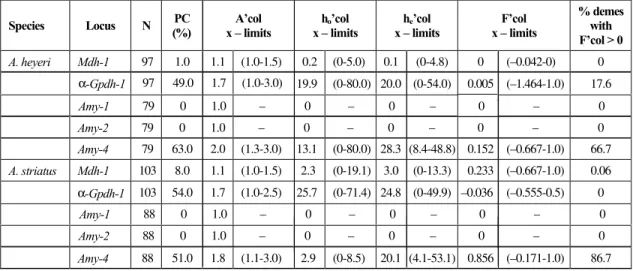
The proportion of polymorphic colonies varied greatly between the different loci analyzed (Table 3). Although Amy-2 presented two alleles in A. heyeri, no polymorphism within-colony was observed. Few colonies exhibited polymorphism for the Mdh-1 locus, only 1% in A. heyeri, and 8% in A. striatus, because a different allele was predominant in each species.
The number of alleles per locus detected in individual colonies ranged from one to three in both species (Table 3). This higher number was verified in the Amy-4 locus, which presented seven alleles considering all individuals analyzed.
Acromyrmex heyeri Acromyrmex striatus
Locus Alelle N Freq. N Freq.
Amy-1 100 900 1.0 1,200 1.0
Amy-2 100 879 0.977 0 –
92 21 0.023 1,200 1.0
Amy-4 100 3 0.003 53 0.043
87 7 0.007 99 0.079
80 56 0.061 790 0.633
67 345 0.375 192 0.154
60 240 0.261 49 0.039
53 208 0.226 61 0.049 33 61 0.067 4 0.003
α-Gpdh-1 100 100 0.078 1,007 0.619
83 201 0.156 100 0.062
75 260 0.201 423 0.260
64 684 0.529 86 0.053 48 47 0.036 10 0.006
Mdh-1 100 1,269 0.957 0 –
74 57 0.043 26 0.016
57 0 – 1,627 0.984
TABLE 2
Allele frequencies of the five isoenzyme loci in Acromyrmex heyeri and A. striatus, calculated from the genotypes of diploid (gynes and workers) and haploid (males) individuals of all colonies analyzed. The denomination given to each allele corresponds to the relative electrophoretic migration (RM) of the
The average heterozygosity observed per locus per colony (ho’col) ranged from 0% to 80% in A. heyeri and 0% to 71.4% in A. striatus. The average heterozygosity expected (he’col) varied between 0% and 54% and between 0% and 49.9% in each species, respectively. With regard to the inbreeding coefficient per locus per colony (F’col), the variation was very significant between loci, with many colonies of both species showing a significant deviation of panmixis (Table 3).
Table 4 presents average observed (Ho) and expected (He) heterozygosities as well as average inbreeding coefficient (F) for demes and popu-lations when all five loci were taken into account. For A. heyeri, a total of six populations, comprising sixteen demes, and more five isolated demes were analyzed for those parameters.
As for the populations, only Osório and Tor-res showed inbreeding coefficients equivalent to zero; the other four presented significant values of F. The Arroio do Sal population exhibited a significant negative F, indicating an excess of hete-rozygotes, and there are good reasons to think that this finding is reliable as discussed later in this article. When the analysis is made at the level of the demes, F was positive in some of them, negative
or zero in others, indicating a greater heterogeneity between demes than between populations.
The picture for the species A. striatus is not strictly comparable to that of A. heyeri, since most data obtained refers to demes and to only three populations as a whole (São Leopoldo, Arroio do Sal, and Torres).
These populations always presented F > 0, and out of the 17 demes studied, only two showed F = 0 (SLCP and VAGRO).
Analyses of the diploid (gynes and workers) and haploid (males) genotypes of individual colo-nies allowed evaluation of the genetic structure and inferences about the social structure of each species, particularly regarding the minimum num-ber of queens present in each colony and the mini-mum number of males which fertilizated the queen or queens. The results concerning the genotype structure of each colony and the frequencies of each type were similar for both species (Table 5). The Mdh-1 locus was of little use because each species has only two alleles, one of them with low frequency. However, for a-Gpdh-1 and Amy-4 loci, a great variability of genotypes in each colony was found, which ranged from one to four homozygous types per colony.
TABLE 3
Polymorphism data for A. heyeri and A. striatus per locus. N = number of colonies analyzed; PC = proportion of polymorphic colonies; A’col = average number of alleles per colony; ho’col = average observed heterozygosity per colony; he’co = average expected heterozygosity per colony; F’col = inbreeding
average coefficient per colony.
Species Locus N PC
(%)
A’col x – limits
ho’col x – limits
he’col x – limits
F’col x – limits
% demes with F’col > 0
A. heyeri Mdh-1 97 1.0 1.1 (1.0-1.5) 0.2 (0-5.0) 0.1 (0-4.8) 0 (–0.042-0) 0
α-Gpdh-1 97 49.0 1.7 (1.0-3.0) 19.9 (0-80.0) 20.0 (0-54.0) 0.005 (–1.464-1.0) 17.6
Amy-1 79 0 1.0 – 0 – 0 – 0 – 0
Amy-2 79 0 1.0 – 0 – 0 – 0 – 0
Amy-4 79 63.0 2.0 (1.3-3.0) 13.1 (0-80.0) 28.3 (8.4-48.8) 0.152 (–0.667-1.0) 66.7
A. striatus Mdh-1 103 8.0 1.1 (1.0-1.5) 2.3 (0-19.1) 3.0 (0-13.3) 0.233 (–0.667-1.0) 0.06
α-Gpdh-1 103 54.0 1.7 (1.0-2.5) 25.7 (0-71.4) 24.8 (0-49.9) –0.036 (–0.555-0.5) 0
Amy-1 88 0 1.0 – 0 – 0 – 0 – 0
Amy-2 88 0 1.0 – 0 – 0 – 0 – 0
TABLE 4
Average observed (Ho) and expected (He) heterozygosities, and average inbreeding coefficient (F) per colony, in each deme (capital letters) and population (small letters) of Acromyrmex heyeri and A. striatus for data
from the five loci analyzed.
Acromyrmex heyeri Acromyrmex striatus
Deme/Pop. Ho He F χχ2 total d.f. Ho He F χχ2 total d.f.
SLNC 0.040 0.056 0.286 16.423a
7 0.072 0.082 0.122 20.173b
6 SLME 0.100 0.106 0.057 1.735 9 0.082 0.088 0.068 40.313c
4 SLSJ 0 0.090 1.0 7.000a
2 0.040 0.083 0.518 27.829c
6 SLCA 0.046 0.100 0.540 54.418c
7 0.143 0.173 0.173 9.160a
2 SLCP 0 0 0 0 0 0.111 0.074 –0.500 3.000 2
S. Leopoldo 0.058 0.086 0.326 50.476c
11 0.065 0.087 0.253 98.462c
9 GCE 0.094 0.133 0.293 11.988a
4 – – – – –
GPR 0.068 0.114 0.404 24.000b
8 – – – – –
Gravataí 0.067 0.115 0.417 24.163b
8 – – – – –
VAGRO 0.014 0.072 0.806 18.217b 4 0.125 0.235 0.468 0.872 1
VURG 0.048 0.110 0.564 28.122c
4 – – – – –
Viamão 0.035 0.096 0.635 44.021c
5 – – – – –
OPO 0.170 0.164 –0.037 20.251c
4 0.056 0.107 0.476 38.649c
9
OR 0.400 0.270 –0.482 1.161 2 – – – – –
Osório 0.219 0.177 –0.237 4.077 5 – – – – –
ASR 0.157 0.143 –0.098 3.660 5 0.029 0.118 0.754 36.917c
5 ASC 0.137 0.114 –0.202 61.993c 4 0.152 0.105 –0.448 10.466a 3
A. do Sal 0.140 0.124 –0.129 50.278c
6 0.091 0.112 0.188 59.029c
5 TP 0.089 0.112 0.205 8.713a
2 0.065 0.104 0.375 24.526c
4 TI 0.039 0.083 0.530 33.764c
6 0.006 0.038 0.842 59.760c
4 TCI 0.084 0.089 0.056 2.458 7 0.097 0.138 0.297 24.160b
7
Torres 0.049 0.088 0.443 9.309 8 0.051 0.087 0.414 99.441c 8
BRHS 0.029 0.104 0.721 19.454c
4 0.072 0.085 0.153 8.565a
3
PVC – – – – – 0 0.049 1.000 7.000b 1
NPE – – – – – 0.099 0.101 0.020 94.540c
4
ESBR – – – – – 0 0.043 1.000 17.000c
1 SPAS – – – – – 0.068 0.228 0.702 35.878c
6 Species 0.066 0.097 0.320 10.342 11 0.062 0.096 0.354 405.376c
10
a p < 0.05; b p < 0.01; c p < 0.001.
The possible social structure of A. heyeri and A. striatus colonies was inferred from these data by analyzing the occurrence of different types of genotypes in each colony (Table 6). Considering
TABLE 5
Frequencies of colonies of Acromyrmex heyeri and A. striatus according to the genotypes in Mdh-1, a-Gpdh-1 and Amy-4 loci.
A. heyeri A. striatus
Locus Colony genotype structure
N Freq. N Freq.
Mdh-1 1 homozygous 96 0.99 94a 0.91
1 homo-1 heterozygous 1 0.01 8a 0.08
2 homozygous – – 1a 0.01
α-Gpdh-1 1 homozygous 48a 0.49 44a 0.43
1 heterozygous 4a 0.04 2a 0.02
1 homo-1 heterozygous 18a 0.19 22a 0.21
1 homo-1 hemizygous 2a 0.02 3a 0.03
1 homo-2 heterozygous 2b 0.02 3b 0.03
1 homo-5 heterozygous 0 0 1b 0.01
2 homozygous 3b 0.03 4b 0.04
2 heterozygous 0 0 1b 0.01
2 homo-1 heterozygous 16b 0.17 14b 0.13
2 homo-2 heterozygous 1b 0.01 5b 0.05
3 homozygous 2c 0.02 0 0
3 homo-1 heterozygous 0 0 1b 0.01
2 homo-3 heterozygous 0 0 1c 0.01
2 homo-1 hetero-1 hemizygous 0 0 1c 0.01
3 heterozygous 0 0 1c 0.01
2 homo-1 hemizygous 1c 0.01 0 0
Amy-4 1 homozygous 25a 0.32 36a 0.41
1 heterozygous 2a 0.02 0 0
1 homo-1 heterozygous 6a 0.08 6a 0.07
2 homozygous 19a 0.24 26b 0.30
2 homo-1 heterozygous 13b 0.16 2b 0.02
1 homo-1 hemizygous 5b 0.06 9b 0.10
2 homo-1 hemizygous 0 0 6c 0.07
1 homo-2 heterozygous 2b 0.03 0 0
1 hetero-1 hemizygous 1b 0.01 0 0
3 homozygous 6c 0.08 2c 0.02
4 homozygous 0 0 1c 0.01 a Monogyny and monoandry; b monogyny and polyandry; c polygyny and polyandry.
A. heyeri and 57% of A. striatus colonies can descend from one necessarily heterozygous queen and multiple mates. Moreover, 17% and 19% of
DISCUSSION
The results obtained in the present inves-tigation showed that the proportion of polymorphic colonies varied greatly between the different loci. When all loci are considered together, the pro-portion of polymorphic colonies was high and very much the same in both species, 80.4% in A. heyeri and 80.6% in A. striatus. This result is interesting since both species showed a great number of demes (and populations) with F > 0 (Table 4). Thus, despite the high levels of inbreeding in the species, A. heyeri and A. striatus are able to maintain a con-siderable number of polymorphic colonies. The polymorphism found in several colonies shows the Mendelian ratios expected, in accordance with a model of monogynic and monoandric colonies. Other findings fitted a monogynic but polyandric model, where as for many colonies only polygyny with polyandry can explain the polymorphism (Table 5).
Monogynic species usually exhibit a high within-colony relatedness, near 75%, which can be reduced only by polyandry (Ross & Fletcher, 1985a, b; Sundström, 1989).
In the case of polygynic species, within-colony relatedness is smaller, though it depends on relatedness between the queens (Stille et al., 1991; Ross, 1993). In polygynic colonies a hierar-chy between the queens can occur (Ross, 1988; Heinze, 1990; Heinze & Smith, 1990), or a queen multiple mate, not necessarily using the sperm of all males in the same proportion (Ross, 1986). In these situations, the degree of within-colony
relatedness can be higher than expected because a smaller number of females and males effectively contribute to brood production; in other words, the effective size of the colony is smaller than the actual size.
The estimate of relatedness sheds no light on this. It can only indicate an average number of reproductive individuals necessary to produce the gene variability observed. Of course, the degree of relationship between queen and males increases the degree of intracolony relatedness. However, this cannot be recognized through analysis of the brood.
The average inbreeding coefficients per colo-ny varied according to locus and with the num-ber of colonies sampled. When the data from the five loci were considered, 62.5% and 82.4% of the demes of A. heyeri and A. striatus, respectively, showed significant levels of inbreeding. Never-theless, the ASC demes of both species presented negative inbreeding coefficients, indicating a signi-ficant excess of heterozygotes per colony.
The high heterozygosity observed in ASC demes could be related to: a large initial number of individuals founding the colonies of these demes, outbreeding occurring in a large population, a recent mixture of populations, preferential crosses, or even differences in the gene frequencies between sexes. Concerning the latter, if in ant colonies specialization occurs in the production of sexual individuals and if in one population only a small number of colonies produce males, then gene frequencies between sexes could differ only by chance.
Monogyny and monoandry
Monogynya and polyandry
Polygyny and polyandry Species
N Freq. N Freq. N Freq.
Acromyrmex heyeri 12 0.15 54 0.68 13 0.17
Acromyrmex striatus 21 0.24 50 0.57 17 0.19
a
Obligatory heterozygous queens; b
considering the five loci together were analyzed 79 and 88 colonies of A. heyeri and A. striatus, respectively.
TABLE 6
As a consequence, deviations will occur in the genotypic proportions with an excess of homo-zygotes or heterohomo-zygotes (Pamilo & Varvio-Aho, 1979). However, this is not the case of A. heyeri and A. striatus since in these species there is no specialization in the production of sexual indi-viduals (Diehl-Fleig, 1993).
The hypothesis for the increase in hetero-zygote frequency as an immediate consequence of a recent mixture of populations, as defended by Crow & Kimura (1970), seems to be the best explanation for the high heterozygosity of the above-mentioned ASC demes. This would involve the fact that the occupied by these colonies was altered in recent years after receiving thousands of cubic meters of sand of different origins.
Thus, it is reasonable to suppose that this change favored the introduction of a great number of individuals from different colonies of A. heyeri and A. striatus of different origin and, consequently, presenting different genotypes.
A smaller number of demes with significant average inbreeding coefficient per colony was found in A. heyeri than in A. striatus. One factor that could be contributing to this difference is the pattern of nuptial flight observed in these species. In A. heyeri, it concerns thousands of sexual individuals from several colonies which fly together, favoring panmixis and reducing inbreeding. Compared to A. striatus, there is low dispersion of alate individuals as well as a small number of individuals participating in that flight (Diehl-Fleig, 1993). As the alate individuals do not go far away, gene flow is restricted, increasing the probability of mating between related individuals. Moreover, analysis of the social structure indicates a greater frequency of monogyny associated with monoandry in A. striatus (Table 6). These facts lead to less intra-colony genotype variation in this species, which could increase the inbreeding coefficient.
Parental genotypes can be inferred from the brood genotypes. However, when the workers are heterozygous it is impossible to establish with full certainty the genotypes of the queen and the male, because they could be daughters of a homo-zygote queen inseminated by one or more he-mizygous males for the other allele. This situation can be reverted when data about the male sibship are available since the males are haploids and have a singler allele originated from the mother.
Con-sidering the data for a-Gpdh-1 and Amy-4 loci, males with different alleles from their sisters were found in two colonies of A. heyeri and in seven of A. striatus (Table 5). Therefore, in 2.1% and 6.8% of A. heyeri and A. striatus colonies, respec-tively, the presence of at least two queens is confirmed. Moreover, the occurrence of two homozygotes together with heterozygotes for different alleles, or the occurrence of three or four homozygotes in only one colony suggests polygyny with polyandry.
of these males between the colonies, but does not change their frequency in the population (Page, 1980, 1986; Crozier & Page, 1985). The increased genetic variation among all diploid offspring may decrease the deleterious effect of non-functional diploid male survival and colony productivity (Pe-dersen & Boomsma, 1999). Out of the 118 males of A. heyeri and 140 of A. striatus analyzed in this work, 2.5% and 0.7%, respectively, were diploid. It is important to emphasize that such males can only be detected when they are he-terozygotes, which implies that the values obtained could be underestimates.
While high levels of polyandry were detected in monogynic colonies of some bees and wasps (Page, 1980; Ross, 1986), the same does not seem to be true for monogynic ants (Ward, 1983; Ross & Fletcher, 1985a; Have et al., 1988; Pamilo, 1991d; Keller & Reeve, 1994). The absence of polyandry or only slight polyandry (oligoandry) in monogynic colonies can be in agreement with the load hypothesis occasioned by diploid males. Monogynic colonies of Solenopsis invicta when producing diploid males suffer such intense disturbance that extinction may ensue (Ross & Fletcher, 1986). In the case of polygynic colonies, polyandry produces a few diploid males, but they do not cause upset (Pamilo & Rosengren, 1984; Ross & Fletcher, 1986; Pamilo, 1993; Pamilo et al., 1994).
The diversity hypotheses emphasize the adap-tive significance of the increase of gene variability among workers; so polyandry would be particularly important and adaptive in monogynic species (Crozier & Page, 1985; Page, 1986; Sherman et al., 1988; Keller & Reeve, 1994). In polygynic species, the existence of many queens in one colony reduces the effects of polyandry (Pamilo, 1993), at the same time that it increases gene diversity (Keller & Reeve, 1994; Pedersen & Boomsma, 1999).
Another interesting fact observed in A. heyeri and A. striatus colonies was the absence of heterozygotes in some colonies with two or more homozygotes. Crozier & Consul (1976), when hy-pothesizing on selection at the colony level, sug-gested that, in colonies with heterozygous queens, defense and foraging tasks would be performed more by heterozygous than by homozygous wor-kers. As a consequence, these would be more
sub-ject to loss, a situation causing a deficiency of heterozygotes in these colonies. Although this hypothesis can explain the results obtained in the present study, its confirmation would need the comparison between genotypes of workers that execute external tasks with those responsible for the internal tasks of the colony.
With regard to the genotype diversity found in most colonies of the two Acromyrmex species, it is likely that polyandry, associated either with monogyny or polygyny, is largely responsibility for the genotype diversity in their colonies. The results suggest that the social structure (mono- or polygyny with mono- or polyandry) is characteristic to each colony and not to the species as a whole. The small degree of variation found between popu-lations suggests that the organization of the so-cial structure of colonies is similar in the different populations studied.
Acknowledgments — We thank Martina da Silva and Senilda
Fritsch for their technical assistance. This research was supported by grants from CAPES, CNPq, FAPERGS, FINEP, PROPESP-UFRGS and PROENPE-UNISINOS.
REFERENCES
ARON, S., CAMPAN, E., BOOMSMA, J. J. & PASSERA, L., 1999, Social structure and split sex ratios in the ant
Pheidole pallidula. Ethol. Ecol. & Evol., 11: 209-227. AYALA, F. J., POWELL, J. R., TRACEY, M. L., MOURÃO,
C. A. & PEREZ-SALAS, S., 1972, Enzyme variability in the Drosophila willistoni group. IV. Genic variation in natural populations of Drosophila willistoni. Genet-ics, 70: 113-139.
CHAO, S. E. & SCANDALIOS, J. G., 1972. Developmen-tally Dependent Expression of Tissue Specific Amylases in Maize. Molec. Gen. Genetics, 115: 1-9.
CONTEL, E. P. B. & KERR, W. E., 1976, Origin of males in Melipona subnitida estimated from data of an isozy-mic polymorphic system. Genetica, 46: 271-277. CROW, J. F. & KIMURA, M., 1970, An Introduction to
Population Genetics Theory. Harper & Row Publishers, NY, 591p.
CROZIER, R. H., 1973, Apparent differential selection at an isozyme locus between queens and workers of the ant
Aphaenogaster rudis. Genetics, 73: 313-318. CROZIER, R. H. & CONSUL, P. C., 1976, Conditions for
DELABIE, J. H. C., 1989, Observações sobre a ocorrência de poliginia em colônias de Acromyrmex subterraneus brunneus Forel, 1893, em cacauais. An. Soc. Ent. Brasil., 18: 193-197.
DIEHL-FLEIG, E., 1993, Sex ratio and nuptial flight pat-tern of the leaf-cutting ants Acromyrmex heyeri and A. striatus (Hymenoptera, Formicidae). Insectes Soc., 40: 111-113.
DIEHL-FLEIG, E. & SOUZA, F. M., 1999, Variabilidade isoenzimática e organização social de Acromyrmex cras-sispinus Forel e A. balzani Emery (Hymenoptera, For-micidae). Rev. Brasil. Entomol., 43: 55-59.
HAVE, T. M. Van Der, BOOMSMA, J. J. & MENKEN, S. B. J., 1988, Sex-investment ratios and relatedness in the monogynous ant Lasius niger (L.). Evolution, 42: 160-172.
HEINZE, J., 1990, Dominance behavior among ant females.
Naturwissenschaften, 77: 41-43.
HEINZE, J. & SMITH, T. A., 1990, Dominance and fertil-ity in a functionally monogynous ant. Behav. Ecol. Sociobiol., 27: 1-10.
HEINZE, J. & TSUJI, K., 1995, Ant reproductive strategies.
Res. Popul. Ecol., 37: 135-149.
HÖLLDOBLER, B. & WILSON, E. O., 1990, The ants. The Belknap Press of Harvard University Press, Cambridge, Mass, 732p.
HUNG, A. C. F. & VINSON, S. B., 1976, Biochemical evi-dence for queen monogamy and sterile male diploid in the fire ant Solenopsis invicta. Isozyme Bull., 9: 55. KAUFMANN, B., BOOMSMA, J. J., PASSERA, L. &
PETERSEN, K. N., 1992, Relatedness and inbreeding in a French population of the unicolonial ant Iridomyrmex humilis (Mayr). Insectes Soc., 39: 195-213.
KELLER, L. & REEVE, H. K., 1994, Genetic variability, queen number, and polyandry in social Hymenoptera.
Evolution, 48: 694-704.
LI, C. C. & HORVITZ, D. G., 1953, Some methods of es-timating the inbreeding coefficient. Amer. J. Hum. Genet., 5: 107-117.
NEI, M., 1972, Genetic distance between populations. Am. Nat., 106.949: 283-292.
PAGE, R. E., 1980, The evolution of multiple mating behav-ior by honey bee queens (Apis mellifera L.). Genetics, 96: 263-273.
PAGE, R. E., 1986, Sperm utilization in social insects. Ann. Rev. Entomol., 31: 297-320.
PAMILO, P. & VARVIO-AHO, S. L., 1979, Genetic struc-ture of nests in the ant Formica sanguinea. Behav. Ecol. Sociobiol., 6: 91-98.
PAMILO, P., 1991a, Evolution of colony characteristics in social insects. 1. Sex allocation. Am. Nat., 137: 83-107.
PAMILO, P., 1991b, Evolution of colony characteristics in social insects. 2. Number of reproductive individuals. Am. Nat., 138: 412-433.
PAMILO, P., 1991c, Evolution of the sterile caste. J. Theor. Biol., 149: 75-95.
PAMILO, P., 1991d, Life span of queens in the ant Formica exsecta. Insectes Soc., 38: 111-120.
PAMILO, P., 1993, Polyandry and allele frequency differ-ences between the sexes in the ant Formica aquilonia.
Heredity, 70: 472-480.
PAMILO, P. & ROSENGREN, R., 1984, Evolution of nesting strategies of ants: genetic evidence from different popu-lation types of Formica ants. Biol. J. Linn. Soc., 21: 331-348.
PAMILO, P., SUNDSTRÖM, L., FORTELIUS, W. & ROSENGREN, R., 1994, Diploid males and colony-level selection in Formica ants. Ethol. Ecol. Evol., 6: 221-235. PEDERSEN, J. S. & BOOMSMA, J. J., 1999, Positive as-sociation of queen number and queen-mating frequency in Myrmica ants: a challenge to the genetic-variability hypotheses. Behav. Ecol. Sociobiol., 45: 185-193. POULIK, M. D., 1957, Starch gel electrophoresis in a
dis-continuous system of buffers. Nature, 180: 1477-1479. ROOSE, M. L. & GOTTLIEB, L. D., 1976, Genetic and biochemical consequences of polyploidy in Trogopogon.
Evolution, 30: 818-830.
ROSS, K. G., 1986, Kin selection and the problem of sperm utilization in social insects. Nature, 323: 798-800. ROSS, K. G., 1988, Differential reproduction in multiple-queen
colonies of the fire ant Solenopsis invicta (Hymenoptera: Formicidae). Behav. Ecol. Sociobiol., 23: 341-355. ROSS, K. G., 1993, The breeding system of the fire ant
Solenopsis invicta: effects on colony genetic structure.
Am. Nat., 141: 554-576.
ROSS, K. G. & FLETCHER, D. J. C., 1985a, Comparative study of genetic and social structure in two forms of the fire ant Solenopsis invicta (Hymenoptera: Formicidae).
Behav. Ecol. Sociobiol., 17: 349-356.
ROSS, K. G. & FLETCHER, D. J. C., 1985b, Genetic ori-gin of male diploidy in the fire ant, Solenopsis invicta
(Hymenoptera: Formicidae), and its evolutionary signifi-cance. Evolution, 39: 888-903.
ROSS, K. G. & FLETCHER, D. J. C., 1986, Diploid male production – a significant mortality factor in the fire ant
Solenopsis invicta (Hymenoptera: Formicidae). Behav. Ecol. Sociobiol., 17: 349-356.
RÜPPELL, O., HEINZE, J. & HÖLLDOBLER, B., 1998, Size-dimorphism in the queens of the North American ant
SEPPÄ, P., 1992, Genetic relatedness of worker nestmates in Myrmica ruginodis (Hymenoptera: Formicidae) popu-lations. Behav. Ecol. Sociobiol., 30: 253-260. SHERMAN, P. W., SEELEY, T. D. & REEVE, H. K., 1988,
Parasites, pathogens and polyandry in social Hymenop-tera. Am. Nat., 131: 602-610.
STILLE, M., STILLE, B. & DOUWES, P., 1991, Polygyny, relatedness and nest founding in the polygynous myrmi-cine ant Leptothorax acervorum (Hymenoptera: For-micidae). Behav. Ecol. Sociobiol., 28: 91-96.
SUNDSTRÖM, L., 1989, Genetic relatedness and popula-tion structure in Formica truncorum (Hymenoptera: For-micidae). Actes Coll. Insectes Soc., 5: 93-100. WARD, P. S., 1983, Genetic relatedness and colony