Submitted1 April 2014 Accepted 16 June 2014 Published10 July 2014
Corresponding author Pedro J. Silva, [email protected]
Academic editor Hendrik Feys
Additional Information and Declarations can be found on page 13
DOI10.7717/peerj.470
Copyright
2014 Bernardo and Silva
Distributed under
Creative Commons CC-BY 4.0
OPEN ACCESS
Computational development of
rubromycin-based lead compounds for
HIV-1 reverse transcriptase inhibition
Carlos E.P. Bernardo and Pedro J. SilvaREQUIMTE/Faculdade de Ciˆencias da Sa ´ude, Universidade Fernando Pessoa, Rua Carlos da Maia, Porto, Portugal
ABSTRACT
The binding of several rubromycin-based ligands to HIV1-reverse transcriptase was analyzed using molecular docking and molecular dynamics simulations. MM-PBSA analysis and examination of the trajectories allowed the identification of several promising compounds with predicted high affinity towards reverse transcriptase mutants which have proven resistant to current drugs. Important insights on the complex interplay of factors determining the ability of ligands to selectively target each mutant have been obtained.
Subjects Biochemistry, Biophysics, Computational Biology
Keywords Molecular dynamics, Docking, Computer-aided drug design
INTRODUCTION
Rubromycins are a small class of compounds containing naphtoquinone and 8-hydroxyisocoumarin moieties (Brasholz et al., 2007). In 1990,β- andγ-rubromycin were shown to inhibit HIV-1 reverse transcriptase (Goldman et al., 1990), although at levels that were also toxic to human T lymphocytes.γ-rubromycin was later shown to be an inhibitor of human telomerase (Ueno et al., 2000), fueling interest in its use as an anti-cancer agent. The development of less toxic variants of these lead compounds has long been prevented due to the difficulty of their laboratory synthesis, but several synthetic routes to these interesting molecules have recently become available (Akai et al., 2007; Rathwell et al., 2009;Wu, Mercado & Pettus, 2011;Wilsdorf & Reissig, 2014), enabling the evaluation of many simpler derivatives as candidates for the inhibition of telomerase (Yuen et al., 2013). As far as we could ascertain, no derivatives ofγ-rubromycin with substitution patterns as complex as those observed in the natural molecule have yet been synthesized. As we envisage that such derivatives might afford higher selectivity towards selected reverse-transcriptase mutants or more favorable pharmacokinetic properties, we decided to evaluated several not-yet-synthesizedγ-rubromycin derivatives using computational docking and molecular dynamics simulations of the most promising candidates. The results are compared to those of the commercially-available, 2nd-generation NNRTI drug rilpivirine.
COMPUTATIONAL METHODS
All computations were performed in YASARA (Krieger et al., 2004) using the crystal structure of the rilpivirine-inhibited HIV1 reverse transcriptase published by Das et al. (PDB: 2ZD1) (Das et al., 2008). A double-mutant structure, (p66)K103N/(p66)Y181C and a quadruple mutant (p51p66)M184I/(p51p66)E138K, were also generated to evaluate the robustness of the ligand binding to reverse transcriptase variants with increased resistance to NNRTIs: K103N is known to strongly reduce susceptibility to efavirenz and nevirapine (Bacheler et al., 2001;Rhee et al., 2004;Eshleman et al., 2006;Zhang et al., 2007;Melikian et al., 2014) and E138K has a similar effect towards rilpivirine, which is increased by M184I (Kulkarni et al., 2012); Y181C reduces suceptibility to efavirenz, etravirine and rilpivirine (Reuman et al., 2010;Tambuyzer et al., 2010;Rimsky et al., 2012).
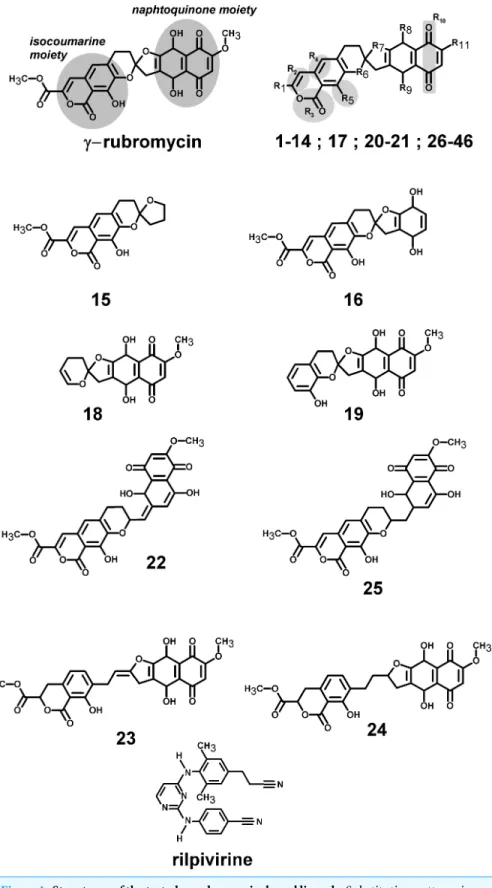
γ-Rubromycin-based ligands (Fig. 1andSupplemental Information 1) were docked to the wild-type structure with AutoDock 4.2.3 (Morris et al., 2009) using default docking parameters and point charges assigned according to the AMBER03 force field (Duan et al., 2003). The highest scoring ligands and poses were selected for molecular dynamics simulations. Initial structures for molecular dynamics simulations of mutant proteins were generated from the corresponding ligand-bound wild-type structures through mutation of the corresponding aminoacids. All simulations were run with the AMBER03 forcefield (Duan et al., 2003), using a multiple time step of 1.25 fs for intramolecular and 2.5 fs for intermolecular forces. Simulations were performed in cells 5 ˚A larger than the solute along each axis (final cell dimensions 127.3×102.6×78.8 ˚A), and counter-ions (88 Cl−
and 77 Na+
forces and the direct space portion of the electrostatic forces, which were calculated using the Particle Mesh Ewald method (Essmann et al., 1995) with a grid spacing<1 ˚A, 4th order B-splines and a tolerance of 10−4for the direct space sum. Simulated annealing
minimizations started at 298 K, velocities were scaled down with 0.9 every ten steps for a total time of 5 ps. After annealing, simulations were run at 298 K. Temperature was adjusted using a Berendsen thermostat (Berendsen et al., 1984) based on the time-averaged temperature, i.e., to minimize the impact of temperature control, velocities were rescaled only about every 100 simulation steps, whenever the average of the last 100 measured temperatures converged. Substrate parameterization was performed with the AM1BCC protocol (Jakalian et al., 2000;Jakalian, Jack & Bayly, 2002). All simulations were run for 30 ns. Differences in ligand binding energies between wild-type and mutant proteins were evaluated using the MM-PBSA methodology (Srinivasan et al., 1998). Although MM-PBSA is unable to afford accurate absolute binding energies and the high standard deviation of MM-PBSA energies limits its ability to discriminate between ligands with similar binding-affinities (Weis et al., 2006) to a protein, its application to the analysis of the affinity of a single molecule to a series of protein mutants affords high quality results (Moreira, Fernandes & Ramos, 2007;Martins et al., 2013), presumably due to better cancellation of errors (as the effect of a point-mutation on a large protein is, in relative terms, much smaller than that of a substitution in a small molecule). For each snapshot (taken at 0.25 ns intervals from the last 15 ns of the simulation) we computed the molecular mechanics energy of the protein–ligand complex, the electrostatic contribution to solvation energy (using the Adaptive Poisson–Boltzmann Solver;Baker et al., 2001) and nonelectrostatic contributions to solvation (with a surface-area-dependent term;Wang et al., 2001). These computations were repeated for each snapshot for the ligand-free protein and the protein-free ligand, to obtain an estimate of the average binding energy of each ligand. Normal mode analysis computations were performed using the Webnm@ server at
http://apps.cbu.uib.no/webnma/home(Hollup, Salensminde & Reuter, 2005).
RESULTS
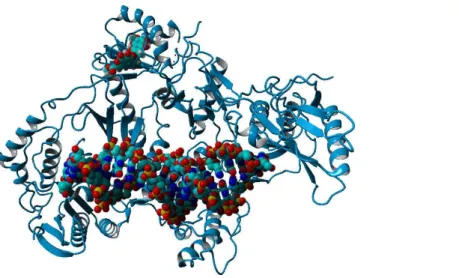
Computational docking allows the fast screening of a large number of candidate ligands, which may afterwards be analyzed through more demanding computational techniques in the search for suitable leads for further development and experimental characterization. Out initial screen analyzed the docking performance ofγ-rubromycin derivatives with/without truncated rings, substitution of the oxygen atoms appended to the spirocyclic ring and different substitution patterns around the rings. Twenty-six of the testedγ-rubromycin-based ligands bind preferentially to an exposed pocket in subunit p51 formed by the Glu89-His96 loop and the Pro157-Leu187 helix-turn-sheet motif. This pocket lies very far away from the nucleic acid binding surface (Fig. 2), which completely prevents this binding mode from competitively inhibiting the reaction mechanism.
Figure 2 Preferential binding mode of ligand 28 to HIV reverse transcriptase, as computed with AutoDock, with superposed DNA molecule taken from the DNA-bound HIV structure (PDB: 2HMI) (Ding et al., 1998).
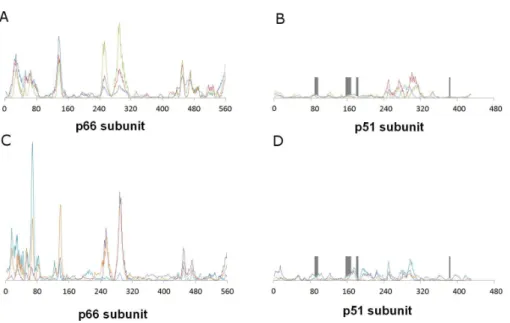
observed with molecular dynamics simulations, we analyzed the available vibrational modes of HIV-1 reverse transcriptase using the efficient algorithm and simplified force field described byHinsen (1998). In this method, the protein is simulated as a coarse-grained series of springs connecting every Cα with all other Cα atoms with exponentially-decaying force-constants. Despite its conceptual simplicity, the computed vibrational modes and vibration frequencies have been shown to correlate very well with those observed in explicit molecular dynamics simulations. Furthermore, important conformational changes can most frequently be explained by the first few non-trivial vibrational modes, which enables its use in the location of allosteric transitions (Tama & Sanejouand, 2001;Zheng & Brooks, 2005;Zheng, Brooks & Thirumalai, 2006;Zheng, Brooks & Thirumalai, 2007;Rodgers et al., 2013;Sanejouand, 2013). Application of this method to the catalytically active “open” conformation of HIV-1 reverse transcriptase (PDB: 2HMI) (Ding et al., 1998) shows that inclusion of a coarse-grained representation of
γ-rubromycin in the proposed binding site does not affect the protein flexibility: indeed, hardly any changes in vibrational modes are observed, as confirmed by the very high correlation coefficients between the normal modes of ligand-bound and empty reverse transcriptase, which always exceeding 0.9977.Figure 3shows the contributions of each aminoacid to the first six non-translational, non-rotational modes obtained by this method, and clearly highlights the negligible contribution of the aminoacids lining this proposed binding pocket to the overall flexibility of the enzyme.
Figure 3 Relative contribution of each amino acid displacement to the first six non-trivial normal modes of HIV-1 reverse transcriptase.(A) and (B) Modes 7 (blue), 8 (red) and 9 (green). C and (D) Modes 10 (violet), 11 (light blue) and 12 (orange). The regions lining the proposed binding pocket are highlighted in dark gray.
Table 1 Substitution patterns and AutoDock-computed binding energies of the best-scoring ligands to the previously characterized NNRTI binding pocket.Only differences from the parent compound (γ-rubromycin) are shown. The binding energy of the drug rilpivirine, computed with the same methods, amounts to−13.25 kcal mol−1. Data for all ligands is available asSupplemental Information 2.
Ligand: γ-rubromycin 46 36 27 45 13 38 37
R1= −COOCH3 –CH2OH
R2= –C=C–H (S)HC–CH2
R3= –C=O–O –O–C=O
R4= =C=C–H –C–CH2–
R5= –C–OH –C=O
R6= –O–
R7= –O–
R8= –OH
R9= –OH
R10= –C=O –C=O
R11= –O–CH3 –CN –F –CN –CH2–CH3 –CN –Cl
Binding energy −12.95 −13.71 −13.72 −13.82 −13.82 −13.91 −14.25 −14.29
and compared to that of rilpivirine. The worst-scoring ligands towards the NNRTI binding pocket were those where any of the rings had been removed, as well as the ones where the oxygen at the R6position was substituted by nitrogen or carbon. Surprisingly,
substitution of the=CH– at the R4position by an isoelectronic=N– (ligand32) also
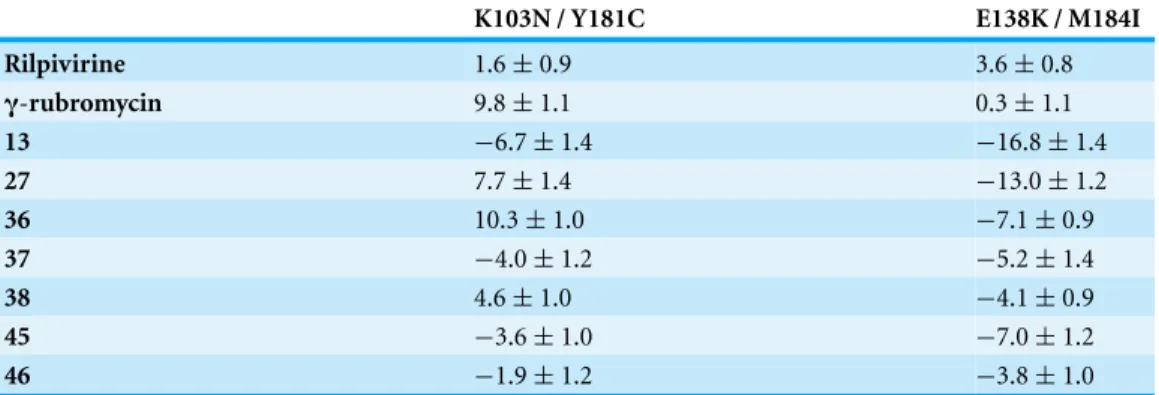
Table 2 Binding affinity (average±standard error of the mean) of the best-scoring ligands to reverse-transcriptase mutants, relative to the binding affinity of each ligand to the wild-type enzyme. Values in kcal mol1.Negative values show stronger binding than observed to the wild-type protein.
K103N / Y181C E138K / M184I
Rilpivirine 1.6±0.9 3.6±0.8
γ-rubromycin 9.8±1.1 0.3±1.1
13 −6.7±1.4 −16.8±1.4
27 7.7±1.4 −13.0±1.2
36 10.3±1.0 −7.1±0.9
37 −4.0±1.2 −5.2±1.4
38 4.6±1.0 −4.1±0.9
45 −3.6±1.0 −7.0±1.2
46 −1.9±1.2 −3.8±1.0
15 ns of each molecular dynamics simulation (Table 2). This method, while not accurate enough to produce reliable absolute binding free energies, has been shown to provide good estimates of binding affinity trends provided that either the ligands or the protein targets under comparison are very similar (Massova & Kollman, 2000). The computed data for rilpivirine agree with the experimentally observed sensitivity of its binding to E138K/M184I variants, and to the relative insensitivity of its effect on the presence/absence of K103N or Y181C mutation, which supports the applicability of the MM-PBSA approach to this system. Ligands13,27, 36and45are computed to bind significantly stronger to the rilpivirine-resistant E138K/M184I HIV1-RT variant than to the wild-type protein, and may therefore be suitable lead compounds for further pharmaceutical developments against rilpivirine-resistant strains. Further insight to the determinants of binding affinity was obtained through close inspection of each simulation.
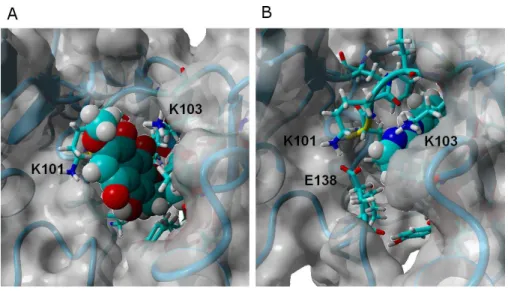
As observed in the crystal structure (Das et al., 2008), rilpivirine remains bound to RT throughout the simulation through a large number of hydrophobic contacts and two very stable hydrogen bonds with the backbone of Lys101, whether in the wild-type or any of the tested mutants. Its high hydrophobicity strongly favor it to adopt a very buried conformation and low solvent-accessible area throughout the simulation. The high stability of the hydrogen bonds does not change in the mutated variants, but the total number of close hydrophobic contacts between rilpivirine and the protein does become smaller in the E138K/M184I mutant, which is consistent with the experimentally observed lower affinity of this drug towards it (Singh et al., 2012), and the computed MM-PBSA binding energy.
Figure 4 γ-rubromycin (A) and rilpivirine (B) bound to wild-type HIV-1 reverse transcriptase. Snap-shots were taken from random points in the last 15 ns of molecular dynamics simulations.
moiety of the ligand to penetrate deeper into the crevice in order to establish a stabilizing hydrogen bond with Asn103. The buried conformation ofγ-rubromycin removes the methoxy group from its favored solvent-exposed environment leading to a binding mode which is computed by MM-PBSA to be markedly less favored than observed in the wild-type protein, but which remains stable due to the difficulty in breaking the large number of favorable hydrogen bonds to Asn103 and Lys101.γ-rubromycin binding to the E138K/M184I is very similar to the wild-type protein: hydrogen bonds between the ligand and Lys101 and Lys103 are also present (though ca. 0.4 ˚A longer), and subtle cavity rearrangements due to the loss of the ionic bridge between Lys101 and (p51)Glu138 (which is mutated to a Lys) lead to the possibility of intermitent H-bonded interactions between the carbonyl of Ile180 (or the sidechain of (p51)Thr139) and the naphtoquinone moiety.
electrostatic component of ligand solvation caused by the presence of two intra-molecular H-bonds in13when bound to the mutant proteins.
The sp3hybridization in the acetyl-bearing carbon of the isocoumarin-moiety in27
introduces a deviation from full planarity in that region of the ligand, which facilitates its interactions with the Trp229 and Ty188 aminoacids on that end of the NNRTI-binding cavity. Ligand27is found to bind much more favorably to the quadruple mutant E138K/M184I (with a very large number of very short and stable hydrogen bonds with Lys101, Lys103, Lys138 and Thr139) than to wild-type or K103N/Y181C, where the only stable hydrogen bonds available are those with Glu138. The electrostatic component of the solvation energy of27follows the opposite trend as the protein is changed from WT to the mutants, but the smaller variation of this factor simply dampens the magnitude of the change in binding affinities brought about by the variation in protein–ligand interactions.
Ligand36 bears a fluorine atom in place of the methoxy group carried byγ -rubromycin. Like ligand27,36has higher affinity to the E138K/M184I mutant than to either the wild-type and, especially, the K103N/Y181C mutant. The minute size of the fluorine substituent allows Lys101 and Glu138 (which lie on opposite sides of the crevice where the ligands bind) to approach each other and form a strong ionic bridge which pushes the ligand further inside the cavity. This ionic bridge cannot form in the E138K/M184I mutant, leading to a binding mode where the ligand is slightly more exposed and strongly binds to Lys101, Lys103 and Lys 138. In the K103N/Y181C, the interactions between ligand and protein are weaker due to the strong deviations from 180◦in the possible H-bonding partners in the binding cavity.
Ligands37and38bear a chlorine and a cyanide (respectively) in place of the fluorine present on36. The intermediate size of these substituents (relative to the fluorine in36
and the methoxy inγ-rubromycin) leads to an intermediate degree of penetration in the binding cavity, between those of36and inγ-rubromycin. As observed in most cases, Lys101 is responsible for the most stable interaction between protein and ligand. No single contribution is, however, determinant in the observed trend of binding affinity of37to the proteins, as the correlation of total binding energies to either electrostatic components of solvation or to protein–ligand interaction is insignificant: the overall effect is rather the result of subtle interplay of the electrostatic component of solvation and the protein–ligand interaction. Solvation effects, in contrast are determinant in the binding trends observed for ligand38, as the higher affinity to the M184I/E138K mutant is correlated to its much smaller desolvation penalty, which is due to the considerable exposure of its nitrile group to solvent when the entrance to the binding channel is not blocked by the Glu138-Lys101 ionic bond (Fig. 5).
Ligand45bears, like ligands38and46, a nitrile group in the position occupied by a methoxy inγ-rubromycin. It differs from38by the replacement of the acetyl substituent of the isocoumarin by a hydroxymethyl and by switching the orientation of the lactone group in isocoumarin from –O–C=O to O=C–O. The replacement of acetyl from
naphtoquinone portion of45to protrude from the other end of the cavity into the solvent. The only H-bonds between ligand and protein now involve the backbone atoms of Lys101 and Glu138. These H-bonds weaken considerably in both mutants, but this destabilizing effect is overtaken by sizable stabilizing effects due to favorable solvation, leading to overall better binding to K103N/Y181C and (especially) E138K/M184I.
Other than the lack of H-bond donating ability in its isocoumarin moiety (due to the replacement of its hydroxyl by a carbonyl), ligand46is identical to ligand38. Unlike ligand38, its ability to bind the K103N/Y181C mutant is not inferior to its affinity to the wild-type protein: the presence of a carbonyl instead of a hydroxyl allows it to accept a hydrogen bond from Tyr183, which is able to rotate into position in the mutant due to the smaller size occupied by Cys181 (compared to the original tyrosine present in the wild type.)
We also performed molecular dynamics simulation of ligands32and24bound to the NNRTI-binding pocket, as these ligands are ranked by AutoDock among the weakest in affinity towards this binding site. These simulations are expected to shed light into structural factors that disfavor binding to HIV-1 reverse transcriptase.
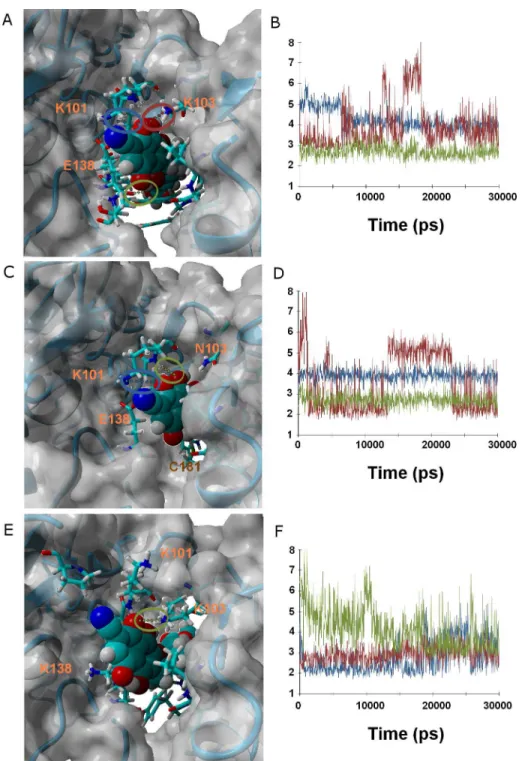
Ligand24(like the weakly-binding ligands22,23and26) lacks the spirocyclic scaffold characteristic of rubromycins. The longer head-to-tail distance due to the opening of the central acetal leads to a binding mode where the naphtoquinone moiety is buried inside the enzyme in a position similar to that taken by isocoumarin in the other simulations and the isocoumarin end becomes much more exposed to the solvent than observed for naphtoquinone in the binding modes of the other ligands. This portion of the molecule now remains continuously exposed to the solvent, significantly decreasing the number of stable hydrophobic ligand-protein interactions. (Figures 6Aand6B.)
Ligand32differs fromγ-rubromycin only in the replacement of the=CH group at
the R4position by a nitrogen atom. This small isoelectronic change does not, however,
lead to very dramatic differences in dynamic behavior, as evidenced by the high similarity of the resulting simulation to that of the originalγ-rubromycin: Lys103 still maintains a strong and stable interaction to the naphtoquinone moiety, and Lys101 now interacts with the appended methoxy group in R11, rather than the –OH group in R8(Fig. 6). The
weaker binding of32predicted by the docking analysis seems to be due mostly to the cost of burying the polar=N– group away from the solvent, rather than on any large differences
of ligand-protein interactions.
INFLUENCE OF LIGAND BINDING ON PROTEIN
DYNAMICS
Figure 6 Ligands 24 (A and B), 32 (C and D) andγ-rubromycin (E and F) bound to wild-type reverse
transcriptase.Snapshots were taken from random points in the last 15 ns of molecular dynamics simulations. As far as possible, the bonds depicted in the graphs have been highlighted with the same color in the corresponding image (the exceptions are the I180 carbonyl• • •OH hydrogen bond shown as the blue line in the B, and the hydrogen bond between K101 carbonyl and methoxy oxygen inγ-rubromycin shown as a blue line in F).
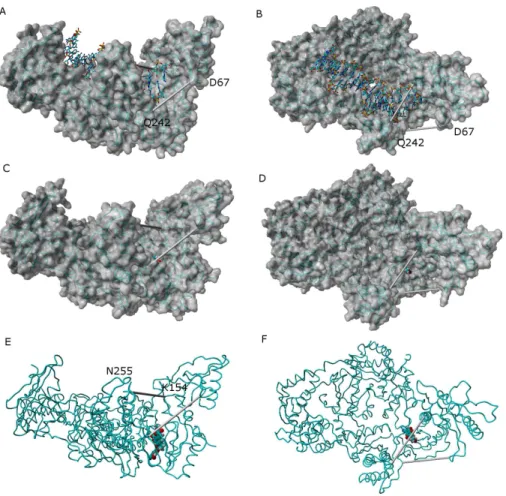
binding pocket (Fig. 7andSupplemental Information 6–16). The only instance where the diagnostic Lys154-Asn255 and Glu67-Gln242 distances stably assume values as short as those observed in the catalytically active conformation is observed in the simulation of the K103N/Y181C mutant in the presence of ligand46.
CONCLUSIONS
Figure 7 Comparison between the catalytically active “open” conformation of HIV-1 reverse tran-scriptase and the “extended” conformations obtained in the simulations.Side-view (A) and “top”-view (B) of nucleic acid-bound reverse transcriptase (PDB: 2HMI) (Ding et al., 1998). Side-view (C and E) and “top”-view (D and F) of a typical ligand-bound structure obtained in our simulations. The highlighted distances can be used as “fingerprints” for the identification of catalytically competent conformations.
allowed the identification of ligands that are predicted to bind very strongly to RT mutants which have shown high resistance towards other NNRTI compounds. The best compounds (13,27,36and45) achieve selective binding to the highly resistant mutant E138K/M184I through very subtle variations on the degree of exposure to solvent, and on the number and strength of hydrogen bonds and hydrophobic interactions with the protein. These molecules should therefore become good candidates in the quest for suitableγ-rubromycin-based drugs.
ADDITIONAL INFORMATION AND DECLARATIONS
Funding
PTDC/QUI-QUI/111288/2009. The funders had no role in study design, data collection and analysis, decision to publish, or preparation of the manuscript.
Grant Disclosures
The following grant information was disclosed by the authors: Fundac¸˜ao para a Ciˆencia e a Tecnologia: PEst-C/EQB/LA0006/2011. Programa Operacional Factores de Competitividade–COMPETE.
FCT–Fundac¸˜ao para a Ciˆencia e a Tecnologia: PTDC/QUI-QUI/111288/2009.
Competing Interests
The authors declare there are no competing interests.
Author Contributions
• Carlos E.P. Bernardo performed the experiments, analyzed the data, prepared figures
and/or tables, reviewed drafts of the paper.
• Pedro J. Silva conceived and designed the experiments, performed the experiments,
analyzed the data, contributed reagents/materials/analysis tools, wrote the paper, prepared figures and/or tables, reviewed drafts of the paper.
Data Deposition
The following information was supplied regarding the deposition of related data: Complete analysis files have been deposited in Figshare:
Pedro J. Silva (2014): Molecular dynamics of rubromycin derivatives bound to WT and mutant reverse transcriptase:http://dx.doi.org/10.6084/m9.figshare.979429.
Supplemental Information
Supplemental information for this article can be found online athttp://dx.doi.org/ 10.7717/peerj.470.
REFERENCES
Akai S, Kakiguchi K, Nakamura Y, Kuriwaki I, Dohi T, Harada S, Kubo O, Morita N, Kita Y. 2007. Total synthesis of(+/−)-gamma-rubromycin on the basis of two aromatic Pummerer-type reactions.Angewandte Chemie International Edition46(39):7458–7461
DOI 10.1002/anie.200702382.
Bacheler L, Jeffrey S, Hanna G, D’Aquila R, Wallace L, Logue K, Cordova B, Hertogs K, Larder B, Buckery R, Baker D, Gallagher K, Scarnati H, Tritch R, Rizzo C. 2001.Genotypic correlates of phenotypic resistance to efavirenz in virus isolates from patients failing nonnucleoside reverse transcriptase inhibitor therapy.Journal of Virology75(11):4999–5008
DOI 10.1128/JVI.75.11.4999-5008.2001.
Baker NA, Sept D, Joseph S, Holst MJ, McCammon JA. 2001.Electrostatics of nanosystems: application to microtubules and the ribosome.Proceedings of the National Academy of Sciences of the United States of America98(18):10037–10041DOI 10.1073/pnas.181342398.
Berendsen HJC, Postma JPM, van Gunsteren WF, DiNola A, Haak JR. 1984. Molecular dynamics with coupling to an external bath.The Journal of Chemical Physics81(8):3684–3690
Brasholz M, S¨orgel S, Azap C, Reißig H-U. 2007. Rubromycins: structurally intriguing, biologically valuable, synthetically challenging antitumour antibiotics.European Journal of
Organic Chemistry2007(23):3801–3814DOI 10.1002/ejoc.200601054.
Das K, Bauman JD, Clark AD, Frenkel YV, Lewi PJ, Shatkin AJ, Hughes SH, Arnold E. 2008.
High-resolution structures of HIV-1 reverse transcriptase/TMC278 complexes: strategic flexibility explains potency against resistance mutations.Proceedings of the National Academy of Sciences of the United States of America105(5):1466–1471DOI 10.1073/pnas.0711209105.
Ding J, Das K, Hsiou Y, Sarafianos SG, Clark AD, Jacobo-Molina A, Tantillo C, Hughes SH, Arnold E. 1998.Structure and functional implications of the polymerase active site region in a complex of HIV-1 RT with a double-stranded DNA template-primer and an antibody Fab fragment at 2.8 A resolution.Journal of Molecular Biology284(4):1095–1111
DOI 10.1006/jmbi.1998.2208.
Duan Y, Wu C, Chowdhury S, Lee MC, Xiong G, Zhang W, Yang R, Cieplak P, Luo R, Lee T, Caldwell J, Wang J, Kollman P. 2003.A point-charge force field for molecular mechanics simulations of proteins based on condensed-phase quantum mechanical calculations.Journal of
Computational Chemistry24(16):1999–2012DOI 10.1002/jcc.10349.
Eshleman SH, Jones D, Galovich J, Paxinos EE, Petropoulos CJ, Jackson JB, Parkin N. 2006.
Phenotypic drug resistance patterns in subtype A HIV-1 clones with nonnucleoside reverse transcriptase resistance mutations.AIDS Research and Human Retroviruses22(3):289–293
DOI 10.1089/aid.2006.22.289.
Essmann U, Perera L, Berkowitz ML, Darden T, Lee H, Pedersen LG. 1995. A smooth particle mesh Ewald method. The Journal of Chemical Physics 103(19):8577–8593
DOI 10.1063/1.470117.
Goldman M, Salituro G, Bowen J, Williamson J, Zink D, Schleif W, Emini E. 1990.Inhibition of human immunodeficiency virus-1 reverse transcriptase activity by rubromycins: competitive interaction at the template.primer site.Molecular Pharmacology38(1):20–25.
Hinsen K. 1998.Analysis of domain motions by approximate normal mode calculations.Proteins 33(3):417–429DOI 10.1002/(SICI)1097-0134(19981115)33:3<417::AID-PROT10>3.0.CO;2-8.
Hollup SM, Salensminde G, Reuter N. 2005.WEBnm@: a web application for normal mode analyses of proteins.BMC Bioinformatics6(1):52DOI 10.1186/1471-2105-6-52.
Hsiou Y, Ding J, Das K, Clark AD, Hughes SH, Arnold E. 1996.Structure of unliganded HIV-1 reverse transcriptase at 2.7 A resolution: implications of conformational changes for polymerization and inhibition mechanisms.Structure4(7):853–860
DOI 10.1016/S0969-2126(96)00091-3.
Ivetac A, McCammon JA. 2009.Elucidating the inhibition mechanism of HIV-1 non-nucleoside reverse transcriptase inhibitors through multicopy molecular dynamics simulations.Journal of Molecular Biology388(3):644–658DOI 10.1016/j.jmb.2009.03.037.
Jakalian A, Bush BL, Jack DB, Bayly CI. 2000.Fast, efficient generation of high-quality atomic charges. AM1-BCC model: I. Method.Journal of Computational Chemistry21(2):132–146
DOI 10.1002/(SICI)1096-987X(20000130)21:2<132::AID-JCC5>3.0.CO;2-P.
Jakalian A, Jack DB, Bayly CI. 2002.Fast, efficient generation of high-quality atomic charges. AM1-BCC model: II. Parameterization and validation.Journal of Computational Chemistry 23(16):1623–1641DOI 10.1002/jcc.10128.
Jochmans D. 2008.Novel HIV-1 reverse transcriptase inhibitors.Virus Research134(1–2):171–185
Jochmans D, Deval J, Kesteleyn B, Van Marck H, Bettens E, De Baere I, Dehertogh P, Ivens T, Van Ginderen M, Van Schoubroeck B, Ehteshami M, Wigerinck P, G¨otte M, Hertogs K. 2006.
Indolopyridones inhibit human immunodeficiency virus reverse transcriptase with a novel mechanism of action.Journal of Virology80(24):12283–12292DOI 10.1128/JVI.00889-06.
Kohlstaedt LA, Wang J, Friedman JM, Rice PA, Steitz TA. 1992. Crystal structure at 3.5 A resolution of HIV-1 reverse transcriptase complexed with an inhibitor. Science 256(5065):1783–1790DOI 10.1126/science.1377403.
Krieger E, Darden T, Nabuurs SB, Finkelstein A, Vriend G. 2004.Making optimal use of empirical energy functions: force-field parameterization in crystal space.Proteins; Structure Function and Bioinformatics57:678–683DOI 10.1002/prot.20251.
Kulkarni R, Babaoglu K, Lansdon EB, Rimsky L, Van Eygen V, Picchio G, Svarovskaia E, Miller MD, White KL. 2012.The HIV-1 reverse transcriptase M184I mutation enhances the E138K-associated resistance to rilpivirine and decreases viral fitness.Journal of Acquired
Immune Deficiency Syndromes59(1):47–54.DOI 10.1097/QAI.0b013e31823aca74.
Martins SA, Perez MAS, Moreira IS, Sousa SF, Ramos MJ, Fernandes PA. 2013.Computational Alanine Scanning Mutagenesis: MM-PBSA vs TI.Journal of Chemical Theory and Computation 9(3):1311–1319DOI 10.1021/ct4000372.
Massova I, Kollman PA. 2000.Combined molecular mechanical and continuum solvent approach (MM-PBSA/GBSA) to predict ligand binding.Perspectives in Drug Discovery and Design 18(1):113–135DOI 10.1023/A:1008763014207.
Melikian GL, Rhee S-Y, Varghese V, Porter D, White K, Taylor J, Towner W, Troia P, Burack J, Dejesus E, Robbins GK, Razzeca K, Kagan R, Liu TF, Fessel WJ, Israelski D, Shafer RW. 2014.
Non-nucleoside reverse transcriptase inhibitor (NNRTI) cross-resistance: implications for preclinical evaluation of novel NNRTIs and clinical genotypic resistance testing.The Journal of
Antimicrobial Chemotherapy69(1):12–20DOI 10.1093/jac/dkt316.
Mitsuya H, Weinhold KJ, Furman PA, St Clair MH, Lehrman SN, Gallo RC, Bolognesi D, Barry DW, Broder S. 1985.3′-Azido-3′-deoxythymidine (BW A509U): an antiviral agent that inhibits the infectivity and cytopathic effect of human T-lymphotropic virus type III/lymphadenopathy-associated virus in vitro.Proceedings of the National Academy of Sciences of the United States of America82(20):7096–7100DOI 10.1073/pnas.82.20.7096.
Moreira IS, Fernandes PA, Ramos MJ. 2007.Computational alanine scanning mutagenesis–an improved methodological approach.Journal of Computational Chemistry28(3):644–654
DOI 10.1002/jcc.20566.
Morris GM, Huey R, Lindstrom W, Sanner MF, Belew RK, Goodsell DS, Olson AJ. 2009.
AutoDock4 and AutoDockTools4: automated docking with selective receptor flexibility.Journal
of Computational Chemistry30(16):2785–2791DOI 10.1002/jcc.21256.
Rathwell DCK, Yang S-H, Tsang KY, Brimble MA. 2009.An efficient formal synthesis of the human telomerase inhibitor(+/−)-gamma-rubromycin.Angewandte Chemie International
Edition48(43):7996–8000DOI 10.1002/anie.200903316.
Reuman EC, Rhee S-Y, Holmes SP, Shafer RW. 2010.Constrained patterns of covariation and clustering of HIV-1 non-nucleoside reverse transcriptase inhibitor resistance mutations.The
Journal of Antimicrobial Chemotherapy65(7):1477–1485DOI 10.1093/jac/dkq140.
Rhee S-Y, Liu T, Ravela J, Gonzales MJ, Shafer RW. 2004. Distribution of human
Rimsky L, Vingerhoets J, Van Eygen V, Eron J, Clotet B, Hoogstoel A, Boven K, Picchio G. 1999.Genotypic and phenotypic characterization of HIV-1 isolates obtained from patients on rilpivirine therapy experiencing virologic failure in the phase 3 ECHO and THRIVE studies: 48-week analysis.Journal of Acquired Immune Deficiency Syndromes59(1):39–46
DOI 10.1097/QAI.0b013e31823df4da.
Rodgers TL, Townsend PD, Burnell D, Jones ML, Richards SA, McLeish TCB, Pohl E, Wilson MR, Cann MJ. 2013.Modulation of global low-frequency motions underlies allosteric regulation: demonstration in CRP/FNR family transcription factors.PLoS Biology 11(9):e1001651DOI 10.1371/journal.pbio.1001651.
Sanejouand Y. 2013.Elastic network models: theoretical and empirical foundations.Methods in
Molecular Biology924:601–616DOI 10.1007/978-1-62703-017-5 23.
Sarafianos SG, Marchand B, Das K, Himmel DM, Parniak Ma, Hughes SH, Arnold E. 2009.Structure and function of HIV-1 reverse transcriptase: molecular mechanisms of polymerization and inhibition.Journal of Molecular Biology385(3):693–713
DOI 10.1016/j.jmb.2008.10.071.
Singh K, Marchand B, Kirby Ka, Michailidis E, Sarafianos SG. 2010.Structural aspects of drug resistance and inhibition of HIV-1 reverse transcriptase.Viruses 2(2):606–638
DOI 10.3390/v2020606.
Singh K, Marchand B, Rai DK, Sharma B, Michailidis E, Ryan EM, Matzek KB, Leslie MD, Hagedorn AN, Li Z, Norden PR, Hachiya A, Parniak MA, Xu H-T, Wainberg MA,
Sarafianos SG. 2012.Biochemical mechanism of HIV-1 resistance to rilpivirine.The Journal
of Biological Chemistry287(45):38110–38123DOI 10.1074/jbc.M112.398180.
Srinivasan J, Cheatham TE, Cieplak P, Kollman PA, Case DA. 1998.Continuum solvent studies of the stability of DNA, RNA, and phosphoramidate–DNA helices.Journal of the American
Chemical Society120(37):9401–9409DOI 10.1021/ja981844+.
Tama F, Sanejouand YH. 2001.Conformational change of proteins arising from normal mode calculations.Protein Engineering14(1):1–6DOI 10.1093/protein/14.1.1.
Tambuyzer L, Vingerhoets J, Azijn H, Daems B, Nijs S, de B´ethune M-P, Picchio G. 2010.
Characterization of genotypic and phenotypic changes in HIV-1-infected patients with virologic failure on an etravirine-containing regimen in the DUET-1 and DUET-2 clinical studies.AIDS
Research and Human Retroviruses26(11):1197–1205DOI 10.1089/aid.2009.0302.
Ueno T, Takahashi H, Oda M, Mizunuma M, Yokoyama A, Goto Y, Mizushina Y, Sakaguchi K, Hayashi H. 2000.Inhibition of human telomerase by rubromycins: implication of spiroketal system of the compounds as an active moiety.Biochemistry39(20):5995–6002
DOI 10.1021/bi992661i.
Wang J, Morin P, Wang W, Kollman PA. 2001.Use of MM-PBSA in reproducing the binding free energies to HIV-1 RT of TIBO derivatives and predicting the binding mode to HIV-1 RT of efavirenz by docking and MM-PBSA.Journal of the American Chemical Society 123(22):5221–5230DOI 10.1021/ja003834q.
Weis A, Katebzadeh K, S¨oderhjelm P, Nilsson I, Ryde U. 2006.Ligand affinities predicted with the MM/PBSA method: dependence on the simulation method and the force field.Journal of
Medicinal Chemistry49(22):6596–6606DOI 10.1021/jm0608210.
Wilsdorf M, Reissig H-U. 2014.A convergent total synthesis of the telomerase inhibitor (±)-γ-Rubromycin.Angewandte Chemie International Edition53(17):4332–4336
Wu K-L, Mercado EV, Pettus TRR. 2011.A convergent total synthesis of (±)-γ-rubromycin.
Journal of the American Chemical Society133(16):6114–6117DOI 10.1021/ja1115524.
Yuen T-Y, Ng Y-P, Ip FCF, Chen JL-Y, Atkinson DJ, Sperry J, Ip NY, Brimble MA. 2013.
Telomerase inhibition studies of novel spiroketal-containing rubromycin derivatives.Australian Journal of Chemistry66(5):530–533.
Zhang Z, Xu W, Koh Y-H, Shim JH, Girardet J-L, Yeh L-T, Hamatake RK, Hong Z. 2007.A novel nonnucleoside analogue that inhibits human immunodeficiency virus type 1 isolates resistant to current nonnucleoside reverse transcriptase inhibitors.Antimicrobial Agents and Chemotherapy 51(2):429–437DOI 10.1128/AAC.01032-06.
Zheng W, Brooks B. 2005.Identification of dynamical correlations within the myosin motor domain by the normal mode analysis of an elastic network model.Journal of Molecular Biology 346(3):745–759DOI 10.1016/j.jmb.2004.12.020.
Zheng W, Brooks BR, Thirumalai D. 2006.Low-frequency normal modes that describe allosteric transitions in biological nanomachines are robust to sequence variations.Proceedings of the National Academy of Sciences of the United States of America103(20):7664–7669
DOI 10.1073/pnas.0510426103.
Zheng W, Brooks BR, Thirumalai D. 2007.Allosteric transitions in the chaperonin GroEL are captured by a dominant normal mode that is most robust to sequence variations.Biophysical