_____________________________
*) Corresponding author: [email protected]
doi: 10.2298/SOS1101063B
UDK 621.762:57.012.3
Microstructures and Mechanical Properties of ZA27-Al
2O
3Composites Obtained by Powder Metallurgy Process
D. Boži
ć
, J. Staši
ć
*
)V. Rajkovi
ć
Materials Department, Institute of Nuclear Sciences “Vin
č
a”, University of Belgrade,
Mike Petrovi
ć
a Alasa 12-14, 11001 Belgrade, Serbia
Abstract:
This paper describes a study of the microstructures and mechanical properties of Zn-matrix composites reinforced by 10 wt.% Al2O3 particles of 0.7 µm average size. Commercial Zn-Al-Cu (ZA27) alloy was gas atomized and the resulting powder was mixed with an Al2O3 powder, and then hot pressed into cylindrical pellets. Metal powder and powder mixtures were pressed at 230°C, for 45 min under the pressure of 150 MPa. The compressive strength testing was performed in the temperature range from 20°C to 160°C, with a deformation rate of 2.4×10⁻³s-1. The microstructures and the fracture surface of the samples were investigated by optical and scanning electron microscopy.
Keywords: Composite materials; Powder metallurgy; Microstructure; Mechanical
properties; Scanning electron microscopy (SEM).
1. Introduction
Zinc alloys with higher aluminium content (25-27 wt.%) obtained by conventional processes of melting and casting, are applied in various fields, particularly in automobile industry [1], because of their good mechanical, technological and economical properties. The main problem, which directly relates to the applications of these alloys, is due to their poor mechanical properties above 100°C [2]. Therefore, ceramic phase reinforcement appears to be an effective method for improving the high-temperature properties of zinc-based alloys. Some papers have reported that the mechanical properties of Zn-25Al-3Cu alloys (ZA27 alloys) at elevated temperatures could be improved considerably with the incorporation of Al2O3 and
SiC particles [2-4].
Zinc matrix composites are usually prepared by direct mixing of reinforcements with molten metal, or by liquid metal infiltration into reinforcement filled dies [5]. An alternative process for fabrication of a Zn-Al matrix composite involves consolidation of rapidly solidified Zn-Al powder which was previously mixed with a particular reinforcing medium [6]. Although this powder is relatively expensive to produce, the process offers a number of potential advantages: the powder mixing technique may produce a more homogeneous composite than conventional casting processes, and deleterious reactions between the molten matrix alloy and the reinforcing medium are avoided [6,7].
The present work focuses on the microstructural and mechanical characteristics of ZA27 alloy and ZA27-Al2O3 composite produced by powder metallurgy techniques, and on a
2. Experimental
The prealloyed ZA27 with nominal chemical composition Zn-25Al-3Cu was atomized in nitrogen atmosphere at 550°C. The alloy and ceramic powder (90 ZA27:10 Al2O3) were dry blended in a cylindrical mixer (Turbula, Switzerland), for 30 minutes.
Presented phases were examined using X-ray diffraction technique (X-ray diffractometer, Siemens, Germany). Hot pressing (MDOS, Slovenia) of the ZA27 powder and powder mixing were performed at 230°C for 45 min under constant pressure of 150 MPa in air. The average size of Al2O3 particles was 0.7 µm. Compressive strength testing of the ZA27 alloy and
ZA27-Al2O3 composite was conducted in the temperature range from 20°C to 160°C in an
Instron (England) testing machine, using samples with dimensions 4×4×8 mm3. The tests were carried out at a constant strain rate ( = 2.4×10⁻³s-1). The microstructure and fracture surface of the samples were examined by scanning electron microscopy (Philips, Netherland) and by optical microscopy (Zeiss Axiovert, Germany).
3. Results and discussion
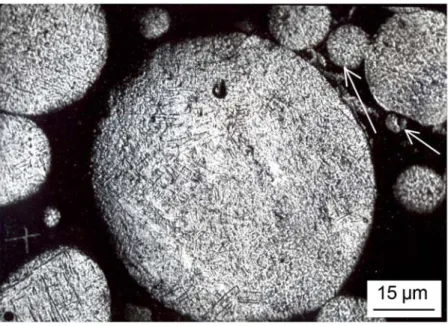
Microstructural analysis of the prealloyed powder (in the size range of 1 to 70 µm) prepared by nitrogen atomization showed that these powder particles were spheroidal and nodular in shape, with some particles sometimes decorated with fine satellite particles (Fig. 1). The microstructures of the particles are homogenous and have dendrite morphology. The presence of smaller dendrites is caused by the high cooling rate.
Fig. 1. OM. ZA27 alloy powder morphology and microstructure. Arrows - satellite
Phases identified by X-ray diffraction in ZA27 powder are shown in Fig. 2. Aside from the three basic phases in this alloy (α, η, ε), two oxides are present as well: CuAlO2 and
ZnO·Al2O3. The presence of these oxides is, in this case, a consequence of insufficiently
Fig. 2. X-ray diffractogram of ZA27 alloy powder
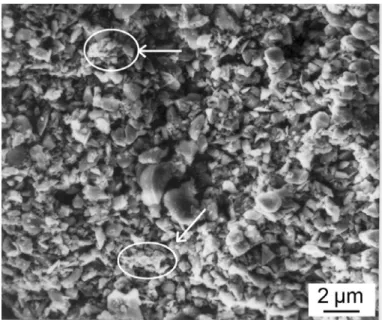
The Al2O3 particles of 0.7 µm average size had a similar nodular and acicular shape
and were characterized by a relatively wide size distribution (30 nm - 2 µm). The bulk of the powder contained numerous agglomerations of the smallest particles (Fig. 3).
Fig. 3. SEM. Al2O3 powder: morphology. Arrows - agglomerate
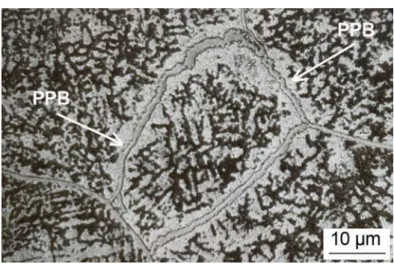
The microstructure of the hot pressed ZA27 alloy (Figs. 4 and 5) is porousless and characterized by the presence of prior particle boundaries (PPB). The oxygen as ZnO·Al2O3
Fig. 4. OM. Microstructure of hot-pressed ZA27 alloy
Fig. 5. SEM. Microstructure of hot-pressed ZA27 alloy. Arrows: prior grain boundaries
Semi-quantitative analysis (EDS) showed the presence of zinc, aluminium and copper in the particle matrix (Fig. 6a), whereas zinc, aluminium and oxygen are identified at the particle boundary (Fig. 6b).
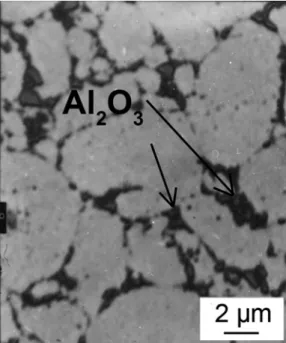
It was observed (Fig. 7) that, in the case of composite, ceramic particles surround the master phase particles. The presence of a certain number of agglomerated Al2O3 particles in
the structure can also be noticed from the figure.
Fig. 7. Microstructure of hot-pressed ZA27-Al2O3 composite. Arrows – Al2O3 particles
Figure 8a, b shows the dependence of the yield strength and elastic modulus in the temperature range from 20°C to 160°C for ZA27 alloy and the ZA27-Al2O3 composite
produced by powder metallurgy techniques, during compression testing. Our composite sample showed an improved yield strength and elastic modulus at room temperature.
a) b)
Fig. 8. The dependence of: a. yield strength and b. elastic modulus of ZA27 alloy and ZA27-Al2O3 composite on temperature
dislocation density and smaller grain size. The reduction of grain size is caused by the rearrangement of dislocations into boundaries and consequent creation of subgrains [10]. This occurs in the grains with high density of dislocations around Al2O3 particles. Reorganization
of dislocations is a recovery process accelerated by the energy within the distorted matrix at the interface [10], while the Al2O3 particles act as an obstacle to their motion.
The local stress in the matrix depends on (i) tensile residual stress field in the matrix, since zinc has a higher coefficient of thermal expansion compared to Al2O3. Partial relief of
this stress increases the dislocation density [11]; (ii) different stiffness of the matrix and Al2O3
particles, so the applied load can not be equally distributed, causing local stress on the matrix lower than the applied nominal stress. One of the factors that influenced the increase of the composite modulus elasticity comparing to monolithic alloy is load redistribution in the material exposed to force action. Al2O3 particles in the composite, having higher stiffness than
the matrix, can endure higher load. This way, the matrix is “relieved”, which leads to the increase of the elastic modulus. The same as for the yield strength, main factors that affected its increase in composite (higher dislocation density, grain size reduction, residual strain) had the identical effect on the stiffness increase of this material.
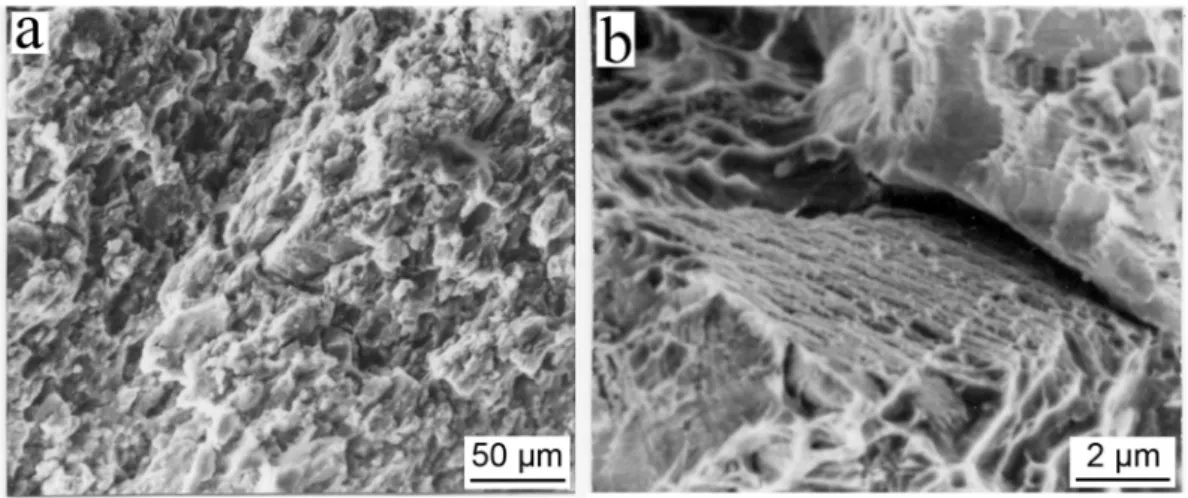
The enhancement is not so prominent due to the existence of agglomerates in the structure (Fig. 7), also present in the starting powder (Fig. 3). The fracture surfaces of ZA27 alloy and composite ZA27-Al2O3 are shown in Figs. 9a,b and 10a,b.
Fig. 9. SEM. Fracture surface of ZA27 alloy: decohesion of alloy particles
Fig. 10. Fracture surface of ZA27-Al2O3 composite: a. OM. Crack propagation, b. SEM.
The dominant cracking mechanism in ZA27 alloy is decohesion between particles, accelerated by the presence of a complex oxide ZnO·Al2O3 on their surfaces. Apart from
decohesion, in ZA27-Al2O3 composites, additional and often predominating cause of cracking
were agglomerated Al2O3 particles present in the matrix structure (Figs. 7 and 10b).
As the temperature increases (above 70°C), the value of ZA27 alloy strength and elastic modulus rapidly decreases (Fig. 8a, b). Heat action causes zinc alloy to soften, allowing easier movement of the dislocations. It is one of the negative features of this alloy, as mentioned in the introduction. As can be seen from this figure, the decrease of the composite yield strength and elastic modulus with temperature is not as strong as it is in the monolithic material. It is the consequence of hard Al2O3 particles present in the metal matrix
(Fig. 7), because these particles (especially the smaller ones) represent barriers for dislocations movement in the material.
4. Conclusions
1. ZA27 alloy powders with spheroidal and nodular particles, homogeneous structure and the dendrite morphology are obtained by the atomization process in nitrogen atmosphere.
2. The oxides in the structure of pressed samples and prealloyed powder are a consequence of insufficiently correct atomization process conduction.
3. ZA27 alloy reinforced with Al2O3 particles has been produced by powder metallurgy
techniques.
4. The presence of agglomerations of Al2O3 particles has detrimental effect on the
strength and stiffness of ZA27 –Al2O3 composite.
5. Yield strength and elastic modulus of the ZA27-Al2O3 composite decreases with an
increasing temperature, but not as strong as in the ZA27 alloy.
5. Acknowledgements
The results presented in this paper were realized with financial support of the Ministry of Science and Technological Development of the Republic of Serbia through project No. 172005.
6. References
1. E. Gervais, R.J. Barnhurst, C.A. Loong, Journal of Metals, 37 (1985) 43-47.
2. M.A. Dellis, J.P. Kenstermans, F. Delannay, J. Wegria, Mater.Sci.Eng. A, 135 (1991) 253-257.
3. H.X. Zhu, S.K. Liu, Composites, 24 (1993) 437-441.
4. S. Muthukumarasamy, S. Seshan, Composites, 26 (1995) 387-393.
5. J.A. Cornie, Cast Reinforced Metal Composites, ASM International, Ohio, 1988. 6. N. Karni, G.B. Barkay, J.Mater.Sci.Lett., 13 (1994) 541-544.
7. H.B. McShane, N. Raghunathan, H.B. Garba, Powder Metallurgy, 33 (1990) 35-39. 8. R.M. German, Powder Metallurgy Science, MPIF, New Jersey, 1994.
9. T.J.A. Doel, P. Bowen, Composites Part A, 27 (1996) 655-665. 10. D.W.A. Rees, Composites Part A, 29A (1998) 171-182.
Са р а:
Zn- 10 .% Al2O3 0,7 µm.
К Zn-Al-Cu (ZA27) ,
Al2O3 .
230°C 45 ,
150 MPa. И
20°C 160°C, 2,1×10⁻³ s-1. М
.
К учн р чи: , , ,