on dysthanasia, euthanasia and orthothanasia
Rudval Souza da Silva 1, Cássia Luiza de Souza Evangelista 2, Rodrigo Duarte dos Santos 3, Gilvânia Patrícia do Nascimento Paixão 4,
Chrisielle Lidianne Alencar Marinho 5, Gerlene Grudka Lira 6
Abstract
The objecive of this study was to analyze the percepion of intensive care nurses on the concepts of dys
-thanasia, euthanasia and orthothanasia and the possible bioethical implicaions for care. An exploratory and descripive study of a qualitaive nature was carried out through quesionnaires applied to eight nurses working in Intensive Care Units. The themes that emerged from the responses were ideniied and analyzed based on literature. The results showed that nurses understood the concepts of dysthanasia, euthanasia and orthothanasia correctly, but could not carry out pracical care based on the principles of orthothanasia, and demonstrated diiculty in deining the four bioethical principles that should direct care. It was concluded that although nurses understood these three concepts relaing to terminal illness and recognized their importance for the provision of care, from the responses analyzed it could not be inferred that the principles of orthotha
-nasia were actually present in rouine care, which can negaively inluence the quality of such care. Keywords: Palliaive care. Nursing care. Bioethics. Intensive care units.
Resumo
Percepção de enfermeiras intensivistas de hospital regional sobre distanásia, eutanásia e ortotanásia
Este estudo analisa a percepção de enfermeiras intensivistas de hospital regional sobre os conceitos distanásia, eutanásia e ortotanásia e possíveis implicações bioéicas no cuidado do doente terminal. Realizou-se pesquisa exploratória e descriiva, de natureza qualitaiva, aplicando quesionários a oito enfermeiras que atuam em duas unidades de terapia intensiva. Ideniicaram-se os temas que emergiram das respostas, que foram então analisados com base na literatura. Os resultados evidenciaram que as enfermeiras sabiam conceituar distanásia, eutanásia e ortotanásia; contudo não conseguiam efeivar um cuidado direcionado pelos princípios da ortotanásia, além de de
-mostrarem diiculdade em deinir os quatro princípios bioéicos que devem direcionar os cuidados. Conclui-se que, apesar das enfermeiras compreenderem os três conceitos de terminalidade e reconhecerem sua importância em relação ao cuidado, não foi possível depreender, das respostas analisadas, que na sua práica coidiana os princípios da ortotanásia estejam efeivamente presentes, o que pode inluenciar negaivamente a qualidade da assistência. Palavras-chave: Cuidados paliaivos. Cuidados de enfermagem. Bioéica. Unidades de terapia intensiva.
Resumen
Percepción de las enfermeras intensivistas de un hospital regional sobre distanasia, eutanasia y ortotanasia
El objeivo de este estudio es analizar la percepción de enfermeras intensivistas sobre los conceptos de la dis
-tanasia, eutanasia y orto-tanasia, y las posibles implicaciones bioéicas en el cuidado de paciente terminal. Se llevó a cabo un estudio exploratorio y descripivo de naturaleza cualitaiva, a través del uso de cuesionarios con ocho enfermeras que trabajan en dos Unidades de Cuidados Intensivos. Se ideniicaron los temas que surgieron de las respuestas y los analizaron a parir de la literatura. Los resultados mostraron que las enfer
-meras sabían conceptualizar la distanasia, eutanasia y ortotanasia correctamente, pero no pueden llevar a la prácica un cuidado dirigido por los principios de la ortotanasia, además demostraron diicultad en deinir los cuatro principios bioéicos que deben conducir los cuidados. Se concluye que, a pesar de que las enfermeras enienden los tres conceptos acerca de un paciente terminal y reconocen su importancia en el cuidado, no fue posible deducir de las respuestas analizadas que en su prácica diaria los principios de la ortotanasia estén realmente presentes, lo cual puede de cierta forma inluir negaivamente en la calidad de la atención. Palabras clave: Cuidados paliaivos. Atención de enfermería. Bioéica. Unidades de cuidados intensivos.
Aprovação CEP-Uneb 344.168
1. Doutor[email protected] – Universidade do Estado da Bahia (Uneb/Campus VII) 2. Graduada [email protected] – Uneb/Campus VII 3. Graduado [email protected] – Uneb/Campus VII 4. Mestre[email protected] – Uneb/ Campus VII 5. Mestre[email protected] – Uneb/Campus VII, Senhor do Bonim/BA, Brasil 6. Mestre gerlene.grudka@upe. br – Universidade de Pernambuco (UPE), Petrolina/PE, Brasil.
Correspondência
Rudval Souza da Silva – Universidade do Estado da Bahia – Uneb/Campus VII, Rodovia Lomanto Júnior BR 407 km 127 CEP 48970-000. Senhor do Bonim/BA, Brasil.
R
e
s
e
a
r
c
h
a
r
t
ic
le
The technological advances achieved from the second half of the twenieth century, associa
-ted with the development of therapeuics, enabled many diseases hitherto considered lethal transform into chronic condiions, also opening the possibility of increasing longevity However, despite accumula
-ted knowledge and the eforts of researchers, death remains a certainty and threatens the ideal of hea
-ling and the preservaion of life 1.
In view of this development and, consequen
-tly, the dilemmas imbricated in the relaionship between technological advances and human life, the quesion arises, “what life is being discussed?” From this quesion comes the need to discuss the ethical and legal dilemmas in the process of caring for the terminally ill in the context of intensive care units (ICU), considering especially the care provi
-ded by nurses. These professionals spend the most ime with paients in the ICU, providing care and/ or supervising the indicated procedures. As many paients of these units are beyond the possibility of a cure, it appears that someimes care pracices end up directed at possible dysthanasia processes, guided by fuile and oten unnecessary treatment, and with litle use of guided measures to limit the therapeuic efort, as well as to adjust measures for the relief of sufering, in order to provide a digniied death.
In this context, it is not only necessary but also imperaive to discuss issues related to bioethics in relaion to care pracices, since this is a ield of study that, steadily, addresses issues involving the boundaries between the beginning and the end of human life. Thus, it seeks to simulate relecion re
-garding the meaning of biotechnological advances and the support health of team professionals in de
-cision making 2.
It is possible to recognize that the acions of nurses as health team members line up with the four pillars of principlist bioethics: beneicence, non-maleicence, autonomy and jusice, with the purpose of preserving the rights of the paient as a person in vulnerable condiions, providing the assu
-rance of acions based on sensiive, decent and safe care 3. Linked to discussions on technological advan -ces and bioethical dilemmas of care for people with no chance of cure came new concepts that deine these impasses in terms of how the process of dying is faced by health professionals. Among these con
-cepts, euthanasia is the most oten reported by the media and has sparked wider discussion in scieniic publicaions.
The word “euthanasia” has its etymological origin from the Greek: eu (good) and thanatos (de
-ath), presented by Francis Bacon as a noble medical duty that consisted of alleviaing sufering in the care of people in the terminal process 4.5. However,
from the twenieth century, a markedly negaive connotaion of the term has crystallized, distoring its deiniion of “good death” and applying a new semanic deiniion, which refers to pracices whose purpose is death caused by a health professional 5. The change is so striking, that the Brazilian Code of Ethics of Nursing Professionals, in its aricle 29, says that it is forbidden for nursing professionals to promote euthanasia or to paricipate in pracices designed to anicipate a paient’s death 6. In the ield of bioethics, it is argued that it is possible to achieve the pracice of “good death” through resources re
-lated to therapeuic adequacy, without shortening life.
Therefore, in opposiion to the new deiniion of euthanasia, the concept of dysthanasia arose. It is sill litle known but widely used by health profes
-sionals. Contrary to what happens with its antonym, dysthanasia is deined as slow death accompanied by much sufering. It is a concept used as a synonym of fuile treatment or therapeuic obsinacy, despite its pracice being highly present in health insitu
-ions, especially in the ICU 7,8.
In order to propose an intermediate relecion, the concept of orthothanasia arose as a mediato
-rial way, considered by palliaive care specialists as the more appropriate care opion for paients with terminal illness, who present intense physical and mental sufering, in line with more humane care pracices 8. This pracice is consistent with care that
takes into account the natural course of life and death as part of life, seeking relief of sufering by adoping palliaive care and avoiding unnecessary procedures that only prolong the sufering of the paient and the family, and consitutes the limit of therapeuic eforts 9.
Coupled with the concept of orthothanasia, in favor of carefully directed and appropriate therapy in order to minimize the people’s sufering during the process of dying, the drive for palliaive care intensi
-ies, with the development of proacive and holisic care for the person whose disease is unresponsive to curaive treatment. This movement aims to pro
-vide the best possible quality of life for paients and families, by controlling pain, other symptoms and psychosocial and spiritual problems. Palliaive care goes beyond the concept of orthothanasia and is
R
e
s
e
a
r
c
h
a
r
t
ic
le
based on philosophical principles that are aimed at relieving symptoms and discomfort, preserving the quality of life to the end, so that death occurs natu
-rally and is never deliberate, paying atenion to the family as part of the care unit, and extending care ater death during the grieving process 1.
The pracice of palliaive care advocates inter
-disciplinary team aciviies, and the paricipaion of nurses in this process is essenial. In this sense, it is necessary to think about the role of the nursing team from the interdisciplinary perspecive, so that, guided by bioethical principles, the nurse can help paients in their process of dying, taking the preser
-vaion of dignity and the relief of sufering as the guiding care principle 10.
Nurses can idenify situaions in which bioe
-thical principles and the rights of paients are not respected, and are able to provide the necessary intervenions to ensure humane and digniied care. Hence, it is important that these professionals have knowledge of the concepts of euthanasia, dystha
-nasia and orthotha-nasia, and of the principles of bioethics regarding the scope of proacive and ho
-lisic care, as recommended by the World Health Organizaion (WHO) with the philosophical princi
-ples of palliaive care 11.
There are many publicaions on palliaive care; however, with regard to bioethical issues, palliaive care and nursing care, there is a relaive scarcity. This jusiies the development of this study, consi
-dering that all nursing professionals, as provided in their Code of Ethics 6, are co-responsible for the search and the adopion of respecful, ethical and responsible measures for the digniied and humane care of terminal ill paients and their families.
Staring from the assumpion that intensi
-vist nurses deal, in their daily life, with criically ill paients that are potenially curable, but also with paients that present diagnosis of incurable disea
-ses, and that these professionals are someimes unaware that the care provided in many situaions is a dysthanasic process - which has contributed to the pracice of therapeuic obsinacy – the objecive of this study was to analyze the percepion of intensive care nurses regarding the concepts of dysthanasia, euthanasia and orthothanasia, and the possible bioethical implicaions for care. The aim is also to contribute to the evaluaion of ongoing training pro
-cesses ofered to these professionals, paricularly considering the pracice of palliaive care in ICUs.
Methodology
It is exploratory and descripive research with a qualitaive approach 12, in which eight nurses have paricipated - seven assising and one resident nur
-se - who worked in two public hospital intensive care units in the São Francisco Valley region in Brazil. Tho
-se who were -selected worked in the ICU for more than six months. During the period of data collecion, the two units were comprised of iteen nurses (twel
-ve assising, two coordinators and one resident) and a twenty-bed capacity. The proile of paients cared for included those sufering from chronic diseases, recovering from serious surgeries and/or with hemo
-dynamic complicaions.
Data collecion occurred from September 2014 to February 2015, with the applicaion of quesion
-naires to the proiling of paricipants, addressing the following variables: age, gender, ime elapsed since graduaion and working in intensive care, possession of a specializaion degree, and funcion in the ICU (cli
-nical, coordinator or resident nurse). It also consisted of eight subjecive quesions about their knowled
-ge regarding euthanasia concepts, dysthanasia and orthothanasia, of the four bioethical principles (of principlism) and its implicaions in the care (Appen
-dix). It is worth menioning that the quesionnaire was validated and already applied in other research 13, being made available by the authors for reuse in this scenario. Professionals completed the quesionnaire while on duty and then returned it to the researcher, not being allowed to take it away to respond later.
All study paricipants, ater the necessary cla
-riicaions regarding the objecive of the research, agreed to voluntarily paricipate in the study and then signed the consent form.
The obtained data was analyzed qualitaively, using the quesionnaires and the content analysis technique 14. The topics that emerged from the res -ponses were ideniied, and then received proper analysis, with the assistance of literature related to the research subject, in order to achieve the objec
-ive of the research. The sequence of quesions was as follows: knowledge of dysthanasia, euthanasia and orthothanasia; frequency of such processes in the daily pracice of nurses; applicability or not of the concepts in their daily pracice; guiding acions in the face of dysthanasia situaions; knowledge of bioethi
-cal principles and their relevance to health care. To maintain the anonymity of the paricipants, a code was used for each paricipant, the leter “P” followed by a number (P1, P2, P3, etc.), according to
R
e
s
e
a
r
c
h
a
r
t
ic
le
the sequence that completed quesionnaires were returned. The Ethics and Research Commitee con
-sidered and approved the project, and the study followed the precepts of Resolução 466/2012 [Re
-soluion 466/2012] of the Brazilian Naional Health Council 15.
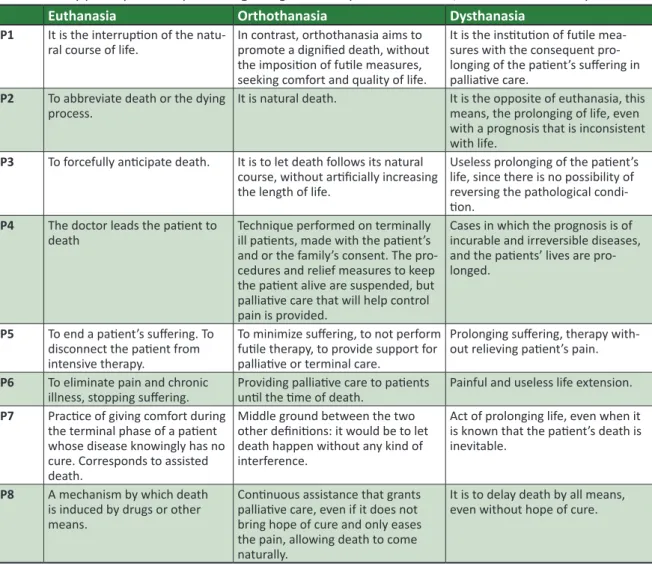
Seeking the best strategy for presening the responses regarding the concepts of euthanasia, or
-thothanasia and dysthanasia, a summary table was built in order to opimize the visual presentaion of the answers. From this summary, informaion was generated and discussed according to the literature. Its use in this study is considered fundamental for the construcion of the analysis, since, based on the responses collected, study paricipants were proiled and the indings were interpreted and analyzed.
Limitaions of the study centered on the di
-iculty of professionals complying to respond to the quesionnaire: they jusiied themselves saying that the quesionnaire was extensive and,
therefore, requested to take it home, ciing lack of ime to answer it while on duty. With concerns that respondents might consult references on the sub
-ject, it was emphasized that the quesions should be answered in due ime and that the quesionnaire could not be taken home. This eventually reduced the number of study paricipants.
Results
As for the proiling of the study paricipants, the average age was 27.5 years, with ime since gra
-duaion ranging from one to seven years, and ime working in ICUs was between six months and four years. Among the paricipants, six had a specializa
-ion degree, of which three were in intensive care and the rest in other areas, such as nephrology, surgery and public health. Two of them only had an undergraduate degree.
Table 1. Study paricipants’ responses regarding the concepts of euthanasia, orthothanasia and dysthanasia.
Euthanasia Orthothanasia Dysthanasia
P1 It is the interrupion of the natu
-ral course of life. In contrast, orthothanasia aims to promote a digniied death, without the imposiion of fuile measures, seeking comfort and quality of life.
It is the insituion of fuile mea -sures with the consequent pro -longing of the paient’s sufering in palliaive care.
P2 To abbreviate death or the dying
process. It is natural death. It is the opposite of euthanasia, this means, the prolonging of life, even with a prognosis that is inconsistent with life.
P3 To forcefully anicipate death. It is to let death follows its natural course, without ariicially increasing the length of life.
Useless prolonging of the paient’s life, since there is no possibility of reversing the pathological condi -ion.
P4 The doctor leads the paient to
death Technique performed on terminally ill paients, made with the paient’s and or the family’s consent. The pro-cedures and relief measures to keep the paient alive are suspended, but palliaive care that will help control pain is provided.
Cases in which the prognosis is of incurable and irreversible diseases, and the paients’ lives are pro-longed.
P5 To end a paient’s sufering. To
disconnect the paient from intensive therapy.
To minimize sufering, to not perform fuile therapy, to provide support for palliaive or terminal care.
Prolonging sufering, therapy with-out relieving paient’s pain.
P6 To eliminate pain and chronic
illness, stopping sufering. Providing palliaive care to paients unil the ime of death. Painful and useless life extension.
P7 Pracice of giving comfort during
the terminal phase of a paient whose disease knowingly has no cure. Corresponds to assisted death.
Middle ground between the two other deiniions: it would be to let death happen without any kind of interference.
Act of prolonging life, even when it is known that the paient’s death is inevitable.
P8 A mechanism by which death
is induced by drugs or other means.
Coninuous assistance that grants palliaive care, even if it does not bring hope of cure and only eases the pain, allowing death to come naturally.
It is to delay death by all means, even without hope of cure.
R
e
s
e
a
r
c
h
a
r
t
ic
le
All paricipants responded posiively regarding having knowledge about the concepts of euthana
-sia, orthothanasia and dysthanasia as shown in the parial quotes transcribed in Table 1.
Regarding the quesion about the occurren
-ce of these pro-cesses in their daily praci-ce, the answers of the paricipants were unanimous in staing that euthanasia does not exist, as it is con
-sidered a criminal act in accordance with Brazilian law. However, there are care pracices that tend either towards therapeuic fuility or towards care based on measures that limit the therapeuic efort, with a view to alleviaing sufering.
When quesioned, all nurses agreed that they contribute to the provision of care aimed at a dig
-niied death, and recognize the inluence of the knowledge of the concepts of euthanasia, dystha
-nasia and orthotha-nasia, as well as the applicaion of these to promote a death with dignity. Two par
-icipants pointed out that communicaion is a major element for the proper applicability of care; another three responded that a proper interrelaionship of teamwork and mulidisciplinarity is a factor that favors the quality of care; the other three stated that care should be based on pracices that avoid euthanasia and dysthanasia, in order to promote orthothanasia.
With regard to the quesion about what gui
-des the nurse’s acions when faced with dysthanasia pracices, four respondents answered that their ai
-tude against these pracices was based on bioethical principles and religiosity; two said it was based on paients’ desires and emoions; for the others, the basis of their convicions would be based on respect for human dignity.
On being asked about bioethical principles, all said they knew the four principles; however, only ive listed them correctly. The other three nurses did not correctly answer the quesion, ciing other prin
-ciples such as equity, or gave incomplete responses. In response to the quesion related to the rele
-vance of nurses knowing these concepts, all agreed on the need to apply the four bioethical principles, in order to preserve the dignity of paients and their families. Three reinforced that this knowledge contributes to improving the pracice of caring for terminally ill paients.
All agreed on the importance of the pari
-cipaion of paients, families and nurses in the decision-making process regarding treatment.
However, only three considered the bioethical principle of paient autonomy as essenial to this process; the others said that the decision should be made by the mulidisciplinary team.
The last quesion brought up the issue of what underlined respondents professional mode of ac
-ion. All answered that, for the good development of their work, it is necessary to be aware of bioe
-thical principles, in paricular the respect for the paient’s individuality, taking into account respect for autonomy as a guiding principle for their profes
-sional acions.
Discussion
As for the deiniion of euthanasia, there were responses that converged with the original concept of euthanasia meaning “good death”, as in the res
-ponses of nurses P5, P6 and P7, described in Table 1. Meanwhile, the others expressed their percepion that euthanasia is an illegal pracice, which implies the inducement of an anicipated death.
Establishing a correlaion between the varia
-bles of postgraduate training and the duraion of experience in ICU, among the P5, P6 and P7 nurses, two have completed specializaion courses in inten
-sive care, while the other has more experience in ICU (more than three years). This associaion leads us to think that these are factors that provide gre
-ater relecion and analysis regarding the concept of euthanasia, in its etymological essence, demons
-traing knowledge that goes beyond the current concept of euthanasia as induced death.
The deiniion of euthanasia by other pari
-cipants corresponds to what is set by the naional legal and ethical system, which supports the Brazi
-lian Code of Ethics of Nursing Professionals 6: that it is a prohibited act, related to promoing or parici
-paing in pracices designed to anicipate the death of the paient 7. Therefore, for these nurses eutha
-nasia is illegal, and assumes the current deiniion of a criminal act, according to Brazilian law. It is no
-teworthy that one can correlate the early concept of euthanasia as “good death” to palliaive care, which seeks to provide care guided by principles that in
-tegrate technique, technology and humaneness in order to promote quality of life for terminally ill pa
-ients, with the relief of pain and sufering, without shortening life, and avoiding therapeuic fuility and obsinacy.
R
e
s
e
a
r
c
h
a
r
t
ic
le
The paricipant P7 deined euthanasia as “assisted death”, which allows us to think that she associated this idea to the concept of assisted suicide. However, for some authors 5, there are dife -rences between these concepts, and euthanasia is seen as an act through which the professional puts an end to the life of a person afected by incurable disease, while assisted suicide occurs when someo
-ne asks for the help of another to, in fact, provoke his/her death, if he/she is not able to perform this acion himself/herself.
The data observed in this study are consistent with the results of another study in which the indin
-gs highlight a concept of euthanasia similar to the meaning provided by the new deiniion, which is also conveyed via the media and is part of people’s general knowledge 16.
The answers regarding the deiniion of dys
-thanasia are quite convergent and tend towards the correct deiniion, focusing on the promoion of the
-rapeuic measures, considered fuile and useless, given to terminally ill paients, resuling in slow and prolonged death, accompanied by sufering, pain and agony. Research on the concept reveal that, in fact, this pracice has been quesioned and discus
-sed for years, regarding the lack of purpose in the treatment of unrecoverable paients, with the in
-discriminate use of advanced therapeuic arsenals, promoing indeinite life support 17. The observaion
of pain and sufering associated with this situaion has generated discussions and implies a bioethical dilemma, which also interferes with the delivery of care undertaken by the nursing staf.
This dilemma covers the mater related to the ime in which one can or should make a decision re
-garding the coninuity of treatment without causing addiional sufering to the paient 17, 18. In this study,
the nurses see this issue as a generator of bioethi
-cal conlict, as they recognize the need for intense discussion between medical and nursing staf for decision making regarding the assistance plan to be proposed to paients in terminal situaions.
This discussion should take advantage of the principle of autonomy, based on enlightening dialo
-gue that allows the paient to refuse treatment with knowledge and freedom, understanding that it is possible to avoid moral conlict when the paient’s autonomy is respected, even if the paient is not communicaive at the ime of decision making. It is also important to consider the bioethical resources, like the advance direcives, as a strategy to assist the
decision-making - by the professional staf, paients and their families - in order to serve the best interest of paients.
In a similar study 13, carried out with 27 nur -ses, 15 of them (55.5%) understood the pracice of dysthanasia as the ariicial prolongaion of life wi
-thout beneits, and 3 paricipants (11.1%), as slow death accompanied by sufering. The others were unable to conceptualize dysthanasia. In this study, paricipants were unanimous in answering that dys
-thanasia is the ariicial prolongaion of life without beneits; and three highlighted that this extension is characterized by the adopion of measures that are fuile and/or useless to the quality of life of the paient.
The paricipant P4 deined dysthanasia as a situaion in which the prognosis is of incurable and irreversible disease, oping for the extension of this condiion. This highlights a pracice of excessive the
-rapeuic measures that end up imposing sufering and pain on people with irreversible and terminal diseases, culminaing in a scenario that generates ethical conlicts regarding the excessive use of te
-chnology as therapy in paients for whom death is inevitable 17.
Finally, orthothanasia is the term used to des
-cribe and represent what is currently presented as digniied death, without adding measures to ab
-breviate life and without imposing measures that increase unnecessary sufering, but with the pro
-moion of comforing measures to allow death to occur in its own ime, as naturally as possible 13,18,19.
This perspecive is also evident in the responses of the nurses in this study. Most answers converged with the concept of orthothanasia as a synonym for natural death and as a process related to the i
-nal stage of the life cycle. However, the responses from nurses P4, P6 and P8, which translated the concept as synonymous with palliaive care, drew atenion. Paricipant P4, in turn, emphasized the need to respect the paients’ autonomy recognizing their right to accept death and to decide not to in
-vest in disproporionate treatments. Meanwhile, nurse P7 brought a somewhat distorted deiniion, referring to an abandonment connotaion, saying that orthothanasia is leing death happen without interference.
A research that aimed to understand the percepion of nurses regarding the pracice of or
-thothanasia in the hospital context 19 found that this
is considered as a new concept. According to nurses,
R
e
s
e
a
r
c
h
a
r
t
ic
le
orthothanasia is a viable opion for treaing death as a constant and irretrievable process, in a way that counteracts the prolonging of human sufering. This interpretaion corroborates the responses of the ei
-ght nurses who answered the quesionnaire in this study.
This data reinforces that paricipants conside
-red that the acions of nurses should be supported by the promoion of care, with a view to the prin
-ciples of orthothanasia, which is seen as the art of dying with dignity and humanity, in order to integra
-te ethics, aestheics, science and -technical skills 20.
However, although the nurses have described or
-thothanasia based on the theoreical concept, it is noiceable, on further analysis, that the concept, al
-though consistent, is not used appropriately in their pracice within the ICU. It is important to note that orthothanasia seeks to promote care that allows de
-ath with relief from pain 21.
Although some nurses considered orthotha
-nasia as a synonym for “palliaive care”, the most appropriate concept is of natural and desirable de
-ath, without the ariicial prolongaion of life, which would cause sufering and alter the natural process of dying 9. Therefore, palliaive care extends this con
-cept to the total care of those who are terminally ill and their families. However, what was not evident in the responses of the paricipants of this study, is the concern of involving the family in the decision
--making process, and if there is, in fact, discussion in defense of the pracice of palliaive care.
There is a theoreical knowledge, but unfortu
-nately it is not applied in pracice. Other studies 16, also showed that nurses, in their daily lives, acknow
-ledge that their care pracices in the ICU environment are guided by dysthanasia measures, relecing the great appreciaion of the therapeuic arsenal inten
-ded to ariicially sustain life. The disproporionate expectaions regarding the efeciveness of medical pracices, as well as the fear of paients and their families in the face of terminal illness, require from professionals a beter reasoning that considers ethics and humaneness, aiming at the best possible comfort for paients. Otherwise, there is the risk of incurring dysthanasia measures that promote sufe
-ring and divert paients from orthothanasia.
Finally, when asked about the adopion of these pracices (euthanasia, orthothanasia and dys
-thanasia) in their daily lives, the paricipants were unanimous in answering that orthothanasia recur
-red in the context of the two ICUs studied. However,
six nurses pointed out that, although they praciced orthothanasia, it was very common to idenify dys
-thanasia processes. All denied the existence of the pracice of euthanasia.
Another study 22 also points out that nurses idenify dysthanasia, in their day-to-day, as death with sufering and great pain, introducing aggressive treatment that only prolongs the process of dying. However, it revealed that it is also nurses’ pracice to ight dysthanasia processes and provide ortho
-thanasia, always giving priority to comfort and pain relief in favor of beter quality of life in the remai
-ning days of the paient. This condiion allows us to infer that the same happens in the environment in which this research was developed.
Moving on to subsequent quesions - the quesion regarding nurses’ contribuion in the care process for a digniied death, and if this contribuion is inluenced by their knowledge regarding eutha
-nasia, orthothanasia and dysthanasia – it veriied a consensus that paricipants seek to provide such care for paients’ wellbeing, based on paricipants’ previous knowledge. Such interference goes throu
-gh acions based on an appropriate interrelaionship amongst the mulidisciplinary team, conigured as a harmonic and dynamic communicaion process, aiming at avoiding euthanasia and dysthanasia pro
-cesses, and promoing orthothanasia.
Communicaion, verbal or nonverbal, is es
-senial for nursing professionals to interpret the informaion and signals transmited by the paients, to pass it on to other caregivers, and to interact properly with paients and their families. However, given the sensiivity of the situaion and the possibi
-lity of paients feeling and expressing contradictory emoions and desires, a large proporion of the paricipants felt unprepared to safely exercise their communicaion skills, making therapy diicult, re
-garding an aspect considered key for proper exercise of palliaive care for paients, families and staf 3. Al -though verbal and non-verbal communicaion is part of the arsenal of innate human capaciies, it does not always prove to be an easy ability to exercise.
The full exercise of communicaive skills demands the exchange of informaion between sender and receiver. It appears that the process is not easy in situaions of diicult decisions for both professionals and paients, in circumstances which allow for more than one interpretaion, be
-cause of the natural dichotomy between the desire to live and the fear of dying. That happens under
R
e
s
e
a
r
c
h
a
r
t
ic
le
the responsibility assumed by professionals when trying to do their best for others, based on their moral consciousness and deontological standards that underlie the exercise of their work aciviies. Together, these circumstances may hinder the professional pracice of palliaive care nursing, the
-reby conveying a sense of helplessness and failure to professionals.
Given this subjecive but powerful picture, in
-tensive care professionals seek guidance to facilitate their daily work acivity. As for what guides their pracice, nurses responded that bioethical principles are benchmark instruments, in paricular the prin
-ciple of autonomy, that is, respecing the paients’ wishes in order to provide humane care in seeking to promote orthothanasia. Although, it was noted that this contradicts previous answers, which can be atributed to the analysis presented above.
Literature suggests that it is the responsibility and duty of the nursing staf atending to paients’ rights and bioethical principles, guaranteeing them assistance that meets all their needs and gives them comfort. Therefore, it is important that nurses have knowledge of dysthanasia pracices, in order to avoid them, for the sake of proper care that does not viola
-te the ethical principles of their profession. This way, providing care that prolongs sufering is avoided 23. This is a situaion that is sill diicult to manage, be
-cause the work guided by interdisciplinarity is very incipient, especially because decision-making by nurses is minimal, being restricted to doctors 22. The -refore, it is important to emphasize that, in palliaive care, the paricipaion of the other members of the mulidisciplinary team is recommended, fostering interdisciplinary care that does not only involve the paricipaion of nurses and doctors.
It is known that principlism in bioethics deines as guiding elements the four principles (autonomy, jusice, beneicence and non-maleicence) and di
-rects its pracical applicaion to the care with dignity of both paients and their families. However, it was noted that three paricipants had diiculty recog
-nizing and describing what those principles were: they were not able to quote or deine the principles. This situaion brings to mind the undervaluaion of bioethics training and discussions regarding its role in professional health pracice, which can inluence the proper ethical and professional pracice of tea
-ms. It is worth highlighing the fact that, although ethics is an intertwined topic in nurse training, there are sill professionals who are confused or unaware
of the bioethical principles that guide their profes
-sional pracice.
Bioethics has been incorporated into the his
-torical and social construcion of nursing, which ensures new foundaions to face daily challenges in connecing ethical and technical care, integraing principles and competencies in the context of caring and accountability for the respect for the human being, in the promoion of health and the relief of sufering 16. Therefore, it is necessary to value bio -ethics as an important ield for relecing about life and, to consider its inclusion in a professional con
-text, ensuring that it is possible to use it as a tool capable of promoing dialogue and respect, making it pluralist and less complex 2, paricularly when it comes to the principle of autonomy.
By analyzing the responses of paricipants, it is clear that there is a need for beter use of bioe
-thical principles to prevent dysthanasia processes and to achieve the pracice of orthothanasia, respecing individuality in the planning of care, recognizing autonomy and human dignity. As evi
-denced in another study 24, nurses emphasized the importance of the use of palliaive care in ICUs and discussed the need for the presence of family, comfort measures and respect for paients’ auto
-nomy to provide humane care. The data collected also made it possible to deduce the need for all professionals involved in clinical pracice to include ethical evaluaion in their work, to ensure a digni
-ied death for the paient 25.
Regarding decision-making, nurses’ respon
-ses allowed the inference that their paricipaion, as well as that of paients and their families, are extremely important, through a process of efeci
-ve communicaion, to ensure paients’ autonomy. Therefore, from the perspecive of interdisciplinari
-ty, it is necessary to include nurses in the palliaive care team’s decision-making, since care is inherent in the profession, from its concepion by Florence Nighingale. Thus, nurses use these guidelines to help terminally ill paients, and their families in the grieving process, using the care and preservaion of dignity as guidelines 10.
Final consideraions
The study concluded that, although nurses un
-derstand the concepts of euthanasia, orthothanasia and dysthanasia, and recognize its importance for the care of both terminal paients and their families,
R
e
s
e
a
r
c
h
a
r
t
ic
le
it was not possible to conclude from the responses analyzed if, in the everyday pracice of professionals, the principles of orthothanasia are actually present. This may, to some extent, negaively inluence the quality of care, paricularly with regard to the appli
-cability of bioethical principles and to the inclusion and paricipaion of the family in the process.
It was evident that the concept of orthothana
-sia is understood as a synonym for “palliaive care”. However, as shown in the discussions, palliaive care goes beyond the simple acceptance of death at the right ime, and requires care measures to alleviate
the sufering, and the inclusion of the family as a unit of care, so that it also receives atenion from the interdisciplinary health care team.
It is sill striking that health care presents evidence of therapeuic fuility and obsinacy. Ho
-wever, it is expected that nurses begin to relect on their situaions in everyday pracice, in order to avoid fuile treatment and to provide care that pro
-motes the dignity of the terminally ill, minimizing paients’ and their families’ sufering, for the sake of a more human grieving process.
Referências
1. Silva RS, Pereira A, Mussi FC. Comfort for a good death: perspecive nursing staf’s of intensive care. Esc Anna Nery. 2015;19(1):40-6.
2. Pessini L, Hosne WS. Bioéica no futuro e o futuro da bioéica. Bioethikos. 2012;6(2):123-4. 3. Silva RS, Amaral JB, Malagui W. Enfermagem em cuidados paliaivos: cuidando para uma boa
morte. São Paulo: Marinari; 2013. p. 77-93.
4. Floriani CA. Moderno movimento hospice: kalotanásia e o revivalismo estéico da boa morte. Rev. bioét. (Impr.). 2013;21(3):397-404.
5. Corvino JDF. Eutanásia: um novo paradigma. Rev. SJRJ. 2013;20(37):53-73.
6. Brasil. Conselho Federal de Enfermagem. Resolução nº 311, de 8 de fevereiro de 2007. Aprova a reformulação do código de éica dos proissionais de enfermagem e dá outras providências. [Internet]. Diário Oicial da União. Seção 1. Brasília; 17 fev 2007 [acesso 23 set 2016]. Disponível: htp://bit.ly/2crqtC.
7. Pessini L. Distanásia: por que prolongar o sofrimento? Ciência Hoje. 2013;301:61-3.
8. Santos DA, Almeida ERP, Silva FF, Andrade LHC, Azevêdo LA, Neves NMBC. Relexões bioéicas sobre a eutanásia a parir de caso paradigmáico. Rev. bioét. (Impr.). 2014;22(2):367-72. 9. Moritz RD. Ortotanásia: o direito à morte no tempo certo. Ciência Hoje. 2013;301:64-5. 10. Boemer MR. Sobre cuidados paliaivos. Rev Esc Enferm USP. 2009;43(3):500-1.
11. World Health Organizaion. Naional cancer control programs: polices and management guidelines. 2ª ed. Genebra: WHO; 2002.
12. Gil AC. Como elaborar projetos de pesquisa. 5ª ed. São Paulo: Atlas; 2010.
13. Biondo CA, Silva MJP, Dal Secco LM. Dysthanasia, euthanasia, orthothanasia: the percepions of nurses working in intensive care units and care implicaions. Rev Laino-am Enfermagem. 2009;17(5);613-9.
14. Brasil. Conselho Nacional de Saúde. Resolução nº 466, de 12 de dezembro de 2012. Diretrizes e normas regulamentadoras de pesquisas envolvendo seres humanos. [Internet]. 2012 [acesso 15 jan 2016]. Disponível: htp://bit.ly/1mTMIS3
15. Bardin L. Análise de conteúdo. 3ª ed. Lisboa: Edições 70; 2011.
16. Silva RS, Campos AER, Pereira A. Cuidando do paciente no processo de morte na unidade de terapia intensiva. Rev Esc Enferm USP. 2011;45(3):738-44.
17. Pessini L. Conceito de distanásia: das origens ao atual debate norte-americano. In: Pessini L. Distanásia: até quando prolongar a vida? São Paulo: Loyola; 2001. p. 141-61.
18. Felix ZC, Costa SFG, Alves AMPM, Andrade CG, Duarte MCS, Brito FM. Eutanásia, distanásia e ortotanásia: revisão integraiva da literatura. Cien Saude Colet. 2013;18(9):2733-46.
19. Bisogno SBC, Quintana AM, Camargo VP. Entre a vida enferma e a morte sadia: a ortotanásia na vivência de enfermeiros em unidade de terapia intensiva. REME Rev. Min. Enferm. 2010;14(3):327-34.
20. Pessini L, Barchifontaine CP. Eutanásia: Por que abreviar a vida? In: Problemas atuais de bioéica. 10ª ed. São Paulo: Loyola; 2012. p. 371-406.
21. Silva FS, Pachemshy LR, Rodrigues IG. Percepção de enfermeiros intensivistas sobre distanásia em unidade de terapia intensiva. Rev Bras Ter Intensiva. 2009;21(2):148-54.
22. Menezes MB, Selli L, Alves JS. Dysthanasia: nursing professionals’ percepion. Rev Laino-am Enfermagem. 2009;17(4):443-8.
23. Coêlho AFVCMB, Costa AKG, Lima MG. Da éica principialista para a bioéica de intervenção: sua uilização na área da saúde. Rev Tempus Actas Saúde Col. 2013;7(4):239-53.
24. Santana JCB, Rigueira ANM, Dutra BS. Distanásia: relexões sobre até quando prolongar a vida em uma Unidade de Terapia Intensiva na percepção dos enfermeiros. Bioethikos. 2010;4(4):402-11.
R
e
s
e
a
r
c
h
a
r
t
ic
le
Recebido: 10.2.2016 Revisado: 20.9.2016 Aprovado: 22.9.2016 25. Camargo JCM, Tercero MPM, Lopez MPN, Maeso MJE, Fernandez-Infantes SP, Valverde PC et al.
Limits of therapeuic efort: Professional opinions. Enferm Intensiva. 2012;23(3):104-14.
Paricipaion of authors’
Rudval Souza da Silva is responsible for the concepion, design, direcion, drating and revising of the study. Cassia Luiza de Souza Evangelista, Rodrigo Duarte dos Santos and Gilvânia Patrícia do Nascimento Paixão paricipated in the concepion, data collecion, drating and revising of the project. Chrisielle Lidianne Alencar Marinho and Gerlene Grudka Lira paricipated in drating and revising the aricle.
R
e
s
e
a
r
c
h
a
r
t
ic
le
Appendix
Data collecion instrument
Iniials: ____ Age: ____ Gender: F ( ) M ( )
Time elapsed since graduaion: _____ Time working in ICU: _____
Do you have a specializaion degree? Y ( ) N ( ) Which one(s)? ___________
Funcion:
( ) Nurse Coordinator ( ) Healthcare Nurse ( ) Resident nurse
1. Do you know the concepts of dysthanasia, euthanasia and orthothanasia? Y ( ) N ( ) If so, deine them:
________________________________________________________________________________________
2. Do these processes occur in your daily pracice? Y ( ) N ( ) If so, which?
________________________________________________________________________________________
3. Do you believe that the nurse may contribute by knowing these concepts and their proper applicability? Y ( ) N ( )
How?
________________________________________________________________________________________
4. What guides your acions as a nurse in the face of a dysthanasia situaion?
________________________________________________________________________________________
5. What bioethical principles do you know?
________________________________________________________________________________________
6. What is the importance, in your daily care duies, of having knowledge of these concepts?
________________________________________________________________________________________
7. Do you believe that the nurse, the family and paients themselves should paricipate in decision-making processes with regard to their treatment? Y ( ) N ( )
If so, how?
________________________________________________________________________________________
8. What is the basis of your professional acion mode?
________________________________________________________________________________________