ABSTRACT:Introduction: In the district of Sobral, for the decade of 2000 at the same time that political measures were implanted towards the decrease of children mortality, discussions have begun about health and educations conditions, as well as life quality of children aged between 5 and 9, which is an age group of lesser vulnerability as far as health goes, although of major importance in the development of healthy habits and for the child’s development itself. Objective: Based on such scenario, it was set up a cohort of children aged between 5 and 9 and residents of the urban area of the district in order to study health and education conditions and quality of life which are essential for the future of these children in light of the Social Determinants of Health. Methods: This is a cross-sectional study with a cohort of children born from 1990 to 1994, home interviews, clinical evaluation and lab exams. The structure for the development of the research was elaborated based on the model of attention towards the health of Family Health Strategy. In this report, the results of such home interviews shall be presented in regards to socio-demographic and environmental conditions in general, with a more detailed analysis of life styles, educational levels, child labor, nutrition and the use of health services by children.
Keywords: Social determinants. School failure. Child labor. Use of health services. Nutrition. Family Health.
Social Determinants of Health among children
aged between 5 and 9 years within the urban
area, Sobral, Ceará, Brazil
Determinantes sociais da saúde de crianças de
5 a 9 anos da zona urbana de Sobral, Ceará, Brasil
Ana Cecília Silveira Lins SucupiraI, Luiz Odorico Monteiro de AndradeII, Ivana Cristina Holanda Cunha BarretoII, José Wellington LimaIII, Anna Vicente SantiagoIV, Adriana Xavier SantiagoIV
IInstitute for Children of Hospital das Clínicas, School of Medicine, Universidade de São Paulo – São Paulo (SP), Brazil. IISchool of Medicine, Universidade Federal do Ceará – Fortaleza (CE), Brazil.
IIIFederal Institute of Education, Science and Technology of Ceará – Fortaleza (CE), Brazil.
IVDepartment of Education of the State of Ceará, Coordination of Professional Education – Fortaleza (CE), Brazil.
Corresponding author: Ana Cecília Silveira Lins Sucupira. Universidade de São Paulo, Hospital das Clínicas da FMUSP, Instituto da Criança. Avenida Enéas de Carvalho Aguiar. CEP 18760-000. Cerqueira Cesar, SP, Brasil. E-mail: [email protected]
Conlict of interests: nothing to declare – Financing source: Municipal Government of Sobral.
INTRODUCTION
The elaboration of social policies aimed at improving the health and quality of life of a population should be based on knowledge of the living conditions of this population. It is important to analyze how social inequities are relected in the possibilities of access to social goods and the level of development of the basic capabilities of individuals. The determination of the health-disease process for social causes has long been used as an argument by actors who advocated state intervention in health matters during the organization of the modern state, from mid-19th century1. From the 1990s, this debate intensiied, occupying a new agenda in the ield of scientiic production and in the technopolitical debate on health. In 2004, the Commission on Social Determinants of Health was created by the WHO2, having as one of its main tasks to lead the formation of similar committees around the world. In Brazil, the National Commission on Social Determinants of Health (CSDH), in its Final Report of 2008, entitled “The social causes of health inequities in Brazil”, makes an extensive analysis of the situation and recommends policies and programs primarily focused on the problem of health inequities in urban areas of the country3. This document strengthens the importance of the study on Social Determinants of Health (SDH) to identify key interventions that must be made to achieve better health, education and social development. Among the models for the analysis of SDHs, is the model by Dahlgren and Whitehead4, which classiies SDHs in diferent layers and tries to show the possible
RESUMO:Introdução: No município de Sobral, para a década de 2000, ao mesmo tempo em que foram implantadas
políticas para redução da mortalidade infantil, tiveram início as discussões sobre as condições de saúde, educação e qualidade de vida das crianças de 5 a 9 anos de idade, uma faixa etária considerada de menor vulnerabilidade do ponto de vista da saúde, mas de grande importância para a formação de hábitos saudáveis e para o desenvolvimento da criança. Objetivo: Nessa perspectiva, criou-se uma coorte de crianças de 5 a 9 anos de idade residentes na zona urbana do município, com o objetivo de estudar as condições de saúde, educação e qualidade de vida, fundamentais para o futuro delas, à luz dos Determinantes Sociais em Saúde. Métodos: Este é um estudo de corte transversal de uma coorte de crianças nascidas nos anos de 1990 a 1994, com entrevistas domiciliares, avaliação clínica e exames laboratoriais. A estrutura do desenvolvimento da pesquisa foi elaborada tendo como base o modelo de atenção à saúde da Estratégia de Saúde da Família. No presente relato são apresentados resultados das entrevistas domiciliares quanto às condições sociodemográicas e ambientais em geral, com análise mais detalhada dos estilos de vida, escolaridade, trabalho infantil, nutrição e consumo de serviços de saúde das crianças.
determinants, from those directly related to the individual characteristics, called proximal, to those located in the more distal layers, considered macrodeterminants. Buss and Pllegrini Filho5 point to one exception: although it is easy to visualize, “the model does not intend to explain in detail the relations and mediations between the various levels and the genesis of iniquities” (Figure 1).
In recent decades, Brazil has made important advances in reducing infant mortality through social and health policies. In Sobral, for the 2000s, while policies to reduce child mortality were deployed, discussions began on health, education and quality of life for children aged 5 to 9 years, an age range considered less vulnerable as far as health goes, but of great importance for the development of healthy habits. In this perspective, a cohort of children aged 5 to 9 years old, residents in the city of Sobral, was created with the aim of studying the health, education and quality of life conditions in the light of the SDHs. One of the most important aspects of the research was the fact that the city has 100% coverage by the Family Health Strategy (FHS). This cohort, on one side, allowed the visualization of the quality of life of children studied, and, on the other, integration between services, education and research, enabling several studies, among which stand out those by Sucupira6, Barreto7, Noro8, Queiroz9, Santiago10.
Source: Dahlgren and Whitehead
Figure 1. Social Determinants of Health: Dahlgren and Whitehead model.
Living and working conditions
Unemployment
Water and Sewage
Social health services
Housing Working
enviroment
Education
Agricultural and food production
G
ENER
AL SO
CIOECO
NOMIC, CULTURAL AND ENVIRONM ENTA
L COND ITIONS
Lifestyle of individuals SOC
IAL AND COMMUNITY NETWORK S
AGE, SEX AND HEREDITARY
METHOD
Cross-sectional study with a cohort of children born between 1990 and 1994, household interviews, clinical evaluation and laboratory tests. The structure of the study’s development is based on the model of health care of FHS, involving the Family Health Teams. Important role played by the Community Health Agents (CHA). The research was conducted in Sobral, Ceará, which, according to the IBGE census of 200011, had a population of 155,276 inhabitants, with 48% of the population between 0 – 19 years.
DEFINITION OF THE SAMPLE
The sample was constructed by random sampling, stratified by year of birth in five age groups, from the register of households of FHS. Only one child per household was considered, with a defined sample of 2,900 children in total, assuming a prevalence of 10% for the rarest event with a confidence interval of 95% including a 10% relative error (95%CI 9 – 11). Considering possible losses, 4,400 children (800 in each age group, plus an additional 10%) were randomly selected. For different reasons, 700 children could not be included. Initially, we obtained 3,700 questionnaires, and 256 children were excluded for different reasons. The final sample was comprised of 3,444 subjects for home interview, 2,856 for nursing assessment, 2,822 for clinical evaluation and 2,795 for the three procedures.
Data collection occurred between November 1999 and October 2000, and to consider the seasonal variations of the municipality, the study population was divided into two groups that were studied in diferent semesters. Home interviews were preferentially made with the child’s mother, using a semistructured questionnaire. The operationalization of the research was done by means of modules based on Family Health Units (USF) and ascribed areas. Community health agents (CHA) helped the interviewers in locating the households and clarifying the research objectives, reassuring and motivating parents to participate in the research. A pilot was conducted in a neighboring municipality with characteristics similar to Sobral. The software used was Epi-Info version 6.04, and the study was double typed, with the correction of the diferences found. The independent variables were grouped into six sets of indicators: demographic, education, nutrition, child labor, morbidity, use of health care services.
ETHICAL ISSUES
RESULTS
The results and discussion have as their guiding thread the model proposed by Dahlgren and Whitehead, and the variables related to the social determinants of health are presented in this article.
Age, sex and hereditary factors – The distribution by sex, year of birth and color, which correspond to the irst layer of the model, are shown in Table 1.
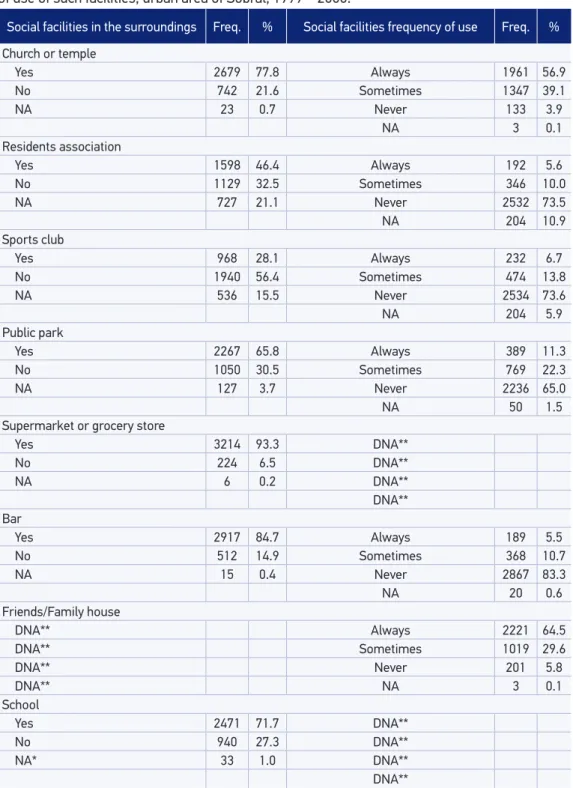
Lifestyle of individuals and social and community networks – Information on layers 2 and 3 are shown in Table 2, which shows the perception of the family as the distance from home to the main social facilities and the most common habits of social contacts.
Living and working conditions – Are located on the fourth layer of the model by Dalgrean & Whitehead.
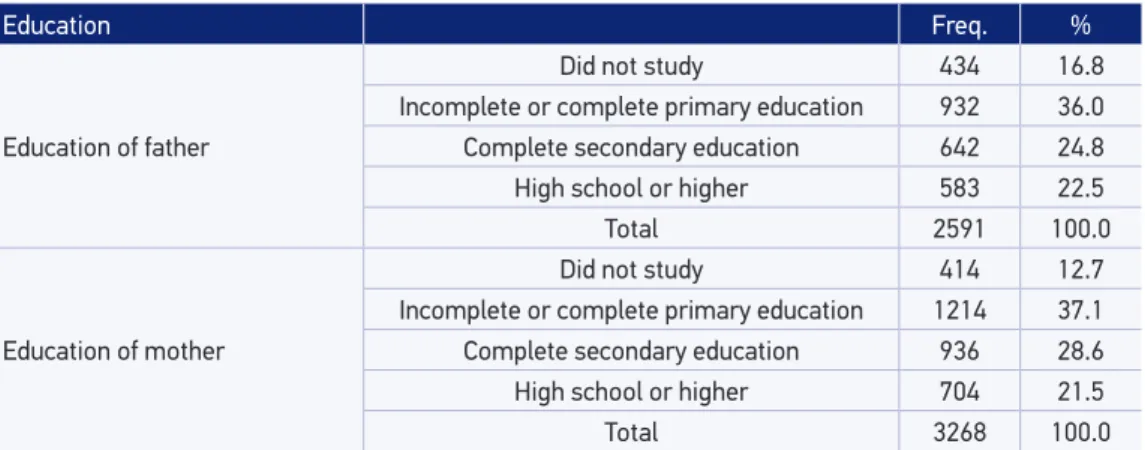
Housing, sanitation, education, employment, health services and child labor are shown in Table 3. Regarding education, few mothers refer to their 7-year-old as knowing how to read correctly. Only 36.9% and 43.6% of children, respectively at 9 and 10 years of age, are seen as knowing how to read properly. 63.2% of preschool children are not in school. At eight years old, 27.2% are still out of school. Over seven years old, predominantly male (64.4%) and black/brown/mulatto (84.6%) children are among those who are out of
Table 1. Distribution of children aged between 5 and 9, by year of birth, gender and race, urban area of Sobral, 1999 – 2000.
Frequency %
Year of birth
1990 689 20.0
1991 709 20.6
1992 689 20.0
1993 688 20.0
1994 669 19.4
Gender
Male 2.722 50
Female 2.722 50
Race
Black/Mulatto/Brown 2.497 72.5
White 935 27.1
Asian 4 0.1
Indigenous 2 0.1
Social facilities in the surroundings Freq. % Social facilities frequency of use Freq. %
Church or temple
Yes 2679 77.8 Always 1961 56.9
No 742 21.6 Sometimes 1347 39.1
NA 23 0.7 Never 133 3.9
NA 3 0.1
Residents association
Yes 1598 46.4 Always 192 5.6
No 1129 32.5 Sometimes 346 10.0
NA 727 21.1 Never 2532 73.5
NA 204 10.9
Sports club
Yes 968 28.1 Always 232 6.7
No 1940 56.4 Sometimes 474 13.8
NA 536 15.5 Never 2534 73.6
NA 204 5.9
Public park
Yes 2267 65.8 Always 389 11.3
No 1050 30.5 Sometimes 769 22.3
NA 127 3.7 Never 2236 65.0
NA 50 1.5
Supermarket or grocery store
Yes 3214 93.3 DNA**
No 224 6.5 DNA**
NA 6 0.2 DNA**
DNA** Bar
Yes 2917 84.7 Always 189 5.5
No 512 14.9 Sometimes 368 10.7
NA 15 0.4 Never 2867 83.3
NA 20 0.6
Friends/Family house
DNA** Always 2221 64.5
DNA** Sometimes 1019 29.6
DNA** Never 201 5.8
DNA** NA 3 0.1
School
Yes 2471 71.7 DNA**
No 940 27.3 DNA**
NA* 33 1.0 DNA**
DNA**
Social facilities in the surroundings Freq. % Social facilities frequency of use Freq. %
Health unit
Yes 2683 77.9 DNA**
No 752 21.9 DNA**
NA 9 0.3 DNA**
DNA** Police station
Yes 1522 44.2 DNA**
No 1755 51.0 DNA**
NA 167 4.8 DNA**
NA* No answers; DNA** Do not apply. Tabela 2. Continuation.
Housing features Freq. %
Type
House 3370 97.9
Apartment 47 1.4
Room 21 0.6
Other/no answer 6 0.2
Ownership of residence
Owned and completely paid 2565 74.5
Leased 501 14.6
Transferred 331 9.6
Financing 32 0.9
Another condition/no answer 15 0.3
Type of construction
Masonry 2377 69.0
Masonry without inishing 466 13.5
Mud walls 401 11.7
Mud walls without inishing 186 5.4
Other/no answer 14 0.4
Sanitation Freq. %
Water supply
Public system with plumbing 2968 86.2
Public system without plumbing 281 8.2
Well water with plumbing 58 1.6
Other sources/no answer 137 4.0
Waste sewage
Public system 1938 56.3
Open air ditch 489 14.2
Rudimentary cesspool os septic tank 381 19.8
Other/No answer 336 9.7
Garbage collection
Collected daily 2427 70.4
Thrown in vacant lot or river 624 18.1
Secondhand Collected 382 11.1
Education Freq. %
Education of father
Did not study 434 16.8
Incomplete or complete primary education 932 36.0
Complete secondary education 642 24.8
High school or higher 583 22.5
Total 2591 100.0
Education of mother
Did not study 414 12.7
Incomplete or complete primary education 1214 37.1
Complete secondary education 936 28.6
High school or higher 704 21.5
Total 3268 100.0
Tabela 3. Continuation.
school, with statistically signiicant diferences by gender and race/color. The lower the mother’s education and family income, the greater the occurrence of grade repetition. Between seven and ten years of age, the percentage of grade repetition was of 20.5% and, considering repetition and dropout, we have 25.1% of school failure.
Regarding health services, only 5.7% of the sample reported owning a private health plan. In a statistically signiicant manner (p < 0.01), the population enrolled in the FHS shows lower levels of education and per capita income than the population that didn’t recognize itself as registered in the FHS. 88.6% of families reported to having sought services of the FHS. Only 11.1% never sought the FHS. Almost 80% reported seeking the FHS when their children gets sick, 16.9% go to private services and only 1% admits they go to a pharmacy. Obtaining consultation on the same day was reported by 97.6% of the families. Almost 40% sought services from Santa Casa, a philanthropic health entity, and for more than three quarters of the subjects, this occurs when there is urgency. The search for Santa Casa signiicantly increased with income (p < 0.01).
Regarding child labor, among the 157 families who reported having no income, 29 (18.7%) reported that the children performed some form of child labor. As the education level of the head of household increases, the percentage of children related to any child labor decreases. The same relationship can be observed with per capita income. As to the reason for the children to work, 83.5 % said it was to help with household chores and 2.4% said it was to help the family income (2.4%). Paid work was reported by 3.9% of children, and 6.2% of them had ixed working hours. 27 children sufered some kind of accident with the most diverse repercussions, and one third required medical attention. A quarter (7 children) missed classes due to the accident. There was no signiicant diference between children who are and who are not in school in the group of children whose families reported some type of child labor. Children who worked had a 1.6 times greater chance of repeating grades than those who did not work.
Table 4. Distribution of children aged 5 – 9 years according to monthly per capita income, possession of goods, environmental conditions and religion, urban zone of Sobral, 1999 – 2000.
Frequency %
Monthly income
No income 157 4.6
0.00 ---| 0.25 MW 1216 35.3
0.25 ---| 0.50 MW 1116 32.4
0.50 ---| 1.00 MW 597 17.3
1.00 ---| 2.00 MW 215 6.2
> 2.00 MW 71 2.1
No answer 72 2.1
Possession of consumer goods
Stove 3,410 99.0
Television 3,076 89.3
Refrigerator 2,298 66.7
Radio 2,020 58.7
Stereo 1,756 51.0
Washing machine 62 1.8
Environmental conditions
Lives in urbanized neighborhood 2456 71.3
Paved streets or sidewalks 2510 72.9
Streetlights 3367 97.8
Religion
Catholic 3047 88.5
Other 294 8.5
None 101 2.9
participated in programs for the malnourished. Only half of the families reported that children consumed daily school meals. There is a statistically signiicant (p < 0.01) relationship, indicating that the lower the income, the higher the consumption of school meals. Signiicant percentages of low-income children who go to school and do not consume meals were also observed.
DISCUSSION
For the discussion, the model proposed by Dahlgren and Whitehead is used again as the guiding thread.
AGE, SEX AND HEREDITARY FACTORS
At the base of the model by Dahlgren and Whitehead are individuals with individual characteristics that inluence the way they live and get sick. The inal sample represented the population of Sobral very well. The color of the child and parents according to the classiication made by the informants themselves, as recommended by IBGE, was considered12,13. In Sobral, according to data from the 2000 Census by IBGE, one third of the population is classiied as white and two-thirds as black or mixed.
LIFESTYLE OF INDIVIDUALS
SOCIAL AND COMMUNITY NETWORKS
The data mentioned above allow inferences about family and religious ties, which constitute major support hubs and can be considered part of those networks. In the literature, there are often references to these public spaces as important means of socialization and access to information14. The results suggest that socialization resulting from coexistence in public recreational areas in the city is still incipient. Several authors have emphasized the set of factors in society that comprise the so-called “social capital”. Kawachi and Kennedy14 discuss the importance of income inequality and social cohesion as determinants of health of a population. The density of associational life, estimated by participation in church groups, sports groups, fraternal organizations and labor unions, is one of the most strongly related components to the quality of life and health6.
LIVING AND WORKING CONDITIONS
Fourth layer of the model by Dalgrean & Whitehead.
HOUSING CONDITIONS
The characteristics of the households relect the housing proile of Sobral, where almost all families live in a house and even those with the lowest income live in their own property, already completely paid for. Although most households are made of masonry without any inishing, 30% of families live in houses without inishing or with mud walls, therefore in unsuitable conditions for health.
BASIC SANITATION
EDUCATION CONDITIONS
The low education of mothers is noteworthy, with the educational level of the head of household being even worse, 22.8% of them having no formal education, probably due to the presence of grandparents as heads of household. Currently, many authors prefer to use education as a socioeconomic indicator instead of family income. This is because these variables, in our setting, appear strongly associated with education, and information on education is more reliable than on income. The education of the head of household is still a determining factor in the way of entering the labor market and, consequently, in the levels of salary and living conditions. Monteiro et al.15, in his study, “Saúde e nutrição das crianças de 0 a 5 anos no município de São Paulo”, chose to stratify the study population according to the education of the head of household, because this is a more available information, due to the dependence education has in relation to social class and the association between the level of education and level of income. Interestingly, the education proile has been changing with the generations. Beltrão16, analyzing the education of men and women in the IBGE demographic census, shows that, in recent decades, the diference in mean education between men and women has decreased, and an actual reversal occurred, with women surpassing men. This change in the education proile between genders relects, among other factors, the changing role of women in society. The low parental education had a great impact on the school proile of the children surveyed. Access to pre-school is very low, seeing the low number of children under seven years old that are out of school. Adding children who are out of school with those who had some repetition, we have a school failure rate of 25.1%. That is, a quarter of children have a history of school failure in their lives6. It is noteworthy that a quarter of the 8-years-old children are out of school. The information that among children who are out of school, boys classiied by families as black/brown/mulatto are predominant is consistent with the literature, pointing school failure as a characteristic of the male, black and poor population6.
EMPLOYMENT
The way parents are inserted in the labor market deines the possibilities of access to goods produced by society. The number of heads of households with occupations requiring more education is small. Among the heads of households who are employed, in general, the level of education is better than in those who unemployed. Retirees are the ones with less education.
HEALTH SERVICES
The ease or difficulty in access affects how those services are used. The differential in Sobral regarding access was the implementation of the FHS with universal coverage since 1997. A key feature of the FHS, the assignment of the population to family health teams, enables a more personalized attention as links are created between the teams and the registered population.
One aspect that was valued in the elaboration of the study was to identify the perception of the population regarding the characteristics of care in the FHS in relation to the dynamics of the population’s registration and link to it. While this is a universal strategy, in the study, subjects from the popular classes were those who beneited the most from the expansion of the coverage of health services. It was noteworthy how the families interviewed recognize the FHS and how they use it. Obtaining a consultation immediately is an excellent indicator of the ease of access to public health services. Regarding the use of hospital services, the demand occurs when the family considers the situation to be urgent.
CHILD LABOR
The same relationship can be observed with per capita income. The percentage of answers regarding help with the family income was small (2.4%), which approached the percentage of 3.6% found by the 2001 National Household Survey on child labor among children of the 5-9 years old age range in the Northeast. Most children do household chores. This is a type of work little quantiied by the diiculty of recognition from the family that the child is performing child labor. Although only 3.9% of children have paid work, 6.2% of families referred journey with ixed working hours. The deinition of work requires a reference to a remuneration, which may be in cash or beneits, such as housing or food or some good. However, children working at their own home, without remuneration, performing tasks that would be the duty of a maid, can be considered as child labor. Thus, these children are ensuring a return to their families, who don’t have to pay for the services of a maid. This kind of work is evident in children in this study, since the majority took care of siblings or performed domestic services, such as washing the dishes, sweeping the loor, tidying the house up, among others. Other forms of remuneration characterize more informal working relationships, as in the case of children who perform work in exchange for food or housing. Although the media points out the detrimental aspects of child labor very well, this was not the representation that the families surveyed had of their children’s child labor. The vast majority made positive remarks on the fact that their children worked. One of the reasons for this appreciation of child labor may be due to the fact that these responses were obtained from families who have children who work. Despite all the diiculties in characterizing child labor referred by families, the number of children who got injured while performing these activities was noteworthy. The analysis of how work interferes in the lives of children becomes diicult by the very nature of the work that is reported, being performed at their homes and often not with a ixed workload. Children who worked were more likely to repeat grades than those who did not work. Despite the importance of the relationship between school performance and child labor, there are few studies on this issue in both national and international literature.
NUTRITION
to its most severe forms. According to the Primary Care System (SIAB) of Sobral, in the period between 1996 and 2002, the proportion of malnourished children under one year old fell from 14.0% to 3.1% and in children between 12 – 23 months of age, malnutrition fell from 23.7% to 10.8%. In children under ive years of age, hospital admissions for malnutrition declined from 9.4% to 0.9% and the mortality rate decreased from 4.9% to 2.6%. This decrease was probably due to the improvement in living conditions recorded in the county in the last six years and the supplemental feeding programs. The thesis that most children go to school because of the meals given for free is widely accepted. While it is evident that there is a statistically signiicant relationship (p < 0.01) indicating that the lower the income, the higher the consumption of school meals, it was also observed that many low-income children go to school and do not consume meals.
GENERAL SOCIOECONOMIC, CULTURAL AND ENVIRONMENTAL CONDITIONS
CULTURAL AND RELIGIOUS ASPECTS
There is a diference between cultural habits of a great part of the low-income population and the small percentage that has a higher income and access to cultural events. The lack of commercial cinemas at the time of the survey justiies that only 2.6% of households said they always or sometimes go to the movies. The availability of leisure facilities in the city and how the population relates to these spaces and the diferent types of activities present at the municipality were already described. The municipality of Sobral is characterized by a strong religiosity, having 22 Catholic churches. The number of people that report having no religion is very small. The proile of the distribution of the population according to religion, in the 2000 census, is quite similar to this study, with 86.5% of Catholics. Among other religions, almost all are evangelicals, because the others did not reach 0.5%. There is no reference to the Jewish religion or to Eastern religions. The growth of other faiths in the city is relatively recent. In Sobral, there are mainly missionary evangelicals (name given by IBGE to traditional Evangelicals or Protestants) and there some Pentecostals.
GENERAL ENVIRONMENTAL CONDITIONS
Another important aspect in the characterization of the household is its location and the improvements that it can rely on, which express the socioeconomic conditions of families and, especially, access to goods and services produced by society. The survey data relect a satisfactory condition of urbanization for the vast majority of households where children live. As to the speciic conditions of the household, leisure areas and situations of risk in the environment in which children live were veriied whenever possible. Although more than half of the households have peridomiciliar areas available, used for recreation by children, a third presents risk for illness or accidents. This information shows the importance that public leisure facilities must assume, since over 40% of the households have no outdoor area. However, as discussed earlier, there is little reference to the existence of parks and public recreational areas close to the households, and especially the habit of going to them, probably conditioned by distance and limited availability of such facilities.
FINAL CONSIDERATIONS
to state that in 2000, despite some advances made in public policies, much had to be done to ensure “health” and equal conditions for social inclusion of most children aged 5 – 9 years in the urban area of Sobral. This reality is probably present in many municipalities with similar characteristics in the country, especially in the Northeast. The analyzes presented here are of great importance as benchmarks for assessing the impact of public policies aimed at this age group that have been implemented from the year 2000 and should be subject of future research and publications.
ACKNOWLEDGEMENTS
The authors would like to thank the Municipality of Sobral for the inancial, infrastructure and operationalization support for this study.
1. Andrade, LOM. A saúde e o dilema da intersetorialidade. São Paulo: Hucitec; 2006.
2. OMS, Comisión sobre Determinantes Sociales de la Salud. Subsanarlas desigualdades en una generación: alcanzar la equidad sanitária actuando sobre los determinantes sociales de la salud. Buenos Aires; 2009.
3. Comissão Nacional sobre Determinantes Sociais em Saúde. As causas sociais das iniqüidades em saúde no Brasil. Relatório Final; 2008.
4. Whitehead M, Dahlgren G. Concepts and principles for tackling social inequities in health: Levelling up Part 1. WHO Collaborating Centre for Policy Research on Social Determinants of Health University of Liverpool. Copenhagen; 2006.
5. Buss PM, Pelleg rini Filho A. A saúde e seus determinantes sociais. PHYSIS: Rev Saúde Coletiva 2007; 17(1): 77-93.
6. Sucupira ACSL. Fracasso escolar e condições de vida em crianças de 7 a 10 anos de idade, Sobral, Ceará. [Tese de Doutorado]. São Paulo: Faculdade de Medicina da USP; 2003.
7. Barreto ICHC, Grisi SJFE. Self-reported morbidity and its conditioning factors in children aged 5 to 9 in the city of Sobral, Brazil. Rev Bras Epidemiol 2010; 13(1): 1-3.
8. Noro LR, Roncalli AG, Mendes Júnior FI, Lima KC. Cad Saúde Pública 2008; 24(7): 1509-16.
9. Queiroz OS. Determinantes sociais da gravidez na adolescência em um município de médio porte no nordeste do Brasil: um estudo prospectivo. 83f [Dissertação de Mestrado] Forataleza (CE): Universidade Federal do Ceará; 2010.
10. Santiago AX, Barreto ICHC, Sucupira ACSL, Lima JWO, Andrade LOM. Equitable access to health services for children aged 5 to 9 in medium city of northeasth of Brazil: a result of Family Health Strategy. Rev Bras Epidemiol, 2013 [No prelo].
11. Instituto Brasileiro de Geograia e Estatística. Censo 2000. Rio de Janeiro: IBGE. Disponível em: www.ibge.gov.br/ censo/2000 (acessado em 3 de dezembro de 2012). 12. Lebrão ML, Carandina L, Magaldi C, et al. Análise das
condições de saúde e de vida da população urbana de Botucatu, São Paulo (Brasil). IV. Morbidade referida em entrevistas domiciliárias, 1983-1984. Rev Saúde Pública 1991; 25(6): 452-60.
13. Cesar CLG, Figueiredo GM, Westpal MF, Cardoso MRA, Costa MZA, Gattás VL. Morbidade referida e utilização de serviços de saúde em localidades urbanas brasileiras: metodologia. Rev Saúde Pública, 1996; 30(2): 153-60.
14. Kawachi I, Kennedy BP. Health and social cohesion: why care about income inequality. BMJ 1997; 314(7086): 1037-40.
15. Monteiro CA. Saúde e nutrição das crianças de São Paulo. São Paulo: Hucitec; 1988.
16. Beltrão KI. Acesso à educação: diferenciais entre os sexos. Texto para discussão n° 879. Instituto de Pesquisa Aplicada (IPEA). Ministério do Planejamento. Rio de Janeiro; 2002.
17. Instituto Brasileiro de Geograia e Estatística. Pesquisa Nacional por Amostra de Domicílios: Trabalho Infantil. 2001. Rio de Janeiro IBGE. Disponível em: http:// www.ibge.gov.br/home/estatistica/populacao/ condicaodevida/trabalhoinfantil/trabinf2001.pdf (acessado em 3 de dezembro de 2012).
18. Instituto Brasileiro de Geografia e Estatística. Pesquisa Nacional por Amostra de Domicílios. 2003. Rio de Janeiro IBGE. Disponível em: http:// www.ibge.gov.br/home/estatistica/populacao/ trabalhoerendimento/pnad2003/ (acessado em 3 de dezembro de 2012).
Received on: 04/30/2012