ABSTRACT: Objective: To identify the association between non-adherence to tuberculosis treatment and access to treatment. Methods: A cross-sectional study was carried out in the Metropolitan Area of Buenos Aires, Argentina. One hundred twenty three patients notiied in 2007 (38 non adherent and 85 adherents) were interviewed regarding the health care process and socio-demographic characteristics. Factors associated to non-adherence were assessed through logistic regression analysis. Results: An increased risk of non-adherence with to treatment was found in male patients (OR = 2.8; 95%CI 1.2 – 6.7), patients who had medical check-ups at hospitals (OR = 3.4; 95%CI 1.1 – 10.0) and those who had diiculties with transportation costs (OR = 2.5; 95%CI 1.1 – 5.9). Conclusion: Risk of non-adherence increases as a result of economic barriers in accessing health care facilities. Decentralization of treatment to primary health care centers and social protection measures for patients should be considered as priorities for disease control strategies in order to lessen the impact of those barriers on adherence to treatment.
Keywords: Tuberculosis. Medication adherence. Therapeutics. Epidemiologic factors. Argentina. Decentralization
Determinants of non adherence to
tuberculosis treatment in Argentina:
barriers related to access to treatment
Determinantes da não adesão ao tratamento da tuberculose na Argentina:
barreiras relacionadas com o acesso ao tratamento
María Belén HerreroI,II, Silvina RamosI, Silvina ArrossiI,II
ICentro de Estudios de Estado y Sociedad – Ciudad Autónoma de Buenos Aires, Argentina.
IIConsejo Nacional de Investigaciones Cientíicas y Técnicas – Ciudad Autónoma de Buenos Aires, Argentina.
Corresponding author: Silvina Arrossi. Sánchez de Bustamante, 27, C1173AAA, Ciudad Autónoma de Buenos Aires, Argentina. E-mail: [email protected]
Conlict of interests: nothing to declare – Financial support: Comisión Nacional Salud Investiga of the Ministry of Health of Argentina.
INTRODUCTION
Despite the availability of a cost-efective treatment, tuberculosis (TB) is still a major public health burden in developing countries1. In Argentina, TB afects around 9,500 people
(25 cases per 100,000 people) and causes 800 deaths every year2.
Treatment adherence is considered a key component for disease control since treatment disruption may result in persistent infectiousness and higher rates of treatment failure, continued transmission, drug resistance, and death3. The World Health Organization (WHO)
recommends that non-adherence should not exceed 5%4. Argentina showed a 13.8%
non-adherence rate in 20105, being one of the highest igures in the last ten years5.
Since 1994, Direct Observed Treatment Strategy (DOTS) has been recommended for treatment adherence and has been introduced in TB control programs in many countries with varying degrees of success6,7. Although it is widely recognized that DOTS is an important
tool in disease control, results from diferent studies have shown that, both in DOTS and non-DOTS contexts, the patient demographic and socio-economic characteristics8-20,
and the availability and organization of health services are key factors inluencing treatment adherence as well. In general, male patients, those with lower level of education, and those unemployed are less likely to comply with treatment8-12. Living conditions, social support,
transportation costs, and distance to health facilities have also shown to inluence treatment adherence, especially in more vulnerable groups13-20. This is mainly due to factors associated
with poverty and underdevelopment, such as poor living conditions, underlying low health status, lack of money to pay for health care and inadequate access to health services21.
RESUMO: Objetivo: Identiicar a associação entre a não adesão ao tratamento da tuberculose e as características de acesso ao tratamento. Métodos: Um estudo transversal foi realizado na Região Metropolitana de Buenos Aires, Argentina. Cento e vinte e três pacientes notiicados em 2007 (38 aderentes e 85 não aderentes) foram entrevistados sobre o processo de cuidados de saúde e características sócio-demográicas. Fatores associados a não adesão foram avaliados através da análise de regressão logística. Resultados: Foi encontrado um aumento do risco de não adesão ao tratamento em pacientes do sexo masculino (OR = 2,8, IC95% 1,2 – 6,7), pacientes que tiveram controles médicos em hospitais (OR = 3,4, IC95% 1,1 – 10,0) e aqueles que tiveram diiculdades com os custos de transporte (OR = 2.5, IC95% 1,1 – 5,9). Conclusão: O risco de não adesão aumenta como resultado de barreiras econômicas no acesso aos serviços de saúde. A descentralização do tratamento para os centros de atenção primária à saúde e medidas de proteção social para os pacientes devem ser considerados como prioridades para as estratégias de controle da doença, a im de diminuir o impacto dessas barreiras na adesão ao tratamento.
Financial barriers to accessing TB treatment and factors related with the attention received have been identiied as key factors in non-compliance and treatment default10,22.
In Argentina, non-adherence rates greatly vary among provinces, from 0 to 27.3%5.
Although the National Program for TB Control recommends DOTS as the main strategy for disease control, its utilization is heterogeneous due to local health systems´ capacities to guarantee patient supervision. From 2008 to 2010 we carried out a study to analyze how treatment modality (DOT versus no-DOT) and patients´ socio-demographic characteristics
inluence non-adherence to treatment23 in municipalities of the Metropolitan Area of Buenos
Aires (MABA), comprising approximately 10% of the country population. Results were published elsewhere23 and showed that almost all patients received non-DOT treatment
and poverty was the predominant social explanatory factor for non-adherence. The study also showed that, in comparison with patients receiving treatment at hospitals, those treated at primary health care centers (PHCs) were more likely to adhere to treatment. While there is some evidence showing that better adherence at PHCs might be related to characteristics of the health care process, like how health services are organized and the accessibility to health care services21,22, in Argentina no previous study has analyzed this
topic. We therefore carried out an analysis of the data, incorporating four variables to understand characteristics of the health care process that inluence on the capacities patients to comply with tuberculosis treatment23: distance to the health facility, diiculties with
transportation costs, diiculties with transportation time, and quality of care. The aim of our study was to identify the association between non-adherence to tuberculosis treatment and characteristics of access to treatment. In our view, this analysis will contribute to a deeper understanding of factors inluencing non-adherence of TB treatment, thus providing evidence to improve treatment adherence in Argentina.
MATERIAL AND METHODS
SETTING
The study was carried out in the 6th Health Region (HRVI), located in the Southern area
of MABA. This is the most populated region in Buenos Aires Province, and the region where the majority of TB cases are notiied every year (13% of total notiied cases in Argentina, and 30% of total notiied in Buenos Aires Province).
STUDY POPULATION
Patients diagnosed with TB during 2007 who were eligible to participate in this study were identiied through the registration records from the National Program for TB control (NPTB). Eligible cases were all patients with pulmonary TB, aged 18 years or older, who lived in any of the selected districts, and were under drug treatment in a participating hospital located in the same district where the patient lived. Non-eligible cases were patients younger than 18 years old, those who completed treatment in a non-participating hospital, and those who were in prison or mentally ill during the treatment period.
In this cross sectional study non-adherents were all eligible patients who did not adhere to their treatment. Following the deinition used by the NPTB, a non-adherent patient was deined as not having received TB treatment for 60 consecutive days or more. Adherents were all eligible patients who completed the stipulated treatment.
STUDY DESIGN
The study protocol was approved by the Ethics Committee of the participating hospitals. Patients were called by telephone by a health team member. After obtaining a signed informed consent, patients were interviewed face-to-face, by an interviewer of our team using a structured questionnaire. A questionnaire was developed that included socio-demographic and socio-economic variables as well as variables related with characteristics of the treatment, of the health care attention received and about accessibility characteristics to the heath care service. Counseling about the importance of completing treatment was provided to non-adherent patients once the interview had inished. The questionnaire was pilot-tested with 10 patients (not included in the study) from the studied area.
STATISTICAL ANALYSIS
was provided (primary health centre, referral hospital), type of health facility where control visits were carried out (primary health centre/others, referral hospital), diiculties in cost of transportation (yes, no), diiculties with transportation time (yes, no), distance to health care facility (less than 3.4 kilometers, more than 3.4 kilometers).
The signiicance of the observed associations was assessed through χ2 tests; means were
compared by independent sample t-tests. All variables with a p-value < 0.05 in univariate analysis were included in the multivariate logistic regression model. In the multivariate analysis, p-value ≤ 0.05 was considered as statistically signiicant. Results are presented in terms of risk for non-adherence (OR) with 95% conidence intervals (95%CI). In this analysis, the interpretation of the OR (measuring association) was the same as relative risk (comparison of risks, depending on the level of exposure).
RESULTS
Between January-December 2007, 193 patients were eligible for this study. Seventy-eight (40%) did not adhere to TB treatment and 115 (60%) patients adhered. One hundred twenty three (64%) patients were surveyed: 38 non-adherents and 85 adherents. Forty non-adherent patients (51%) and 30 adherent patients (26%) could not be reached due to death, wrong address or relocation to another district (Table 1).
Table 2 shows the socio-demographic characteristics of the 123 participant patients. Mean age was 39 (Standard deviation – SD 1.5). 33 (27%) had never gone to school or had up to primary level of education uncompleted. Ninety-eight (80%) had no health insurance, 63 (51%) had incomes lower than 750 $ and 77 (64%) were employed without social protection. Eighty nine (72%) belonged to households whose heads had not social security.
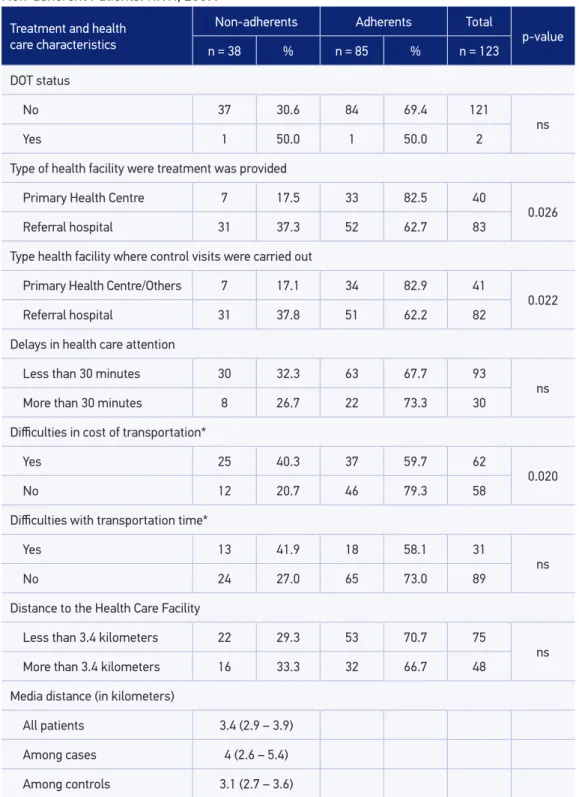
Prevalence of characteristics related to treatment and health care organization can be seen in Table 3. Most patients (98%) received no-DOT treatment. Eighty three (67%) were treated at referral hospitals and 41 (33%) had control visits at primary health care centers. Ninety-three (76%) reported delays of less than 30 minutes to receive health care in each visit to the health center, 62 (52%) reported diiculties in cost of transportation
Table 1. Treatment outcome in terms of participation in the survey. Adherent and Non-adherent Patients. HRVI, 2007.
Participation in the study Non-adherents Adherents Total
n % n % n %
Yes 38 30.9 85 69.1 123 100.0
No 40 57.1 30 42.9 70 100.0
Total 78 40.4 115 59.6 193 100.0
Table 2. Socio-demographic characteristics of patients and heads of households. Adherent and Non-adherent Patients. HRVI, 2007.
Characteristics Non-adherents Adherents Total p-value
n = 38 % n = 85 % n = 123
Sex
Male 12 22.2 42 77.8 54
0.05
Female 26 37.7 43 62.3 69
Age (years)
18 – 24 11 37.9 18 62.1 29
ns
25 – 34 12 27.3 32 72.7 44
35 – 64 13 35.1 24 64.9 37
65 and more 2 15.4 11 84.6 13
Mean age (SD) 37 (2.3) 41 (1.8) ns
Educational level
Never gone to school/
Primary Incomplete 8 24.2 25 75.8 33
ns
Primary Complete 12 37.5 20 62.5 32
Secondary or more 18 31.0 40 69.0 58
Social Security
Yes 6 24.0 19 76.0 25
ns
No 32 32.7 66 67.3 98
Head of household Social Security
Yes 6 17.6 28 82.4 34
ns
No 32 36.0 57 64.0 89
Type of occupation of patients* Employed with
social protection 3 12.0 22 88.0 25
ns
Employed without
social protection 27 35.1 50 64.9 77
Inactive or Unemployed 8 40.0 12 60.0 20
Household income level**
More than 750 $ 14 22.2 49 77.8 63
0.023
Up to 750 $ 24 41.4 34 58.6 58
*Missing data for one case; **Missing data for two cases; HRVI: 6th Health Region; RS6: Região de Saúde 6;
Table 3. Prevalence of characteristics of health care received by patients. Adherent and Non-adherent Patients. HRVI, 2007.
Treatment and health care characteristics
Non-adherents Adherents Total
p-value
n = 38 % n = 85 % n = 123
DOT status
No 37 30.6 84 69.4 121
ns
Yes 1 50.0 1 50.0 2
Type of health facility were treatment was provided
Primary Health Centre 7 17.5 33 82.5 40
0.026
Referral hospital 31 37.3 52 62.7 83
Type health facility where control visits were carried out
Primary Health Centre/Others 7 17.1 34 82.9 41
0.022
Referral hospital 31 37.8 51 62.2 82
Delays in health care attention
Less than 30 minutes 30 32.3 63 67.7 93
ns
More than 30 minutes 8 26.7 22 73.3 30
Diiculties in cost of transportation*
Yes 25 40.3 37 59.7 62
0.020
No 12 20.7 46 79.3 58
Diiculties with transportation time*
Yes 13 41.9 18 58.1 31
ns
No 24 27.0 65 73.0 89
Distance to the Health Care Facility
Less than 3.4 kilometers 22 29.3 53 70.7 75
ns
More than 3.4 kilometers 16 33.3 32 66.7 48
Media distance (in kilometers)
All patients 3.4 (2.9 – 3.9)
Among cases 4 (2.6 – 5.4)
Among controls 3.1 (2.7 – 3.6)
*Missing data for three cases; DOT: Direct Observed Treatment; ; ns: not signiicant; HRVI: 6th Health Region;
and 31 (25%) reported diiculties with transportation time. Most patients (61%) lived less than 3.4 kilometers far from the health care facility where they received treatment.
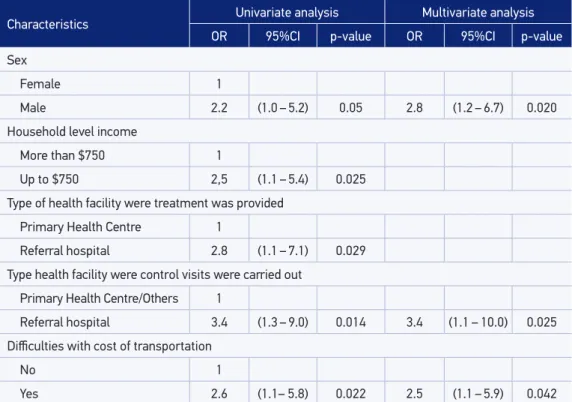
Table 4 presents the results of univariate and multivariate associations between health care characteristics and non-adherence, including socio-demographic characteristics of patients to control for potential confounding. Those patients who had their control visits at hospitals (OR = 3.4; 95%CI 1.3 – 9.0) and were supplied with TB drugs at hospitals (OR = 2.8; 95%CI 1.1 – 7.1) were three times more likely not to adhere to treatment. It was also observed that the risk of non-adherence to treatment was higher among those who had economic constrains to back transportation costs (OR = 2.6; 95%CI 1.1 – 5.8). Male patients (OR = 2.2; 95%CI 1.0 – 5.2) and those with the lowest household income (OR = 2.5, 95%CI 1.1 – 5.4) were at higher risk of non-adherence.
In multivariate analysis (Table 4), three variables remained signiicantly associated to non-adherence: sex, type of health service where patients had their control visit, and having diiculties with transportation costs. Male patients were 2.8 times more likely to non-adhere to treatment (95%CI 1.2 – 6.7). Patients who had medical check-ups at hospitals had almost a 3.4 times higher risk of non-adherence (95%CI 1.1 – 10.0). Patients who had diiculties with transportation costs had a 2.5 times higher risk of non-adherence (95%CI 1.1 – 5.9).
Table 4. Univariate and multivariate associations between socio-demographic, socioeconomic, treatment and health care characteristics and non compliance. Adherent and Non-adherent Patients. HRVI, 2007.
Characteristics Univariate analysis Multivariate analysis
OR 95%CI p-value OR 95%CI p-value
Sex
Female 1
Male 2.2 (1.0 – 5.2) 0.05 2.8 (1.2 – 6.7) 0.020
Household level income
More than $750 1
Up to $750 2,5 (1.1 – 5.4) 0.025
Type of health facility were treatment was provided
Primary Health Centre 1
Referral hospital 2.8 (1.1 – 7.1) 0.029
Type health facility were control visits were carried out
Primary Health Centre/Others 1
Referral hospital 3.4 (1.3 – 9.0) 0.014 3.4 (1.1 – 10.0) 0.025
Diiculties with cost of transportation
No 1
Yes 2.6 (1.1– 5.8) 0.022 2.5 (1.1 – 5.9) 0.042
DISCUSSION
To our knowledge, this is the irst time that health care process characteristics are included in the analysis of the social determinants of adherence to tuberculosis treatment in Argentina. Our results showed that the burden of transportation costs and the type of health facility are major explanatory factors. Besides, results showed that in the Argentinean context, being male is an important risk factor for the treatment non-adherence.
In efect, patients with diiculties regarding transportation costs presented almost three times higher risks of non-adherence to treatment. Several studies have shown that costs related to treatment, such as transportation costs or costs associated to supplementary medication, negatively inluences adherence18-20. They have also found that the provision
of drugs free of charge is not enough to guarantee compliance, especially in lower-income sectors. A study in Nepal found that although the medication was provided free of charge, the burden of travel costs was a restricting factor in completing treatment19. In other study
in Gambia, patients who spent more time travelling to the health center or had higher travel expenses were at higher risk of non adherence to treatment24. Although several
studies have found that the association between non-adherence and cost of transportation is related to increasing travelling distances to receive health care9,10,18,19,25-27, in our study the
relationship between distance to health facilities and non-adherence was not statistically signiicant, thus suggesting that for the study population, cost of transportation is a barrier independently of the distance to health care centers.
These results conirmed our previous indings23 that showed that for a self-administered
treatment population, patients treated at hospitals (versus those who do so in PHCs) have
an increased risk of non-adherence. In a study from Sudan26, authors also found a higher
rate of treatment success in PHCs than among patients treated at hospitals. In this context, decentralization to community-based tuberculosis services was highlighted as a key factor for treatment adherence and the lower default rate at PHCs was interpreted as an efect of better conditions for directly observed treatment and follow-up26. A study carried out in China
evaluated whether decentralization results in access improvement to TB services and showed that patients in the decentralized group spent less on travel and treatment for TB, and that a higher quality of care was observed in this group as well as better treatment outcomes28.
While several studies have analyzed how decentralization to PHC contributes to better outcomes by reducing distance between patient´s place and the health service19,26,28, few
studies have focused on the health facilities’ characteristics and treatment outcomes. Results from a study in Peru29 aimed at evaluating users’ satisfaction with PHCs and
Our results showed that men were at higher risk of treatment non-adherence than women. Studies that analyzed the relationship between sex/gender and non-adherence showed that men´s breadwinner status as head of households explained their fewer adherences to treatment. A study conducted in India30 found that being male and being employed implied
twice the risk of abandoning treatment, mainly because workers have trouble in leaving their duties for a health care center visit. In proportion, in our study, the group of employed heads of household with social protection had higher levels of adherence than those with employment but with no social protection, or those who were unemployed or inactive.
Although these diferences were not signiicant in our study, most likely due to the small sample size, the fact that the majority of patients who were heads of households were male (72%) supports this hypothesis. On the same line, a study conducted in Argentina31
on treatment adherence of cancer patients showed that one main factor in reducing the adherence rate was the loss of income resulting from disruption of work activities during the treatment, especially when workers did not have any social protection. Consequently, household income decreases, and the capacity to aford the costs associated to treatment is threatened31. Another possible explanatory factor of the lower adherence among men is that,
in general, they have fewer contacts with the health care system. In the above mentioned study from India a greater adherence to treatment was found among women. They concluded that this might be a consequence of women having more contacts with the health services given that they usually take care of their children´s health31. In a study conducted in Nicaragua10
authors found that male patients had a risk to drop out from treatment nearly two and a half times higher than women, and that this risk was still higher after controlling for factors related with lifestyle behaviors, such as alcoholism, smoking and drug abuse.
This study has some limitations. Firstly, it may be afected by selection bias, as 51% of the non-adherent and 26% of the adherent patients were not contacted as a consequence of erroneous address information. Despite this limitation, no signiicant statistical diference was found in relation to age and sex between interviewed and non-interviewed cases (both non-adherent and adherent patients) (Table 5). This matches with other studies
Table 5. Socio-demographics characteristics and treatment outcome in terms of participation in the survey. Adherent and Non-adherent Patients. HRVI, 2007.
Socio-demographics Characteristics
Non-adherents (n = 78) Adherents (n = 115)
p-value Participation in the Surrey Participation in the Surrey
Yes n = 38
No n = 40
Yes n = 85
No n = 30
Mean age (SD) 37 (2.3) 36 (2.5) 41 (1.8) 35 (2.3) ns
Sex
Female 54,5% 45,5% 70,5% 29,5%
ns
Male 46,4% 53,6% 77,8% 22,2%
that have also showed a greater diiculty in reaching patients who had not comply with treatment18,32. Secondly, only one patient refused to take part in this study, making the
participation rate close to 100%. Therefore it can be concluded that this study has not been afected by selection bias due to participation refusal.
CONCLUSION
We believe that our study contributes to the identiication of socio-economic factors related to non-adherence to TB treatment in Argentina. It also contributes to delineating the proile of non-adherent patients: male, having diiculties with transportation costs, and receiving treatment at hospitals. Decentralization of TB treatment to primary health care centers and social protection measures for patients in vulnerable social conditions should be considered priorities in TB control strategies.
ACKNOWLEDGMENTS
The authors would like to thank the patients, the research assistants, the health staf of health facilities that participated in the research project, Patricia Bidondo from the HRVI TB Program, the National Minister of Health and the National Program for TB Control. We would also like to thank Mina Itabashi for her contributions with the translation of the manuscript. Finally the authors would like to thank José Ueleres Braga for his suggestions and comments on the manuscript.
1. World Health Organization. Global Tuberculosis Control: WHO Report 2009. Geneva, Switzerland: WHO, 2009.
2. INER-Coni. Instituto Nacional de Enfermedades Respiratorias - INER “Dr. Emilio Coni”. Notiicación de casos de tuberculosis en la República Argentina. Período 1980-2011. Ministerio de Salud - Presidencia de la Nación, 2012.
3. U.S. Department of Health & Human Services. Core curriculum on tuberculosis: What the clinician should know (4th ed.). Atlanta, GA: CDC. 2000.
4. World Health Organization. Tuberculosis control and research strategies for the 1990s: memorandum from a who meeting, Bull World Health Organ 1992; 70:17-21.
5. INER-Coni. Instituto Nacional de Enfermedades Respiratorias - INER “Dr. Emilio Coni”. Resultado del
tratamiento de la tuberculosis pulmonar ED(+) en la República Argentina. Período 1980-2010. Ministerio de Salud - Presidencia de la Nación, 2012.
6. Singh V, Jaiswal A, Porter JDH, Ogden JA, Sarin R, Sharma PP, et al. TB control, poverty, and vulnerability in Delhi, India. Trop Med Int Health 2002; 7(8): 693-700.
7. World Health Organization. The Stop TB Strategy: Building on and enhancing DOTS to meet the TB-related Millennium Development Goals. WHO/HTM/TB/2006.368. Geneva, Switzerland: WHO, 2006.
8. Hasker E, Khodjikhanov M, Usarova S, Asamidinov U, Yuldashova U, J van der Werf M, et al. Default from tuberculosis treatment in Tashkent, Uzbekistan; Who are these defaulters and why do they default? BMC Infect Dis 2008; 8: 97.
9. Galiano MA, Montesinos N. Modelo predictivo de abandono del tratamiento antituberculoso para la región Metropolitana de Chile. Enferm Clín 2005; 15(4): 192-8.
10. Soza Pineda NI, Pereira SM, Barreto ML. Abandono del tratamiento de la tuberculosis en Nicaragua: resultados de un estudio comparativo. Rev Panam Salud Pública 2005; 17(4): 271-8.
11. Cáceres FM, Orozco LC. Incidencia y factores asociados al abandono del tratamiento antituberculoso. Biomédica 2007; 27: 498-504.
12. Xu W, Lu W, Zhou Y, Zhu L, Shen H, Wang J. Adherence to anti-tuberculosis treatment among pulmonary tuberculosis patients: a qualitative and quantitative study. BMC Health Serv Res 2009; 9: 169.
13. Shrestha-Kuwahara R, Wilce M, Joseph HA, Carey JW, Plank R, Sumartojo E. Tuberculosis Research and Control. Anthropological Contribution. In: Ember CR, Ember M (Eds.): Encyclopedia of Medical Anthropology: Health and Illness in the World’s Cultures Topics - Vol.1. Kluwer Academic/Plenum Publishers; 2004. p. 528-542.
14. Comolet TM, Rakotomalala R, Rajaonarioa H. Factors determining compliance with tuberculosis treatment in an urban environment, Tamatave, Madagascar. Int J Tuberc Lung Dis 1998; 2(11): 891-7.
15. Barnhoorn F, Adriaanse H. In search of factors responsible for noncompliance among tuberculosis patients in Wardha District, India [Erratum appears in Soc Sci Med 1992; 34(11), II]. Soc Sci Med 1992; 34(3): 291-306.
16. Sumartojo EM. When tuberculosis treatment fails: A social behavioral account of patient adherence. Am Rev Respir Dis 1993; 147(5): 1311-20.
17. Farmer P. Social scientists and the new tuberculosis. Soc Sci Med 1997; 44(3): 347-58.
18. O’Boyle SJ, Power JJ, Ibrahim MY, Watson JP. Factors afecting patient compliance with anti-tuberculosis chemotherapy using the directly observed treatment short-course strategy (DOTS). Int J Tuberc Lung Dis 2002; 6(4): 307-12.
19. Mishra P, Hansen EH, Sabroe S, Kafle KK. Socio-economic status and adherence to tuberculosis treatment: a case-control study in a district of Nepal. Int J Tuberc Lung Dis 2005; 9(10): 1134-9.
20. Shargie EB, Lindtjørn B. Determinants of treatment adherence among smear-positive pulmonary tuberculosis patients in southern Ethiopia. PLoS Med 2007; 4(2): e37.
21. Zhao Q, Wang L, Tao T, Xu B. Impacts of the “transport subsidy initiative on poor TB patients” in Rural China: A Patient-Cohort Based Longitudinal Study in Rural China. PLoS One 2013, 8(11): e82503.
22. Zhang T, Tang S, Jun G. Persistent problems of access to appropriate, afordable TB services in rural China: experiences of diferent socio-economic groups. BMC Public Health 2007, 7: 19.
23. Arrossi S, Herrero MB, Greco A, Ramos S. Factores predictivos de la no adherencia al tratamiento de la tuberculosis en municipios del Área Metropolitana de Buenos Aires, Argentina. Salud Colect 2012; 8(1): S65-S76.
24. Feachem R, Kjellstrom T, Murray C, Over M, Phillips M. The Health of adults in the developing world. New York: Oxford University Press, 1993.
25. Dodor EA. Tuberculosis treatment default at the Communicable Diseases Unit of Effia-Nkwanta Regional Hospital: a 2-year experience. Int J Tuberc Lung Dis 2004; 8(11): 1337-41.
26. El-Sony AI, Mustafa SA, Khamis AH, Enarson DA, Baraka OZ, Bjune G. The efect of decentralization on tuberculosis services in three states of Sudan. Int J Tuberc Lung Dis 2003; 7(5): 445-50.
27. Lake IR, Jones NR, Bradshaw L, Abubakar I. Efects of distance to treatment centre and case load upon tuberculosis treatment completion. Eur Respir J 2011; 38(5): 1223-5.
28. Wei X, Liang X, Liu F, Walley JD, Dong B. Decentralising tuberculosis services from county tuberculosis dispensaries to township hospitals in China: an intervention study. Int J Tuberc Lung Dis 2008; 12(5): 538-47.
29. Seclén-Palacin J, Darras C. Satisfacción de usuarios de los servicios de salud: Factores sociodemográicos y de accesibilidad asociados. Peru, 2000. An Fac Med 2005; 66(2): 127-41.
30. Balasubramanian VN, Oommen K, Samuel R. DOT or not? Direct observation of anti-tuberculosis treatment and patient outcomes, Kerala State, India. Int J Tuberc Lung Dis 2000; 4(5): 409-13.
31. Nene B, Jayant K, Arrossi S, Shastri S, Budukh A, Hingmire S, et al. Determinants of women’s participation in cervical cancer screening trial, Maharashtra, India. Bull World Health Org 2007; 85: 264-72.
32. Naing NN, D´Este C, Isa AR, Salleh R, Bakar N, Mamad MR. Factors contributing to poor compliance with anti-TB treatment among tuberculosis patients. Southest Asian J. Trop Med Public Health 2001; 32(2): 369-82.
Received on: 11/13/2013