Cristiani Vieira MachadoI Fernanda Gonçalves Ferreira SalvadorII
Gisele O’DwyerI
I Escola Nacional de Saúde Pública. Fundação Oswaldo Cruz. Rio de Janeiro, RJ, Brasil
II Curso de Medicina. Universidade Federal do Rio de Janeiro. Rio de Janeiro, RJ, Brasil Correspondence:
Cristiani Vieira Machado
R. Leopoldo Bulhões, 1480 – Manguinhos Prédio ENSP-FIOCRUZ – sl. 715 21041-210 Rio de Janeiro, RJ, Brasil E-mail: [email protected] ocruz.br Received: 6/9/2010
Approved: 11/14/2010
Artigo disponível em português e inglês em: www.scielo.br/rsp
Mobile Emergency Care Service:
analysis of Brazilian policy
ABSTRACT
OBJECTIVE: To analyze the confi guration of mobile emergency health care policy in Brazil.
METHODOLOGICAL PROCEDURES: The study was based on public
policy analysis. Bibliographic and document review, analysis of offi cial
data and interviews with federal administrators related to formulation and implementation of the Mobile Emergency Care Service (SAMU) in Brazil in the 2000s were performed.
ANALYSIS OF RESULTS: Priority was given to SAMU at the federal level since 2003. During the fi rst years of implementation, municipal level services
predominated; in 2008, services with regional scope became more signifi cant.
Estimated coverage reached 53.9% of the population in 2009, in 20.5% of Brazilian municipalities. Implementation varied between States, and there were less advanced support ambulances than recommended, both nationally and in several States.
CONCLUSIONS: SAMU was adopted nationwide since 2003 upon development of federal norms. Implementation of the policy involves challenges, including adequate investment, integration of the service into an established urgent care network, arrangement of appropriate information systems and personnel capacity. Addressing these challenges will allow SAMU to become a key health care strategy in the unifi ed health system.
DESCRIPTORS: Emergency Medical Services. Ambulances. Health Priorities. Unifi ed Health System. Health Policy.
INTRODUCTION
The burden on emergency services has increased with demographic, epide-miologic and social changes. Therefore, many countries organize urgent care systems under different models.17,21,a In general these systems show good results
in terms of decreasing morbidity and mortality, and none of these models are proven more effective.17,21,16
The French model allows for early initiation of treatment, critical in clinical emergencies, but has been criticized for trauma care delays in transportation to the fi nal care location.21
The United States model, which is internationally infl uential, proposes rapid removal of the patient from location of care.17,21 Intervention is performed by
emergency medical technicians and paramedics.
In Brazil, a large part of the population seeks care in hospital emergency rooms, despite the increased supply of primary care services since 1990. Therefore, hospitals are still important entry points for medical assistance, which can be explained by diffi culties in access to primary, specialized and diagnostic services. Nonetheless, the sense of urgency for the patient may not be the same as for health professionals.8
According to Carret et al4 inadequate utilization of
emergency services is harmful for seriously ill patients, who require timely care, and for non-critical patients, who are not guaranteed continuity of care when using hospital-based care. Access to primary health care reduces inappropriate use of emergency services only if the patient has rapid access to emergency services in primary care.4
A study to monitor primary care sentinel events in emergency rooms concluded that opportune medical assistance is fundamental and emphasized the need to overcome infrastructure defi ciency, poor organization and insuffi cient resources for this level of care.18
A review of international literature on interventions for overburdened emergency services reports that efforts to resolve the current model of emergency care services in Brazil should by systematic and focus on users, with redefi nition and integration of assistance, reorganization of schedules and new agreement of work processes.2
In Brazil, emergency care reveals structural defi ciencies in the health system, such as: diffi culties at various levels of care, lack of specialized beds, lack of know-ledge of reference mechanisms and inadequate training of health professionals. In the beginning of the 2000s,
the Ministry of Health began structuring a specifi c
policy in this area.
Given the importance of the federal executive in defi -ning health policy in Brazil,12 we studied the factors
that infl uence formation of national emergency care
policy and its principal characteristics.
The current study objective was to analyze the forma-tion of policy for emergency prehospital care in Brazil in 2000, with attention to the Serviço de Atendimento Móvel de Urgência (SAMU – Emergency Mobile Care Service).
METHODOLOGICAL PROCEDURES
The study was based on referential public policy analysis,9,19 and focused on SAMU policy formulation,
content24 and implementation in Brazil.
Our analysis of the introduction of SAMU into the
federal agenda came from the approach by Kingdon,10
in which “agenda” includes a combination of themes
that seriously mobilize the attention of governmental agencies or associated people at a given moment. The
study considered three relevant themes to defi ne the
agenda: problems (related to the recognition by gover-nments of an issue as a problem), solutions (concerning the formation of alternatives by specialists) and policy (related to variables such as governmental or team changes). According to this approach, the convergence between the schedules opens a window of opportunity so that the theme enters the governmental agenda and translates to public policy.
The categories for analysis were defi ned as:
intro-duction of SAMU in the federal agenda (precedents, infl uences, motives); policy content (proposal design, relation with other strategies); and implementation of SAMU (national development of services from 2004 to July 2009).
The methodological strategies were: bibliographic review; analysis of documents and federal norms; analysis of data provided by the Ministry of Health; and interviews with seven federal managers, selected according to offi cial position in the Ministry and period (between 2003 and 2010), including two ministers of health, two federal secretaries from the highest level and three federal emergency coordinators. In the presen-tation of the results, participants are described only by type of position (respectively: minister, secretary and coordinator).
The term “urgency” is utilized generically in the article without differentiation from “emergency”, as done in federal documents.
The research project was approved by the Research Ethics Committee at the Escola Nacional de Saúde Pública Sérgio Arouca/FIOCRUZ (Process number 022.0.031.000-07).
ANALYSIS OF RESULTS
Policy formulation: entrance on agenda and design of SAMU
The construction of federal policy for attention to emergencies in Brazil involved three main moments: 1998-2002—first initiatives for regulation; 2003-2008—formulation and implementation of National Emergency Care Policy with prioritization of SAMU; and since the end of 2008—continuity of SAMU and
implementation of Unidades de Pronto Atendimento
(UPA – Emergency Care Units). Table presents the main federal norms regarding the design of emergency care policies and SAMU, from 1998 to 2009.
of state systems for emergency care and publication of
the fi rst norm concerning mobile prehospital care.
Although national policies for this issue did not exist, debates supported their formation with discussion of international experiences, specifi c municipalities and
fi remen involved in emergency care in Brazil.
Communities of specialists were involved in the
formulation of alternative proposals for the fi eld,
including professional societies (medicine and nursing) and the Brazilian Network for Cooperation
in Urgency and Emergency. Offi cial documents and
interviews mentioned the congress organized by this Network in 2000:
“The Health Care Secretary (…) came to the opening of the congress and said that there really was no esta-blished policy for emergency care in the Ministry and that he was open to discussion (…) we worked enthu-siastically at the congress to make a report and create a national proposal to take to the Ministry.” (Coordinator)
The congress resulted in debates over the creation of federal policy in the following years, involving professionals in the fi eld and the support of managers. It resulted in the publication of the Regulation of Emergency Care of State Systems in 2002, the basis for subsequent policy structure. There was not yet an area within the Ministry responsible for emergency care policy, nor fi nancial instruments for operationalization.
The second period (2003-2008) was marked by the formulation of the National Emergency Care Policy and by the priority given to the SAMU, to be implemented as a fi rst component of this policy.The main institu-tional changes in the period were: the formalization of a Emergency Care offi ce by the ministry, the formula-tion of naformula-tional rules for SAMU and the instituformula-tion of specifi c fi nancing mechanisms.
The National Emergency Care Policy of 2003 proposed the creation of state, regional and municipal emergency
care systems guided by the principles of the Sistema
Único de Saúde (SUS – National Unified Health
System). This policy was structured in fi ve categories: promotion of quality of life, organization of the services network, operation of regulatory centers, ongoing capa-city-building and education and humanization of care.
The following components were considered in the orga-nization of emergency care networks to assure conti-nuity of care: fi xed prehospital (basic health units and family health units, teams of community health agents, specialized ambulatory, diagnostic and therapy services and non-hospital emergency care units); mobile prehos-pital (SAMU); hosprehos-pital; and post-hosprehos-pital (household care, day hospital and rehabilitation projects).
According to participants, the introduction of SAMU on the agenda of federal priorities in 2003 was supported by previous discussions of specialists, by the existence
of municipal experiences and prior national regulation. Support of new federal directors, including the Minister of Health and the President was decisive:
“Minister Humberto Costa knew the prehospital service because he implemented it in Recife (…) defended the proposal for it to be the fi rst component for the Ministry to implement in the emergency care fi eld (…) It was a spectacular job by the director, secretary and the minister together with President Lula so that this project was prioritized by the coordinators and so we had resources to implement this service in Brazil. It was very gratifying when President Lula became very enthusiastic.” (Coordinator)
“There was some idealism by the president who said: I want this for the country. I had political support, and not just technical support that had been discussed, so it could be implemented at the national level.” (Coordinator)
SAMU remained on the federal agenda in subsequent ministerial administrations, which is demonstrated by: attention as a presidential goal; inclusion in presidential and ministerial speeches; expansion of services in the country; and recognition by study participants.
“The President asked me: ‘you do something to reach the goals established for SAMU’ (…) It was a conti-nuing priority for the administration.” (Minister)
Justifi cation for implementation of SAMU as a fi rst step of the new policy was based on the argument that regulation centers would be important for organiza-tion of continuity of care in emergencies, since they could observe the care network of the health system. Performance data would be relevant for planning actions to increase and standardize access to emergency care in the country. Due to its mandate SAMU consti-tuted a point of entry to the system, receiving population
demand and demonstrating system defi ciencies.
Due to the priority given to SAMU, the strategy involved tools of persuasion, such as federal norms
and fi nancial mechanisms. The SAMUs consist of
remote areas or with intense traffi c; and air transporta-tion for specifi c situations.
According to participants, although it was inspired by international experiences, the Brazilian SAMU model acquired its own characteristics:
“The French model is 100% medicalized, but we do not have the conditions to do this (…) we mirrored the French model a lot, but our SAMU is a Brazilian model: it is made in accordance with our conditions.” (Coordinator)
Table. List of the main federal norms for the National Urgencies Policies and the Emergency Mobile Care Services in Brazil.
Instrument/Year Content
Norm 2923/1998 Institutes the support program for implementation of state systems of reference hospitals for urgent and emergency care.
Norm 479/1999 Creates mechanisms to implement state systems of reference hospitals in urgent and emergency care.
Norm 824/1999a Approves the standardization of pre-hospital care.
Norm 814/2001a
Establishes concepts, principles and mandates in the medical regulation of urgencies. Establishes the standardization of Emergency Pre-Hospital Mobile Care Services in existence, as well as ones to be
created.
Norm 2048/2002 Regulates the care of the State Systems of Urgency and Emergency; establishes principles and mandates; defi nes norms, criteria for functioning, classifi cation and enrollment of emergency hospitals.
Norm 1863/2003 Institutes the National Emergency Care Policy (PNAU) to be implemented in all federal units, respecting the competencies of the three spheres of management.
Norm 1864/2003
Institutes the mobile pre-hospital component as a fi rst step of PNAU, through the implementation of the Emergency Mobile Care Service (SAMU) in municipalities and regions in all of Brazil, under the
domain of SUS.
Norm 2072/2003 Institutes the National Emergency Care Administration Committee and defi nes its assignments and responsibilities.
Decree 5055/2004
Institutes SAMU in municipalities and regions throughout Brazil and establishes the adherence process for these services.
Norm 1828/2004 Institutes fi nancial incentive for adequate physical structures of the Centers for Emergency Medical Regulation in states, municipalities and regions across the country.
Norm 1927/2004
Estabilshes fi nancial incentive for states and municipalities, enrolled in SAMU and accredited by the Ministry of Health, for adequate physical areas in the Centers for Emergency Medical Regulation in
the country.
Norm 2420/2004 Establishes the Technical Group to evaluate and recommend intervention strategies for SUS to address sudden deaths.
Norm 2657/2004 Establishes the assignment of the Centers for Emergency Medical Regulation and the technical dimensions to structure and operate the SAMU Centers.
Norm 3125/2006
Institutes the QualiSUS Program and defi nes competencies. Establishes the mandate for structure and organization of emergency health care with a focus on stationary pre-hospital and hospital
components of the Emergency Care Network.
Norm 491/2008
Institutes the Technical Assistance Assembly for CGUE/DAE/SAS/MS, to perform research, develop technical descriptions and terms of reference for the public procurement announcement of items
related to SAMU.
Norm 2922/2008a
Establishes mandates for the organization of regional networks for emergency care. Defi nes concepts, responsibilities and requirements for implementation of UPA in strategic locations to structure these
networks.
Norm 2970/2008 Institutes technical and fi nancial mandates to support the regionalization of the National SAMU Network.
Norm 2971/2008 Institutes and implements the motorcycle as a frontline intervention in all the SAMU Network and defi nes criteria and parameters for aquisition, utilization, fi nancing and costs.
Norm 2972/2008 Guides the continuity of the QualiSUS Program, prioritizing the organization and qualifi cation of regional networks for emergency care.
Norm 1020/2009 Establishes mandates for implementation of the pre-hospital component – UPA and SE – to organize regional networks of emergency care.
Source: SaudeLegis System. Available from: <http://portal2.saude.gov.br/saudelegis/LEG_NORMA_PESQ_CONSULTA.CFM>. Adapted by the author.
a The indicated norms were revoked/substituted by subsequent norms.
The idea of a fi rst responder, although debated in Brazil at the end of the 1990s, was rejected when defi ning the strategy for SAMU, following resistance from profes-sional societies and confi rmation that the profession does not exist in the country:
“We have nurses, nurse assistants, technicians (…) who have their fi elds and legislation. We do not have here legislation for fi rst responders, as in the United States.” (Coordinator)
The design of the SAMU strategy planned on a
fede-rative arrangement for fi nancing and management.
Federal incentives were adopted for investment and costs, with a proposal for co-fi nancing by other spheres of government whose adherence is fundamental for implementation of SAMU. Responsibility for manage-ment of the regulation center can be municipal or state,
and the coverage area can be municipal or regional, depending on institutional conditions and agreements in each state. During the beginning, adherence of isolated municipalities predominated, but later, preoccupation with the regional management of SAMU grew:
“Cities with a greater capacity to organize themselves, those with larger populations, ended up having the service. The smaller municipalities did not have the strength to organize (…) The states that had vision and were able to assume control of these networks had the most success (…) Today we have many regional SAMU.” (Coordinator)
“The limitation for SAMU is its municipal base. If it had a more established regional base with regional management...” (Secretary)
0 20 40 60 80 100 120 140 160
2004 2005 2006 2007 2008 2009 (jul)
municipal regional total
Source: Urgency and Emergency Coordination/ Health Care Department/ Brazilian Ministry of Health.
Figure 1. Annual number of SAMU by coverage type. Brazil, 2004 to July 2009.
1.2 3.7
6.9
15.3 18.4
20.5
7.8
24.3
33.0
49.0
52.9 53.9
0.0 10.0 20.0 30.0 40.0 50.0 60.0
2004 2005 2006 2007 2008 2009 (July)
% municipalities covered % population covered
Source: Urgency and Emergency Coordination/ Health Care Department/ Ministry of Health and the Instituto Brasileiro de Geografi a e Estatística.
“From now on, no SAMU project will begin unless it is regional.” (Coordinator)
Management committees were also proposed, with the
involvement of police, fi remen, health managers and
education managers, although participants recognized that inter-institutional capacity for planning is variable nationally.
An understanding of SAMU as a component of an
emergency care network with defi ned service systems
for given areas, has existed since 2002 and was again emphasized at the end of 2008 by federal norms. The policy focus shifted to other strategies, with emphasis on UPA:
“In national policy for emergency care, there are
two other important components. QualiSUS fi nances
emergency rooms in SUS, and verifi es the quality of
care. (…) Although there are non-hospital units that provide 24 hour emergency care throughout Brazil, since norm 2048 from 2002 we have described the non-hospital emergency care units (…) in December [of 2008] it materialized as the 24h UPA, emergency care unit”. (Coordinator)
A third moment appears to have begun since late-2008,
when the UPA again gained attention as a fi xed care
prehospital component, mobilizing federal action in the normative, fi nancial and policy spheres.
National implementation of SAMU
The number of SAMU inaugurated in Brazil increased progressively between January 2004 and July 2009, with slower increases the last year (Figure 1).
Regarding the type of coverage, regional SAMU surpassed municipal SAMU in 2008. This may indicate earlier adherence by large municipalities, as well as the subsequent concern of the Ministry of Health to stimulate the participation of states and the regional organization of SAMU in order to include smaller municipalities in the emergency care networks.
Figure 2 supports these hypotheses by showing that the proportion of the population covered is always greater than the proportion of municipalities with SAMU. Between 2007 and 2008, variation in the proportion of municipalities covered was greater than variation in population coverage, suggesting that smaller municipa-lities were incorporated. In 2009, the strategy already reached more than 100 million people or more than half the population residing in 20.5% of municipalities.
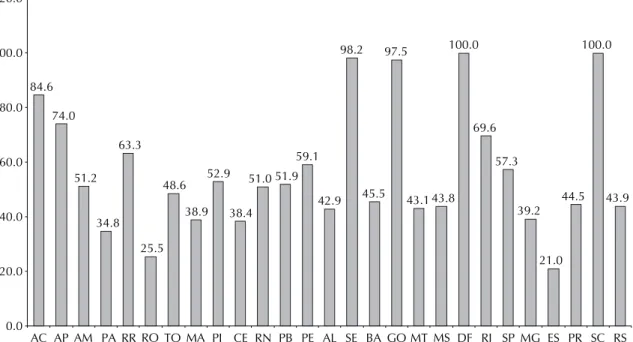
The population covered by SAMU is non-uniformly distributed across the national territory (Figure 3). This is related to the decentralized implementation of the strategy, dependent on adherence by states and/ or municipalities, which have different situations in regards to: population distribution; previous supply of services and health system organization; and implemen-tation capacity and prioritization for SAMU, conside-ring responsibilities of management, co-fi nancing and operationalization.
84.6
74.0
51.2
34.8 63.3
25.5 48.6
38.9 52.9
38.4 51.0 51.9
59.1
42.9 98.2
45.5 97.5
43.1 43.8 100.0
69.6
57.3
39.2
21.0 44.5
100.0
43.9
0.0 20.0 40.0 60.0 80.0 100.0 120.0
AC AP AM PA RR RO TO MA PI CE RN PB PE AL SE BA GO MT MS DF RJ SP MG ES PR SC RS
Source: Urgency and Emergency Coordination/ Health Care Department/ Brazilian Ministry of Health and the Instituto Brasileiro de Geografi a e Estatística.
In 2009, the majority of ambulances in Brazil were for basic support; 21.5% were for advanced support.
This proportion approximates the rate specifi ed in
the national regulation, which foresaw a ratio of one advanced support ambulance to four basic support ambulances. Nonetheless, considering the national recommendation of at least one advanced support ambulance per 450 thousand residents, the national average and the average in many states is below this parameter (Figure 4).
DISCUSSION
Before the 2000s, various municipalities recognized emergency care as a problem for SUS to address. These municipalities, under policy and administrative decentralization, sought to expand care and instituted local experiences.6,20,22
Communities of specialists (societies and professional networks) developed alternatives for emergency care and found infl uence with the Ministry of Health in the beginning of the 2000s, resulting in normative princi-ples for the fi eld.
Nonetheless, the change of government in 2003 was decisive for SAMU to become a priority in the federal agenda. A window of opportunity opened for the proposals being debated to become national policy, with adoption of formal implementation tools (norms and incentives).
The large scope of national emergency policy launched in 2003 reveals a path dependency trajectory,15 since it
complies with the SUS directives and was supported by the existence of a 2002 norm that resulted from the maturation of debate over the previous years. In summary, institutional variables (national rules, local experiences) as well as policies (such as adoption of the policy by the government, high value by stakeholders) were important for SAMU to assume high priority on the federal agenda.
Given the major importance of the federal Executive Power1 and the Ministry of Health in the establishment
of policies in Brazil,12 implementation of SAMU was
signifi cant. Nonetheless, as expected in the federative context, there are differences between states in popula-tion coverage and the characteristics of SAMU imple-mentation. The diversity in implementation requires specifi c studies to understand the results of the strategy, opportunities and limitations.
Several countries adopted mobile prehospital care stra-tegies as components of their emergency care system.17,a
Medical regulation of prehospital care can contribute to structure the relationships between services and patients, as well as identify determinants of problems
and help to plan emergency care.20 In Brazil, SAMU
can support the organization of care networks, since it requires regulatory centers, which could stimulate strategies to regulate care in other areas.
Recent studies of implementation of SAMU show advances and problems concerning structural condi-tions,5,11,13 management,3,5,7,11 network integration,7,11,13
capacity-building for professionals5 and care
prac-tices.14,23 These studies suggest the persistence of
limitations cited by participants of this study.
2.9
AC AP AM PA RR RO TO MA PI CE RN PB PE AL SE BA GO MT MS DF RJ SP MG ES PR SC RS Brasil 3.2
1.5 1.1
2.4
2.02.31.9 1.9
0.8
1.92.1
1.7
1.0 5.9
1.4 3.0
1.7 1.7 2.7
2.0
1.0 1.2 1.4 1.5
3.4
1.41.6
0.0 1.0 2.0 3.0 4.0 5.0 6.0 7.0
Recommended level*
Figure 4. Number of advanced support ambulances per 1,000,000 residents, according to federal unit. Brazil, July 2009. Source: Data provided by the Urgency and Emergency Coordination/ Health Care Department/ Ministry of Health and the Instituto Brasileiro de Geografi a e Estatística.
The organization of an integrated emergency care system requires greater public investment at various levels (basic, specialized and hospital care), develop-ment of services throughout the country and effective mechanisms for public regulation. The emphasis on
specifi c policy components – SAMU, UPA – appears
insuffi cient given the complexity of the problem.
Currently, different information systems exist in states and municipalities, but there are no consolidated
data on the profi le and outcomes of care provided by
SAMU. This would be useful for planning actions to improve emergency care.
Another limitation is related to the training of profes-sionals that work in regulatory centers and ambulances, due to the specifi city of this type of care. Although they
were specifi ed by the policy framework, formation
initiatives still have limited reach.
Addressing these limitations is fundamental for consoli-dation of SAMU as a structural strategy within SUS and a component of an integrated policy for emergency care, rather than just a high visibility program with a risk of limited effectiveness to resolve the health problems of the population.
1. Almeida MHT. O Estado no Brasil contemporâneo: um passeio pela história. In: Melo CR, Sáez MA, organizadores. A democracia brasileira: balanço e perspectivas para o século 21. Belo Horizonte: Editora UFMG; 2007. p.17-34.
2. Bittencourt RJ, Hortale VA. Intervenções para solucionar a superlotação nos serviços de emergência hospitalar: uma revisão sistemática. Cad Saude Publica. 2009;25(7):1439-54. DOI:10.1590/S0102-311X2009000700002
3. Cabral APS, Souza WV. Serviço de Atendimento Móvel de Urgência (Samu): análise da demanda e sua distribuição espacial em uma cidade do nordeste brasileiro. Rev Bras Epidemiol. 2008;11(4):530-40. DOI:10.1590/S1415-790X2008000400002
4. Carret MLV, Fassa AG, Domingues MR. Inappropriate use of emergency services: a systematic review of prevalence and associated factors. Cad Saude Publica. 2009;25(1):7-28. DOI:10.1590/S0102-311X2009000100002
5. Chomatas M. Integração de saberes e práticas na organização do Samu de Curitiba – PR. Divulg Saude Debate. 2005;(32):90-5.
6. Ciconet RM, Marques GQ, Lima MADS. Educação em serviço para profi ssionais do Serviço de Atendimento Móvel de Urgência (Samu): relato da experiência de Porto Alegre-RS. Interface (Botucatu). 2008;12(26):659-66. DOI:10.1590/S1414-32832008000300016
7. Evangelista PA, Barreto SM, Guerra HL. Central de regulação de leitos do SUS em Belo Horizonte, Minas Gerais: avaliação de seu papel pelo estudo das internações por doenças isquêmicas do coração. Cad Saude Publica. 2008;24 (4):767-76. DOI:10.1590/ S0102-311X2008000400006
8. Giglio-Jacquemot A. Urgências e emergências em saúde: perspectivas de profi ssionais e usuários. Rio de Janeiro: Editora Fiocruz; 2005. (Coleção Antropologia e Saúde).
9. Ham C, Hill M. The policy process in the modern capitalist state. Brighton: Wheatsheaf Books; 1984.
10. Kingdon JW. Agendas, alternatives and public policies. 2. ed. New York: Longman; 2003.
11. Lima JC, Rivera FJU. Redes de conversação e coordenação de ações de saúde: estudo em um
serviço móvel regional de atenção às urgências. Cad Saude Publica. 2010;26(2):323-36. DOI:10.1590/ S0102-311X2010000200011
12. Machado CV. O modelo de intervenção do Ministério da Saúde brasileiro nos anos 90. Cad Saude
Publica. 2007;23(9):2113-26. DOI:10.1590/S0102-311X2007000900019
13. Minayo MCS, Deslandes SF. Análise da implantação do sistema de atendimento pré-hospitalar móvel em cinco capitais brasileiras. Cad Saude Publica. 2008;24(8):1877-86. DOI:10.1590/S0102-311X2008000800016
14. Morais DA, Carvalho DV, Timerman S, Gonzalez MMC. Parada cardiorrespiratória em ambiente pré-hospitalar: ocorrências atendidas pela Serviço de Atendimento Móvel de Urgência de Belo Horizonte. Rev Bras Clin Med. 2009;7(4):211-8.
15. Pierson P. Politics in time: history, institutions and social analysis. Princeton: Princeton University Press; 2004.
16. Pinet LM. Atención prehospitalaria de urgencias en el Distrito Federal: las oportunidades del sistema de salud. Salud Publica Mex. 2005;47(1):64-71. DOI:10.1590/S0036-36342005000100010
17. Pozner CN, Zane R, Nelson SJ, Levine M. International EMS systems: the United States: past, present
and, future. Resuscitation. 2004;60(3):239-44. DOI:10.1016/j.resuscitation.2003.11.004
18. Puccini PT, Cornetta VK. Ocorrências em pronto-socorro: eventos sentinela para monitoramento da atenção básica de saúde. Cad SaudePublica. 2008;24(9):2032-42. DOI:10.1590/S0102-311X2008000900009
19. Sabatier PA, editor. Theories of the policy process. 2. ed. Boulder: Westview Press; 2007.
20. Santos JS, Scarpelini S, Brasileiro SLL, Ferraz CA, Dallora MELV, Sá MFP. Avaliação do modelo de organização da Unidade de Emergência do HCFMRP-USP, adotando, como referência, as políticas nacionais de atenção às urgências e de humanização. Medicina (Ribeirão Preto). 2003;36(2/4):498- 515.
21. Scarpelini S. A organização do atendimento às urgências e trauma. Medicina (Ribeirão Preto). 2007;40(3):315-20.
The research was funded by the Conselho Nacional de Desenvolvimento Científi co e Tecnológico (CNPq - Process n° 565982/2008-7) and by the Fundação de Amparo à Pesquisa do Estado do Rio de Janeiro (FAPERJ - Process nº. E-26/102.283/2009).
Salvador FGF was supported by the CNPq (Scientifi c Initiation Grant). The authors declare that there are no confl icts of interest.
22. Tannebaum RD, Arnold JL, De Negri Filho A, Spadoni VS. Emergency medicine in Southern Brazil. Ann Emerg Med. 2001;37(2):223-8. DOI:10.1067/ mem.2001.112252
23. Vieira CMS, Mussi FC. A implantação do Projeto de Atendimento Móvel de Urgência em Salvador/
Bahia: panorama e desafi os. Rev Esc Enferm USP. 2008;42(4):793-7. DOI:10.1590/S0080-62342008000400024