I
ntroductIonThe process of population aging appears as a challenge to the health system in Brazil. Within decades, the percen-tage of elderly people in the country will be similar to that of developed countries.1,2. Following the national trend, the State
of Minas Gerais is undergoing a gradual process of population aging. According to the 2000 Census, the State of Minas Gerais has an elderly population above the national average.3.
The scenario of Brazilian population aging is associated with intense socioeconomic inequality, which produces multiple risks to health, a phenomenon known as epidemiological complexity4.
Much of the morbidity and mortality concentrates in chronic degenerative diseases, generally associated with comorbidi-ties that require high-complexity health care5. In this context,
circulatory diseases are major causes of morbidity and morta-lity, including acute myocardial infarction (AMI) and stroke.6.
Stroke is considered one of the main diseases in the elderly population, being among the major causes of morbidity and mortality worldwide.7. AMI has a large epidemiological
importance due to its impact on mortality rates, number of hospital admissions, and in-hospital mortality8.
The implementation of the National Urgent Care Policy (Polí-tica Nacional de Atenção às Urgências, PNAU) is part of a major reorganization of health care in Brazil, in an attempt to provide effective responses to the challenges posed by the process of demographic and epidemiological transition. We highlight the prehospital components arising from this policy: the Family Health Strategy (Estratégia de Saúde da Família, ESF) – stationary component; and the Mobile Emergency Care Service (Serviço de Atendimento Móvel de Urgência, SAMU) – mobile component. Therefore, the study of indicators relating to AMI and stroke relates to PNAU, which aims to reduce hospital admissions and deaths resulting from injuries for which prehospital care can be effective.9.
The present study aimed to analyze the association between PNAU-related indicators and some health indicators related to stroke and AMI in the elderly population in preselected munici-palities of the State of Minas Gerais, Brazil.
*Correspondence:
Rua Nossa Senhora das Mercês, 107 - apto 203 - Fonseca
Niterói - RJ, Brazil CEP: 24130-050
AbstrACt
objectIve. To analyze the association between prehospital components of the National Urgent Care Policy (Política Nacional de Atenção às Urgências, PNAU) – the Family Health Strategy (Estratégia de Saúde da Família, ESF) and the Mobile Emergency Care Service (Serviço de Atendimento Móvel de Urgência, SAMU) – and indicators of morbidity and mortality from stroke and acute myocardial infarc-tion (AMI) in the elderly populainfarc-tion in preselected municipalities of the State of Minas Gerais, Brazil.
Methods. A longitudinal ecological study was carried out. Data analysis was performed using a series of multilevel regression models. Health indicators were analyzed from 2001 to 2007.
results. Statistically signiicant associations were found between indicators of ESF coverage and presence of SAMU with indicators of stroke and AMI mortality, for both sexes, except for male AMI. Regarding hospital admission rates, the most consistent effects were identiied for female AMI.
conclusIon. The heterogeneity of the results points to an incipient stage of PNAU, which does not allow the observation of clear effects. This inding may also suggest that this policy has not yet been able to achieve its goals concerning the elderly. Further evaluation of PNAU is essential for the establishment of strategies that can enhance its effectiveness.
Keywords: Stroke. Myocardial Infarction. Prehospital Care. Aged.
analysIs
of
prehospItal
care
for
stroke
and
acute
MyocardIal
InfarctIon
In
the
elderly
populatIon
of
MInas
geraIs
,
brazIl
carlosde castro luz1*, WashIngton leIte junger2, lucIana trIcaI cavalInI3
Study conducted at Universidade Federal Fluminense, Niterói, RJ, Brazil
1. Mestrado em Saúde Coletiva – Psicólogo pela Universidade Federal de Juíz de Fora, Juíz de Fora, MG
M
ethodsA longitudinal ecological study was carried out using, for data analysis, a series of multilevel Poisson regression models, weighted by population size. Two-level models were performed: years (level 1) and municipality (level 2). The models were adjusted using MLwiN version 2.15.10.
The analysis was performed for municipalities of over 5,000 inhabitants from the health macroregions: Central region (82 municipalities) and Southeast (55 municipalities) of the State of Minas Gerais, between 2001 and 2007.
The dependent variables included mortality rates and hospital admission rates due to stroke and AMI, by sex, speciic for the population aged 60 years or older, standardized by the direct method.
The independent variables included ESF population coverage and a dichotomous variable, which classiied the study years as pre- (2000-2004) and post- (2005-2007) SAMU implementa-tion. The effect of time was controlled by entering the year as a discrete numerical variable.
Data sources for the generation of indicators used in this study included the Mortality Information System (Sistema de Informações sobre Mortalidade, SIM) of the Brazilian Ministry of Health, and the Hospital Information System (Sistema de Informações Hospitalares do Sistema Único de Saúde, SIH/ SUS) and the Primary Care Information System (Sistema de Informação da Atenção Básica, SIAB) of the Brazilian public Uniied Health System.
This study was partially funded by the Brazilian Foundation for Higher Education Research (Coordenação de Aperfeiçoa-mento de Pessoal de Nível Superior, CAPES) under research grants for the Master’s Program.
R
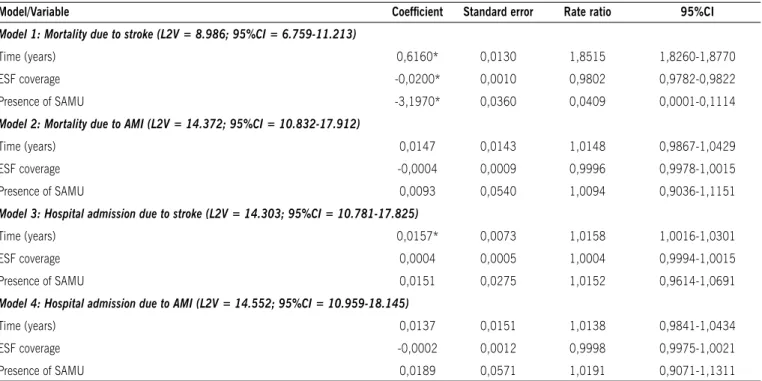
esultsThe multivariate models adjusted for this study showed the following characteristics in common: presence of statistically signiicant level 2 variance (municipality) and lack of signiicance for all other proposed variables, after adjusting for time, ESF coverage, and presence of SAMU. Thus, all models presented in this study were adjusted only for these three variables. However, signiicant differences were observed between models concerning power and direction of the association obtained for the variables included, as described below and according to the results shown in Table 1, for men, and in Table 2, for women.
Male
Regarding mortality from stroke, time showed a statistically signiicant positive association, with an increase of 85.15% per year. ESF coverage showed a statistically signiicant negative association, each 1% increase in ESF coverage represented a decrease of 1.98% in this indicator. As for the presence of SAMU, this variable was also inversely, statistically signiicant, associated with this mortality, and post-SAMU implementation years showed a decrease of 95.91% in this rate.
In the analysis of in-hospital morbidity from stroke, time showed a statistically signiicant direct association, with an increase of 1.58% per year. ESF coverage and presence of SAMU
showed a positive association, with no statistical signiicance. Concerning in-hospital morbidity and mortality from AMI, none of the three variables analyzed showed statistically signi-icant associations.
Female
Regarding mortality from stroke, time showed a statistically signiicant inverse association, with a reduction of 2.76% per year. ESF coverage showed a statistically signiicant negative association, each 1% increase in ESF coverage represented a decrease of 0.30% in this indicator. The presence of SAMU was directly, statistically signiicant, associated with this mortality, and post-SAMU implementation years showed an increase of 12.52% in this rate.
As for mortality from AMI, time showed a statistically signii-cant direct association, with an increase of 9.75% per year. ESF coverage also showed a statistically signiicant direct association, each 1% increase in ESF coverage represented an increase of 0.40% in this indicator. The presence of SAMU showed a statistically signiicant negative association with this mortality, and post-SAMU implementation years showed a reduction of 17.72% in this rate.
Regarding in-hospital morbidity from stroke, time showed a statistically signiicant negative association, with a reduction of 4.78% per year. The presence of SAMU was directly, statisti-cally signiicant, associated with this morbidity, and post-SAMU implementation years also showed an increase of 38.31% in this rate. ESF coverage showed a positive association, with no statistical signiicance.
Regarding in-hospital morbidity from AMI, time showed a statistically signiicant direct association, with an increase of 11.52% per year. ESF coverage showed a statistically signiicant inverse association, each 1% increase in ESF coverage repre-sented a decrease of 1.09% in this indicator. The presence of SAMU was also inversely, statistically signiicant, associated with this morbidity, and post-SAMU implementation years showed a reduction of 97.11% in this rate.
d
IscussIonThe results of this study demonstrated an important variability in the behavior of morbidity and mortality from stroke and AMI between sexes in the elderly population of municipalities studied from 2001 to 2007.
Firstly, it is worth noting that the behavior of mortality, or morbidity, indicators for the same disease varies signiicantly between men and women. The pattern observed in this study is corroborated by evidence in the literature, obtained from several elderly populations. Studies have demonstrated that both stroke and AMI show important differences, between men and women, in terms of incidence, lifetime risk, mean age at irst-ever episode, prevalence of postevent disability, hospital admission rates, and prognosis.11-14.
table 1 – results of multivariate models for the association of time, EsF coverage, and presence of sAMU with morbidity and mortality indicators of male stroke and AMI. Municipalities from the Central and southeast macroregions of the state of Minas Gerais,
brazil, 2001-2007
Model/Variable Coeficient standard error rate ratio 95%CI
Model 1: Mortality due to stroke (L2V = 8.986; 95%CI = 6.759-11.213)
Time (years) 0,6160* 0,0130 1,8515 1,8260-1,8770
ESF coverage -0,0200* 0,0010 0,9802 0,9782-0,9822
Presence of SAMU -3,1970* 0,0360 0,0409 0,0001-0,1114
Model 2: Mortality due to AMI (L2V = 14.372; 95%CI = 10.832-17.912)
Time (years) 0,0147 0,0143 1,0148 0,9867-1,0429
ESF coverage -0,0004 0,0009 0,9996 0,9978-1,0015
Presence of SAMU 0,0093 0,0540 1,0094 0,9036-1,1151
Model 3: Hospital admission due to stroke (L2V = 14.303; 95%CI = 10.781-17.825)
Time (years) 0,0157* 0,0073 1,0158 1,0016-1,0301
ESF coverage 0,0004 0,0005 1,0004 0,9994-1,0015
Presence of SAMU 0,0151 0,0275 1,0152 0,9614-1,0691
Model 4: Hospital admission due to AMI (L2V = 14.552; 95%CI = 10.959-18.145)
Time (years) 0,0137 0,0151 1,0138 0,9841-1,0434
ESF coverage -0,0002 0,0012 0,9998 0,9975-1,0021
Presence of SAMU 0,0189 0,0571 1,0191 0,9071-1,1311
AMI = acute myocardial infarction; ESF = Estratégia de Saúde da Família (Family Health Strategy); L2V = level 2 variance; SAMU = Serviço de Atendimento Móvel de Urgência (Mobile Emergency
Care Service); 95%CI = 95% conidence interval of statistical signiicance
table 2 – results of multivariate models for the association of time, EsF coverage, and presence of sAMU with morbidity and mortality indicators of female stroke and AMI. Municipalities from the Central and southeast macroregions of the state of Minas Gerais,
brazil, 2001-2007
Model/Variable Coeficient standard error rate ratio 95%CI
Model 5: Mortality due to stroke (L2V = 18.58; 95%CI = 14.040-23.122)
Time (years) -0,0280* 0,0110 0,9724 0,9508-0,9939
ESF coverage -0,0030* 0,0010 0,9970 0,9950-0,9990
Presence of SAMU 0,1180* 0,0420 1,1252 1,0429-1,2076
Model 6: Mortality due to AMI (L2V = 19.043; 95%CI = 14.361-23.725)
Time (years) 0,0930* 0,0140 1,0975 1,0700-1,1249
ESF coverage 0,0040* 0,0010 1,0040 1,0020-1,0060
Presence of SAMU -0,1950* 0,0560 0,8228 0,7131-0,9326
Model 7: Hospital admission due to stroke (L2V = 18.856; 95%CI = 14.217-23.495)
Time (years) -0,0489* 0,0063 0,9522 0,9399-0,9646
ESF coverage 0,0008 0,0005 1,0008 0,9999-1,0017
Presence of SAMU 0,3243* 0,0253 1,3831 1,3336-1,4326
Model 8: Hospital admission due to AMI (L2V = 5.667; 95%CI = 4.246-7.088)
Time (years) 0,1090* 0,0240 1,1152 1,0681-1,1622
ESF coverage -0,0110* 0,0020 0,9891 0,9851-0,9930
Presence of SAMU -3,5450* 0,0840 0,0289 0,0001-0,1935
AMI = acute myocardial infarction; ESF = Estratégia de Saúde da Família (Family Health Strategy); L2V = level 2 variance; SAMU = Serviço de Atendimento Móvel de Urgência (Mobile Emergency
of morbidity and mortality. Speciically, new curative treatments or, at least, with some effect in improving the mean survival, have managed to reduce mortality rates, but these treatments usually do not affect non-infectious disease morbidity rates.15-17.
When analyzing the speciic multivariate models, we observed a beneicial effect of ESF coverage on mortality from stroke, in both sexes, and on the rate of hospital admission due to AMI in women. Likewise, a beneicial effect of the presence of SAMU was observed for mortality from stroke in men and for both in-hospital morbidity and mortality due to AMI in women. Despite widespread criticism of the quality of primary care delivered to patients with chronic diseases,18-19, there is evidence suggesting
an improvement in prognosis, at least for stroke, associated with ESF coverage20.
One can observe a consistency in the beneicial effects of both components of PNAU, stationary (ESF) and mobile (SAMU) components, on the indicators selected for this study. Speciically, with respect to mobile prehospital care, the beneicial effects on the prognosis of acute cardiovascular and cerebrovascular diseases are well known.21-22.
However, results were found indicating a direct association between PNAU components and some of the indicators studied. Speciically, an increased ESF coverage was directly associated with an increased mortality from AMI in women, and the presence of SAMU was associated with increased in-hospital morbidity and mortality due to stroke in women. Although the effect of increased in-hospital morbidity due to stroke in women may suggest that SAMU plays a role in promoting an increased hospital demand of cases that would have once resulted in death, this assumption contradicts the concomitant increase in mortality rates for the same disease in women.
On the other hand, it is suggested that the existence of a prehospital care service may increase early diagnosis and referral of suspected stroke patients.23. Thus, the increase in mortality
may be allegedly occurring due to better record of the cause of deaths and cases of stroke that were previously recorded as ill-deined causes. Although there are no speciic studies on the underdiagnosis of causes of death among the elderly, there is evidence in the literature of an underestimation of risk (although for AMI, not stroke) due to the underdiagnosis of the cause of death.8 With regard to a possible improvement in diagnosis through the ESF, the little evidence found in the literature points in the opposite direction;24 however, this subject certainly deserves
a better analytical destiny.
Overall, PNAU components had less effect on indicators studied in the male population, compared with more signiicant effects observed in the female population. More speciically, neither of PNAU components showed signiicant effects on any of the causes of in-hospital morbidity, or on mortality due to AMI, for men. This effect could be explained by the male over female mortality, both overall and speciic for diseases studied herein,25-27 reducing the occurrence of events, or the impact of
interventions, in the age groups analyzed in this study. Additio-nally, the lack of effect on both admission rates for men may be indicating the gender inequality inherent in health policies.28
The fact that the measures of association estimated in the models (mortality and admission rate ratios) showed statisti-cally signiicant results, yet close to the unit, may lead to an
interpretation that these are low-impact effects. However, in the case of ecological studies, using population-based indicators, one should bear in mind that effects occur in a similar way in the population as a whole. That is to say, an association ratio measure with a value of 1.01 for a given independent variable means that the variation of one unit of this variable increases the indicator by 1% on average (weighted by population size), for observation units.29. Thus, low-value measures of association
are expected in ecological studies, without implying an actual low effect of independent variables on the phenomena studied.30-32.
Some limitations of our study design, which might have inluenced the results, need to be discussed.
First, we chose to analyze morbidity and mortality rates due to stroke and AMI standardized for the population aged 60 years or older as a whole, rather than analyzing each speciic age group. This choice may have narrowed the analytical scope of the study, since a progressive increase was observed in these rates with advancing age, as age is the main nonmodiiable risk factor. This increase is not affected only by the increase in life expectancy, since the improvement in the quality of secondary and tertiary care inluences the increased survival of patients with these diseases. This reinforces the need for early detection of stroke and AMI in early stages; in addition, measures to prevent and control risk factors for circulatory diseases should be prioritized in decision making in health care.33,34.
We must also raise questions about the adoption of an ecological design with multilevel modeling to estimate effects. Although prevalent in the ield of social epidemiology and health economics, this design has raised questions, since some studies extrapolate the analysis of their results to effects beyond the ecological level, which are those that can actually be analyzed in this type of study.35. In the present study, we sought to avoid
this impropriety by focusing the discussion of the results on the analysis of population-based or hospital-based phenomena that could corroborate the indings of this study.
However, it is worth noting that this study analyzed outcomes for which there is abundant literature demonstrating the existence of risk factors at the individual level. According to Diez-Roux,36,
this methodological choice could introduce the so-called “socio-logistic fallacy”, in which inferences drawn at the level of aggre-gation lack adjustments for individual-level variables. In order to verify the occurrence of such undesired effect in this study, investigations employing more complex sample designs and analysis should be conducted, including independent variables of both levels, which remains as a knowledge gap to be illed in relation to PNAU.
Thus, the present study is considered a non-exhaustive, exploratory analysis of some health indicators considered as targets of PNAU. The results obtained point to a possible partial effectiveness of the policy in question during its irst years of implementation, for the municipalities studied in the State of Minas Gerais, Brazil. However, some effects observed in the opposite direction point to the need for further research covering a larger geographic area.
c
onclusIoncapacity of primary health care units, the use of hospitals as gateways, the hegemony of hard technologies, and disregard of the peculiarities of the elderly are some of these problems. It is evident, therefore, the need for new standards of health care in this population.
Despite being a breakthrough in terms of health policy, PNAU still presents serious obstacles to achieving the proposed goals. The agreement among managers at different levels of govern-ment in making decisions on availability of beds and services may be an alternative for solving several problems. Hospital overcrowding worsens the relationship between hospital and prehospital care. Regarding the diseases analyzed in this study, in which time is a crucial factor in the outcome of the situation, this issue requires the adoption of consistent and achievable strategies.
The use of indicators to assess implementation of a parti-cular program or policy at different levels in health systems may assist in developing intervention strategies. However, the mass of information available, unfortunately, is neither used to analyze health situations nor to define priorities. We hope that this study can serve as model for the use of available secon-dary data to evaluate health policies from their early stages of implementation.
Finally, we can state that the analysis of morbidity and morta-lity indicators and PNAU-related indicators presents as a viable alternative for the discussion and study of this policy, in terms of allocation of resources for those diseases perceived to have the most urgent need for care. Thus, further research is warranted to conceive an overview of the aging process and its implications on the planning and management of health care services.
Conlict of interest: No conlicts of interest declared concer-ning the publication of this article.
r
eferêncIas1. Carvalho JAM, Garcia RA. O envelhecimento da população brasileira: um
enfoque demográico. Cad Saúde Pública. 2003;19:725-33.
2. Instituto Brasileiro de Geograia e Estatística. IBGE. Censo demográico 2000.
Rio de Janeiro: IBGE; 2008.
3. Instituto Brasileiro de Geograia e Estatística. IBGE. Peril dos idosos respon -sáveis pelos domicílios no Brasil. Rio de Janeiro:IBGE; 2002.
4. Chaimowicz F. A saúde dos idosos brasileiros às vésperas do século XXI: problemas, projeções e alternativas. Rev Saúde Pública. 1997;31:184-200. 5. Nunes A. “O envelhecimento populacional e as despesas do Sistema Único
de Saúde”. In: Camarano AA, organizador. Os novos idosos brasileiros: muito além dos 60? Rio de Janeiro: IPEA; 2004. p.427-49.
6. Souza MFM, Timerman A, Serrano Jr. CV, Santos RD, Mansur AP. Trends in death from circulatory diseases in Brazil between 1979 and 1996. Arq Bras Cardiol. 2001,76:569-75.
7. Giles MF, Rothwell PM. Measuring the prevalence of stroke. Neuroepidemiology. 2008;30:205-6.
8. Melo, ECP; Carvalho, MS; Travassos, C. Distribuição espacial da mortalidade por infarto agudo do miocárdio no Município do Rio de Janeiro, Brasil. Cad Saúde Pública. 2006;22:1225-36.
9. Ministério da Saúde. Política Nacional de Atenção às Urgências. 3a ed. Brasília (DF): Ministério da Saúde; 2006.
10. Rasbash J, Steele F, Browne WJ, Goldstein H. A user’s guide to MLwiN version 2.10. Bristol 2009; Centre for Multilevel Modeling; 2009.
11. Petrea RE, Beiser AS, Seshadri S, Kelly-Hayes M, Kase CS, Wolf PA. Gender differences in stroke incidence and poststroke disability in the Framingham heart study. Stroke. 2009;40:1032-7.
12. Neill J, Adgey J. Predictors of excess mortality after myocardial infarction in women. Ulster Med J. 2008;77:89-96.
13. Sheikh K, Bullock CM. Effect of measurement on sex difference in stroke mortality. Stroke. 2007;38:1085-7.
14. Keller KB, Lemberg L. Gender differences in acute coronary events. Am J Crit Care. 2000; 9:207-9.
15. Lewsey JD, Gillies M, Jhund PS, Chalmers JW, Redpath A, Briggs A, et al. Sex differences in incidence, mortality, and survival in individuals with stroke in Scotland, 1986 to 2005. Stroke. 2009;40:1038-43.
16. Perers E, Caidahl K, Herlitz J, Karlsson T, Hartford M. Impact of diagnosis and sex on long-term prognosis in acute coronary syndromes. Am Heart J. 2007;154:482-8.
17. Vrbova L, Crighton EJ, Mamdani M, Moineddin R, Upshur RE. Temporal analysis of acute myocardial infarction in Ontario, Canada. Can J Cardiol. 2005; 21:841-5.
18. Ciruzzi MA, Schargrodsky H, Villahermosa MT, Borrego C, Vulcano N, Soifer S, Sinisi A, Zylbersztejn H, Forcada P. General physicians and the management of heart failure in an Argentine population. Medicina (B Aires). 2004;64:219-26. 19. Abubakar I, Kanka D, Arch B, Porter J, Weissberg P. Outcome after acute myocardial infarction: a comparison of patients seen by cardiologists and general physicians. BMC Cardiovasc Disord. 2004;4:14.
20. Cabral NL, Goncalves AR, Longo AL, Moro CH, Costa G, Amaral CH, ET AL. Trends in stroke incidence, mortality and case fatality rates in Joinville, Brazil: 1995-2006. J Neurol Neurosurg Psychiatry. 2009;80:749-54.
21. Steg PG, Bonnefoy E, Chabaud S, Lapostolle F, Dubien PY, Cristoini P, et al. Impact of time to treatment on mortality after prehospital ibrinolysis or primary
angioplasty: data from the CAPTIM randomized clinical trial. Circulation. 2003;108:2851-6.
22. Diez-Tejedor E, Fuentes B. Acute care in stroke: the importance of early inter-vention to achieve better brain protection. Cerebrovasc Dis. 2004;17 (Suppl 1):130-77.
23. Ferri M, Luca A, Giorgi-Rossi P, Lori G, Guasticchi G. Does a pre-hospital emergency pathway improve early diagnosis and referral in suspected stroke patients? Study protocol of a cluster randomised trial. BMC Health Serv Res. 2005;5:66.
24. Baptista EKK, Marcon SS, Souza RKT. Avaliação da cobertura assistencial das equipes de saúde da família às pessoas que faleceram por doenças cerebro-vasculares em Maringá, Paraná, Brasil. Cad Saúde Pública. 2008;24:225-9. 25. Aquino EML, Menezes GM, Amoedo BEM, Nobre LCC. Mortalidade feminina
no Brasil: sexo frágil ou sexo forte? Cad Saúde Pública. 1991;7:174-89 .
26. Laurenti R, Jorge MHPM, Gotlieb SLD. Peril epidemiológico da morbi-morta -lidade masculina. Ciênc Saúde Coletiva. 2005;10:35-46.
27. Berger JS, Brown DL. Gender-age interaction in early mortality following primary angioplasty for acute myocardial infarction. Am J Cardiol. 2006;98:1140-3. 28. Braz M. A construção da subjetividade masculina e seu impacto sobre a saúde
do homem: relexão bioética sobre justiça distributiva. Ciênc Saúde Coletiva.
2005;10:97-104.
29. Dice LR. Measures of the amount of ecologic association between species. Ecology. 1945;26:297-302.
30. Reza Nakhaie M, Smylie LK, Arnold R. Social inequalities, social capital, and health of Canadians. Rev Radical Polit Econ. 2007;39:562-85.
31. Backlund E, Rowe G, Lynch J, Wolfson MC, Kaplan GA, Sorlie PD. Income inequality and mortality: A multilevel prospective study of 521 248 individuals in 50 US states. Int J Epidemiol. 2007;36:590-6.
32. Cavalini LT, Ponce de Leon ACM. Morbidity and mortality in Brazilian munici-palities: a multilevel study of the association between socioeconomic and healthcare indicators. Int J Epidemiol. 2008;37:775-83.
33. Williams MA, Fleg JL, Ades PA, Chaitman BR, Miller NH, Mohiuddin SM, et al. Secondary prevention of coronary heart disease in the elderly (with emphasis
on patients >=75 years of age): an American Heart Association scientiic
statement from the Council on Clinical Cardiology Subcommittee on Exercise, Cardiac Rehabilitation, and Prevention. Circulation. 2002;105:1735-43. 34. Mathias TAF, Mello Jorge MHP, Laurenti R. Cardiovascular diseases in the
elderly: Analysis of the behavior of mortality in a municipality in the Southern Region of Brazil from 1979 to 1998. Arq Bras Cardiol. 2004;82:542-50. 35. Blakely TA, Woodward AJ. Ecological effects in multi-level studies. J Epidemiol
Commun Health. 2000; 54:367-74.
36. Diez-Roux AV. Bringing context back into epidemiology: variables and fallacies in multilevel analysis. Am J Public Health. 1998;88:216-22.