372
Rev. Col. Bras. Cir. 2015; 42(6): 372-375
C o e l h o C o e l h o C o e l h o C o e l h o C o e l h o Epidemiological profile and postoperative complications of women undergoing gynecological surgery in a reference center in the northern brazilian legal amazon Original Article Original ArticleOriginal Article Original Article Original Article
DOI: 10.1590/0100-69912015006004
Epidemiological profile and postoperative complications of
Epidemiological profile and postoperative complications of
Epidemiological profile and postoperative complications of
Epidemiological profile and postoperative complications of
Epidemiological profile and postoperative complications of
women undergoing gynecological surgery in a reference center in
women undergoing gynecological surgery in a reference center in
women undergoing gynecological surgery in a reference center in
women undergoing gynecological surgery in a reference center in
women undergoing gynecological surgery in a reference center in
the northern brazilian legal amazon
the northern brazilian legal amazon
the northern brazilian legal amazon
the northern brazilian legal amazon
the northern brazilian legal amazon
Perfil epidemiológico e complicações pós-operatórias das mulheres submetidas
Perfil epidemiológico e complicações pós-operatórias das mulheres submetidas
Perfil epidemiológico e complicações pós-operatórias das mulheres submetidas
Perfil epidemiológico e complicações pós-operatórias das mulheres submetidas
Perfil epidemiológico e complicações pós-operatórias das mulheres submetidas
à cirurgia ginecológica em centro de referência do extremo setentrional da
à cirurgia ginecológica em centro de referência do extremo setentrional da
à cirurgia ginecológica em centro de referência do extremo setentrional da
à cirurgia ginecológica em centro de referência do extremo setentrional da
à cirurgia ginecológica em centro de referência do extremo setentrional da
amazônia legal brasileira
amazônia legal brasileira
amazônia legal brasileira
amazônia legal brasileira
amazônia legal brasileira
SÔNIA MARIA COELHO1; ELIZABETHDE LA TRINIDAD CASTRO PEREZ1; CYNTHIA DANTASDE MACEDO LINS1,2; MARIANO TAMURA VIEIRA GOMES3,4;
ZSUZSANNA ILLONA KATALINDE JÁRMY DI BELLA4; MARINADE PAULA ANDRES5; SERGIO PODGAEC3,5
A B S T R A C T A B S T R A C T A B S T R A C T A B S T R A C T A B S T R A C T
Objective: Objective: Objective: Objective:
Objective: To evaluate the epidemiological profile and the operative complications of patients undergoing gynecological operations for benign diseases in a tertiary public hospital in the state of Roraima, Brazil. MethodsMethodsMethodsMethods: We conducted aMethods retrospective survey through the analysis of 518 records of patients submitted to gynecological operations between January and June 2012. We included the three major operations during this period (n = 175): hysterectomy, colpoperineoplasty and suburethral sling placement. We excluded 236 cases of tubal ligation and 25 cases where it was not possible to access to medical records. ResultsResultsResultsResultsResults: The mean age was 47.6 years; the education level of most patients was completed junior high (36.6%); 77% were from the State capital, 47.4% were in stable relationships and 26.3% were housewives. The majority of patients had given birth three or more times (86.6%), with previous vaginal delivery in 50.2%, and cesarean delivery, 21%. The main diagnostic indications for surgical treatment were uterine myoma (46.3%), urinary incontinence (27.4%) and genital dystopias (17.7%). We found three cases (1.7%) of high-grade intraepithelial lesions on Pap smear. The most common procedure was total hysterectomy (19.8%), 15.5% vaginally. The most common complication was wound infection (2.2%). ConclusionConclusionConclusionConclusionConclusion: Women undergoing gynecological operations due to benign disease had a mean age of 47 years, most had levels of basic education, came from the capital, were in stable relationships, predominantly housewives, multiparous and showed low operative complication rates.
Key words: Key words: Key words: Key words:
Key words: Surgery. Hysterectomy. Suburethral Slings. Pelvic Organ Prolapse. Postoperative Complications.
1. Hospital Materno-Infantil Nossa Senhora de Nazaré, Roraima; 2. Universidade Federal de Roraima (UFRR); 3. Hospital Israelita Albert Einstein, São Paulo; 4. Departamento de Ginecologia da Escola Paulista de Medicina / UNIFESP; 5. Divisão de Clínica Ginecológica do Hospital das Clínicas da Faculdade de Medicina da Universidade de São Paulo.
INTRODUCTION
INTRODUCTION
INTRODUCTION
INTRODUCTION
INTRODUCTION
G
ynecologic Surgery is a branch of General Surgery that treats the female genital tract and surgical diseases of women, considering the breasts and pelvis. As for the pelvic area, the main benign diseases requiring surgical procedures relate to the uterus and its appendages and correction of urinary incontinence. However, specific features of certain populations bring peculiarities to the indications and results obtained1.2.The city of Boa Vista, capital of Roraima, lies on the northern reaches of the Brazilian Amazon, has a population of 314,900 inhabitants (63% of the state population), of which around 70,000 women aged between 20 and 50 years. Most of this contingent inhabits the urban area, 2.5% living in rural areas. The per capita monthly income is R $786.00, comparatively lower than
in São Paulo (R$ 1,516.00), one of the main capitals of the country. As an example of local health care characteristics, according to IBGE data, the city has only four inpatient units in emergency obstetric and four mammography centers3.
C o e l h o C o e l h o C o e l h o C o e l h o C o e l h o
Epidemiological profile and postoperative complications of women undergoing gynecological surgery in a reference center in the northern brazilian legal amazon
373
Rev. Col. Bras. Cir. 2015; 42(6): 372-375
many countries, the mainly used is the abdominal (70-90%), with only 10-30% vaginal and less than 5% laparoscopic1,2,4.
Urinary incontinence (UI), on its turn, represents about 10% of gynecological complaints5-10. The operative techniques of suburethral sling for correction of UI can use a wide variety of autologous and synthetic materials and consist of the use of a strip positioned inferiorly to the urethra or bladder neck without tension. Their cure rates range between 61% and 93%11,12. The use of synthetic meshes in sling procedures reduces the operation time and eliminates the potential morbidity at the graft site extraction5,13.
The aim of this study was to evaluate the clinical and epidemiological profile of patients undergoing gynecological surgeries due to benign disease in a reference center of Roraima.
METHODS
METHODS
METHODS
METHODS
METHODS
We conducted a cross-sectional, retrospective, descriptive study through the analysis of medical records of 518 patients who underwent surgical treatment between January and June 2012 at the Women’s Health Reference Center (CRSM) of the Hospital Materno-Infantil Nossa Se-nhora de Nazaré (HMINSN), a public tertiary hospital in Boa Vista, Roraima, on the northern reaches of the Brazilian Amazon.
We selected the three major gynecological operations, totaling 436 patients. Of these, we excluded 236 tubal sterilizations (45.5%) and other 25 cases (12.5%) due to lack of access the medical records.
The epidemiological variables analyzed were type and number of deliveries, pre and postoperative diagnosis and postoperative complications, through measures of cen-tral tendency (median, mode and relative frequency). The study was approved by the Ethics in Research Committee of the Federal University of Roraima (UFRR), Protocol 609 239.
The patients underwent transvaginal ultrasound and Pap smear for preoperative evaluation. In cases of
hysterectomy, the uterus was sent for histopathological evaluation after the procedure.
The results obtained in the study were divided into categorical and continuous variables for analysis. Categorical variables were analyzed descriptively, by calculating absolute and relative frequencies. Continuous variables are expressed as means, medians, standard deviations, absolute and relative frequencies. To compare proportions we used the chi-square test and, where appropriate, Yates’ correction. The level of significance was set at p <0.05 for all tests.
RESULTS
RESULTS
RESULTS
RESULTS
RESULTS
We performed 518 operations. The most prevalent gynecological procedures in the Service were hysterectomy, colpoperineoplasty, vaginal sling surgery and cistopexy with or without perineoplasty, corresponding to 175 cases (Table 1). The average age of patients was 47.6 years, ranging from 24 to 84, with a predominance of the range between 40 and 49 years (45.7, CI: 38.18-53.40). The predominant level of education was completed junior high school, in 36.6% of cases, 27.4% had completed high school, and 5.7% of patients attended higher education (Table 2). The patients were mainly from the State capital (77%), married or in a stable relationship (47.4%) and housewives (26.3%).
Patients were multiparous (three or more previous deliveries) in 86.6% of cases, 50.2% with only vaginal deliveries and 21% had a history of at least one previous cesarean delivery. The Pap smear showed high-grade cervical intraepithelial neoplasia in 1.7% of patients.
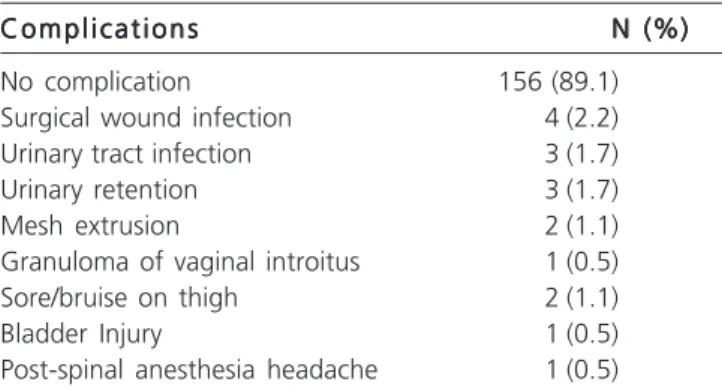
Preoperative diagnoses were uterine myoma in 46.3%, urinary incontinence in 27.4%, and genital dystopia in 17.7% as indications for hysterectomy, vaginal Sling and colpoperineorrhaphy, respectively. All patients were followed for a minimum of six months postoperatively. Most patients had no postoperative complication (89.1%). The complications were wound infection, urinary tract infection, urinary retention, vaginal mesh extrusion, vaginal opening granuloma, thigh hematoma/pain, bladder injury and post-spinal anesthesia headache (Table 3).
Table 1 Table 1 Table 1 Table 1
-Table 1 - Main operations performed (n = 518).
S u r g e r y S u r g e r y S u r g e r y S u r g e r y
S u r g e r y N (%)N (%)N (%)N (%)N (%)
Tubal sterilization 236 (45.5)
Hysterectomy 103 (19.8)
Anterior Colpoperineoplasty 14 (2.7)
Posterior Colpoperineoplasty 37 (7.1)
Vaginal sling and anterior/posterior Colpoperineoplasty 18 (3.4)
Vaginal Sling 3 (0.5)
374
Rev. Col. Bras. Cir. 2015; 42(6): 372-375
C o e l h o C o e l h o C o e l h o C o e l h o C o e l h o Epidemiological profile and postoperative complications of women undergoing gynecological surgery in a reference center in the northern brazilian legal amazon
There was a correlation between postoperative histopathology with preoperative diagnosis of uterine leiomyoma, with statistical significance (p = 0.004 Yates X2). There was no significant relationship between endometrial hyperplasia and endometrial thickening in the preoperative ultrasound. The main histopathological findings were 36 cases of leiomyoma, four cases of endometrial hyperplasia without atypia and 24 cases of adenomyosis.
DISCUSSION
DISCUSSION
DISCUSSION
DISCUSSION
DISCUSSION
The major benign gynecological conditions with surgical indication are uterine myoma and urinary incontinence. While in specialized centers they are treated today with minimally invasive techniques, in centers distant from large capitals the conventional surgical treatments dominate2,5.
Interestingly, the average age of the patients submitted to surgery was 47.6 years, consistent with the literature14-16.
As for the origin of the patients, in Brazilian studies 81.5% to 92.6% of patients were from the town itself and 7.37% to 18.43% lived in the countryside14-16. In our study, most patients had urban origin (77%). It is believed that the prevalence of patients coming from the urban area served by the service is due to patients from the countryside and surrounding towns lacking access to information and public health services. In an IBGE survey in 2009 in the North of the country, only 1.8 hospital beds were available for every 1,000 inhabitants, below the standard recommended by the Ministry of Health, and, in Roraima, these beds are available for the SUS, the Brazilian NHS, in only four health establishments3.
With regard to deliveries, 86.6% of women were multiparous, concordant with world literature, but higher than other Brazilian samples, such as Primo et al., who found 37.5% multiparous17. The predominant level of education was complete junior high in 36.6%11,15,16. Multiparity is a known risk factor for genital dystopias and urinary incontinence. Studies show that every birth increases by 1.2% the risk for dystopias and that among women who had two or more births, the number of hospitalizations for genital prolapse repair increases by up to eight times when compared to nulliparous women18.
The most common complication was wound infection, present in 2.2% of patients, consistent with the findings in the literature. Regarding the extrusion of synthetic mesh through the vagina, we found a frequency of 9.5% among patients undergoing sling surgery. In the literature mesh extrusion rate is 0-14%, and in other Brazilian studies, 4%7.
It should be noted that this study is a pioneering survey on the characteristics of gynecologic surgeries performed in the far north of the country. The limitation of
the results lie in its retrospective nature, based on information collected from medical records and dependent on correct completion. From this data, the first time in our country, we wanted to know the characteristics of these patients, which could help promote management strategies adapted to the local population, as well as the establishment of possible preventive measures directed to these women.
The sample shows that women undergoing gynecological operations due to benign diseases in the Centro de Referência de Saúde da Mulher (CRSM) do Hos-pital Materno-Infantil Nosssa Senhora de Nazaré (HMINSN) between January and June 2012 had an average age of 47, most had completed junior high, came from the State capital, were in a stable relationship, were predominantly housewives, multiparous and showed low operative complication rates.
Table 2 -Table 2 -Table 2
-Table 2 -Table 2 - Epidemiological and clinical characteristics of the patients submitted to gynecological surgery (n = 175).
Characteristic CharacteristicCharacteristic
CharacteristicCharacteristic N (%)N (%)N (%)N (%)N (%)
Age (years) 47.6
Schooling
Elementary school 64 (36.6)
High School 48 (27.4)
Higher Education 10 (5.7)
Unknown 53 (30.2)
Marital status
Married 83 (47.4)
Single 48 (27.4)
History of three or more deliveries 13 (86.6) Exclusive vaginal delivery 87 (50.2)
Source: medical records of the Centro de Referência de Saúde da Mulher (CRSM) do Hospital Materno-Infantil Nossa Senhora de Nazaré (HMINSN)– jan-jun/2012.
Table 3 -Table 3 -Table 3
-Table 3 -Table 3 - Postoperative complications of patients undergoing gynecological surgery (n = 175).
C o m p l i c a t i o n s C o m p l i c a t i o n sC o m p l i c a t i o n s
C o m p l i c a t i o n sC o m p l i c a t i o n s N (%)N (%)N (%)N (%)N (%)
No complication 156 (89.1)
Surgical wound infection 4 (2.2) Urinary tract infection 3 (1.7)
Urinary retention 3 (1.7)
Mesh extrusion 2 (1.1)
Granuloma of vaginal introitus 1 (0.5)
Sore/bruise on thigh 2 (1.1)
Bladder Injury 1 (0.5)
Post-spinal anesthesia headache 1 (0.5)
C o e l h o C o e l h o C o e l h o C o e l h o C o e l h o
Epidemiological profile and postoperative complications of women undergoing gynecological surgery in a reference center in the northern brazilian legal amazon
375
Rev. Col. Bras. Cir. 2015; 42(6): 372-375
R E S U M O R E S U M O R E S U M O R E S U M O R E S U M O
Objetivo Objetivo Objetivo Objetivo
Objetivo: avaliar o perfil epidemiológico e as complicações operatórias das pacientes submetidas à operações ginecológicas realizadas devido à presença de doenças benignas em um hospital público terciário no Estado de Roraima, Brasil. Métodos:Métodos:Métodos:Métodos:Métodos: foi realizado um levantamento retrospectivo, por meio da análise de prontuários de 518 pacientes submetidas à operações ginecológi-cas entre os meses de janeiro e junho de 2012. Foram incluídas as três principais operações realizadas nesse período (n=175): histerectomia, colpoperineoplastia e colocação de sling suburetral. Foram excluídos 236 casos de laqueadura tubária e 25 casos em que não foi possível acesso ao prontuário médico. ResultadosResultadosResultadosResultadosResultados: A média etária foi 47,6 anos, predominaram pacientes com ensino fundamental (36,6%), provenientes da capital (77%), com relações estáveis (47,4%) e ocupação prevalente “do lar” (26,3%). As pacientes, em sua maioria, tinham antecedentes três ou mais partos (86,6%), com via vaginal prévia em 50,2% e parto cesáreo prévio em 21%. Os principais diagnósticos indicativos de tratamento cirúrgico foram: mioma uterino (46,3%), incontinência urinária de esforço (27,4%) e distopias genitais (17,7%). Foram encontrados três casos (1,7%) de lesões intraepiteliais de alto grau na colpocitologia oncótica. A operação mais realizada foi a histerectomia total (19,8%), sendo 15,5% por via vaginal. A complicação mais frequente foi a infecção de ferida operatória (2,2%). ConclusãoConclusãoConclusãoConclusãoConclusão: as mulheres submetidas às operações ginecológicas devido à doenças benignas apresentavam média etária de 47 anos, a maioria tinha nível de escolaridade fundamental, eram provenientes da capital, tinham união estável, eram predominantemente do lar, multíparas e apresentaram taxas de complicações operatórias baixas.
Descritores: Descritores: Descritores: Descritores:
Descritores: Cirurgia. Histerectomia. Slings Suburetrais. Prolapso de Órgão Pélvico. Complicações Pós-Operatórias.
REFERENCES
REFERENCES
REFERENCES
REFERENCES
REFERENCES
1. Merighi MAB, Oliveira DM, Jesus MCP, Hoga LAK, Pedroso AGO. Experiências e expectativas de mulheres submetidas à histerectomia. Texto contexto – enferm. 2012;21(3):608-15. 2. Costa AAR, Amorim MMR, Cursino T. Histerectomia vaginal versus
histerectomia abdominal em mulheres sem prolapso genital, em maternidade-escola do Recife: ensaio clínico randomizado. Rev Bras Ginecol Obstet. 2003;25(3):169-76.
3. Brasil. Ministério da Saúde. IBGE – Instituto Brasileiro de Geografia e Estatística [Internet]. Estatísticas da saúde. Assistência médico-sanitária; 2009. [acessado em: 2014 outubro 8]. Disponível em: h t t p : / / w w w . i b g e . g o v . b r / h o m e / e s t a t i s t i c a / p o p u l a c a o / condicaodevida/ams/2009/ams2009.pdf.
4. Chen B, Ren DP, Li JX, Li CD. Comparison of vaginal and abdominal hysterectomy: A prospective non-randomized trial. Pak J Med Sci. 2014;30(4):875-9.
5. Tanuri ALS, Feldner Jr PC, Bella ZIKJ, Castro RA, Sartori MGF, Girão MJBC. “Sling” retropúbico e transobturário no tratamento da incontinência urinária de esforço. Rev Assoc Med Bras. 2010;56(3):348-54.
6. Feuser MR, Luz CM, Virtuoso JF, Luz SCT, Longo EK, Espíndola DS. Comportamento da continência urinária após tratamento cirúrgi-co cirúrgi-com faixa sintética (sling): um estudo de sete casos. ACM arq catarin med. 2011;40(2):41-6.
7. Silveira ABFN, Fogiatto D, Kulak Júnior J, Busato D, Francisco JAFC. Sling transobturário: resultados de um centro de uroginecologia em Curitiba no ano de 2004. Rev Col Bras Cir. 2007;34(2):123-6. 8. Sartori JP, Martins JAM, Castro RA, Sartori MGF, Girão MJBC. Sling de aponeurose e com faixa sintética sem tensão para o tratamento cirúrgico da incontinência urinária de esforço femini-na. Rev Bras Ginecol Obstet. 2008;30(3):127-34.
9. Feldner Jr PC, Bezerra LRPS, Girão MJBC, Castro RA, Sartori MGF, Baracat EC, et al. Valor da queixa clínica e exame físico no diag-nóstico da incontinência urinária. Rev Bras Ginecol Obstet. 2002;24(2):87-91.
10. Feldner Jr PC, Sartori MGF, Lima GR, Baracat EC, Girão MJBC. Diagnóstico clínico e subsidiário da incontinência urinária. Rev Bras Ginecol Obstet. 2006;28(1):54-62.
11. Rovner ES, Ginsberg DA, Raz S. The UCLA surgical approach to sphincteric incontinence in women. World J Urol. 1997;15(5):280-94.
12. Martins JAM, Castro RA, Girão MJBC, Sartori MGF, Baracat EC, Lima GR. Correção da incontinência urinária de esforço com sling: resultados iniciais. Rev Bras Ginecol Obstet. 2000;22(5):301-5. 13. Cândido EB, Triginelli SA, Silva Filho AL, Noviello MB, Santos Filho
AS, Silva LB. Utilização de pericárdio bovino no sling pubovaginal para o tratamento da incontinência urinária de esforço. Rev Bras Ginecol Obstet. 2003;25(7):525-8.
14. Carvalho Júnior AM, Carretette FB, Muller V, Vaz FP. Estudo com-parativo entre sling pubovaginal de parede vaginal e sling de fáscia do reto abdominal no tratamento da incontinência urinária de esforço. Rev Col Bras Cir. 2003;28(3):203-7.
15. Frare JC, Souza FT, Silva JR. Perfil de mulheres com incontinência urinária submetidas a procedimento cirúrgico em um hospital de ensino do sul do país. Semina cienc biol saude. 2011;32(2):185-98. 16. Santos CRS, Santos VLCG. Prevalência da incontinência urinária em amostra randomizada da população urbana de Pouso Alegre, Minas Gerais, Brasil. Rev Latino-Am Enfermagem. 2010;18(5):903-10.
17. Primo CC, Plaster FA, Bravin MF, Leite FMC, Lima EFA. Perfil epidemiológico de mulheres submetidas à cirurgia na Unidade de Ginecologia de um hospital universitário. REME rev min enferm. 2012;16(4):494-501.
18. Lima MIM, Lodi CTC, Lucena AA, Guimarães MVMB, Meira HRC, Lima LM, Lima SA. Prolapso genital. Revisão. FEMINA. 2012:40(2):69-77.
Received at: 06/04/2015
Accepted for publication: 20/06/2015 Conflict of interest: none.
Source of funding: none.
Mailing address: Mailing address: Mailing address: Mailing address: Mailing address: Marina de Paula Andres