Thinning with NAA, NAD, ethephon, urea and
by hand to improve fruit quality of ‘Gerdi’ apricot
Leila Taghipour
1, Majid Rahemi
1and Pedram Assar
1*
1 Department of Horticultural Science, College of Agriculture, Shiraz University, Shiraz, Iran
* Corresponding author: [email protected]
Received: 24 July 2011; Accepted: 24 January 2012
AbsTRAcT
This research was conducted to study the effects of chemical and hand thinning on fruit quality of ‘Gerdi’ apricot. In the first year, three weeks after full bloom (AFB) branches of mature trees were sprayed with naphthalene acetic acid (NAA) at 10, 20, and 40 mg L-1, naphthalene acetamide (NAD) at 20, 40, and 80 mg L-1, ethephon at 50, 100 and 200 mg L-1, or urea at 0.2, 0.4, and
0.6%. In next year, hand thinning was performed as a separate experiment and leaf to fruit ratio (LFR) was adjusted to 10:1, 20:1 or 30:1 at pit-hardening stage of fruit development. In both years, NAA at 40 mg L-1, NAD at 80 mg L-1 and all concentrations of
ethephon significantly increased fruit drop. All concentrations of urea significantly increased fruit drop in 2006, but only the two lower concentrations were effective in 2007. NAA at 20 and 40 mg L-1, and NAD at 40 and 80 mg L-1 increased fruit weight in
2006, but only the highest concentration of NAD was effective in 2007, while urea was effective at all concentrations in both years. Ethephon effect on fruit weight was not significant at all. Hand thinning consistently increased fruit weight, but length and diameter were increased only at a leaf to fruit ratio of 30:1. Hand thinning also increased total soluble solids (TSS), total soluble solids to total acidity ratio (TSS/TA), pit weight and flesh to pit ratio.
Key words: chemical thinning, fruit characteristics, Prunus armeniaca, total soluble solids.
INTRODUcTION
Fruit thinning has been used for many years. Heavy crop load can result in fruits with small size and poor quality, breakage of limbs, exhaustion of tree reserves and reduced cold hardiness (Dennis, 2000). Apricot trees are often affected by spring frost. So, fruit thinning on apricot
trees must to be done on time (Bolat and Karlidağ, 1999) and as reported earlier (Surányi, 1982), best results gained
when fruit thinning was applied after the danger of spring frost was averted. In blossoming period, favorable weather conditions for insect activity, pollen germination and fertilization can lead to excessive fruit set. This is a special problem with self-fertile apricot cultivars where pollen vectors are require to move the pollen only short distances
within individual blossoms (Webster and Spencer, 2000). Fruit thinning can be done by hand, mechanical or chemical methods. In comparison with other methods, hand thinning
is more expensive and time consuming one (Ryugo, 1988).
Leaf to fruit ratio, total number of fruit per tree, fruit size and the distance between fruits are four main indexes to
estimate thinning amount (Mitra et al., 1991). Maximum two fruits are kept on each spur (Mitra et al., 1991). Generally, stone fruits ripening take place during 75-90 days after full
bloom (AFB). So, for having good size fruits, leaf to fruit ratio (LFR) must to be adjusted seven weeks after full
bloom (AFB) (Ryugo, 1988).
Surányi (1986) reported that 25-75 mg l-1 of NAA
Apricot’, were the best concentrations, and improved fruit size and quality. Thinning of peaches and nectarines with different concentrations of urea at closed pink-stage, full bloom and the early fruitlet stage showed that fruit set reduced significantly, fruitlet weight increased until two weeks after application, and final fruit weight of all treated
cultivars increased (Zilkah et al., 1988).
The potassium salt of NAA has been tested as a thinner on the apricot cultivar ‘Magyar Kauszi’ in Hungary
(Surányi, 1978), where it was less effective than the
amide of NAA (NAD). In contrast, ‘Biborkajszi’ cultivar was more sensitive to thinning with potassium salt of NAA than to the NAD. Son (2004) applied NAA at 10, 20, and 30 mg l-1 on ‘priana’ and ‘Beliana’ apricot and found that
NAA significantly increased fruit weight. Surányi (1978)
reported that ethephon was less effective chemical thinner for apricot, but 200 mg l-1 ethephon on French prune
resulted in optimum thinning, reducing fruit set by 50% and increasing final fruit size and soluble solids in harvested
fruits (Martin et al., 1975).
‘Gerdi’ apricot commonly grown in Meshkan, Neyriz, Fars province in Iran. Fruit set of this cultivar is very high in most years. Therefore, fruit size and other quality properties decrease and breakage of limbs occure before harvest. The purpose of this study was to evaluate the effects of NAA, NAD, ethephon, and urea and hand thinning on thinning rate and some of the fruit characteristics in ‘Gerdi’ apricot.
MATeRIALs AND MeThODes
The experiments were conducted in 2006 and 2007 on 10-year-old trees of Prunus armeniaca L. cv. ‘Gerdi’ spaced at 6×6 m in the commercial orchard in Neyriz, Fars province in Iran. The design of the experiment was a factorial in a complete randomized design, with four replicates in each treatment. Three weeks AFB (11 April 2006 and 12 April 2007) aqueous solutions of naphthalene acetic acid (NAA) at 10, 20, and 40 mg l-1; naphthalene acetamide (NAD)
at 20, 40, and 80 mg l-1; ethephon at 50, 100, and 200
mg l-1 or urea at 0.2, 0.4, and 0.6% were applied on four
branches per tree to the point of run-off. Control branches were sprayed with distilled water. Also, at the beginning of pit hardening (26 April 2007), leaf to fruit ratios adjusted to 0, 10:1, 20:1, and 30:1 by hand thinning. In order to
evaluate the percent of fruit drop, total numbers of fruitlets per branches were recorded before treatment, two weeks after treatment and at harvest time.
The mature fruits were harvested at firm-ripe stage at the end of May and fruit characteristics related to the size such as fruit weight (g), diameter (cm), and length (cm) were measured on 10 fruit samples. Total soluble solids (TSS) content was measured using a digital refractometer (Atago, Tokyo, Japan). Total acidity (TA) was determined by titration with 0.2 N NaOH. Flesh weight (g), nut weight (g), and flesh to nut ratio were also determined. All data were subjected to statistical analysis using SAS statistical software and means were compared using DNMRT (p<0.05).
ResULTs
chemical thinning: Thinning treatments were significantly different in their effects on fruit drop (Table 1). In 2006, all concentrations of ethephon increased fruit drop and at harvest time these treatments, NAA at 40 mg l-1 and NAD at
80 mg l-1 significantly increased fruit drop. In 2007, Ethephon
and urea at all concentrations, NAA at 40 mg l-1 and NAD at
80 mg l-1 significantly increased fruit drop and at harvest time
all concentrations of ethephon, NAA at 40 mg l-1, NAD at 80
mg l-1 and urea at 0.2 and 0.4% significantly increased fruit
drop (Table 1).
Fruit weight increased significantly up to 37.75 g and 44.13 g in 2006 and 2007, respectively. In 2006, NAA at 20 and 40 mg l-1 , NAD at 40 and 80 mg l-1 and urea at all
concentrations and in 2007, NAD at 80 mg l-1 and urea at
all concentrations significantly increased fruit weight (Table 2). In both years ethephon reduced fruit weight, but the highest concentration was more effective in decreasing fruit weight (Table 2). Also, fruit volume was affected by these treatments. In compare with the control, NAA at 40 mg l-1,
NAD and urea at all concentrations significantly increased fruit volume (Table 2).
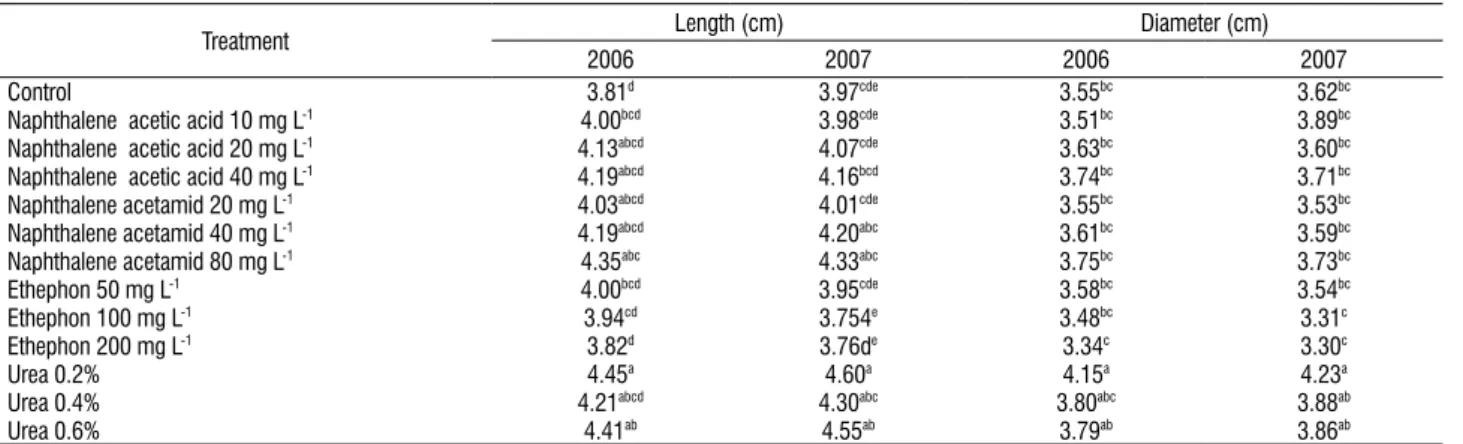
In 2006, NAD at 80 mg l-1 and urea at 0.2 and 0.6%
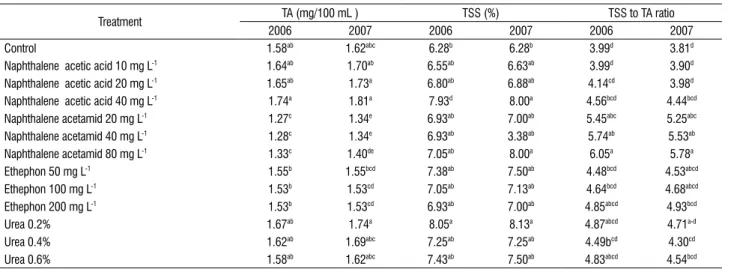
and in 2007, urea at 0.2 and 0.6% significantly increased fruit length (Table 3). In both years, Urea at 0.2% significantly increased fruit diameter (Table 3), NAD at all concentrations decreased total acidity and NAA at 40 mg l-1, NAD at 80 mg l-1
Table 1. Effect of chemical thinning on ‘Gerdi’ apricot fruit thinning at 2 weeks after treatment and at harvest.
Treatment
Fruit drop (%)
2 weeks after spray At harvest
2006 2007 2006 2007
Control 44.24cd 43.75c 52.42c 49.94c
Naphthalene acetic acid 10 mg L-1 51.97bcd 49.19bc 63.28abc 60.48abc
Naphthalene acetic acid 20 mg L-1 53.00bcd 59.5ab 62.36abc 59.56abc
Naphthalene acetic acid 40 mg L-1 57.98abcd 61.14ab 76.00a 74.51a
Naphthalene acetamid 20 mg L-1 40.72d 38.03c 55.22bc 52.49bc
Naphthalene acetamid 40 mg L-1 60.93abc 58.39ab 65.83abc 63.79abc
Naphthalene acetamid 80 mg L-1 61.47abc 58.04ab 71.59ab 69.84a
Ethephon 50 mg L-1 67.49ab 65.26a 72.00ab 69.72a
Ethephon 100 mg L-1 71.85a 68.75a 77.13a 74.06a
Ethephon 200 mg L-1 68.06ab 66.43a 75.61a 73.04a
Urea 0.2% 61.41abc 59.58ab 67.24abc 65.61ab
Urea 0.4% 59.93abc 57.10ab 67.33abc 66.01ab
Urea 0.6% 59.41abc 57.00ab 66.05abc 64.04abc
Means in each column with the similar superscript letters are not significantly different at P = 0.05 using DNMRT.
Table 2. Effect of chemical thinning on ‘Gerdi’ apricot fruit weight and volume.
Treatment Weight (g) volume (cm
3)
2006 2007 2006 2007
Control 26.22e 26.23def 24.96e 24.94de
Naphthalene acetic acid 10 mg L-1 28.23cde 28.02cdef 27.63de 27.63cd
Naphthalene acetic acid 20 mg L-1 31.70abcd 30.85bcde 30.75bcde 30.75bcd
Naphthalene acetic acid 40 mg L-1 33.98abcd 32.60bcd 33.88abcd 33.25bc
Naphthalene acetamid 20 mg L-1 31.68abcde 31.40bcde 30.17bcde 32.17bcd
Naphthalene acetamid 40 mg L-1 33.55abc 32.27bcde 33.50abcd 34.67bc
Naphthalene acetamid 80 mg L-1 35.62ab 34.85bc 35.25abc 34.75bc
Ethephon 50 mg L-1 28.87bcde 26.18def 28.87cde 25ed
Ethephon 100 mg L-1 28.47bcde 24.18ef 28.47de 25ed
Ethephon 200 mg L-1 27.46ed 21.83f 27.47de 18.82e
Urea 0.2% 37.75a 44.13a 37.50a 42.5a
Urea 0.4% 34.00abcd 35.48bc 33.75abcd 36.67ab
Urea 0.6% 35.88ab 38.70ab 35.41ab 38.13ab
Means in each column with the similar superscript letters are not significantly different at P = 0.05 using DNMRT.
Table 3. Effect of chemical thinning on ‘Gerdi’ apricot fruit length and diameter in 2006 and 2007.
Treatment Length (cm) Diameter (cm)
2006 2007 2006 2007
Control 3.81d 3.97cde 3.55bc 3.62bc
Naphthalene acetic acid 10 mg L-1 4.00bcd 3.98cde 3.51bc 3.89bc
Naphthalene acetic acid 20 mg L-1 4.13abcd 4.07cde 3.63bc 3.60bc
Naphthalene acetic acid 40 mg L-1 4.19abcd 4.16bcd 3.74bc 3.71bc
Naphthalene acetamid 20 mg L-1 4.03abcd 4.01cde 3.55bc 3.53bc
Naphthalene acetamid 40 mg L-1 4.19abcd 4.20abc 3.61bc 3.59bc
Naphthalene acetamid 80 mg L-1 4.35abc 4.33abc 3.75bc 3.73bc
Ethephon 50 mg L-1 4.00bcd 3.95cde 3.58bc 3.54bc
Ethephon 100 mg L-1 3.94cd 3.754e 3.48bc 3.31c
Ethephon 200 mg L-1 3.82d 3.76de 3.34c 3.30c
Urea 0.2% 4.45a 4.60a 4.15a 4.23a
Urea 0.4% 4.21abcd 4.30abc 3.80abc 3.88ab
Urea 0.6% 4.41ab 4.55ab 3.79ab 3.86ab
Table 4. Effect of chemical thinning on ‘Gerdi’ apricot fruit TA, TSS and TSS to TA ratio in 2006 and 2007.
Treatment TA (mg/100 mL ) TSS (%) TSS to TA ratio
2006 2007 2006 2007 2006 2007
Control 1.58ab 1.62abc 6.28b 6.28b 3.99d 3.81d
Naphthalene acetic acid 10 mg L-1 1.64ab 1.70ab 6.55ab 6.63ab 3.99d 3.90d
Naphthalene acetic acid 20 mg L-1 1.65ab 1.73a 6.80ab 6.88ab 4.14cd 3.98d
Naphthalene acetic acid 40 mg L-1 1.74a 1.81a 7.93d 8.00a 4.56bcd 4.44bcd
Naphthalene acetamid 20 mg L-1 1.27c 1.34e 6.93ab 7.00ab 5.45abc 5.25abc
Naphthalene acetamid 40 mg L-1 1.28c 1.34e 6.93ab 3.38ab 5.74ab 5.53ab
Naphthalene acetamid 80 mg L-1 1.33c 1.40de 7.05ab 8.00a 6.05a 5.78a
Ethephon 50 mg L-1 1.55b 1.55bcd 7.38ab 7.50ab 4.48bcd 4.53abcd
Ethephon 100 mg L-1 1.53b 1.53cd 7.05ab 7.13ab 4.64bcd 4.68abcd
Ethephon 200 mg L-1 1.53b 1.53cd 6.93ab 7.00ab 4.85abcd 4.93bcd
Urea 0.2% 1.67ab 1.74a 8.05a 8.13a 4.87abcd 4.71a-d
Urea 0.4% 1.62ab 1.69abc 7.25ab 7.25ab 4.49bcd 4.30cd
Urea 0.6% 1.58ab 1.62abc 7.43ab 7.50ab 4.83abcd 4.54bcd
Means in each column with the similar superscript letters are not significantly different at P = 0.05 using DNMRT.
Urea at 0.2% had the highest effect on TSS in 2006 and 2007 (Table 3). Thinning treatments also significantly increased TSS to TA ratio. NAD at all concentrations significantly increased this parameter (Table 4). Nut weight was not affected by treatments (Table 5). NAD at all concentrations in 2006 and 2007 and urea at 0.2 and 0.6% in 2007 significantly increased flesh to nut ratio (Table 5).
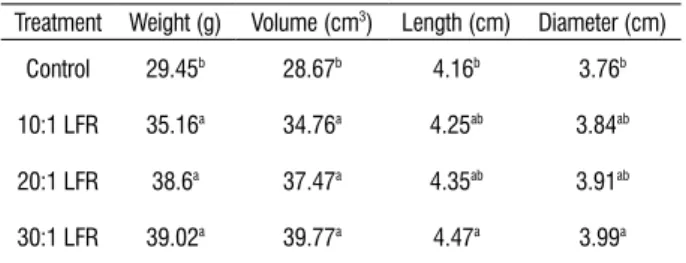
hand thinning: Hand thinning affected fruit size of ‘Gerdi’ cultivar apricot in both aspects of fruit weight and volume (Table 6). Increasing the thinning intensity by adjusting the
LFR to 30:1, significantly increased fruit weight (39.02 g) and
fruit volume (39.77 cm3). Also, fruit length and diameter were
significantly increased (Table 6). Control fruits registered the lowest value for this parameter.
Table 5. Effect of chemical thinning on ‘Gerdi’ apricot fruit nut weight and flesh to nut ratio in 2006 and 2007.
Treatment Nut weight(g) flesh to nut ratio
2006 2007 2006 2007
Control 2.24abc 2.32abcd 10.78c 10.31de
Naphthalene acetic acid 10 mg L-1 2.22abc 2.27abcd 11.66bc 11.29cde
Naphthalene acetic acid 20 mg L-1 2.28abc 2.35abcd 12.89abc 12.03bcde
Naphthalene acetic acid 40 mg L-1 2.37abc 2.43abc 13.38abc 12.36abcde
Naphthalene acetamid 20 mg L-1 1.96c 2.04cd 15.36ab 14.38abc
Naphthalene acetamid 40 mg L-1 2.04bc 2.11cd 15.67ab 14.55abc
Naphthalene acetamid 80 mg L-1 2.07bc 2.15bcd 16.19a 15.21ab
Ethephon 50 mg L-1 1.98c 2.03cd 13.87abc 11.98e
Ethephon 100 mg L-1 1.95c 2.01d 13.89abc 10.96cde
Ethephon 200 mg L-1 1.96c 2.01d 12.95abc 9.87abcde
Urea 0.2% 2.59a 2.66a 14.00abc 15.85a
Urea 0.4% 2.33abc 2.41abcd 13.64abc 13.75abcd
Urea 0.6% 2.44ab 2.51ab 13.94abc 14.57abc
Table 6. Effect of hand thinning at pit hardening stage on ‘Gerdi’ apricot fruit weight, volume, length and diameter in 2007.
Treatment Weight (g) volume (cm3) Length (cm) Diameter (cm)
Control 29.45b 28.67b 4.16b 3.76b
10:1 LFR 35.16a 34.76a 4.25ab 3.84ab
20:1 LFR 38.6a 37.47a 4.35ab 3.91ab
30:1 LFR 39.02a 39.77a 4.47a 3.99a
Means in each column with the similar superscript letters are not significantly different at P = 0.05 using DNMRT. LFR: leaf to fruit ratio.
Hand thinning had no significant effect on TA (Table 7), however all of treatments significantly increased TSS (Table 7). In LFR of 20:1 and 30:1, TSS to TA ratio significantly increased (Table 7). All of hand thinning treatments significantly increased nut weight (from 2.36 g for control to 2.62 g for LFR of 30:1) (Table 7). Also, flesh to nut ratio influenced by these treatments.
Table 7. Effect of hand thinning at pit hardening stage on ‘Gerdi’ apricot fruit TSS, TA, TSS to TA ratio and nut weight and flesh to nut ratio in 2007.
Treatment TSS (%)
TA (mg/100 mL )
TSS to TA ratio
Nut weight (g)
Flesh to nut ratio
Control 6.87c 1.52a 4.59b 2.36b 12.47b
10:1 LFR 8b 1.59a 5.02ab 2.6a 13.56ab
20:1 LFR 8.5ab 1.54a 5.49a 2.6a 14.87a
30:1 LFR 8.8a 1.54a 5.77a 2.62a 15.04a
Means in each column with the similar superscript letters are not significantly different at P = 0.05 using DNMRT. LFR: leaf to fruit ratio.
DIscUssION
chemical thinning: In this study NAA and NAD significantly increased fruit drop. This data is in agreement with previous reports showed that application of NAA at 20 mg.l-1 (4 weeks AFB) was a good treatment for fruit thinning of
apricot (Surányi, 1986; Bolat and Karlidağ, 1999; Son, 2004).
Results showed that the difference between NAA and NAD on fruit abscission of ‘Gerdi’ cultivar was not significant, and this finding is not in agreement with trails conducted in ‘Hungary’
cultivar (Surányi, 1978), that reported differences in thinning
efficiency from application of potassium salt of NAA and NAD for different cultivars of apricot.
NAA application stimulates ethylene production in fruitlet and this increased concentration could induce abscission
(Dennis, 2000). Ebert and Bangerth (1982) measured both
extractable and diffusible auxin content of apple fruitlets following application of carbamyle, ethephon and NAD and they concluded that reduced auxin transport was the major responsible in thinning that occurred due to these treatments.
Urea at all concentrations induced fruitlet abscission in apricot trees and its effect was the same as NAA and NAD. The results of this study were in agreement with previous reports that urea significantly reduced fruit set in peaches
and nectarines (Zilkah et al., 1988), and pistachio (Rahemi
and Ramezanian, 2007). Ethephon effectively induced fruit abscission. As ethephon is absorbed by the tissue, its hydrolysis occures and released ethylene induces abscission by elevating respiration rate and production of enzymes which hydrolyze cellulose in the abscission layer (Wolpert and
Ferguson, 1990). The result of this study was in agreement with Estembridge and Gambrell (1971), who found that for
peach cultivars, application of ethrel at 100 to 150 mg l-1 in
endosperm cytokinesis stage resulted in sufficient thinning.
The application of NAA, NAD and urea significantly increased fruit weight and volume in the harvested fruits. This data confirms previous reports that increasing NAA and NAD concentrations had an increased effect on fruit weight in apricot (Son, 2004). The biggest fruit was related to 0.2% urea
treatment. Zilkah et al. (1988) also found that urea significantly
increased the final fruit weight of peaches and nectarines. In this experiment, ethephon at all concentrations significantly increased fruit thinning, but had no effects on weight, volume, and length of fruits at harvest. Treated fruits with ethephon
had the lowest fruit diameter. El-Zeftawi (1976) reported that
application of ethephon at 300 mg l-1 on mandarin increased fruit
good results without any defoliation (Taghipour and Rahemi,
2009). Thus, we concluded that the time of application was
not responsible factor for negative effects of ethephon and it was related to the differences in vigor of cultivars, because ‘Khiary’ apricot is too vigorous and the leaves may not be affected by the ethephon. NAD at all concentrations reduced TA; probably it was related to its effect on fruit ripening. Treated fruits ripened about one week earlier than control ones (Data not shown). In this experiment increasing NAA and NAD concentrations significantly increased TSS content, similar to the reported results of Son (2004). Flesh to nut ratio was the greatest in fruits treated with NAD. This data was in agreement with Son (2004) that stated 20 mg l-1 NAA had positive effects
on flesh to nut ratio of ‘Beliana’ apricot.
hand thinning: The results of this experiment showed that hand thinning significantly increased fruit weight, volume and quality and from this aspect, highest leaf to fruit ratio adjustment was the best treatment. Removing excessive fruits by fruitlet thinning prevent the energy draining of the tree by pits. Also, TSS and other fruit quality characteristics improved by hand thinning.
Dhinesh Babu and yadave (2004) reported that hand thinning of peach trees in subtropical north eastern India, significantly increased fruit weight. Our results were in agreement with Son (2004), who reported that hand thinning increased fruit weight and TSS.
It was concluded that chemical thinning increased fruitlet abscission, but hand thinning had the added benefit of being able to selectively remove any small and frost damaged fruits. Anyway, hand thinning is more expensive and time consuming than chemical method of fruit thinning.
Acknowledgements: The authors wish to thank Mr. Bahram Zarei for using his orchard during the course of this experiment.
RefeReNces
Dhinesh Babu K, yadave DS (2004) physical and chemical thinning of peach in subtropical north eastern India. Acta Hort. 662: 327-331.
Bolat I, Karlidağ H (1999) Thinning by NAA and hand of ‘Hacihaliloglu’ and
‘Hasanbey’ apricot cultivars. Acta Hort. 488: 507-510.
Dennis FGJr (2000) The history of fruit thinning. J. plant Growth Regul. 31: 1-16.
Ebert A, Bangerth F (1982) Possible hormonal modes of action of three apple
thinning agents. Sci. Hort. 16: 343-356.
El-zeftawi BM (1976) Effects of ethephon and 2,4,5-T on fruit size, rind
pigments and alternate bearing of ‘Imperial’ mandarin. Sci. Hort. 5: 315-320.
Estembridge GE, Gambrell CE (1971) Thinning peaches with bloom and
post-bloom applications of 2-chloroethylphosphonic acid. J. Amer. Soc. Hort. Sci.
96: 7-10.
Martin GC, Fitch LB, Sibbett GS, Comil GC, Ramos DE (1975) Thinning
French prune (Prunus domenstica L.) with (2-chloroethyl) phosphonic acid.
J. Am. Soc. Hort. Sci. 100: 90-93.
Mitra SK, Bose TK, Rathore DS (1991) Temperate Fruits. Horticulture and
Allied publishers, Calcutta, India.
Rahemi M, Ramezanian A (2007) potential of ethephon, NAA, NAD, and urea for thinning pistachio fruitlets. Sci. Hort. 111: 160-163.
Ryugo K (1988) Fruit Culture. Its Science and Art. John Willey and Sons,
New york, U.S.A.
Son L (2004) Effects of hand and chemical thinning on fruit size and quality of ‘priana’ and ‘Beliana’ apricot (Prunus armeniaca) cultivars. New Zealand J. Crop Hort. Sci. 32: 331-335.
Surányi D (1978) A Kajszibarack vegyszeres gyümölcsritkitása (Chemical fruit thinning of the apricot). Kertgazdaság. 10: 9-22.
Surányi D (1982) chemical thinning results of apricots. Acta Hort. 121: 335-339.
Surányi D (1986) The role of ecological factors affecting the fruit thinning of apricot. Acta Hort. 192: 73-80.
Taghipour L, Rahemi M (2009) Evaluation the effects of some chemical agents
on thinning percent and quality of apricot cv. ‘Khiary’ (Prunus armeniaca L). J. Hortic. Sci. 23: 78-84 (in persian).
Taghipour L, Rahemi M (2010) The influence of fruit thinning on the apricot cultivar ‘Gerdi’. Research J. Environ. Sci. 4: 467-472.
Webster AD, Spencer JE (2000) Fruit thinning plums and apricots. J. plant Growth Regul. 31: 101-112.
Wolpert JA, Ferguson L (1990) Inflorescence bud retention in Kerman pistachio: effects of defruiting date and branch size. HortScience. 25: 919-921.