Case Report
Key words
Thoracic-injuries; wounds, penetrating; tricuspid valve insufficiency; echocardiography.
Tricuspid valve lesions caused by penetrating chest trauma are rare and often underdiagnosed. The objective of this report is to describe a case of severe tricuspid insufficiency secondary to a knifing incident with an insidious evolution, diagnosed 19 years after the incident. The case emphasizes the importance of adequate follow-up of patients that are victims of penetrating chest trauma for a long period after the injury, to detect possible late complications of the trauma.
Tricuspid Valve Lesion due to Penetrating Chest Trauma
Renata de Carvalho Bicalho Carneiro, Fernanda de Azevedo Figueiredo, Luciana Campomizzi Calazans, Marcelo
Martins Pinto Filho, Daniel Furtado Vidigal, Maria do Carmo Pereira Nunes
Hospital das Clínicas da Faculdade de Medicina - Universidade Federal de Minas Gerais, Belo Horizonte, MG - Brazil
Mailing address: Maria do Carmo Pereira Nunes•
Rua Ludgero Dolabela, 801/601 - Gutierrez - 30430-130 - Belo Horizonte, MG - Brazil
E-mail: [email protected], [email protected]
Manuscript received on November 3rd, 2008; revised manuscript received
on January 21, 2009; accepted on August 6, 2009.
Introduction
Tricuspid valve lesions caused by penetrating chest trauma are rare1. The traumatic rupture of the tricuspid valve is
well-tolerated hemodynamically and thus, the number of reported cases is often underestimated. The diagnosis is made many months, or even years, after the trauma2.
The following report describes a case of traumatic tricuspid insufficiency secondary to a knifing incident.
Case Report
A 57-year-old male patient with chest trauma caused by a knifing incident that had occurred 19 years before was referred to cardiological assessment with a diagnosis of arterial hypertension. At the time of the chest trauma, he was submitted to hemothorax and hemopericardium drainage and surgical correction of the myocardial laceration.
Currently, the patient has presented dyspnea on great exertion, abdominal discomfort and lower-limb edema. At physical examination, he presented good general status, was eupneic and blood pressure (BP) was 140/90 mmHg. At the assessment of the jugular venous pulse, jugular ingurgitation was observed, with evident v wave. Cardiac auscultation showed a more audible systolic murmur at the lower left sternal border, which was accentuated by inspiration.
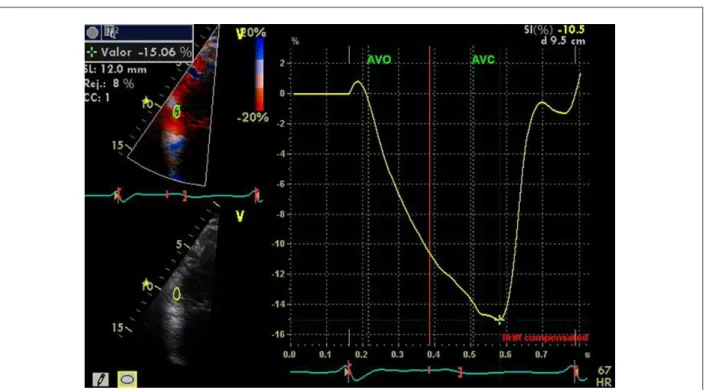
The electrocardiogram showed complete blocking of the right branch. The chest X-ray showed an increase in the cardiothoracic index, but no evidence of pulmonary congestion. The echocardiogram study showed rupture of the tricuspid valve leaflets, with bad coaptation at systole (Figure 1), causing massive tricuspid regurgitation (Figure 2). The right chambers showed large dilatation, but normal systolic pressure in the pulmonary artery (25 mm Hg). The contractility of the right ventricle was slightly reduced at the two-dimensional echocardiographic assessment, in spite of the volume overload caused by the valvular regurgitation. The analysis by the strain technique, a parameter used to assess the right ventricular systolic function measured at the basal segment of the free wall of the right ventricle showed a value of 15% (NV = 27 ± 6%), indicating systolic dysfunction of this chamber3.
Discussion
Heart lesions caused by chest trauma include several presentations, such as cardiac contusion, free-wall rupture, septal rupture and valvular lesion4.
Traumatic tricuspid regurgitation is rare and is often underestimated as it is hemodynamically well-tolerated and due to the attention given to lesions in the other organs. The time between the trauma and the surgery varies greatly, according to the etiology of each case, although the mean is 17 years5. In fact, regarding the present case, the diagnosis
of post-traumatic tricuspid valvular lesion was made 19 years after the traumatic event.
Due to its anterior location, the right ventricle is the most commonly affected chamber in penetrating chest trauma cases6, presenting a predisposition to
antero-posterior compression injuries. A sudden elevation in the right intraventricular pressure results in tricuspid valvular apparatus injury. When a sub-valvular lesion, papillary muscle rupture or avulsion occurs, the patient seems to become symptomatic more rapidly7. However, as seen in
our case, the leaflet lesions due to laceration or rupture close to the annulus evolve with more insidious symptoms8.
The mild tricuspid regurgitation constitutes a frequent finding at the echocardiogram, present in more than 75% of normal individuals9. However, the regurgitation of any
etiology, from moderate to severe, is associated with a worse long-term prognosis. A study with 5,223 patients showed that the 1-year survival rate was 90% in patients with or without mild tricuspid regurgitation; 79% in those with moderate regurgitation and 64% in cases of severe regurgitation, regardless of the age, biventricular systolic
Case Report
Carneiro e cols. Insuficiência tricúspide por trauma torácico
Arq Bras Cardiol 2010;94(2): e16-e18
Figure 1 -Apical 4-chamber view at the echocardiogram, showing rupture of the tricuspid valve lealets (arrows).
Figure 2 -Apical 4-chamber view at the echocardiogram, showing signiicant tricuspid regurgitation at the color Doppler.
function and right ventricular dimensions10. Thus, although
the patient had recovered from a severe chest trauma, he presented a residual lesion in the tricuspid valve with impact on survival.
The evaluation of the right ventricular function at the
echocardiogram presents several limitations. Recently, a new technique derived from the tissue Doppler, the strain technique (Figure 3), a parameter that directly analyzes the movement of the myocardial fibers, is being employed. A previous study demonstrated a correlation between the
Case Report
Carneiro et al
Tricuspid insufficiency due to chest trauma
Arq Bras Cardiol 2010;94(2): e16-e18
References
1. Doty JR, Cameron DE, Elmaci T, Salomon NW. Penetranting trauma to the tricuspid valve and ventricular septum: delayed repair. Ann Thorac Surg. 1999; 67: 252-3.
2. Herbots T, Vermeersch P, Vaerenberg M. Delayed post-traumatic tamponade together with rupture of the tricuspid valve in a 15 year old boy. Heart. 2001; 86: e12.
3. Gilman G, Khandheria BK, Hagen ME, Abraham TP, Seward JB, Belohlavek M. Strain rate and strain: a step-by-step approach to image and data acquisition. J Am Soc Echocardiogr. 2004; 17: 1011-20.
4. Nelson M, Wells G. A case of traumatic tricuspid valve regurgitation caused by blunt chest trauma. J Am Soc Echocardiogr. 2007; 20: 198: e4-5.
5. Van Son JA, Danielson GK, Schaff HV, Miller FA Jr. Traumatic tricuspid valve insufficiency: experience in thirteen patients. J Thorac Cardiovasc Surg. 1994; 108: 893-8.
6. Morelli S, Perrone C, Bernardo ML, Voci P. Flail tricuspid valve in a patient with history of stab chest wound. Int J Cardiol. 1998; 66: 111-3.
7. Werne C, Sagraves SG, Costa C. Mitral and tricuspid valve rupture from blunt chest trauma sustained during motor vehicle collision. J Trauma. 1989; 29: 113-5.
8. Ribichini F, Conte R, Lioi A, Dellavalle A, Ugliengo G. Subacute tricuspid regurgitation with severe hypoxemia complicating blunt chest trauma. Chest. 1996; 109; 289-91.
9. Oh JK, Seward JB, Tajik JA. The echo manual. 3rd ed. New York: Lippincott Williams & Wilkins; 2007.
10. Natch J, Foster E, Heidenreich PA. Impact of tricuspid regurgitation on long-term survival. J Am Coll Cardiol. 2004; 43: 405-9.
11. Urheim S, Cauduro S, Frantz R, McGoon M, Belohlavek M, Green T, et al. Relation of tissue displacement and strain to invasively determined right ventricular stroke volume. Am J Cardiol. 2005; 96: 1173-8.
Figure 3 -Measurement of the strain in the basal segment of the free wall of the right ventricle. Observe the negative curve of the strain, measuring the dislocation peak.
AVO - aortic valve opening; AVC - aortic valve closing.
strain and the invasive measurements of the right ventricular systolic function11. In the present case, the reduced strain
confirmed the right ventricular dysfunction secondary to the tricuspid lesion.
Conclusion
In conclusion, the case reported here emphasizes the importance of adequate follow-up of patients that have suffered penetrating chest trauma for several months after the injury, to detect possible late trauma complications.
Potential Conflict of Interest
No potential conflict of interest relevant to this article was reported.
Sources of Funding
There were no external funding sources for this study.
Study Association
This study is not associated with any post-graduation program.