DOI: 10.1590/0004-282X20160009
ARTICLE
Main determinants of physical activity levels
in individuals with Parkinson’s disease
Fatores determinantes do nível de atividade física de indivíduos com doença de Parkinson
Raquel de Carvalho Lana1, Lysandra Nogueira de Araujo2, Francisco Cardoso3, Fátima Rodrigues-de-Paula2
Parkinson’s disease (PD) is a chronic and degenera-tive disease of the central nervous system characterized by
a combination of motor and non-motor disorders1. PD may
severely compromise the ability to perform tasks such as walking, writing, turning, and moving in bed1, mainly because
of a combination of motor limitations, fatigue, and apathy2.
he progression of PD is associated with progressive deicits,
which might contribute to sedentarism, and result in reduced physical ability in these patients3.
A recent study indicated that individuals with PD are 29% less active than healthy individuals2. However, the ability of
patients in the initial phase of PD to perform physical exercise
may be comparable to that of healthy individuals when they maintain a certain level of regular physical activity. Although the daily pattern of physical activity in the initial phase of the disease appears similar to that of controls4, this tends to
change when PD progresses4.
Recent studies have assessed factors that might play a role in the level of physical activity of PD patients2,5. Factors
related to the disease such as severity of disease, levodopa daily dose and motor impairment level; factors related to the individual such as age and walking performance were point-ed out as determinants of the physical activity level2,5. Factors
such as lower limb bradykinesia, clinical subtype and fatigue,
1Universidade Federal de Minas Gerais, Programa de Pós-graduação em Ciências da Reabilitação, Belo Horizonte MG, Brazil; 2Universidade Federal de Minas Gerais, Departamento de Fisioterapia, Belo Horizonte MG, Brazil;
3Universidade Federal de Minas Gerais, Departamento de Medicina Interna, Belo Horizonte MG, Brazil.
Correspondence: Fátima Rodrigues-de-Paula; Departamento de Fisioterapia, Escola de Educação Física, Fisioterapia e Terapia Ocupacional da Universidade Federal de Minas Gerais; Avenida Antônio Carlos, 6627; 31270-901 Belo Horizonte MG, Brasil; E-mail: [email protected]
Conflict of interest: There is no conlict of interest to declare.
Support: Fundação de Amparo à Pesquisa do Estado de Minas Gerais (FAPEMIG), Conselho Nacional de Desenvolvimento Cientíico e Tecnológico (CNPq), Pró-reitoria de Pós-graduação da Universidade Federal de Minas Gerais (UFMG).
Received 31 October 2014; Received in inal form 20 September 2015; Accepted 13 October 2015.
ABSTRACT
This study analyzed the relationship between patient characteristics, factors associated with Parkinson’s disease (PD), and physical activity level of individuals affected by the disease. Forty-six volunteers with mild-to-moderate idiopathic PD were assessed using sections II/III of the Uniied Parkinson’s Disease Rating Scale and their motor functions were classiied according to the modiied Hoehn and Yahr (HY) scale. Data such as age, disease duration, the Human Activity Proile (HAP), the Fatigue Severity Scale were collected. Lower limb bradykinesia and clinical subtypes of PD were deined. Two models that explained 76% of the variance of the HAP were used. The irst comprised age, ability to perform activities of daily living (ADL), and the HY scale; the second comprised age, ability to perform ADL, and lower limb bradykinesia. Possible modiiable factors such as the ability to perform ADL and lower limb bradykinesia were identiied as predictors of physical activity level of individuals with PD.
Keywords: Parkinson’s disease, physical activity, bradykinesia, fatigue.
RESUMO
Este estudo analisou a relação entre características dos pacientes, fatores associados com a doença de Parkinson (DP) e nível de atividade física de indivíduos afetados pela doença. Quarenta e seis voluntários com DP leve a moderada foram avaliados usando a Escala de Avaliação Uniicada da Doença de Parkinson (UPDRS), e classiicados de acordo com a Escala de Hoehn e Yahr modiicada (HY). Dados como idade, duração da doença, Peril de Atividade Humana (PAH), Escala da Severidade da Fatiga (FSS) foram coletados. Bradicinesia de membros inferiores e subtipos clínicos foram deinidos. Dois modelos que explicaram 76% da variância do PAH foram observados. O primeiro compreende idade, habilidade de realizar Atividades de Vida Diária (AVD) e a escala de HY modiicada; e o segundo compreende idade, habilidade de realizar AVD, e bradicinesia. Fatores modiicáveis como a habilidade de realizar AVD e bradicinesia foram identiicados como preditores do nível de atividade física de indivíduos com DP.
that may decrease the level of physical activity in individuals with PD, have not yet been studied.
It is known that inactivity is considered a risk factor for several diseases and may worsen various motor and
non-motor symptoms that are afected in PD2. Additionally,
previous studies have explained only up to 28% of the vari-ance of the level of physical activity of these individuals2,5.
Knowledge of the factors that afect the level of physical ac -tivity of individuals with PD may guide clinicians that work with PD rehabilitation, and thereby prevent inactivity and its
consequences. herefore, the aim of the present study was
to analyze factors associated with the disease (progression time, severity, clinical subtype, and lower limb bradykinesia) and the individual (age, ability to perform daily living activi-ties, and fatigue) that may predict or explain the variance in the level of physical activity of individuals with PD.
METHOD
Participants
his was a cross-sectional study in which the partici -pants were recruited by convenience from the University’s Outpatient Clinic for Movement Disorders. Participants were recruited by students and evaluated by a trained re-searcher. Individuals with idiopathic PD, diagnosed by a neurologist specialized in movement disorders, according to
the UK Brain Bank criteria6, classiied as a score of 1–4 on
the modiied Hoehn and Yahr (HY) disability scale7, using
antiparkinsonian medication, and who did not show other neurological, musculoskeletal, or cardiovascular disorders were included in the analysis. All participants were briefed on the objectives of the research, and then they signed a free
and informed consent form. his study was approved by the
Ethics in Research Committee of the university.
Measures
Identification and characterization
he study participants were subjected to an initial evalu -ation for data collection, which included questions regarding
identiication, age, medication use, progression of the dis -ease, and associated pathologies.
Clinical evaluation and questionnaires
To evaluate the severity of the disease, activities of
dai-ly living (ADL) and motor sections of the Uniied Parkinson’s Disease Rating Scale (UPDRS) and the modiied HY scale
were used7,8. he bradykinesia score from the lower limbs
was calculated using the sum of the scores of items 26, 27,
29, and 31 of the UPDRS. he higher scores of those items
indicated increased severity of bradykinesia9. he clinical
subtypes of PD were classiied as tremor-dominant (T), rigid-akinetic (RA), and mixed (M) according to the classiication
proposed by Schiess et al.10. he perception of fatigue was as
-sessed using the Fatigue Severity Scale (FSS), and the level of physical activity was determined using the Human Activity
Proile (HAP). he HAP was adapted and validated to portu -guese (Brazil)11 and comprises 94 items of routine activities
with diferent functional levels, and can classify individuals
as inactive, moderately active, or active11,12.
Procedures
he initial evaluation for the collection of data was per
-formed through an interview and an identiication form. he participants were informed about the aims of the study,
and the eligible individuals were subjected to a clinical functional evaluation using the partial UPDRS and the
modiied HY scale. Next, the level of physical activity of the
participants was evaluated by a trained examiner using the
HAP questionnaire. Subsequently, subjects were classiied
into PD subtypes, and the lower limb bradykinesia score was calculated. Lastly, the FSS was applied to classify the subjects’ fatigue levels.
Statistical analysis
All analyses were performed using R version 2.13.0 soft-ware, and descriptive statistics was carried out for all the investigated variables. First, simple linear regression analysis was conducted to verify the relationships between the HAP as a dependent variable and the various independent variables (age, PD progression time, UPDRS-motor score, UPDRS-ADL
score, modiied HY stage, clinical subtypes, lower limb brady
-kinesia, and fatigue). Next, multiple linear regression analyses
were performed, using forward selection for the variables. In
the irst step, it was included in the model the variable which
explained most the variance in the univariate regression,
provided it was signiicant for a signiicance level of 0.05. In
the following step, an additional variable was added,
provid-ed it resultprovid-ed in a better it (in terms of explainprovid-ed variance)
compared to the other still not included variables and that
all variables in the model remain signiicant. Similar steps
followed until the point in which the inclusion of any oth-er variable would not result in a model with all independent
variables statistically signiicant.
RESULTS
A total of 46 individuals with PD participated in this study, including 29 men and 17 women, with a mean age of
65.9 ± 12.1 years (range, 42–88 years). he mean time of dis
-ease progression was 11.1 ± 7.4 years (range, 2–38 years). One
(2%), 4 (9%), 21 (46%), 6 (13%), 9 (19%), and 5 (11%)
individu-als were classiied as stage 1, 1.5, 2, 2.5, 3, and 4 according to the modiied HY scale, respectively. Regarding the clinical subtypes of PD, twenty-four (52%) patients were classiied as
the participants showed signiicant fatigue. According to the HAP score, 50% of the individuals were classiied as active,
19.6% as moderately active, and 30.4% as inactive.
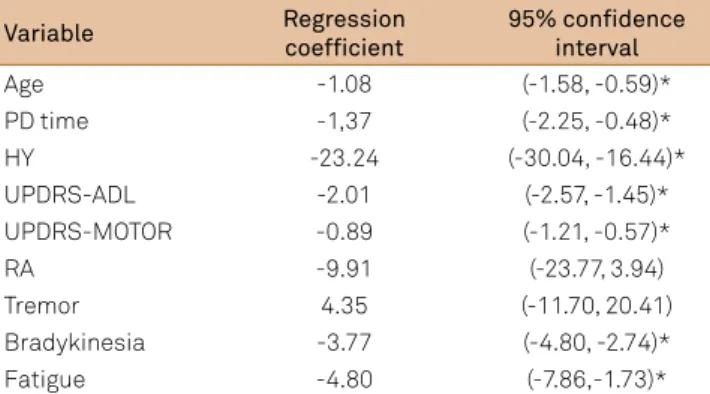
he FSS, UPDRS-ADL, UPDRS-motor, and HAP scores are shown in Table 1. he results from the univariate linear
regression analysis are shown in Table 2. Age, PD
progres-sion time, modiied HY stage, UPDRS-ADL, UPDRS-motor, lower limb bradykinesia, and fatigue all showed signiicant
associations with the HAP score.
Two models were proposed by the multiple linear
re-gression analysis. he results of these proposed models are shown in Tables 3 and 4. In the irst model, age, UPDRS-ADL score, and modiied HY stage were found to explain 76% of
the variance of the HAP score. In the second model, age, UPDRS-ADL score, and lower limb bradykinesia were found to also explain 76% of the HAP score variance.
DISCUSSION
We proposed two models to explain the variance in the level of physical activity in individuals with PD, because it
would be impossible to statistically deine which variable,
namely disease severity or lower limb bradykinesia would best predict the level of physical activity in such individuals.
he two models were able to predict 76% of the variance in
the level of physical activity, as evaluated by the HAP.
Although few studies have assessed factors afecting
physical activity level of individuals with PD, some authors have indicated factors associated with the disease and/or the
individual. Nimwegen et al.2 observed that a higher severity of
the disease, walking deicits, and an inability to perform ADL
predicted 24% of the variance of the patients’ daily physical activity level. Our results also indicated the inability to per-form ADL and disease severity as predictors of the level of physical activity in individuals with PD. However, after add-ing these factors to age, a higher percentage of this variance was explained (76%).
Furthermore, in a recent study, age, levodopa daily dose, distance covered in the 6-min walk test, and the total UPDRS score were found to predict only 28% of the daily physical ac-tivity level in sedentary PD patients5. As in this previous study,
we found that age was a determinant of the level of physical activity. Increased age was associated with increased pro-gression of motor impairment; decreased responsiveness to levodopa treatment; and more severe postural, walking, and
cognitive deicits in patients with PD13,14,15. he strong inlu
-ence of age on the physical activity level and the non-inlu-ence
of disease duration, as observed in this study, have been
pointed out by many authors15,16. hus, the decrease in the
physical activity level seems to be highly associated with the
immobility and sedentarism of older individuals16, since the
aging process by itself is characterized by a decline in the physical ability and functional performance17.
Table 3. Coeficients of regression and 95% conidence
intervals (95%CI) of the multivariate regression analysis, with inclusion of HY stage.
Variable Regression
coefficient 95%CI
Age -0.81 (-1.11, -0.51)*
UPDRS-ADL -1.20 (-1.78, -0.62)*
HY -10,30 (-17.24, -3.36)*
Intercept 159.28
R2 0.76
Regression equation: Y = 159.28 – 0.81 Xi – 1.20 Xu – 10.30 Xh. With Xi = age; Xu = UPDRS-ADL; and Xh = HY.
UPDRS: Uniied Parkinson’s Disease Rating Scale; ADL: activities of daily living; HY: Hoehn and Yahr disability stages; R2: Explained variance. *p < 0.05.
Table 1. Scores obtained in the evaluations performed in the
study (n = 46).
Test Mean
(standard deviation) Range
FSS 4 (2.1) 1–7
UPDRS-ADL 31.3 (17.4) 0–52
UPDRS-MOTOR 14.2 (8.8) 0–108
HAP 63.8 (24.2) 0–94
FSS: Fatigue Severity Scale; UPDRS: Uniied Parkinson’s Disease Rating Scale; ADL: activities of daily living; HAP: Human Activity Proile.
Table 2. Coeficients of univariate regression.
Variable Regression
coefficient
95% confidence interval
Age -1.08 (-1.58, -0.59)*
PD time -1,37 (-2.25, -0.48)*
HY -23.24 (-30.04, -16.44)*
UPDRS-ADL -2.01 (-2.57, -1.45)*
UPDRS-MOTOR -0.89 (-1.21, -0.57)*
RA -9.91 (-23.77, 3.94)
Tremor 4.35 (-11.70, 20.41)
Bradykinesia -3.77 (-4.80, -2.74)*
Fatigue -4.80 (-7.86,-1.73)*
PD time: Parkinson’s disease progression time; HY: Hoehn and Yahr disability stages; UPDRS: Uniied Parkinson’s Disease Rating Scale; ADL: activities of daily living; RA: rigid-akinetic. *Signiicant relationship (p < 0.05) between the variables and the physical activity level (HAP).
Table 4. Regression coeficients and 95%CI of the multivariate
regression analysis, with inclusion of lower limb bradykinesia.
Variable Regression
coefficient 95%CI
Age -0.81 (-1.11, -0.50)*
UPDRS-ADL -1.10 (-1.75, -0.45)*
Lower limb bradykinesia -1.72 (-2.94, -0.50)*
Intercept 144.03
R2 0.76
Regression equation: Y = 144.03 – 0,81 Xi – 1.10 Xu – 1.72 Xb. With Xi = age; Xu = UPDRS-ADL; and Xb = bradykinesia.
he ability to perform ADL was found to be a predictive
factor for the level of physical activity in patients with PD,
as previously reported2.A higher loss of functional
indepen-dence was associated with a higher UPDRS score and a more
severe disease as per the modiied HY scale, indicating a pos -itive association between disease severity and the need for help in ADL and instrumental activities18.
Disease severity was found to be a predictive factor of the physical activity level in such individuals in other previous studies2,5. Unlike the results of our study, previous studies2,5
noted that the total UPDRS score alone or along with the HY
stage were predictive factors of the level of physical
activi-ty in PD patients. he HY scale has been widely used for the
clinical evaluation of PD patients, and describes categories of motor dysfunction. High correlations have been reported
be-tween HY progression and motor decline and deterioration of quality of life in individuals with PD, conirming its wide use in the classiication of PD severity8.
To our knowledge, ours is the irst study to identify that
lower limb bradykinesia is a predictive factor of the level of physical activity in patients with PD. Bradykinesia is con-sidered the most debilitating symptom of the disease and is associated with reduced ability of the patient to perform vari-ous functional tasks1. In addition, an interaction efect between
the duration of the disease and age on bradykinesia has been previously reported15. his indicates that the simultaneous
efects of age and disease duration on bradykinesia are not
additive, as they are highly dependent on each other. Various clinical scores, including the UPDRS-motor score, have been reported to show stronger associations with velocity than
with amplitude of movement19. Despite the complex relation
between these factors, these previous indings, as well as the indings from this study, indicate that lower limb bradykinesia is associated with motor deicits, age, and disease progression.
For the deinition of bradykinesia, we used the subscore proposed by Allen et al.9. In fact, it is a lower limb bradykinesia
subscore derived by summing items of the UPDRS motor examination. As many studies used the same subscore, it
allowed us to make comparisons between them9,19. Besides
that, most of the activities of the HAP (more than 75%) in-volve mainly the lower limbs.
To our knowledge, this was the irst study assessing sub
-type classiication as a possible predictive factor of the level
of physical activity of patients with PD. Although the clinical heterogeneity among patients with PD has been extensively debated7, indicating the existence of clinical subtypes of the
disease, this classiication remains controversial and requires a better deinition. Accordingly, several authors have pro
-posed diferent subtype classiications10,20,21, although a clear
and accepted classiication has not yet been established. his indeinition may have inluenced with the indings of the
present study, and this requires further investigation. Finally, fatigue was not a predictive factor of the physi-cal activity level in individuals with PD. It is known that the
physiologic stress of daily physical activities is increased in pa-tients with PD, and this may contribute to the elevated level of fatigue that is characteristic of the disease22. hus, we ex
-pected that fatigue would inluence the physical activity level
of such individuals. However, the relationship between fatigue and the measures of physical activity is intriguing. Garber and
Friedman23 observed that a higher degree of fatigue was
as-sociated with a low level of physical activity. It is evident that patients with increased fatigue move less, but it is uncertain whether fatigue is the cause of physical inactivity or if it is the result of a sedentary lifestyle23. According to Elbers et al.24 the
variance in the physical activity level explained by fatigue is
small (only 2%). hese indings, as well as those from our study,
suggest that fatigue may be an independent symptom of PD that cannot predict the level of physical activity and that may only represent a minor factor within the numerous factors that
afect the level of physical activity in individuals with PD. he indings of our study indicate that the level of phys -ical activity is in part explained by factors that cannot be
modiied, such as age, but also by factors modiiable by
therapeutic intervention, such as ability to perform ADL and lower limb bradykinesia.
Based on our results, bradykinesia and the identiication of diiculties in performing ADL must be target during physi -cal therapy evaluation, particularly when these factors are
present in older individuals with PD. herefore, rehabilitation
programs should include functional training of activities and gain of speed, which could make such individuals more physi-cally active and reduce the adverse consequences of inactivity. Our study has some limitations. Although most activities related to the physical activity level involve the lower limbs, up-per limb bradykinesia was not evaluated. Moreover, although
no signiicant diiculty has been observed during the tests,
cognition was not formally evaluated in all participants. Most importantly, we were unable to identify which variable
(modi-ied HY stage or lower limb bradykinesia) better predicted the level of physical activity in patients with PD. his was likely due to a strong association between then, with both relecting disease severity, making it diicult to deine which variable is
the best predictor in this study, considering the relatively small
sample size. his interaction may also have occurred due to the methodological bias between the scales itself. he brady -kinesia measure is derived from four questions of the motor
UPDRS, which relects disease severity, such as the HY scale.
In conclusion, up to 76% of the variance in the physical activity level of individuals with PD can be explained by age, the ability to perform ADL, and the severity of the disease (as
determined by the modiied HY scale), or by lower limb brady -kinesia. In contrast to the expected result, the UPDRS-motor score, disease progression time, clinical subtypes of the dis-ease, and fatigue did not explain this variance. According
to our results, factors that can be modiied by therapeutic intervention were identiied and they must be evaluated and
References
1. Morris ME. Movement disorders in people with Parkinson disease: a model for physical therapy. Phys Ther. 2000;80(6):578-97.
2. Nimwegen M, Speelman AD, Hofman-van Rossum EJM, Overeem S, Deeg DJH, Borm GF et al. Physical inactivity in Parkinson’s disease. J Neurol. 2011;258(12):2214-21. doi:10.1007/s00415-011-6097-7
3. Canning CG, Alison JA, Allen NE, Groeller H. Parkinson’s disease: an investigation of exercise capacity, respiration function, and gait. Arch Phys Med.Rehabil. 1997;78(2):199-207. doi:10.1016/S0003-9993(97)90264-1
4. Hilten JJ, Hoogland G, Velde EA, Middelkoop HA, Kerkhof GA, Roos RA. Diurnal effects of motor activity and fatigue in Parkinson’s disease. J Neurol Neurosurg Psychiatry. 1993;56(8):874-7. doi:10.1136/jnnp.56.8.874
5. Dontje ML, Greef M, Speelman A,Ninwegen M, Krijnen WP, Stolk R. Determinants of daily physical activity in inactive Parkinson’s disease patients. J Sci Med Sport. 2013;15:S34-126. doi:10.1016/j.jsams.2012.11.190
6. Hughes AJ, Daniel SE, Kilford L, Lees AJ. Accuracy of clinical diagnosis of idiopathic Parkinson’s disease:a clinico-pathological study of 100 cases. J Neurol Neurosurg Psychiatry. 1992;55(3):181-4. doi:10.1136/jnnp.55.3.181
7. Schenkman ML, Clark K, Xie T, Kuchibhatla M, Shinberg M, Ray L. Spinal movement and performance of a standing reach task in participants with and without Parkinson disease. Phys Ther. 2001;81(8):1400-11.
8. Goetz CG, Poewe W, Rascol O, Sampaio C, Stebbins GT, Giladi N et al.
MovementDisorder Society Task Force report on the Hoehn and Yahr staging scale: status and recommendations. Mov Disord. 2004;19(8):1020-8. doi:10.1002/mds.20213
9. Allen NE, Canning CG, Sherrington C, Fung VSC. Bradykinesia, muscle weakness and reduced muscle power in Parkinson’s disease. Mov Disord. 2009;24(9):1344-51. doi:10.1002/mds.22609
10. Schiess MC, Zheng H, Soukup VM, Bonnen JG, Nauta HJW.
Parkinson’s disease subtypes: clinical classiication and
ventricular cerebrospinal luid analysis. Parkinsonism Relat Disord. 2000;6(2):69-76. doi:10.1016/S1353-8020(99)00051-6
11. Souza AC, Magalhães LC, Teixeira-Salmela LF. Adaptação transcultural e análise das propriedades psicométricas da versão brasileira do Peril de Atividade Humana. Cad Saúde Pública. 2006;22(12):2623-36. doi:10.1590/S0102-311X2006001200012
12. Davidson M, Morton N. A systematic review of the Human Activity Proile. Clin Rehabil. 2007;21(2):151-62. doi:10.1177/0269215506069475
13. Lee CS, Schulzer M, Mak EK, Snow BJ, Tsui JK, Clane S et al. Clinical observations on the rate of progression of idiopathic parkinsonism. Brain. 1994;117(3):501-7. doi:10.1093/brain/117.3.501
14. Levy G, Louis ED, Cote L, Perez M, Mejia-Santana H, Andrews H et al. Contribution of aging to the severity of different motor signs in Parkinson Disease. Arch Neurol. 2005;62(3):467-72. doi:10.1001/archneur.62.3.467
15. Levy G. The relationship of Parkinson disease with aging. Arch Neurol. 2007;64(9):1242-6. doi:10.1001/archneur.64.9.1242
16. Potter JM, Evans SAL, Duncan G. Gait speed and activities of daily living function in geriatric patients. Arch Phys Med Rehabil. 1995;76(11):997-9. doi:10.1016/S0003-9993(95)81036-6
17. Matsudo SM, Matsudo VKR. Prescrição e benefícios da atividade física na terceira idade. Rev Bras Ciênc Mov. 1992;6(4):19-30.
18. Shulman LM, Gruber-Baldini AL, Anderson KE, Vaughan CG, Reich SG, Fishman PS et al. The evolution of disability in Parkinson disease. Mov Disord. 2008;23(6):790-6. doi:10.1002/mds.21879
19. Kim JW, Kwon Y, Kim YM, Chung HY, Ecom GM, Jun JH et al. Analysis of lower limb bradykinesia in Parkinson’s disease patients. Geriatr Gerontol Int. 2012;12(2):257-64. doi:10.1111/j.1447-0594.2011.00761.x
20. Stebbins GT, Goetz CG, Bum DJ, Jankovic J, Khoo TK, Tiley BC.
How to identify tremor dominant and postural instability/gait dificulty groups with the movement disorder society uniied Parkinson’s disease rating scale: comparison with the Uniied Parkinson’s Disease Rating Scale. Mov Disord. 2013;28(5):668-70. doi:10.1002/mds.25383
21. Van Rooden SM, Colas F, Martinez-Martin P, Visser M, Verbaan D, Marinus J et al. Clinical subtypes of Parkinson’s disease. Mov Disord. 2011;26(1):51-8. doi:10.1002/mds.23346
22. Christiansen CL, Schenkman ML, Mc Fann K, Wolfe P, Kohrt WM. Walking economy in people with Parkinson’s disease. Mov Disord. 2009;24(10):1481-7. doi:10.1002/mds.22621
23. Garber CE, Friedman JH. Effects of fatigue on physical activity and function in patients with Parkinson’s disease. Neurology. 2003;60(7):1119-24. doi:10.1212/01.WNL.0000055868.06222.AB