Relationships among the Y balance test, Berg Balance
Scale, and lower limb strength in middle-aged
and older females
Dong-Kyu Lee1, Min-Hyeok Kang1, Tae-Sik Lee2, Jae-Seop Oh3
ABSTRACT | Background: Older females have less dynamic postural control and muscle strength than do middle-aged females. Aging-related strength losses may limit balancing performance. Objective: The purpose of this study was to investigate the ability of the Y Balance Test (YBT) and lower limb strength to discriminate between females in 2 age groups, the relationship between YBT distance and the Berg Balance Scale (BBS), and the degree to which performance on YBT distance is related to lower limb strength in middle-aged and older females. Method: The 40 healthy, independently active females were divided into 2 groups: older and middle-aged. The participants underwent measurements of YBT distance using the YBT, maximal muscular strength of the lower limbs using a handheld dynamometer, and the BBS. Results: The YBT distance in 3 directions and lower limb muscle strength for both lower limbs were signiicantly lower
in the older adults than in the middle-aged group. A moderate correlation but insigniicant correlation was found between the YBT composite distance and the BBS score. In the older females, YBT distance was signiicantly positively correlated with strength of the knee lexor and hip abductor. In the middle-aged group, YBT distance was signiicantly positively correlated with strength of the knee lexor and hip extensor. Conclusions: Performance on the YBT was inluenced by the strength of lower limb. We suggested that YBT can be used to alternative as a measurement of dynamic balance. Proper training programs for older people could include not only strengthening exercises but also YBT performance to improve balance.
Keywords: aging; Berg Balance Scale; lower limb strength; physical therapy; Y Balance Test.
HOW TO CITE THIS ARTICLE
Lee D-K, Kang M-H, Lee T-S , Oh J-S. Relationships among the Y balance test, Berg Balance Scale, and lower limb strength in middle-aged and older females. Braz J Phys Ther. 2015 May-June; 19(3):227-234. http://dx.doi.org/10.1590/bjpt-rbf.2014.0096
1Department of Rehabilitation Science, Graduate School, INJE University, Gimhae, South Korea 2Department of Physical Therapy, Dong-Eui Institute of Technology, Busan, South Korea
3Department of Physical Therapy, College of Biomedical Science and Engineering, INJE University, Gimhae, South Korea Received: July 18, 2014 Revised: Nov. 21, 2014 Accepted: Feb. 19, 2015
Introduction
In older adults, high levels of lower limb strength and balance are important prerequisites for the independent and successful performance of activities of daily living. Age-related musculoskeletal changes lead not only to muscle strength and mass decline but also limit balance and gait1,2. These changes are
closely related to the incidence of falls. In older adults, falls can cause severe injuries such as hip fractures (50%), arm fractures (13%), and head injuries (10%) or even death3,4.
Aging is associated with diminished muscle strength5,
changes in posture6, and lower postural stability7.
The decrease in strength seems to be explained, to a great extent, by the reduction in muscle mass, perhaps related to a decline in the intensity of daily physical activities8. Previous studies have reported
dynamic balance decreases with age9,10. Bouillon and
Baker10 reported that postural control scores based on
the Star Excursion Balance Test (SEBT) were lower in older females than in younger females. However, there is a lack of age-related differences in various measures of lower limb strength and dynamic balance between middle-aged and older females.
The Berg Balance Scale (BBS) has been widely used to assess dynamic and static balance in older adults. The BBS includes 14 items that are common in everyday life. In the clinical setting, the BBS is easy to apply and assesses balance in older adults to help predict the risk of falling11. However, some
studies have reported that the BBS is unreliable for screening the risk of falls among older adults12-14.
Despite its high reliability and validity11, the BBS
scored on an ordinal scale, it may not be suficiently
sensitive to change, particularly in active older adults with high levels of balancing ability. Given the low sensitivity of the BBS for balance limits, and that it has a ceiling effect, a new test should be developed to measure balance in a more challenging way for active older women.
The Y Balance Test-YBT (Move2Perform, Evansville, IN, USA) is a dynamic balance test that may be less likely than the BBS to demonstrate a ceiling effect. The YBT is essentially an instrumented version of the components of the SEBT, and it was developed to improve measurement repeatability and to standardize the performance of the test15. The YBT incorporates
reaching in 3 directions (anterior, posteromedial, and posterolateral) with the unsupported lower limb while in a single-limb stance on a centralized stance platform. In sports players, the YBT can be used for injury prediction and performance discrimination16. The beneits of the YBT are that it has a standard
protocol and high inter-rater (0.991.00) and intra-rater (0.850.91) reliabilities13. However, there was no
previous study demonstrating the reliability of the YBT in middle-aged and older females. Nevertheless, the YBT can be used to test and train simultaneously,
which is beneicial for the development of rehabilitation
and training programs.
From a therapist’s point of view, knowledge of the relationship between the strength of the lower limb muscles and balance may be important for both the
identiication of older adults with an increased risk
of falling and the development of fall-preventive training programs. Despite evidence demonstrating the importance of prevention of falling in older females, the relationship between the strength of the lower limbs and balance is not fully understood. By understanding the relationship between the YBT and strength, we can obtain more clinical information regarding which exercises would best help middle-aged and older females to achieve a long YBT distance. We believe that repeated investigation of the training to extend the YBT distance during one-leg standing will provide
beneicial information to clinicians for prevention of falls in older females. Thus, the irst purpose of
this study was to compare lower limb strength and the YBT distance in 3 directions in middle-aged and older females. The second purpose was to assess any relationship between the YBT distance and the BBS in older females and to determine any relationship between the YBT distance and lower limb strength in middle-aged and older females.
Method
Study design
This cross-sectional study required each participant to be assessed for YBT distance (anterior, posteromedial, and posterolateral), maximal muscular strength
of the lower limbs (hip extension, hip lexion, hip abduction, knee extension, knee lexion, and ankle dorsilexion), and BBS score. The study sample
was divided into 2 groups at 65 years: middle-aged and older women. This was a correlational study of relationships among YBT distance, the BBS, and lower limb strength in middle-aged and older females. All subjects read and signed an informed consent form approved by the Inje University Ethics Committee, Gimhae, Gyeongsangnam-Do, South Korea (approval number 2014067) for Human Investigations prior to participation.
Subjects
The 40 female participants, aged 45-80 years, volunteered for this study and were categorized into age groups: middle-aged (45-60 years) or older (70-80 years). There were 20 middle-aged females (53.9±5.0 years; 56.0±6.2 kg; 159.8±4.7 cm) and 20 older females (77.5±2.7 years; 51.7±7.7 kg; 152.8±4.4 cm). The older females were recruited from senior citizen centers in Haeundae, Busan, Republic of Korea. The middle-aged females were recruited from the community. Participants were healthy, living independently, were self-ambulatory without a cane or walker, and had no history of falls. Participants with self-reported neurological disease, musculoskeletal problems, visual impairment, or vestibular disease were
excluded. Older females with comprehension deicits
or disabilities that might limit the tasks of performance on the YBT or the BBS were also excluded.
Y Balance Test
The YBT is a reliable and valid tool for quantitative balance assessment13. The participants reached
with one foot in the anterior, posteromedial, and posterolateral directions during standing on the other foot on a central plastic footplate. All testing and practices were performed barefoot with both the left and right limbs to eliminate additional balance and stability from the shoes17. Each subject was allowed
allowed rest on a chair for 3 min between practice and recorded trials, but not between trials. The subject maintained a single-leg stance with hands on the pelvis while pushing a rectangular reach-indicator block with the contralateral leg as far as possible along the 3 directions (Figure 1). The reach distance was recorded to the nearest 0.5 cm as the point at which the reach-indicator block was pushed closest
to the central footplate. The speciic testing order
was right anterior, left anterior, right posteromedial, left posteromedial, right posterolateral, and left posterolateral (a consistent testing protocol was established to improve the reproducibility of the test).
A trial was classiied as invalid if the participant
did not return to the starting position, kicked the plate with the reaching foot to gain more distance, failed to maintain a unilateral stance on the platform, stepped on top of the reach indicator for support, or removed her hands from her hips. If an invalid trial occurred, the data were discarded, and the subject repeated the trial.
For normalization, the participants’ lower limb length while lying in the supine position (anterosuperior iliac spine to the center of the ipsilateral medial malleolus) was measured in centimeters bilaterally. For data analysis, the reach distance in each direction was normalized to the lower-limb length by calculating the maximized reach distance (%MAXD) using the formula (6 excursion distance/ both lower-limb length × 3) × 100 = % MAXD because of leg length differences within individuals18. The sum of 6 normalized
reach distances (right and left in all 3 directions) was then averaged to generate a composite distance.
Handheld Dynamometer
A digital handheld dynamometer (HHD; PowerTrack II, JTech Medical, Salt Lake City, UT) was used to measure the maximum voluntary strength in each participant. As in the BBS, the rater was a physical therapist with 5 years of experience. The maximal
isometric strength of the bilateral hip extensors, lexors, and abductors, knee extensors and lexors, and ankle dorsilexors was assessed by physical therapists with
5 years of experience using the PowerTrack II on each limb separately. We did not measure the isometric
force of the ankle plantar lexors because handheld
dynamometry provides unreliable measures of ankle
plantar lexor strength19. The testing positions, based
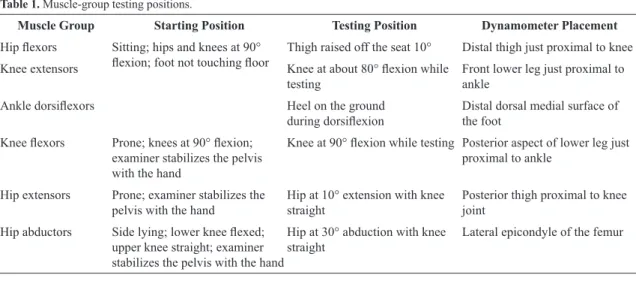
on Wang et al.20, are described in Table 1. Participants were told to stop contracting when the tester inished
counting to 5 seconds because this duration was shown to be adequate for most subjects to reach the maximum force in a previous study21. The mean peak value of
these 3 measurements was used for the data analysis.
Berg Balance Scale
To gain an understanding of the participants’ static and dynamic balance abilities, assessments were carried out with the BBS, a 14-item summative ordinal scale evaluating postural changes from sitting to standing and vice versa, transfers, sitting balance, and a variety of other standing balance tasks22. The rater
was a physical therapist with 5 years of experience. Among the 14 items, tandem standing and single-leg
standing have been described as the most dificult22;
in our study, some older females obtained low scores for these items. The BBS has demonstrated excellent
inter-rater reliability (intraclass correlation coeficient
= 0.99) and test-retest reliability (intraclass correlation
coeficient = 0.98)22. However, the BBS may not be the
most appropriate test of mobility or balance because of the ceiling effect in active community-living older females.
Statistical analysis
Data were analyzed using the SPSS software (ver. 18.0; SPSS, Chicago, IL, USA). After testing for a normal distribution using the Kolmogorov-Smirnov
test, signiicant differences between the groups (middle-aged and older females) were identiied
using the independent ttest for YBT distance and
muscle strength. The signiicance level was set at p<0.05 and was adjusted for multiple hypothesis tests (padj<0.008 (0.05/6) and padj<0.007 (0.05/7)).
In each group, Pearson’s correlation coeficients
were used to quantify the linear relationships among YBT composite distance, the BBS score, and muscle
strength. The correlation signiicance level was set
at p<0.01 for a strong presumption against the null
hypothesis. Intraclass correlation coeficients (ICC)
were used to quantify test-retest reliability of the YBT. The ICC model (3,1) was used.
Results
Tables 2 and 3 summarize the mean ± SD of YBT distance and strength. Same-day intra-rater reliability was also calculated from 3 repeat tests done on day 1 by rater 1 and all measurements were highly reliable (ICC=0.92 to 0.97; Table 2). The 3 reach
directions for both lower limbs in the YBT and
lower limb muscle strength tests were signiicantly
higher and longer in middle-aged females than in older females (padj<0.008 or padj<0.007; Tables 2, 3). The mean BBS score ± SD of the older females was 55.1±1.1 (range: 52-56); the middle-aged females exhibited a perfect BBS score.
In the older group, there was a fair relationship
but insigniicant correlation was found between the
YBT composite distance and the BBS score. Right
hip abductor, right knee lexor, and left knee lexor
strength were positively correlated with the YBT composite distance.
In the middle-aged group, right hip extensor, left
hip extensor, and right knee lexor strength were
positively correlated with the YBT composite distance.
Discussion
Several previous studies reported that older adults
have signiicantly lower limb strength and balance
ability than do middle-aged females23. The results of the
present study indicated that the YBT distance and the
lower limb strength in each muscle were signiicantly
lower in older adults than in middle-aged females. However, muscle group strength in the different age groups was inconsistently correlated with the YBT composite distance.
The indings of this study also indicated that the
lower limb muscle strength of the older adult group was
signiicantly lower than that of the middle-aged group.
Aging causes quantitative and qualitative alterations in the neuromuscular system, especially a generalized loss of skeletal muscle mass and strength. In males, Table 1. Muscle-group testing positions.
Muscle Group Starting Position Testing Position Dynamometer Placement
Hip lexors Sitting; hips and knees at 90°
lexion; foot not touching loor Thigh raised off the seat 10° Distal thigh just proximal to knee
Knee extensors Knee at about 80° lexion while
testing
Front lower leg just proximal to ankle
Ankle dorsilexors Heel on the ground
during dorsilexion Distal dorsal medial surface of the foot
Knee lexors Prone; knees at 90° lexion;
examiner stabilizes the pelvis with the hand
Knee at 90° lexion while testing Posterior aspect of lower leg just proximal to ankle
Hip extensors Prone; examiner stabilizes the pelvis with the hand
Hip at 10° extension with knee straight
Posterior thigh proximal to knee joint
Hip abductors Side lying; lower knee lexed; upper knee straight; examiner stabilizes the pelvis with the hand
Hip at 30° abduction with knee straight
lower limb strength declines gradually24, whereas
in females it declines sharply after menopause25.
Many factors associated with inactivity contribute to this decline in lower limb strength, such as a low score on the activities of daily living scale, balance abnormalities26, bed rest, or a sedentary lifestyle27. A
reduction in lower limb strength could have deleterious effects on the performance of basic activities of daily living and contribute to an increased risk of falls28,29. Consistent with previous studies, there was a signiicant difference between the middle-aged and
older adult groups. However, Sousa et al.30 reported
that once-weekly sessions of resistance training are
suficient to improve muscle strength. It is important
that therapists and other healthcare practitioners recommend appropriate exercises or training programs for the recovery of strength in the elderly.
An exploratory inding was that, across all participants, all directions of the YBT were signiicantly lower in
the older adult group than in the middle-aged group.
Bouillon and Baker10 reported that younger females
were able to reach approximately 7 cm farther than middle-aged females during the anterior, anteromedial, and posteromedial directions in the SEBT. Differences between groups may be assumed to be the result of decreased lower extremity strength or range of motion. Thus, we measured lower limb strength and
conirmed that the strength of all muscle groups in
both lower limbs was less in older than in middle-aged females; this may affect dynamic postural control. Thus, it may be that dynamic postural control can be improved by increasing lower limb strength in older females; however, further study is needed to evaluate targeted strength interventions. Moreover, the decreased distance in older females during YBT performance suggests that older adults have more
dificulty than middle-aged adults in maintaining a
posture with a single-limb stance on a limited support base (central plastic footplate). The single-limb stance Table 2. Y balance test distance (%MAXD) in both lower limbs between middle-aged and older females.
Direction Middle-aged
Mean(SD) ICC(3,1) 95% CI
Older Adult
Mean(SD) ICC(3,1) 95% CI
Right anterior 78.2(4.6)* 0.94 0.71-0.93 62.4(5.8) 0.95 0.76-0.94
Left anterior 77.0 (4.9)* 0.97 0.84-0.96 63.1(5.8) 0.93 0.67-0.92
Right posteriomedial
120.9(7.3)* 0.94 0.69-0.92 98.2(8.9) 0.96 0.78-0.95
Left
posteriomedial
119.0(7.3)* 0.92 0.65-0.91 97.8(9.5) 0.94 0.72-0.93
Right posteriolateral
117.7(8.7)* 0.97 0.83-0.96 93.4(10.2) 0.95 0.76-0.94
Left posteriolateral
118.6(8.6)* 0.96 0.80-0.95 95.0(10.3) 0.94 0.72-0.93
Composite 105.2(5.5)* 85.0(6.9)
ICC= Intraclass correlation coeficient; 95% CI=95% conidence interval; Independent t-test is signiicant at *padj<0.007 (0.05/7).
Table 3. Strength values (Mean(SD); kg) of muscle groups in middle-aged and older females.
Muscle Group Middle-aged (n=20) Older (n=20)
Right Left Right Left
Hip lexor 74.9(13.6)* 72.8(12.3)* 55.0(12.4) 56.6(11.3)
Hip extensor 58.2(16.4)* 54.5(14.0)* 32.5(7.2) 32.9(8.3)
Hip abductor 78.2(15.6)* 73.9(13.6)* 53.3(9.8) 51.9(11.2)
Knee lexor 57.4(10.5)* 55.8(10.0)* 38.9(11.6) 36.7(11.2)
Knee extensor 72.2(17.4)* 67.4(17.0)* 45.5(8.9) 43.9(9.2)
Ankle dorsilexor 62.5(13.1)* 61.1(10.3)* 44.8(7.9) 44.2(6.3)
is a signiicant challenge for older adults so caution is
needed to prevent falling during YBT performance. Brauer et al.31 assessed the balance of 100 healthy
older females with a mean age of 73.0±5.0 years and reported that the BBS results indicated a ceiling effect for the groups both with and without a history of falls. In addition, Newton32 suggested that modiications should be made to the BBS when it is
applied to active older adults. This means that the BBS cannot predict a risk of falling at high levels of balance ability. Participants in this study gained a BBS score close to the maximum (>52 points), and
the BBS is not suficiently sensitive in active older
adults. Therefore, the BBS cannot be recommended for this population because of the ceiling effect. The tasks of the BBS in healthy elderly people may not
be suficiently challenging to detect subtle balance deicits, so there is a need for alternative measures,
such as the YBT. The BBS is scored on an ordinal scale; however, the YBT distance is measured on a ratio scale. In addition, an advantage of the YBT is its ability to simultaneously perform both functional performance testing and training.
In our study, a signiicantly strong relationship was
noted between the YBT composite distance and the
knee lexor strength in both the older and middle-aged
groups. The SEBT showed that the greatest amount of
knee lexion ROM occurred during performance of the
anteromedial reach33. To perform the YBT, subjects
lean forward and backward to maintain their balance, and gravity acting on the upper body creates a large
knee-lexion moment. Consequently, the knee lexor
may contribute to a greater YBT distance when the body sway is converted from forward to backward. This
inding is supported by previous research that indicated
increased hamstring activity when a leg is extended
backwards; the trunk lexes to maintain balance32.
The YBT reaching included 2 of the 3 directions (i.e. posteromedial and posterolateral) when the leg is extended backwards. Hubbard et al.34 reported that
posteriomedial and posteriolateral excursion during the SEBT are correlated with hip abduction and extension strength. However, we found a correlation between the YBT composite distance and the lower
limb strength. The indings of this study showed that
the hip abductor was positively correlated with the YBT composite distance in the older adult group, but that the hip extensor was correlated with the YBT composite distance in the middle-aged group. An
increased hip lexion range of motion is required for
a greater reaching distance in SEBT, which may have
led to an increased demand on hip extensor strength to maintain postural control35. Based on our results,
it may be inferred that low hip extensor strength (32.7 kg) could be substituted by strong hip abductor strength (53.6 kg), as the hip abductor can contribute
to the YBT distance in the older group. These indings
suggest that differences between groups may play a role separate from balance strategy according to the changes in muscle strength with aging. Therefore, clinicians should consider different treatments according to age by assessing performance in the YBT. There
were signiicant correlations between the YBT test
and strength measures for both age groups but, in fact,
the relationships were only signiicant in 25% of the
muscle groups tested in the older group (3/12) and younger groups (3/12). A post hoc power analysis determined that at least 19 subjects were necessary
to establish statistical signiicance at a power of .90, which supports the signiicance of our indings.
Our study had some limitations. When interpreting the results, the constraints of our cross-sectional research design must be considered. We recruited a group of females with no history of falls. The BBS as a comparison measure of balance was inappropriate because of a ceiling effect. However, we used BBS as a dynamic balance measurement to assess the test in active older females. We did not measure the range of motion in the lower extremities because the available
lower extremity range of motion for ankle dorsilexion
and the hip internal and external range of motion that
participants exhibited did not inluence the reaching
distance36. We did not consider a small potential effect of
fatigue during the YBT. We supervised the movements of body sway for fear of falling by visual judgment during YBT performance. Although visual judgment is used widely in the clinical setting, further study would be useful to provide objective validity using a motion analysis system. Additionally, future studies should assess relationships between each direction distance in YBT and lower limb strength. Although the YBT is not available for balance assessment in
all clinical facilities, the present indings provide a
fundamental framework from which to expand and develop the YBT.
Conclusions
The present indings provide clinicians with useful
middle-aged and older adult groups. In older females, the decreased ability for dynamic balance by YBT distance could be associated with declined muscle strength. We recommend that therapists and other healthcare practitioners use YBT performance in the development of rehabilitation and training programs in older people; however, further studies are needed to determine the clinical utility of this test.
References
1. Kallman DA, Plato CC, Tobin JD. The role of muscle loss in the age-related decline of grip strength: cross-sectional and longitudinal perspectives. J Gerontol. 1990;45(3):M82-8. http://dx.doi.org/10.1093/geronj/45.3.M82. PMid:2335723 2. Cabell L, Pienkowski D, Shapiro R, Janura M. Effect of age
and activity level on lower extremity gait dynamics: an introductory study. J Strength Cond Res. 2013;27(6):1503-10. http://dx.doi.org/2013;27(6):1503-10.1519/JSC.0b013e318269f83d. PMid:22964857
3. Sattin RW, Lambert Huber DA, DeVito CA, Rodriguez JG, Ros A, Bacchelli S, et al. The incidence of fall injury events among the elderly in a defined population. Am J Epidemiol. 1990;131(6):1028-37. PMid:2343855.
4. Bergeron E, Clement J, Lavoie A, Ratte S, Bamvita JM, Aumont F, et al. A simple fall in the elderly: not so simple. J Trauma. 2006;60(2):268-73. http://dx.doi.org/10.1097/01. ta.0000197651.00482.c5. PMid:16508481
5. Thelen DG, Schultz AB, Alexander NB, Ashton-Miller JA. Effects of age on rapid ankle torque development. J Gerontol A Biol Sci Med Sci. 1996;51(5):M226-32. http:// dx.doi.org/10.1093/gerona/51A.5.M226. PMid:8808994 6. Woodhull-McNeal AP. Changes in posture and balance with
age. Aging (Milano). 1992;4(3):219-25. PMid:1420405. 7. Lord SR, Ward JA. Age-associated differences in
sensori-motor function and balance in community dwelling women. Age Ageing. 1994;23(6):452-60. http://dx.doi.org/10.1093/ ageing/23.6.452. PMid:9231937
8. Mälklä E, Impivaara O, Heliövaara J, Maatela, J. The physical activity of healthy and chronically ill adults in Finland at work, at leisure and during commuting. Scand J Med Sci Sports. 1994;4(1):82-7. http://dx.doi.org/10.1111/j.1600-0838.1994. tb00409.x.
9. Bouillon LE, Sklenka DK, Driver AC. Comparison of training between 2 cycle ergometers on dynamic balance for middle-aged women. J Sport Rehabil. 2009;18(2):316-26. PMid:19561372.
10. Bouillon LE, Baker JL. Dynamic balance differences as measured by the Star Excursion Balance Test between adult-aged and middle-aged women. Sports Health. 2011;3(5):466-9. http://dx.doi.org/10.1177/1941738111414127. PMid:23016044
11. Steffen TM, Hacker TA, Mollinger L. Age- and gender-related test performance in community-dwelling elderly people: six-minute walk test, berg balance scale, timed up & go test, and gait speeds. Phys Ther. 2002;82(2):128-37. PMid:11856064.
12. Bogle Thorbahn LD, Newton RA. Use of the Berg Balance Test to predict falls in elderly persons. Phys Ther. 1996;76(6):576-83. PMid:8650273.
13. Shumway-Cook A, Baldwin M, Polissar NL, Gruber W. Predicting the probability for falls in community-dwelling older adults. Phys Ther. 1997;77(8):812-9. PMid:9256869. 14. Muir SW, Berg K, Chesworth B, Speechley M. Use of
the Berg Balance Scale for predicting multiple falls in community-dwelling elderly people: a prospective study. Phys Ther. 2008;88(4):449-59. http://dx.doi.org/10.2522/ ptj.20070251. PMid:18218822
15. Plisky PJ, Gorman PP, Butler RJ, Kiesel KB, Underwood FB, Elkins B. The reliability of an instrumented device for measuring components of the star excursion balance test. N Am J Sports Phys Ther. 2009;4(2):92-9. PMid:21509114. 16. Butler RJ, Southers C, Gorman PP, Kiesel KB, Plisky PJ.
Differences in soccer players’ dynamic balance across levels of competition. J Athl Train. 2012;47(6):616-20. http:// dx.doi.org/10.4085/1062-6050-47.5.14. PMid:23182008 17. Gribble PA, Hertel J. Effect of lower-extremity muscle fatigue
on postural control. Arch Phys Med Rehabil. 2004;85(4):589-92. http://dx.doi.org/10.1016/j.apmr.2003.06.031. PMid:15083434 18. Robinson RH, Gribble PA. Support for a reduction in the
number of trials needed for the star excursion balance test. Arch Phys Med Rehabil. 2008;89(2):364-70. http://dx.doi. org/10.1016/j.apmr.2007.08.139. PMid:18226664 19. Arnold CM, Warkentin KD, Chilibeck PD, Magnus CR. The
reliability and validity of handheld dynamometry for the measurement of lower-extremity muscle strength in older adults. J Strength Cond Res. 2010;24(3):815-24. http://dx.doi. org/10.1519/JSC.0b013e3181aa36b8. PMid:19661831 20. Wang CY, Olson SL, Protas EJ. Test-retest strength reliability:
hand-held dynamometry in community-dwelling elderly fallers. Arch Phys Med Rehabil. 2002;83(6):811-5. http:// dx.doi.org/10.1053/apmr.2002.32743. PMid:12048660 21. Bohannon RW. Testing isometric limb muscle strength with
dynamometers. Crit Rev Phys Med Rehabil. 1990;2:75-86. 22. Berg KO, Wood-Dauphinee SL, Williams JI, Maki B. Measuring
balance in the elderly: validation of an instrument. Can J Public Health. 1992;83(Suppl 2):S7-11. PMid:1468055. 23. Weirich G, Bemben DA, Bemben MG. Predictors of balance
in young, middle-aged, and late middle-aged women. J Geriatr Phys Ther. 2010;33(3):110-7. PMid:21155505. 24. Doherty TJ. Invited review: Aging and sarcopenia. J Appl
Physiol (1985). 2003;95(4):1717-27. http://dx.doi.org/10.1152/ japplphysiol.00347.2003. PMid:12970377
25. Hughes VA, Frontera WR, Roubenoff R, Evans WJ, Singh MA. Longitudinal changes in body composition in older men and women: role of body weight change and physical activity. Am J Clin Nutr. 2002;76(2):473-81. PMid:12145025. 26. Baumgartner RN, Koehler KM, Gallagher D, Romero L,
Heymsfield SB, Ross RR, et al. Epidemiology of sarcopenia among the elderly in New Mexico. Am J Epidemiol. 1998;147(8):755-63. http://dx.doi.org/10.1093/oxfordjournals. aje.a009520. PMid:9554417
Sarcopenia in Older People. Age Ageing. 2010;39(4):412-23. http://dx.doi.org/10.1093/ageing/afq034. PMid:20392703
28. Lawrence RH, Jette AM. Disentangling the disablement process. J Gerontol B Psychol Sci Soc Sci. 1996;51(4):S173-82. http://dx.doi.org/10.1093/geronb/51B.4.S173. PMid:8673646
29. Barry BK, Carson RG. The consequences of resistance training for movement control in older adults. J Gerontol A Biol Sci Med Sci. 2004;59(7):730-54. http://dx.doi. org/10.1093/gerona/59.7.M730. PMid:15304540
30. Sousa N, Mendes R, Abrantes C, Sampaio J, Oliveira J. Is once-weekly resistance training enough to prevent sarcopenia? J Am Geriatr Soc. 2013;61(8):1423-4. http:// dx.doi.org/10.1111/jgs.12387. PMid:23937497
31. Brauer SG, Burns YR, Galley P. A prospective study of laboratory and clinical measures of postural stability to predict community-dwelling fallers. J Gerontol A Biol Sci Med Sci. 2000;55(8):M469-76. http://dx.doi.org/10.1093/ gerona/55.8.M469. PMid:10952371
32. Newton RA. Balance screening of an inner city older adult population. Arch Phys Med Rehabil. 1997;78(6):587-91. http:// dx.doi.org/10.1016/S0003-9993(97)90423-8. PMid:9196465
33. Earl JE, Hertel J. Lower-extremity muscle activation during the Star Excursion Balance Tests. J Sport Rehabil. 2001;10:93-104.
34. Hubbard TJ, Kramer LC, Denegar CR, Hertel J. Correlations among multiple measures of functional and mechanical instability in subjects with chronic ankle instability. J Athl Train. 2007;42(3):361-6. PMid:18059991.
35. Robinson R, Gribble P. Kinematic predictors of performance on the Star Excursion Balance Test. J Sport Rehabil. 2008;17(4):347-57. PMid:19160909.
36. Nakagawa L, Hoffman M. Performance in static, dynamic, and clinical tests of postural-control in individuals with recurrent ankle sprains. J Sport Rehabil. 2004;13:255-68.
Correspondence Jae-Seop Oh
INJE University College of Biomedical Science and Engineering Department of Physical Therapy 607 Obang-Dong, Gimhae, Gyeongsangnam-Do, 621-740, South Korea