https://doi.org/10.1590/0004-282X20170021 ARTICLE
Cognitive cooperation groups mediated by
computers and internet present significant
improvement of cognitive status in older
adults with memory complaints: a controlled
prospective study
Grupos de Cooperação Cognitiva mediados pelo uso de computadores e internet mostram
uma melhora significativa no estado cognitivo em idosos com queixas de memória: estudo
controlado prospectivo
Rodrigo de Rosso Krug1, Anna Quialheiro Abreu da Silva2,3, Ione Jayce Ceola Schneider4,
Luiz Roberto Ramos5, Eleonora d’Orsi1,3, André Junqueira Xavier2,3.
1Universidade Federal de Santa Catarina, Centro de Ciências da Saúde, Programa de Pós-Graduação em Ciência Médicas, Florianópolis SC, Brasil; 2Universidade do Sul de Santa Catarina, Palhoça SC, Brasil;
3Universidade Federal de Santa Catarina, Centro de Ciências da Saúde, Programa de Pós-Graduação em Saúde Coletiva, Florianópolis SC, Brasil; 4Universidade Federal de Santa Catarina, Curso de Fisioterapia, Programa de Pós-Graduação em Ciências da Reabilitação, Araranguá SC, Brasil; 5Universidade de Federal de São Paulo, Programa de Pós-Graduação em Saúde Coletiva, São Paulo SP, Brasil.
Correspondence: Rodrigo de Rosso Krug; Centro de Ciências da Saúde, bloco A, sala 126, Campus Universitário; 88040-410 Florianópolis SC; Brasil; E-mail: [email protected]
Conflict of interest: There is no conlict of interest to declare.
Received 22 March 2016; Received in inal form 15 November 2016; Accepted 27 December 2016. ABSTRACT
Objective: To estimate the effect of participating in cognitive cooperation groups, mediated by computers and the internet, on the Mini-Mental State Examination (MMSE) percent variation of outpatients with memory complaints attending two memory clinics. Methods: A prospective controlled intervention study carried out from 2006 to 2013 with 293 elders. The intervention group (n = 160) attended a cognitive cooperation group (20 sessions of 1.5 hours each). The control group (n = 133) received routine medical care. Outcome was the percent variation in the MMSE. Control variables included gender, age, marital status, schooling, hypertension, diabetes, dyslipidaemia, hypothyroidism, depression, vascular diseases, polymedication, use of benzodiazepines, exposure to tobacco, sedentary lifestyle, obesity and functional capacity. The inal model was obtained by multivariate linear regression. Results: The intervention group obtained an independent positive variation of 24.39% (CI 95% = 14.86/33.91) in the MMSE compared to the control group. Conclusion: The results suggested that cognitive cooperation groups, mediated by computers and the internet, are associated with cognitive status improvement of older adults in memory clinics.
Keywords: rehabilitation; cognition; computers; aged.
RESUMO
Objetivo: Avaliar o efeito da participação em Grupos de Cooperação Cognitiva mediados por computadores e internet na variação do Mini-Exame de Estado Mental (MEEM) de pacientes ambulatoriais com queixas de memória, participantes de duas clínicas de memória.
Métodos: Estudo prospectivo de intervenção controlada, realizado em 2006-2013 com 293 idosos. O grupo de intervenção (n = 160) participou de um Grupo de Cooperação Cognitiva (20 sessões de 1,5 horas cada). O grupo controle (n = 133) recebeu acompanhamento médico. O desfecho foi a variação percentual no MEEM. As variáveis de controle incluíram genêro, idade, estado civil, escolaridade, hipertensão, diabetes, dislipidemia, hipotiroidismo, depressão, doenças cardiovasculares, polimedicação, uso de benzodiazepínicos, exposição ao tabaco, sedentarismo, obesidade e capacidade funcional. Todas as variáveis foram coletadas antes e após a intervenção. O modelo multivariado inal foi obtido por regressão linear múltipla. Resultados: O grupo de intervenção obteve variação positiva independente de 24,39% (IC95% = 14.86/33.91) no MEEM em relação ao grupo controle. Conclusão: Os resultados deste estudo sugerem que o grupo de intervenção, mediados por computadores e internet estão associados com melhora do status cognitivo em idosos de clínicas de memória.
Individuals aged 60 years and older who report subjective memory problems are at high risk for cognitive decline, fur-ther mild cognitive impairment, and dementia. hey require exhaustive assessment and follow-up care1,2. Cognitive
decline, which can begin as early as 45 years of age, causes diiculties in learning, memory, language, orientation, and executive functions3.
A memory clinic is an outpatient interdisciplinary ser-vice organized to prevent, diagnose, coordinate care and pro-vide autonomy and independence for persons sufering from cognitive impairment and dementia4. It can also provide
non-pharmacological care such as psychosocial interventions and cognitive stimulation5. Memory clinics worldwide should
share their best practices, assessment, early interventions, information on innovative practices, teaching, and research5.
Consistent evidence arising from controlled and ran-domized clinical trials and meta-analysis shows that various forms of cognitive stimulating activities have a delaying efect on cognitive decline, even among those with mild cognitive impairment or initial dementia6-9. Decreasing the impact of
known risk factors (such as diabetes, hypertension, obesity, depression, having an unhealthy diet or sedentary lifestyle, smoking, and alcohol abuse), and providing better educa-tional opportunities and cognitive activities can prevent one in three cases of Alzheimer’s disease10.
Possibly because of this, the incidence and prevalence of dementia appears to be stabilizing, or even decreasing, in high income countries11. Among the factors suggested as
responsible for this are increased income with its resulting reduction of vulnerability, higher levels of education, and the reduction of cardiovascular risk factors12,13. Preventive
mul-tidomain measures focused on known risk factors and an incentive for physical, cognitive, and social activity seem to decrease cognitive decline and its consequences14.
he skill of using computers and the internet is called digi -tal literacy and is deined as the ability to plan, execute and evaluate actions using digital instruments, such as search-ing the internet, and sendsearch-ing and receivsearch-ing messages to solve daily problems. Digital literacy can mitigate physical, mental and socioeconomic limitations associated with age-ing, allowing people to participate and cooperate in society, and share their material and symbolic wealth within a con-text of active ageing15. A cohort study with 5,506 Australian
men between 69 and 87 years old found a reduction in the incidence of dementia in older adults who used computers, even after adjusting for age, education, depression, and health problems15. Digital literacy generates greater interaction with
friends and/or family members, greater integration into mod-ern society, increases self-esteem, and can maintain cogni-tive capacity16-18. In addition to that, the English Longitudinal
Study on Ageing showed stabilization and delay of cognitive decline resulting from everyday use of computers and the internet. his occurred in both middle aged individuals and the elderly, including those with a lower cognitive capacity19.
he objective of this study was to estimate the efect of participating in cognitive cooperation groups mediated by computers and the internet, on the Mini-Mental State Examination (MMSE) percent variation of outpatients with memory complaints attending two memory clinics.
METHODS
Study design, population and sample
his was a non-randomized prospective controlled inter -vention study carried out from 2006 to 2013. he population of this study consisted of community dwelling older adults (both genders) aged 60-85 years old, in two university memory clinics in southern Brazil. All participants reported subjective mem-ory complaints and lived independently in the community. he intervention group (IG) comprised those who accepted the invitation to attend the cognitive cooperation groups; the con-trol group (CG) comprised those who did not, but agreed to be interviewed for the study. All participants received medical fol-low-up and guidelines regarding the practice of healthy habits in terms of physical activity, nutrition, and intellectual activity. he exclusion criteria were: uncontrolled acute or chronic dis -ease, severe sensory disabilities (visual and hearing) and a pre-vious clinical diagnosis of dementia or mild cognitive impair-ment. All participants with 22 points or less in the irst MMSE (MMSE1) were also excluded.
During the study, each patient in both groups attended at least four appointments at the memory clinics.
he cognitive cooperation groups aimed to compen -sate for, and stimulate cognitive impairments via interaction mediated by digital instruments (computers and the inter-net) in a cooperative enviroment. he groups were guided by assistants, who teach basic computer use through an error-less methodology20. here were 20 sessions of 1.5 hours each,
twice a week. Previously-trained undergraduate students from the medical school (assistants) conducted the sessions in com-puter labs; each group had 15 - 20 participants and one assis-tant for every four participants. his was a sustainable program because the students learn how to deal with, and care for, older people as a part of their curriculum. his is a key consideration in terms of cost efectiveness, implementation and sustainabil -ity5. he cognitive cooperation groups methodology was based
on learning how to use the mouse, free drawing tools, picture viewers, games, browsers, hypertextual navigation, email, and social networking. At the end of each session, there was a group discussion about the learning process, progress and diiculties, both those related to the session itself, and the awareness of changes in the participants’ daily lives21. his session was fun
a new methodology developed by Krug et al.22. he cognitive
cooperation groups sessions were diferent every day, and were planned by taking into account the evolution of the class and the comments shared by the participants at the end of each encounter. he sessions were planned by the academic medical assistants and supervised by the coordinators of the study. he structure of each section can be seen in the study by Xavier23.
Instruments
All data were collected by trained and supervised person-nel via assessments, one week before and one week after the intervention in both the IG and CG.
he control variables included in the study were known risk factors for cognitive decline found in the literature10,11,12,13.
hey included gender, age, marital status, schooling (years of study), and income (more than US$500 per capita per month versus US$500 or less). Health control variables included hypertension, diabetes, dyslipidaemia, hypothyroidism, depression, vascular diseases, polymedication (the continu-ous use of more than three medications), benzodiazepines, exposure to tobacco, sedentary lifestyle (physical activity less than three times per week), and being overweight/obese (body mass index > 27.0 Kg/m2).
Functional capacity was measured using the Brazilian Multidimensional Functional Assessment adapted from Older Americans Resources and Services24, which consists of 15
questions about basic and instrumental activities of daily liv -ing. We calculated the interval, in days, between the date of the irst and second assessment. he initial and inal cognitive sta -tuses were measured by the MMSE validated in Brazil19.
he outcome variable was obtained by calculating the change in percentage between the irst MMSE1 and second MMSE (MMSE2), taking into account the ceiling and ground efects according to the following formulae25:
When MMSE2 > MMSE1
∆Y * = ((MMSE2 - MMSE1) / (30 - MMSE1)) x 100
When MMSE2 < MMSE1
∆Y = ((MMSE2 - MMSE1) / (MMSE1)) x 100 When MMSE2 = MMSE1
∆Y = 0
* % Percent change (∆Y) between intervals calculated considering 30 points as the roof and the 0 points as the loor.
his outcome variable takes into account the efort in gaining or losing points, valuing variations in the upper and lower limits of the test. It expresses in percentage how much a speciic participant gained or lost, in relation to their initial score, and the possible room left for gains or losses.
Data analysis
We performed descriptive statistics, estimated β coef-icients and 95% conidence intervals (CI 95%), via simple and multiple linear regression, with a signiicance level of p ≤ 0.05. Variables with value of p ≤ 0.05 in the bivari -ate analysis were included in the inal multivari-ate model.
All analyses were performed using STATA SE 11.0 soft-ware (StataCorp. 2009. Stata Statistical Software: Release 11. College Station, TX: StataCorp LP.). Means comparisons of MMSE1 and MMSE2 between the two groups studied were obtained by T test and ANOVA.
his study fulilled all ethical principles and was approved by the ethics committee involving human beings. All those involved in the study gave written informed consent.
RESULTS
From the initial sample of 323 individuals, there were 18 losses among the participants of the IG (those who missed more than 25% of the sessions), three because of acute dis-ease and 15 because of schedule incompatibility. Among the CG, three refused to perform the second assessment, two were excluded because their assessments were less than 45 days apart, and seven were excluded because of delayed sec-ond assessments (interval longer than 365 days).
he sample of 293 participants analysed were 68.50 ± 6.13 years of age and had 8.61 ± 4.47 years years of schooling (160 in the IG and 133 in the CG). he descriptive characteristics are presented in Table 1 and Table 2.
he IG was signiicantly younger than the CG, had lower income and was less sedentary. he IG also had a lower dys -lipidemia prevalence but higher peripheral arterial insuf-iciency; the IG group had a tendency to use more medica -tion. here was no signiicant diference between the groups regarding the MMSE1, functional capacity and schooling. he IG showed signiicant increase in the MMSE scores from pre-test to post-test evaluations, contrary to the CG, in which the diference in mean MMSE scores between the pre- and post-test was not signiicant (Table 2).
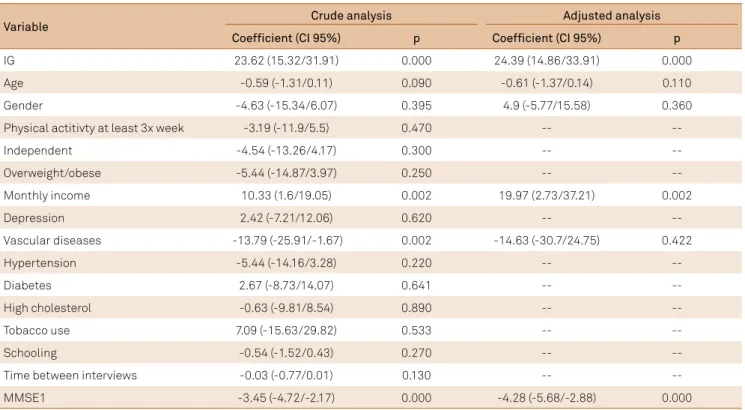
In terms of overall progress, both groups showed posi-tive variation in the MMSE through the paired samples t test (IG = 40.48 ± 40.16 and CG = 15.82 ± 29,99; p = 0.000). Table 3 shows the crude and adjusted analyses of outcome “percent variation between the MMSE1 and MMSE2”. he IG showed a positive variation +24.39 (CI 95% 14.86 - 33.91) higher when compared with the CG. Other independent predictors were lower income, and the MMSE1 cognitive status.
DISCUSSION
he IG showed signiicant improvement in cognitive sta -tus, when compared to the CG.
less apparent improvement25,26; the higher the MMSE1
score, the harder it is to increase the score in the MMSE225.
Schooling was not signiicant in the analysis; its inluence may be too distal, or it’s not that important in terms of vari-ation of cognitive status, as both groups had similar school-ing levels. However, the monthly income was associated with the study’s outcome: the higher the monthly income, the higher the prevalence of gain in the MMSE2. Some studies11-13 have shown that really low monthly income can
accelerate cognitive problems.
Both groups showed cognitive status improvements throughout the study. hese results are in line with Barnes et al.27, who reported signiicant improvement in both groups
participating in his controlled study. Several cognitive and functional deicits have reversible causes28 and the use of
computers is associated with the slowing of cognitive decline and decrease in the incidence of dementia6,7,8,16,17,18,19.
A systematic review study9 that analyzed 84 research
studies aiming to evaluate diferent types of cognitive rehabilitation programs, showed that the use of comput-ers improves creativity, cognitive lexibility, attention, task execution, executive functions, episodic memory and other cognitive abilities.
he main strengths of this study are the low attrition, the percent variation used to address the ceiling efect bias and the medical follow-up.
Among the limitations of the study is the fact that the participants were not randomized, which fosters the occur-rence of selection bias. he IG was younger, more active, poorer, and had less dyslipidemia. Age advancement9,
physi-cal inactivity9,10, dyslipidemia10 and low schooling11,12,13 are
factors that may inluence MMSE scores.
he fact that both groups showed a positive variation in the outcomes studied also can be considered a study limita-tion. his may be due to learning bias in the cognitive testing and/or due to the medical follow-up ofered to both groups. here was also a signiicant diference in the elapsed time between the irst and second assessment of both groups.
Table 1. Caracteristics of the intervention group (IG) and
control group (CG) in the pre-test.
Variables IG (n = 160) f (%) CG (n = 133) f (%) p
Gender
0.940
Male 27 (16.75) 33 (24.82)
Female 133 (83.15) 100 (75.18)
Marital Status
0.160
Married 83 (51.87) 80 (60.15)
Single 18 (11.25) 17 (12.78)
Separated 20 (12.50) 13 (9.77)
Widow 39 (24.37) 23 (17.29)
Monthly income
0.000* US$500 or less
per month 119 (74.38) 80 (60.15)
More than US$500 per month
41 (25.62) 53 (39.85)
Independent
0.270
No 68 (42.5) 65 (48.87)
Yes 92 (57.5) 68 (51.13)
Sedentary
0.000*
No 90 (56.25) 45 (43.84)
Yes 70 (43.75) 88 (66.16)
Overweight/obese
0.200
No 107 (66.88) 98 (73.68)
Yes 53 (33.12) 35 (26.32)
Tobacco use
0.740
No 154 (96.25) 127 (95.49)
Yes 6 (3.75) 6 (4.51)
Depression
0.200
No 119 (74.38) 90 (67.67)
Yes 41 (25.62) 43 (32.33)
Vascular disease
0.090
No 141 (88.13) 108 (81.2)
Yes 19 (11.87) 25 (18.8)
Hypertension
0.240
No 65 (40.62) 63 (47.37)
Yes 95 (59.38) 70(52.63)
Diabetes
0.260
No 128 (80) 113 (84.96)
Yes 32 (20) 20 (15.04)
Dyslipidaemia
0.001*
No 115 (71.88) 78 (58.65)
Yes 45 (28.12) 55 (41.35)
Peripheral vascular insuficiency
0.029*
No 83 (51.7) 89 (67.1)
Yes 77 (48.3) 44 (32.9)
Polymedication
0.051
No 96 (60.0) 92 (69.17)
Yes 64 (40.0) 41 (30.83)
Benzodiazepines
0.610
No 153 (95.62) 125 (93.98)
Yes 7 (4.38) 8 (6.02)
IG: intervention group; CG: control group; f: frequency; %: percent; p-value of the chi square test; *p ≤ 0.05.
Table 2. Sample characteristics of the intervention group (IG)
and control group (CG) in the pre-test and post-test.
Variables IG (n=160) x ± SD CG (n=133) x ± SD p
Age. complete
years 67.19 ± 5.68 69.97 ± 6.30 0.001
Years of
schooling 8.29 ± 4.58 8.95 ± 4.02 0.180
MMSE 1
(pre-test) 25.95 ± 2.95 26.41 ± 3.58 0.240**
MMSE2
(post-test) 27.28 ± 2.52 26.50 ± 3.28 0.009**
Time* between
interviews 131.90 ± 87.39 206.78 ± 97.39 0.000*
his limitation was addressed by its use as a control vari -able, and by the fact that, initially, there were no participants with dementia, who typically present faster rates of decline. Another limitation of the study is the use of a single cognitive tracking test, considering that other instruments might have been better at detecting diferences between pre-test and
Table 3. Crude and adjusted analysis of the effect of the cognitive cooperation program percent variation.
Variable Crude analysis Adjusted analysis
Coefficient (CI 95%) p Coefficient (CI 95%) p
IG 23.62 (15.32/31.91) 0.000 24.39 (14.86/33.91) 0.000
Age -0.59 (-1.31/0.11) 0.090 -0.61 (-1.37/0.14) 0.110
Gender -4.63 (-15.34/6.07) 0.395 4.9 (-5.77/15.58) 0.360
Physical actitivty at least 3x week -3.19 (-11.9/5.5) 0.470 --
--Independent -4.54 (-13.26/4.17) 0.300 --
--Overweight/obese -5.44 (-14.87/3.97) 0.250 --
--Monthly income 10.33 (1.6/19.05) 0.002 19.97 (2.73/37.21) 0.002
Depression 2.42 (-7.21/12.06) 0.620 --
--Vascular diseases -13.79 (-25.91/-1.67) 0.002 -14.63 (-30.7/24.75) 0.422
Hypertension -5.44 (-14.16/3.28) 0.220 --
--Diabetes 2.67 (-8.73/14.07) 0.641 --
--High cholesterol -0.63 (-9.81/8.54) 0.890 --
--Tobacco use 7.09 (-15.63/29.82) 0.533 --
--Schooling -0.54 (-1.52/0.43) 0.270 --
--Time between interviews -0.03 (-0.77/0.01) 0.130 --
--MMSE1 -3.45 (-4.72/-2.17) 0.000 -4.28 (-5.68/-2.88) 0.000
IG: Intervention group; CI 95%: 95% conidence interval; MMSE1: irst mini mental status examination.
References
1. Fonseca JA, Ducksbury R, Rodda J, Whitield T, Nagaraj C, Suresh K et al. Factors that predict cognitive decline in patients with subjective cognitive impairment. Int Psychogeriatr. 2015;27(10):1671-7. https://doi.org/10.1017/S1041610215000356
2. Verdelho A, Madureira S, Moleiro C, Santos CO, Ferro JM, Erkinjuntti T et al. Self-perceived memory complaints predict progression to Alzheimer disease: the LADIS study. J Alzheimer’s Dis. 2011;27(3):491-8. https://doi.org/10.3233/JAD-2011-110494 3. Singh-Manoux A, Kivimaki M, Glymour MM, Elbaz A, Berr C,
Ebmeier KP et al. Timing of onset of cognitive decline: results from Whitehall II prospective cohort study. BMJ. 2012;344:d7622. https://doi.org/10.1136/bmj.d7622
4. Jolley D, Moniz-Cook E. Memory clinics in context. Indian J Psychiatry. 2009;51(Suppl 1):S70-6.
5. Moniz-Cook E, Vernooij-Dassen M, Woods B, Orrell M. Psychosocial interventions in dementia care research: the INTERDEM manifesto. Aging Ment Health. 2011;15(3):283-90. https://doi.org/10.1080/13607863.2010.543665
6. Woods B, Aguirre E, AE Spector, Orrell M. Cognitive stimulation to improve cognitive functioning in people with dementia. Cochrane Database Syst Rev. 2012;(2):CD005562. https://doi.org/10.1002/14651858.CD005562.pub2
7. Cotelli M, Manenti R, Zanetti O, Miniussi C. Non-pharmacological intervention for memory decline. Front Hum Neurosci. 2012:6:46. https://doi.org/10.3389/fnhum.2012.00046
8. Jean L, Bergeron ME, Thivierge S, Simard M. Cognitive intervention programs for individuals with mild cognitive impairment: systematic review of the literature. Am J Geriatr Psychiatry. 2010;18(4):281-96. https://doi.org/10.1097/JGP.0b013e3181c37ce9
9. Diamond A, Ling DS. Conclusions about interventions, programs, and approaches for improving executive functions that appear justiied and those that, despite much hype, do not. Dev Cogn Neurosci. 2016;18:34-48. https://doi.org/10.1016/j.dcn.2015.11.005
10. Norton S, Matthews FE, Barnes DE, Yaffe K, Brayne C. Potential for primary prevention of Alzheimer’s disease: an analysis of population-based data. Lancet Neurol. 2014;13(8):788-94. https://doi.org/10.1016/S1474-4422(14)70136-X
11. Matthews FE, Arthur A, Barnes LE, Bond J, Jagger C, Robinson L et al. A two-decade comparison of prevalence of dementia in individuals aged 65 years and older from three geographical areas of England: results of the Cognitive Function and Ageing Study I and II. Lancet. 2013;382(9902):1405-12. https://doi.org/10.1016/S0140-6736(13)61570-6
12. Fratiglioni L, Qiu C. Prevention of cognitive decline in ageing: dementia as the target, delayed onset as the goal. Lancet Neurol. 2011;10(9):778-9. https://doi.org/10.1016/S1474-4422(11)70145-4 13. Lincoln P, Fenton K, Alessi C, Prince M, Brayne C,
Wortmann M et al. The Blackfriars Consensus on brain health and dementia. Lancet. 2014;383(9931):1805-6. https://doi.org/10.1016/S0140-6736(14)60758-3
post-test conditions. he sample studied refers to a speciic group and can not be generalized.
14. Ngandu T, Lehtisalo J, Solomon A, Levälahti E, Ahtiluoto S, Antikainen R et al. Articles A 2 year multidomain intervention of diet , exercise, cognitive training , and vascular risk monitoring versus control to prevent cognitive decline in at-risk elderly people (FINGER): a randomised controlled trial. Lancet. 2015;385(9984):2255-63. https://doi.org/10.1016/S0140-6736(15)60461-5
15. Xavier AJ, d’Orsi E, Wardle J, Demakakos P, Smith SG, Wagner C. Internet use and cancer-preventive behaviors in older adults: indings from a longitudinal cohort study. Cancer Epidemiol Biomarkers Prev. 2013;22(11):2066-74. https://doi.org/10.1158/1055-9965.EPI-13-0542 16. Almeida OP, Yeap BB, Alfonso H, Hankey GJ,
Flicker L, Norman PE. Older men who use computers have lower risk of dementia. PLoS One. 2012;7(8):e44239. https://doi.org/10.1371/journal.pone.0044239
17. Paiva SB, Del-Masso MCS. Information technology as a technical resource for the memories: memories of unati-marília in the virtual environment. J Inf Syst Technol Manag. 2013;10(2):377-88. https://doi.org/10.4301/S1807-17752013000200011
18. Xavier AJ, d’Orsi E, Oliveira CM, Orrell M, Demakakos P, Biddulph JP et al. English longitudinal study of aging: can internet/E-mail use reduce cognitive decline? J Gerontol A Biol Sci Med Sci. 2014;69(9):1117-21. https://doi.org/10.1093/gerona/glu105. 19. Lourenço RA, Veras RP. Mini-Mental State
Examination: psychometric characteristics in elderly outpatients. Rev Saúde Pública. 2006;40(4):712-9. https://doi.org/10.1590/S0034-89102006000500023
20. Lee GY, Yip CC, Yu EC, Man DW. Evaluation of a computer-assisted errorless learning-based memory training program for patients with early Alzheimer’s disease in Hong Kong: a pilot study. Clin Interv Aging. 2013;8:623-33. http://doi.org/10.2147/CIA.S45726
21. Frith CD. The role of metacognition in human social interactions. Philos Trans R Soc Lond B Biol Sci. 2012;367(1599):2213-23. https://doi.org/10.1098/rstb.2012.0123
22. Krug RR, Ono LM, Quialheiro A, d’Orsi E, Ramos LR, Xavier AJ. A Stimulation and rehabilitation program: oicina da lembrança. Rev Bras Ativ Fis Saúde. 2015;20(5):534-40. https://doi.org/10.12820/rbafs.v.20n5p534
23. Xavier AJ. Estado cognitivo, capacidade funcional e o processo de inclusão digital de idosos [thesis]. São Paulo: Universidade Federal de São Paulo; 2007.
24. Ramos LR. [Determinant factors for healthy aging among senior citizens in a large city: the Epidoso Project in São Paulo]. Cad Saúde Pública. 2003;19:793-8. Portuguese. https://doi.org/10.1590/S0102-311X2003000300011
25. Hesket R, Skrondal A. A review of multilevel and longitudinal modeling using stata. J Educ Behav Stat. 2009;34(3):559-60.
26. La Rue A. Healthy brain aging: role of cognitive reserve, cognitive stimulation, and cognitive exercises. Clin Geriatr Med. 2010;26(1):99-111. https://doi.org/10.1016/j.cger.2009.11.003
27. Barnes DE, Santos-Modesitt W, Poelke G, Kramer AF, Castro C, Middleton LE et al. The Mental Activity and eXercise (MAX) trial: a randomized controlled trial to enhance cognitive function in older adults. JAMA Intern Med. 2013;173(9):797-804. https://doi.org/10.1001/jamainternmed.2013.189