Recebido em 01/janeiro/2014 Aprovado em 20/agosto/2015
Sistema de Avaliação: Double Blind Review Editor Cientíico: Nicolau Reinhard
DOI: 10.5700/rausp1221
We thank The Center for Organization Studies CORS-USP for the inancial support for the research on these three wineries. We thank Prof. Maria Sylvia Macchione Saes and Prof. Daniel Friel for the motivation and important comments for this research.
Understanding the hierarchy governance choice
of some wineries in Brazil – case study of 3
Brazilian wineries
Kassia Watanabe
Universidade Federal do Recôncavo da Bahia – Cruz das Almas/BA, Brasil
Mark Wever
Universidade Federal do Rio Grande do Sul – Porto Alegre/RS, Brasil
Rúbia Nara Rinaldi Leão de Sousa Universidade de São Paulo – São Paulo/SP, Brasil
Claudia Cheron Koenig
Universidade de São Paulo – São Paulo/SP, Brasil
Análise da escolha das estruturas de governança em vinícolas brasileiras – estudos de casos em 3 vinícolas
A decisão da melhor estrutura de governança adotada pelas empresas tem sido objeto de estudo de diversas vertentes teóricas, muitas vezes, dissociadas. Assim, este estudo pretende contribuir para a compreensão dos múltiplos fatores que inluenciam nas decisões de governança da empresa, a partir dos argumentos da Economia dos Custos de Transação; da Visão Baseada em Recursos e da Teoria dos Direitos de Propriedade. Para identiicar alguns desses fatores, foram analisados três casos na indústria do vinho brasileiro: Miolo, localizada no Vale dos Vinhedos (Sul do Brasil) e no Vale do Rio São Francisco (Nordeste do Brasil); Don Laurindo, localizada no Vale dos Vinhedos; e a Vinibrasil, localizada no Vale do Rio São Francisco. A maioria das vinícolas estudadas produz as uvas utilizadas na produção de vinho. Apenas a Miolo compra uma quantidade insigniicante de uvas fora de sua produção. É importante observar que no Brasil, a produção de uva nestas regiões tem uma longa tradição e não é difícil comprar uma quantidade suiciente de uvas destinadas à produção de vinho. Identiicou-se que a qualidade das uvas é fácil de ser medida e o custo de compra no mercado é mais barato do que a produção própria. Porém, as vinícolas argumentam que produzem a própria uva para garantir a qualidade das uvas e, consequentemente, do vinho produzido. Entretanto, o nível de especiicidade dos ativos presentes na transação entre produtor de uva e vinícola parece, por si só, insuiciente para justiicar o uso de forma de governança hierárquica. Assim, o objetivo do artigo é analisar as razões pelas quais essas vinícolas, em grande parte, dependem da forma de governança hierárquica para adquirir suas uvas. O que explica o uso de governança hierárquica, uma vez que tanto a especiicidade de ativos como os problemas de mensuração parecem relativamente baixos?
Palavras-chave: vinícolas brasileiras, governança hierárquica, economia dos custos de transação, visão baseada em recursos, direitos de propriedade.
RESUMO
Kassia WatanabeFederal do Recôncavo da Bahia (CEP 44380-000 – , Professora da UniversidadeCruz das Almas/BA, Brasil) E- mail: [email protected];
[email protected] Endereço:
Universidade Federal do Recôncavo da Bahia Avenida Rui Barbosa, 710
44380-000 – Cruz das Almas – Bahia Mark Wever, Pesquisador convidado na Universidade Federal do Rio Grande do Sul (CEP 91540-000 – Porto Alegre/RS, Brasil) E-mail: [email protected]
Rúbia Nara Rinaldi Leão de Sousa, Pesquisadora do Center for Organization Studies (CORS) da Universidade de São Paulo (USP) (CEP 05508-010 – São Paulo/SP, Brasil).
E-mail: [email protected]
Claudia Cheron Koenig, Pesquisadora do Center for Organization Studies (CORS) da Universidade de São Paulo (USP) (CEP 05508-010 – São Paulo/ SP, Brasil).
1.INTRODUCTION
The Portuguese introduced viticulture in Brazil in the early of 16th century and production was restricted to the south and
southeast up to 1960s, after which the cultivation of grape was brought to semiarid region of the Vale do Rio São Francisco, the viticulture in tropical Brazil (Instituto Brasileiro do Vinho
[IBRAVIN], 2013a). In the mid-1970s with the entry of
multinational companies that have introduced innovations in production and logistics sector, this activity has emerged in the country (Schmidt, 2012). From the 80s, according to Protas (2008), the industry engaged in political action to promote improvements in the structure of national winemaking through intensive investments in the modernization of the wineries. The motivation of the business was due to the possibility of domestic market growth, both for traditional products such as
the international standard (ine wines), which have potential
for commercialization with greater added value. In short, the wineries have sought strategies to expand their market.
Currently, the Brazilian viticulture covers an area of 81 thousands hectares with vineyards from the far south to regions near the equator. Two regions stand out: Vale dos Vinhedos
in the South of Brazil, producing an average of 777 million
kilos of grape per year, and Vale do Rio São Francisco in the Brazilian Northeastern (IBRAVIN, 2013b). With regard to the Vale do Rio São Francisco, currently, it is estimated that there is an area of vineyards with varieties geared to producing wines
that give rise to approximately 7 million liters of wine / year,
80% red wine and 20% white (IBRAVIN, 2013a).
The wineries are concerned about the quality of grapes; it is an important issue to produce wine with good quality. This is the main incentive to wineries cultivate their own grapes in order to control and monitor all phases of their wine production. However, the general argument applied to the hierarchy governance is broader than just transaction cost.
Resource attributes that include skills/knowledge or resource
based view and property rights theory is well connected to the former theories.
This study aims to contribute understanding the multiple
factors that inluence irm’s governance decisions. To identify
some of those factors, we analyzed three cases in the Brazilian wine industry as an example. The Brazilian wine industry is an interesting context for the purpose of this study because there is already viticulture consolidated in Rio Grande do Sul, where Vale dos Vinhedos is located, and in Vale do Rio São Francisco located in the Brazilian Northeastern. Although the purchase of grapes in market is feasible, some wineries have attempted
to produce grapes in-house.
The three wineries selected for this study are located in Vale dos Vinhedos and in Vale do Rio São Francisco, where production of grapes is well developed. Although plural forms were observed (Koenig, Sousa, Watanabe & Wever, 2014), they are mainly organized into hierarchy governance form, what
seem contradictory since it is not dificult purchase grapes in
the market. One of the reasons for choosing the hierarchy form is that the wineries are concerned about the quality of grapes, because it is an important issue to produce wine with good quality. On the other hand the quality of grapes is measurable and the cost to buy grapes in the market is less expensive
than producing it in-house. Therefore, asset speciicity and
measurement problems seem to be not the only characteristics that explain the hierarchy governance choice. The question that then arises is: What explains the hierarchy governance,
besides the asset speciicity and measurement problems? In
other words, the general argument applied to the hierarchy governance, besides transaction cost economics, also requires
a resource based view and property rights-based explanation,
both which are well connected to transaction cost economics. The remainder of the paper is organized as follows. In the next section, the three theories – transaction cost, property
rights, and resource-based view – are briefly described.
Subsequently, we discuss the methodology used in the study. In the fourth section, the cases – Miolo, Don Laurindo, and ViniBrasil – are described and analyzed using the theories
discussed. In the ifth and inal section, concluding remarks
are presented.
2. THEORETICAL FRAMEWORK
In this section we argue that each of the three theories – Transaction Cost Economics; Resource Based View; Property Rights – gives an incomplete picture of the factors
affecting irms’ governance decisions when taking in isolation. Some authors’ contributions concerned the comparison,
complementarity or possible integration between the theories. Particularly, with regard to transaction costs, there are studies
that explore the possibilities of integration with capabilities/
resources (Williamson, 1999; Jacobides & Winter, 2005; Argyres & Bigelow, 2008; Argyres & Zenger, 2012). As we will explain below, in some situations each of the three theories will predict a different governance decision, while in other situations the theories will predict the same governance decision, but for different reasons. Jointly considering all three theoretical
perspectives when analyzing irms’ governance decisions will
therefore help researchers to better predict what governance
forms irms use in speciic situations and why.
2.1. Transaction cost economics
Differently from neoclassical economic conceptualizations,
that considers pricing mechanism and irm solely as a production function, transaction cost economics (TCE) describes the irm also as an eficiency-inducing administrative instrument that
takes into account the costs for negotiation efforts, contract
developed by Williamson (1979, 1985, 1991a) under the label of transaction costs. The transaction costs include ex-ante costs
for negotiation efforts, contracts design, and safeguarding
agreements, and ex-post costs for aligning and adapting the
contract (Williamson, 1985).
The choice of institutional arrangement is seen as a central
means through which management inluences, monitors and enforces contractual performance (Williamson, 1975). It is related to irm’s intentions to economize on transaction costs.
The presence of these costs explains which transactions are undertaken through the market and which are internalized within
the irm (Coase, 1937). Economic agents align transaction with
institutional arrangement to affect outcomes; therefore, the costs of one mode of governance are always examined in relation to alternative feasible modes (Williamson, 1996). Transaction costs arise from human behavioral assumptions that are: bounded
rationality and opportunism. Bounded rationality is deined
as behavior where economic agents attempt to optimize, but lack the cognitive capabilities to do so. In other words, it is the inability of economic actors to anticipate properly the consequences of their actions as well as the contingencies
(Simon, 1957). Opportunism refers to the assumption that economic actors are self-interested in a calculative and devious
manner – they comply with rules and regulations only when the
cost of compliance is lower than the costs of non-compliance and they try to hide non-compliance (Williamson, 1985).
Different institutional arrangements depend on transaction attributes, which are part of TCE and they are related to various
dimensions of the transaction, especially asset speciicity and uncertainty. According to Williamson (1979, 1985, 1991a, 1996, 2005), these dimensions affect a irm’s governance decision that
is based on a choice between competing alternative forms: market, hybrid, and hierarchy. In the original TCE framework, as developed by Williamson (1985), three main attributes of the
transaction were distinguished: asset speciicity, uncertainty and
frequency. However, `frequency` is not considered in our study,
since its effect on irms’ governance decisions is ambiguous and
not well understood (Geyskens, Steenkamp & Kumar, 2006;
Rindleisch & Heide, 1997).
Asset specificity refers to the degree by which the investments a party makes to support the transaction, ties it to the
other party to the transaction. Williamson (1985) deines asset speciic investment as “durable investment that are undertaken
in support of particular transactions, the opportunity cost of which investment is much lower in best alternative uses or by alternative uses should the original transaction be prematurely terminated”. In other words, a specialized investment cannot be used in another transaction without a loss in value. The
difference in value of the assets within and out of the speciic relation is called the quasi-rent (Alchian, 1984). Hence, insofar as asset speciicity is present, ex-post bargaining or hold-up risk
increases and transaction costs rise (Klein, Crawford & Alchian,
1978). In order to reduce the hold-up risk in the transaction that
involves specialized investment, the transaction parties have
strong incentives to rely less on spontaneous, market-based governance forms and more on hands-on governance forms
(Williamson, 1991b). This can take the form of neoclassical contracts (i.e., arbitrator mediated arrangements) for transactions
involving mixed-use investments (i.e., for transactions involving medium levels of asset speciicity), or uniied, hierarchical
governance (vertical integration) for transactions involving idiosyncratic investments (i.e., for transactions involving highly
speciic investments) (Williamson, 1991a; see also Williamson, 1975, 1979, 1985; Klein et al., 1978).
Uncertainty refers to unanticipated changes in the larger
industry-context and institutional environment in which transactions are embedded. Given actors’ bounded rationality,
they cannot (fully) anticipate these changes when entering into a transaction. As a result, actors will not be able to write contracts, which take into account all future states of the world; i.e., contracts are incomplete. Uncertainty makes transactions
more unstable involving speciic investments (more prone to maladaptation and hold-up problems) and more likely to be internalized even when the investments are only of a mixed-use
nature (see Williamson, 1991a).
2.2. Resource based view
The Resource-based view (RBV) is largely based on the
work of Wenerfelt (1984), Rumelt (1984), Barney (1991), Peteraf (1993) and Conner (1991). RBV has been developed with a specific focus on how firms manage resources or knowledge and the complex combination between different sets of resources. According to RBV theory, resources that are common to many companies or which are easily available in the market cannot provide a sustainable competitive advantage. Only strategic resources (e.g., assets, skills, knowledge) that
satisfy the conditions of being valuable rare, inimitable and
non-substitutable can generate such an advantage (Barney, 1991). Barney (1991) distinguishes three main categories of resources: physical resources such as plant and equipment, human resources, such as technical specialists and teams, but also company executives, and organizational resources, formed by the norms and routines that coordinate the physical and human resources of the company. Hierarchical governance can help to develop and transfer tacit resources or knowledge, including shared norms and routines. Barney (1991) considers the dynamics of the process performance among the resources and their effects on the organization. Therefore, the strategic value of the resource is not only a result of the resource itself, nor for their connection with each other, but coming from the
inter-relationships that exist between the whole set of resources
controlled by the organization.
From this perspective, the essence of the irm is its ability to
organization, according to the perceptions of managers, then
the irms are heterogenic and, consequently, there is different proitability among them. This conception of heterogeneity
comes from the assumption that admits the nature of competition determined by establishing barriers to imitation and constant innovations. In RBV, not all features and capabilities have elastic supply, even for that, to be developed; some of them require a
long period of time. This inelasticity of supply implies that irms
possessing valuable resources can gain sustainable competitive advantage (Peteraf, 1993). In this sense, the deduction is that
the main sources differences in proitability between irms arise
from rents in Ricardian sense (return higher than the opportunity cost). In other words, it is assumed that economic rents for
eficient irms derive from scarce sources and are made possible
by the imperfections of market factors. Imperfections arise from
managerial ability, the unique language used inside the irm and its speciic organizational culture. They also arise from physical
assets and innovations protected by patents or organizational competence, and even intangible assets such as consumer
conidence, brand image and reputational capital. Barney and
Arikan (2001) argue that these factors of production are perfectly
inelastic, since the quantities offered are ixed (they are unique)
and do not respond to changes in prices. From this perspective, what makes it a valuable resource is the peculiar way in which
it is used by the irm (Teece and Pisano, 1994). However, there
are authors that expand the notion of resources, assuming that its value, at least in part, depends on environmental conditions (Barney, 2001; Foss & Foss, 2005).
Foss and Foss (2005) argue in their study that also the property rights aspects of resources should be considered, especially the social environment should also be seen as a source of resource value, not only as a restrictive factor. The way how property rights are restricted under law, agreements or norms,
inluences the value that an owner of any resource can create
and how much can be appropriated from that resource (Foss &
Foss, 2005). For Kim and Mahoney (2007), if the property rights
of the resource with the potential for value creation are not fully guaranteed in a business context in which multiple partners are involved, value creation cannot happen (see also Barney and
Hansen, 1994; Kim and Mahoney, 2002). Similar dificulties may arise within irms, where multiple agents that provide inputs
are producing economic value jointly (teamwork) (Alchian &
Demsetz, 1972; Holmstrom, 1982). Kim and Mahoney (2007)
argue that historical examples show that in some sectors the potential economic value creation (and rents) does not guarantee the effective creation of economic value.
2.3. Property rights
Besides TCE, also Property Rights theory attempts to
understand irm boundaries and their choice of institutional arrangement. Demsetz (1967) discussed property rights, using
the neoclassical perspective to understand how property rights
for speciic transactions arise. According to Demsetz, property rights arise with the internalization of beneicial and harmful
effects (externalities), when the gains of internalization become
larger than the cost of internalization. Demsetz (1967) argues
that property rights are exchanged in a transaction. Then, the value of the rights determines the value of the exchange. The problem that results from untradeable property rights is known
as the common-resource problem, public-goods problem,
free-rider problem, and the tragedy of the commons (Milgrom & Roberts, 1992). According to Milgrom and Roberts (1992),
“…when many people have the right to use a single shared resource, there is an incentive for the resource be overused…”
(p. 294). Considering the asset investment, if the residual
returns of it are widely shared, no one has a suficient interest
to bear the cost of maintaining and increasing the value. For
economic analysis, the “owning an asset” interpretation means
that the residual rights of control, which is the right to make
any decisions concerning the asset’s use that are not explicitly
controlled by law or assigned by another contract. If ownership means having residual control, then its importance must derive
from the dificulty of writing contracts that specify all the
control rights. Thus, concentrating the ownership rights might
be the eficient way; consequently, the hierarchy form prevails.
Although TCE and property rights have been developed along different lines, both of them focus on the role of
ownership as a way to avoid hold-up problems (Araujo, Dubois & Gadde, 2003). Then, the emergence of the irm becomes a response to hold-up problems combined with the intrinsic
opportunistic nature of human actors and the specialized assets
required for eficient production.
A perspective on property rights has been developed by
Barzel (1982, 2001, 2002), who made signiicant contribution
to Measurement Cost Theory. In Measurement Cost Theory, transactions are decomposed into various dimensions. Each transaction dimension represents a property right exchange
and can be identiied by a measurement cost. This cost brings a speciic value to agents involved in the transaction. According to Zylbersztajn (2005), the speciic value in the transaction can be dispersed if the property rights are not well deined, which can be dificult to measure, hence it can become dificult to contract speciic attribute of transaction. Barzel (1997)
considers the concept of property rights closely related to that
of transaction costs. Transaction costs are deined by Barzel (1997) as “the costs associated with the transfer, capture, and
protection of rights” (p.2). Barzel (2002) argues that the easier it is to measure and verify contract stipulations, the more readily the contract can be enforced. In other words, if the property
rights can be well deined, the transaction will be performed by means of a formal contract. Insofar as it is dificult to measure
According to Zylbersztajn (2005), although both transaction cost economics and measurement cost theory share similarities, they differ in internal logic, explicit assumptions, and key measurable variables, which has methodological implications. Therefore, the difference between the transaction cost and the measurement cost theories deals with the empirical evidence of each theory to offer explanatory motives and testable hypotheses to determine alternative institutional arrangements.
Based on Barzel (1997, 2002), the property rights structure
is based on formal institutions, related to legal rights and the
use of contracts; and the property rights deined by informal
norms related to economic rights that prevail in the agreements. According to Zylbersztajn (2010), there are always aspects of property rights, which are unprotected; therefore, part of the
value is subject to capture. It can be dificult to measure the
transaction attributes and the contract might therefore not be executed.
The transaction is the principal unit of analysis, whenever the property rights are negotiated. Transactions occur within the institutional environment that impact the process of the property rights exchange. As it is the case with transaction cost theory, property rights theory assumes that the contracts are incomplete. With regard to residual control, the notion of residual returns that Milgrom and Roberts (1992) take into account is closely linked to contractual incompleteness. If contracts are complete, the division of the wealth in each eventuality could be ‘contracted
on’, and there would be no economic returns that could be considered as ‘residual’. These two aspects of ownership –
residual control and residual return – provide incentives for the
owner to maintain and increase an asset’s value. The clearance
and enforceable property rights that cannot be transferred easily
or the information asymmetry denote the ineficiency in the
transaction under market or contractual relation. If property rights are neither tradable nor secure, then owners will not invest great amounts in assets that they may lose with no compensation,
or they may protect the speciic assets under their own control
without sharing or transacting. Then, the ownership rights should be structured with a concern to minimize the distortion
in investment decision caused by the hold-up problem.
2.4. Possibilities for linking the theories
The Transaction Cost Economics (TCE) perspective has
dominated the studies of make-or-buy decisions, providing
ample evidence that transactions characterized by high levels
of asset speciicity tend to be internalized (Williamson, 1975, 1985, Klein et al., 1978). Much progress has been made in the
analysis of vertical integration issues to understand what drives the governance decisions, such as transaction characteristics used by TCE. However, as observed Jacobides and Winter (2005) other stream of studies concerning strategy has come
to discuss the boundary of irm: resource and capability-based
view. This approach emphasizes the importance of resources in
guiding irm action, and the management of a irm’s resource
and capability portfolio as the central concern of strategy (Jacobides & Winter, 2005).
In terms of competence perspective, Williamson (1999) argues that it gives greater prominence to organization
theory since it “entails coordination and learning, is based on
skill, assets, and routines, and is judged in comparison with rivals” (p.1094). Both governance and competence share a lot of ground and they are needed in complementary ways
to understand complex phenomena of the boundary of irm,
although there are differences between them (Williamson,
1999). Then, assessing the resources bases of irms is necessary
to understand choices of scope.
Jacobides and Winter (2005) work on the theoretical
framework that explains how capabilities co-evolve with transaction costs in order to better understand the firms’
governance structure choices. The authors focus on firm capabilities because, as they argue, in order to understand the decision to vertical integrate (or not), it is necessary to take into account the mechanisms by which transactional and capability conditions determine the choice of vertical integration. The capabilities are observed as well in the studies made by Bigelow and Argyres (2008). The production experiences obtained by
irms, as well as the nature of irms’ pre-entry history, affect their boundaries decisions. From this perspective, irms with
longer experience are more likely to integrate vertically (since they have more experience in doing so). Argyres and Zenger (2012) discuss the importance of the transaction cost and
capabilities perspectives in studying irms’ boundary decisions,
considering that these perspectives are interlaced in a particular dynamic way. According to these authors (Argyres & Zenger,
2012), “if a irm possesses a comparatively superior capability because of its unique complementarity with the irm’s other
assets, then ownership of this capability may both explain its historical formation and be essential to protecting the rents it generates” (p.11) Resource based view and transaction cost perspectives present complementarity logics as to drivers of
irm boundaries (Augusto, Souza & Cario, 2013).
The resources are related to the capabilities to create and
retain value. Both TCE and resource-based view (RBV) logics
motivate integration in order to protect the value created from external appropriation. More generally, in order to minimize the transaction costs associated with generating and managing the assets. The protection of value is related to property rights
and transaction costs as well (Barzel, 1997; Araujo et al., 2003). In the property rights approach, the irm is regarded as a set of
assets under common ownership and control is equated with ownership. For Araujo et al. (2003), this view is only able to
provide an answer to where the boundaries of the irm should
lie, when those boundaries are related to the decision about physical asset ownership. These authors include the capabilities
Table 1
Comparative Characteristics of the Three Theories
Unit of analysis Transaction/ contract Resources Individual property rights
(Foss & Foss, 2005)
Focal dimension Characteristic of transaction Possession of resources Ensure the property rights
Risk and
uncertainty TCE emphasizes the downside associated with risk or uncertainty in describing how
uncertainty in the presence of speciic
investment may lead to misappropriation or
hold-up problems (Williamson, 1985).
The expected results due to the uncertainty depend on the judgment of the agents and their learning.
Generates opportunism of parties: moral hazard, adverse selection and free rider problem requires structures to protect the property rights
Focal cost
concern
Economizing on transaction costs by reducing maladaptation or hold-up problems, resulting from making speciic investments to the extent that the marginal costs of reducing the problem are equal the opportunity costs of continued exposure to the problem.
Maximizing the return on the irm’s assets based on acquiring unique assets, which either has upside potential, or which potential can better realized inside the acquiring irm.
Maximizing the marginal return on
non-contractible investments.
The property rights arise with the internalization of beneicial and harmful effects (externalities), when the gains of internalization become larger than the cost of internalization (Demsetz, 1967) Sources of
market friction Degree of asset speciicity, uncertainty and performance ambiguity. Dificult to replicate resources Information asymmetry
Predicted response to
market friction
- Increase in degree of asset speciicity increases likelihood of vertical integration. - Increase in uncertainty reduces threshold for vertical integration when asset speciicity is present.
- Increase in performance measurement ambiguity increases likelihood of vertical
integration.
- Vertically integrate to
acquire unique resources - To the extent that unique resources are also idiosyncratic, TCE and RBV will predict that irms vertically integrate under the
same conditions.
- Increase in asset speciicity only increases likelihood of vertical integration if the marginal returns on non-contractible returns are affected – (See Whinston 2003).
Motivation for
response
Integration increases administrative control
(which reduces ability for parties to act opportunistic) and reduces incentives for (strong-forms) opportunism (as hard-powered incentives are replaced by low-powered incentives). (Williamson, 1991a)
Intangible knowledge can be better transferred inside the irm (integration).
Boundaries are related to the decision about physical asset ownership
Source: Adapted from “Property rights theory, transaction costs theory, and agency theory: An organizational economics approach to strategic management” from Kim and Mahoney (2005), Managerial and Decision Economics, 26: 223-242.; and “Reassessing the Fundamentals and Beyond: Ronald Coase, the Transaction Cost and
Resource-based Theories of the Firm, and the Institutional Structure of Production” by Madhok (2002), Strategic Management Journal, 23: 535-550.
capabilities. Then, the capability assessments are irm speciic
and are internally governed because of capability in an asset
is irm speciic (Argyles & Zenger, 2012).
2.5. Theoretical predictions
According to the theories used to analyze some wineries in Brazil to understand the reasons for hierarchy form, the theoretical predictions are described as following:
Transaction Cost Economics: As the level of asset
speciicity increases in the grape-growers-winery transaction,
the likelihood that hierarchical forms are used to govern the transaction increases;
Property rights: As the level information asymmetry
between the grape-grower and winery increases, the likelihood
that hierarchical forms are used to govern the transaction increases;
Resource Based View: As the need to learn about (changes in) grape production methods increases and the required knowledge becomes more tacit, the likelihood that hierarchical forms are used to govern the transaction increases.
3. METHODOLOGY
more consistent insights than a single case study. The purpose of the case study method is theoretical generalization rather than statistical generalization (Yin, 1989; De Vaus, 2001). The objective of this study is to understand the production and transaction characteristics that lead to the choice governance form in organizations in the process of transforming grapes into wine. Three wineries were selected in order to help understand
the multiple factors that inluence their governance decisions.
Data was gathered by means of personal interviews with
owners and senior executives of the wineries. A semi-structured
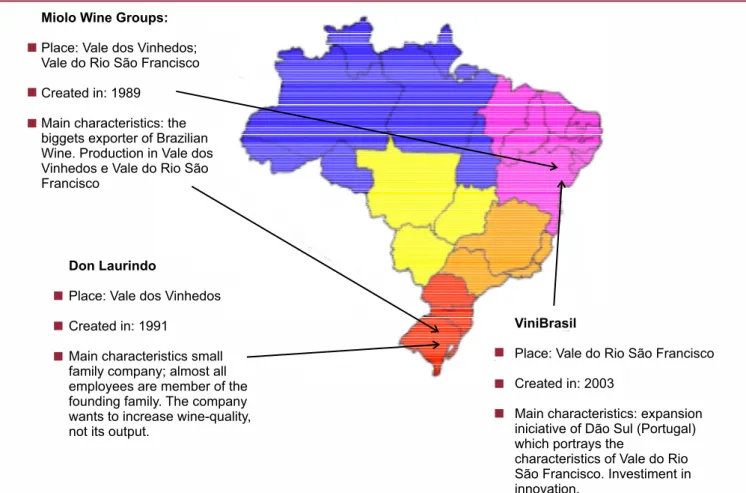
research instrument was used. Additionally, secondary data was collected about the Brazilian wine sector, using sources such as IBRAVIN – Instituto Brasileiro do Vinho. The three wineries are located in Vale dos Vinhedos and Vale do Rio São Francisco: Don Laurindo is located in Vale dos Vinhedos (RS); Miolo is in Vale dos Vinhedos and in Vale do Rio São Francisco; and ViniBrasil is in Vale do Rio São Francisco (Figure 1).
4. THE CASE OF WINE PRODUCERS IN BRASIL
By the end of 1980s, medium and large companies, and cooperatives dominated the wine industry. The grape growers
supplied the wineries and only produced the grapes for the market (Schmidt, 2012). In terms of technology, improvement
occurred in the industrial ield, but the same did not happen
in the viticulture sector. In the late 1980s and early 1990s, the
large wineries went through economic and inancial crises,
and were affected by the opening of the market in the 1990s to foreign companies, which provided an environment for the increase of wine imported from 13% in 1992 to 32% in 1994 (Mello, 1995). Moreover, the Mercosul and the high level of tax motivated the farmers to new decisions and strategies. Thus dozens of small wineries arose in rural area. These wineries were characterized by the industrialization of wine production,
which resulted in the improvement of the Brazilian ine wines
quality (Falcade, 2004).
The wine in Brazil is regulated since 1988 with the Law
n. 7678 and amended with the Law 10970 in 2004, which
provides regulation for production, distribution and marketing of wine and grapes.
The focus of this work is one the analysis of the upstream
part of the supply chain of wine – the grape-grower and winery transaction. A supply chain is a set of commercial and inancial
relations which establish, among all the stages of processing
a stream of exchange, located upstream and downstream,
between suppliers and customers (Batalha, 2007).
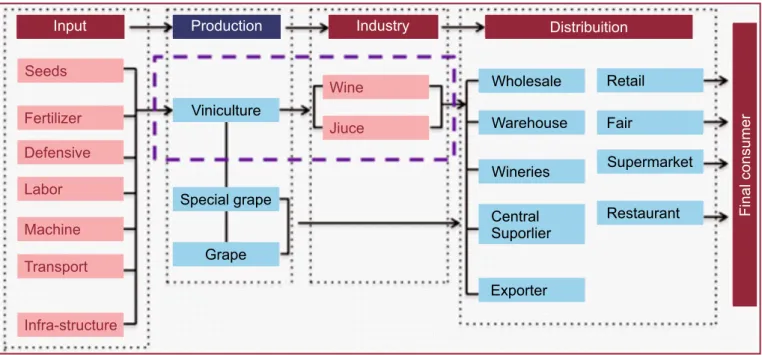
Figure 2, in general, is the systematization of the supply
chain of the grape and / or wine, due to their inter-relationships.
According to Garcia Filho (1999) regarding the establishment
of the agricultural production system, it can be deined as a
combination (in time and space) of resources available for obtaining the crops and animals. A production process is a system of actions that are interrelated dynamically and are geared towards the transformation of certain elements. Thus, the input elements, the grapes, become output elements, the wine, following a process of value added.
The production itself refers to the practice of grape cultivation, corresponding to the stage of planting and harvesting (Pereira & Gameiro, 2008). Grape production in the South of Brazil, the largest producer of grapes in the country, is almost entirely focused on the manufacture of wines. Called the operation vintage harvest grape for wine making, which depends on several factors, the most important being the health
and ripeness of the grapes, which deines the type of wine to be produced (Santos, Machado, Dias, Novai & Ferreira, 2007).
4.1. Cases studies analysis
4.1.1. Miolo Wine Group
Although the Miolo winery was founded in 1989 by three
brothers of Miolo’s family, the company existed prior to
that date, when the Miolo’s family arrived in Brazil in 1897
(Dolabella & Bittencourt, 2012). Before the foundation of the company they were only grape growers to supply wineries around their farm. The decision to start the production of wine took place because of the crisis in the Brazilian wine industry when the grapes started to have the same value as the American and hybrid grapes (Dolabella, 2006). Since 1995, sales began to grow a lot, which led the company to be the leader in the
ine wine national market (P.Miolo, personal communication,
March 11, 2013).
Miolo, which began producing wines from their own grapes and bottling them, also bought grapes from other 80 producers, called outgrowers, in the Vale dos Vinhedos (Dolabella, 2006). Although there is no formal contract between the Miolo and their outgrowers, the company supplied them with seeds and discounted the value of these over time and monitored the production. In the year of 2000, Miolo acquired 81 acres of land in the city of Bagé (500 km from Bento Gonçalves). The production in the lands of Bage enabled the company to reduce the number of outgrowers to 20, and the selection of these outgrowers was according to the quality, volume and adoption of planting grape in trellises. In 2006, the Miolo changed its name to Miolo Wine Group, and acquired the winery Ouro Verde in Petrolina, Vale do Rio São Francisco, where it produces sparkling wine named Terra Nova. Grapes out of its own production are used sporadically for the production of sparkling base. In case of purchasing grapes in the market, this is due to the opportunity offered by the market, when the grapes
Figure 2: Wine Supply Chain
are not exported, have good quality and can be purchased at a price below its own production cost, according to Miolo (2013).
A TCE perspective: motives for vertical integration
According to the respondent of our interview, although Miolo buys the grapes from these known 20 outgrowers, if they decide no longer work with the Miolo, it would not be a big concern to the company, because the quantity purchased of
them is small, around 500 tons/year, which represents 4% of the total. Because of the asset speciicity (Williamson, 1991a), such as temporal speciicity, locational speciicity, brand name capital, eficiency of production presented in the hierarchy arrangement justiies the preference of Miolo. The company
maintains relationships with 20 selected outgrowers at that time
because they were able to adapt to Miolo’s requirements. Miolo
offers full support for the 20 outgrowers supplying the seeds and technical assistance throughout the production process in order to obtain grapes with the required quality. There is a social aspect that Miolo and these outgrowers built a trust relation, what allow a relation without a written contract. In terms of TCE, as the reputation has been built between the parties, there
is no need for all the speciications in the contract or even a
contract, which decreases the ink costs.
A RBV perspective: ability to vertically integrate
Although Miolo purchases grapes from its 20 outgrowers, the wine branded Lote 43 is produced only from the grapes of its own production. This wine is named Lote 43 because it was
the land that the Miolo’s family received when they arrived
in the Vale dos Vinhedos. Considering the RBV, the value is created on the production of the wine Lote 43 since it is direct related to the grapes produced in the Lote 43 and cannot be
imitable. This speciic wine for Miolo generates a competitive advantage for Miolo, using Barney’s study (1991). Moreover,
the complex process of producing wine is related to the knowledge and skills of Miolo that is intangible assets, which
are dificult to be transferred or traded. Then, the centralized control ownership into an integrated irm is justiied thorough RBV theory, besides the TCE related to the asset speciicity.
A property rights theory perspective: measurement problems are not an issue
In terms of Property Rights Theory, if the property rights
were well deined, they could be easily traded. As Miolo has the residual control, then it is dificult to write the contract
specifying all the control rights prevailing the informal contracts with its 20 outgrowers. The government (National
Supply Company - CONAB) establishes the price of each
grape variety. The process to obtain the quality required for the production of a particular type of wine depends on the sugar
and acidity contained in the grape that can be evaluated in the laboratory, beyond the time of harvest. However, the monitoring of grape production is complex and not easily to be transferred.
As Miolo prioritizes quality of grapes, it offers inancial
incentives to its 20 outgrowers. The company evaluates the
characteristics of the grapes received and classiies them as following: 2A, 1A, 1B, 1C. According to the classiication,
Miolo pays a bonus on the value of the CONAB price. This bonus varies as following: 2A – plus 100% of the value of
CONAB; 1A – plus 70% of the value of CONAB; 1B – plus
30% of the value of CONAB; 1C – do not buy. In this case,
the attributes of transaction are deined and the measurement
costs decreases. Then, Miolo can perform contracts with its 20 outgrowers than vertical integration instead, analyzed according
to Barzel’s studies (1982, 2001, 2002).
A combined perspective
Analyzing Miolo’s strategy from a governance and
competence perspective, the company tends to vertical integration since competence implies coordination and learning and it is based on skill, assets, and routines. Miolo has acquired knowledge for wine production process since the experience in
the wine ield is before the foundation of the company, when Miolo’s family only cultivated grapes. This experience makes
the Miolo Wine Group more likely to integrate vertically the
grape production for its wine because of resource/capability
view and TCE, based on Bigelow and Argyres (2008). Although Miolo brought grapes from 80 outgrowers, the winery decided to invest in its own land to increase its grape production. It has continued to purchase grapes from only 20 outgrowers, which
is not very signiicant considering the size of the company. The
decision to become more vertically integrated, according to its historical context, is because Miolo has superior productive capabilities in comparison with its outgrowers, based on Jacobides and Winter (2005). Moreover, based on Jacobides
and Winter (2005), Miolo’s knowledge accumulation lead
gains from its specialization in wine production process and it might imply the success in its products trade. Miolo owns the residual rights of control to produce its wine according to its
requirement. These residual rights are dificult to be expressed
into a contract (Milgrom & Roberts, 1992); then Miolo is more likely vertically integrated.
4.1.2. Don Laurindo Winery
wine each year. For its wine production, the company uses only grapes from its own vineyards. The company markets its wines almost exclusively within Brazil; just 2% of its production is exported(1).
The company’s history goes back to the late 19th century, when the current owners’ great grandfather, Marcelino
Brandelli, emigrated from Italy to Brazil. This was a period in which Rio Grande do Sul attracted many immigrants from Italy.
Brazil’s federal government incentivized the immigrants to
come to the state by offering them favorable terms to purchase land. The Italians were mainly offered land within the Serra Gaúcha region, where Vale dos Vinhedos is located. When Mr. Brandelli arrived there in the 1880s, he relied on substance
farming to support him-self. He also started to grow vineyards
in order to make wine for family consumption.
Mr. Brandelli’s offspring purchased additional land for commercial grape production, while continuing the patriarch’s
tradition of making wine for friends and family. This modus operandi, where the Brandelli family commercialized its grapes but not its wines, continued until the beginning of the 1990s. During the systemic crisis that plagued Brazilian`s wine industry in this period, the family`s main customer stopped procuring grapes while earlier several of its smaller customers had already gone bankrupt. Subsequently, the family started its own winery – Vinhos Don Laurindo LTDA. As of today, the company markets all of its grape production to its own internal winery. The winery uses the grapes to produce 90.000 liters of wine each year. Ninety percent of this is red wine, while the remaining 10 percent is white wine (including sparkling wine). A couple of
its wines are certiied as “Origin Controlled Denomination”.
(A.Brandelli, personal communication, March 11, 2013).
A TCE perspective: motives for vertical integration
The transaction attributes demand uncertainty and temporal
asset speciicity help to explain why the company integrated
into wine production. The main purpose of the company in taking this step was to guarantee its survival during adverse market conditions. This decision was more or less forced on the company because of these two TCE factors; integration helped the company to economize on transaction costs resulting from
uncertainty and temporal asset speciicity.
Demand uncertainty was the main factor in the company decision. Market conditions can certainly be characterized as uncertain when Don Laurindo integrated into wine production. As it is explained above, the Brazilian wine industry was affected by a crisis in the beginning of the 1990s. This perhaps especially affected Don Laurindo, as its main customer stopped procuring its grapes. Thus, it not only faced the prospect of low
grape-prices and uncertainty about future demand, it had also
lost its main marketing channel. To understand the company decision to make its own wine, note that the company would have been less affected by demand uncertainty as an integrated
grape grower-winery operation than as an independent grape
grower. Grapes have to be harvested within a certain period and cannot be stored, unlike wine. Therefore, an integrated
grape grower-winery has more control over the time at which it
markets its (wine) output as it can hold inventory when demand is low(2). As an independent grape grower, Don Laurindo was
not able to hold inventory. Integrated helped the company to reduce its exposure to uncertainty.
While the above-mentioned market conditions were an obvious factor in Don Laurindo’s decision to start marketing its own wines, the role of asset speciicity was subtler. At present, grape grower-winery relations in the Vale dos Vinhedos region do not seem to be characterized by asset speciicity related concerns.
There are multiple wineries within the region and grape growers can easily switch from one winery to another as most wineries
use similar types of grape-inputs. However, during the crisis, temporal speciicity (e.g., see Williamson, 1991a) could have affected grape grower-winery transactions. Especially, wineries might have used the above-mentioned temporal constraints
that affect grape production to opportunistically renegotiate transaction terms. They would certainly be in position to do this; grape growers would have had fewer alternatives to market their grapes than during normal market conditions, as several wineries
faced dificulties. Forward integration into wine production reduces a grape-grower’s exposure to such temporal related
opportunism. While retailers may also attempt to renegotiate transaction terms, temporal constraints play a more limited role as the winery can store its output. Vertical integrated therefore also helped to reduce the company`s exposure to demand risk of opportunism, in line with TCE`s predictions.
A RBV perspective: ability to vertically integrate
The crisis not only had a downside. With various wineries
now experiencing dificulties, the wine market was also less
crowded than before. The company saw this as an opportunity to leverage its human resources and start marketing its own
wines, using its high quality grapes and knowledge about
wine-production to make exclusive wines. The company was able to forward integrate because the family honed the tacit knowledge or skill of making high quality wine over various generations. Thus, while demand uncertainty forced the company to take action, the reason it was able to start producing its wine was that the company already possessed the human resources to do it. In other words, while TCE factors helps us to understand the company`s motive to vertically integrate, RBV helps us to understand why the company was in position to do this.
RBV helps to explain not only why the company was able to integrate into wine production, but also why the company is still organized in this manner. The Brandelli family has a long tradition in the production of grapes (and wine) and this cannot be easily replicated in the market. According to
high-quality grape producers in Vale dos Vinhedos, as also
external grape growers possess the required human and physical resources to produce high quality grapes. However, they lack the required tacit knowledge about how producing the grapes
with the speciic characteristics Don Laurindo requires for its
particular wines. This knowledge, embedded deeply within the norms and routines of the organization, cannot be easily
codiied and communicated to external grape growers.
A property rights theory perspective: measurement problems are not an issue
PRT appears, at irst, less relevant than the other two theories for explaining the irms choice of governance form. For
example, according to the management of Don Laurindo, it is
not dificult to measure grape quality (e.g., laboratory analysis
can reveal the acid levels of the grapes). Therefore, no material information asymmetries exist between grape producers and wine producers about the quality of the grapes. If the company did use external suppliers, shirking or quality cheating by those suppliers would not be a problem; the suppliers could be paid based on the quality of the delivered grapes. For example, Don Laurindo could give the suppliers bonuses if the grapes meet or exceed its requirements (as Miolo does).
However, issues with regard to residual control rights over the production process do affect the company choice of procurement form. While many aspects of the production
process could be speciied in advance in contracts with external
grape growers (e.g., type of grapes to use, type of technology), such contracts would limit the company ability and rights to make adjustments to the process when it so desires. Internal procurement gives the company full control over how the production process is organized and it can make adjustments to that process whenever it wants.
A combined perspective
The Don Laurindo case showed that, as Williamson (1999) observed, the TCE and RBV perspectives are complementary. While a TCE perspective help to explain why Don Laurindo
vertically integrated into wine-production, a RBV perspective
explains why the company was in a position to do so.
Furthermore, both perspectives combine well with the
Property-Rights (PR) perspective in this case. PR helps to explain why Don Laurindo remains fully vertically integrated; i.e., it sheds
light on why the winery-part of the company does not procure grapes (also) from external grape-grower.
From a TCE perspective, high temporal asset speciicity
and demand uncertainty increased the company`s costs of transacting with external wineries. Vertical integration into
wine-production reduced those costs. From a RBV perspective,
the knowledge and experience Don Laurindo had acquired
over various generations about wine-production over various
generations meant that the company already had the required
competences to make high-quality wines. Based on a study of
Bigelow and Argyres (2008) that combines RBV with TCE, it is observed that the experience of Don Laurindo in wine production makes the company more likely to move from being
a mere grape-producer to being also a wine producer. Because
Don Laurindo is vertical integrated, this governance structure affects the knowledge development process and allows it to
also develop and leverage its superior capabilities in
wine-making, according to Jacobides and Winter (2005). From a PR perspective, the company remains vertically integrated rather
than, for example, spinning-of the grape-production part of its business, because of dificulties in fully specifying residual control rights over the grape-production process. Sourcing grapes from external grape-growers is furthermore not a desirable option for Don Laurindo because such grape-growers lack the tacit knowledge to produce the speciic grapes that the companies require for the production of its ine wines. Therefore,
Don Laurindo remains integrated also because of the superior
capability of its internal-grape grower vis-à-vis external growers
to make the grapes it needs (see also Argyres & Zenger, 2012).
4.1.3. ViniBrasil (Global Wines/Dão Sul)
ViniBrasil was founded in June 2003, started by a top Portuguese wine company, Dão Sul. It is located in the Vale do Rio São Francisco, which in itself makes an interesting story
as the vast majority of wineries producing ine wines in Brazil are located in the Vale dos Vinhedos - RS. ViniBrasil grows
its grapes in a challenging environment (close to the equator) using innovative management practices such as controlled
irrigation and year-round harvesting (Bell, Neves, Thomé e
Castro & Shelman, 2010).
The company currently has a total production area of 2000 hectares, with 200 hectares of grapes, as well as an experimental area for testing new varieties and combinations.
The winery produces about 1 million liters of wine/year, with
84 permanent employees (J.Santos, personal communication, March 14, 2013).
The ViniBrasil positioned itself as a winery producing
differentiated wine-products in Brazil. The price for the inal consumer is equivalent to the price of ine wines in the market,
and even below some of the wine products from Argentina and Chile (Bell et al, 2010) and its product portfolio consists of the following brands: Rio Sol, Paralelo 8 Tenants, Vinha Maria, Matuto and Adega do Vale. Paralelo 8 is the highest quality wine of ViniBrasil.
A TCE perspective: motives for vertical integration
the grapes in-house. ViniBrasil opted to have total control of
production since its foundation. Then, the company produces its own grapes in order to acquire the characteristics required for its wine production. Santos (2013) observes the fact that having its own grape production, the company eliminates demand problems since it controls what will produce. Currently, the company is guaranteed with a stock production for a year of sales.
Site speciicity is one of the most important assets for
ViniBrasil, because its wine is characterized as unique wine with qualities related to the location. The ViniBrasil invested
in brands, highlighting speciic characteristics of the region and
its wines. For example, the Rio Sol is a brand that blends the idea of the São Francisco River with the sun, which explains
the geographical location of the winery - the border of the São
Francisco River, 8 degrees south latitude. The region at this latitude is the exception to produce commercial wines, as well as being one of the new frontiers wineries in the world. Also
the slogan used by the company highlights this feature, “New Latitude, New Attitude” (p.12) according to Bell’s et al. study
(2010), that means that produce wines overcoming technical
paradigms, such as the use of irrigation in a semi-arid region.
A RBV perspective: ability to vertically integrate
ViniBrasil has invested in innovation, breeding of grapes, because the company believed that it would not be easy to
ind suppliers of grapes in the Vale do Rio São Francisco with
the same characteristics as those produced by ViniBrasil. The expertise of the production process has been developed over the years since the region has a particular climate in comparison with other producing regions in Brazil.
The workers have few job options in Vale do Rio São Francisco what make favorable for ViniBrasil. The number of permanent employees increases in the company and some of them have been working in ViniBrasil since its foundation. This aspect is extremely important because the company has been developing its human resources over the years. It is understood that vertical integration enables the company to control the entire process and prevents it from being imitated. They have been investing for many years in grapes adapted to the Vale do Rio São Francisco, and they created an intangible asset that is
dificult to be copied or even switched.
A property rights theory perspective: measurement problems are not an issue
ViniBrasil wants to ensure that all the investment it has made over the years, such as in innovation, improvement of grape seeds adapted to the region, and irrigation, is secure. The company is interested in appropriating the value created.
Thus, for the irm, vertical integration allows the company to
create value and also to keep the value created. Furthermore, the winery has the residual control rights over the production
process. Similar to Don Laurindo, ViniBrasil can make adjustments to its production process whenever it is necessary. Since there are no suppliers with the ViniBrasil requirements, they need to be developed and this process of development involves knowledge transfer and higher investments in irrigation. Moreover, ViniBrasil would need to monitor these suppliers. On the other hands, these suppliers could require part of the residual control rights. Sharing the knowledge with the suppliers, ViniBrasil could fail to appropriate the value generated through the brand related to its location.
A combined perspective
ViniBrasil invested in capability improvement in the particular climate of Vale do Rio São Francisco. According to Jacobides and Winter (2005), the development of capabilities
depends on how integrated a irm is. ViniBrasil made speciic
investments and created superior capability to cultivate grapes for its wine in a Brazilian region that is radically different from other grape producing regions. Because of its superior capability, outside suppliers with comparable capability do not exist; therefore, ViniBrasil continues to be integrated (Argyres & Zenger, 2012). ViniBrasil possesses its own grape
production process for providing speciic grapes to its wine
that developed a superior capability in comparison with outside grape producers. It is observed that capability resource view
and TCE perspectives are complementary. Besides the resource/
capability resource based view, ViniBrasil has the residual control rights and does not want to share the knowledge to other suppliers what makes this winery for vertical integration choice.
5. FINAL REMARKS
In this paper we studied governance decisions in the Brazilian wine industry. Especially, we examined the types of governance forms three wineries used to procure their grapes. We analyzed the governance decisions through three different theoretical lenses: TCE, PRT, and RBV. We used the cases to illustrate that, in isolation, each of the theories
yields insuficient insights into the motives and ability for irms to select and use hierarchical governance forms. Table 2
summarizes the main results of the study.
The table shows how the different theoretical perspectives are complementary. While TCE and PRT are mainly useful for identifying the motives companies have to vertically integrate, RBV is more useful for identifying whether companies have capabilities to integrate or undertake a certain production
activity (in this case wine-production). Studies that would
only from a TCE perspective would not be able to explain why the company remains vertically integrated. That is because the TCE factors that led the company to integrate into wine
production (demand uncertainty and temporal asset speciicity)
are no longer present. Likewise, a RBV analysis of the case would not be able to explain why the company, if it had the
capabilities to make ine wines, it did not integrate earlier into
wine production; i.e., it would only be able to explain why the company was able to integrate, but not when it choose to do so. Furthermore, a PR analysis of the case would be able to explain why the company remains integrated, but not be able
to explain why it integrated in the irst place. This is because the dificulty the wine-part of the company had in specifying control rights of the grape-production process only arose after
the company integrated into wine production.
While some studies argue for integrating the different theoretical perspectives, we would not go so far. In our opinion,
combining the various perspectives is a suficient and a more
productive way forward. In the former (integrating theoretical
perspectives), a shared theoretical language would need to be
developed (e.g., changing `asset speciicity` for `idiosyncratic
competences`) and possible inconsistencies in the different theoretical perspectives would need to be overcome (e.g., situations in which one perspective argues for integration and another perspective argues against). In the latter (combining theoretical perspectives), researchers simply attempt to study the subject of their analysis from various angles. Whenever the
perspectives offer conlicting recommendations, the researcher
opportunistically uses the perspective, which best help to explain the studied phenomenon. And, more importantly, the researcher attempts to leverage the best of each perspective; that is the researchers attempts to use the various perspectives to explain different aspects of the studied phenomenon (e.g., to use TCE for studying the motivation of a company to integrate, and to use RBV for studying its ability to integrate). Our study suggests that future research into this complex interaction among the three different theories is well warranted to explain the hierarchical governance form.
Table 2
Comparative Characteristics of the Three Theories Applied to the Wineries Cases
Miolo Don Laurindo ViniBrasil
TCE
- TCE helps to explain why the company integrated into wine production and purchased from small number of selected outgrowers: it reduced transaction costs resulting from demand uncertainty, temporal and locational asset speciicity
- TCE helps to explain why the company vertically integrated into wine production: it reduced transaction costs resulting from demand uncertainty and temporal asset speciicity.
- TCE helps to explain why the company is vertically integrated: it reduced transaction costs resulting from uncertainty and locational asset speciicity
RBV
- RBV helps to explain why the company was able to vertically integrate: the company has longer experience producing grapes and wine with tacit knowledge acquired.
- RBV helps to explain why the company was able to vertically integrate: it already possessed the required competences to make ine wines.
- RBV furthermore helps to explain why the company remained integrated: the tacit knowledge the company has about grape production is dificult to communicate to external growers.
- RBV helps to explain why the company was
able to vertically integrate: it invested in innovation,
breeding of grapes that are speciic to a region with particular climate.
PR
- PR helps to explain why the company prefers to vertically integration: the control of residual rights of the grape and wine production. Moreover, because the dificult to trade the residual control, informal contracts with outgrowers prevail.
- PR offers another perspective on why the company remains integrated: the control rights of the grape-production process are dificult to specify in a contract since the production requirements frequently change.
- PR helps to explain why the company decided
to vertically integrate: to
ensure that all investment
in innovation, grapes seeds
adapted to the region.
(1) Its main export markets are Canada, the Czech Republic and Mexico.
(2) Note that companies are not able to hold inventory if they face strong liquidity constraints (i.e., when
they need to sell of inventory to generate cash). Differential liquidity constraints amongst industry participants may therefore explain why some of them were not able to withstand the crisis.
Alchian, A.A., Demsetz, H. (1972). Production, information
costs and economic organization. American Economic
Review, 62,777-795.
Alchian, A. (1984). Speciicity, specialization and
coalitions. Journal of Economic Theory and Institutions,
140(3), 34-49.
Araujo, L., Dubois, A., Gadde, L-E. (2003). The multiple
boundaries of the irm. Journal of Management Studies,
40(7), 1255-1277.
Argyres, N., Zenger, T. (2012). Capabilities, transaction
costs, and irm boundaries. Organization Science, 1-15.
Augusto, C.A.; Souza, J.P.; Cario, S.A.F. (2013).
Estruturas de governança e recursos estratégicos em
destilarias do estado do Paraná: uma análise a partir
da complementaridade da ECT e da VBR. Revista de
Administração [RAUSP], 48(1), 179-195.
Barney, J. (1991). Firm resources and sustained competitive
advantage. Journal of Management, 17(1), 99-120.
doi:10.1177/014920639101700108.
Barney, J. B. (2001). Is the resource-based “view” a useful
perspective for strategic management research? Yes. The
Academy of Management Review,26, 41-56.
Barney, J. B., Hansen, M. H. (1994). Trustworthiness as a
source of competitive advantage. Strategic Management
Journal, 15, 175-190.
Barney, J.B., Arikan, A.M. (2001). The resource-based view: Origins and implications. In Hitt, M.A., Freeman, R.E.,
Harrison, J.S. (2001). Handbook of Strategic Management.
Oxford: Basil Blackwell.
Barzel, Y. (1982). Measurement cost and the organization of
markets. Journal of Law & Economics, 25(1), 27-48.
Barzel, Y. (1997). Economic analysis of property rights.
Cambridge: Cambridge University Press.
Barzel, Y. (2001). A theory of organizations to supersede the
theory of the irm. Working Paper.
Barzel, Y. (2002). A theory of the state: Economic rights,
legal rights, and the scope of the state. Cambridge: Cambridge University Press.
Batalha, M. O. (Coord.). Gestão Agroindustrial. GEPAI:
Grupo de Estudos e Pesquisas Agroindustriais. 3. ed São Paulo: Atlas, 2007.
Bell, D., Neves, M. F., Thomé e Castro, l., Shelman, M.
(2010). Vinibrasil: New latitude wines. Harvard Business
School. Case 509-003.
Bigelow, L.S., Argyres, N. (2008). Transaction costs, industry experience and make-or-buy decisions in the population
of early U.S. auto irms. Journal of Economic Behavior &
Organization, 66, 791-807.
Coase, R. H. (1937) The nature of the irm. Economica, 4,
386-404.
Coase, R. H. (1960). El problema del costo social. Journal
of Law, Economics, & Organization, (october), 1-44.
Conner, K.R. (1991). A historical comparison of resource- based theory and ive schools of thought within industrial organization economics: Do we have a new theory of the
irm? Journal of Management,17, 121-154.
De Vaus, D. (2001). Research design in social research.
London: Sage Publications.
Demsetz, H. (1967). Toward a theory of property rights. The
American Economic Review, 57, 2.
Dolabella, R.V.M, Bitencourt, C.C.(2012). A consolidação
das competências organizacionais na vitivinicultura
brasileira: o caso da vinícola Miolo. Organizações Rurais &
Agroindustriais, 14(2), 174-189.
Embrapa. Embrapa Uva e Vinho. (2007). Disponível em: http://sistemasdeproducao.cnptia.embrapa.br/FontesHTML/ Uva/UvaNiagaraRosadaRegioesTropicais/index.htm. Acesso
em 20.02.2008.
Falcade, I.(2004). O espaço rural e a vitivinicultura na serra gaúcha e vale dos vinhedos. Disponível em: <http://ler.letras.up.pt/uploads/icheiros/9702.pdf>. Acesso em 14.04.2013.
Foss, K., Foss, N. J. (2005). Resources and transaction costs: How property rights economics furthers the
resource-based view. Strategic Management Journal, 553(12),
541-553. doi:10.1002/smj.465.
Garcia Filho, D.P. (1999). Guia metodológico: análise
diagnóstico de sistemas agrários. Convênio INCRA/FAO,
Brasília, 59p.
Geyskens, I., Steenkamp, J.E. ,Kumar, N.(2006). Make,
buy, or ally: A transaction cost theory meta-analysis. The
Academy of Management Journal, 49(3), 519-543.
Holmstrom, B. (1982). Moral hazard in teams. Bell Journal of
Economics, 13, 324-340.
IBRAVIN (2013a). História do vinho no Brasil. Disponível
em: http://www.ibravin.org.br/historia-do-vinho-no-brasil.
php> Acesso em 25 de marco de 2013.
IBRAVIN (2013b). Principais regiões produtoras. Disponível
em: http://www.ibravin.org.br/regioesprodutoras.php.
Acesso em 25 de marco de 2013.
Jacobides, M.G., Winter, S.G. (2005). The co-evolution of capabilities and transaction costs: Explaning the institutional
structure of production. Strategic Management Journal,26,
395-413.
Kim, J., & Mahoney, J.T. (2002). Resource-based and property rights perspectives on value creation: The case of