Valores Humanos e Escolha do Consumidor na Austrália e Brasil
Claudio V. Torres1 Universidade de Brasília, Brasil
Michael W. Allen University of Sydney, Australia
RESUMO - O presente estudo teve o objetivo de observar quais implicações as diferenças culturais têm para o comportamento
do consumidor. Um total de 793 participantes (brasileiros e australianos) foi exposto à Escala de Valores, Escala de Signiicado
e Julgamento, e medidas de atributos de carros e comportamento de consumo. Observou-se o efeito de país sobre padrões culturais, de modo que australianos apresentaram escores mais altos para individualismo do que para coletivismo. Australianos preferiram um julgamento passo-a-passo e colocaram maior importância em atributos tangíveis, enquanto que brasileiros preferiram um julgamento afetivo. Conforme predito, a rota direta foi mais forte para brasileiros, enquanto que a rota indireta foi a preferida por australianos. Os resultados são discutidos em termos da validade ética do modelo para indivíduos que endossam valores culturais não individualistas.
Palavras-chave: escolha do consumidor; valores humanos; signiicado e julgamento do produto.
Human Values and Consumer Choice in Australia and Brazil
ABSTRACT – The present study aimed to determine the effect of cultural differences on consumer behavior. A total of 793 participants (both Brazilians and Australians) were exposed to the Values Scale, the Meaning and Judgment Scale, and measures of car attributes and consumer behavior. There was a main effect of country on cultural patterns such that Australians scored higher on individualism than on collectivism. Australians preferred piecemeal judgment and placed more importance on the product’s tangible attributes, whereas Brazilians preferred affective judgment. As predicted, the direct route was stronger for Brazilians than for Australians, who preferred the indirect route. Results are discussed in terms of the ethic validity of the model for individuals who endorse cultural values other than individualism.
Keywords: consumer choice; human values; product meaning and judgment.
1 Endereço para correspondência: Claudio V. Torres. Depto. de Psicologia Social e do Trabalho, Instituto de Psicologia, Universidade de Brasília. Brasília, DF (Brasil). CEP 70900-900. E-mail: claudio.v.torres@gmail. com. Michael W. Allen. Discipline of Marketing, University of Sydney. Sydney, New South Wales (Australia). E-mail: [email protected]. edu.au.
Research on cross-cultural consumer practices must necessarily take into consideration the variable of culture. A nation’s culture can be examined by measuring that country’s cultural dimensions. However, although the concept of culture is widely discussed, there is no consensus about its
deinition. In an effort to understand this variable, Kluckho
-hn (1962) divided the concept of culture into its objective elements (e.g., craftwork produced by social groups) and subjective elements (i.e., the values, beliefs, and social norms of those groups). According to Triandis (1994), the analysis of subjective culture enables one to understand how people perceive, make social categorizations of, formulate beliefs
about, and value speciic aspects of the social ambience
around them. The present study examined subjective culture, which correlates with consumer expectations and satisfaction
(Kahle, 1996). The general objective of this study was to ob
-serve the effect of cultural differences on consumer behavior.
Speciically, it examined the cultural values of individualism
and collectivism to determine whether they correlate with consumer behavior.
Culture and the Consumer
Heller (1987) suggested that national and ethnic cultures are distinguished by their degree of regulation of behavior, attitudes, and values; their domain of regulation; and their consistency and clarity of regulation and of tolerance of other cultures. Moreover, culture is not restricted to beliefs or values (Ferdman, 1992) but entails different elements that predispose people to act in ways considered to be most appropriate in their own reality. That is, the ways in which people make sense of experiences regulate what they expect and what they consider to be acceptable from other people. Arnould, Prince, and Zinkhan (2003) understood culture as “the dynamic blueprints for action and interpretations that enable a person to operate in a manner acceptable to other members of the culture” (p. 74). These blueprints consist of
two components: cultural categories, which deine and orga
-nize time, space, nature, and society; and cultural principles, which enable things to be grouped into cultural categories, ranked, and interrelated. The latter includes values, norms, and beliefs.
Hofstede (1980) gave a more succinct deinition of culture
points in time, he identiied four dimensions of cultural varia -tion: masculinity–femininity, uncertainty avoidance, power distance, and individualism–collectivism (Hofstede, 1980; for more detail and reviews of the dimensions, see Smith & Bond, 1999; Smith et al., 1994; Triandis, 1994). Hofstede’s research showed that people of different cultural groups have different intentions, make different attributions, and even behave differently. This suggests that consumer behavior and perceptions will also vary as a result of differences in cultural values.
Hofstede’s dimension of individualism–collectivism
relects the extent to which a culture emphasizes group over
individual goals. Hofstede (1983) observed that members of individualist cultures are focused on doing their own thing, whereas members of collectivist cultures give preference to group goals over individual goals. According to Singelis, Triandis, Bhawuk and Gelfand (1995), social behavior in collectivist cultures is best predicted from social norms and obligations, whereas that in individualist cultures is best predicted from attitudes and other internal processes. Much empirical evidence supports this proposition (e.g., Smith & Bond, 1999; Smith, Dugan, Peterson & Leung, 1998).
Some scholars (e.g., Triandis, 1994) have suggested that the individualism–collectivism dimension is essential for analyzing a culture, because many studies have demonstrated
the inluence of this dimension on the behavior of members
of social groups (e.g., Ashmos & McDaniel, 1996; Campbell, Bommer & Yeo, 1993; Smith & Bond, 1999; Triandis, Mc-Cusker & Hui, 1990). Yet, Singelis et al. (1995) suggested that the constructs of individualism and collectivism are too broad to be measured accurately. They proposed that the “vertical” and “horizontal” variations of individualism–
collectivism have more idelity than the individualism and
power distance constructs alone.
The concept of verticality recognizes that inequalities between people necessitate a certain amount of conformity in the service of hierarchy, whereas horizontalness
recog-nizes that individuals should be free from the inluence of
others. Analyzing individualism and collectivism from this perspective results in a 2 × 2 matrix describing four cultural patterns: vertical individualism, horizontal individualism, vertical collectivism, and horizontal collectivism. Poortinga and Sinha (1992) suggested that distinctions between groups should be made with regard to all aspects of social behavior,
and these four cultural types relect such distinctions.
There is some evidence (e.g., Triandis & Gelfand, 1998) demonstrating the importance of measuring which of these four cultural patterns is more valued by a particular social group and how these patterns affect other social behaviors. Research has demonstrated the possibility of measuring such cultural patterns outside the United States (e.g., Dessen & Torres, 2002). However, there is evidence that Singelis et al.’s (1995) Values Scale may represent an imposed etic in Brazil, capturing the four cultural patterns with some limitations (Nogueira, 2001; Nogueira, Torres, Guimarães & Lucas, 2002; Torres, 1999). Thus, the present study investigated these cultural patterns and their relationship with consumer behavior in two distinct social groups: Australians and Brazi-lians. This research responds to Poortinga and Sinha’s (1992)
recommendation to compare countries that occupy different positions on the individualism–collectivism continuum.
Brazil is an example of a collectivist culture (e.g., Hofste-de, 1980; Torres, 1999; Torres & Dessen, 2006; Van Horn & Marques, 1999). As members of a collectivist society, Brazi-lians see themselves as belonging to an in-group (Hofstede, 1980). Furthermore, they recognize and accept inequality and differences in status (Pearson & Stephan, 1998). In contrast, Singelis et al. (1995) suggested Australia as an example of an individualist culture. Such cultures ascribe to the idea of an autonomous self.
The cultural differences between individualist and collectivist systems determine what values each system considers to be appropriate and may account for differences in consumer behavior between the cultures. For instance, according to Arnould et al. (2003), when consumer goods show a distinction between two cultural categories, they express the cultural principles that distinguish these cate-gories. Thus, to successfully communicate about products and services, marketers should build on cultural blueprints (Arnould et al., 2003). Consumer purchases are connected
to the illing of basic cultural values (e.g., Allen, 2000;
Arnould et al., 2003) because culture imposes boundaries on human behavior, with obvious implications for consumer behavior. One explanation for the relationship between culture and consumer practices may be found in the Di-derot effect, or “the force that encourages an individual to maintain a cultural consistency in his/her complement of consumer goods” (Arnould et al., 2003, p. 100). Other explanations may exist, but the link between culture and consumer behavior does not appear to be clear in any of
them. Thus, it is important to look to psychology, a ield in
which cultural values have long been studied, to discover more about consumer behavior and its relation to culture.
Consumer Psychology
The number of researchers in the ield of consumer
psychology, as well as the number of topics investigated, has
increased in recent years. In the irst article in the Annual
Review of Psychology dedicated exclusively to consumer psychology, Guest (1962) limited himself to describing the data collection techniques and other methodological aspects of consumer research as well as to making a comprehen-sive review of subliminal commercials. Today, consumer researchers represent almost half of the professors in marke-ting schools worldwide (Simonson, Carmon, Dhar, Drolet & Nowlis, 2001), and the study of consumer behavior is the most rapidly increasing area in anthropology and sociology (Miller, 1995).
A sociocognitive orientation prevails in the field of consumer psychology, just like in almost all other areas of psychology. Some sociocognitive models interpret con-sumer choice as a method of problem solving determined by rational information processing. According to these models, information about products, brands, and prices is
rationally analyzed, classiied, interpreted, and transformed
called attention to the popularity of this type of theoretical
approach, highlighting its importance for scientiic progress.
He proposed a model of consumer behavior that emphasizes the effects of intraindividual variables (i.e., Foxall, 1986, 1987, 1990). But what are good predictors of consumer behavior? What impact do culture and cultural values have on consumption? Answering these questions is essential to understanding consumer behavior.
The meaning of the product is one variable that predicts searching and buying behavior (e.g., Allen, 2000; Richins, 1994). Contrary to traditional economic theories, which un-derstand the value of a product solely as its exchange value in the market, Allen (2000) suggested that the product meaning itself gives value to the product. Two broad types of mea-ning may be attributed to a product. The utilitarian meaning represents the tangible function of the product, which gives the individual some control over the environment (Dittmar, 1992). Such meaning is derived from the practical utility of the product and is intrinsically linked to product
convenien-ce, eficiency, and the product’s exchange value per se. An
example of the utilitarian meaning of a car is its capability of transporting its user from point A to point B as well as the power of its engine (i.e., the car’s tangible attributes).
The symbolic meaning is the result of social experiences (through social institutions, communication systems, and culture itself) that lead to the subjective categorization of the product. Attributes that are intangible and are culturally
shared relect the image or symbolism of the product. Thus,
the symbolic meaning is strongly related to the culture of
a group (Dittmar, 1992). However, as Kilbourne (1991)
noted, the term symbolic does not imply a lack of functional meaning. Rather, it “refers to an object which (sic) symbolic meaning takes precedence over the functional” (p. 445). As an example of symbolic meaning, consider the social status attributed to a car in part because of its luxurious design (an intangible attribute).
Allen and colleagues (i.e., Allen, 2000; Allen & Ng, 1999a; Allen, Ng & Wilson, 2002) have suggested that basic
human values have a direct inluence on consumer choice
when individuals evaluate the symbolic meaning of a product and thus make an affective judgment about it. When consu-mers appraise the utilitarian meaning of a product, judging each of its utilitarian characteristics, then basic values have
an indirect inluence on choice through the product’s tangible
attributes. Note, however, that Allen’s evidence relates to basic human values (Schwartz, 1992). Although other scho-lars (e.g., Dittmar, 1992) have demonstrated the relevance of also investigating cultural values, this macrolevel aspect has
not been yet considered in terms of the inluence of product
meaning on consumer choice.
The consumer decision-making process may be a result of conscious choices among an array of alternatives, and these choices are systematically related to psychological processes (i.e., perception, attitudes, beliefs formation). Thus, some of the models used to understand consumer behavior (e.g.,
McGuire, 1969; Peter & Olson, 1993) have the ield of social
cognition as their main theoretical basis. When identifying and proposing the mediation of cognitive responses, such models make salient the role that human values play in
consumer behavior. For instance, Kleindorfer, Kunreuther
and Schoemaker (1993) stated that individuals often use the
most simpliied decision processes to make their choices.
In contrast, Tversky, Sattath and Slovic (1998) suggested a weight contingency model in which individuals balance the
costs and beneits of the probability and utility dimensions.
Allen’s two-route model (Allen, 2000; Allen & Ng, 1999a; Allen et al., 2002) has been tested with several products and services, such as holiday destinations, cars, eyeglasses, and food (e.g., Allen & Ng, 1999b). The results
conirm that the route by which basic human values inluence
product choice is restricted by function. That is, when a pro-duct has an instrumental function (i.e., utilitarian meaning), consumers make a piecemeal judgment. When a product has an expressive function (i.e., symbolic meaning), consumers make an affective judgment about the product. In this way, human values transpose the analysis of tangible product
attributes and inluence preference directly.
Allen’s model recognizes that culture affects consumer choice and behavior (Allen et al., 2002); however, this does not mean that this impact can been generalized to different cultural groups (Statt, 1997; Triandis, 1994). Although some social behaviors may make sense and be logical in some contexts, they may not in others (Smith & Bond, 1999). Allen’s model has yet to be tested in collectivist cultures or in contexts in which the self is pereceived as interdependent.
Yet, once Allen’s model has been used to make predic-tions from basic human values, a different approach will be needed to test for its impact in different cultures. The distinction between individual- and culture-level analyses is of great importance in this context. Using a measure of basic human values (an individual-level measure) to predict cultural values is an example of what Hofstede (1980) refer-red to as ecological falacy (see also, Smith & Bond, 1999; Triandis, 1994). Explaining similarities and differences in consumer behavior across cultures calls for the use of a culture-level measure. As discussed previously, culture and cultural values can be measured in several ways. We propose that this variable can best be captured using individualist– collectivist cultural patterns, which are good predictors of behavior (Hofstede, 1980; Merritt, 2000; Smith & Bond, 1999). The individualism–collectivism continuum “holds a pivotal place in the contemporary development of all areas in cross-cultural psychology” (Smith & Bond, 1999, p. 50). Previous researchers have investigated differences in consu-mer needs, preferences for products and services, and their
relation with basic human values (Kahle, 1996). Others have
suggested that marketing professionals and scholars planning communication strategies or research projects consider cul-tural values as criteria for market segmentation (Madrigal &
Kahle, 1994). However, no study has directly investigated the
relationship between cultural pattern and consumer choice. Thus, the present study aimed to identify, control, and analyze some of the cultural variables that affect consumer behavior.
Speciically, its goal was to determine the preferred cultural
patterns of Australians and Brazilians and observe the rela-tionship of these patterns to consumer preferences for cars. The following three hypotheses were tested.
Australians will score higher on individualism than collec-tivism, whereas Brazilians will score higher on collectivism than individualism.
Hypothesis 2: Members of the individualist culture (who have an independent self, emphasize tasks more, and are more rational) will prefer piecemeal judgment and utilita-rian meaning. Members of the collectivist culture (who are interdependent and are more oriented toward relationships, maintaining face, and maintaining group image and harmony) will prefer affective judgment and symbolic meaning.
Hypothesis 3: The direct route between values and car ownership will be stronger for the collectivist Brazilians than for the individualist Australians because Brazilians will prefer affective judgment when deciding which car to buy whereas Australians will prefer piecemeal judgment.
Method
Participants
Participants were Australian and Brazilian university students and members of the general population. All of them consumed goods and products in their daily lives. Copies of the questionnaire were given to students in class in large universities; those students had 1 week to return the materials. When the students returned the completed questionnaire, they were asked to pass on three more copies to persons other than college students. These general population respondents also had 1 week to respond to the questionnaire and return it to the student, who then passed it back to the researchers. Of the 1,800 questionnaires sent out, 756 were valid for analysis, yielding an effective response rate of 42%.
Information about participants’ gender, age, and educa-tional level is presented in Table 1. In all, 364 participants were Australian and 392 were Brazilian. The majority of the Australian sample (41.1%) occupied clerical positions (i.e., administrative assistant, secretary), but this sample also included 36.7% college students. The majority of the Brazilian sample (56.4%) also occupied clerical positions, and 27.9% were college students.
Instruments
A 6-page self-administered questionnaire was given to participants. The questionnaire contained, in the following order, the Values Scale (32 items in the English version, 45
items in the Portuguese version), the Meaning and Judgment Scale (19 items), the Selection Criteria Questionnaire for cars, an ownership of product measure for cars, and a short demographic questionnaire. Participants took, on average, 20 to 25 min to answer the entire questionnaire. Because all instruments were originally created in English, the translation–retranslation technique (Brislin, 1980; Brislin, Lonner & Thorndike, 1973) was used to ensure language equivalence in Portuguese.
Values Scale. Singelis et al.’s (1995) Values Scale was used to measure cultural patterns. The original English-language version of the scale (which was administered to the Australian sample) has 32 items, and the Portuguese version has 44 items. In both, individuals rate on a scale of 1 to 9, where 1=strongly disagree and 9=strongly agree. Focus groups with Brazilian college students were used to validate the Portuguese-language version of the scale by adding items with content and language structure relevant to the Brazilian culture. The scale was then translated and back-translated prior to being published (Pérez-Nebra & Torres, in press; Torres & Pérez-(Pérez-Nebra, 2007).
Singelis et al.’s (1995) Values Scale measures vertical individualism (VI), vertical collectivism (VC), horizontal individualism (HI), and horizontal collectivism (HC) at
the individual level. Internal consistency coeficients were
calculated for the four subscales for both countries. The
re-sulting reliability coeficients were inadequate for the kind of
assessment proposed here: for Brazilians, VI=.61, VC=.61, HI=.55, and HC=.76; for Australians, VI=.46, VC=.61,
HI=.49, and HC=.70. Therefore, coeficients were calculated
for only individualism and collectivism. These scores were
more reliable: for Brazilians, α=.88 for collectivism, α=.87 for individualism; for Australians, α=.88 for collectivism, α=.91 for individualism.
Meaning and Judgment Scale. Allen’s (1997, 2001) 19-item Meaning and Judgment Scale measures preference for judgment type (piecemeal or affective) and importance of pro-duct meaning (utilitarian or symbolic). Participants respond to each item on a scale of 1 to 7, where 1=strongly disagree and 7=strongly agree. To test the scale and the associations between preference for judgment and product meaning, we conducted a factor analysis with varimax rotation with data
aggregated by country (KMO=.87; Bartlett’s χ2=1715.29;
p<.0001). Two factors were obtained, and sample scores
were calculated. The irst factor, which consisted of 9 items
(α=.75), measured piecemeal judgment and utilitarian mea
-ning. The second factor, which consisted of 10 items (α=.79),
measured affective judgment and symbolic meaning. Car Attributes Measure. Using the Selection Criteria Questionnaire (Allen, 2001), respondents rated the
importan-Table 1. Gender, age, and educational level of participants.
Gender Age (years) Education
Male Female M SD High School Undergraduate
Australians (n=364) 50.1% 49.9% 31 14.63 52.5% 12.8%
Brazilians (n=392) 49.5% 50.5% 25 8.83 77.8% 15.9%
ce of attributes of cars on a scale of 1 to 10, where 1=not at all important and 10=very important. A pool of 20 attributes was then reduced through a factor analysis with varimax
rotation (KMO=.84; Bartlett’s χ2=3316.84; p<.0001), again
with data aggregated by country. The analysis yielded four factors: Comfort (e.g., air conditioning, luxurious interior,
color; α=.86), Size (e.g., large engine, large body size,
high-speed capabilities; α=.82), Safety (e.g., quality work
-manship, low on pollution, safety; α=.76), and Economy
(e.g., reliability, few repairs needed/low maintenance, high
gas mileage; α=.74).
Consumer Behavior Measure. Participants were asked “What is the make, model, and year of the car you own now?” They were then asked to assign their car to one of the following categories: small family car, large family car, luxury car, sports car, four-wheel drive, sport utility vehicle, or minivan. Later, the cars were recategorized into one of these categories by independent judges (gra-duate students) in both countries. All judges were blind to participants’ categorization. The correlation between the categories assigned by participants and those assigned by the judges was .92 for Australians and .84 for Brazi-lians (p<.01, two-tailed). Each individual’s proportional car ownership was calculated as the percentage of that
individual’s ownership of a speciic car category in rela
-tion to the total sample ownership using a procedure quite similar to within-subject standardization (Smith & Bond, 1999). This was done to compensate for frequent buyers and to focus the subsequent analyses on individuals’
pre-ferences for speciic categories of cars.
Results
Hypothesis 1 proposed that there would be a main effect of country on cultural pattern such that Australians would score higher on individualism and Brazilians would score higher on collectivism. The main effects of country on cul-tural pattern were tested using a series of one-way analyses of variance (ANOVAs). The results of Singelis et al.’s (1995) instrument were the dependent variables, and country was the independent variable. The mean scores for Australians (n=364) and Brazilians (n=392) are reported in Table 2 along with the results of the ANOVAs.
Hypothesis 1 was supported. As Table 2 shows, there was an effect of country on cultural pattern. Brazilians scored higher on collectivism, whereas Australians scored higher
on individualism. There was also a highly signiicant diffe
-rence between Brazilians and Americans in terms of cultural
pattern. The results of the one-way ANOVAs showed that the predominant cultural pattern for Brazilians was collectivism and that for Australians was individualism. That is, Brazilians endorsed more collectivist values than Australians, who endorsed more individualist values.
Hypothesis 2 proposed that people in individualist cul-tures (characterized by an independent self, an emphasis on tasks, and a more rational orientation) would prefer piece-meal judgment and utilitarian meaning, whereas people in collectivist cultures (characterized by an interdependent self, an orientation toward relationships, and the maintenance of group harmony) would prefer affective judgment and sym-bolic meaning. To test this hypothesis we performed two
ANOVAs. The irst compared the mean ratings for affective
and piecemeal judgment between Australians and
Brazi-lians. A signiicant effect was found for judgment type and
country (F(1, 720)=13.21, p<.001). The second compared the mean ratings for utilitarian and symbolic meaning between
Australians and Brazilians. A signiicant effect was found for
meaning and country (F(1, 720)=7.54, p<.01).
Hypothesis 2 was supported. As predicted, there was an effect of country on judgment type and meaning. Brazilians scored higher on affective judgment (M=5.57, SD=.05) than did Australians (M=5.12, SD=.04), and Australians scored higher on piecemeal judgment (M=5.38, SD=.05) than did
Brazilians (M=5.28, SD=.06). There was also a signiicant
effect of country on the meaning participants attributed to the product. The results of the ANOVAs showed that Brazilians preferred affective judgment and symbolic meaning, whereas Australians preferred piecemeal judgment and utilitarian meaning.
Hypothesis 3 was tested using the percentage of car category owned by the participant as the dependent varia-ble. An analysis of the consumer behavior measure and the car’s categorization (transformed into percentages) yielded the following results. Most participants (84.6%) owned a car. Of these participants, 27.9% of Australians owned a small family car and 19.9% owned a large family car. In contrast, 46,0% of Brazilians owned a small family car and only 6.9% owned a large family car. As for the rest of participants, less than 6% owned a car in any of the other categories (i.e., luxury car, sports car, four-wheel drive, sport utility vehicle, or minivan). Therefore, only a transformed category “small family cars” was used as a dependent variable because of its representation in the sample. The resulting variable of the transformation of the categorical variable “small family car ownership” is hereafter called “small car ownership.” Yet, this does not refer to a categorical variable.
Table 2.Means, standard deviations, standard errors, and one-way analyses of variance of cultural pattern by country.
Brazil (n=392) Australia (n=364)
Cultural Pattern M SD SE M SD SE df F
Collectivism 7.14 0.62 1.25 4.96 0.92 1.09 1,755 428.23**
Individualism 5.51 1.01 1.27 6.56 0.94 1.45 1,755 43.91**
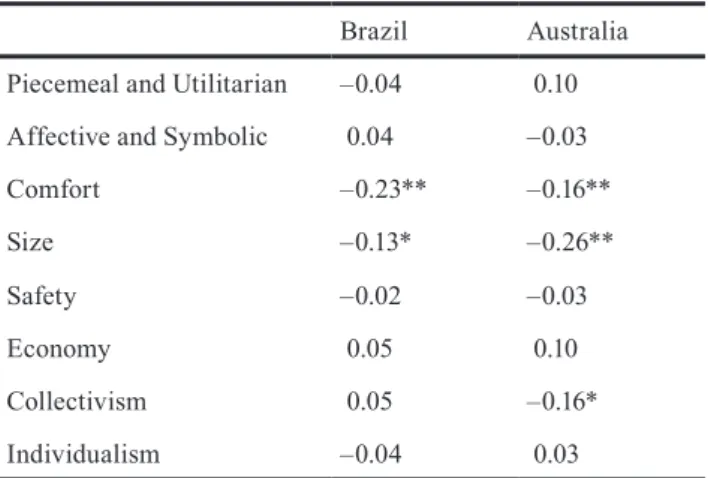
Table 3 describes the correlations among small car ownership, meaning and judgment preference, car attri-butes, and individualism–collectivism for both countries.
Although not all correlations were signiicant, the meanings
and judgments that formed the basis of car ownership can be inferred from the data. Small car ownership was negatively correlated with piecemeal judgment and utilitarian meaning for Brazilians and positively correlated with these factors for Australians. With affective judgment and symbolic mea-ning, the relationships were in the opposite direction. Even
though not all relationships were signiicant, they were in
the predicted directions. In terms of tangible car attributes, Comfort and Size correlated negatively for Brazilians and Australians. Collectivism correlated (negatively) only with Australian car ownership.
Hypothesis 3 was that the direct route between values and car ownership would be stronger for Brazilians than for Aus-tralians. To test the proposition, we regressed both Brazilian and Australian small car ownership onto the individualism– collectivism cultural values scores in an initial regression set. Then hierarchical regressions were conducted with Brazilian and Australian small car ownership regressed onto the four car attributes (i.e., Comfort, Size, Safety, and Economy) in Block 1 and then onto cultural values in Block 2. This use of hierarchical regression to test for mediator effects is discussed elsewhere (e.g., Allen & Ng, 1999a; Allen et al., 2002) and is recommended as a parsimonious way to test for mediators (Abbad & Torres, 2002). Of main interest are the R-squareds from the regressions.
Among Brazilians, cultural values alone predicted small car ownership (R2=.04; F
(2, 390)=3.57, p<.05). Closer exami-nation indicated that only the unique weight for collectivism
yielded a signiicant relationship (β=.17; t(391)=2.67, p<.001).
Car attributes signiicantly predicted small car ownership
(R2=.08; F
(4, 385)=5.71, p<.001). Cultural values in Block 2
added to this prediction (ΔR2=.03; ΔF
(2, 387)=3.52, p<.05),
indicating that the direct inluence of values on car ownership was signiicant. The indirect inluence of human values on small car ownership was 0.01 (0.04 – 0.03), the signiicance
of which could not be calculated. Thus, among Brazilians,
cultural values had a signiicant direct inluence on small
car ownership.
Among Australians, cultural value scores were not
signi-icant in terms of predicting small car ownership (R2=.005,
p=.94). Car attributes (Block 1) predicted small car ownership (R2=.07; F
(4, 360)=4.92, p<.001). Individualism/collectivism
(Block 2) added to this prediction (ΔR2=.02; ΔF
(2, 356)=3.52, p<.01). If one assumes Allen’s (2006) and Abbad and Torres’s (2002) arguments for the testing of mediator effects by com-paring prediction increase in hierarchical regressions, these results indicate that among Australians, car attributes acted as a mediator in the relationship between cultural values and small car ownership. This suggests that the indirect route was the preferred route for Australians.
Taken together, those analyses show that cultural
va-lues inluenced Brazilian small car ownership primarily by
inluencing car attributes, which in turn inluenced car ow
-nership (i.e., indirect route). The direct route between values and car ownership was stronger for Brazilians (R2=.04) than for Australians (R2=.005, ns; F
(2, 390)=2.37, p<.05).
Finally, note that all of the regressions described here were recalculated, controlling for demographics (i.e., gen-der, age, and education). In those regressions, demographic
characteristics were entered irst (Block 1), then car attributes
(Block 2), followed by values (Block 3). The results of these regressions paralleled the results presented here,
demonstra-ting that demographics did not account for the indings.
Discussion
Hypothesis 1 predicted a relationship between country and preferred cultural pattern. This hypothesis was suppor-ted. A main effect of country on cultural pattern was found such that the Brazilian sample had a predominant collecti-vist orientation and the Australian sample tended toward individualism. Brazilians had been expected to score high on collectivism, a characteristic attributed to most coun-tries in Latin America (Smith & Bond, 1999). Australia, in contrast, is considered an individualist culture (Hofstede, 1980). Levine and Norenzayan (1999) ranked 31 countries ranked from most collectivist (1) to least collectivist (10). Australia was an individualist country, whereas Brazil scored as collectivist (4).
Although the items on Singelis et al.’s (1995) Values Scale have strong face validity, they are designed to allow respondents to determine for themselves their preferred cul-tural pattern. Triandis and Gelfand (1998) warned that the use
of the Values Scale might be inluenced by social desirability
bias. It could be that Brazilian participants felt “forced” to prefer collectivism because of recent changes in the Brazilian economy. Brazil is radically changing its business climate from a paternalistic and protected system to a free-enterprise system (Ettorre, 1998). Given these changes, there may be pressures for Brazilian employees to present themselves as
more collectivist than they really are. Yet, the indings of the present study do not appear to relect this tendency.
The results show that Brazilians prefer more collectivist
values than Australians. This inding agrees with those of
several other scholars (e.g., Hofstede, 1980; Smith & Bond, Table 3. Correlations among small family car ownership, meaning and
judgment preference, car attributes, and individualism and collectivism by country.
Brazil Australia
Piecemeal and Utilitarian –0.04 0.10
Affective and Symbolic 0.04 –0.03
Comfort –0.23** –0.16**
Size –0.13* –0.26**
Safety –0.02 –0.03
Economy 0.05 0.10
Collectivism 0.05 –0.16*
Individualism –0.04 0.03
1999; Triandis, 1995) indicating that collectivism is a cultural characteristic of Brazilians. It is also interesting to note that
signiicant differences were found between the samples in
terms of individualist values. This result supports a large body of evidence (e.g., Hofstede, 1980; Smith et al., 1994) that Australians prefer individualist values. Therefore, not only was the Values Scale sensitive enough to capture the expected differences in the endorsement of individualist values by both samples, but this degree of endorsement predicted differences in consumer behavior between the countries (see Table 2).
Hypothesis 2 was also supported. Given the literature about culture and about product judgment and meaning, this hypothesis predicted that Australians would prefer piecemeal judgment and utilitarian meaning, whereas Brazilians would prefer affective judgment and symbolic meaning. The results revealed an effect of country on judgment type and meaning such that Brazilians had a much stronger preference for affective judgment than Australians. These data should be carefully considered when designing campaigns that target Brazilians consumers. Marketing strategies that stress col-lectivist values, for example, by positioning the product (in this case, cars) in line with these values, might have a greater appeal for this population.
Yet, caution should be used when interpreting the results of the Meaning and Judgment Scale used here. As stated
pre-viously, the reliability coeficients for the Brazilian sample
alone were less than those for the Australian sample. Triandis and Gelfand (1998) suggested that the attitude items used in
Western scales relect individualism more than collectivism.
This suggests that the Meaning and Judgment Scale might have a low etic value for use in collectivist populations.
Future research should pay close attention to the emic value of this scale. Another scale that uses situations or scenarios as items should be tested as a means of measuring judgment and product meaning. The use of such a scale might eliminate the measurement bias of the attitude items alluded to by Triandis and Gelfand (1998). Researchers could assess which scale (i.e., situational or attitudinal) has better face
validity in a speciic culture (i.e., individualist or collectivist)
and whether either scale represents an imposed emic. The cultural principles and categories that express individualism
or collectivism vary among cultures, as do speciic behaviors
linked to these values. These limitations complicate the use of abstract value schemes by international marketers (Ar-nould et al., 2003). Differing norms regarding, for example, the use of time, interpersonal interaction, personal space, and body language are a primary reason why consumers from one culture often misunderstand service experiences
in other cultures. These differences become signiicant for
marketers when organizations operate internationally or when they serve customers of different cultural backgrounds. An adaptation of marketing elements is then required (Arnould et al., 2003).
Hypothesis 3 was also supported. The direct route is stronger for small car ownership in Brazil. Allen’s two-route model (Allen, 2000; Allen & Ng, 1999a; Allen et al., 2002)
states that human values may inluence product preference
directly or indirectly. The present results suggest that com-pared to consumers who endorse individualist values, those
who hold collectivist values may be inluenced more directly
by values when it comes to choosing a car. These consumers form their attitudes toward a product by attending to and eva-luating human values symbolized by the product in relation to human values that they themselves endorse. Allen (2000) suggested that people have more positive attitudes toward items that symbolize a human value that they endorse and more negative attitudes toward items that symbolize a human value that they reject. The results of the regression among
the Brazilian sample show that human values, speciically
collectivism (positive unique contribution), help explain the decision to buy a car. Thus, this result shows that in addition to the objective attributes of cars, individuals’ human values form one basis of evaluating cars and choosing whether to buy.
The present study investigated one aspect of subjective culture: human values. According to Triandis (1995), the analysis of subjective culture leads to an understanding of how people perceive, categorize, and develop their beliefs and give value to their environment; the current results de-monstrate this. But also important is that the present study provides evidence for the etic validity of Allen’s two-route model for use in collectivist cultures. In other words, the
two routes by which human values inluence product pre
-ference appear to be of universal equivalence. Moreover, a relationship between human values and product ownership is present in collectivist Brazilian culture. If the argument about the etic validity of the two-route model is correct, then the existence of choice between the routes for product prefe-rence and the symbolism attached to the product is universal. Future research should include more samples from different countries to provide a strong basis for this argument.
Although the present results show the validity of the two-route model for use in the Brazilian culture, future studies should investigate the etic validity of the model for use in other collectivist cultures beyond, for example, Asian
cul-tures (Smith, Bond & Kagitçibasi, 2006). Latin America is
composed of 22 countries; although they are all collectivist countries, they have many cultural differences. As noted by Porras and Robertson (1992), there is often greater variance within subcultures of a single country than across countries. Each country in Latin America includes its own unique sub-cultures or groups that differ among themselves. Researchers should continue to investigate as many groups as possible to contribute to a better understanding of patterns of product preference in different cultures.
References
Abbad, G., & Torres, C. V. (2002). Regressão múltipla stepwise
e hierárquica em Psicologia Organizacional: aplicações, problemas e soluções. Estudos em Psicologia (Natal), 7, 19–29.
Allen, M. W. (1997). The direct and indirect inluences of human
values on consumer choices. Doctoral Dissertation, University of Wellington, New Zealand.
Allen, M. W. (2000). The attribute-mediation and product
meaning approaches to the inluences of human values on consumer
choices. In F. Columbus (Ed.), Advances in psychology research,
Allen, M. W. (2001). A practical method for uncovering the direct and indirect relationships between human values and consumer purchases. Journal of Consumer Marketing, 18, 102–120.
Allen, M. W. (2006). A dual-process model of the inluence
of human values on consumer choice. Revista Psicologia: Organizações e Trabalho, 6, 15–49.
Allen, M. W., & Ng, S. H. (1999a). The direct and indirect
inluences of human values on product ownership. Journal of Economic Psychology, 20, 5–39.
Allen, M. W., & Ng, S. H. (1999b). The psychology of poverty.
In P. E. Earl & S. Kemp (Eds.), The Elgar companion to consumer research and economic psychology (pp. 463–468). Cheltenham, England: Elgar.
Allen, M. W., Ng, S. H., & Wilson, M. (2002). The functional approach to instrumental and terminal values and the value-attitude-behavior system. European Journal of Marketing, 36, 111–135.
Arnould, E. J., Prince, L., & Zinkhan, G. (2003). Consumers
(2nd ed.). New York: McGraw-Hill.
Ashmos, D. P., & McDaniel, R. R. (1996). Understanding the participation of critical task specialists in strategic decision making.
Decision Sciences, 27, 103–113.
Brislin, R. W. (1980). Translation and content analysis of oral and written materials. In H. C. Triandis & J. W. Berry (Eds.),
Handbook of cross-cultural psychology, Vol. 4 (pp. 398-444). Boston: Allyn & Bacon.
Brislin, R. W., Lonner, W., & Thorndike, R. M. (1973). Cross-cultural research methods. New York: Wiley.
Campbell, D. J., Bommer, W., & Yeo, E. (1993). Perceptions of appropriate leadership style: Participation versus consultation across two cultures. Asia Paciic Journal of Management, 10, 1–19.
Dessen, M. A., & Torres, C.V. (2002). Family and socialization factors in Brazil: An overview. In W. J. Lonner, D. L. Dinnel, S. A. Hayes & D. N. Sattler (Eds.), Online readings in psychology and culture, Vol. 13 (pp. 1–11). Bellingham: Western Washington University, Center for Cross-Cultural Research.
Dittmar, H. (1992). The social psychology of material possessions: To have is to be. New York: St. Martin’s Press.
Ettorre, B. (1998). A business case for today’s Brasil and Argentina. Management Review, 87, 10–15.
Ferdman, B. M. (1992). The dynamics of ethnic diversity in
organizations: Toward integrative models. In K. Kelly (Ed.), Issues, theory and research in industrial/organizational psychology (pp. 339–384). Amsterdam: North Holland.
Foxall, G. R. (1986). Consumer theory: Some contributions of a behavioral analysis of choice. Management Bibliographies and Reviews, 12, 27–51.
Foxall, G. R. (1987). Radical behaviorism and consumer research: Theoretical promise and empirical problems. Marketing, 4, 111–129.
Foxall, G. R. (1990). Consumer psychology in behavioral perspective. New York: Routledge.
Guest, L. (1962). Consumer analysis. Annual Review of Psychology, 13, 315–344.
Heller, M. (1987). The role of language in the formation of ethnic identity. In J. S. Phinney & M. J. Rotheram (Eds.), Children’s ethnic socialization: Pluralism and development (pp. 180–200). Newbury Park, CA: Sage.
Hofstede, G. (1980). Culture’s consequences. Beverly Hills, CA: Sage.
Hofstede, G. (1983). The cultural relativity of organizational practices and theories. International Business Studies, 14, 75–89.
Hofstede, G. (1984). The cultural relativity of the quality of life concept. Academy of Management Review, 9, 389–398.
Hofstede, G. (1991). Cultures and organizations: Software of the mind. Maidenhead, England: McGraw-Hill.
Kahle, L. R. (1996). Social values and consumer behavior:
Research from the list of values. In C. Seligman, J. M. Olson & M. P. Zanna (Eds.), The psychology of values: The Ontario symposium
(pp. 135–151). Mahwah, NJ: Erlbaum.
Kilbourne, W. E. (1991). The impact of the symbolic dimensions
of possession on individual potential: A phenomenological perspective. Journal of Social Behavior and Personality, 6,
445–456.
Kleindorfer, P. R., Kunreuther, H. C., & Schoemaker, P. J. H.
(1993). Decision sciences: An integrative perspective. Cambridge: Cambridge University Press.
Kluckhohn, C. (1962). Universal categories of culture. In S. Tax
(Ed.), Anthropology today. Chicago: University of Chicago Press. Levine, R. V., & Norenzayan, A. (1999). The pace of life in 31 countries. Journal of Cross Cultural Psychology, 30, 178-205.
Madrigal, R., & Kahle, L. R. (1994). Predicting vacation activity
preferences on the basis of value-system segmentation. Journal of Travel Research, 32, 22–28.
McGuire, W. G. (1969). The nature of attitudes and attitude change. In G. Lindzey & E. Aronson (Eds.), Handbook of social psychology (2nd ed) (pp. 136–314). New York: Longman.
Merritt, A. (2000). Culture in the cockpit: Do Hofstede’s dimensions replicate? Journal of Cross-Cultural Psychology, 31,
283–301.
Miller, D. (1995). Consumption and commodities. Annual Review of Anthropology, 24, 141–161.
Nogueira, A. H. A. (2001). Cultural patterns and norms for leadership behaviors: A comparative study between social security in Brazil and the U.S. Doctoral Dissertation, University of Brasília, Brasília.
Nogueira, A. H. A., Torres, C. V., Guimarães, T. A., & Lucas, E. C. (2002). Cultural patterns and styles of leadership: A comparative study among Brazilian and American employees [Abstract]. In Society for the Study of Work and Organizational Values(Org.),
Proceedings of the 8th Bi-Annual Conference of the International Society for the Study of Work and Organizational Values. Warsaw, Poland: ISSWOV.
Pearson, V. M., & Stephan, W. G. (1998). Preferences for styles of negotiation: A comparison of Brasil and the U.S. International Journal of Intercultural Relations, 22, 67–83.
Pérez-Nebra, A. R., & Torres, C. V. (in press). Imagem do destino de turistas com relação ao Brasil: uma pesquisa da Psicologia do Consumidor. Turismo, Visão e Ação.
Peter, J. P., & Olson, J. C. (1993). Consumer behavior and marketing strategy. Homewood, IL: Irwin.
Poortinga, Y. H., & Sinha, J. B. (1992). Methodological concerns, choice of groups and instruments. In R. DeRidder & R. C. Tripathi (Eds.), Norm violation and intergroup relations (pp. 38–50). New York: Oxford University Press.
Porras, J. I., & Robertson, P. J. (1992). Organizational development: Theory, practice and research. In M. D. Dunnette & L. M. Hough (Eds.), Handbook of industrial and organizational psychology, Vol. 3 (2nd ed.) (pp. 719–822). Palo Alto, CA:
Richins, M. L. (1994). Valuing things: The public and private meanings of possessions. Journal of Consumer Research, 21, 19–26.
Schwartz, S. H. (1992). Universals in the content and structure of values: Theoretical advances and empirical tests in 20 countries. In M. Zanna (Ed.), Advances in experimental social psychology, Vol. 25 (pp. 1–64). San Diego: Academic Press.
Simonson, I., Carmon, Z., Dhar, R., Drolet, A., & Nowlis, S. M. (2001). Consumer research: In search of identity. Annual Review of Psychology, 52, 249–275.
Singelis, T. M., Triandis, H. C., Bhawuk, D. P. S., & Gelfand, M. J. (1995). Horizontal and vertical dimensions of individualism
and collectivism: A theoretical and measurement reinement. Cross-Cultural Research, 29, 240–275.
Smith, P. B., & Bond, M. H. (1999). Social psychology: Across cultures (2nd ed.). Boston: Allyn & Bacon.
Smith, P. B., Bond, M. H., & Kagitçibasi, C. (2006). Understanding social psychology across cultures: Living and working in a changing world. London: Sage.
Smith, P. B., Dugan, S., Peterson, M. F., & Leung, K. (1998).
Individualism: Collectivism and the handling of disagreement: A 23 country study. International Journal of Intercultural Relations, 22, 351–367.
Smith, P. B., Peterson, M. F., Akande, D., Callan, V., Cho, N. G.,
Jesuino, J., D’Amorim, M. A., Koopman, P., Leung, K., Mortazawi,
S., Munene, J., Radford, M., Ropo, A., Savage, G., & Viedge, C. (1994). Organizational event management in fourteen countries: A comparison with Hofstede’s dimensions. In A. M. Bouvy, F. van der Vijver, P. Schmitz & P. Boski (Eds.), Journeys into cross-cultural psychology (pp. 364–373). Amsterdam: Swets & Zeitlinger.
Statt, D. A. (1997). Understanding the consumer: A psychological approach. London: Macmillan.
Torres, C. V. (1999). Leadership style norms among Americans and Brazilians: Assessing differences using Jackson’s return potential model. Doctoral Dissertation, California School of Professional Psychology, San Diego.
Torres, C. V., & Dessen, M. A. (2006). The Brazilian jeitinho: Brazil’s sub-cultures, its diversity of social contexts, and its family structures. In J. Georgas, J. W. Berry, F. J. R. van de Vijver, C.
Kagitçibasi & Y. H. Poortinga (Eds.), Families across cultures: A 30-nation psychological study (pp. 259–267). Cambridge: Cambridge University Press.
Torres, C. V., & Pérez-Nebra, A. R. (2007). The inluence of
human values on holiday destination choice in Australia and Brazil.
Brazilian Administration Review, 4, 63–76.
Triandis, H. C. (1994). Cross-cultural industrial and organizational psychology. In H. C. Triandis, M. D. Dunnette & L. M. Hough (Eds.), Handbook of industrial and organizational psychology, Vol. 4 (2nd ed.) (pp. 103–172). Palo Alto, CA:
Consulting Psychologists Press.
Triandis, H. C. (1995). Individualism and collectivism. Boulder, CO: Westview Press.
Triandis, H. C., & Gelfand, M. J. (1998). Converging measurement of horizontal and vertical individualism and collectivism. Journal of Personality and Social Psychology, 74,
118–128.
Triandis, H. C., McCusker, C., & Hui, C. H. (1990). Multimethod probes of individualism and collectivism. Journal of Personality and Social Psychology, 59, 1006–1020.
Tversky, A., Sattath, S., & Slovic, P. (1998). Contingent weighting in judgment and choice. Psychological Review, 95,
371–384.
Van Horn, K. R., & Marques, J. C. (1999). Development
of interpersonal negotiation strategies in Brazilian adolescents.
Interamerican Journal of Psychology, 32, 21-31.
Recebido em 30.07.07 Primeira decisão editorial em 17.03.08
Versão inal em 29.03.08