Short Report
Preparation of Thermostable Poly(Ethylene Glycol) Using Thermal Treatment in Sealed System
Carmem D. Cardosoa, Majulaine Copettib, Leticia Schwerzb, Nádia Viarob and Martha Adaimeb*
a
Escola de Farmácia - Universidade Católica de Pelotas - RS, Brazil b
Departamento de Química Universidade Federal de Santa Maria -Campus Camobi - 97105-900 - Santa Maria - RS, Brazil
O trabalho descreve um método rápido para a preparação de Carbowax 20M imobilizada sobre suporte, através do uso de tratamento térmico em forno convencional. O processo de extração com solventes remove a fase estacionária não imobilizada de poli(etileno glicol) (PEG) do suporte e a diferença de massa antes e após a extração fornece o percentual extraído e, consequentemente, o percentual total imobilizado. O tratamento térmico a 250 °C por 10 horas mostrou que a imobilização reduziu a atividade do material e aumentou o número de pratos (N) e a resolução (Rs), enquanto o fator de retenção (k) reduziu. Desta forma, a separação na coluna com material tratado é mais rápida e mais eficiente.
A rapid method is described for preparation of support - bonded Carbowax 20M columns packing using a conventional furnace to heat the packing. Solvent extraction of the stationary phase removes the non-immobilized poly(ethylene glycol) (PEG) from the support and the difference between final and initial weight provides the total percent extracted and, consequently, the total percent immobilized. Treatment of the packing material at 250 °C for 10 h. reveals that the immobilization reduces the material activity and increases the plates number (N) and resolution (Rs) while the retention factor (k) is decreased. Thus, separations with this treated column are faster and display higher efficiency.
Keywords: thermal treatment, immobilization, Carbowax 20M, capillary gas chromatography
J. Braz. Chem. Soc., Vol. 11, No. 2, 191-194, 2000. Printed in Brazil
c 2000 Soc. Bras. Química 0103 - 5053 $6.00+0.00
Introduction
Carbowax® PEG 20M is widely used in gas
chromatogra-phy (GC) because of its unique selectivity, which allows resolution of polar compounds having similar boiling points. However, the ease of oxidation and low thermal stability of this stationary phase reduce its application in GC.
The development of bonded Carbowax capillary columns in recent years has increased, due to its high stability, extended column lifetime as well as the easy removal of residue materials from contaminated column. Immobilization of the stationary phase is generally achieved by bonding the polymer chain to the support. This immobilization process is initiated by free radicals which are produced by heat1-5, chemical initiators such
as azocompounds6-8, peroxides9-13 or ozone14,15, and
ioniz-ing radiation such as electrons16, gamma radiation17,18 and
low-temperature plasmas19. All these methods have been
suc-cessfully applied to produce immobilized nonpolar silicone phases within capillary columns. On the other hand, very little information exists on immobilization of supported stationary phases used in packed-column gas chromatography.
Support-bonded Carbowax 20M column packing has re-cently become available from several commercial sources.
The cost of these materials is high compared with that of conventional column packings, and variations in quality among batches and suppliers have been noticed.
In this article a rapid method is described for the prepa-ration of support-bonded Carbowax 20M column packing. A conventional furnace was used to heat the packing which was sealed inside a glass ampoule.
Experimental
Materials
20% Carbowax 20M (Merck) on Chromosorb W/AW (80-100 mesh, Merck) was prepared by evaporation20 of
solvent. This material was placed in borosilicate glass ampoules which were sealed under N2 and heated at dif-ferent temperatures (200, 250, 300, 350 and 400 ºC) for 5 and 10 h.
Column preparation
192 Cardoso et.al J. Braz. Chem. Soc
Equipment
A Varian 3400 Gas Chromatograph with flame ioniza-tion detector was used with 1.5 m x 0.2 cm (i.d.) stainless steel columns placed to permit on-column injection. Vis-ible spectra were obtained on a Perkin-Elmer model l 16 spectrophotometer.
Packing characterization
Solvent extractions of immobilized and non-immobilized packing materials were carried out at reflux temperature for 5 h. with each of three solvents (methanol, benzene and chloroform) using a modification of the method of Sanchez
et al.21.
Methyl orange adsorption on the active surface, used to determine the relative difference between well-coated and non-coated particles, was carried out by a modification of the method of Shapiro and Kolthoff22. Known quantities of the
packing materials were stirred in contact with 5% (v/v) of me-thyl orange in acetic acid solution. After a fixed time the sus-pension was filtered and the absorbance of the methyl orange remaining in solution was measured at 505.6 nm. The surface activity was determined from the difference in absorption be-tween pure and filtered methyl orange solutions, after contact.
Chromatography
Two different polar mixtures (methyl octanoate/methyl hexanoate at 160 °C and cyclohexanol/cyclohexanone at 160 ºC) were used to evaluate the chromatographic param-eters of the phases using a flow rate of 30 mL min-1 (N2).
The tM (Mobile Phase Retention Time) was determined with
butane at three different temperatures (120, 140 and 160 ºC). To verify their thermal stability (bleeding) the columns were submitted to high temperatures (250 ºC) and the back-ground current was registered.
In the thermogravimetric simulation these packings were heated under N2 and weighted several times using a
spe-cial ampoule adapted for Gas Chromatography.
Results
Solvent extraction of the stationary phase removes the non-immobilized poly(ethylene glycol) from the support and the final and initial weight difference provide the total per-cent extracted and, consequently, the total perper-cent immobi-lized. Temperature of 400 °C causes immobilization of a sig-nificant quantity of the phase (up to 80%), but at 200 °C no significant immobilization is observed. However, at 400 °C and 350 °C treated packings underwent decomposition, appearing to be burned.
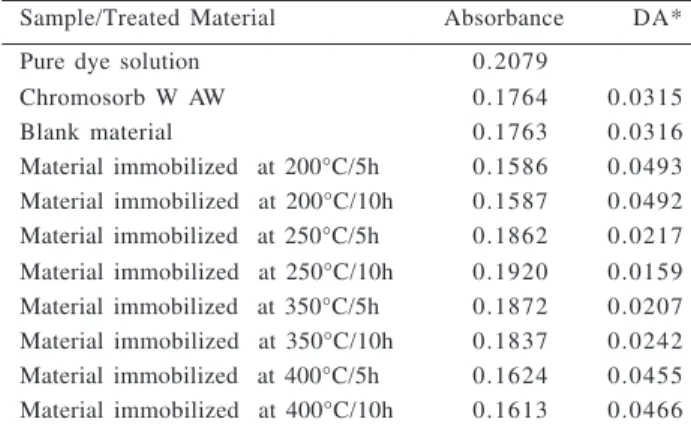
Table 1. Difference in adsorption (DA*) between pure methyl orange solution and the filtered methyl orange solution after contact with different materials.
Sample/Treated Material Absorbance DA* Pure dye solution 0.2079
Chromosorb W AW 0.1764 0.0315 Blank material 0.1763 0.0316 Material immobilized at 200°C/5h 0.1586 0.0493 Material immobilized at 200°C/10h 0.1587 0.0492 Material immobilized at 250°C/5h 0.1862 0.0217 Material immobilized at 250°C/10h 0.1920 0.0159 Material immobilized at 350°C/5h 0.1872 0.0207 Material immobilized at 350°C/10h 0.1837 0.0242 Material immobilized at 400°C/5h 0.1624 0.0455 Material immobilized at 400°C/10h 0.1613 0.0466
Figure 1. Separation of cyclohexanol and cyclohexanone in (a) non-immobilized and (b) non-immobilized (250°C/10 h.) columns.
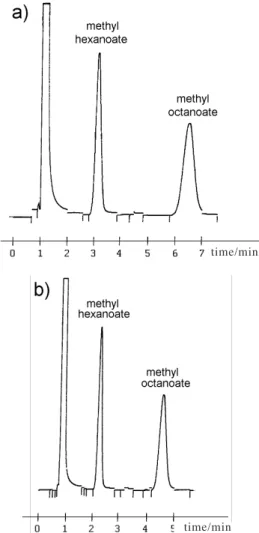
The relative difference between well-coated and non-coated particles was evaluated as shown in Table 1. The chromatographic separations are shown in the Figures 1 and 2, comparing immobilized and non-immobilized columns.
time/min
Vol. 11, No. 2, 2000 Thermostable Poly(Ethylene Glycol) 193
The necessary temperature to cause increase in the back-ground current is higher for immobilized than for the non-immobilized phase indicating an increase in stability with this treatment.
Discussion
Although treatment at 250 °C showed only 1.5% of im-mobilization, this material was chosen due to its better chro-matographic performance.
The increased absorbance of the packing immobi-lized at 250 ºC for 10 h, compared with the non-immobi-lized one reveals that immobilization reduces the pack-ing activity.
The immobilized column possesses a greater plate num-ber (N) and higher resolution (Rs) than the non-immobi-lized column, while the retention factor (k) decreased after immobilization.
These results are similar to those obtained by Aue et al.1 who used temperature treatments of 260 ºC to 280 ºC
for 12 h. In that work the chromatographic behavior of po-lar compounds showed symmetric peaks with very short retention times.
This result is confirmed by thermogravimetric simula-tion where we observe that the immobilized packing lost 3.5 % of the stationary phase while the non-immobilized pack-ing lost 11.0 % of stationary phase at 300 °C.
Conclusion
We conclude that the preparation of Carbowax 20M phase immobilized on Chromosorb W/AW is a simple method that uses a sealed system, minimizing the station-ary phase loss. This procedure produces efficient columns with higher plate number and smaller retention factor than the non-immobilized columns.
Figure 2. Separation methyl hexanoate and methyl octanoate in (a) non-immobilized and (b) immobilized (250 °C/10 hours) columns.
Figure 3. Effect of Carbowax 20M immobilization on background current.
The effect of immobilization on thermal stability is shown by measurements of the background current, indicated in Figure 3.
Thermal stability is also determined by thermogravi-metric simulation (Figure 4).
Figure 4. Percentage of the liquid stationary phase (Carbowax 20M) lost as a function of the temperature for blank and treated packings.
time/min
time/min
194 Cardoso et.al J. Braz. Chem. Soc
References
1. Aue, W.A.; Hasting, C. R.; Kapila, S. J. Chromatogr.
1973, 77, 299.
2. Lipsky, S. R.; McMurray, W. J. J. Chromatogr. 1982,
239, 61.
3. Petsev, N. D.; Pekov, G. I.; Alexandrova, M. D.; Dimitrov, C. Chromatographia 1985, 20, 228.
4. Sandra, P.; David, F.; McNair, H. M. Analysis 1992,
20, 117.
5. Lai, G.; Mühleck, U.; Nicholson, G. J.; Schmid, J.; Bayer, E. Chromatographia 1991, 32, 241.
6. Richter, B. E.; Kuei, J. C.; Park, N. J.; Crowley, S. J.; Bradshaw, J. S.; Lee, M. L. J. High Resol. Chromatogr. Chromatogr. Commun. 1983, 6, 371.
7. Janák, K.; Horká, M.; Tesarík, K. J. Chromatogr. 1989,
471, 237.
8. Horká, M.; Kahle, V.; Krejcí, M. J. Chromatogr.1993,
637, 96.
9. Grob, K.; Grob, G. J. Chromatogr. 1981, 211, 243. 10. Wright, B. W.; Peaden, P. A.; Lee, M. L.; Seark, J.
J. Chromatogr. 1982, 248, 17.
11. Blomberg, L.; Buijten, J.; Markides, K.; Wannman, T.
J. Chromatogr. 1982, 239, 51.
12. Ghijsen, R. T.; Nooitgedacht, F.; Poppe, H. Chro-matographia 1986, 22, 201.
13. Cigánek, M.; Dressler, M.; Teplý, J. J. Chromatogr.
1991, 588, 225.
14. Grob, K.; Grob, G. J. Chromatogr. 1981, 213, 211. 15. Chuang, C. H.; Shanfield, H.; Zlatkis, A.
Chro-matographia 1987, 3, 169.
16. Markides, K.; Blomberg, L.; Buijten, J.; Wannman, T.
J. Chromatogr. 1983, 267, 29.
17. Hubball, J. A.; DiMauro, P. R.; Barry, F.; Lyons, E. A.; George, W. A. J. Chromatogr. Sci. 1984, 22, 185. 18. Basso, M. A.; dos Santos, M. J. T. F.; Collins, K. E.;
Collins, C. H. J. High Resol.Chromatogr. Chromatogr. Commun. 1989, 7, 500.
19. Springston, S. R.; Dezaro, D. A. J. Chromatogr. 1989,
473, 79.
20. Supina, W. R. The Packed Column in Gas Chromato-graphy; Supelco Inc.; Bellefonte, PA,1974.
21. Sanchez, E. F.; Dominguez, J. A.; Munõz, J. A. G.; Molera, M. J. J. Chromatogr. 1984, 299, 151. 22. Shapiro, J.; Kolthoff, I. M. J. Am. Chem. Soc. 1950,
72, 776.