Introduction
Kinematic variables of table vault on artistic gymnastics
CDD. 20.ed. 796.023 796.41
http://dx.doi.org/10.1590/1807-55092016000100097
Sarah Maria Boldrini FERNANDES* Paulo CARRARA* Júlio Cerca SERRÃO* Alberto Carlos AMADIO* Luis MOCHIZUKI**
*Escola de Educa-ção Física e Esporte, Universidade de São Paulo, São Paulo, SP, Brasil.
**Escola de Artes Ciên-cias e Humanidades, Universidade de São Paulo, São Paulo, SP, Brasil.
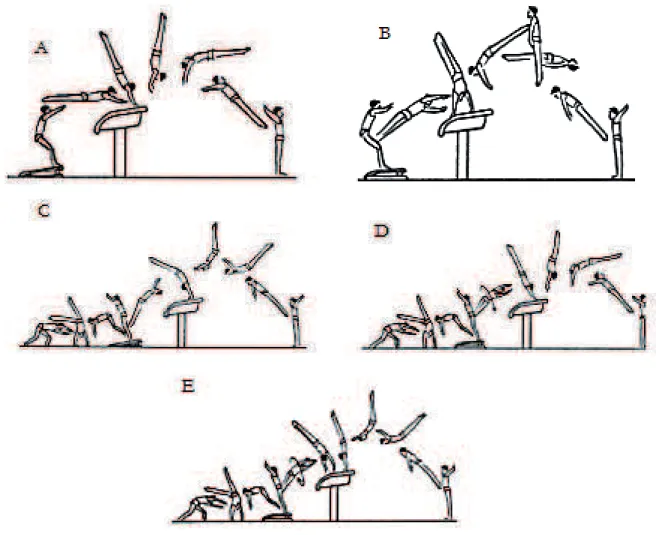
Vault is one of the artistic gymnastics events, either for males and females competitions. Since 2001, vault regulations include an approach running of 25 m, a springboard and a rectangular table with a surface measuring 1.20 m x 0.95 m. Th e table height is diff erent among males (1.35 m)1, females (1.25 m)2 and juniors categories (1.15 m)3. Th e competition regulations require from a gymnast to perform two vaults from fi ve groups, characterized by diff erent approaching positions on the table (FIGURE 1)1.
For males, the number of vaults coded in each group are: 34 in group I (forward handspring), 24 in group II (handspring with ¼ turn in the fi rst fl ight phase, Tsukahara), 19 in group III (round off entry, Yurchenko), 16 in group IV (round off entry with
in group the fi rst fl ight phase, Nemov) and 14 on group V (round off entry with turn in the fi rst fl ight phase of the jump, Scherbo), in a total of 107 vaults coded1. For females, the number of vaults coded in each group are: 24 in group I (handspring), 14 in group II (handspring and salto), 12 in group III (¼ or ½ turn in the fi rst fl ight phase, Tsukahara), 19 in group IV (round off entry and salto, Yurchenko) and 11 on group V (round off entry with ½ turn in the fi rst fl ight phase), in total of 80 vaults coded2.
Due to those coded vaults, research would be needed about general concepts of vaulting biomechanics, to develop principles for qualitative application of biomechanics to improve movement performance and to reduce the risk of injury4.
Abstract
The table vault is an event of male and female Artistics Gymnastics. Although it can be performed in a variety of rotations and body positions in different phases, it can be separated in three groups: handspring, Yurchenko and Tsukahara. It is believed that kinematic variables of vault may vary according to group of vault or gymnast body position, but few studies compares the real differences among the three groups of vaults, comparing and describing the variables in different phases. Vault kinematic variables could be diversifying according to the approach or position of the vaulting, but little has been studied about the biomechanical differences, comparing and describing behaviours at different stages. The aim of this study was to organize critical, objective and to systematize the most relevant kinematic variables to performance on vaulting. A Meta analysis over the basis Pubmed, Sport Discus and Web of Science were performed about this issue. From the selected references, we described and analyzed the kinematics of the table vault. Vault can be characterized in seven phases of analysis. Most of the studies are descriptive, and some do not descript all phases. Differences among vault variables according to group vaults, technical level and gender were analysed only in recent studies. There still gaps of knowledge about kinematic variables of table vault, in order to provide comprehensive information about all possibilities of vaults in this gymnastic event. It is concluded that kinematic variables of table vault depends upon vault group and may be considered to the improvement of technical performance. More researches are needed to approach the coaching interface with biomechanics applicable knowledge.
Th erefore, one main need for research in gymnastics and biomechanics is to present objective and systematic knowledge about the apparatus and provide information to the coaches in fi eld5.
An understanding of the biomechanics variables related to the vault groups, body position (tucked, piked or stretched), the number of rotations around the transversal and longitudinal body axis, gymnasts sectors and categories would provide information about the research gaps. Also, to present coaches with a comprehensive understand about what is already known6. If there are diff erences between vault groups would explain individual gymnast performance needing to attend
FIGURE 1 - Vault groups1.
Th e scientifi c questioning about the reference parameters that base coaches actions6. Due to the complexity and variability of motor actions in gymnastics, it is pertinent to analyze each event separately. Close monitoring of the evolution of skill on table vault apparatus is paramount for gymnastics coaching13.
Coaches’ access to applied biomechanics knowledge is also limited because the youth of biomechanics means there are fewer narrative or meta-analysis review papers on sport biomechanics issues4. In Artistic sports where it is important the presentation, the technical level and the increase of complexity, it is necessary to analyse kinematic aspects of performance, and competition requirements. It is necessary to organize biomechanical-based classifi cation for the exercises in artistic gymnastics7-11. In order to approach such proposal, is there biomechanics diff erences regarding the vault types and table height? Is there the group vault more preferable or effi cient? Th e understanding of the performance variables in a sportive movement is fundamental to improve gymnasts technical achievements4. Such variables, when interpreted and manipulated, are important to understand the adaptations and limitations of movement patterns, by complete characterization of sportive movement, and to elaborate a plan of action to improve performance12.
Method
This meta-analysis research was conducted based in papers within the data basis: Pubmed, Sport Discus and Web of Science. Th is search was performed in those databases from 1980 up to 2015. Moreover, book of abstracts with reviewing process from International Society of Biomechanics, International Society of Biomechanics in Sports and Brazilian Society of Biomechanics were included. Th e keywords used in English were: “gymnastics” and “vault” and “kinematic”; and in Portuguese: “ginástica” and “salto” and “cinemática”. From the resulting references, papers that have considered vault kinematics were selected for analysis in the present study. Biomechanics and kinematics are adequate to characterize the mechanics of causes and eff ects of movements and variables of performance12.
The gymnastics table
For an adequate understanding, the studies describing the characteristics and predictors of performance in vaults were grouped variables. Th e dependent variables were the vault group (group one to fi ve) and body posture (tucked, picked or extended), as during vault 2nd fl ight phase it is another factor of differentiating and increasing complexity and vault value. The independent variables were the gender (male or female), category (seniors, juniors or beginners) and technical level (Olympic, World Championship, international or national). Some studies refer to the former horse used for vault. Th ey were included to allow observing the interdependence and relations among vault phases.
Th e table vault is composed by a sequence of complex movements and is presented on male and female competitions1-2, 20. As shown in
Variables
Results and discussion
determine the variables which can lead to performance improvement or score increase6.
Besides being recognized as empiric by great part of scientifi c community, importance of such variables, most of the studies are descriptive, some are comparative among vault parameters to the fi nal score5, 14. Th ere are few studies comparing the
main variables in the vault event15-16, in special over
diff erent vault groups, in which the biomechanical factor is diff erent17. It is believed that the kinematic
variables of vault may vary according to the vault group, gender or technical level, but still lack of knowledge about the real diff erences among vault groups, mainly when considering direct methods of
measuring18-19. Sport coaches naturally want the best
for their athletes to help them improve performance and reduce their risk of injury4, 6.
After these considerations, the question arises from this scenario: what are the main parameters or vault phases that should be considered about gymnastics table vault? Are there essential variables which predict vault performance? Do the kinematic variables of vault vary over vault group, gender or technical level? Th e aim of this study is to present comprehensive information about the movement patterns of table vault, discuss the most relevant kinematic variables of vault performance and point out lacking points in research about this gymnastics event.
Th e vaults may be categorized in: a) continuous rotation (were the movement rotations happen on the gymnast transversal plane) handspring and Yurchenko; and b) change of direction, which the movement rotation axis of the 2nd fl ight is reverted in relation to the fi rst fl ight25. Th us, the main fi rst fl ight groups can be grouped in handspring, Tsukahara and Yurchenko5, 26.
Within the 40 studies we have found, 18 studies (45%) described handspring group, four studies (10%) described Yurchenko group and two (5%) described Tsukahara group. No studies were found about vaults from group VI or V. One reason for it could be because the entry for these groups are performed with ½ turn or more in the 1st fl ight phase, so they are more complex to be performed with similar vault values as the other groups. Besides, the number of codifi ed vaults for group IV and V is only half of the number of codifi ed group I, and two thirds of group II vaults, containing less options for a vault that best fi t for a gymnast, considering the best vault values and penalties applicable.
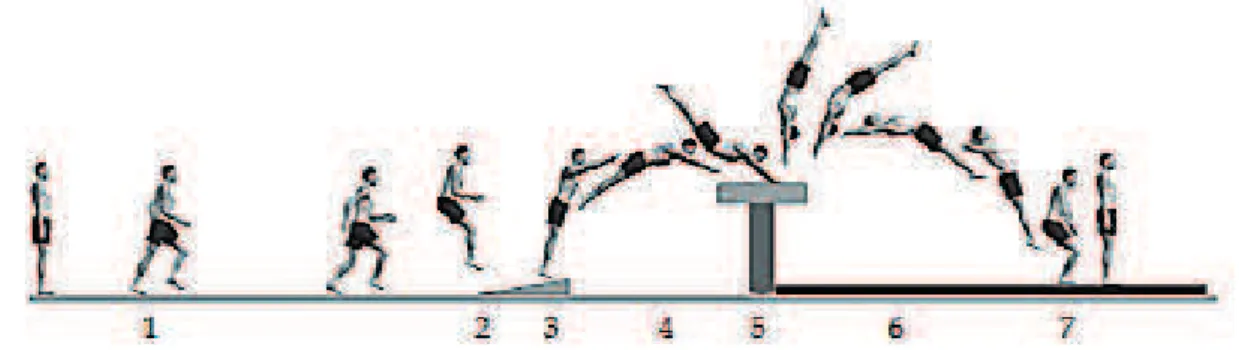
Vault preparation occurs during running to springboard. Th e gymnast runs to increase the kinetic energy and increase the mechanical energy to the linear and angular rotations to be performed on the vault 2nd fl ight16. Following, after the contact and leave the springboard, the 1st fl ight is the displacement with the feet from springboard to the hands contacting the table. After the 1st fl ight, the contact table phase begins with the preparation for the 2nd fl ight. On 2nd fl ight, the gymnast performs rotations and get ready for the vault fi nal phase, which is the landing16, 27. Vault lasts about two seconds of running, 0.1 s of springboard contact, 0.2 s of 1st fl ight and table contact, and one second of 2nd fl ight28.
The biomechanical characteristics that limits vaulting performance are related to the execution velocity, linear and angular body segments positions24
and the vault phases duration5, 27 (described in FIGURE 1). Th e score attributed by a judge is highly related with the 1st fl ight duration, 2nd fl ight duration and height peak23, 29; while for Takei21 the centre of mass (CM) horizontal displacement reach at 2nd fl ight peak would be the best predictor of judges’ scores. To explain the relation between biomechanical parameters and vault values of diff erent men’s vault groups, Aticović24 applied a mathematical model to explain the fi nal phase (2nd fl ight) of vault. Vaulting performance depends on: CM position and height in final phase; 1st flight mechanical parameters during table contact; base of table spring properties; segments acceleration and torques between gymnast and table30; strength, fl exibility and acceleration31.
However, Schwiezer32 determined important mechanical variables for optimal vault performance: variation of hand placement, reaction forces at hand support phase, minimal distance between body CM and the edges of the table, minimal and maximum distances between body and the edge of the table while crossing the apparatus, position at which the gymnast hits the vaulting board, distance of the vaulting board, and landing distance behind the table. Hetch vault (group 1 handspring - reverse rotation on 2nd fl ight) was found in three (11%) studies. It was a compulsory vault in Men’s Artistic Gymnastics during the Olympic cycle 1993-1996. Th e Hecht vault required a low trajectory of CM during pre-fl ight, with a low vertical CM velocity and low angular velocity of the body at horse contact33. In contrast, the optimum handspring somersault required a high pre-fl ight trajectory, with a high angular velocity of the body and a high vertical velocity at horse contact33. Th is is useful for technical development considerations when learning from Hecht to handspring vaults.
Hetch vault is an unusual vault in gymnastics34-35. Unusual for elite competitions because it is not coded anymore1, but it is considered the fi rst vault FIGURE 2 - Vault seven phases24.
1: run;
2: jump on springboard; 3: springboard support phase;
Th e running approach is preliminary phase that allows gymnast to reach peak horizontal velocity at jumping, what will be relevant for the next phases44. It is when the gymnast accelerates towards the table until the last movement before springboard contact. Some studies about vault biomechanics25, 29, 45 had shown that as higher velocity peak is; more favourable is the development of propulsion to reach enough height and distance for 2nd fl ight rotations.
Furthermore, there are many studies reporting successful vault performances such as run speed, maximum speed on springboard, 1st fl ight and 2nd fl ight position8, 17, 20, 23, 29, 32, 44.
For kinematics comparisons between the actual table and horse in vault, the running approach and springboard contact characteristics remained unchanged, as equipment modifi cations did not change gymnast performance in these initial phases13. An analysis of men’s and women’s vault showed that during ten years the running approach velocity have increased, except for Yurtchenko group vault44. For those authors, the technical improvement of gymnastics during these ten years led a rise of the vault values, what means increasing the number of rotations and the complexity of body positions, infl uencing on large velocity necessities44. Yurtchenko characteristics appear to be a factor limiting velocity, as round off entry requires more precise movements than jumping straightforward over the springboard. Technical level of gymnast can determine the running approach acceleration to springboard. Approach running
for beginners. Contact phase were studied and shoulder angles were emphasized to build models to understand the performance of Hetch vault35.
Studies about juniors or beginners categories were found, and the Hetch vault would be a good example of search for any kinematics variable diff erences from juniors to seniors, over an identical skill. Another paper advance on the relation between wrist and shoulder angles on junior female handspring vaults36.
Th ese comparisons would allow more knowledge about the common gymnast’s errors and how to develop the vault technical progressions.
Optimization studies were applied to optimize performance scores for vaults with fi xed rotation potential37-39. Th e increase in height of 0.4 m between real condition (2.7 m) and optimum simulation (3.1 m) may seem rather high but is consistent with the heights reached in elite performances of handspring double front somersault (Roche) vaults (3.0 ± 0.1 m) which requires similar angular momentum29, 39.
For Kasamatsu and Tsukahara vaults, horizontal CM velocity decreased, vertical CM velocity increased, and angular momentum was produced in the board contact phase. In addition, horizontal and vertical velocity decreased in the vault contact phase. However, no diff erence was observed between both vaults. Th e contribution of upper limbs to angular momentum about the centre of mass was higher for Kasamatsu vault than that for Tsukahara vault at vault takeoff 40. Th e CM height contributes to
vertical reception on landing, contributing with improved control. For high scores handsprings vaults, it was observed larger horizontal velocity and translational kinetic energy at takeoff from the board, larger vertical velocity and greater amplitude on 2nd fl ight and superior landing performance41. For the Roche (handspring plus double salto tucked forward) vault comparisons, gymnasts with high score in competition had: 1) greater height of body CM and a more fully extended body position at the horse take-off ; 2) greater height of body CM at the peak of post-fl ight, knee release, and touchdown on the mat; 3) greater horizontal and vertical displacements of body CM, greater somersaulting rotation, and longer time from the knee release to mat touchdown; and 4) markedly smaller landing point deductions29.
Modelling handspring was found with the former horse used for vault42 and for the current table39, 43, while was not found for other vault groups. It was verifi ed that changing the apparatus from horse to table has changed handspring vertical take-off
velocity13. But no studies were found regarding
kinematics changes of other vaults.
Čuk et al.17 presented biomechanical characteristics of vault and the most important factors for a successful vault jump. Th ese factors included morphologic characteristics, run velocity, length of fl ight on the springboard, duration of board contact, position of feet from springboard edge, duration of 1st fl ight phase, duration of support on table phase, duration of 2nd fl ight phase height of jump, distance from
take-off 2nd fl ight phase, and landing.
Th e jump on springboard starts when a gymnast jumps from the running track, after the last approaching step. Its objective is to transmit the impulse produced on running and on springboard to 1s and 2nd fl ight phases10. Th e energy provided from this approach will be redirected to the table by the springboard action27. At this instant it is important the gymnast posture, force generated by the gymnast, where this force is applied over the springboard, the velocity acquired and how the energy will be transferred15, 27, 46-47.
When gymnast’s feet contact the springboard with foot, the ground reaction force peak is around ten times the body weight48. Th ere is any factor related to the other phases that influence the Springboard contact
springboard contact (vertical velocity, horizontal velocity and entrance angle), except the approach running46, 49. However, the springboard support phase can infl uence the subsequent phases15-16.
Th e position at which gymnasts hit the vaulting board is also important. Considering the handspring vault, jumping over the distal part of the springboard reduces more the gymnast horizontal velocity than jumping over the middle part32. In addition, the horizontal velocity of impacts was 18% higher over the distal part of the springboard, contributing more to the inversion of the gymnast due to larger horizontal velocity on anteroposterior direction27. Th is consideration is important as the developing categories of gymnasts who do not have enough power to springboard should precisely jump over the springboard distal part to achieve the handspring vault. Moreover, the handspring group is one of the most challenging vaults for gymnasts who are as tall as the table height, and are passive to fall over the table with their back. One rule adjustment in Brazil is to allow one springboard to be place over another for beginners’ categories, lowering the diff erence between table and gymnast height and improving the propulsion3. Considering Tsukahara group, for example, the lateral hand position base is larger over the table, facilitating the small gymnast to pass over the table, besides allowing gymnasts to have visual contact during all vault phases, facilitating any skill corrections needed. Any of the found research relates table and gymnasts height to model the minimal kinematics parameters required to pass over the table, what would be useful for coaching purposes. Just one paper31 associated training and kinematics variables in initial gymnasts categories (11-13 years old).
Another study analysing men’s and women’s vault kinematic parameters associated springboard contact and vault performance15. Women reached the springboard contact with lower entrance angle than men. By reducing 7% of horizontal or vertical velocity on springboard, it would reduce respectively by 13% and 25% of the distance on 2nd fl ight15. Because 2nd flight distance is one parameter evaluated by judges1-2, the entrance velocity over
the springboard can infl uence gymnast fi nal score15.
Th e distance of vaulting board32 and high take-off
velocity was directly related to judge’s score26.
Th e fi rst fl ight phase starts at the fi rst instant gymnast takes off the springboard until contact the Veličković et al.20 analyzed the running velocity of the
last ten steps from the fi nalist gymnasts of the world championship (elite) and of the world cup (high level). In the last ten steps, gymnasts increase progressively velocity and reach the peak in the last step, being the elite (9.95 m/s) faster than high level (8.57 m/s) gymnasts. Th erefore, elite gymnasts are more prepared to perform better vaults, due to larger fi nal velocity and impulse, better adjustment and running precision20.
All vaults of Stuttgart World championship had the running approach analysed, and velocity patterns were depicted accordingly vault group and gender. Handspring vaults had shown larger mean velocities, followed by Tsukahara and Yurchenko group vaults. Men were faster than women (handspring: 8.3 m/s versus 7.7 m/s; Tsukahara: 8.2 m/s versus 7.5 m/s), except for Yurchenko vaults (7.3 m/s for both genders). Th ese diff erences on running velocities may occur due to interaction of lower table height and lower vault value (number of rotations and body position) for women competition. Th e decreasing acceleration pattern during running was inversely proportional to velocity increase, aiming to target springboard. Considering the number of steps as a scale to estimate gymnast velocity20 or distance44 peak velocity occurs
close to springboard, suggesting that larger velocity facilitates the subsequent execution of 1st fl ight.
An increased necessity of running acceleration is related to vault score, and if there is an error during approaching, hardly it can be corrected26.
Generally, gymnast builds up kinetic energy during a sprint and that energy is partitioned into linear and angular momentum during springboard phase. These moments dictate the linear and angular momentum carried into the vaulting table24.
table. Its aim is to displace body from springboard to the table, promoting velocity and optimum entrance angles for the 2nd fl ight5, 16, 30. On the 1st
fl ight phase, it is defi ned the vault group related to its rotation, by maintaining the same direction to contact the table (handspring and Yurtchenko) or by changing the direction (Tsukahara)18, 30.
Dimitrova et al.11 monitored women hips
kinematics in the main vault phases of diff erent group vaults. Th e fi rst fl ight mean acceleration was: for Tsukahara piked (group 2) 17.09 m/s2, for Yurchenko
stretched salto backward (group 3) 19.02 m/s2 and for
Handspring tucked salto forward (group 1) 21.83 m/ s2, showing that for junior gymnasts, the vault group
can infl uence the fi rst fl ight acceleration11.
In Tsukahara vault group, there is a chance that gymnast touches the table with one hand before than another, this also might be a reason for the larger time of support19. Th is fact assists gymnast to complete
a turn of up to 180°. Th e duration of 2nd fl ight was larger for handspring, compared to Tsukahara group vault. However, the body position was not considered, what could infl uence in these results.
Koh and Jennings30 investigated the variations
of body entrance angle on 1st fl ight (as consequence of segments angular position variation) or angular moment on 1st flight (by segment angular velocity variation) would aff ect vault performance, understanding the posture of rotations and the 2nd fl ight phase. It was analyzed the vaults performance of women’s elite gymnasts, according to international judges observations and a model optimal vault was developed. Th is model had shown that when the angle body (entrance) is kept low during table contact, the angular momentum of 1st fl ight increases, with incoming earns on support phase, producing effi cient vaults. Th erefore, the increase only in angular momentum to improve performance no 2nd fl ight may not happen due to the highly increase of velocity angular required. Similarly, higher body angles on contact were unattainable. A rise of CM on takeoff of table was essential to reach height and distance suffi cient on 2nd fl ight. To compensate such factors, observed that, although as gymnasts lower angle body optimum, they increases partially CM rise and, mainly, velocity acquired, what provided larger height on 2nd fl ight.
Similarly, Yeadon et al.47 analyzed elite gymnasts
vault from Canadian national championships to establish how the characteristics of 1st fl ight determine 2nd fl ight performance. Th ey found that
peak height of CM on 2nd fl ight was correlated to CM vertical velocity on contact with the table; rotation velocity of body was correlated with shoulder angle on instant of support phase begin, and that the fi nal result of vault, judges scores, were correlated with a height peak of CM during 2nd fl ight. Since 1st fl ight performance limits of 2nd fl ight performance, the 1st fl ight must occur in an effi cient manner. Th us, as larger the velocity is acquired a rise of CM during 1st fl ight and entrance angle, as better the fi nal performance of gymnast will be improved30, 47.
Considering velocity, Yeadon et al.47 studied
how 1st flight vault influences 2nd flight by means of vertical and horizontal velocity on vault Hetch and handspring vault. Th ey have found that gymnasts that performed vault Hetch have shown horizontal velocity of 5.56 m/s and vertical velocity of 3.38 m/s, while those performing vault handspring have shown horizontal velocity of 5.31 m/s and vertical velocity of 3.76 m/s. During table contact, the gymnast interacts with the table to further refi ne post fl ight linear and angular momentum requirements, to achieve the vault’s desired distance, height and rotations24. Th e
simulations presented in handspring double salto43
demonstrated that changes in horizontal velocity and contact technique both have an infl uence on post-fl ight rotation potential. Th is fi nd reinforces that increasing horizontal approach velocity would improve performance25.
Schwiezer32 determined mechanical variables
important for optimal vault performance: variability of hand position, reaction force during the support phase of the hands, minimal distance between body CM and the far edge of the table while crossing the table, minimal and maximum distances between body and the far edge of the table while crossing the apparatus. Th e morphologic characteristics are important factors for a successful vault jump24. Th is
when a gymnast lands softly, knees should not be bent to lower body momentum of inertia, because lowering momentum of inertia increases angular velocity, and the movement became faster, leading to additional steps during landing.
In brief, the approach running is infl uenced by the vault group, gender20 and technical level26, 44.
Distance of springboard to table was investigated by only one paper49 on handspring vault, focusing on
how the distance can infl uence the approach running.
Nonetheless, other kinematics variables were diff erent in other vault phases for expert German gymnasts. Changing the springboard distance to table by only 0.10 m aff ected how far gymnasts’ wrists were to back edge of the vaulting table and the take-off angle49. Further studies would help on improving other vault group performance, for beginner’s categories and intermediate vault values as well, within an immediate possibility of changing vaulting parameters.
First fl ight duration was diff erent according to the vault group11, 47. No additional studies were found
comparing gender or technical level diff erences. Although vertical velocity was similar in all phases, the mechanical needs are unequal, suggesting that the propulsion on vault is infl uenced by vault group, constraining the angular parameters as source of variation19. Second fl ight duration were diff erent
according to the vault group19, 30, 40; and technical
level21, 29, 54. No other studies were found comparing
gender diff erences or relating vault and table height. Body posture (tucked, picked or extended) during 2nd fl ight phase, aff ects vault value and vault complexity, even though it was not the focus of evaluation of most studies found43. It is expected
that by changing body posture would eff ect on kinematics. For example, the same vault in the code of points has more value added according to the body posture adopted on 2nd fl ight1-2.
From five vault groups in the code of Points, we grouped them into three main vault groups: handspring, Tsukahara and Yurchenko. A kinematic variable depends upon the vault type. Handspring is a direct vault, without turns before de 2nd fl ight. Th is means that less precision is needed to springboard for table contact, allowing larger velocity and height achieved on 2nd fl ight.
Tsukahara is characterized by a body round off rotation in 1st flight, what mean loss of velocity compared to another group vaults. Hands placement makes the gymnast to spend more time over the table, lowering the 2nd flight height. However, more vaults with higher score value are The 2nd flight phase starts immediately after
the end of support phase and ends before gymnast reaches the landing mats with his feet. Th is is when gymnast has to maintain a body posture, showing or not rotations on longitudinal and or on transversal axis. According to the gymnastics Code of Points1-2,
judges must consider on 2nd flight height and distance gymnast achieved from the table, as criteria for applying penalties. An excellent 2nd fl ight depends on the characteristics of previous phases20-21, 23, 29, 46. As
faster is the last table approach, larger is the potential to generate impulse no vault. Yeadon et al.39 found
that increasing touchdown velocity and angular momentum lead to additional 2nd fl ight height and therefore to additional rotation potential.
Th e fast and intense impact on springboard and the push with upper limbs on support phase might increase height of 2nd fl ight, due to increase of kinetic energy. With larger height in 2nd fl ight, more time is available to complex rotations on transversal or longitudinal axis20, facilitating
gymnast’s control of subsequent phase.
Th e landing is determined when gymnast reaches the mat and fi nishes the vault. It is fundamental evaluation criteria for judges and infl uenced by performance of 1st and 2nd fl ights. While the 1st fl ight depends of contact phase with springboard, the execution of landing depends on each of precedent phases and refl ect the overall quality of vault29. In this phase, gymnast must reach the mat
sticking on it, without more steps or jumps, and CM must be over the support base and any step, instability or oscillations of arm position may result in judges’ deductions1-2, 50.
All kinetic energy stored is lost on the landing mat and on gymnast body, and the impact magnitude depends about height of fl ight and complexity of movement51. For a safe landing, without more steps
or fall, it is important that the gymnast reach the mat with a correct posture, increasing the chances to “stick” the landing (without moving) and allowing the adequate use of ground reaction force to hold rotation with lower muscular eff ort24, 50-52.
For Marinsec51, knee angle defi nes if the landing
is stable or not. If the gymnast show knee angles over 63°, means that the landing was wrong, and penalties are applied. Studies describing the main landing errors and variables that would infl uence that errors53
Resumo
Variáveis cinemáticas do salto sobre a mesa na ginástica artística
O salto sobre a mesa é uma prova da ginástica artística, tanto no setor masculino quanto no setor feminino. Embora existam inúmeras combinações para a realização de um salto, podemos separá-los em três grupos: reversões, Yurchenko e Tsukahara. Acredita-se que as variáveis cinemáticas do salto podem variar de acordo com o tipo de abordagem ou posição corporal do ginasta, porem pouco se têm estudado acerca das reais diferenças entre os três grupos de saltos, comparando-os e descrevendo os comportamentos em diferentes fases. Assim, o objetivo deste estudo foi organizar de maneira crítica, objetiva e sistemática as variáveis cinemáticas mais relevantes para o performance no salto sobre a mesa. Foi realizada uma meta-análise nas bases de dados Pubmed, Sport Discus and Web of Science sobre o assunto. A partir das referências bibliográfi cas resultantes, foi descrita e analisada a cinemática do salto sobre a mesa. O salto foi caracterizado em sete fases de análise. A maior parte dos estudos é descritiva, e alguns não abordam todas as fases. As diferenças entre as variáveis dos saltos de acordo com os grupos de saltos, nível técnico e gênero foram analisadas somente em estudos mais recentes. Ainda há lacunas na pesquisa sobre as variáveis cinemáticas do salto sobre a mesa, para fornecer infor-mação abrangente sobre as possibilidades de saltos neste aparelho da ginástica artística. Concluiu-se que as variáveis cinemáticas do salto sobre a mesa dependem do tipo de salto e devem ser consideradas para a melhora da performance técnica. Mais pesquisas são necessárias para que uma interface entre o conhecimento da biomecânica e a aplicação prática seja abrangente ao técnico de ginástica.
PALAVRAS-CHAVE: Biomecânica; Performance; Técnicos.
References
1. Fédération Internationale de Gymnastique. 2013-2016 Code of points: men’s artistic gymnastics. Lausanne: FIG; 2015. 2. Fédération Internationale de Gymnastique. 2013-2016 Code of points: women’s artistic gymnastics. Lausanne: FIG; 2015. 3. Confederação Brasileira de Ginástica. Regulamento técnico 2015: ginástica artística masculina - programa competitivo.
Aracaju: CBG; 2015.
4. Knudson D. Qualitative biomechanical principles for application in coaching. Sports Biomech. 2007;6:109-18. 5. Prassas S, Kwon Y-H, Sands WA. Biomechanical research in artistic gymnastics: a review. Sports Biomech. 2006;5:261-91. 6. Irwin G, Bezodis IN, Kerwin DG. Biomechanics for coaches. In: Jones R, Kingston K, editors. An introduction to
sports coaching: connecting theory to practice. London: Routledge; 2013. p.145-60.
found in Tsukahara group than in Yurchenko group. Furthermore, Tsukahara vault group can be easier developed with beginners because the visual contact over the table.
Yurchenko is characterized by round off on springboard, what induces less velocity than handspring, but it uses more the springboard mechanical energy than Tsukahara, because is direct (no turns before 2nd fl ight). As handspring, simultaneous hand placement allows base to gymnast reach 2nd fl ight higher than Tsukahara group vaults.
7. Knoll K, editor. Basic biomechanical relationships at pushoff for handspring forward vaults. Proceedings of XX Interna-tional Symposium on Biomechanics in Sports; 2002; Extremadura, SPA. Extremadura: University of Extremadura; 2002. 8. Krug J, Knoll K, Koethe T, et al. Running approach velocity end energy transformation in diffi cult vaults in gymnastics. Pro-ceedings of XVI International Symposium on Biomechanics in Sports; 1998; Konstanz, GER. Konstanz: Universitatsverlang Konstanz; 1998.
9. Penitente G, Merni F, Fantozzi S, et al. Kinematics of the springboard phase in Yurchenko-style vaults. Proceedings of XXV International Symposium on Biomechanics in Sports; 2007; Ouro Preto, BR. Outro Preto: Universidade Federal de Minas Gerais; 2007.
10. Sano S, Ikegami Y, Nunome H, et al. Th e continuous measurement of the springboard reaction force in gymnastic vaulting. J Sports Sci. 2007;254:381-91.
11. Dimitrova B, Tankusheva N, Petrova M. Velocity gradient-basic methodological classifi cation of vault. Res Kines. 2015;43:66-70.
12. Amadio AC, Serrão JC. Contextualização da biomecânica para a investigação do movimento: fundamentos, métodos e aplicações para análise da técnica esportiva. Rev Bras Educ Fís Esporte. 2007;21:61-85.
13. Irwin G, Kerwin DG. Th e infl uence of the vaulting table on the handspring front somersault. Sports Biomech. 2009;82:114-28.
14. Farana R, Uchytil J, Zahradník D, et al. Th e “Akopian” vault performed by elite male gymnasts: which biomechanical variables are related to a judge’s score? Acta Gymnica. 2015;45:33-40.
15. Bento MF, Yamauchi MS, Carrara P, et al. Análise biomecânica do salto sobre a mesa: relação entre o tipo de salto e seus parâmetros cinemáticos. XII Congresso Brasileiro de Biomecânica; 2007; Águas de São Pedro, BR. Rio Claro: UNESP; 2007.
16. Mochizuki L, Tupiniquim C, Serrão JC, et al. Análise biomecânica do salto sobre a mesa: relação entre parâmetros cinemáticos e tempo de voo. XI Congresso Brasileiro de Biomecânica; 2005; João Pessoa, BR. João Pessoa: Sociedade Brasileira de Biomecânica; 2005.
17. Čuk I, Karacsony I. Vault: methods, ideas, curiosities, history. Ljubljana: ŠTD Sangvinčki; 2004.
18. Bradshaw E, Hume P, Calton M, et al. Reliability and variability of day-to-day vault training measures in artistic gymnastics. Sports Biomech. 2010;9:79-97.
19. Farana R, Uchytil R, Jandacka D, et al. Comparison of the key kinematic parameters of diffi cult handspring and tsukahara vaults performed by elite male gymnasts. 30th Conference of Biomechanics in Sports; 2012; Melbourne, AUS. Melbourne: ISBS; 2012.
20. Veličković S, Petković D, Petković E. A case study about diff erences in characteristics of the run-up approach on the vault between top class and middle class gymnasts. Sci Gym. 2011;3:25-34.
21. Takei Y, Dunn JH, Blucker EP. Somersaulting techniques used in high-scoring and low-scoring Roche vaults performed by male olympic gymnasts. J Sport Sci. 2007;25:673-85.
22. Ferkolj M. A kinematic analysis of the handspring double vault forward tucked on a new style of vaulting table. Sci Gym. 2010;2:35-47.
23. Aticović. A, Smaljović. N. Relation between vault difi cult values and biomechanical parameters in men’s artistic gym-nastic. Sci Gym. 2011;3:91-105.
24. Atiković A. New regression models to evaluate the relationship between biomechanics of gymnastic vault and initial vault diffi culty values. J Hum Kinet. 2012;35:119-26.
25. Takei Y. Techniques used in performing handspring and salto forward tucked in gymnastic vaulting. Int J Sports Biom. 1988;4:260-81.
26. Bradshaw E. Gymnastics. Sports Biomech. 2004;3:125-44.
27. Coventry E, Sands WA, Smith SL. Hitting the vault board: implications for vaulting take-off - a preliminary investi-gation. Sports Biomech. 2006;5:63-75.
28. Dillman CJ, Cheetham PJ, Smith S. A kinematic analysis of men’s olympic long horse vaulting. J Appl Biomech. 1985;1:96-110.
29. Takei Y. Th e roche vault performed by elite gymnasts: somersaulting technique, deterministic model, and judges’ scores. J Appl Biomech. 2007;23:1-11.
30. Koh M, Jennings L. Strategies in prefl ight for an optimal Yurchenko layout vault. J Biomech. 2007;40:1256-61. 31. Kochanowicz A, Kochanowicz K, Sawczyn S. Special fi tness and the eff ectiveness of technical preparation in gymnastic
32. Schwiezer L. Vaults with the new table. Lausanne: International Gymnastics Federation; 2003.
33. King MA, Yeadon MR, Kerwin DG. A two-segment simulation model of long horse vaulting. J Sport Sci. 1999;17:313-24. 34. Takei Y, Blucker EP, Nohara H, et al. Th e Hecht vault performed at the 1995 World Gymnastics Championships:
Deterministic model and judges’ scores. J Sports Sci. 2000;18:849-63.
35. King MA, Yeadon MR. Factors infl uencing performance in the Hecht vault and implications for modelling. J Biomech. 2005;38:145-51.
36. Penitente G, Sands WA. Exploratory investigation of impact loads during the forward handspring vault. J Hum Kinet. 2015;46:59-68.
37. Gervais P. A prediction of an optimal performance of the handspring 1 1/2 front salto longhorse vault. J Biomech. 1994;27:67-75.
38. Koh M, Jennings L, Elliott B, et al. A predicted optimal performance of the Yurchenko layout vault in women’s artistic gymnastics. J Appl Biomech. 2003;19:187-204.
39. Yeadon MR, Jackson MI, Hiley MJ. Th e infl uence of touchdown conditions and contact phase technique on post--fl ight height in the straight handspring somersault vault. J Biomech. 2014;47:3143-8.
40. Motoshima Y, Maeda A. Kasamatsu versus Tsukahara vault. Sci Gym J. 2015;7:15-24.
41. Takei Y, Blucker EP, Dunn JH, et al. A three-dimensional analysis of the men’s compulsory vault performed at the 1992 Olympic Games. J Appl Biomech. 1996;12:237-57.
42. Dainis A. A model for gymnastics vaulting. Med Sci Sports Exerc. 1981;13:34-43.
43. Hiley MJ, Jackson MI, Yeadon MR. Optimal technique for maximal forward rotating vaults in men’s gymnastics. Hum Mov Sci. 2015;42:117-31.
44. Naundorf F, Brehmer S, Knoll K, et al. Development of the velocity for vault runs in artistic gymnastic for the last decade. 26th Conference of Biomechanics in Sports; 2008; Seoul, KOR. Seoul: ISBS; 2008.
45. Takei Y. Th ree-dimensional analysis of handspring with full turn vault: deterministic model, coaches’ beliefs, and judges’ scores. J Appl Biomech. 1998;14:190-210.
46. Heinen T, Vinken PM, Jeraj D, et al. Movement regulation of handsprings on vault. Res Q Exerc Sport. 2013;84:68-78. 47. Yeadon MR, King MA, Sprigings EJ. Pre-fl ight characteristics of Hecht vaults. J Sport Sci. 1998;16:349-56. 48. Greenwood M, Newton JW. Direct force meansurements of the vault take-off in gymnastics. XIV International
Sym-posium on Biomechanics in Sport; 1996; Lisboa, POR. Lisboa: Universidade Técnica de Lisboa; 1996.
49. Heinen T, Jeraj D, Th oeren M, et al. Target-directed running in gymnastics: the role of the springboard position as an informational source to regulate handsprings on vault. Biol Sport. 2011;28:215-21.
50. Mills C, Yeadon MR, Pain MTG. Modifying landing mat material properties may decrease peak contact forces but increase forefoot forces in gymnastics landings. Sports Biomech. 2010;9:153-64.
51. Marinšec M. Basic landing characteristics and their application in artistic gymnastic. Sci Gym. 2010;2:59-67. 52. Mills C, Pain MT, Yeadon MR. Modeling a viscoelastic gymnastics landing mat during impact. J Appl Biomech.
2006;22:103-11.
53. Marinšec M. Landing characteristics in the men’s fl oor exercise on European Championships 2004. Sci Gym.
2009;1:31-9.
54. Takei Y, Dunn HJ, Blucker EP. Techniques used in a high-scoring and low-scoring ‘Roche’ vaults performed by elite male. Sports Biomech. 2003;2:141-62.
55. Irwin G, Kerwin D. Biomechanical similarities of progressions for the longswing on high bar. Sports Biomech. 2005;4:163-78.
56. Irwin G, Kerwin DG. Inter-segmental coordination in progressions for the longswing on high bar. Sports Biomech. 2007;6:131-44.
ENDEREÇO Paulo Carrara Laboratório de Biomecânica Escola de Educação Física e Esporte - USP Av. Prof. Mello Moraes, 65 05508-030 - São Paulo - SP - BRASIL
e-mail: [email protected]