Original Ar
tic
le
Study conducted at the Department of Speech-Language Pathology and Audiology, Bauru School of Dentistry, Universidade de São Paulo – USP – Bauru (SP), Brazil.
Conflict of interests: None
(1) Department of Speech-Language Pathology and Audiology, Bauru School of Dentistry, Universidade de São Paulo – USP – Bauru (SP), Brazil; Center of Audiologic Research, Hospital de Reabilitação de Anomalias Craniofaciais, Universidade de São Paulo – USP – Bauru (SP), Brazil.
(2) Undergraduate Program in Speech-Language Pathology and Audiology, Ba-uru School of Dentistry, Universidade de São Paulo – USP – BaBa-uru (SP), Brazil. (3) Graduate Program (Doctorate degree) in Speech-Language Pathology and Audiology, Bauru School of Dentistry, Universidade de São Paulo – USP – Bauru (SP), Brazil.
Correspondence address: Kátia de Freitas Alvarenga. Al. Dr. Octávio Pin-heiro Brisola, 9/75, Vila Universitária, Bauru (SP), Brasil, CEP: 17012-901. E-mail: [email protected]
Received: 12/21/2010; Accepted: 12/19/2011
families in the process of early detection
Triagem auditiva neonatal: motivos da evasão das famílias no
processo de detecção precoce
Kátia de Feitas Alvarenga1, Juliana Maria Gadret2, Eliene Silva Araújo3, Maria Cecília Bevilacqua1
ABSTRACT
Purpose: To analyze the reasons for evasion of the families from the newborn hearing screening program conducted at a public hospital, and to correlate them with the demographic distribution of the families and the characteristics of the program. Methods: Participants were 132 families, from a total of 739 contacted, whose children had been born in a maternity hospital in the interior of the state of São Paulo, Brazil, from October/2003 to December/2005, and who had not showed up for the newborn hearing screening test or retest. A questionnaire regarding the causes for evasion was applied, asking information related to the newborn hearing screening, level of education and occupation of parents, and the child’s hearing and language development. Results: The questionnaire was applied to 132 families (17.86%); contact was not possible with the other families. From this total, 82 had not shown up in the first stage of the hearing screening (test), and 50 had not returned for retest. The most frequently provided reasons for the evasion were lack of interest and scheduling conflicts. There was no association between the reasons for the evasion and parent’s education level and occupation, nor with the professional who provided orientation regarding the newborn hearing screening. Hearing alteration were not referred, as well as significant language development delay. Conclusion: The reasons for family evasion are independent from variables related to the family and the dynamics of the hearing screening program.
Keywords: Neonatal screening; Hearing; Lost to follow-up; Family; Questionnaires
aring health programs, has been the most effective and recom-mended way to propitiate the detection and early intervention of hearing problems in newborns(3,4). In Brazil, Law nº 12.303, which makes the Evoked Otoacoustic Emission examination in all the hospitals and public maternities mandatory(5), has recently been sanctioned. Such determination represents a great advance in infantile hearing health. However, in order for objectives to be reached, programs of NHS with adequate cost-effectiveness and that are inserted in a national network for hearing health with services of high complexity accredited in the Health Department are necessary.
The Joint Committee on Infant Hearing considers different indicators of quality for these programs, and one of them is related to the rate of adhesion and evasion of the families. With respect to this indicator, for a program to be considered of good quality, the NHS must be carried through in at least 95% of newborns and, among those with “fail” in the NHS, at least 90% must be submitted to the audiologic evaluation by the third month of life(6).
Even though the existing programs try to follow such re-commendations and reach these rates, literature has evidenced the confrontation of great difficulties due to the high evasion of the families in the different phases of the NHS(7-10). In this context, the importance of the development of studies with the
INTRODUCTION
The future of a hearing impaired child is directly related to the early identification of the deficiency, followed by imme-diate and adequate intervention. The earlier the intervention is initiated, the more significant the benefits obtained, favoring the child’s development and turning her into a productive member in the non-hearing impaired hearing society(1,2)
he-purpose to analyze the reasons of this evasion is highlighted, supplying information so that new strategies are created in order to reduce it.
In face of the problematic displayed, the purpose of the present study was to analyze the reasons for family evasion in the NHS program conducted at a public hospital and to cor-relate them with the demographic distribution of the families and the characteristics of the program.
METHODS
This is a prospective study approved by the Research Ethics Committee of the Bauru School of Dentistry – Universidade de São Paulo (FOB-USP), under nº 109/2003. The parents/guar-dians of the children attended at the Clinic of Infant Audiology of the institution signed, on the day of the first visit with Social Services, the Free and Informed Consent Term. However, as the study was carried out via telephone, consent was obtained by means of acceptance or not from the guardians/parents in answering the proposed questionnaire.
The proposal of the Model Project of Hearing Health in Newborns consists in the accomplishment of the universal neonatal hearing screening (UNHS) in two stages, test and retest, by means of evoked otoacoustic emissions by transient stimuli. The orientation concerning the importance of having the NHS is performed with the mother still in her room, before discharge from the hospital. The test is carried out preferably before discharge and the retest on the day of the PKU test carried out at the maternity.
Participants
A general overview of the UNHS was carried out at Ma-ternidade Santa Isabel, Bauru (SP), Brazil, in the period from October 2003 to December 2005 (Figure 1).
The sample was composed by 739 families, from a total of 1290 families whose children had been born at the Maternida-deSanta Isabel in the studied period and that had not showed up
for either the NHS test or retest. The selection was performed randomly, looking to obtain a representative and balanced distribution of the amount of newborns throughout the studied period. The information related to the address and telephone number for the families to be contacted were obtained in the identification protocols filed in the UNHS program.
Participants were divided into two groups: NHS test, com-prised by families of newborns that had not been submitted to hearing screening; and NHS-retest, with families of newborns that obtained “fail” in the first stage of the NHS and did not return for the retest.
Procedure
A telephone contact was established with the parents/guar-dians of the newborns and a questionnaire to survey the causes of evasion in the NHS programs, created by the team of the program and the Department of Speech-Language Pathology and Audiology of the institution was applied. For the group NHS, the questionnaire consisted only of closed-ended ques-tions (Appendix 1), and for the NHS-retest group a question-naire containing closed and open-ended questions was applied (Appendix 2). The reasons for the evasion, knowledge about the NHS, parents’ education level and occupation, and child’s auditory abilities and language development were questioned.
In cases where the telephone contact was not possible due to inexistent numbers or calls not answered after an average of five attempts at distinct times, letters were sent with date and time so that the families could come to the Clinic of Speech--Language Pathology and Audiology of the FOB-USP for application of the questionnaire.
Data analysis
The data obtained was submitted to descriptive and inferen-tial statistical analyses, calculating the percentage for each of the questions that composed the questionnaires and using the Chi-square test.For all cases, the significance level adopted was 5% (p≤0.05).
RESULTS
Contact was made via telephone and/or letter, with the fa-milies of the 739 newborns that were part of the initial sample. However, no contact was possible with 607 families due to the lack of updated contact information or no response from the parents to the letters, what culminated in the possibility of applying the questionnaire with 132 families, corresponding to 17.86% of the initial sample. From this total, all families accepted to participate in the study, and the questionnaire was applied to 129 families over the telephone and to three families face-to-face. The sample was then formed by 82 families of newborns from the group NHS-test and by 50 families from the NHS-retest group.
As for the reasons of evasion from the NHS program, the answers obtained were grouped in six categories: lack of knowledge about the newborn hearing screening, financial difficulties, scheduling conflicts, lack of interest, no
appoint-Legend: NSR = no show to retest; NSHS = no show to hearing screening
ment scheduled, and the category “others”. The latest category encompassed different aspects, such as emotional factors or the fact that they had received orientation from the pediatrician stating that the NHS was unnecessary (Figure 2).
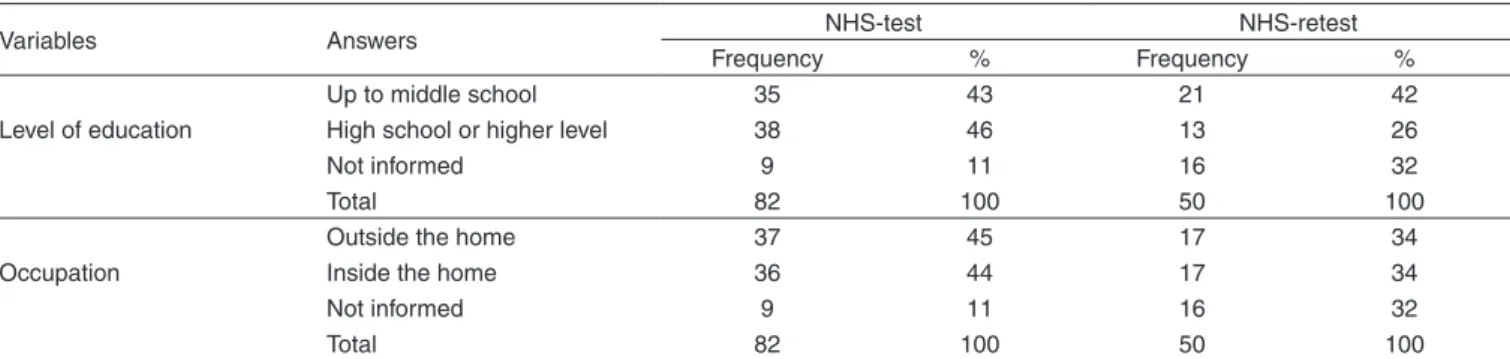
Regarding parents’/guardians’ education, they were grouped into two categories: middle school, and high school or college level. Those with complete or incomplete middle school were in the first category; those whose school level varied between incomplete high school and complete college level were in the second category (Table 1).
A great number of occupations were reported by the pa-rents/guardians, which were grouped into two categories in order to make the analysis easier: external environment oc-cupations, that is, performed in non-residential environments; and internal occupations, considering those performed in hou-seholds, such as maid and stay-at-home parent, whose social interaction is smaller during their work activities (Table 1).
The statistical Chi-square test (χ2)was used in order to
verify if the presented reasons to justify evasion from the program were correlated with guardians’/parents’ education and/or occupation. In both groups, the absence of association between the reasons presented and education (p=0.611 for the NHS-test, and p=0.610 for the NHS-retest group) was confirmed. The same occurred in the association with the occupations (p=0.055 for the NHS-test, and p=0.705 for the NHS-retest group).
Figure 2. Percentile distribution of the reasons indicated by each
group to justify evasion from the newborn hearing screening program.
Table 1. Distribution of the parents/guardians’ level of education and occupation
Variables Answers NHS-test NHS-retest
Frequency % Frequency %
Level of education
Up to middle school 35 43 21 42
High school or higher level 38 46 13 26
Not informed 9 11 16 32
Total 82 100 50 100
Occupation
Outside the home 37 45 17 34
Inside the home 36 44 17 34
Not informed 9 11 16 32
Total 82 100 50 100
Note: NHS-test = evasion in the hearing screening; NHS-retest = evasion in the hearing screening retest
Children’s parents/guardians from both groups were questioned about their child’s hearing ability by the question:
“Do you think your child can hear?”. Only two mothers – one of each group – reported that they believed their children presented hearing difficulty and demonstrated interest about their child being submitted to an audiologic evaluation in the Speech-Language Pathology and Audiology Clinic of the institution. The assessments were carried out and evidenced the absence of auditory alterations in both cases.
Children’s language development, considering the norma-lity standards for each age was also questioned. Five mothers reported delay in their children’s language, three from the NHS-test and two from the NHS-retest group. Of these, only one presented complaint in regards to the hearing of their child. Children had appointments scheduled at the Speech--Language Pathology and Audiology Clinic of the institution, went through the necessary assessments, and their hearing was verified as within normality. The examiner explained the stages of language development and the need for follow up to the mothers, as well as offered guidance as to the possibility of speech-language therapy at the institution, in the areas of Audiology and Language.
More specifically to the NHS-test group, the knowledge of the family regarding the hearing screening was investigated and it was evidenced that 15% had no knowledge about the existence of the NHS at all; 24% learned about hearing scre-ening at the moment of discharge; 22% during their hospital stay; 12% after discharge; 4% before being admitted; and the remaining families (23%) didn’t know how to answer.
This same group was questioned about which profession-als had explained about NHS. The majority (41%) reported being the nurse, 5% the speech-language pathologist, and 4% the doctor. Moreover, 27% reported not having received orientation, and the remainder (23%) did not know how to answer. There was absence of association (p=0.611) between the reasons for evasion and the area of the professional who carried out the orientation about the importance of the ac-complishment of the NHS.
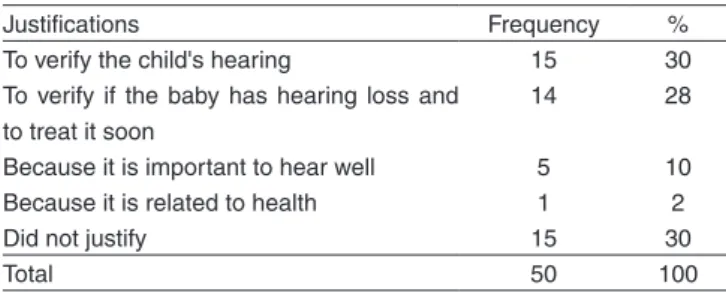
Moreover, the families from this group were questioned about the importance of the NHS. From the total, 98% conclu-ded that the NHS is important and justified such importance (Table 2).
DISCUSSION
The program’s early identification of hearing impairment makes the diagnosis and the intervention possible in a deter-mining period for the language development. However, so that the objectives of such programs are reached, it is essential that the families adhere to all stages of the process(11).
Among all the children who were born at Maternidade Santa Isabel in the studied period, 922 (10.19%) had not been submitted to the newborn hearing screening and 368 (4.07%) did not show up for the retest, totaling 1290 (14.26%) families who have no information about their child’s hearing condition. Such data demonstrated that the family’s participation is a concerning aspect in both stages of the NHS, even with the proposal of having it done before discharge. Other studies disclosed similar results, evidencing high evasion rates of the families(7-10).
Based on this reality, studies have been developed in order to investigate the causes of evasion. However, difficulties have been found in contacting a large amount of families(8,12-14). It was not different in the present study: the application of the questionnaire with 17.86% of the initial sample occurred due to lack of updated contact information and/or lack of response from the parents to the letters sent.
Such data is favorable to the evidences of literature that characterize the follow up of the newborns as a difficult pro-cess, due to great difficulty in the family, who has constant address and telephone number changes(12,15). Apparently, the possible way to solve this problem would be the creation of a national register in the Unified Health System.
This way, although the sample of this study is limited to 132 families, being that the majority of them (62.5%) belongs to the group NHS-test, the data obtained allows a reflection on the reality of the participation of the families in NHS pro-grams. Among the families that were contacted, none of them refused to participate in the research, answering the proposed questionnaire. Such data allows the assumption that the appli-cation of questionnaires is a viable way for accomplishment of studies of this nature. Such inference corroborates data from the literature that states that the questionnaire is a useful ins-trument to investigate the parents’ satisfaction with the NHS program, to identify small imperfections of a service and to
provide guidance for the implementation of improvements(16,17). In spite of the questionnaires used having been structured as to contemplate simple questions, there were difficulties in obtaining some answers, even when the informers were the child’s parents themselves, since many of them had stated not to remember or not to know how to answer some questions. This reflects the importance that the studies be carried through after a short period of the occurrence of the evasion, since it causes the parents to remember all the information. Even with difficulty in the collection of some information, the instrument used in this study proved to be effective in the verification of the reasons for the no show in the NHS program (test/retest). As routine, the orientation to the family on the importance of the participation of the family guides all the stages of the NHS program. However, it could be verified that the lack of interest and scheduling conflicts were the most frequent an-swers in both groups. Similar reasons had been found in other studies(11,14). In the group NHS-test, the lack of knowledge about the hearing screening was the third most frequent answer, what corroborates studies that demonstrate the family’s lack of knowledge regarding the program.
As for the lack of interest and the lack of knowledge, the high occurrence of these justifications point to the necessity of the service to develop strategies of education in health aiming at a bigger adhesion to the NHS programs. The importance of keeping updated address and telephone information in health services must be taken into account. On the other hand, the difficulty with scheduling conflicts strengthens the importance of the newborn hearing screening to be carried through while the mother is still in the maternity hospital and to conciliate the retest with follow up appointments for other examina-tions. In such a way, the risk of evasion to the program will be minimized.
In the NHS-retest group the third more frequent justifica-tion was that the examinajustifica-tion had not been scheduledd. Such data points to the possibility of communication breakdown between the professionals involved in the program and the families. Such data confirms the results of a study that veri-fied a percentage of 42.25% of this same justification(8) and of another study that refers to the occurrence of divergence between the information of the professionals involved in the program and the families concerning the NHS(18).
Financial difficulty was also a response presented by a number of families, what confirms a study carried through in the 90’s(20). The authors also observed a high evasion rate in follow up programs, mainly in the low-income population that does not have the financial resources to travel to the ap-pointments. However, when the variable financial condition was controlled, a high absenteeism rate in the considered appointment was also evidenced, what demonstrates that the educational aspect directed to health is the main aspect to be worked on with this population(11,12,21).
Other justifications were found in the literature, such as: the statement that the child does not present hearing altera-tions, forgetting the appointment, distance from the hospital and transportation problems(8,11,12). In the present study these justifications could be observed indirectly, since they can be related to the lack of interest and financial questions.
Table 2. Justifications for the importance of undergoing the newborn
hearing screening, presented by the parents/guardians belonging to the hearing screening retest group
Justifications Frequency %
To verify the child's hearing 15 30
To verify if the baby has hearing loss and to treat it soon
14 28
Because it is important to hear well 5 10
Because it is related to health 1 2
Did not justify 15 30
As far as justifications for the evasion, it was possible to verify that they are not related to the parents’ level of education and the fact that they work outside the home, what, in theory, would provide to greater possibility of contact with informa-tion regarding the importance of the NHS. A previous study investigated this relation and, as for the mothers’ occupation, a similar result was verified(11). However, with regard to the level of education, it was evident that the least amount of education the mother received, the smaller the probability of her participation in the follow up(11), what was not observed in the present study.
In reference to how the population receives information about the importance of going through the NHS, as well as the field of the professional that passes it on and the period where it occurs, it was verified that 15% of the mothers reported being unaware of the hearing screening; 46% learned about the NHS at the moment they were admitted and only 4% were given the information about the program before being admitted, what agrees with results obtained previously(18,19,22,23). Considering that the parents generally present limited knowledge about the importance of the NHS, the ideal would be that the orientation was carried through still in the gestational period.
In regard to the field of the professionals responsible for transmitting the information about the NHS, data obtained indicates that the nurses were mentioned more frequently. As these professionals have bigger contact with the mothers and have the chance of adding auditory health in the scope of information that they transmit, the need for these professionals to be trained in hearing health is highlighted(18).
It is relevant to say that in the UNHS program at the Ma-ternidade Santa Isabel, the orientation is carried through by a Language and Speech Therapist duly introduced, except for the newborns who were discharged over the weekend. It is not possible to justify for sure why this professional was not mentioned more often; however, it is possible to assume that since it is a profession little known by the mothers, they may not have adequately memorized the profession of the profes-sional who provided the orientation.
The professional responsible for the orientation was a variable also statistically analyzed. The results pointed to the lack of association between such variable and the reasons presented to justify the evasion (p=0.612). Possibly the lack of association occurred due to the fact that the justifications observed are linked directly to the family dynamics and not to the characteristics of the program or even to the field of the involved professionals.
The feedback provided to the parents when a result “fail” is obtained in the first stage of the hearing screening must be careful, since it can trigger negative feelings towards the NHS(24). The feedback mentioned does not suggest that the family has not returned for the retest due to the information received. On the other hand, 10% of the families reported that they had not received information regarding the result, an unlikely situation, as the orientation is present in all stages of the program. This fact can indirectly suggest the lack of understanding of the orientation received, what contributes for evasion, since the lack of education makes it so that less families participate in the program(18,19).
In addition, the fact that great part of the casuistry has completed only middle school, in accordance with previous results(21,25,26), strengthens the possibility of considering how these families have difficulty understanding the hearing scree-ning and the feedback. This confirms studies that included the level of education as one of the factors that contribute to the lack of understanding of the information and to the increase in concern from the mothers towards hearing screening(25,26). Thus, although the parents/guardians’ level of education do not correlate with the reasons presented to justify the evasion, it can be indirectly associated with the smaller participation in the NHS by the parents, as discussed previously.
In addition to the investigation of the reasons of the evasion, the questionnaires used contemplated questions concerning hea-ring and language development, what allowed the ascertainment on the development of these children. There was no reference to hearing alteration or significant delay in language development. The follow up of the development is of particular relevance, once identification and early intervention of any alterations is essential for maximization of the child’s development(1,18,27,28).
The data demonstrated, still, that 98% of the families who answered the questionnaire, judged the NHS important and knew to justify it correctly. Such result is similar to that obtai-ned in another study(24). Certain incoherence is noticed, then, once the families did not show up for the NHS, even though they understood its importance.
As such, the present study emphasizes the need to imple-ment and make specific strategies possible in order to reduce the evasion in the NHS programs. It is important to provide orientation to the mother still in the gestational period in regard to the importance of the NHS, to deliver printed educational materials, to carry through the NHS before discharge, to conciliate the retest with other follow up examinations, and to enable the nursing staff so that these professionals include in their routine the importance of the NHS. The performance of community health agents can also represent a viable option to minimize this evasion, since studies(29,30) demonstrated that the qualification of these professionals in the area of infantile hearing health has been promising in the rescue of the families that do not show up to the proposed appointments.
CONCLUSION
ACKNOWLEDGEMENTS
The São Paulo Research Foundation (Fundação de Amparo
à Pesquisa do Estado de São Paulo – FAPESP) for the research Grant provided for the accomplishment of the study, process number 2006/059.
1. Yoshinaga-Itano C. Early intervention after universal neonatal hearing screening: impact on outcomes. Ment Retard Dev Disabil Res Rev. 2003;9(4):252-66.
2. Weber BA, DIefendorf A. Triagem auditiva neonatal. In: Musiek FR, Rintelmann WF. Perspectivas atuais em avaliação auditiva. São Paulo: Manole; 2001. p. 323-38.
3. Northen JL, Dows MP. Audição em crianças. 3a ed. São Paulo: Manole; 1989.
4. Mauak GW, Gass MA, Behrens TR. Historical political and technological context associated with early identification of hearing loss.
Seminars in Hearing. 1993;14:01-18.
5. BRASIL. Lei 12.303, de 02 de agosto de 2010. Dispõe sobre a obrigatoriedade de realização do exame denominado Emissões Otoacústicas Evocadas. Brasília, 2010. Disponivel em: <http://www. planalto.gov.br>. Acesso em: 04 ago 2010.
6. American Academic of Pediatrics, Joint Committee on Infant Hearing. Year 2007 position statement: principles and guidelines for early hearing detection and intervention programs. Pediatrics. 2007;120(4):898-921. 7. Berni PS, Almeida EO, Amado BC, Almeida Filho N. Triagem auditiva
neonatal universal: índice de efetividade no reteste de neonatos de um hospital da rede pública de Campinas. Rev CEFAC. 2010;12(1):122-7. 8. Mukari SZ, Tan KY, Abdullah A. A pilot project on hospital-based
universal newborn hearing screening: lessons learned. Int J Pediatr Otorhinolaryngol. 2006;70(5):843-51.
9. Gaffney M, Green DR, Gaffney C. Newborn hearing screening and follow-up: are children receiving recommended services? Public Health Rep. 2010;125(2):199-207.
10. Liu CL, Farrell J, MacNeil JR, Stone S, Barfield W. Evaluating loss to follow-up in newborn hearing screening in Massachusetts. Pediatrics. 2008;121(2):e335-43.
11. Fernandes JC, Nozawa MR. Estudo da efetividade de um programa de triagem auditiva neonatal universal. Cien Saude Colet. 2010;15(2):353-61.
12. Folsom RC, Widen JE, Vohr BR, Cone-Wesson B, Gorga MP, Sininger YS et al. Identification of neonatal hearing impairment: recruitment and follow-up. Ear Hear. 2000;21(5):462-70.
13. Todd NW. Universal newborn hearing screening follow-up in two RESUMO
Objetivo: Analisar os motivos da evasão familiar no programa de triagem auditiva neonatal realizado em um hospital público e correlacioná-los com a distribuição demográfica das famílias e as características do programa. Métodos: Participaram 132 famílias, de um total de 739 contatadas, cujos filhos nasceram em uma maternidade no interior do estado de São Paulo de outubro/2003 a dezembro/2005 e que não haviam comparecido para a realização do teste ou reteste da triagem auditiva neonatal. Foi aplicado um questionário de levantamento das causas de evasão, contendo perguntas relacionadas à triagem auditiva, nível de escolaridade e profissão dos pais e também sobre a audição e o desenvolvimento de linguagem da criança. Resultados: Realizou-se a aplicação do questionário com 132 famílias (17,86%); com as demais não foi obtido contato. Deste total, 82 haviam faltado na primeira etapa da triagem auditiva (teste) e 50 não haviam retornado para realização do reteste. Os motivos mais frequentes para justificar a evasão foram o desinteresse e a dificuldade em conciliar o agendamento com a rotina familiar. Não houve associação entre os motivos da evasão e o nível de escolaridade e ocupação dos pais, nem com o profissional que realizou a orientação acerca da triagem auditiva. Não foi referido nenhum caso de alteração auditiva, nem de atraso significativo no desenvolvimento da linguagem. Conclusão: Os motivos da evasão familiar independem de variáveis voltadas à família e à dinâmica do programa de triagem auditiva.
Descritores: Triagem neonatal; Audição; Perda de seguimento; Família; Questionários
REFERENCES
Georgia populations: newborn, mother and system correlates. Int J Pediatr Otorhinolaryngol. 2006;70(5):807-15.
14. Bevilacqua MC, Alvarenga KF, Costa OA, Moret AL. The universal newborn hearing screening in Brazil: from identification to intervention. Int J Pediatr Otorhinolaryngol. 2010;74(5):510-5.
15. Lieu JE, Karzon RK, Mange CC. Hearing screening in the neonatal intensive care unit: follow-up of referrals. Am J Audiol. 2006;15(1):66-74. 16. Mazlan R, Hickson L, Driscoll C. Measuring parent satisfaction
with a neonatal hearing screening program. J Am Acad Audiol. 2006;17(4):253-64.
17. MacNeil JR, Liu CL, Stone S, Farrell J. Evaluating families’ satisfaction with early hearing, detection and intervention services in Massachusetts. Am J Audiol. 2007;16(1):29-56.
18. Hilú MR, Zeigelboim BS. O conhecimento, a valorização da triagem auditiva neonatal e a intervenção precoce da perda auditiva. Rev CEFAC. 2007;9(4):563-70.
19. Pacheco LC, Tochetto TM, Checalin MA, Carvalho CD. Triagem auditiva neonatal: informações de gestantes de diferentes classes sociais. Einstein. 2009;7(2 Pt 1):159-62.
20. Azevedo MF; Vieira RM; Vilanova LC. Desenvolvimento auditivo de crianças normais e de alto risco. São Paulo: Plexus; 1995.
21. Lima ML, Assis AB, Mercês GB, Barros PF, Griz SM. Triagem auditiva: perfil socioeconômico de mãe. Rev CEFAC. 2008;10(2):254-60. 22. Neves DC, Aguiar AM, Andrade IS. O conhecimento de gestantes
adolescentes sobre fonoaudiologia relacionada à saúde materno-infantil. RBPS. 2007;20(4):207-12.
23. Muniz L, Caldas Neto SS, Gouveia MC, Albuquerque M, Aragão A, Mercês G et al. The knowledge of gynecologists and pediatricians from Recife public hospitals about hight risk factors for deafness. Braz J Otorhinolaryngol. 2010;76(4):510-6.
24. Tochetto TM, Petry T, Gonçalves MS, Silva ML, Pedroso FS. Sentimentos manifestados por mães frente à triagem auditiva neonatal. Rev CEFAC. 2008;10(4):566-71.
Appendix 1. Questionnaire for the families of the children who did not undergo newborn hearing screening
Baby’s date of birth: ____/____/____
Baby’s name: ________________________________________________________ Sex: ( ) Male ( ) Female
Mother: _____________________________________________________________Age: ______________________________________ Level of education: ______________________________________________Occupation: ______________________________________ Pai: ________________________________________________________________Age: ______________________________________ Level of education: ______________________________________________Occupation: ______________________________________
1. Why didn’t you have your child undergo newborn hearing scre-ening?
In case that the parent/guardian demonstrates difficulty in answering the question, the examiner will provide him/her with some direction regarding:
- Lack of knowledge about hearing screening - Financial Difficulties
- Scheduling conflict - Emotional Factors - Lack of interest
2. When did you learn that your baby would undergo hearing scre-ening?
( ) before being admitted to the hospital. ( ) during the hospital stay
( ) after discharge ( ) I do not remember
3. Who explained hearing screening to you? ( ) Speech Therapist ( ) Nurse
4. How did you learn about hearing screening, anxious or concerned? ( ) not concerned ( ) slightly concerned
( ) a little concerned ( ) concerned ( ) very concerned
5. Did you receive a pamphlet about hearing screening? ( ) yes ( ) no ( ) I do not remember
6. Was the pamphlet important for your knowledge about your child’s hearing and language?
( ) yes ( ) no
7. Can your child speak? (the examiner will have to ask this question considering the child’s age expected language development)
Appendix 2. Questionnaire for the families of the children who did not show up for the newborn hearing screening
Baby’s date of birth: ____/____/____
Baby’s name: ________________________________________________________ Sex: ( ) Male ( ) Female
Mother: _____________________________________________________________Age: ______________________________________ Level of education: ______________________________________________Occupation: ______________________________________ Pai: ________________________________________________________________Age: ______________________________________ Level of education: ______________________________________________Occupation: ______________________________________
1. Why didn’t you come to the hearing screening retest?
In case that the parent/guardian demonstrates difficulty in answering the question, the examiner will provide him/her with some direction regarding:
- Lack of knowledge about hearing screening - Financial Difficulties
- Scheduling conflict - Emotional Factors - Lack of interest
2. What were you told after the hearing screening retest?
3. How did you feel at that moment?
4. What did you expect to happen at the retest appointment?
5. Do you think hearing screening is important? ( ) yes
( ) no
Justifify: ______________________________________________
6. Do you think your child can hear? ( ) yes ( ) no
7. Can your child speak? (the examiner will have to ask this question considering the child’s age expected language development)
programa de triagem auditiva neonatal universal [dissertação]. Bauru: Universidade de São Paulo - Faculdade de Odontologia de Bauru.; 2006. 27. Gatto CI, Tochetto TM. Deficiência auditiva infantil: implicações e
soluções. Rev CEFAC. 2007;9(1):110-5.
28. Borges CA, Moreira LM, Pena GM, Fernandes FR, Borges BC, Otani BH. Triagem auditiva neonatal universal. Rev Arq Int Otorrinolaringol. 2006;10(1):28-34.
29. Alvarenga KF, Bevilacqua MC, Martinez MA, Melo TM, Blasca WQ, Taga MF. Proposta para capacitação de agentes comunitários de saúde em saúde auditiva. Pró-Fono. 2008;20(3):171-6.