
J. Braz. Chem. Soc., Vol. 18, No. 7, 1397-1404, 2007. Printed in Brazil - ©2007 Sociedade Brasileira de Química 0103 - 5053 $6.00+0.00
ArticleArticleArticleArticleArticle
*e-mail: [email protected]
Density, Degeneracy, Delocalization-Based Index of Aromaticity (D
3BIA)
Caio L. Firme,a Sergio E. Galembeck,b O. A. C. Antunesa and Pierre M. Esteves*,a
a
Instituto de Química, Universidade Federal do Rio de Janeiro, Centro de Tecnologia - Bloco A, 21949-900 Rio de Janeiro-RJ. Brazil
b
Departamento de Química, Faculdade de Filosofia, Ciências e Letras de Ribeirão Preto, Universidade de São Paulo, Av. Bandeirantes, 3900, 14400-901 Ribeirão Preto-SP, Brazil
A aromaticidade tem sido exaustivamente discutida e continua sendo um tema misterioso. Nesse trabalho é proposto um novo índice de aromaticidade chamado índice baseado na
densidade-degenerescência-deslocalização ou, simplesmente, D3BIA, numa tentativa de lançar
nova introspecção sobre esse tema. Esse índice é baseado na teoria de átomos em moléculas (AIM) e, de certa forma, é suportado pela teoria dos spins acoplandos (SC). A aromaticidade diminui com o número de heteroátomos na molécula aromática, pois a degenerescência diminui, e diminui com o aumento do tamanho do anel do composto aromático porque desfavorece a sobreposição dos estados monoeletrônicos. A relação entre planaridade do anel, sua densidade eletrônica e aromaticidade é também observada. A interação atrativa da ressonância de 6 elétrons
π no diânion ciclobutadieno compensa sua interação repulsiva carbono-carbono enquanto no
seu parente dicatiônico a ressonância de 2 elétrons π é insuficiente para contrabalancear sua
interação repulsiva e adota uma estrutura não-plana.
Aromaticity has been exhaustedly discussed for several years and it remains as a misterious issue. In this work it is proposed a new index of aromaticity named density, degeneracy and
delocalization-based index of aromaticity or simply D3BIA in an attempt to cast new insight and
perspective over this theme. This index is based on AIM (atoms in molecules) theory and it is somewhat supported by SC (spin-coupled) theory. Aromaticity decreases as the number of heteroatoms in the aromatic molecule increases since degeneracy decreases and it decreases as the ring size of an aromatic compound increases because it disfavors overlap of single-electron states. The relation between planar structures, electron density and aromaticity is also observed.
The attractive interaction of 6π-electron resonance in cyclobutadiene dianion compensate its
carbon-to-carbon repulsive interaction while in its dicationic parent the 2π-electron resonance is
insufficient to counterbalance its carbon-to-carbon repulsive interaction and it adopts a puckered structure.
Keywords: delocalization index; degeneracy; ring density; aromaticity
Introduction
In the nineteenth century benzene was the pivot of the
aromatic empiricism.1 After its early studies by Couper
and Loschmidt,2 Kekulé proposed the most important
theory about benzene: the oscillation hypothesis.3 Other
theories at that time were Claus’centric hypothesis,4
Bayer’s reformulations of centric benzene,5 Dewar’s
hypothesis6 and Ingold’s bridged formula.7
In the early twentieth century quantum theory study gave rise to a novel hypothesis for benzene. From a
molecular orbital (MO) study of benzene and other
unsaturated cyclic systems, Hückel8 arrived at his famous
rule for aromaticity. Two years later, Pauling and
Wheland’s9 valence bond (VB) study of benzene (and
naphtalene) gave the same result by following Hückel’s premises and Slater method. Their simpler treatment was
based on resonance10 among independent Kekulé and
Dewar canonical structures and became known as
resonance hybrid hypothesis.9 However, for
cyclobutadiene both theories gave completely different
results.8,11 Hückel’s MO study predicted the stability of
other aromatic compounds and zero stability for
latter ones were ascribed by Breslow and Dewarto have anti-aromatic character.12
It was established that aromatic species have π electrons in delocalized bonds, uniform geometry and special stability with respect to an open chain referential.
Conversely, anti-aromatic systems have π electrons in
localized bonds and non-uniform geometries in alternate
single and double bonds.13 Several criteria to evaluate
aromaticity were created so far: energetic criterion,14
geometric criterion15 and magnetic criterion.16 However,
Schleyer and Jiao17 stated that magnetic susceptibility is
the unique criterion applied to aromaticity. Schleyer et
al.18 also remarked that downfield proton chemical shifts
are not a reliable aromaticity criterion and that aromaticity phenomenon can be statistically regarded as
multi-dimensional.19 Many different magnetic criteria have
appeared so far, based on magnetic shielding or ring current.20
Within MO theory, the aromatic character of benzene is explained through delocalized orbitals. Nevertheless by using the spin coupled valence bond theory (SCVB), Gerratt et al.21 established that all the six π electrons of
benzene are localized and symmetrically distorted towards neighboring carbon atoms on each side and possess the same energy and shape. Other studied
aromatic molecules have similar features.22 Within the
description SCVB, the stability of aromatic systems is ascribed to the modes of coupling the electron spins which
resembles Pauling’s resonance structures.21,23 Hiberty et
al.24 demonstrated that delocalization of the π-electrons
in benzene is energetically unfavorable and the σ
-framework determines the structural symmetry of
benzene. They25 stated that π electronic system distorts
benzene to D3h symmetry while σ-framework keeps it in
D6h, although Havenith et al.14f have established the
necessity of resonance to obtain a fully symmetric benzene
molecule. Havenith26a demonstrated that resonance
between Kekulé structures does not influence the magnetic and electric properties of benzene and that ring
currents exist in its D3h symmetry.26 Within modern VB
scope Cooper et al.27 obtained the following order of
degree of aromaticity: C6H6 ~ B6 > N6 > Al6 ~ Si6H6 > P6. Atoms in molecules (AIM) theory has also been applied to study aromaticity.30 Bader et al.28 found out a greater π
density delocalization in cyclic unsaturated hydrocarbons
than that in acyclic ones. Solà et al.29 related the
delocalization index30 (DI) to different aromatic criteria.
They introduced a new local aromatic criterion: the paradelocalization index (PDI). Hernández-Trujillo and Matta31 also proposed a geometric criterion that takes into
account the DI as a measure of electron-sharing alternation.
From the AIM theory,32 we propose a new criterion for
aromaticity based on the electronic density in the ring, on the degree of delocalization uniformity and on the degree
of degeneracy of atoms in the ring, named D3BIA (density,
degeneracy and delocalization-based index of aromaticity). This criterion casts new light on the way aromaticity has been reasoned.
Computational Methods
All calculations were performed using the GAUSSIAN
2003 package.33 The geometries were optimized in DFT
level employing Becke three-parameter interchange
functional34 (B3) in conjunction with Lee-Yang-Parr35
correlation functional (LYP) and the split valence basis
set36 6-311++G**.
The AIM 2000 software37 was used for charge density
calculations from the electronic densities (ρ) obtained at
B3LYP/6-311++G** level.
Rationale
Rationale on D3BIA index was influenced by modern
(VB) studies on aromaticity and particularities of some
aromatic compounds.38 The similarities of results
between AIM and SC encouraged us to use the former since it provides us important and complementary information. The coherence between AIM and SC can be noticed from AIM results of benzene. The DI between carbon atoms in benzene is 1.39. Since DI between carbon atoms in ethane is 1.0, it is established that 0.39 e. from
π system is delocalized in each C-C bond of benzene
ring. This means that 0.61 from each 2pz electron is
localized in each carbon atom in benzene. This result
matches with the SC one in which a 2pz electron of benzene
is localized and symmetrically distorted towards
neighboring carbon atoms on each side.21 Moreover,
Gerratt et al.21 remarked that distortion effects of C(2p z)
orbitals are not larger than those of C-C π bonds in
conjugated systems. From AIM calculations, DI’s for hexatriene are 1.74 (double bond) and 1.14 (single bond). This indicates another convergence of results between SC and AIM theories since the latter shows that delocalization index in double bonds in acyclic conjugated systems is greater than that in benzene.
Pauling and Wheland9 stated that benzene is
represented by a linear combination of five independent canonical structures. This view is emphasized by SC
theory,21,23 in which a two-electrons spin coupling allows
1399 Firme et al.
Vol. 18, No. 7, 2007
From a more rigorous quantum mechanical standpoint,39 benzene has no resonance40 since there is no
intersection of degenerate point group states. It means that
benzene (D6h symmetry) cannot be related to Kekulé (D3h
symmetry) or Dewar (D2h) structures (see Electronic
Supplementary Information). In this case, benzene stability is ascribed to maximum overlap among six degenerate single-electron states.41
Then, the existence of resonance in benzene depends on the rigor of the theory applied to it. By spin coupling π
electrons, within same D6h symmetry in SC, it is possible
to associate the obtained stability with resonance of hybrid
structures.21 Otherwise, benzene molecule cannot be
represented by “hybrids” of symmetries D3h and D2h since
it is forbidden by point group symmetry rules.42
The index D3BIA is based on the density in the ring,
the degeneracy and the delocalization index of atoms in the ring. With respect to AIM theory, degeneracy is the similar energy of basins. Delocalization index (DI) is a measure of the number of electrons that are shared between two atoms or basins. All data are obtained from AIM theory.
Results and Discussion
All studied compounds are depicted in Scheme 1. For an aromatic system, according to modern VB theory, the degeneracy of single-electron states plays an
important role on aromaticity.41 In AIM theory, the
degeneracy can be reasoned in terms of energy of each atomic basin of atoms in the aromatic ring and also
associated with its delocalization indexes of each atomic pair im the aromatic ring. The greater the uniformity of atomic energy and the DIs among atoms in the ring is, the greater is the degeneracy of atoms of the aromatic system. The importance of the electron density in aromaticity arises from the following points: (i) the relative stability of three-membered rings is related to the electron density in the ring;30 (ii) the overlap among (near) degenerate p
z
single-electron states can be correlated to the single-electron density in
the ring; (iii) thespin coupling to form Dewar structures
can be correlated to the electron density in the ring.
The D3BIA formula is:
D3BIA = [RDF][DIU]δ (1)
The ring density factor (RDF) formula is:
RDF = (1+ λ2) ρRCP (2)
Where λ2 is the mean eigenvalue of the density Hessian
matrix from the bond critical point (BCP) towards the ring critical point (RCP) and ρRCP is the density value of ring critical point. One can see that the more negative is
λ2 the steeper is the curvature of the surface of the density at this direction.
AIM provides a delocalization index for each bond
between vicinal atoms.30,37 The delocalization index
uniformity (DIU) can be correlated to the efficiency of
the single-electron states interaction (or overlap). The
maximum degree of delocalization uniformity parallels the maximum overlap among single-electron states, which
can be verified in benzene (1) (Scheme 2).
The delocalization index of uniformity (DIU) formula is:
⎟ ⎠ ⎞ ⎜ ⎝ ⎛ − =
DI DIU 100 100σ
(3)
Where σ is mean deviation and DI— is mean DI of the ring. The uniformity of delocalization is also taken into account in the degree of degeneracy to fine tune this parameter because a molecule may have atoms nearly degenerate, but with completely different delocalization indexes (see p-xylylene (21) in Scheme 2). Then, uniformity of delocalization is used to adjust the degree of degeneracy.
The formula of the degree of degeneracy (δ) is the
number of degenerate atoms divided by the number of atoms
in the ring. The δ takes into account the following
requisites: (i) if all atoms of the ring are degenerate and if all of these atomic pairs have same delocalization indexes, the molecule has the maximum degree of degeneracy
(δ=1); (ii) if the atoms of the atomic ring are
near-degenerate (within range of 0.3 a.u.) and have near delocalization indexes (within range of 0.05) they may be regarded degenerate; (iii) if all atoms of the ring are near-degenerate and have completely different delocalization indexes (ΔI > 0.3) the molecule has the minimum degree of degeneracy (δ=0), where ΔI is the difference between DI’s. From D3BIA formula (equation 1) p-xylylene (21) does
not have aromaticity since it has δ=0 (requisite III).
Hexaradialene (22) has no aromaticity either. It has no
planar structure and no π electrons between C-C bonds in
the ring (Scheme 2), as can be seen by its DI values (similar to single bonds).
1401 Firme et al.
Vol. 18, No. 7, 2007
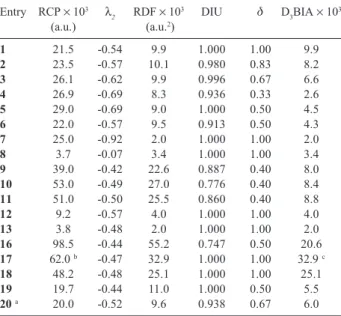
In Table 1 it is depicted either the values of the
individual parameters and D3BIA values. Energy and DI
values are also depicted in Scheme 2.
By analyzing D3BIA values of compounds 1 to 4 in
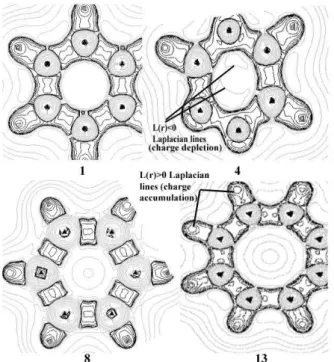
Table 1 it is remarkable that the decrease of degeneracy of single-electron states and aromaticity of the respective compound are related to the number of heteroatoms in the aromatic molecule. The more heteroatoms in the ring then, the smaller are the degeneracy and the aromaticity. The heteroatoms break uniformity of the electron density in the ring as one can see Figure 1. It is known from literature that benzene has different aromaticity from the corresponding aromatic compounds containing nitrogen atoms, e.g., pyridine.43 One also can see that D
3BIA value
of 1,3,5-triazine (5) is greater than that from 1,2,4-triazine
(4) since the former is more symmetric than the latter.
Moreover, the pyridinium (6) has smaller D3BIA value
than that from non-protonated species (2) because the
former lost some of delocalization index uniformity (DIU)
and degree of degeneracy (δ) (see Scheme 2).
From the analysis of D3BIA values (Table 1) of
compounds 1, 12 and 13 one can also notice that ring size and aromaticity are inversely related, where other
parameters are kept constant. Moreover, compound 8 has
smaller D3BIA than that from compound 1 where C-C
bond length (1.394 Å) in compound 1 is smaller than
Si-Si bond length (2.219 Å) in compound 8. However, Si6H6
is not a minimum in the potential energy surface. This reverse relation is probably due to decrease of the density in the ring which disfavors overlap of single-electron
states.41 In Figure 1 it is possible to see how electronic
interaction inside the ring is stronger in benzene than in
compounds 8 and 13 since there is only one Laplacian
line inside benzene ring unlike 8 and 13.
The difference among D3BIA values of thiophene (9),
furane (10) and pyrrole (11) is not so large (Table 1). One can also realize that the expected smaller aromaticity of
anthracene (20) with respect to benzene (1) is supported
by their D3BIA values (Table 1).
In Scheme 2 one can see that from all ionic aromatic species, cyclobutadiene dianion (16) is the unique with non-uniform delocalization indexes involving its C-C bonds and non-degeneracy among all carbon atoms. One can also see in Scheme 2 that delocalization indexes involving carbon and nitrogen atoms are quite similar in pyridine and pyrazine unlike 1,3,4-triazine where they are completely different. Furthermore, the carbon atoms in the ring of p-xylylene (21) are near-degenerate but they have different delocalization indexes which shows the importance of uniformity of the delocalization index, of all atomic pairs belonging to the aromatic ring, in aromaticity (Scheme 2).
Optimization calculations were performed for the
dicationic species 14 and 15, but they gave no planar
structures as it is supported experimentally38 and
computationally.44 On the other hand, their dianion
parents, cyclooctetraene dianion (13) and cyclobutadiene
dianion (16), respectively, have planar structures.45
The high D3BIA value of 16 might explain its planar
structure since its 6π-electron resonance compensates its
carbon-to-carbon repulsive interaction in which each carbon atom has a charge of -0.5 a.u. Its parent dication (15) probably
has a puckered structure because the 2π-electron resonance
does not compensate its carbon-to-carbon repulsive interaction (with 0.5 a.u. positively charged carbons). Accordingly, the
puckered structure of cyclooctatetraenyl dication (14) is
probably due to its overall 2.0 a.u. charge and ineffective 6π -electron resonance in an eight-membered ring while its dianion parent (13) has planar structure because of its 10π -electron resonance.
From all studied ionic aromatic species the
cyclopentadiene anion (18) is the most aromatic system
since the D3BIA value of 17 (Table 1) is overestimated
because it is not possible to eliminate thoroughly the influence of its C-C ρ electrons.
Borazine46 (19) D
3BIA value higher than those from
triazines, N6H6 and Si6H6 but smaller value than those from
Table 1. Charge density of the ring critical point (ρRCP), eingenvalue of
density Hessian matrix from BCP towards RCP ring (λ2), ring density
factor (RDF), degree of delocalization index uniformity (DIU), degree of degeneracy (δ), D3BIA
Entry RCP × 103 λ
2 RDF × 10
3 DIU δ D
3BIA × 10 3
(a.u.) (a.u.2)
1 21.5 -0.54 9.9 1.000 1.00 9.9
2 23.5 -0.57 10.1 0.980 0.83 8.2
3 26.1 -0.62 9.9 0.996 0.67 6.6
4 26.9 -0.69 8.3 0.936 0.33 2.6
5 29.0 -0.69 9.0 1.000 0.50 4.5
6 22.0 -0.57 9.5 0.913 0.50 4.3
7 25.0 -0.92 2.0 1.000 1.00 2.0
8 3.7 -0.07 3.4 1.000 1.00 3.4
9 39.0 -0.42 22.6 0.887 0.40 8.0
10 53.0 -0.49 27.0 0.776 0.40 8.4
11 51.0 -0.50 25.5 0.860 0.40 8.8
12 9.2 -0.57 4.0 1.000 1.00 4.0
13 3.8 -0.48 2.0 1.000 1.00 2.0
16 98.5 -0.44 55.2 0.747 0.50 20.6
17 62.0 b -0.47 32.9 1.000 1.00 32.9 c
18 48.2 -0.48 25.1 1.000 1.00 25.1
19 19.7 -0.44 11.0 1.000 0.50 5.5
20 a 20.0 -0.52 9.6 0.938 0.67 6.0
a Data from central ring; b Densities of ring critical point in cyclopropane
and in cyclopropenyl cation are 0.195 a.u. and 0.257 a.u., respectively, and difference between them represents the electron density in RCP from p trons without influence of r electrons. However, it remains a partial r elec-tron influence in the density of RCP since C-C bond lengths in cyclopropenyl cation are smaller than those in cyclopropane; c Imprecise value of D3BIA
other six-membered and five-membered aromatic compounds as one might expect.
Other examples of application of D3BIA can be found
in the Electronic Supplementary Information section. Another important analysis from AIM theory is the Laplacian of the charge density. It is defined as the sum of the three principal curvatures of the function at each point of the space. The density is locally concentrated in those regions where L(r)>0, since ∇2ρ<0 when ρ(r) is a
local maximum. Likewise, the density is locally depleted in those regions where L(r)<0, since ∇2ρ<0 when ρ(r) is
a local minimum.30
In Figure 1, one can see that the inner part of benzene ring is surrounded by only one L(r)<0 Laplacian line (first
green line within the ring) while compounds 8 and 13
have another inner concentric L(r)<0 Laplacian lines within their rings. This means that the electronic interaction inside the ring is stronger in benzene than in
compounds 8 and 13. As for 1,3,4-tryazine (4) one can
realize that the L(r)<0 Laplacian lines inside its ring are not concentric. This demonstrates how heteroatoms impair a uniform electronic interaction.
Conclusions
We have proposed an index for quantifying aromaticity
(D3BIA). This index shows that aromaticity decreases as
the number of heteroatoms in the aromatic molecule
increases, since the degeneracy of single-electron states decreases. The ring size of an aromatic compound and aromaticity are inversely related, because the decrease of the charge density in the ring which disfavors the overlap of single-electron states.
The attractive interaction of 6ρ-electron resonance in
cyclobutadiene dianion compensate its carbon-to-carbon repulsive interaction, while in its dicationic parent the
2π-electron resonance is insufficient to counterbalance
its carbon-to-carbon repulsive interaction and it adopts a puckered structure. Accordingly, the puckered structure of cyclooctatetraenyl dication is probably due to its overall
2.0 a.u. charge and ineffective 6π-electron resonance in
an eight-membered ring while its dianion parent has planar
structure because of its 10π-electron resonance.
Cyclopentadiene anion is the most aromatic molecule of all studied ionic aromatic species.
Acknowledgments
Authors thank CNPq, CAPES, FAPERJ and FAPESP for financial support.
Supplementary Information
Examples of application of D3BIA and other data are
available free of charge at http://jbcs.sbq.org.br/, as PDF file.
References
1. Brush, S.; Stud. Hist. Phil. Sci. 1999, 30, 21.
2. Couper, A. S.; Phil. Mag.1858, 16, 104; Loschmidt, J., Chemische Studien I, Carl Gerold´s Sohn 1861.
3. Kekulé. A.; Bull. Soc. Chim. Parts1865, 3, 98; Kekulé, A.; Bull. Acad. Roy. Bel. 1865, 19, 551; Kekulé, A.; Ann. Chem. Pharm. 1865, 137, 129; Kekulé, A.; Ann. Chem. Pharm. 1872, 162, 77, 309; An important experimental support for Kekulé´s oscillation hypothesis was the Cole and Levine´s ozonolysis of o-xilene. For more information see Levine, A. A.; Cole, A. G.; J. Am. Chem. Soc. 1932, 54, 338.
4. Claus, A.; Berichte 1882, 15, 1405; Claus, A.; Berichte 1887, 20, 1422.
5. Bayer, A. v.; Berichte 1886, 19, 1797; Bayer, A.; Ann. Chem. Pharm. 1888, 245, 103; Bayer, A.; Ann. Chem. Pharm. 1889, 251, 257.
6. Dewar, J.; Proc. Roy. Soc. Edinburgh 1867, 6, 82. 7. Ingold, C. K.; J. Chem. Soc. 1922, 121, 1133.
8. Hückel, E.; Zeitschrift für Physik 1931, 70, 104; Hückel, E.; Zeitschrift für Physik 1931, 72, 310; Hückel, E.; Zeitschrift für Physik 1932, 76, 628.
1403 Firme et al.
Vol. 18, No. 7, 2007
9. Pauling, L.; Wheland, G.W.; J. Phys. Chem. 1933, 1, 362. 10. Resonance concept was claimed to be co-invented by Ingold
who named it intra-nuclear tautomerism or mesomerism. For more information see Ingold, C. K.; J. Chem. Soc. 1922, 121, 1133; Ingold, C. K.; J. Chem. Soc. 1933, 143, 1120. 11. Lennard-Jones, J.E.; Turkevich, J.; Proc. Roy. Soc. 1937, 158A,
297; Wheland, G.W.; J. Phys. Chem. 1934, 2, 474.
12. Breslow, R.; Angew. Chem. Int. Engl. 1968, 7, 565; Dewar, M. J. S.; Pure App. Chem. 1975, 44, 767; Wiberg, K. B.; Chem. Rev. 2001, 101, 1317.
13. Krygowski, T. M.; Cyranski, M. K.; Chem. Rev. 2001, 101, 1385.
14. Pauling, L.; Sherman, J.; J. Chem. Phys. 1933, 1, 606.; Kistiakowski, B.; Ruhoffm, J. R.; Smith, H. A.; Vaughan, W. E.; J. Am. Chem. Soc. 1936, 58, 146; Wiberg, K.; Chem. Rev. 2001, 101, 1317; Dewar, M. J. S.; Schmeising, H. N.; Tetrahedron 1959, 5, 166; Schleyer, P. v. R.; Puhlhofer, F.; Org Lett. 2002, 4, 2873; van Lenthe, J. H.; Havenith, R. W. A.; Dijkstra, F.; Jenneskens, L. W.; Chem. Phys. Lett. 2002, 361, 203.
15. Julg, A.; François, Ph.; Theor. Chim. Acta 1967, 7, 249; Bird, C. W.; Tetrahedron 1985, 41, 1409; Krygowski, T.M.; Ciesielski, A.; Cyranski, M.; Chem. Pap.1995, 49, 128; Kruszewski, J.; Krygowski, T. M.; Tetrahedron Lett. 1972, 3839. 16. Pauling, L.; J. Phys. Chem. 1936, 4, 673; Hess, B. A.; Schaad, L. J.; Nakagawa, M. J.; J. Org. Chem. 1977, 42, 1669; Haddon, R. C.; J. Am. Chem. Soc. 1979, 101, 1722; Flygare, W. H.; Chem. Rev. 1974, 74, 653; Dauben, H. J.; Wilson, J. D.; Laity, J. L.; J. Am. Chem. Soc.1969, 91, 1991; Pople, J. A.; Mol. Phys.1958, 1, 175; McWeeny, R.; Mol. Phys.1958, 1, 311; Steiner, E.; Fowler, P. W.; J. Phys. Chem. A 2001, 105, 9553; Schleyer, P. v. R.; Maerker, C.; Dransfeld, A.; Jiao, H.; Hommes, N. J. R. v. E.; J. Am. Chem. Soc. 1996, 118, 6317.
17. Schleyer, P. v. R.; Jiao, H.; Pure Appl. Chem. 1996, 68, 209. 18. Wannere, C. S.; Corminboeuf, C.; Allen, W. D.; Schaefer III,
H. F.; Schleyer, P. v. R.; Org. Lett. 2005, 7, 1457.
19. Cyranski, M.; Krygowski, T. M.; Katritzky, A. R.; Schleyer, P. v. R.; J. Org. Chem. 2002, 67, 1333.
20. Jusélius, J.; Sundholm, D.; Phys. Chem. Chem. Phys. 1999, 1, 3429; Herges, R.; Geuenich, D.; J. Phys. Chem. A 2001, 105, 3214; Heine, T.; Schleyer, P. v. R.; Corminboeuf, C.; Seifert, G.; Reviakine, R.; Weber, J.; J. Phys. Chem. A2003, 107, 6470; Corminboeuf, C.; Heine, T.; Seifert, G.; Schleyer, P. v. R.; Phys. Chem. Chem. Phys. 2004, 6, 273; Merino, G.; Heine, T.; Seifert, G.; Chem. Eur. J. 2004, 10, 4367; Matito, E.; Duran, M.; Solá, M.; J. Chem. Phys.2005, 122, No 014109; Jusélius, J.; Sundholm, D.; Gauss, J.; J. Chem. Phys.2004, 121, 3952; Heine,. T.; Corminboeuf, C.; Seifert, G.; Chem. Rev. 2005, 105, 3889; Chen, Z.; Wannere, C. S.; Corminbouef, C.; Puchta, R.; Schleyer, P. v. R.; Chem. Rev. 2005, 105, 3842; Kirchner, B.; Sebastiani, D.; J. Phys. Chem. A 2004, 108, 11728; Heine, T.; Islas, R.; Merino, G.; J. Comput. Chem. 2007, 28, 302.
21. Cooper, D. L.; Gerratt, J.; Raimondi, M.; Nature 1986, 323, 699; Cooper, D. L.; Gerratt, J.; Raimondi, M.; Chem. Rev. 1991, 91, 929.
22. Sironi, M.; Cooper, D.L.; Gerratt, J.; Raimondi, M.; J. Chem. Soc. Chem. Comm. 1989, 675; Cooper, D. L.; Wright, S. C.; Gerratt, J.; Raimondi, M.; Chem. Soc. Perkins Trans. 1989, 255, 263.
23. In SCVB theory a bond is made by spin coupling two electrons and it allows the description of the different possible resonance structures. For more information see ref. 25.
24. Hiberty, P. C.; Shaik, S. S.; Lefour, J. M.; Ohanessian, G.; J. Org. Chem. 1985, 50, 4657.
25. Hiberty, P. C.; Davovich, D.; Shurki, A; Shaik, S. S. J. Am. Chem. Soc. 1995, 117, 7760; Shaik, S. S.; Hiberty, P. C.; J. Am. Chem. Soc. 1985, 107, 3089.
26. Havenith, R. W. A.; J. Org. Chem. 2006, 71, 3559; Havenith, R. W. A.; Jenneskens, L. W.; Fowler, P. W.; Chem. Phys. Lett. 2003, 367, 468.
27. Hill, J. G.; Cooper, D. L.; Karadakov, P. B.; J. Phys. Chem. A 2006, 110, 7913.
28. Bader, R. F. W.; Streitwieser, A.; Neuhaus, A.; Laidig, K. F.; Speers, P.; J. Am. Chem. Soc. 1996, 118, 4959.
29. Poater, J.; Fradera, X.; Duran, M.; Solà, M.; Chem. Eur. J. 2003, 9, 400; Poater, J.; Duran, M.; Solà, M.; Silvi, B.; Chem. Rev. 2005, 105, 3911.
30. The delocalization index is a measure of the number of electrons that are shared or exchanged between two atoms or basins. Integration of the Fermi hole density leads to the localization index (LI) and delocalization index. For more information see Fradera, X.; Austen, M. A.; Bader, R. F. W.; J. Phys. Chem. A 1999, 103, 304; Merino, G.; Vela, A.; Heine, T.; Chem. Rev. 2005, 105, 3812.
31. Matta, C. F.; Hernández-Trujillo, J.; J. Phys. Chem. A2003, 107, 7496.
32. Bader, R. F. W.; Chem. Rev. 1991, 91, 893; Bader, R. F. W. Acc. Chem. Res.1985, 18, 9; Popelier, P.; Atoms in Molecules. 1st
ed., Prentice Hall. Manchester, 2000.
Baboul, A. G.; Clifford, S.; Cioslowski, J.; Stefanov, B. B.; Liu, G.; Liashenko, A.; Piskorz, P.; Komaromi, I.; Martin, R. L.; Fox, D. J.; Keith, T.; Al-Laham, M. A.; Peng, C. Y.; Nanayakkara, A.; Challacombe, M.; Gill, P. M. W.; Johnson, B.; Chen, W.; Wong, M. W.; Gonzalez, C.; and Pople, J. A.; Gaussian. Inc. Pittsburgh P. A. 2003.
34. Becke, A. D.; J. Chem. Phys. 1993, 98, 1372; Becke, A. D.; J. Chem. Phys. 1993, 98, 5648.
35. Lee, C.; Yang, W.; Parr, R. G.; Phys. Rev. B. 1998, 37, 785. 36. Krishnan, R.; Binkley, J. S.; Seeger, R..; Pople, J. A.; J. Chem.
Phys. 1980, 72, 650.
37. Biegler-König, F.; Schönbohm; J.; AIM2000 Version 2.0, 2002. 38. Garratt, P. J. Aromaticity, 1st ed., John Wiley: New York, 1986.
39. Nascimento, M. A. C.; Barbosa, A. G.H.; Chaer, M.A. In Advanced Topics in Theoretical Chemical Physics; Murani, J.; Lefevbre, V.; McWeeny, R., eds., Kluwer: Amsterdan, 2003, p. 247-267.
40. Resonance is only possible when the superposition of the hybrids can recover the full symmetry of the system. Resonance is related to degeneracy or near-degeneracy effects. Degeneracy may be due to the existence of symmetry groups that commute with hamiltonian. For more information see McWeeny, R.; Symmetry, Pergamon: Oxford, 1963; Löwdin, P. O.; Rev. Mod. Phys. 1967, 39, 259.
41. Nascimento, M.A.C.; Barbosa, A.G.H.; In Fundamental World of Quantum Chemistry, Brändas, Erkki J.; Kryachko, E.S.,eds.; Kluwer: Dordrech, 2003, Vol. 1.
42. Klein, D. J.; Carlisle, C. H.; Matsen, F. A.; Adv. Quantum Chem. 1970, 5, 219; Li, X.; Paldus, J.; J. Math. Chem. 1993, 13, 273;
Altmann, S. L.; Herzig, P.; Point Group Theory Tables, Clarendon: Oxford, 1994.
43. Bird, W. Clive; Tetrahedron 1997, 53, 3319; Bird, W. Clive; Tetrahedron 1992, 48, 335; Zhou, Z.; Parr, R. G.; Garst, J. F.; Tetrahedron Lett. 1988, 29, 4843; Bird, W. Clive; Tetrahedron 1996, 52, 9945.
44. Our CCSD/6-311++G** calculation also showed that the cyclobutadiene dication has a puckered structure.
45. Sekiguchi, A.; Matsuo, T.; Tanaka, M.; Organometal. 2002, 21, 1072; Sekiguchi, A.; Matsuo, T.; Watanabe, H.; J. Am. Chem. Soc. 2000, 122, 5652; Simons, L. H. Lagowski, J. J.; Tetrahedron Lett. 2002, 43, 1771; Evans, W. J.; Wayda, A. L.; Chang, C.-W.; Cwirla, W. M.; J. Am. Chem. Soc. 1978, 100, 333; Evans, W. J.; Wink, D. J.; Wayda, A. L.; Little, D. A.; J. Org. Chem. 1981, 46, 3925.
46. Stock, A.; Pohland, E.; Chem. Ber. 1926, 59, 9B, 2215; Wideman, T.; Sneddon, L. G.; Inorg. Chem. 1995, 34, 1002; Hough, W. V.; Guibert, C. R.; Hefferan, G. T.; U.S. Patent No. 4,- 150,097, April 17, 1979; Chiaviarino, B.; Crestoni, M. E.; Marzio, A. D.; Fornarini, S.; Rosi, M.; J. Am. Chem. Soc. 1999, 121, 11204; Chiaviarino, B.; Crestoni, M. E.; Fornarini, S.; J. Am. Chem. Soc. 1999, 121, 2619; Muszkat, K. A.; J. Am. Chem. Soc. 1964, 86, 1250; Cowley, A. H. ; Sisler, H. H.; Ryschkewitsch, G. E.; J. Am. Chem. Soc. 1960, 82, 501; Paine, R. T.; Narula, C. K.; Chem. Rev. 1990, 90, 73.
Received: January 17, 2007 Web Release Date: November 14, 2007
J. Braz. Chem. Soc., Vol. 18, No. 7, S1-S9, 2007. Printed in Brazil - ©2007 Sociedade Brasileira de Química 0103 - 5053 $6.00+0.00
Supplementary InformationSupplementary InformationSupplementary InformationSupplementary InformationSupplementary Information
*e-mail: [email protected]
Benzene and resonance
Resonance is related to degeneracy or near-degeneracy effects. Degeneracy may be due to the existence of symmetry
groups that commute with hamiltonian.1 The eigenfunctions
of the exact hamiltonian must transform as irreducible representations of the commuting symmetry groups. When a given group has degenerate representations, some or all eigenstates of the hamiltonian of the system will reflect its degeneracy.
The real Hilbert space is always partitioned into a direct sum of subspaces, each representing a different energy eigenvalue of the spectrum of the hamiltonian operator. The direct product decomposition is the mathematical tool to analyze the symmetry of the allowed individual states. It is
related to the “ascent in symmetry” method2 for
decomposition of tensor spaces in independent parts and
justified by the Littlewood-Richardson rules3. These rules
define the only allowed decompositions of a tensor space (e.g. point group space), providing us with the possible symmetries of the resonance hybrids, which reproduce the total symmetry of the system. Only invariant subgroups of some larger group can accommodate coherent states.
The possible forms of decomposing D6h point group in
direct products4 are:
D6h = D6⊗ Ci, D6⊗ Cs, C6v⊗ Cs
The ground state of benzene is not degenerate, and there is no theoretical or experimental evidence of a near-degenerate electronic state with same geometry as the ground state. If there is no intersection of degenerate point group states one cannot follow the symmetry descent path in this case. The only alternative would be that of an accidental symmetry, but this is not possible since there is
not direct product decomposition5 from D
3h (Kekulé
structure) and D2h (Dewar structure).
Density, Degeneracy, Delocalization-Based Index of Aromaticity (D
3BIA)
Caio L. Firme,a Sergio E. Galembeck,b O. A. C. Antunesa and Pierre M. Esteves*,a
1
Instituto de Química, Universidade Federal do Rio de Janeiro, Centro de Tecnologia - Bloco A, 21949-900 Rio de Janeiro-RJ. Brazil
2
Departamento de Química, Faculdade de Filosofia, Ciências e Letras de Ribeirão Preto, Universidade de São Paulo, Av. Bandeirantes, 3900, 14400-901 Ribeirão Preto-SP, Brazil
However, in SCVB study of benzene, Gerratt et al.6 stated
that spin coupling two electrons (within same D6h symmetry) allows the description of the different possible resonance structures and generates the stability of aromatic systems.
Then, the existence of resonance in benzene depends on the rigor of the theory applied to it. By spin coupling ð
electrons, within same D6h symmetry in SCVB, it is
possible to associate the obtained stability with resonance
of hybrid structures6. Otherwise, benzene molecule cannot
be represented by “hybrids” of symmetries D3h and D2h
since it is forbidden by point group symmetry rules5.
1. McWeeny, R. in Symmetry, Pergamon, 1963; Löwdin, P. O.; Rev. Mod. Phys. 1967, 39, 259.
2. Klein, D.J.; Carlisle, C.H.; Matsen, F.A.; Adv. Quantum Chem. 1970, 5, 219.
3. Li, X.; Paldus, J.; J. Math. Chem. 1993, 13, 273.
4. Altmann, S.L.; Herzig, P. Point Group Theory Tables Clarendon, 1994.
5. Nascimento, M. A. C.; Barbosa, A.G. H.; Adv. Top. in Theor. Chem. Phys. 2003, 247
6. Cooper, D.L.; Gerratt, J.; Raimondi, M.; Nature 1986, 323, 699; Cooper, D.L.; Gerratt, J.; Raimondi, M.; Chem. Rev. 1991, 91, 929.
Table 1. Density of ring critical point [ρ(RCP)], density of bond critical point [ρ(BCP)], eingenvalue of density Hessian matrix from BCP towards RCP (λ2), mean delocalization index (DI—), density value of the first inner isodensity contour line [ρ-FICL], ring density factor (RDF), delocalization index uni-formity (DIU), degree of degeneracy and delocalization (δ) and D3BIA of cyclopropane 1, cyclotrisilane 2 and oxirane 3a
Other examples of D
3BIA application
Computed energy values of compounds 1 to 22
Entry H (Hartree) S(cal mol-1 K-1) G(Hartree)
1 -232.205849 64.137 -232.236323
2 -248.209492 68.707 -248.242137
3 -264.305792 68.377 -264.338281
4 -280.326802 68.421 -280.359311
5 -280.369164 68.201 -280.401568
6 -248.611219 69.098 -248.644049
7 -328.335146 63.925 -328.365519
8 -1740.563821 106.940 -1740.614631
9 -553.001853 67.902 -553.034115
10 -230.018224 65.11 -230.044494
11 -210.143473 65.924 -210.174796
12 -270.615437 74.696 -270.650927
13 -309.440110 83.234 -309.479658
14 -308.751424 76.907 -308.787965
15 -153.834554 62.849 -153.864416
16 -154.505413 62.541 -154.535129
17 -115.711986 58.324 -115.739698
18 -193.497856 66.211 -193.529315
19 -242.649258 72.150 -242.683538
20 -539.456780 95.232 -539.502027
21 -309.560749 80.578 -309.599034
22 -464.294248 103.558 -464.343452
23 -233.341880 79.454 -233.379631
Z matrices of optimized structures
Structure 1
C C,1,B1 C,2,B2,1,A1 C,3,B3,2,A2,1,D1,0 C,4,B4,3,A3,2,D2,0 C,1,B5,2,A4,3,D3,0 H,1,B6,6,A5,5,D4,0 H,2,B7,1,A6,6,D5,0 H,3,B8,2,A7,1,D6,0 H,4,B9,3,A8,2,D7,0 H,5,B10,4,A9,3,D8,0 H,6,B11,1,A10,2,D9,0 Variables:
B1=1.39440453 B2=1.39440453 B3=1.39440453 B4=1.39440453 B5=1.39440453
B6=1.08414438 B7=1.08414438 B8=1.08414438 B9=1.08414438 B10=1.08414438 B11=1.08414438 A1=120.
A2=120. A3=120. A4=120. A5=120. A6=120. A7=120. A8=120. A9=120. A10=120. D1=0. D2=0. D3=0. D4=180. D5=180. D6=180. D7=180. D8=180. D9=180.
Structure 2
C C,1,B1 C,2,B2,1,A1 C,3,B3,2,A2,1,D1,0 C,4,B4,3,A3,2,D2,0 N,1,B5,2,A4,3,D3,0 H,3,B6,2,A5,1,D4,0 H,1,B7,6,A6,5,D5,0 H,2,B8,1,A7,6,D6,0 H,4,B9,3,A8,2,D7,0 H,5,B10,4,A9,3,D8,0 Variables:
S3 Firme et al.
Vol. 18, No. 7, 2007
A2=118.55732361 A3=118.45459639 A4=123.64708704 A5=120.72340293 A6=115.96448905 A7=120.23365301 A8=121.3227876 A9=120.39469107 D1=-0.00085748 D2=-0.00027783 D3=0.00084097 D4=179.99973377 D5=-179.99860638 D6=179.99938554 D7=179.99866508 D8=179.99786837
Structure 3
C C,1,B1 N,2,B2,1,A1 C,3,B3,2,A2,1,D1,0 C,4,B4,3,A3,2,D2,0 N,5,B5,4,A4,3,D3,0 H,1,B6,6,A5,5,D4,0 H,2,B7,1,A6,6,D5,0 H,4,B8,3,A7,2,D6,0 H,5,B9,4,A8,3,D7,0 Variables:
B1=1.3944643 B2=1.33517205 B3=1.33516227 B4=1.39447345 B5=1.33516151 B6=1.08581257 B7=1.08581242 B8=1.08581332 B9=1.08581322 A1=121.95775055 A2=116.08438257 A3=121.95783498 A4=121.95778353 A5=117.14731371 A6=120.89500816 A7=117.14769003 A8=120.89436211 D1=0.
D2=0. D3=0.
D4=179.99961332
D5=179.99960988 D6=-179.99992285 D7=-179.99961172
Structure 4
C C,1,B1 N,2,B2,1,A1 C,3,B3,2,A2,1,D1,0 N,1,B4,2,A3,3,D2,0 H,1,B5,5,A4,4,D3,0 H,2,B6,1,A5,5,D4,0 H,4,B7,3,A6,2,D5,0 N,5,B8,1,A7,2,D6,0 Variables:
B1=1.39694097 B2=1.32613093 B3=1.33897954 B4=1.33095238 B5=1.08461118 B6=1.08650035 B7=1.08496975 B8=1.33096423 A1=120.53452404 A2=114.56815535 A3=121.52415286 A4=116.19633291 A5=121.6757319 A6=117.49143894 A7=118.33975949 D1=0.0008028 D2=-0.00007078 D3=179.99969931 D4=-179.99967331 D5=-179.99729214 D6=-0.00006306
Structure 5
C N,1,B1 C,2,B2,1,A1 C,1,B3,2,A2,3,D1,0 N,4,B4,1,A3,2,D2,0 H,3,B5,2,A4,1,D3,0 H,1,B6,2,A5,3,D4,0 H,4,B7,1,A6,2,D5,0 N,4,B8,1,A7,2,D6,0 Variables:
B1=1.33431752
B2=1.33409095 B3=2.24199906 B4=1.33408459 B5=1.08627642 B6=1.08622505 B7=1.08628641 B8=1.33447517 A1=114.3206068 A2=92.83816582 A3=32.84183836 A4=117.19154735 A5=117.16232203 A6=150.03164766 A7=92.85549533 D1=-0.00014012 D2=-179.99931832 D3=-179.99970637 D4=-179.99953958 D5=-179.99881671 D6=-0.00016944
Structure 6
C C,1,B1 C,2,B2,1,A1 C,3,B3,2,A2,1,D1,0 C,4,B4,3,A3,2,D2,0 N,1,B5,2,A4,3,D3,0 H,3,B6,2,A5,1,D4,0 H,1,B7,6,A6,5,D5,0 H,2,B8,1,A7,6,D6,0 H,4,B9,3,A8,2,D7,0 H,5,B10,4,A9,3,D8,0 H,6,B11,1,A10,2,D9,0 Variables:
A5=119.99099241 A6=116.83818764 A7=119.41328103 A8=121.49457477 A9=123.91934849 A10=118.35573423 D1=-0.00090959 D2=0.00062294 D3=0.00051687 D4=-179.99924284 D5=-179.99982947 D6=-179.99978996 D7=-179.99931003 D8=179.99956296 D9=179.99938435
Structure 7
N N,1,B1 N,2,B2,1,A1 N,1,B3,3,A2,2,D1,0 N,1,B4,4,A3,3,D2,0 N,2,B5,1,A4,5,D3,0 Variables:
B1=2.64387171 B2=1.32191784 B3=1.32191784 B4=1.32191784 B5=1.32191784 A1=59.99934566 A2=29.99979642 A3=119.9986908 A4=59.99934514 D1=180.
D2=0. D3=0.
Structure 8
Si H,1,B1 Si,1,B2,2,A1 H,3,B3,1,A2,2,D1,0 Si,3,B4,1,A3,2,D2,0 H,5,B5,3,A4,1,D3,0 Si,5,B6,3,A5,1,D4,0 H,7,B7,5,A6,3,D5,0 Si,7,B8,5,A7,3,D6,0 H,9,B9,7,A8,5,D7,0 Si,9,B10,7,A9,5,D8,0 H,11,B11,9,A10,7,D9,0
Variables: B1=1.48250009 B2=2.21926329 B3=1.48249901 B4=2.21924638 B5=1.48249901 B6=2.21926329 B7=1.48250009 B8=2.21926329 B9=1.48249902 B10=2.21924638 B11=1.48249902 A1=120.00043164 A2=120.00654187 A3=120.00043159 A4=119.9930266 A5=120.00043158 A6=120.00043167 A7=119.99913684 A8=120.00654189 A9=120.00043157 A10=119.99302648 D1=0.
D2=180. D3=180. D4=0. D5=180. D6=0. D7=180. D8=0. D9=180.
Structure 9
C C,1,B1 C,2,B2,1,A1 C,3,B3,2,A2,1,D1,0 S,1,B4,2,A3,3,D2,0 H,1,B5,2,A4,3,D3,0 H,2,B6,1,A5,5,D4,0 H,3,B7,2,A6,1,D5,0 H,4,B8,3,A7,2,D6,0 Variables:
B1=1.36602858 B2=1.42752012 B3=1.36607262 B4=1.73300885 B5=1.07910408 B6=1.08209208 B7=1.08208892 B8=1.0791118
A1=112.71240688 A2=112.71233472 A3=111.54582158 A4=128.47885155 A5=123.27047263 A6=124.01571123 A7=128.48698442 D1=0.01504194 D2=-0.01394321 D3=179.9935755 D4=179.99606713 D5=-179.99303583 D6=179.99482022
Structure 10
C C,1,B1 C,2,B2,1,A1 C,3,B3,2,A2,1,D1,0 O,4,B4,3,A3,2,D2,0 H,1,B5,2,A4,3,D3,0 H,2,B6,1,A5,5,D4,0 H,3,B7,2,A6,1,D5,0 H,4,B8,3,A7,2,D6,0 Variables:
B1=1.35823665 B2=1.43538838 B3=1.35828896 B4=1.36309213 B5=1.0766432 B6=1.07833604 B7=1.07833992 B8=1.0766494 A1=106.13630242 A2=106.13732933 A3=110.40067299 A4=133.70318445 A5=126.43720024 A6=127.42939036 A7=133.69973475 D1=0.01483043 D2=0.00869411 D3=179.99375372 D4=179.98073612 D5=-179.98738933 D6=179.99555833
Structure 11
S5 Firme et al.
Vol. 18, No. 7, 2007
C,2,B2,1,A1 C,3,B3,2,A2,1,D1,0 N,1,B4,2,A3,3,D2,0 H,5,B5,1,A4,2,D3,0 H,1,B6,5,A5,4,D4,0 H,2,B7,1,A6,5,D5,0 H,3,B8,2,A7,1,D6,0 H,4,B9,3,A8,2,D7,0 Variables:
B1=1.37685212 B2=1.4249325 B3=1.37690055 B4=1.37501039 B5=1.00606914 B6=1.07782742 B7=1.0788239 B8=1.07882856 B9=1.07783011 A1=107.43848758 A2=107.43918282 A3=107.65260156 A4=125.09167455 A5=121.27400334 A6=125.72591563 A7=126.83823262 A8=131.06976646 D1=0.01231332 D2=-0.00700582 D3=179.99477434 D4=179.9960186 D5=179.99842797 D6=-179.9961642 D7=179.99489475
Structure 12
C C,1,B1 C,2,B2,1,A1 C,1,B3,2,A2,3,D1,0 C,3,B4,2,A3,1,D2,0 C,4,B5,1,A4,2,D3,0 C,5,B6,3,A5,2,D4,0 H,1,B7,2,A6,3,D5,0 H,2,B8,1,A7,4,D6,0 H,3,B9,2,A8,1,D7,0 H,4,B10,1,A9,2,D8,0 H,5,B11,3,A10,2,D9,0 H,6,B12,4,A11,1,D10,0 H,7,B13,5,A12,3,D11,0 Variables:
B1=1.39590979
B2=1.39595673 B3=1.39595673 B4=1.39593647 B5=1.39593647 B6=1.39597973 B7=1.08564984 B8=1.08564984 B9=1.08565496 B10=1.08565496 B11=1.08565253 B12=1.08565253 B13=1.08564337 A1=128.57422566 A2=128.57422566 A3=128.56663523 A4=128.56663523 A5=128.57662225 A6=115.71234436 A7=115.71234436 A8=115.71246798 A9=115.71246798 A10=115.71515045 A11=115.71515045 A12=115.71748367 D1=0.
D2=-0.00848507 D3=0.00848507 D4=0.00237422 D5=-179.99537418 D6=179.99537418 D7=179.9975722 D8=-179.9975722 D9=-179.98409157 D10=179.98409157 D11=-179.99713128
Structure 13
C C,1,B1 C,1,B2,2,A1 C,2,B3,1,A2,3,D1,0 C,3,B4,1,A3,2,D2,0 C,5,B5,3,A4,1,D3,0 C,1,B6,2,A5,4,D4,0 C,7,B7,1,A6,2,D5,0 H,3,B8,1,A7,7,D6,0 H,5,B9,3,A8,1,D7,0 H,6,B10,5,A9,3,D8,0 H,4,B11,2,A10,1,D9,0 H,2,B12,1,A11,7,D10,0 H,1,B13,7,A12,8,D11,0
H,7,B14,1,A13,2,D12,0 H,8,B15,7,A14,1,D13,0 Variables:
B1=1.41956141 B2=3.41492222 B3=1.4120985 B4=1.41956141 B5=1.41209256 B6=1.41209256 B7=1.41956719 B8=1.09643308 B9=1.09643724 B10=1.09642834 B11=1.09648239 B12=1.09643308 B13=1.09643724 B14=1.09642834 B15=1.09648239 A1=89.99561258 A2=134.95702066 A3=90.00438718 A4=134.94481209 A5=134.94481208 A6=134.95700515 A7=157.55612631 A8=112.44156911 A9=112.60550474 A10=112.58452586 A11=112.41415679 A12=112.58583929 A13=112.60550474 A14=112.43914583 D1=-3.31967647 D2=-0.0076983 D3=3.32540648 D4=0.0025292 D5=-4.68978141 D6=5.96629019 D7=-178.79424031 D8=177.53378832 D9=-177.42326969 D10=-177.76916772 D11=177.43207854 D12=177.53378849 D13=-177.89162544
Structure 14
C,3,B4,1,A3,2,D2,0 C,5,B5,3,A4,1,D3,0 C,1,B6,2,A5,4,D4,0 C,7,B7,1,A6,2,D5,0 H,3,B8,1,A7,2,D6,0 H,5,B9,3,A8,1,D7,0 H,6,B10,5,A9,3,D8,0 H,2,B11,1,A10,7,D9,0 H,1,B12,2,A11,4,D10,0 H,8,B13,7,A12,1,D11,0 H,7,B14,1,A13,2,D12,0 H,4,B15,2,A14,1,D13,0 Variables:
B1=1.40088145 B2=3.79828706 B3=1.4924877 B4=1.40100457 B5=1.40112486 B6=1.40113204 B7=1.49233166 B8=1.08787294 B9=1.08430162 B10=1.08789305 B11=1.08785833 B12=1.08430633 B13=1.11345695 B14=1.0879014 B15=1.11340704 A1=73.22138143 A2=107.69742063 A3=106.76748429 A4=111.04401286 A5=111.04106818 A6=107.69753733 A7=127.87685331 A8=124.48298948 A9=125.24818968 A10=125.2563634 A11=124.47739963 A12=100.10319651 A13=125.23411849 A14=100.13882568 D1=9.55889677 D2=0.03567646 D3=-0.0260735 D4=9.54882201 D5=9.563192 D6=-176.40327871 D7=179.97662243 D8=176.54911144 D9=-176.55451486
D10=-170.45795261 D11=83.53719679 D12=-176.54100554 D13=83.57656755
Structure 15
C C,1,B1 C,2,B2,1,A1 C,1,B3,2,A2,3,D1,0 H,4,B4,1,A3,2,D2,0 H,1,B5,4,A4,3,D3,0 H,3,B6,2,A5,1,D4,0 H,2,B7,1,A6,4,D5,0 Variables:
B1=1.42481184 B2=1.42487598 B3=1.4248786 B4=1.09788682 B5=1.09787609 B6=1.09787775 B7=1.09787671 A1=85.72387085 A2=85.72256906 A3=137.01596685 A4=137.02404 A5=137.02785756 A6=137.02698387 D1=30.54577791 D2=144.30018206 D3=144.24195093 D4=144.32832334 D5=-144.27358739
Structure 16
C C,1,B1 C,2,B2,1,A1 C,1,B3,2,A2,3,D1,0 H,2,B4,1,A3,4,D2,0 H,3,B5,2,A4,1,D3,0 H,1,B6,4,A5,3,D4,0 H,4,B7,1,A6,2,D5,0 Variables:
B1=1.55338928 B2=1.36197633 B3=1.36197572 B4=1.08401868 B5=1.08401898
B6=1.08401955 B7=1.08401927 A1=89.96761182 A2=89.96764846 A3=135.40165693 A4=134.54735483 A5=134.54738473 A6=134.54739759 D1=-2.90867294 D2=-179.79098806 D3=179.48765503 D4=179.48927423 D5=179.4890158
Structure 17
C C,1,B1 C,1,B2,2,A1 H,3,B3,1,A2,2,D1,0 H,1,B4,3,A3,2,D2,0 H,2,B5,1,A4,3,D3,0 Variables:
B1=1.36255632 B2=1.36255684 B3=1.08210653 B4=1.08211651 B5=1.08211651 A1=60.00001271 A2=150.00001273 A3=150.00124631 A4=149.99874094 D1=180.
D2=180. D3=180.
Structure 18
C C,1,B1 C,2,B2,1,A1 C,3,B3,2,A2,1,D1,0 C,4,B4,3,A3,2,D2,0 H,1,B5,2,A4,3,D3,0 H,2,B6,1,A5,5,D4,0 H,3,B7,2,A6,1,D5,0 H,4,B8,3,A7,2,D6,0 H,5,B9,4,A8,3,D7,0 Variables:
S7 Firme et al.
Vol. 18, No. 7, 2007
B3=1.4152511 B4=1.41525367 B5=1.0857133 B6=1.0857105 B7=1.08572847 B8=1.08571325 B9=1.08574101 A1=108.00057818 A2=107.99857183 A3=108.00837583 A4=126.00818589 A5=126.00566775 A6=125.98546177 A7=125.99542121 A8=126.00145392 D1=0.01984693 D2=-0.01237432 D3=-179.9750034 D4=179.99871732 D5=-179.98475189 D6=-179.93642063 D7=-179.91465701
Structure 19
N N,1,B1 N,2,B2,1,A1 B,3,B3,2,A2,1,D1,0 B,1,B4,2,A3,4,D2,0 B,2,B5,1,A4,5,D3,0 H,5,B6,1,A5,6,D4,0 H,3,B7,2,A6,1,D5,0 H,4,B8,3,A7,2,D6,0 H,2,B9,1,A8,5,D7,0 H,6,B10,2,A9,1,D8,0 H,1,B11,5,A10,3,D9,0 Variables:
B1=2.44117417 B2=2.4412199 B3=1.4309723 B4=1.430987 B5=1.43097199 B6=1.19194899 B7=1.00883313 B8=1.19195049 B9=1.00883872 B10=1.19194913 B11=1.00883931 A1=60.00055053 A2=31.4636619
A3=91.46411968 A4=31.46461701 A5=121.4641091 A6=150.00235262 A7=121.46659511 A8=149.99908185 A9=121.46633735 A10=118.54039403 D1=-179.99472661 D2=-0.00238167 D3=179.99652677 D4=-179.9983263 D5=179.99778921 D6=179.99927961 D7=-179.99922231 D8=-179.99911442 D9=-179.99900556
Structure 20
C C,1,B1 C,2,B2,1,A1 C,3,B3,2,A2,1,D1,0 C,4,B4,3,A3,2,D2,0 C,5,B5,4,A4,3,D3,0 C,3,B6,2,A5,1,D4,0 C,4,B7,3,A6,2,D5,0 C,8,B8,4,A7,3,D6,0 C,7,B9,3,A8,2,D7,0 C,10,B10,7,A9,3,D8,0 H,11,B11,10,A10,7,D9,0 C,11,B12,10,A11,7,D10,0 C,13,B13,11,A12,10,D11,0 C,14,B14,13,A13,11,D12,0 H,7,B15,3,A14,2,D13,0 H,1,B16,2,A15,3,D14,0 H,2,B17,1,A16,6,D15,0 H,5,B18,4,A17,3,D16,0 H,6,B19,5,A18,4,D17,0 H,8,B20,4,A19,3,D18,0 H,13,B21,11,A20,10,D19,0 H,14,B22,13,A21,11,D20,0 H,15,B23,14,A22,13,D21,0 Variables:
B1=1.36737552 B2=1.42927781 B3=1.44300659 B4=1.42919493 B5=1.36739747 B6=1.39872912
B7=1.39879051 B8=1.39872936 B9=1.39879098 B10=1.42919493 B11=1.08509336 B12=1.36739715 B13=1.42498276 B14=1.36737597 B15=1.08592918 B16=1.08420018 B17=1.08509634 B18=1.08509332 B19=1.08419031 B20=1.08592922 B21=1.08419022 B22=1.08420038 B23=1.08509646 A1=120.97349279 A2=118.57836209 A3=118.5888481 A4=120.97445592 A5=122.31290441 A6=119.10186462 A7=121.78943839 A8=121.78942638 A9=122.3092082 A10=118.56306847 A11=120.97443491 A12=120.43828126 A13=120.44660697 A14=119.10990854 A15=120.15616499 A16=120.46836662 A17=118.56291589 A18=120.1605731 A19=119.10138437 A20=120.16088871 A21=119.39771674 A22=120.4681715 D1=0.00536913 D2=-0.00454473 D3=0.0014198 D4=-179.99546081 D5=179.99862929 D6=0.
D13=-0.00235251 D14=179.99794777 D15=179.9973736 D16=-179.99789539 D17=179.99904075 D18=179.99877477 D19=-179.9971076 D20=-179.99972008 D21=-179.99894747
Structure 21
C C,1,B1 C,2,B2,1,A1 C,3,B3,2,A2,1,D1,0 C,4,B4,3,A3,2,D2,0 C,1,B5,2,A4,3,D3,0 H,1,B6,2,A5,3,D4,0 H,2,B7,1,A6,6,D5,0 H,4,B8,3,A7,2,D6,0 H,5,B9,4,A8,3,D7,0 C,6,B10,1,A9,2,D8,0 H,11,B11,6,A10,1,D9,0 C,3,B12,2,A11,1,D10,0 H,13,B13,3,A12,2,D11,0 H,6,B14,1,A13,2,D12,0 H,3,B15,2,A14,1,D13,0 Variables:
B1=1.3469848 B2=1.45995185 B3=1.45994897 B4=1.34698645 B5=1.45995229 B6=1.08525062 B7=1.08525006 B8=1.08525056 B9=1.08525003 B10=1.35236259 B11=1.08374069 B12=1.35243419 B13=1.08374137 B14=2.1286993 B15=2.12876647 A1=121.94526317 A2=116.10923931 A3=121.94558559 A4=121.94512202 A5=120.30210049 A6=120.30168631 A7=117.75312282
A8=120.30136729 A9=121.94457217 A10=121.41739227 A11=121.94547563 A12=121.41805668 A13=147.69596096 A14=96.19498587 D1=-0.00158728 D2=0.00162492 D3=-0.00012555 D4=-179.99988566 D5=179.99942591 D6=-179.99840636 D7=-179.99982191 D8=-179.99888948 D9=0.00735204 D10=179.99820887 D11=-179.99025621 D12=179.99388427 D13=179.99925271
Structure 22
C C,1,B1 C,2,B2,1,A1 C,3,B3,2,A2,1,D1,0 C,4,B4,3,A3,2,D2,0 C,1,B5,2,A4,3,D3,0 C,4,B6,3,A5,2,D4,0 H,7,B7,4,A6,3,D5,0 C,5,B8,4,A7,3,D6,0 H,9,B9,5,A8,4,D7,0 C,6,B10,1,A9,2,D8,0 H,11,B11,6,A10,1,D9,0 C,1,B12,2,A11,3,D10,0 H,13,B13,1,A12,2,D11,0 C,2,B14,1,A13,6,D12,0 C,3,B15,2,A14,1,D13,0 H,16,B16,3,A15,2,D14,0 H,3,B17,2,A16,1,D15,0 H,4,B18,3,A17,2,D16,0 H,5,B19,4,A18,3,D17,0 H,6,B20,1,A19,2,D18,0 H,1,B21,2,A20,3,D19,0 H,2,B22,1,A21,6,D20,0 H,2,B23,1,A22,6,D21,0 Variables:
B1=1.4908711 B2=1.49129294 B3=1.49100042
S9 Firme et al.
Vol. 18, No. 7, 2007
D10=-154.51979919 D11=3.92967224 D12=-152.23716343 D13=127.08376849 D14=-177.06483508 D15=127.66751525 D16=-154.46048011 D17=-152.0093962 D18=-152.80755224 D19=-157.71753492 D20=-151.21128088 D21=-152.01672643
Structure 23
C H,1,B1 H,1,B2,2,A1 C,1,B3,3,A2,2,D1,0 H,4,B4,1,A3,3,D2,0 C,4,B5,1,A4,3,D3,0 H,6,B6,4,A5,1,D4,0
C,6,B7,4,A6,1,D5,0 H,8,B8,6,A7,4,D6,0 C,8,B9,6,A8,4,D7,0 H,10,B10,8,A9,6,D8,0 C,10,B11,8,A10,6,D9,0 H,12,B12,10,A11,8,D10,0 H,12,B13,10,A12,8,D11,0 Variables:
B1=1.08548362 B2=1.08312735 B3=1.34100541 B4=1.08831554 B5=1.44874714 B6=1.08891622 B7=1.34967469 B8=1.08891457 B9=1.44875221 B10=1.08831681 B11=1.34100412 B12=1.08548233 B13=1.08312884 A1=116.92879402
A2=121.60942933 A3=119.09982547 A4=124.49676363 A5=116.75511595 A6=124.30368758 A7=118.94216795 A8=124.30144385 A9=116.40186531 A10=124.49872358 A11=121.46312562 A12=121.60834053 D1=180.
![Table 1. Density of ring critical point [ρ (RCP) ], density of bond critical point [ρ (BCP) ], eingenvalue of density Hessian matrix from BCP towards RCP (λ 2 ), mean delocalization index (DI—](https://thumb-eu.123doks.com/thumbv2/123dok_br/18991656.460863/9.892.481.823.993.1068/density-critical-density-critical-eingenvalue-density-hessian-delocalization.webp)
