Endoscopic anatomy of the
anterior ethmoidal artery: a
cadaveric dissection study
Summary
Bernardo Cunha Araujo Filho1, Raimar Weber2,Carlos Diógenes Pinheiro Neto3, Marcus Miranda
Lessa4, Richard Louis Voegels5, Ossamu Butugan6
1 Otorhinolaryngologist, residency at HCFMUSP, Member of the ABORL-CCF, PhD student at the Otorhinolaryngology Department HCFMUSP. 2 Resident Physician.
3 MD – Federal University of Ceará. Otorhinolaryngology Resident at the University Hospital – University of São Paulo.
4 PhD in Sciences – Otorhinolaryngology Department - FMUSP, Fellow in Endoscopic Nasal Surgery – University of Graz/Austria, Professor of Otorhinolaryngology – Medical School - UFBA.
5 Associate Professor - FMUSP. 6 Associate Professor - FMUSP.
Study carried out at the Department of Otorhinolaryngology – University Hospital – Medical School of the University of São Paulo - HCFMUSP. Mailing address: Bernardo Cunha Araújo Filho - Rua Oscar Freire 1799 ap. 1101 Pinheiros São Paulo SP 05409-011.
E-Mail: [email protected]
Paper submitted to the ABORL-CCF SGP (Management Publications System) on March 14th, 2005 and accepted for publication on March 30th, 2006.
I
ntroduction: The anterior ethmoidal artery (AEA) is an important point of anatomical reference in order to locate the frontal sinus and the skull base. Notwithstanding, despite numerous endoscopic studies in cadavers, we still lack an anatomical study on the AEA in the western population. Aim: to determine reference points used to locate the artery, study its relationship with the skull base and its degree of dehiscence, as well as to study intra and inter individual variations. Materials and Methods: we dissected the nasal fossae belonging to 25 cadavers. Results: the average intranasal length of the anterior ethmoidal artery was 5.2 mm. The anterior ethmoidal canal presented some degree of dehiscence in 66.7%. The average distance between the artery middle point to the anterior nasal spine was of 61.72 mm (sd = 4.18 mm); to the lateral nasal wall (nasal axilla) was of 64.04 mm (sd = 4.69mm); and from the anterior axilla to the middle turbinate was of 21.14 mm (sd = 3.25 mm). For all the measures there was no statistically significant measures when both sides were compared (p>0.05). Conclusions: We concluded that the middle conchae axilla is the most reliable point of reference to locate the AEA.Keywords: anatomy, ethmoidal anterior artery, endoscopic, endoscope.
ORIGINAL ARTICLE
INTRODUCTION
The lack of knowledge on endonasal surgical tech-niques, most specially its anatomy, was the main factor related to the high rate of complications seen associated to
this surgical procedure during the 80’s1. However, today,
with greater experience and more knowledge about na-sosinusal endoscopic anatomy, acquired through cadaver dissections, the rate of severe complications has reduced
considerably2. Thus, identifying nasosinusal anatomic
structures and knowing its boundaries are essential for both the efficacy and the safety of nasosinusal endoscopic
surgeries, regardless of the technique used3.
The anterior ethmoid artery (AEA) is an important anatomic point of reference to locate the frontal sinus and
the anterior skull base2. An unwanted damage to this artery
during surgery may cause serious complications, such as intense bleeding, CSF leak, artery retraction towards the intra-orbitary region and, consequently, orbit hematoma
and even cerebral infections4,5. In rare cases (1%), a
surgi-cal treatment is necessary to control posterior epistaxis, by
means of artery ligation or cauterization6, and in selected
cases, with posterior bleeding; the anterior ethmoid artery
should also be ligated7. In their study about failures in
li-gating the sphenopalatine artery, Rockey et al.7 considered
the possibility of always ligating the AEA during the same
surgical approach. Woolford et al.3 propose an endoscopic
procedure for this ligation, and this makes it fundamental to know its endoscopic anatomic location.
Thus, we see that the ethmoid artery correct loca-tion is very important in order to recognize structures of difficult access (frontal sinus) and outlining the upper limit during endonasal surgery (skull base). Besides, finding this artery allows us, in some instances, to treat a severe epistaxis site.
Ethnicity and gender have been proven to cause anatomical differences as far as the anterior ethmoid artery
is concerned2. However, despite many endoscopic
stud-ies carried out in cadavers, we still lack an anatomical study of the AEA in the western population, in terms of its relationship with the skull base, in order to normalize its location during endoscopic nasosinusal procedures (ethmoidectomies, frontal sinus surgeries, AEA endoscopic ligation).
The present study aims at studying the endoscopic anatomy of the anterior ethmoid artery, through the dissec-tion of cadaver nasal cavities, identifying reference points for its location and studying its intra and inter-individual variations.
MATERIALS AND METHODS
This study was approved by the Ethics Committee for Research Project Analysis - CAPPEsq of the Clinical
Board of the University Hospital of the University of São Paulo (protocol # 113/04). We dissected 25 cadavers (50 nasal cavities) consecutively at the University Hospital Morgue (SVOC-USP). Cadaver data regarding gender, age, height, weight and race were collected. The cause of death was not taken into account, and we only included individuals above 18 years of age. Notwithstanding, some exclusion criteria were used:
• Past of nasal injury;
• Past of nasosinusal surgery;
• Presence of diseases that altered the anatomy and made it difficult to observe the sphenoid sinus structures (e.g. sinusitis, polyposis etc.).
Methods
Video-documentation system
All procedures were documented by a system comprising a halogenous light source (Konlux-HL2250); a micro-camera (Toshiva IK-CU 43ª); a video screen (SEMP 10”) and a digital video recorder (SONY Mini-DV DCR-TRV 50). This system was taken to the SVOC-USP morgue and used to record all the procedures.
Endonasal surgery instruments were used for the dissections (Cottle, angled and straight pressure forceps, cutting forceps, a seeker and a curette for the frontal sinus), a 4mm 0o Storz Hopkinsâ and a 4mm 45o Storz Hopkinsâ endoscopes, a 10mm wide and 100mm long ruler and a pachymeter for the measurements (Figure 1).
Dissection technique
The dissection, always carried out by the same surgeon, comprised the following for each nasal cavity: uncinectomy and anterior ethmoidectomy all the way to the anterior skull base where the anterior ethmoid artery was located. After that, the following were made: removal of the papyraceous wall anteriorly and adjacent to the an-terior ethmoid artery; detachment of the papyraceous wall and the periorbital tissue to confirm the AEA identification in the region where it penetrated the papyraceous wall, through the anterior ethmoidal foramen (Figure 2).
route were checked.
Statistical analysis
The data collected were stored in a data base and analyzed using the SPSSâ 10.0 for windows software. The chi-squared, non-parametric test was used for the compari-son of the dehiscence prevalence between the sides. In order to analyze measures difference among genders and sides, we used the Mann-Whitney U test. The measures between the sides were correlated using the Pearson linear correlation coefficient. The agreement of dehiscence pres-ence between the sides was analyzed through the Kappa agreement coefficient. “p”values below or equal 0.05 were
considered statistically significant. In order to calculate sample and a 95% confidence interval, the confidence grade was of 5% for the non-parametric values.
RESULTS
Among the cadavers studied, 10 (40%) were males and 15 (60%) were females. Age varied from 39 to 83 years (average: 60.64 ± 12.63 years). Table 1 depicts data regarding ethnicity for the 25 cadavers involved in the study. However, we did not observe statistically significant differences as to the measures observed among the differ-ent races studied (p>0.05).
Table 1. Racial distribution. RAÇA
Caucasoid 52% Africanoid 20% Brown 28% Total 100%
Table 2. Dehiscence in the anterior ethmoid canal. ETHMOID CANAL
Frequence % % valid Dehiscent 12 24,0 25,0 Partially dehiscent 20 40,0 41,7
Intact 16 32,0 33,3
Total 48 96,0 100,0
Not found 2 4,0
Total 50 100,0
Figure 1. Instruments used for dissection.
Figure 2. Anterior ethmoid artery in the left nasal cavity during en-doscopic dissection in cadaver, depicting the complete dehiscence of the bony canal.
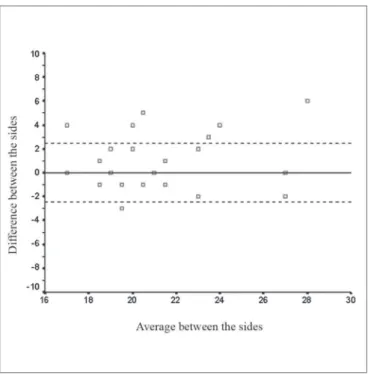
Chart 1. Relationship of the anterior ethmoid artery distance to the ante-rior insertion of the middle turbinate between the right and left side.
We studied 50 nasal cavities and in two of them we were unable to locate the anterior ethmoid artery. The anterior ethmoid canal was partially dehiscent in 41.7% of the nasal cavities and fully dehiscent in 25% (Table 2). The canal was intact in 33.3% of the cases. There was no statistical difference, as far as dehiscence was concerned,
between the two genders (χ2 p= 0.45). The agreement
between the right and left sides in relation to dehiscence of the ethmoid canal was week, with a Kappa coefficient
of 0.337; the sides were in agreement in only 52% of the cases.
The distances of the anterior ethmoid artery in rela-tion to the anatomical references in this study are presented on Table 3. The average length of the anterior ethmoid artery intranasal route was of 5.82mm (standard deviation = 1.41mm). The average distance of the artery middle point to the anterior nasal spine was of 61.72mm (sd = 4.18mm); to the AXN was of 64.04mm (sd = 4.69mm); and to the
Table 3. Anterior ethmoid artery measures in relation to the reference points and according to gender.
Reference point
N Average Mm
Standard deviation
P (Mann-Whitney
U test) Anterior ethmoid
artery length 48 5,82 1,41
0,885 Male 19 5,89 1,62
Female 29 5,78 1,28 Distance from the
anterior nasal spine 48 61,72 4,18
0,000 Male 19 65,10 1,66
Female 29 59,51 3,85 Distance from the
anterior nasal axilla 48 64,04 4,69
0,000 Male 19 67,31 2,45
Female 29 61,89 4,60 Distance from the
middle turbinate anterior axilla
48 21,14 3,25
0,640 Male 19 21,31 2,84
Female 29 21,03 3,54
Figure 4. Presence of the anterior ethmoid canal in the nasal cavity crossing the ethmoidal labyrinth at more than 5mm away from the skull base (45 degree endoscope).
AXCM it was 21.14mm (sd = 3.25mm).
For all the measures, there were no statistically significant differences when the right and left sides were compared (p>0.05). Such fact was observed in the agree-ment between the sides as to the distance of the ethmoid artery to the AXCM (Chart 1).
There were statistically significant differences be-tween the genders as to the distance bebe-tween the artery and the ENA and the AXN (p<0.0001). Males had longer average distances between the artery and the ENA, and between the artery and the AXN when compared to the measures found in females (Table 3). However, we ob-served that the distance between the artery and the AXCM did not present statistically significant differences between genders (p= 0.640). Table 3 depicts the averages. The intranasal route length of the anterior ethmoid artery was also not different between genders (p= 0.885).
As to the distance between the artery and the skull base, 83.3% of the arteries were attached to the ethmoid ceiling (Figure 4), 4.1% were between 2.5 and 5mm; and 12.5% were located at a distance greater than 5mm from the skull base (Figure 5). There was no difference between sides (p= 0.383).
DISCUSSION
In its intranasal route, the anterior ethmoid artery lies inside a bony canal called anterior ethmoidal canal that leaves the orbit through the anterior ethmoidal foramen. This artery is responsible for irrigating anterior ethmoidal cells and the frontal sinus, it branches off into meningeal vessels within the olfactory cleft and it descends to the nasal cavity where it irrigates the anterior third of the nasal septum and the lateral wall of the adjacent nasal cavity4. This artery runs through the ethmoidal ceiling in a diagonal direction, postero-inferiorly (Figure 2) and the site where it penetrates the skull (joint between the cribiform plate and the olfactory cleft lateral lamella) is the region most
fragile and prone to injury, causing CSF leaks8,9.
A number of studies have concocted techniques
to help identify the AEA. Kirchner et al.8 studied the AEA
anatomy, useful for an external approach, not endoscopic.
Stammberger et al.10 suggested that the AEA would be
located at 1 to 2mm posteriorly to the highest point of the
ethmoidal bulla anterior face; while Lund et al.11 submit
that the frontal recess posterior wall is the reference point for this artery. However, these studies all mention possible ethnical differences, which are not always a rule.
In our study, there was some artery dehiscence in almost two-thirds (66%) of the nasal cavities dissected. Such finding stresses the importance of knowing the exact location of the AEA during endonasal procedures, since dehiscence of the bony canal makes the artery more sus-ceptible to unwanted injuries. Having a canal dehiscence in one nasal cavity does not mean the contralateral artery
will also be exposed, since this was true in only 52% of
the cadavers. Moon et al.3 and Stammberger et al.8
pre-sented lower rates of dehiscence in their studies (11.4% and 40%, respectively). The fact that we considered partial dehiscence and racial differences may explain such dif-ferences.
We were unable to locate the AEA in two nasal
cavi-ties. Lee et al.2 considered the absence of the ethmoidal
artery; however they did not prove this in their study
carried out only among Chinese subjects. Isaacson et al.12
studying children skulls, reported anterior ethmoidal fora-men absent in 5% of the cases. There are reports of absent
AEA and of its route within the skull base bony wall13, thus
making it impossible to locate, however we do not relate its absence to the latter, since we confirmed its presence in its intra-orbitary route (out of its bony route).
The present study has shown that the anterior ethmoid artery is located, in general, at 21.14mm away from the middle turbinate anterior axilla; at 61.72mm away from the anterior nasal spine; and at 64.04mm away from the upper-medial nostril border. Such measures
were very similar to those found by Lee et al.2. The same
authors described a linear relation between the upper medial nostril border, the middle turbinate anterior axilla and the anterior ethmoid artery (Figure 3), however, we do not agree with such findings. We observed that this straight line met the skull at 3 to 4mm posteriorly to the
anterior ethmoid artery (AEA). In their study, Lee et al.2
removed the region equivalent to the middle turbinate axilla mucosa, and this could possible bring its measure more anteriorly. In similar studies, Moom et al. and Lee et al. used 0 degree endoscopes in their dissections, and this may impair AEA finding, which we often times were only able to locate using a 45 degrees endoscope. The linear relation is valid; however we must consider the posterior overestimation of this rule.
The measures found in the present study were significantly different between the genders, being greater in males, thus disagreeing from data collected in other
dissection studies2,4. It was only the distance between the
AEA to the AXCM that did not present differences between genders and side, and its standard deviation was the lowest observed among the distances measured in the sample. Thus, we may consider this measure as very useful and reliable in clinical practice to help locate the AEA.
necessary in order to avoid the possible injuries and ir-reparable sequels aforementioned.
Ohnishi et al.4 and Lynch considered the possibility of doing a lateral cantotomy to treat possible AEA iatro-genic lesions. However, based on our methodology, we may consider ligating this vessel endoscopically, as advo-cated by Woolford et al.14, or by skin micro-incision and
use of endoscopes, as proposed by Douglas et al.15.
CONCLUSIONS
• The middle turbinate axilla is the most reliable reference to locate the AEA, since it is located in general at 21mm away from the artery, and it did neither show gender nor side differences.
• In 12.5% of the cases in our sample the risk of inadvertently injuring the anterior ethmoid artery during Functional Endoscopic Sinus Surgery was greater because it was located over 5mm off the ethmoid ceiling.
• In 66.7% of the cases, the anterior ethmoid canal presents some degree of dehiscence. Thus, endoscopic sinus surgery in the ethmoid sinus should be careful, estab-lishing the limits in order to avoid severe complications.
REFERENCES
1. Stankiewz JA. Complications of endoscopic intranasal ethmoidectomy. Laryngoscope 1987;97:1270-3.
2. Lee WC, Ku PKM, Hasselt CA. New guidelines for endoscopic localiza-tion of the anterior ethmoidal artery: a cadaveric study. Laryngoscope 2000;110:1173-8.
3. Moon Hyoung-Jin, Hyung-Ung Kim, Jeung-Gweon Lee, In Hyuk Chung. Surgical anatomy of the anterior ethmoidal canal in ethmoid roof. Laryngoscope 2001;111:900-4.
4. Ohnishi T, Yanagisawa E. Endoscopic anatomy of the anterior eth-moidal artery. Ear Nose and Throat Journal 1994:634-6.
5. Voegels RL. Cirurgia endoscópica dos seios paranasais. Arquivos de otorrinolaringologia 1997;1(1).
6. Brouzas D, Charakidas A, Androulakis M, Moschos M. Traumatic optic neuropathy after posterior ethmoidal artery ligation for epistaxis. Otolaryngology - Head and Neck Surgery 2002;126 (4):323-25. 7. Rockey JG, Anand R. A critical audit of the surgical management of
intractable epistaxis using sphenopalatine artery ligation/diathermy. Rhinology 2002;40:147-149.
8. Kirchner JA, Yanagisawa E, Crelin ES. Surgical anatomy of the eth-moidal arteries. Arch Otolaryngol 1961;74:382-6.
9. Basak S, Karamam CZ, Mutlu C, Odabasi O. Evaluation of some im-portant anatomical variations and dangerous areas of the paranasal sinuses by CT for safer endonasal surgery. Rhinology 1998;36:162-7.
10. Stammberger H. Functional Endoscopic Sinus Surgery: The Mes-serklinger Technique. St. Louis, MO: Mosby-Year Book; 1991.p.70-6.
11. Lund VJ. Anatomy of the nose and paranasal sinuses. In: Gleeson M, ed. Scott Brown’s Otolaryngology, 6th ed. London: Butterworths, 1996.
12. Isaacson G, Monge JM. Arterial ligation for pediatric epistaxis: develo-pmental anatomy. American Journal of Rhinology 2003;17(2):75-81. 13. Becker SP. Applied anatomy of the paranasal sinuses with emphasis
on endoscopic surgery. Ann Otol Rhinol Laryngol Suppl 1994;162:3-32.
14. Woolford TJ, Jones NS. Endoscopic ligation of anterior ethmoidal artery in treatment of epistaxis. The Journal of Laryngology & Otology 2000;114:858-60.