Microsurgical anatomy of the external carotid artery: a
stereoscopic study
Anatomia microcirúrgica da artéria carótida externa: um estudo estereoscópico
Gustavo Rassier Isolan1, Adamastor Humberto Pereira2, Paulo Henrique Pires de Aguiar1,
Ápio Cláudio Martins Antunes3, João Pedro Mousquer4, Marcel Rozin Pierobon5
Abstract
Background: Knowledge of the anatomical structures of the external carotid artery by means of stereoscopic study may yield better results in microsurgery of the external carotid artery.
Objective: To describe the structures of the external carotid artery under stereoscopic view, identifying its multiple aspects.
Methods: he cervical regions of twelve cadavers were dissected using a surgical microscope with 3 to 40 X magniication. he anatomical dissections were documented using the technique to obtain three-dimensional images (3D), aiming at producing stereoscopic images.
Results: he use of the stereoscopic technique allowed a tri-dimensional approach to the extracranial arterial circulation, and the performance of surgical dissections such the combined approach to the posterior fossa and infratemporal fossa, making microvascular surgery and neurosurgical procedures more precise.
Conclusion: he use of images obtained by the stereoscopic technique produced a more assertive result in relation to the anatomy study for microsurgical or neurosurgical procedures, allowing better analysis before performing complex neurosurgical procedures.
Keywords: stereoscopic vision; carotid artery, external; three-dimensional images.
Resumo
Contexto: O conhecimento das estruturas anatômicas da artéria carótida externa por meio do estudo estereoscópico pode determinar melhores resultados em microcirurgias da artéria carótida externa.
Objetivo: Descrever as estruturas da artéria carótida externa sob a visão estereoscópica, identiicando seus múltiplos aspectos.
Métodos: Doze regiões cervicais foram dissecadas, utilizando-se microscópico cirúrgico com 3 a 40X de aumento. As dissecções anatômicas foram documentadas utilizando-se a técnica para obtenção de imagens tridimensionais (3D), objetivando a produção de impressões estereoscópicas. Resultados: O uso da técnica estereoscópica possibilitou a abordagem da circulação arterial extracraniana, sendo realizados estudos cirúrgicos do tipo combinado fossa posterior e fossa infratemporal, tornando as microcirurgias e os procedimentos neurocirúrgicos vasculares mais precisos.
Conclusão: O uso das imagens obtidas pela técnica estereoscópica produziu um resultado mais assertivo em relação ao estudo da anatomia para a microcirurgia e procedimentos neurocirúrgicos, facilitando melhor aprendizado previamente à realização de procedimentos complexos em neurocirurgia.
Palavras-chave: visão estereoscópica; artéria carótida externa; imagens tridimensionais.
Study carried out at the Microsurgery Laboratory of the University of Arkansas, Little Rock, USA.
1 PhD; Professor at the Surgical Science Postgraduate Program of Federal University of Rio Grande do Sul (UFRGS) – Porto Alegre (RS), Brazil.
2 PhD; Professor at the Vascular Surgery Service of the Clinics Hospital of Porto Alegre; Postgraduated in Surgical Science at UFRGS – Porto Alegre (RS), Brazil. 3 PhD; Professor at the Neurosurgery Service of the Clinics Hospital of Porto Alegre – Porto Alegre (RS), Brazil.
4 Medical Student at UFRGS – Porto Alegre (RS), Brazil.
5 MsD Student; Postgraduated in Surgical Science at UFRGS – Porto Alegre (RS), Brazil.
Financial support: none.
Introduction
he external carotid artery presents complex anatomy that should be known in depth by vascular surgeons, neu-rosurgeons, head and neck surgeons, among other profes-sionals. When studied using conventional photographic images, such anatomy does not show the real depth of some structures. In order to to mitigate this problem and to provide a tri-dimensional (3D) perspective in printed images, the 3D anaglyphic method was created. he pur-pose of this study is to present detailed results of micro-surgical dissections of the external carotid artery by means of stereoscopic imaging.
Material and methods
his study was conducted at the Microsurgery Laboratory, University of Arkansas, Little Rock, United States. he cervical region of twelve cadavers were dis-sected using a surgical microscope of 3 to 40 X magniica-tion. he cadavers were injected with color silicon and po-sitioned with a Mayield skull clamp; the head was stretched and rotated, simulating the surgical position to approach the extracranial arterial circulation. hen, combined poste-rior fossa and infratemporal fossa surgical dissections were performed, that simulated operations for jugular foramen tumors, as well the simulation of vascular neurosurgical procedures, such as: endarterectomy and extra- to intracra-nial arterial anastomosis.
he anatomical dissections were documented using the technique to obtain 3D images, aiming at the production of stereoscopic prints. In this technique, pictures are tak-en of the same object from two difertak-ent positions, but on the same horizontal plane. he irst position corresponds to the let eye view and the second position corresponds to the right eye view. he images were superimposed, using a previously deined sotware program, coordinated and printed. A Nikkon D70 camera, 8.0 megapixels with macro lens was used to document the dissections. he device was adapted to a sliding bar assembled on a tripod. he lens and the shutter speed were set at f32 and 1/60 seconds, respec-tively. he stereoscopic technique employed by the authors is detailed in a previous study conducted by Ribas et al.1.
he prints made using the stereoscopic technique should be viewed with red-green stereoscopic glasses.
Results
he authors described the anatomy based on the stud-ies conducted by Testut and Latarjet2 and Rhoton3.
he external carotid artery arises from the bifurcation of the common carotid artery, also called primitive carotid artery; there is one artery on the right and another on the let side of the neck. he right common carotid originates from the brachio-cephalic trunk, at the lower part of the neck, while the common let carotid starts at the aortic arch, presenting a small intratho-racic segment, which makes it longer than the right common ca-rotid. hese arteries run from their origins to the upper border of the thyroid cartilage, where they bifurcate to form external and internal arteries.
he common carotid arteries are located in each side of the antero-lateral region of the neck (carotid region), and are related posteriorly with the cervical sympathetic chain and with the transverse apophysis of cervical vertebrae covered by the prevertebral muscles and the deep cervical aponeurosis.
he transverse apophysis (transverse process) of C6
presents a voluminous and palpable tubercle, which is used as the surgical reference point to access the common ca-rotid; this prominence is called Chassaignac tubercle. At this level, the common carotid artery is crossed posteriorly by the inferior thyroid artery. It is related to the esophagus and the trachea (tracheoesophageal axis) inferiorly, to the laringotracheal axis superiorly, to the sternocleidomastoid muscle anteriorly, and in close contact with the internal jug-ular vein along all its extension. he vagus nerve is between these two large caliber vessels.
he common carotid artery, the internal jugular vein and the vagus nerve form the neurovascular bundle of the neck, which is wrapped by a very evident sheath, ofering an excellent plane for surgical dissection. his artery bifurcates at the level of the upper border of the thyroid cartilage, forming the internal and external carotids. At the bifurcation, the common carotid
artery presents a bulge, known as carotid bulb.
he external carotid artery starts at the level of the upper border of the thyroid cartilage lamina and ends behind the neck of the mandible, between the tip of the mastoid process and the angle of the mandible. It bifurcates inside the parotid gland forming the supericial temporal artery and the maxil-lary artery, also known as internal maxilmaxil-lary artery.
Figures 1 to 10 illustrate the external carotid artery anatomy. he external carotid artery branches are: superior thyroid artery, ascending pharyngeal artery, lingual artery, facial artery, occipital artery, posterior auricular artery, su-pericial temporal artery and (internal) maxillary artery.
Superior thyroid artery
above the usual level, this artery can have its origin at the carotid bulb. Running a deep anterior and later downward course , it divides into small branches onto the upper pole of the thyroid lobe. Along its course, the superior thyroid artery is in contact with the pharynx and the larynx, below the in-frahyoid muscles. In this course, it supplies the thyroid gland with its terminal (anterior and posterior) branches and the larynx with its collateral (superior laryngeal and cricothy-roid) branches. he following branches have been identiied:
• Infrahyoid branch: parallel to the lower border of the hyoid
bone, it supplies the supra- and infrahyoid muscles.
• Middle sternocleidomastoid artery branch: 4 to 6 cm
long, it starts and crosses the common carotid artery and the internal jugular vein, entering the deep portion of the sternocleidomastoid muscle, and it is accompa-nied by a large tributary of the internal jugular vein.
• Superior laryngeal artery: has its origin at the supe -rior thyroid artery, following an anteroinfe-rior course to subsequently bifurcate into two terminal branches, one external and one posterior. he external branch is behind the terminal branches of the superior laryngeal nerve and the upper portion of the branch behind the posterior nerve bundles. he posterior branch runs posteriorly, closely related to the arytenoid fold.
• Inferior and posterior laryngeal arteries: they run up -wards posteriorly to the cricoarytenoid muscle, ater anastomosing with the posterior portion of the superior laryngeal branch. hey supply the inferior pharyngeal constrictor, the ary-arytenoid, posterior cricoarytenoid and the cricothyroid muscles.
• Terminal branches: an internal branch that accompanies
the upper border of the thyroid body and that anasto-moses at the midline with the branch from the opposite side; an external branch that runs downwards and bifur-cates over the external portion of the corresponding thy-roid lobe; and a posterior branch that crosses behind the thyroid gland, between this gland and the trachea4.
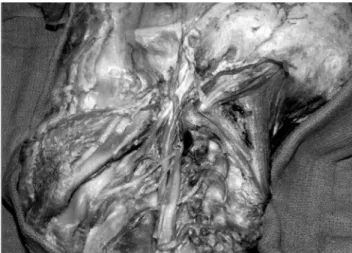
Figure 1 shows the side view of the external carotid ar-tery branches and Figure 2 shows the same image, but using the stereoscopic technique.
Ascending pharyngeal artery
he ascending pharyngeal artery is the only branch that comes of the posterior face of the external carotid ar-tery, near or at the same level of the lingual artery. It runs upwards in contact with the lateral wall of the pharynx and ends at the base of the skull, entering the jugular foramen and the hypoglossal canal5.
It supplies the dura-mater of the inferior clivus region, and at the same time, it anastomoses with branches of the dorsal meningeal artery, which starts at the meningohypo-physeal trunk into the cavernous sinus. hese branches sup-ply the upper two-thirds of the clivus5 (Figures 3 and 4).
Lingual artery
he lingual artery has its origin at the medial aspect of the external carotid artery, on average 2 cm cephalad to the carotid bulb, and runs obliquely and anteriorly. It runs in front of and over the greater cornu of the hyoid
Figure 1. Side view of the external carotid artery branches. 1. superior thyroid artery; 2. inferior pharyngeal constrictor muscle; 3. thyroid car-tilage; 4. submandibular gland; 5. lingual artery; 6. hypoglossal nerve; 7. facial artery; 8. ascending palatine artery; 9. stylohyoid muscle; 10. sty-loglossus muscle; 11. ascending pharyngeal artery; 12. internal jugular vein (sectioned); 13. vertebral artery; 14. suboccipital triangle; 15. styloid process and posterior auricular artery; 16. maxillary artery; 17. infraor-bitary nerve; 18. buccinator muscle.
bone and runs under the hyoglossal muscle to reach the anterior portion of the tongue through its terminal branch (deep lingual artery)5,6.
Along its course, the lingual artery gives of three im-portant collateral branches:
• Hyoid branch: it runs along the hyoid bone, irst above
and then below it. It anastomoses with the branch from the opposed side at the midline, forming an arch locat-ed between the genioglossus and geniohyoid muscles. It supplies the insertions of the infrahyoid muscles above and the stylohyoid branches, at the junction where the digastric and mylohyoid branches meet.
• Dorsal lingual artery: it is usually of small caliber and
was identiied in only one cadaver. It has an ascending branch that runs inferiorly, reaching both sides of the base of the tongue and ending at the mucosa that cov-ers the caliciform papillae, the anterior arch, the sot palate and the epiglottis.
Sublingual artery: it is a lexible vessel in the anatomical dissections that runs in parallel to Wharton’s duct, between the mylohyoid and genioglossus muscles. Along its course, it gives of branches to the sublingual gland and the hyoglossus mus-cle, branches above the genioglossus and branches below the geniohyoid muscle before bifurcating into terminal branches: one superior, towards to middle portion of the horizontal branch of the mandible and one inferior, which enters the mid-dle mental canal through the sub and intragenian foramina.
Figure 3. Advanced dissection of the skull base, showing the middle meningeal artery and its point of penetration into the middle fossa (12), as well as the cervical internal carotid artery entering the skull base, after which it is called intrapetrous portion of the internal carotid artery. 1. lat-eral rectal muscle; 2. V1; 3. V2; 4. V3; 5. trochlear nerve; 6. oculomotor nerve; 7. M2 branches of the middle cerebral artery above the insula; 8. posterior cerebral artery; 9. Gasserian ganglion; 10. ICA; 11. Eustachian tube; 12. mid-dle meningeal artery; 13. V3; 14. oropharynx; 15. styloid process.
Figure 4. A) Axial magnetic nuclear resonance in T1 with gadolinium, showing an injury on the right jugular foramen surface, compatible with a paraganglio-ma; B) arteriography with injection of contrast into the right external carotid artery, showing illing across the occipital artery (single arrow) and ascending pha-ryngeal artery (dual arrow), the two vessels were embolized; C) cross-sectional arteriography with catheterization of the right internal carotid artery, showing a small tumoral blush originated in the carotid-tympanic branches of the intrapetrous portion of the ICA; D) surgical stage showing the previously separated temporalis muscle; E) dissection and exposure of the neurovascular structures of the neck; F) computed axial tomography in the immediate post-operative period, showing hypodense material compatible with fat graft inside the mastoid portion of the temporal bone during the skull base reconstruction.
A
D
B
E
C
Facial artery
he facial artery has its origin on average 1.5 cm above the lingual artery. It runs an ascending and oblique course anteriorly; initially in contact with the pharyngeal wall, it passes under the posterior belly of the digastric muscle and the stylohyoid muscle, entering the anterior groove of the masseter muscle and crossing the horizontal ramus of the mandible7. Finally, it runs obliquely upward and forward,
following the nasolabial crease. It ends at the internal angle of the eye, under the name of angular artery, which anasto-moses with one of the branches of the ophthalmic artery7.
he collateral branches of the facial artery are: the cervical and facial branches (Figures 6 and 7).
Cervical branches
The inferior ascending palatine artery arises from the facial artery 4 to 5 cm distally to its origin. It runs anterior e superiorly, passing between the fibers of the styloglossus muscle. It ascends through the lateral aspect of the pharynx, gives off a branch to the tongue muscles and branches off distally to the palatine tonsil, superior pharyngeal constrictor muscle and stylopharyngeal mus-cle. It anastomoses with the superior palatine and inferi-or pharyngeal arteries. The internal pterygoid muscle ar-tery arises from the inferior palatine, and rarely from the facial artery, and supplies the internal pterygoid muscle. The submental artery is a larger vessel, that has its ori-gin at the facial artery at the level of the submandibular gland. It runs horizontally along the lower border of the mandible, between the mylohyoid muscles and the ante-rior belly of the digastric muscle, supplying several small branches to these muscles along its course. It ends in the mental region, where it anastomoses with the terminal ramifications of the inferior dental arch.
Facial branches
The inferior masseteric artery has this name to be distinguished from the masseteric artery, which arises from the internal maxillary artery and is the main sup-plier to the masseter muscle. The inferior labial artery arises from the facial artery at the level of the lips. It runs horizontally into the muscles of the lower lip and it anas-tomoses at the midline with the same artery from the op-posite side. The superior labial artery starts at the same level as the inferior labial artery, but it runs to the upper lip, where it anastomoses at the midline with the same artery from the opposite side. The lateral nasal artery
arises from the facial artery at the level of the nose side and runs forward and inside and bifurcates, almost im-mediately after its origin, in the three branches, resulting in slender ramifications to the alae, to the dorsum and to the lobe. The terminal branches of this artery anastomo-ses with the same arteries from the opposite side.
Figure 5. Posterior cervical region showing the occipital artery and vein (sin-gle arrows). Contralateral occipital artery (dual arrow) and C2 dorsal branch.
Occipital artery
It arises from the posterior aspect of the external ca-rotid artery, near the origin of the facial artery, and runs posteriorly and upwards to supply the neck region. he col-lateral branches of the occipital artery are:
• superior sternocleidomastoid branch: runs to the deep
sternocleidomastoid muscle;
• muscular branches in variable number that are given
of at diferent levels of the occipital artery and go to neighboring muscles;
• stylomastoid branch: enters the stylomastoid foramen,
in close relation with the facial nerve along its course. Its ramiications go to the eardrum, mastoid cavity and semicircular canals.
• meningeal artery: enters the mastoid foramen, supply -ing the dura-mater of the mastoid region (Figure 5).
Posterior auricular artery
Also named retroauricular artery, it arises right above the occipital artery and runs a posterosuperior oblique course, passing beneath the posterior belly of the digastric muscle, finally reaching the posterior border of the mastoid8,9.It has the following terminal
branches: an anterior branch that supplies the inter-nal face of the ear and supplies the exterinter-nal face with small distal branches, called perforators, which supply the skin of the helix, antihelix, concha and earlobe; one posterior branch, which spreads in the region behind the ear, anastomosing with branches from the occipital and superficial temporal arteries.
Superficial temporal artery
he supericial temporal artery is one of the terminal branches of the external carotid artery. It arises right above the mandibular condyle, inside the parotid gland and goes upward, anterior to the tragus. In its most supericial course, it passes (between the two fascias of the temporalis muscle) above the temporalis muscle and the anterior auricular mus-cle, and divides into two terminal branches: frontal and pari-etal. he supericial temporal artery is accompanied along all its course by the supericial temporal vein and partially by the auriculotemporal nerve5,6 (Figure 8).
Maxillary artery
he maxillary artery is one of the terminal branches of the external carotid artery (the other one is the supericial
temporal artery), which arises at the level of the neck of the mandible and its initial course is inside the parotid gland5. he maxillary artery is divided into three portions:
mandibular (or retromandibular), pterygoid and pterygo-palatine. hese subdivisions of the maxillary artery are es-tablished in relation to the lateral pterygoid muscle5. From
lateral to medial direction, the irst portion is laterally, the second is at the same level and the third is medially located in relation to the muscle. In our dissections, the maxillary artery was lateral to the buccal and lingual arteries and to the inferior alveolar nerve in all specimens5.
The branches of the first portion penetrate into fo-ramens of base of the skull. This segment of the maxil-lary artery passes between the mandibular condyle and the sphenomandibular ligament, running alongside the auriculotemporal nerve. Its branches are: the deep au-ricular artery, closely related to the wall of the external acoustic meatus4; the anterior tympanic artery, which
runs parallel to the chorda tympani nerve and enters the petrotympanic fissure; and the middle meningeal artery, the first maxillary artery branch that runs super-ficially to the lateral pterigoid muscle. It may start at a trunk in common with the inferior alveolar artery, but this pattern was not observed in our dissections. It as-cended to enter the spinal foramen; the accessory men-ingeal artery may start at the medium menmen-ingeal artery and ascends next to the tensor veli platini and levator
Figure 8. Anatomo-radiologic correlation of the supericial temporal artery. 1. frontal branch; 2. parietal branch. he arrow in the smaller igure indi-cates the maxillary artery.
veli palatine muscles and to reach the foramen ovale, which was observed in two cadavers. The mandibular artery enters the mandibular foramen through the me-dial surface of the mandible to supply the mandible and the teeth of the inferior dental arch10.
The second portion of the maxillary artery was lo-cated superficially to the lateral pterygoid muscle in all specimens. The anterior and posterior branches of the deep temporal artery supply the temporalis muscle. The masseter artery runs inside the mandibular incisure to reach the masseter muscle7,9. The pterygoid artery
presents a variable number and supplies the pterygoid muscle. The buccal artery runs parallel to the buccal branch of the mandibular nerve and supplies the skin and mucous membrane above the buccinator muscle7,9
(Figures 9 and 10).
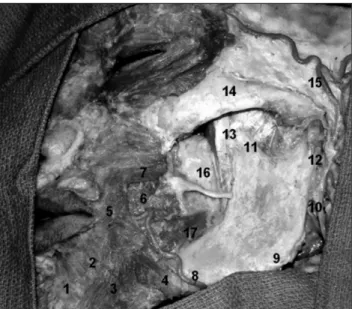
Figure 9. Side view of the left face with dissection of deeper tissues. he masseter muscle was removed. he insertion of the temporalis muscle tendon was inserted in the coronoid process of the mandible. 1. mentalismuscle; 2. depressor labii inferioris; 3. depressor anguli oris; 4. platysma muscle ibers; 5. orbicularis oris muscle; 6. risorius muscle; 7. greater zygomatic muscle; 8. facial artery; 9. angle of the mandible; 10. retromandibular vein; 11. coronoid process; 12. condylar process; 13. temporalis muscle tendon inserted in the coronoid process; 14. zygoma; 15. supericial temporal artery; 16. perioral fat.
Discussion
he external carotid artery supplies most of the sot tis-sues of the head and neck, as well as the meninges, giving of six branches before dividing into the supericial tempo-ral artery and the maxillary artery.
Studies on the external carotid artery are extremely im-portant, due to the anatomical structures found there. Poor knowledge of this artery surgical anatomy may lead to in-advertent injuries. At operation, two parameters are used to identify the external carotid artery: it runs more anteriorly than the internal carotid artery and gives of several branch-es in the neck, while the internal carotid artery has none.
Carotid endarterectomy is the surgical procedure with the highest number of co-operative studies demonstrat-ing its efectiveness. he selection criteria for symptomatic patients were determined particularly by the co-operative study called NASCET (North-American Symptomatic Carotid Endarterectomy Trial)11, according which the
neu-rologically stable patients with carotid stenosis of 70% or above beneit from the surgery in the services where the morbimortality is below 6%. he higher the stenosis degree, the higher the surgery beneit. But, in patients with stenosis between 50 and 69%, the surgery should be indicated only in services where the morbimortality is below 2%12.
When exposing the cervical spine for cervical spine discectomy through an anterior approach, ater opening the supericial fascia and retracting laterally the sternocleido-mastoid muscle, the pre-tracheal fascia was observed, which involves the muscles from the lower portion of the hyoid (of which the most important is the omohyoid muscle), the vasculo-nervous bundle, the esophagus and trachea. his bounded region is called the carotid triangle12,13.
he occipital artery is the main branch used for arterial bypass in the posterior fossa and it is usually anastomosed to the posterior inferior cerebellar artery (PICA).
he ascending pharyngeal artery is the main blood supply to the paragangliomas of the jugular foramen and other tumors located in it.
For reconstruction of the base of the skull ater resec-tion for carcinoma, the facial artery is the main artery used to supply the lap to be grated. In juvenile nasopharyngeal angioibromas, the maxillary artery is the main artery to be embolized. In some cases, the posterior auricular artery supplies the glomic tumors of the jugular foramen, and it may be embolized in the preoperative period or ligated dur-ing the operation.
he supericial temporal artery is the main vessel that can be anastomosed in the M4 branch of the middle cere-bral artery, in the low-low bypass12.
he brain processes the stereoscopic view by observing an object captured from two diferent points (retina of each eye), providing a notion of depth. he stereoscopic photo-graphic documentation provides this notion of depth which, otherwise, would not be conceived with conventional 2D images. Currently, 3D images have been increasingly pro-duced, not only for medical publications, but especially for general media, which can be seen in 3D movies and
ani-mations produced in the last years. However, it should be
noted that this technology is not new. Since the publication of Bassett Stereoscopic Atlas13, originally published in 1961
and reedited in 1994, up to two recently published micro-surgery atlas, one edited by Poletti and Ojemann in 198514
and one by Kraus and Bailey in 199415,16, stereoscopic
im-ages have been presented.
Recently, surgical and anatomical stereoscopic vid-eos have been used for pedagogical purposes in projec-tors, computer displays and printed (anaglyphic) method. Besides ofering a better anatomical illustration and a better 3D understanding, the use of stereoscopic images can also enhance the individual’s familiarity with his/her own three-dimensionality and promote the spatially re-lated skills. he article of Ribas et al.3 already highlighted
that the form is the primitive unit of perception and that stereoscopic images have deinitive advantage in the pro-duction of illustrations. Virtual environments for surgery planning and training, which are being developed through telesurgical systems, will also require stereoscopic visual-ization and the individual’s familiarity with the 3D con-cepts and stereoscopy.
Conclusion
he study of the external carotid artery, under the per-spective of microsurgical anatomy, provides a 3D view to the surgeon, due to the fact that an anatomical region can be studied in diferent angles and according to the surgical position of the patients. he stereoscopic documentation is useful, as it adds the sense of depth of the documented anatomy. Studies of this type can be more didactical in the teaching of anatomy.
References
1. Ribas GC, Bento RF, Rodrigues AJ Jr. Anaglyphic three-dimensional stereoscopic printing: revival of an old method for anatomic and surgical teaching and reporting. J Neurosurg. 2001;5:1057-66.
2. Testut L, Latrajet A. Tratado de Anatomia Humana. Salvat Editores S.A; 1988. p. 206-40.
4. Isolan GR, Rowe R, Almefty O. Microanatomy and surgi-cal approaches to the infratemporal fossa: an anaglyphic three-dimensional stereoscopic printing study. Skull Base. 2007;17:285-302.
5. Isolan GR, Almefty O. Fossa infratemporal: microanatomia e abor-dagens cirúrgicas. J Bras Neurocir. 2008;19:7-18.
6. Alves E. Anatomia descritiva. São Paulo: Atheneu; 1965. p. 416-25..
7. Gardner GOR. Anatomia estudo regional do corpo. 4. ed. Rio de Janeiro: Guanabara Koogan; 1988. p. 683-684.
8. Krayenbühl N, Isolan GR, Almefty O. The foramen spino-sum: a landmark in middle fossa surgery. Neurosurg Rev. 2008;31:397-401.
9. Krayenbuhl N, Miguel ABDO, Isolan GR, Krisht A. Cerebral Revascularization: part 2. Contemp Neurosurg. 2007;28:225-8.
10. Isolan GR, Chem RC, Webster R et al. Reconstrução da base do crânio: enxertos e retalhos regionais - duas séries dife-rentes provenientes de um departamento de neurocirurgia e de um departamento de cirurgia plástica. J Bras Neurocir. 2007;18:5-13.
11. Carotid endarterectomy: three critical evaluations. North American Symptomatic Carotid Endarterectomy Study Group. Stroke. 1987;18:987-9.
12. Aguiar PHP, Antunes ACM, Machado HR et al. Tratado de téc-nica operatória em Neurocirurgia. São Paulo: Atheneu; 2009. p. 63-72.
13. Wirth FP, Dowd GC, Sanders HF, Wirth C. Cervical discectomy – a prospective analysis of three operative techniques. Surg Neurol. 2000;53(4):340-6.
14. Bassett DL. A Stereoscopic Atlas of Human Anatomy. Portland, OR: Sawyer; 1961.
15. Poletti CE, Ojemann RG. Stereo Atlas of Operative Microneurosurgery. St. Louis: Mosby; 1985.
16. Kraus GE, Bailey GJ. Microsurgical Anatomy of the Brain: A Stereo Atlas. Baltimore: Williams & Wilkins; 1994.
Correspondence Gustavo Rassier Isolan Hospital de Clínicas de Porto Alegre Rua Ramiro Barcelos, 2.350 CEP 90035-903 – Porto Alegre (RS), Brazil E-mail: [email protected]
Author´s contributions Study conception and design: GRI Data analysis and interpretation: GRI, ACMA, MRP Data collection: GRI Writing: GRI, MRP Critical analysis: AHP, PHPA, JPM Final approval*: GRI, AHP, PHPA, SPM, MRP, ACMA Overall responsibility: GRI*All authors have read and approved the inal version submitted to J Vasc Bras.