A
rti
c
le
0103 - 5053 $6.00+0.00
*e-mail: [email protected]
Long Alkyl Chain bis-Quaternary Ammonium-based Ionic Liquids as Biologically Active
Xanthenes Dyes
Juliusz Pernak,*,a Anna Świerczyńska,a Filip Walkiewicz,a Ewa Krystkowiakb and Andrzej Maciejewskib,c
aPoznan University of Technology, Faculty of Chemical Technology, Poznan, Poland
bFaculty of Chemistry and cCentre of Ultrafast Laser Spectroscopy, A. Mickiewicz University, Poznan, Poland
Foram preparados novos exemplos de líquidos iônicos hidrofílicos e hidrofóbicos, estáveis frente ao ar e à umidade, derivados de amônio bi-quaternário. Esses líquidos iônicos foram propostos para atuar como pigmentos biologicamente ativos, com características físico-químicas únicas, como uma alternativa a alguns pigmentos convencionais aniônicos derivados de xanteno, como eosina Y, fluoresceina e eritrosina.
New examples of air- and moisture-stable, hydrophobic and hydrophilic bis-quaternary ammonium derived ionic liquids have been prepared. These ionic liquids have been proposed to act as biological active dyes with characteristic unique physicochemical properties, providing alternatives to some conventional anionic xanthene dyes such as eosine Y, fluorescein and erythrosine.
Keywords: ionic liquids, xanthene dyes
Introduction
Studies of ionic liquids (ILs) are driven by the intrinsic interest as well as by possible applications. The letters give rise to the series of ILs generations. The evolution of ionic liquids proceeds very quickly from the first generation (ILs with unique tunable physical properties), through the second generation (ILs with targeted chemical properties combined with selected physical properties), to the third generation (ILs with targeted biological properties combined with chosen physical and chemical properties).1 In particular, the air and water stable ILs are considered to be promising solvents for wide variety of applications including organic synthesis,2-4 catalysis5-7 (with biocatalysis),8 biphasic systems,9 electrochemistry10-12 and tissues preservation.13 The vapor pressure of ILs is generally negligible. However, they can be distilled under high vacuum.14 In addition, ILs have been shown to be non-flammable. The non-flammability of ILs is often highlighted as a safety advantage of these liquids over volatile organic compounds (VOCs). Though many ILs are not flammable themselves, they are not safe to use near fire or heat sources. The decomposition products formed
during the thermal decomposition of some IL are sensitive to combustion.15 The ILs cycle of life has already been established16 and a brief overview of the ecotoxicological, bioaccumulation, and biological activity of these liquids has appeared in the literature.17
Long Alkyl Chain bis-Quaternary Ammonium-based Ionic Liquids as Biologically Active Xanthenes Dyes J. Braz. Chem. Soc.
840
ion pair extraction procedure. Xanthene dyes such as eosin form 1:2 ion associates with quaternary ammonium cations at pH 7-9.22 Purkait et al.23 separated eosin dye from wastewater with cloud point extraction by using a nonionic surfactant Triton X-100. Recently liquid-liquid extraction with imidazolium IL was proposed for removal of eosin dye from aqueous solutions.24
Here, we describe novel bis-quaternary ammonium based ionic liquids as biological active dyes.
Results and Discussion
Synthesis
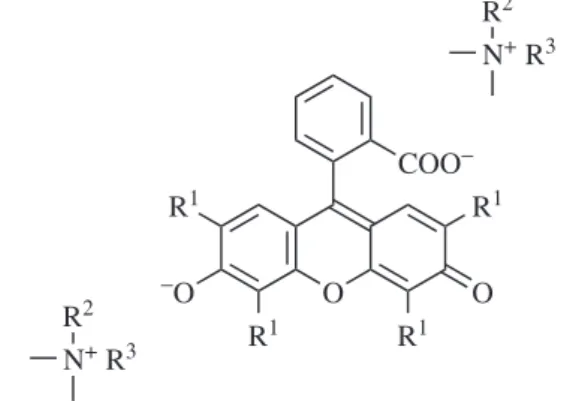
Metathesis reactions of long alkyl chain quaternary ammonium chlorides, the commercially inexpensive and broadly used didecyldimethylammonium - DDA, benzalkonium - BA (alkyl group ranging between n-C8H17 and n-C18H37) and hexadecyltrimethylammonium - CTA, were carried out using disodium salts of eosine Y, or fluorescein, or erythrosine. The prepared ion pairs are listed in Scheme 1 and 2 and Table 1.
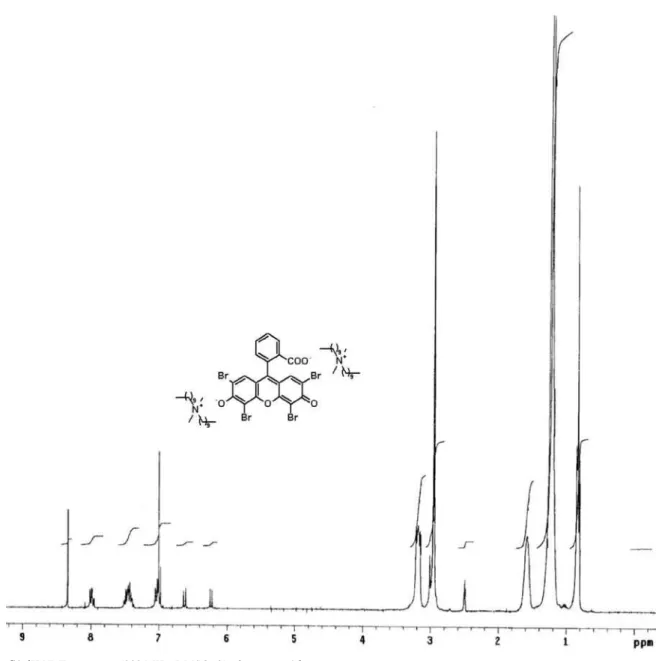
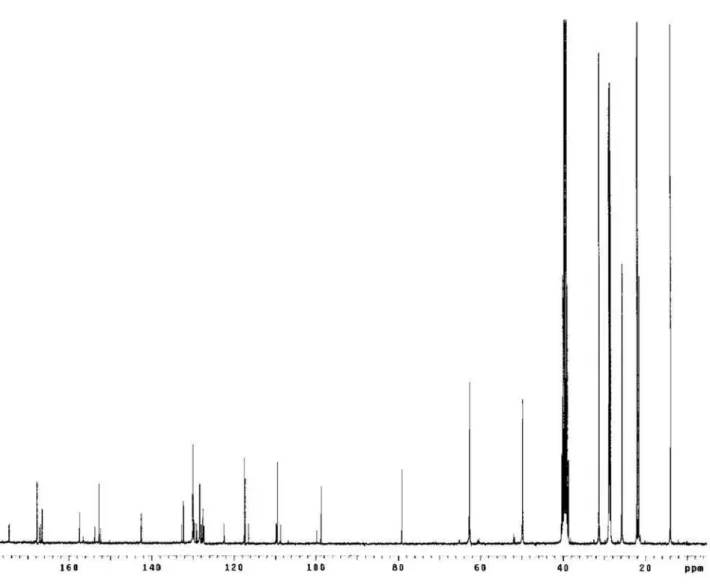
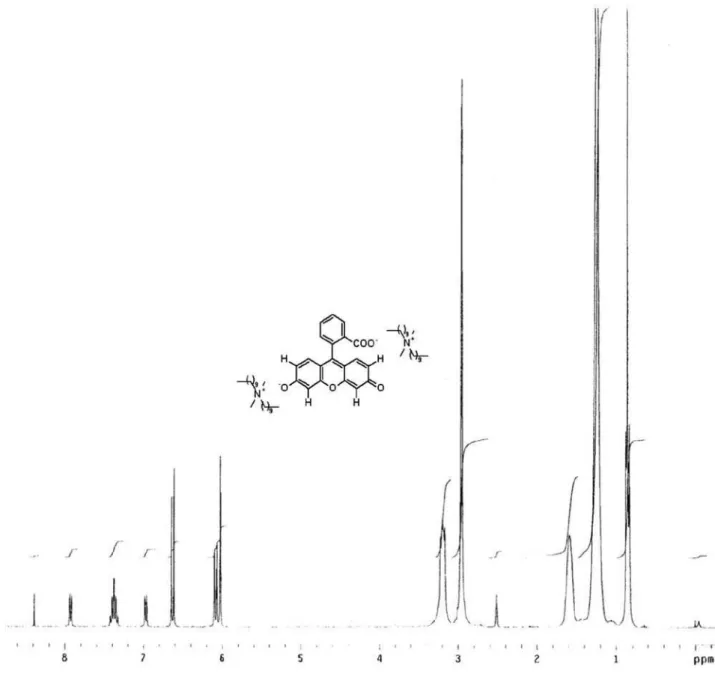
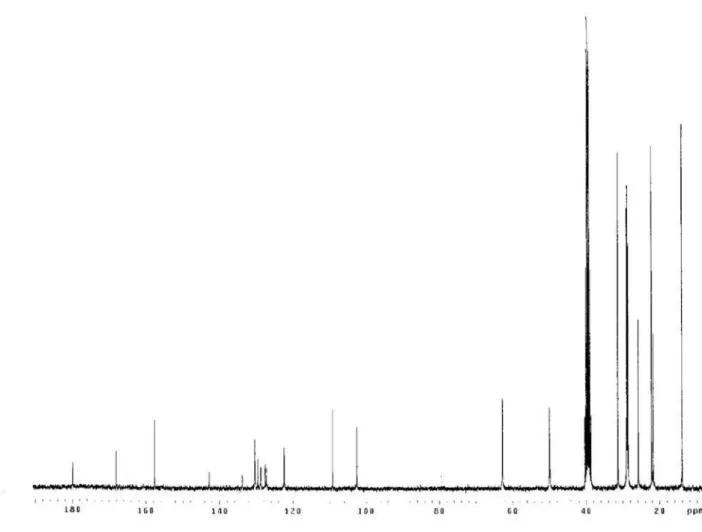
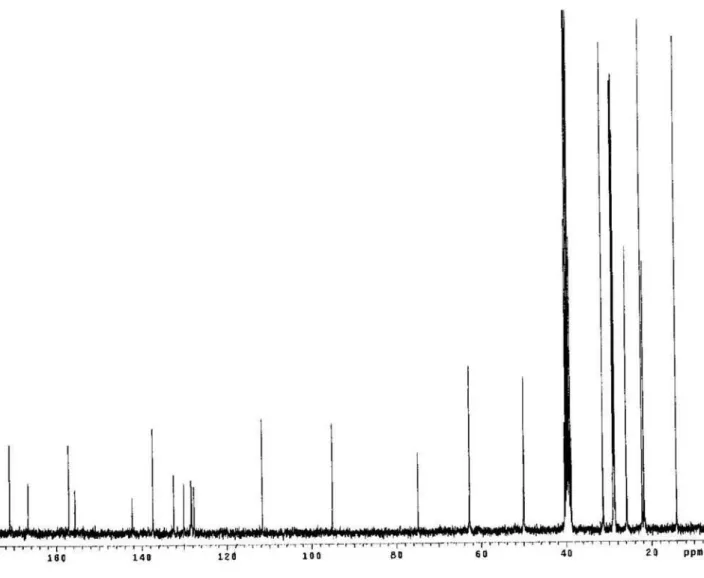
All isolated bis-salts are nonvolatile, nonflammable, soluble in chloroform, acetone, DMF, DMSO, alcohol (methanol, 1-decanol, cyclohexanol), and insoluble in hexane and CCl4. These new compounds are insoluble in water, with the exception of the 4-6 salts. The hydrophilic and hydrophobic products were dried in vacuum at 80 oC for 24 h and stored over P4O10.The water contents, determined by Karl-Fischer measurements, were found to be less than 500 ppm. The salts were characterized by 1H and 13C NMR analyses and by elemental analysis.
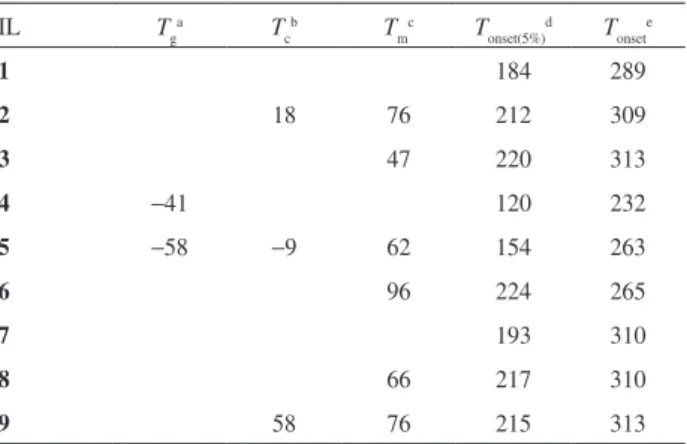
The thermal properties for the reported ILs were determined using DSC and TGand are presented in Table 2. The salt 4 formed a cooled phase, with a glass transition
temperature (Tg) of −41 oC. Melting points (T
m) for 2, 3,
5, 6, 8 and 9 were observed to be 76, 47, 62, 96, 66, and 76 oC, respectively. Salts 2, 3, 8, 9 were stable up to 210 oC and the onset for thermal decomposition (T
onset) amounted
to 310 oC. They remained stable in air, in aqueous solution and in common organic solvents and can be assigned to the class of “ionic liquids” (salts that melt at < 100 oC) with very high viscosity.
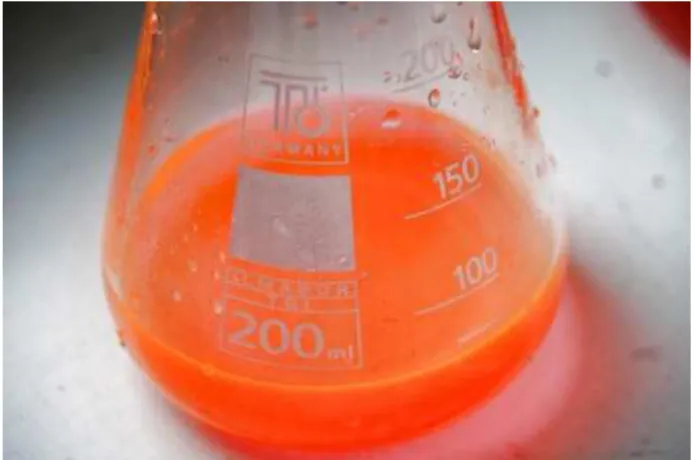
All prepared ion-pairs were soluble in poly(ethylene glycol), PEG 600. Solutions (1%) proved to be stable, demonstrated a very good lubrication ability and represented colorful materials, being orange (1-3), yellow (4-6), or pink (7-9).
Table 1. Prepared ion pairs
Salts Anion Cation Quaternary
ammonium cation
Yield (%) Color solution
R1 R2 R3 Acetone Chloroform
1a Br CH
2C6H5 C8H17-C18H37 BA 99 Bright orange Red
2a Br CH
2(CH2)8CH3 CH2(CH2)8CH3 DDA 95 Bright orange Red
3a Br CH
3 CH2(CH2)14CH3 CTA 96 Bright orange Red
4b H CH
2C6H5 C8H17-C18H37 BA 95 Yellow green Orange
5b H CH
2(CH2)8CH3 CH2(CH2)8CH3 DDA 93 Yellow green Orange
6b H CH
3 CH2(CH2)14CH3 CTA 85 Yellow green Orange
7c I CH
2C6H5 C8H17-C18H37 BA 91 Bright pink Pink
8c I CH
2(CH2)8CH3 CH2(CH2)8CH3 DDA 90 Bright pink Pink
9c I CH
3 CH2(CH2)14CH3 CTA 96 Bright pink Pink
aRed tar with green tinge. bOrange wax with green tinge. cPink tar green tinge
O O COO− −O R1 R1 R1 R1 N+ R2 R3 N+ R2 R3
Scheme 1. Structure of the ion pairs form 1:2 (1-9).
N+
N+ N+
( )n ( )n
( )n
( )n
BA (n = 7 - 17) DDA (n = 9) CTA (n = 15)
Biological evaluation
The biological activity of the prepared bis-quaternary ammonium ILs was estimated and the minimum inhibitory concentration (MIC) and minimum bactericidal or fungicidal concentration (MBC) were established by the tube dilution method. MIC and MBC values for 12 strains (rods, cocci, bacilli and fungi) of the prepared ion-pairs and the commercially available BA chloride are compared in Table 3. The results demonstrated that the synthesized ILs were very effective agents against bacteria and fungi. The activity depended upon the kind of cation and anion. The salt 5, which contains DDA cation, was particularly strongly active against all of the microorganisms and exhibited in this respect a higher efficiency than BA chloride. This salt manifested microstatic activity, i.e. MIC values, and microbiocidal activity, measured by MBC values at the same level. Selection of an appropriate ion-pair as an
Table 2. Thermal properties of the prepared bis-quarternary ammonium ILs
IL Tga T
c
b T
m
c T
onset(5%)
d T
onset e
1 184 289
2 18 76 212 309
3 47 220 313
4 −41 120 232
5 −58 −9 62 154 263
6 96 224 265
7 193 310
8 66 217 310
9 58 76 215 313
aGlass transition temperature determined by DSC on heating;
bCrystallization temperature determined by DSC on heating; cMelting
point determined by DSC on heating; dDecomposition temperature
determined from onset to 5% mass loss; eDecomposition temperature
determined from onset to 50% mass loss.
Table 3. MICa and MBCa values of the ILs studied
Strains Salts
1 2 3 4 5 6 7 8 9 BAf
M. luteus b MIC 0.2 0.5 1 0.2 < 0.1 < 0.1 0.2 0.5 0.5 0.5
MBC 0.2 2 8 1 < 0.1 0.5 0.2 0.5 1 4
S. aureus b MIC 2 2 2 1 0.5 1 2 2 1 2
MBC 31 16 4 4 1 2 8 4 2 8
S. epidermidis b MIC 2 1 0.5 0.2 < 0.1 < 0.1 < 0.1 0.5 0.2 0.5
MBC 4 2 4 2 0.2 0.5 < 0.1 2 1 2
E. feacium b MIC 2 2 1 2 0.5 0.5 2 4 2 2
MBC 8 16 4 4 0.5 8 8 4 4 8
M. catarrhalis b MIC 0.5 0.2 1 1 0.2 0.2 1 0.2 0.2 0.2
MBC 250 4 4 1 1 0.2 4 0.5 2 0.5
E. coli c MIC 0.5 4 2 2 0.2 0.5 0.2 2 4 2
MBC 1 4 8 2 0.5 2 1 4 4 2
S. marcescens c MIC 250 > 500 > 500 31 16 62 500 > 500 > 500 62
MBC 250 > 500 > 500 31 31 62 500 > 500 > 500 62
P. vulgaris c MIC 250 31 > 500 31 16 62 500 > 500 > 500 31
MBC 250 250 > 500 62 16 62 500 > 500 > 500 31
P. aeruginosa c MIC > 500 > 500 > 500 62 31 > 500 > 500 > 500 > 500 62 MBC > 500 > 500 > 500 125 31 > 500 > 500 > 500 > 500 62
B. subtilis d MIC 2 2 2 2 0.2 1 2 2 4 2
MBC 2 2 2 2 0.2 1 2 2 4 2
C. albicans e MIC 4 16 8 4 2 8 8 62 > 500 4
MBC 4 31 8 4 4 16 125 125 > 500 31
Rhodothorula Rubrae MIC 4 8 4 4 2 8 16 62 > 500 8
MBC 8 16 8 8 2 16 62 250 > 500 31
Long Alkyl Chain bis-Quaternary Ammonium-based Ionic Liquids as Biologically Active Xanthenes Dyes J. Braz. Chem. Soc.
842
effective biocidal agent must be preceded by determination of its antimicrobial activity. Results presented in Table 3 showed that despite the generally high activity of 1-9
ILs against microbes, there existed dyes, such as Serratia marcescens, Proteus vulgaris and Pseudomonas aeruginosa
in particular, which were insensitive to 1, 3, 7, 8 and 9.
Spectral, absorption and emission properties
The absorption spectra, fluorescence spectra and fluorescence excitation spectra of 2, 3, 5, and 6 in 1-C3H7Cl or DMSO have been measured. For the compounds in concentrations > 10-6 mol L-1 the spectra revealed considerable changes. With decreasing concentration the maxima of the long-wavelength band in the absorption spectra, fluorescence excitation spectra, and fluorescence spectra were shifted towards longer wavelengths and their shapes changed. In view of the above, the study was performed for IL in low concentrations, ≤ 10-6 mol L-1 in order to avoid dimer and oligomer formation.19,22 The exemplary absorption spectra, fluorescence excitation spectra, and fluorescence spectra, recorded for 3 in 1-C3H7Cl and for 6 in DMSO are presented in Figures 1 and 2. As the fluorescence excitation spectra are the same as the absorption spectra, we can conclude that the emission comes only and exclusively from the ILs studied and not from the impurities.
Disodium salt of eosin Y or fluorescein can occur in the form of dianion or monoanion. Martin25 and Petrossyan et al.26,27 proved that these salts in DMF or in DMSO occur in the form of dianion, in whose absorption spectrum the long-wavelength band maximum is at lASmax= 520 nm. For monoanion in the same solvents lASmax= 460 nm,28 so the maximum is strongly hipsochromically shifted relative to its position in the spectrum of dianion. Therefore, measurement of the absorption spectra permits distinction of these two individuals. For 6 in DMSO (Figure 2) lASmax = 520 nm, which means that it occurs at 1:2 (dianion).
The most important spectral properties of the liquids studied are collected in Table 4. Besides the positions of the maxima in the absorption, –nASmax, fluorescence, –n
FS max,
and fluorescence excitation spectra, –nFEmax
S, the Table 4
Figure 1. Normalized absorption (solid bold line), fluorescence excitation (lem= 600 nm) and fluorescence (dotted line) (lexc= 470 nm) spectra of
3 (≤ 10-6 mol L-1) in 1-C 3H7Cl.
Figure 2. Normalized absorption (solid bold line), fluorescence excitation (lem= 600 nm) and fluorescence (dotted line), (lexc= 520 nm) spectra of
6 (ca. 10-6 mol L-1) in DMSO.
Table 4. Position of the maximum of the long-wavelength band in the absorption spectrum (–nASmax) in the fluorescence excitation spectrum (–n FE max
S) and in the fluorescence spectrum (–nFSmax); the FWHM of the bands (D–n
AS 1/2, D–n
FE 1/2
S, D –
nFS
1/2) and Stokes shifts (D–nmax(AS-FS), D–nmax (FES-FS)) for 2, 3, 5 and 6 for concentration ≤ 10-6 mol L-1
IL –nASmax –n
FE max
S
–
nFS
max D–n
AS
1/2 D–n
FE 1/2
S D
–
nFS
1/2 D–nmax (AS-FS) D–nmax (FES-FS)
2a 18450 18315 17545 1050 975 1690 905 770
3a 18380 18380 17760 920 885 1730 620 620
5a 19455 19085 18020 2580 1410 2530 1630 1065
6a - 18520 17890 - 960 1515 - 630
6b 19230 19230 18480 905 905 1280 750 750
–
n and D–n in cm-1; ain 1-C 3H7Cl;
presents full width at half-maximum values, Dn–1/2 and Stokes shifts, Dn–max, determined from the absorption and fluorescence spectra as well as for the fluorescence excitation and fluorescence spectra. As follows from the data shown in Table 4, the spectral properties of 6 in DMSO and fluorescein sodium salt in DMSO25 are very similar, indicating that the absorption and emission properties of these salts are determined by the 1:2 form. An independent confirmation of the lack of the influence of the type of cations on the spectral properties of the IL studied comes from the very similar positions of the maxima –nASmax, –n
FE max
S and –nFSmax in the spectra of 2 and 3 in 1-C
3H7Cl.
Experimental
General considerations
1H NMR spectra were recorded on a Mercury Gemini 300
spectrometer operating at 300 MHz, with tetramethylsilane as the internal standard. 13C NMR spectra were obtained with the same instrument at 75 MHz. Elemental analyses were performed at the A. Mickiewicz University, Poznan. The water content was determined by using an Aquastar volumetric Karl Fischer titrator with composite 5 solution as the titrant and anhydrous methanol as the solvent. DSC analyses were measured using a Perkin-Elmer differential scanning calorimeter. Samples were sealed in aluminium pans and scanned at the rate of 10 °C min-1 in a nitrogen atmosphere. A Mettler Toledo DA 110 M scale was used for the mass/density measurements. Samples between 2-10 mg were heated under the constant heating at 10 °C min-1 in a nitrogen atmosphere. UV-Vis spectra were recorded using Cary 300 Bio (Varian) and V-550 (Jasco) spectrophotometers. The steady-state corrected emission spectra and the corrected excitation spectra were recorded with a modified MPF-3 (Perkin-Elmer) and modified SPF (Aminco-Bowman) spectrofluorimeters with the single-photon counting detection a cooled (T < −20 °C) R-928 (Hamamatsu) PMT. Excitation spectra were corrected using a rhodamine B quantum counter and emission spectra were corrected using set of secondary emission standards.29
Synthesis
General procedure for preparation of hydrophobic ILs (1-3, 7-9)
Quaternary ammonium chloride (20 mmol) was dissolved in distilled water (30 mL) and disodium salt of eosin Y or erythrosine (10 mmol) was added. The reaction mixture was stirred at 80 oC for 0.5 h. The product was heavier than water. After cooling to room temperature
chloroform (30 mL) was added. The organic phase was washed with distilled water until chloride ions were no longer detected using AgNO3. Chloroform was removed and the obtained product was dried in vacuum.
2 ’ , 4 ’ , 5 ’ , 7 ’ - Te t r a b ro m o - 3 ’ , 6 ’ - d i h y d ro x y s p i ro [ i s o b e n z o f u r a n - 1 ( 3 H ) , 9 ’ - [ 9 H ] x a n t h e n ] - 3 - o n e bisbenzalkonium salt (1)
1H NMR(300 MHz DMSO-d
6 ) d 0.83 (t, J 6.6 Hz, 6H); 1.24 (m, 40H); 1.75 (m, 4H); 2.93 (s, 12H); 3.2 (t, J
8.3 Hz, 4H); 4.25 (s, 4H); 7.0 (s, 1H); 7.13 (d, J 6,9 Hz, 1H); 7.52 (m, 12H); 8.03 (d, J 6.9 Hz, 1H); 8.34 (s, 1H);
13C NMR(300 MHz DMSO-d
6 ) 14.0; 21.8; 25.8; 28.7; 28.8; 28.96; 29.03; 29.07; 29.08; 31.3; 49.0; 63.4; 66.1; 79.2; 99.0; 109.6; 117.8; 128.1; 128.5; 128.7; 128.9; 130.0; 130.6; 132.6; 132.9; 140.8; 152.9; 156.8; 167.0; 168.8.
2 ’ , 4 ’ , 5 ’ , 7 ’ - Te t r a b ro m o - 3 ’ , 6 ’ - d i h y d ro x y s p i ro [ i s o b e n z o f u r a n - 1 ( 3 H ) , 9 ’ - [ 9 H ] x a n t h e n ] - 3 - o n e bis(didecyldimethylammonium) salt (2)
1H NMR(300 MHz DMSO-d
6 ) d 0.84 (t, J 6.6 Hz, 12H); 1.23 (m, 56H); 1.58 (m, 8H); 2.96 (s, 12H); 3.19 (t,
J 8.2 Hz, 8H); 7.0 (m, 2H); 7.45 (m, 2H); 8.00 (d, J 1.73
Hz, 1H); 8.34 (s, 1H); 13C NMR(300 MHz DMSO-d
6 ) d 13.9; 21.7; 22.1; 25.7; 28.5; 28.7; 28.8; 28.9; 31.1; 31.3; 49.8; 62.7; 79.1; 98.8; 109.4; 117.4; 128.2; 128.4; 129.1; 129.6; 130; 132.5; 142.2; 155.7; 157.4; 167.7. Calcd for C64H102Br4N2O5: C, 59.17; H, 7.91; N, 2.16. Found: C, 58.87; H, 7.83; N, 1.81.
2 ’ , 4 ’ , 5 ’ , 7 ’ - Te t r a b ro m o - 3 ’ , 6 ’ - d i h y d ro x y s p i ro [ i s o b e n z o f u r a n - 1 ( 3 H ) , 9 ’ - [ 9 H ] x a n t h e n ] - 3 - o n e bis(hexadecyltrimethylammonium) salt (3)
1H NMR(300 MHz DMSO-d
6 ) d 0.89 (t, J 6.7 Hz, 6H); 1.29 (m, 52H); 1.69 (m, 4H); 3.1 (s, 18H); 3.28 (t, J 8.4 Hz, 4H); 7.08 (s, 1H); 7.16 (d, J 6,32 Hz, 1H); 7.55 (m, 2H); 8.09 (d, J 6.04 Hz, 1H); 8.42 (s, 1H); 13C NMR(300 MHz DMSO-d6 )d 13.9; 22.0; 22.1; 25.8; 28.5; 28.7; 28.8; 28.9; 29.0; 29.06; 31.3; 52.0; 65.2; 98.7; 109.4; 117.5; 127.7; 128.4; 129.9; 132.2; 142.1; 152.7; 157.2; 166.6; 167.8. Calcd for C58H90Br4N2O5: C, 57.34; H, 7.47; N, 2.31. Found C, 57.89; H, 7.41; N, 2.03.
3’,6’-Dihydroxy-2’,4’,5’,7’-tetraiodospiro[isobenzofuran-1(3H),9’-[9H]xanthen]-3-one bisbenzalkonium salt (7)
1H NMR(300 MHz DMSO-d
Long Alkyl Chain bis-Quaternary Ammonium-based Ionic Liquids as Biologically Active Xanthenes Dyes J. Braz. Chem. Soc.
844
128.4; 128.6; 128.8; 130.1; 132.9; 137.5; 142.6; 155.8; 157.2; 166.9; 171.1.
3’,6’-Dihydroxy-2’,4’,5’,7’-tetraiodospiro[isobenzofuran-1(3H),9’-[9H]xanthen]-3-one bis(didecyl dimethyl-ammonium) salt (8)
1H NMR(300 MHz DMSO-d
6) d 0.83 (t, J 6.6 Hz, 12H); 1.24 (m, 56H); 1.6 (m, 8H); 2.96 (s, 12H); 3.16 (t, J 8.4 Hz, 8H); 7.01 (d, J 8.5 Hz, 1H); 7.25 (s, 2H); 7.44 (m, 2H); 8.00 (d, J 9.0 Hz, 1H); 13C NMR(300 MHz DMSO-d
6) d 14.0; 21.8; 22.2; 25.8; 28.5; 28.7; 28.8; 29.0; 31.4; 50.0; 62.8; 74.9; 95.0; 111.6; 127.6; 128.2; 128.4; 130.1; 132.5; 137.4; 142.2; 155.6; 157.0; 166.7; 171.0. Calcd for C64H102I4N2O5: C, 51.69; H, 6.91; N, 1.88. Found: C, 51.88; H, 6.82; N, 2.01.
3’,6’-Dihydroxy-2’,4’,5’,7’-tetraiodospiro[isobenzofuran-1(3H),9’-[9H]xanthen]-3-one bis(hexadecyltrimethyl-ammonium) salt (9)
1H NMR(300 MHz DMSO-d
6 ) d 0.83 (t, J 6.7 Hz, 6H); 1.23 (m, 52H); 1.60 (m, 4H); 3.02 (s, 18H); 3.21 (t, J 8.5 Hz, 4H); 7.02 (d, J 8.5 Hz, 1H); 7.24 (s, 2H); 7.32 (m, 2H); 7.97 (d, J 8.8 Hz, 1H); 13C NMR (300 MHz DMSO-d
6) d 14.0; 22.0; 22.1; 25.8; 28.5; 28.7; 28.8; 29.0; 29.03; 29.07; 31.3; 52.0; 65.2; 74.9; 95.1; 111.7; 127.6; 128.3; 128.5; 130.2; 132.5; 137.5; 142.9; 155.9; 157.2; 166.7; 171.1. Calcd for C58H90I4N2O5: C, 49.65; H, 6.47; N, 2.00. Found: C, 49.56; H, 6.33; N, 2.19.
General procedure for preparation of hydrophilic ILs (4-6)
Quaternary ammonium chlorides (10 mmol) were dissolved in distilled water (30 mL) and disodium salt of fluorescein (10 mmol) was added. The solution was stirred at 60 oC for 1 h. Then, water was removed and dry acetone (15 mL) was added. NaCl was filtered and the volatile materials were removed under reduced pressure.
3’,6’-Dihydroxyspiro[isobenzofuran-1(3H),9’-[9H] xanthen]-3-one bisbenzalkonium salt (4)
1H NMR(300 MHz DMSO-d
6 ) d 0.83 (t, J 6.5 Hz, 6H); 1.24 (m, 40H); 1.74 (m, 4H); 2.90 (s, 12H); 3.25 (t, J 7.9 Hz, 4H); 4.62 (s, 4H); 6.10 (m, 4H); 6.66 (s, 2H); 7.03 (d, J 6.9 Hz, 1H); 7.49 (m, 12H); 8.0 (d, J 6.8 Hz, 1H); 13C NMR(300 MHz DMSO-d6 )d 14.0; 21.9; 22.1; 25.9; 28.6; 28.8; 28.9; 29.03; 29.1; 30.6; 31.3; 48.8; 63.3; 65.9; 102.4; 109.3; 128.1; 121.8; 127.6; 128.2; 128.1; 128.5; 129.2; 129.9; 130.0; 130.6; 132.8; 133.0; 141.6; 157.1; 168.3; 178.7.
3’,6’-Dihydroxyspiro[isobenzofuran-1(3H),9’-[9H] xanthen]-3-one bis(didecyldimethylammonium) salt (5)
1H NMR(300 MHz DMSO-d
6 ) d 0.83 (t, J 6.6 Hz,
12H); 1.24 (m, 56H); 1.59 (m, 8H); 2.96 (s, 12H); 3.2 (t, J
8.1 Hz, 8H); 6.03 (m, 4H); 6.61 (s, 2H); 6.96 (d, J 5.8 Hz, 1H); 7.37 (m, 2H); 7.81 (d, J 8.8 Hz, 1H); 13C NMR(300 MHz DMSO-d6 )d 14.0; 21.7; 22.2; 25.8; 28.6; 28.8; 28.9; 29.0; 31.4; 49.9; 62.8; 102.5; 109.1; 122.4; 127.2; 128.8; 129.5; 130.3; 133.8; 142.8; 157.7; 168.1; 179.9. Calcd for C64H106N2O5: C, 78.16; H, 10.86; N, 2.85. Found: C, 77.86; H, 10.91; N, 2.57.
3’,6’-Dihydroxyspiro[isobenzofuran-1(3H),9’-[9H] xanthen]-3-one bis(hexadecyltrimethylammonium) salt (6)
1H NMR(300 MHz DMSO-d
6 ) d 0.85 (t, J 6.7 Hz, 6H); 1.24 (m, 52H); 1.66 (m, 4H); 3.03 (s, 18H); 3.23 (t, J 8.5 Hz, 4H); 6.0 (m, 2H); 6.05 (m, J 11.5 Hz, 2H); 6.57 (d, J 9.3 Hz, 2H); 7.03 (d, J 8.8 Hz, 1H); 7.42 (m, 2H); 7.92 (d, J 9.0
Hz, 1H); 13C NMR(300 MHz DMSO-d
6 ) d 14.0; 22.0; 22.1; 25.8; 28.7; 28.9; 29.05; 29.08; 31.3; 52.12; 65.3; 102.5; 109.0; 122.3; 127.8; 128.9; 129.7; 130.2; 134.4; 140.7; 157.5; 158.6; 169.5; 179. Calcd for C58H94N2O5: C, 77.46; H, 10.53; N, 3.11. Found: C, 77.43; H, 9.87; N, 3.38.
Biological evaluation
The following microorganisms were used: bacteria
Micrococcus luteus NCTC 7743, Staphylococcus aureus
NCTC 4163, Staphylococcus epidermidis ATCC 49134,
Enterococcus faecium ATCC 49474, Moraxella catarrhalis
ATCC 25238, Escherichia coli ATCC 25922, Serratia marcescens ATCC 8100, Proteus vulgaris NCTC 4635,
Pseudomonas aeruginosa NCTC 6749, and fungi Bacillus subtilis ATCC 6633, Candida albicans ATCC 10231,
Rhodothorula rubra (Demml 1889, Lodder 1934). Standard strains were supplied by the National Collection of Type Cultures (NCTC) and London and American Type Culture Collection (ATCC). Rhodothorula rubra was obtained from the Department of Pharmaceutical Bacteriology, University of Medical Sciences, Poznan.
on an agar medium with inactivates (0.3% lecithin, 3% polysorbate 80, and 0.1% cysteine L) and incubated for 48 h at 37 oC (bacteria) or for 5 days at 28-30 oC (fungi). The lowest concentration of bis-quaternary ammonium IL supporting no colony formation was defined as the MBC.
Conclusions
We obtained new, more economic, multifunctional bis-quaternary ammonium-based ionic liquids which are easy to prepare. Also, their spectral properties were studied. It was showed that the emission observed comes from their anionic part. Additionally, the potential applications of these ILs are markedly extended because of their very high anti-microbial activities. These ILs are proposed to act as biological active dyes with characteristic unique physicochemical properties, providing alternatives to some conventional anionic xanthene dyes such as eosine Y, fluorescein, and erythrosine.
T h e s e m a t e r i a l s a r e ex p e c t e d t o o p e n n ew opportunities and enable advancements in different areas, including biological imaging, fundamental photophysical and photochemical studies, and using them as photosensitizers.
Acknowledgment
This work was supported by Poznan University of Technology under grant No. DS 32-007/2008.
Supplementary Information
Supplementary information is available free of charge at http://jbcs.org.br, as PDF file.
References
1. Hough, W. L.; Smiglak, M.; Rodriguez, H.; Swatloski, R. P.; Spear, S. K.; Daly, D. T.; Pernak, J.; Grisel, J. E.; Carliss, R. D.; Soutullo, M. D.; Davis Jr, J. H.; Rogers, R. D.; New J. Chem.
2007, 31, 1429.
2. Wasserscheid, P.; Welton, T.; Ionic Liquids in Synthesis, Wiley-VCH, Weinheim, 2008.
3. Chowdhury, S.; Mohan, R. S.; Scott, J. L.; Tetrahedron2007,
63, 2363.
4. Martins, M. A. P.; Frizzo, C. P.; Moreira, D. N.; Zanatta, N.; Bonacorso, H. G.; Chem. Rev.2008, 108, 2015.
5. Dupont, J.; de Souza, R. F.; Suarez, P. A. Z.; Chem. Rev. 2002,
108, 1474.
6. Pârvulescu, V. I.; Hardacre, C.; Chem. Rev. 2007, 107, 2615. 7. Haumann, M.; Riisager, A.; Chem. Rev. 2008, 108, 1474. 8. van Rantwijk, F.; Sheldon, R. A.; Chem. Rev. 2007, 107,
2757.
9. Mehnert, C. P.; Chem-Eur. J. 2004, 11, 50.
10. Buzzeo, M. C.; Evans, R. G.; Compton, R. G.; ChemPhysChem 2004, 5, 1106.
11. Endres, F.; Abedin, S. Z. E.; Phys. Chem. Chem. Phys. 2006,
8, 2101.
12. Silvester, D. S.; Rogers, E. I.; Barrose-Antle, L. E.; Broder, T. L.; Compton, R. G.; J. Braz. Chem. Soc. 2008, 19, 611. 13. Pernak, A.; Iwanik, K.; Majewski, P.; Grzymisławski, M.;
Pernak, J.; Acta Histochem. 2005, 107, 149.
14. Earle, M. J.; Esparanca, J. M. S. S.; Gilea, M. A.; Lopes, J. N. C.; Rebelo, L. P. N.; Magee, J. W.; Seddon, K. R.; Wildegren, J. A.; Nature2006, 439, 831.
15. Smiglak, M.; Reichert, W. M.; Holbrey, J. D.; Wilkes, J. S.; Sun, L.; Thrasher, J. S.; Kirichenko, K.; Singh, S.; Katritzky, A. R.; Rogers, R. D.; Chem. Commun. 2006, 24, 2554. 16. Kralisch, D.; Stark, A.; Korsten, S.; Kreisel, G.; Ondruschka,
B.; Green Chem. 2005, 7,301.
17. Ranke, J.; Stolte, S.; Störmann, R.; Arning, J.; Jastorff, B.;
Chem. Rev. 2007, 107, 2183.
18. Bhowmik, B. B.; Ganguly P.; Spectrochim. Acta2005, 61A, 1997.
19. De, S,; Das, S.; Girigoswami, A.; Spectrochim. Acta2005, 61A, 1821.
20. Schep, L. J.; Jones, D. S.; Tucker, I.; Shepherd, M. G.; Int. J. Pharm. 1995, 113, 263.
21. Jones, D. S.; Schep, L. J.; Tucker, I.; Shepherd, M. G.; Int. J. Pharm. 1995, 126, 281.
22. Sakai, S.; Hirose, A.; Talanta2003, 59, 167.
23. Purkait, M. K.; Banerjee, S.; Mewara, S.; Dasgupta, S.; De, S.;
Water Res. 2005, 39, 3885.
24. Pei, Y. C.; Wang, J. J.; Xuan, X. P.; Fan, J.; Fan, M.; Environ. Sci. Technol. 2007, 41, 5090.
25. Martin, M. M.; Chem. Phys. Lett. 1975, 35, 105.
26. Mchedlov–Petrossyan N. O.; Kukhtik, V. I.; Bezugliy, V. D.;
J. Phys. Org. Chem. 2003, 16, 380.
27. Mchedlov-Petrossyan, N. O.; Mayorga, R. S.; J. Chem.Soc. Faraday Trans. 1992, 88, 3025.
28. Mchedlov-Petrossyan, N. O.; Mayorga, R. S.; Yu N. S.;
Zh. Obshch. Khim. 1991, 61, 225.
29. Gardecki, J. A.; Maroncelli M.; App. Spectroscopy1998, 52, 1179.
S
u
p
p
le
m
e
nta
ry
Inf
o
rm
a
ti
o
n
J. Braz. Chem. Soc., Vol. 20, No. 5, S1-S7, 2009. Printed in Brazil - ©2009 Sociedade Brasileira de Química 0103 - 5053 $6.00+0.00
*e-mail: [email protected]
Long Alkyl Chain bis-Quaternary Ammonium-based Ionic Liquids as Biologically Active
Xanthenes Dyes
Juliusz Pernak,*,a Anna Świerczyńska,a Filip Walkiewicz,a Ewa Krystkowiakb and Andrzej Maciejewskib,c
aPoznan University of Technology, Faculty of Chemical Technology, Poznan, Poland
bFaculty of Chemistry and cCentre of Ultrafast Laser Spectroscopy, A. Mickiewicz University, Poznan, Poland
Figure S1. 1H NMR spectrum (300 MHz, DMSO-d
Figure S2. 13C NMR spectrum (300 MHz, DMSO-d
Pernak et al. S3 Vol. 20, No. 5, 2009
Figure S3. 1H NMR spectrum (300 MHz, DMSO-d
Figure S4. 13C NMR spectrum (300 MHz, DMSO-d
Pernak et al. S5 Vol. 20, No. 5, 2009
Figure S5. 1H NMR spectrum (300 MHz, DMSO-d
Figure S6. 13C NMR spectrum (300 MHz, DMSO-d
Pernak et al. S7 Vol. 20, No. 5, 2009
Figure S7. 1% solution of compound 1 in chloroform. Figure S10. 1% solution of compound 1 in acetone.
Figure S8. 1% solution of compound 4 in chloroform. Figure S11. 1% solution of compound 4 in acetone.