Article
0103 - 5053 $6.00+0.00
*e-mail: [email protected]
Design, Synthesis and
In Vitro
Evaluation on Glucosamine-6P Synthase
of Aromatic Analogs of 2-Aminohexitols-6P
Danielle F. Dias,a Céline Roux,b Philippe Durand,b Bogdan Iorga,b
Marie A. Badet-Denisot,b Bernard Badetb and Ricardo J. Alves*,a
aFaculdade de Farmácia, Universidade Federal de Minas Gerais,
31970-201 Belo Horizonte-MG, Brazil
bInstitut de Chimie des Substances Naturelles-CNRS, 1 Avenue de la Terrasse,
91198 Gif-sur-Yvette, France
A glicosamina-6-fosfato sintase (GlmS) catalisa a formação de glicosamina-6-fosfato a partir de frutose-6-fosfato. Esta é a primeira etapa da via biossintética de aminoaçúcares, componentes estruturais importantes da parede celular de fungos e bactérias. Este trabalho descreve o planejamento, a síntese e a avaliação da atividade inibitória da GlmS de dois novos compostos aromáticos enantioméricos, análogos de 2-amino-2-desoxi-D-glucitol-6-fosfato (ADGP) e de seu
epímero 2-amino-2-desoxi-D-manitol-6-fosfato (ADMP), dois importantes inibidores da GlmS.
Os análogos aromáticos apresentaram atividade inibitória modesta, na faixa de mmol L-1.
The aminosugars are very important structural components of bacterial and fungi cell walls. Glucosamine-6-phosphate synthase (GlmS), which catalyses the irst step of the aminosugar biosynthetic pathway i.e. the formation of D-glucosamine-6-phosphate from D
-fructose-6-phosphate, is therefore an interesting target in the ight against microorganisms. In this work is described the synthesis of aromatic analogs of 2-amino-2-deoxy-D-glucitol-6-phosphate (ADGP) and its epimer 2-amino-2-deoxy-D-manitol-6-phosphate (ADMP), two important inhibitors of
GlmS. The aromatic analogs displayed modest inhibitory activity against GlmS, with IC50 in the mmol L-1 range.
Keywords: glucosamine synthase, inhibitors, aminohexitols derivatives
Introduction
Systemic fungi infections remain a problem in modern chemotherapy. Current therapeutic arsenal does not fulfill all medical needs. The increasing number of immunocompromised patients, due to anticancer chemotherapy, organ transplantation and AIDS, along with drug resistance, makes things more complicated.1,2
Thus the search for new antifungal agents is mandatory. Glucosamine-6-phosphate synthase (GlmS) catalyses the transformation of D-fructose-6-phosphate (Fru-6P) into D-glucosamine-6-phosphate (GlcN-6P). This is, in turn, converted into UDP-GlcNAc, the nucleotide form of N-acetylglucosamine that is the building block for the
biosynthesis of chitin.3,4 The enzyme has been validated as a
new target for the development of new antifungal agents.4,5
GlmS has two catalytic domains, namely, a glutaminase and an isomerase domains. The glutaminase domain is responsible for the hydrolysis of glutamine and generation of ammonia and glutamate. The ammonia released travels across a hydrophobic tunnel to reach the isomerase domain, where it is transferred to enzyme-bound Fru-6P.6,7
Several inhibitors of both domains have been reported.8-11 Inhibitors of the glutaminase domain are
L-glutamine mimics whereas inhibitors of the isomerase domain have been trying to mimic the putative transition state intermediates.4 Therefore
2-amino-2-deoxy-D-glucitol-6-phosphate (ADGP) and 2-amino-2-deoxy-D -manitol-6-phosphate (ADMP) are, along with D-arabinose-oxime-6-phosphate, the most potent inhibitors described thus far.9,10 Nevertheless, these compounds possess weak in vitro antifungal activity which was attributed to low
were prepared and some of them did display enhanced in vitro activity,11 reinforcing the importance of hydrophilic/
lipophilic balance for good activity.
The replacement of carbohydrate moieties of bioactive compounds by an aromatic ring has been a useful strategy for the obtention of active analogs.13 Besides increasing
the lipophilic character, the ring introduces conformational restriction, which might eventually enhances activity by selecting the bioactive conformation. The 6-phosphate and 2-amino groups of ADGP have been suggested as crucial for its enzyme inhibitory potency.11 Substitution of the
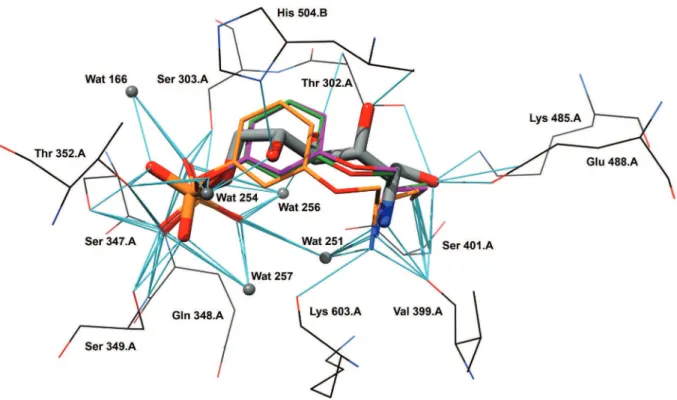
C3-C6 backbone chain by a meta phenyloxy ring linking the two groups was envisaged as one possibility for aromatic introduction. This was supported by molecular modeling (docking) which points out a similar distance between C2 and O6 atoms in the two molecules (5.3 Å for ADGP vs
5.7 Å for 2), and the good itting for some of the aromatic
molecule conformers with the crystallographic structure of ADGP in the active site of GlmS (E. coli) (Figure 1).
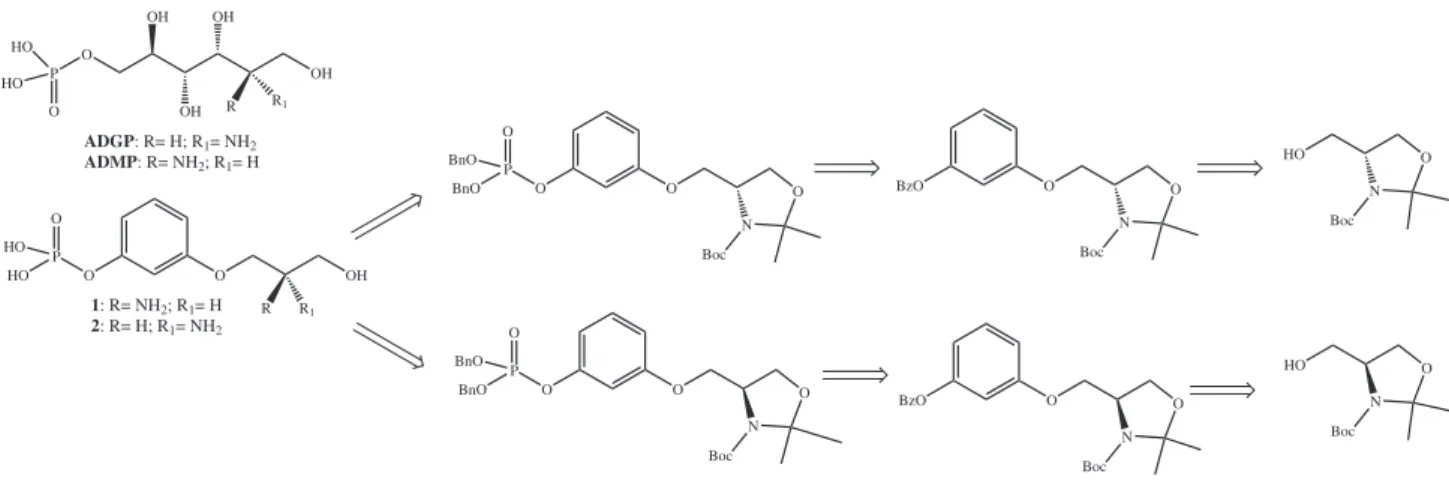
With this in mind we planned the synthesis of compounds 1 and 2, according to the retrosynthetic analysis
shown in Figure 2.
The synthesis of 1 and 2 were then carried out according
to the synthetic route shown in Figure 3.
Results and Discussion
Initially, the commercially available protected serine 3
was reacted with LiBH4 in THF/CH3OH at −10 oC to give
the alcohol 4.14 Reaction of 4 with 3-benzoyloxyphenol
under Mitsunobu conditions15 at 80 °C afforded the
corresponding ether 5. Removal of the benzoyl protecting
group was achieved upon treatment with CH3ONa in CH3OH at 0 °C to afford 6 in high yield. Phosphorylation
with dibenzylphosphite (HPO(BnO)2), in the presence of NaOH and CBr4,16 gave the aromatic phosphate 7 in 90%
yield. Hydrogenolysis of the benzyl phosphate (H2,
Pd-C, Parr hydrogenator, 40 psi) and subsequent removal of
N-Boc and dimethyl acetal groups with TFA17 followed by
preparative HPLC puriication gave the target compounds
1S or 2R, in 19% and 30% overall yield, respectively.
Inhibitory assay against GlmS from E. coli was performed
according to published procedures.18 Results are given
in Table 1.
As shown in Table 1, compounds 1 and 2 were poor
inhibitors of GlmS, displaying IC50 in the millimolar range. Although the replacement of the hydroxyl groups in ADGP and ADMP by an aromatic ring can provide higher lipophilicity to the resulting analogs, as predict by ACD
Figure 1. Comparison between crystal structure of ADGP (Stick model, colored by heteroatom) and docked conformers of 2 (orange, green and magenta)
in the active site of Glms (E.coli). Potential hydrogen bonds are represented by Blue lines. Conserved crystallographic water molecules are shown as grey
software calculations of Clog D pH 7(−6.5 for ADGP
and ADMP vs−4.6 for 1 and 2), it is deleterious for their
interaction with the enzyme active site.
Conclusions
In conclusion, we reported the design, synthesis and evaluation of two chiral aromatic analogs of the GlmS inhibitors ADGP and ADMP. Although the target compounds displayed weak inhibitory activity, they represent a new class of Glms inhibitors whose activity can be improved by further modiication. This is in progress and will be reported in due time.
Experimental
General procedures
The reactions were monitored by thin-layer chromatography (TLC) performed on silica gel 60 F254 (Merck®). Melting points were determined with a Microquímica MQAPF 301 apparatus and are uncorrected. Flash chromatography was performed on silica gel 230-600 mesh (Merck®). NMR spectrum was recorded on a Bruker AC300 or AC500 spectrometer at ambient temperature or under heating at 363K. Chemical shifts (d) were reported in ppm and standardized to the residual undeuterated solvents as the reference peaks and coupling constants (J) in Hz. The
products 1S and 2R were puriied on Atlantis® Prep dC18
OBD preparative column (19 mm × 150 mm, 5 µm) using an HPLC apparatus (Waters) equipped with a photodiode array detector. Gradient elution was employed using solvent A (10 mmol L-1 NH
4OAc), solvent B (CH3CN); gradient: 0-7 min
100% A; 7-9 min linear change to A-B (40:60); 9-30 min, isocratic elution with 60% B (column rinsing); 30-50 min 100% A (column equilibration). The low rate was kept at
HO N O Boc P O OH OH OH OH R1 R O HO HO
ADGP: R= H; R1= NH2 ADMP: R= NH2; R1= H
O OH
R R1
1: R= NH2; R1= H
2: R= H; R1= NH2
O N O Boc O P O P O O HO HO BnO BnO O N O Boc BzO O N O Boc O P O BnO BnO HO N O Boc O N O Boc BzO
Figure 2. Retrosynthetic analysis leading to compounds 1 and 2, aromatic analogs of ADGP and ADMP, respectively.
O BocN O BzO HO BocN O O BocN O O O BocN O HO O BocN O O P O BnO BnO O OH O P O HO HO NH2
3 R S
4 R (71%) S (90%)
5 R (67%) S (76%)
6 R (95%) S (85%)
7 R (89%) S (76%)
2 R (68%)
1 S (48%)
a b c
d
e
Figure 3. Synthetic route to compounds 1 and 2. Reagents and conditions (a) LiBH4, THF, CH3OH, −10 °C; (b) 3-benzoyloxyphenol, DEAD, PPh 3, toluene,
80 °C; (c) CH3ONa/ CH3OH, 0 °C; (d) CBr4, TEBA, 30% NaOH, CH2Cl2, HPO(OBn)2; (e) 1- H2, Pd-C, THF; 2- TFA, CH3OH.
Table 1. Inhibition of GlmS by ADGP and compounds 1-2
Compounds IC50 / (mmol L-1)a
ADGP 0.294 (± 0.07)
1 3.156 (± 1.0)
2 3.220 (± 1.7)
aValues are means of three experiments, standard deviation is given in
17 mL min-1 and the sample injection volume was 0.5 mL. The
alcohol 4 was synthesized following standard procedure.14,19
Synthesis of (R)-tert-butyl 4-((3-(benzoyloxy)phenoxy) methyl)-2,2-dimethyl-oxazolidine-3-carboxylate 5R
Diethyl azodicarboxylate (0.20 mL, 1.20 mmol) was added to a mixture of 3-benzoyloxyphenol (0.25 g, 1.20 mmol), alcohol 4R (0.20 g, 1.00 mmol) and PPh3
(0.31 g, 1.20 mmol) in toluene (8 mL) at room temperature under an argon atmosphere and the reaction mixture was stirred for 40 h at 80 °C. The solution was cooled to room temperature and was washed with 1 mol L-1 NaOH solution
(20 mL) and then H2O (2 × 20 mL). The organic phase was dried over MgSO4, iltered and evaporated under reduced pressure. The residue was puriied by lash chromatography on silica gel (n-hexane/EtOAc 9:1) to give the desired ether
5R (0.23 g, 67%). [α]
D20−49.0 (c 1.0, CHCl3). HRMS
(ESI+) calculated for C24H29NO6Na (M+Na), 450.1893. Found: 450.1898. 1H NMR (500 MHz, DMSO-d6, 363 K) d 1.44 (s, 9H, tBu); 1.48 and 1.54 (2s, 6H, iPr); 3.96-4.18
(m, 5H); 6.88-6.94 (m, 3H, CH-aromatics); 7.36 (t, 1H, 2J
7.75 Hz, CH-aromatic); 7.60 (t, 2H, 2J 7 Hz; mCH-benzoyl
group); 7.73 (t, 1H, 2J 7.5 Hz, pCH-benzoyl group); 8.13 (d,
2H, 2J 7.5 Hz, oCH-benzoyl group). 13C NMR (125 MHz,
DMSO-d6, 363K) δ 23.32 (CH3-iPr); 26.17 (CH3-iPr); 27.56
(CH3-tBu); 55.15 (CH); 64.47 (CH
2); 67.0 (CH2); 79.09
(C-tBu); 92.81 (C-iPr); 108.15 (C-aromatic); 112.09 (C
H-aromatic); 113.74 (CH-aromatic); 128.24 (mCH-benzoyl
group); 128.80 (C-benzoyl group); 129.10 (oCH-benzoyl
group); 129.37 (mCH-aromatic); 133.19 (pCH-benzoyl
group); 150.86 (C=O NBoc); 151.32 (C-ipso); 158.89
(C-ipso);163.83 (C=O benzoyl group).
Synthesis of (S)-tert-butyl 4-((3-(benzoyloxy)phenoxy) methyl)-2,2-dimethyl-oxazolidine-3-carboxylate 5S
The S enantiomer was prepared following the same procedure described above to prepare 5R (0.21 g, 0.9 mmol)
to give 5S (0.29 g, 76%). [α]
D20 49.2 (c 1.05, CHCl3). HRMS
(ESI+) calculated for C24H29NO6Na (M+Na), 450.1893. Found: 450.1892.1H NMR and 13C NMR spectra, as for 5R.
Synthesis of (R)-tert-butyl 4-((3-hydroxyphenoxy)methyl)-2,2-dimethyloxazolidine-3-carboxylate 6R
To a solution of 5R (0.19 g, 0.44 mmol) in dry CH3OH
(3 mL), was added CH3ONa (24 mg, 0.44 mmol) at 0 °C. After 30 min. the solvent was removed under reduced pressure. The residue was puriied by lash chromatography on silica gel (n-hexane/ AcOEt 8:2) to give pure 6R as a
white solid, (0.14 g; 95%). mp 110.6-111.6 °C. [α]
D20−34.5
(c 1.0, CHCl3). HRMS (ESI+) calculated for C17H25NO5Na
(M+Na), 346.1631. Found: 346.1634. 1H NMR (500 MHz,
DMSO-d6, 363K) d 1.45 (s, 9H, CH3-tBu); 1.47 (s, 3H,
CH3-iPr); 1.53 (s, 3H, CH
3-iPr); 3.87 (t, 1H, 2J 9.4Hz, CH2);
3.93 (d, 1H, 2J 8.5Hz, CH
2); 4.00 – 4.02 (m, 1H, CH2); 4.05
(t, 1H, 2J 9.4Hz, CH
2);4.13 (br, s, 1H, CH); 6.38 – 6.42 (m,
3H, CH-aromatics); 7.04 (t, 1H, 2J 8 Hz, mCH-aromatic);
8.98 (br, s, 1H, OH). 13C NMR (125 MHz, DMSO-d6,
363 K) d 23.37 (CH3-iPr);26.17 (CH3-iPr);27.59 (CH3-tBu);
55.30 (CH); 64.51 (CH2);66.52 (CH2); 79.02 (C-tBu);92.76
(C-iPr); 102.08 (CH-aromatic); 105.04 (CH-aromatic);
108.04 (CH-aromatic); 129.16 (CH-aromatic); 150.86
(C=O NBoc); 158.16 (C-ipso phenolic); 159.22 (C-ipso).
Synthesis of (S)-tert-butyl 4-((3-hydroxyphenoxy)methyl)-2,2-dimethyloxazolidine-3-carboxylate 6S
The S enantiomer was prepared following the same procedure described above to prepare 6R (0.18 g,
0.42 mmol) to give pure phenol 6S (0.12 g, 85%). mp
110.7-111.6 °C. [α]
D20 36.0 (c 1.02, CHCl3). HRMS (ESI+)
calculated for C17H25NO5Na (M+Na), 346.1631. Found: 346.1636. 1H NMR and 13C NMR spectra, as for 6R.
Synthesis of (R)-tert-butyl 4-((3-(bis(benzyloxy) phosphoryloxy)phenoxy)methyl)-2,2-dimethyloxazolidine-3-carboxylate 7R
A solution of dibenzylphosphite (0.12 g, 0.46 mmol) and phenol 6R (0.10 g, 0.31 mmol) in CH2Cl2 (2 mL) was
added to an ice-cold two-phase system consisting of CBr4 (0.053 g, 0.16 mmol), 30% (m/v) aqueous NaOH (100 µL), H20 (1 mL) and CH2Cl2 (1 mL). The system was stirring for 30 min at room temperature. CH2Cl2 (10 mL) was added and the organic layer was separated, washed with H2O (3 × 5 mL), dried over MgSO4 and iltrated. Concentration followed by lash chromatography on silica gel of the crude material afforded the product 7R (0.17 g, 89% yield) as
colorless oil. [α]
D20−37.0 (c 1.03, CHCl3). HRMS (ESI+)
calculated for C31H38NO8PNa (M+Na), 606.2233. Found: 606.2230. 1H NMR (500 MHz, DMSO-d6, 363 K) d 1.44
(br, s, 9H, CH3-tBu);1.47 (s, 3H, CH
3-iPr); 1.53 (s, 3H,
CH3-iPr); 3.90-4.14 (m, 5H); 5.15-5.17 (m, 4H, CH2-benzyl
group);6.77-6.64 (m, 3H, CH-aromatics); 7.26 (t, 1H, 2J
8.5 Hz; CH-aromatic); 7.36 (br, s, 10H, CH-benzyl group). 13C NMR (75 MHz, CDCl
3) d 23.30; 24.50; 27.00; 27.80
(CH3-iPr); 28.60; 28.70 (CH3-tBu); 56.00; 56.20 (CH);65.40;
65.6 (CH2); 66.50; 67.10 (CH2); 70.10;70.20 (CH2-benzyl
group);80.50;80.80 (C-tBu); 93.80; 94.30 (C-iPr); 107.20;
107.30 (CH-aromatic); 111.40; 111.7 (CH-aromatic); 112.7;
112.80 (CH-aromatic); 128.20; 128.80 (CH-aromatic benzyl
group); 130.30 (CH-aromatic); 135.60; 135.70 (C-ipso
benzyl group); 151.60; 151.90 (C-aromatic and C=O NBoc),
159.70 (C-ipso). 31P NMR (121.5 MHz, CDCl
3, external 85%
Synthesis of (S)-tert-butyl 4-((3-(bis(benzyloxy) phosphoryloxy)phenoxy)methyl)-2,2-dimethyloxazolidine-3-carboxylate 7S
The S enantiomer was prepared following the same procedure described above to prepare 7R (0.12 g, 0.37 mmol) to give 7S (0.15g, 76% yield). [α]
D20
37.4 (c 1.01, CHCl3). HRMS (ESI+) calculated for
C31H38NO8PNa (M+Na), 606.2233. Found: 606.2228.
1H NMR and 13C NMR spectra, as for 7R.
Synthesis of 3-(2-(S)-amino-3-hydroxypropoxy)phenyl dihydrogenphosphate 1
A solution of dibenzylphosphate 7R (0.16 g, 0.27 mmol)
in THF (2 mL) was hydrogenolyzed under hydrogen pressure (40 psi) in presence of 10% activated Pd-C (40 mg) at room temperature for 1h. The reaction mixture was iltered and the THF evaporated under vacuum. TFA (1 mL) was then added to a solution of the residue in CH3OH (2 mL). The reaction mixture was stirred at room temperature for 3h. TFA was eliminated by co-distillation with CH2Cl2 and CH3OH. The product 1Swas puriied by preparative RP-HPLC and obtained as an amorphous white solid (35 mg, 48% yield). mp 168.0-168.7 °C. [α]
D20 7.2 (c 0.5, H2O). HRMS (ESI+)
calculated for C9H14NO6PNa (M+Na), 286.0456. Found: 286.0455. 1H NMR (500 MHz, D
2O)d 3.79-3.84 (m, 1H,
CH); 3.92 (dd, 1H, J
gem 12.3 Hz,
2J 6.6 Hz, CH
2); 3.99 (dd,
1H, Jgem 12.2 Hz, 2J 4.7 Hz, CH2);4.26 (dd, 1H, Jgem 10.5 HZ, 2J 6.6 Hz, CH
2); 4.36 (dd, 1H, Jgem 10.5 Hz,
2J 3.8 Hz, CH 2);
6.77 (dd, 1H, 2J 8.2 Hz, 3J 2.2 Hz, CH-aromatic);6.89 (d,
1H, 2J 8.3 Hz, CH-aromatic);6.95 (s, 1H, CH-aromatic);
7.32 (t, 1H, 2J 8.1 Hz, CH-aromatic). 13C NMR (125 MHz,
D2O) d 52.18 (CH); 58.74 (CH2); 65.01 (CH2); 107.15
(d, 3J 4.6 Hz, CH-aromatic); 108.81 (CH-aromatic);
113.96 (d, 3J 4.6 Hz, CH-aromatic); 129.96 (CH-aromatic);
154.87 (d, 2J 6.4 Hz, C-ipso);158.31 (C-ipso). 31P NMR
(202.5 MHz, D2O, external 85% H3PO4)d−0.273.
Synthesis of 3-(2-(R)-amino-3-hydroxypropoxy)phenyl dihydrogenphosphate 2
The R enantiomer was prepared following the same procedure using 7S (0.13g, 0.22 mmol) to give the desired
phosphate 2R (39 mg; 68% yield). mp 163.9-165.0 °C.
[α]
D20 −7.5 (c 0.5, H2O). HRMS (ESI+) calculated for
C9H14NO6PNa (M+Na), 286.0456. Found: 286.0451.
1H NMR and 13C NMR spectra, as for 1.
Determination of enzyme activity
GlmS was puriied to homogeneity using a protocol adapted from the procedure irst reported by Badet and co-workers.20 GlmS activity was spectrophotometrically
assayed using the modified microplate Morgan-Elson method.18 The assay mixture contained, in a inal volume
of 100 µL for each well of the microplate, 100 mmol L-1
phosphate buffer, pH 7.2, 50 mmol L-1 KCl, 1 mmol L-1
EDTA, 0.4 mmol L-1 D-Fru-6P (a concentration close to
the Km value was chosen), and 4 mmol L-1 Gln (saturating
concentration). Inhibitors were used at the following concentrations: ADGP at 0-0.5 mmol L-1, 1 or 2 at
0-7 mmol L-1. Following preincubation at 37 °C for 10 min,
the enzymatic reaction was initiated by the addition of 0.06 unit of GlmS. Precisely 30 min later (initial rate conditions), the reaction was stopped by the addition of 10 µL of a 1.5% (v/v) acetic anhydride solution in acetone (prepared daily) followed by 50 µL of a 0.2 mol L-1 borate solution.
After being heated to 80 °C for 30 min, the microplate (containing the various reaction mixtures) was centrifuged before addition of 130 µL of Ehrlich reagent (10% (m/v) solution of p-dimethyl-aminobenzaldehyde in acetic acid/
concentrated HCl mixture (87/13; v/v) to each well. Then, the amount of GlcN-6P formed was measured from the absorbance of the Ehrlich adduct at 585 nm (ε value was
determined daily from a GlcN-6P standard solution). The initial rate of formation of Glc-N6P as a function of the inhibitor concentration allowed the determination of the IC50 value (inhibition that gives an initial rate equal to 50% of the rate in the absence of inhibitor).
Molecular modeling
The tridimensional structures of compounds 1 and 2
were constructed using Corina v3.44. Docking studies were performed on the dimer structure of GlmS (PDB code 2J6H)21 with Gold 4.0,22 using the default parameters and
the GoldScore scoring function. A number of ive water molecules (W166, W251, W254, W256, W257), which are conserved in all GlmS structures, were considered in the docking procedure. Ligand 2-deoxy-2-amino-D -glucitol-6-phosphate (ADGP) from the structure 1MOS 23 was used
as reference in the docking analysis. Raytraced image was produced with UCSF Chimera24 and POV-Ray.25
Acknowledgments
References
1. Ascioglu, S.; Rex, J. H.; Pauw, B.; Bennett, J. E.; Bille, J.; Crokaert, F.; Denning, D. W.; Donnelly, J. P.; Edwards, J. E.; Erjavec, Z.; Fiere, D.; Lortholary, O.; Maertens, J.; Meis, J. F.; Patterson, T. F.; Ritter, J.; Selleslag, D.; Shah, P. M.; Stevens, D. A.; Walsh, T. J.; Clinical Infectious Diseases 2002, 34, 7. 2. Barnes, R. A.; J. Antimicrob. Chemother. 2008, 61, i3.
3. Durand, P; Golinelli-Pimpaneau, B.; Mouilleron, S.; Badet, B.; Badet-Denisot, M.-A.; Arch. Biochem. Biophys. 2008, 474, 302.
4. Milewski, S.; Biochim. Biophys. Acta2002, 1597, 173. 5. Borowski, E.; Il Farmaco2000, 55, 206.
6. Mouilleron, S.; Badet-Denisot, M.-A.; Golinelli-Pimpaneau, B.; J. Biol. Chem.2006, 281, 4404.
7. Floquet, N.; Mouilleron, S.; Daher, R.; Maigret, B.; Badet, B.; Badet-Denisot, M.-A.; FEBS Lett.2007, 581, 2981.
8. Le Camus, C.; Chassagne, A.; Badet-Denisot, M.-A.; Badet, B.; Tetrahedron Lett.1998, 39, 287; Le Camus, C.;
Badet-Denisot, M.-A.; Badet, B.; Tetrahedron Lett.1998, 39, 2571; Chittur, S. V.; Grifith, R. K.; Bioorg. Med. Chem. Lett.2002,
12, 2639; Zgódka, D.; Jedrzejczak, R.; Milewski, S.; Borowski, E.; Bioorg. Med. Chem.2001, 9, 931.
9. Badet-Denisot, M.-A.; Leriche, C.; Masserie, F.; Badet, B.;
Bioorg. Med. Chem Lett. 1995, 5, 815.
10. Milewski, S.; Janiak, A. M.; Wojciechowski, M.; Arch. Biochem. Biophys.2006, 450, 39.
11. Janiak, A. M.; Hoffmann, M.; Milewska, M. J.; Milewski, S.;
Bioorg. Med. Chem.2003, 11, 1653; Melcer, A. Lacka, I.;
Gabriel, I.; Wojciechowski, M.; Liberek, B.; Wisniewski, A.; Milewski , S.; Bioorg. Med. Chem. Lett.2007, 17, 6602.
12. Janiak, A. M.; Cybulska, B.; Szlinder-Richert, J.; Borowski, E.; Milewski, S.; Acta Biochim. Pol. 2002, 49, 77.
13. Raiber, E-A.; Wilkinson, J.A.; Manetti, F.; Bota, M.; Deakin, J.; Gallagher, J.; Lyon, M.; Ducki, S.W.; Bioorg. Med. Chem. Lett. 2007, 17, 6321. Finley, J.B.; Atigadda, V.R.; Duarte, F.; Zhao, J.J.; Brouillette, W.J.; Air, G.M.; Luo, M.; J. Mol. Biol.
1999, 293, 1107.
14. Meffre, P.; Durand, P.; Branquet, E.; Le Gofic, F.; Synth. Commun. 1994, 24, 2147; Garner, P.; Park, J. M.; J. Org. Chem.
1987, 52, 2361.
15. Pavé, G.; Usse-Versluyus, S.; Viaud-Massuard, M. C.; Guillaumet, G.; Org. Lett.2003, 5, 4253.
16. Zwierzak, A.; Synthesis1975, 507.
17. Kobayashi, H.; Ohashi, J.; Fujita, T.; Iwashita, T.; Nakao, Y.; Matsunaga, S.; Nobuhiro, F.; J. Org. Chem.2007, 72, 1218; Meffre, P.; Gauzy, L.; Durand, P.; Branquet, E.; Le Gofic, F.;
Tetrahedron1996, 52, 11215.
18. Ghosh, S.; Roseman, S.; Methods Enzymol.1962, 5, 414;
Burghardt, C. K.; Kochan, J. P.; Eur. Pat. Appl.EP1431396,
2004.
19. Dondoni, A.; Perrone, D.; Synthesis1997, 527;Williams, L.; Zhang, Z.; Shao, F.; Carroll, P. J.; Joullié, M. M.; Tetrahedron
1996, 52, 11673.
20. Badet, B.; Vermoote, P.; Haumont, P. V.; Lederer, F.; Le Gofic, F.; Biochemistry1987, 26, 1940.
21. Mouilleron, S.; Badet-Denisot, M.-A.; Golinelli-Pimpaneau, B.; J. Biol. Chem.2006, 281, 4404.
22. Verdonk, M. L.; Cole, J. C.; Hartshorn, M. J.; Murray, C. W.; Taylor, R. D.; Proteins2003, 52, 609.
23. Teplyakov, A.; Obmolova, G.; Badet-Denisot, M.-A.; BAdet, B.; Protein Sci.1999, 8, 596.
24. Pettersen, E. F.; Goddard, T. D.; Huang,C. C.; Couch,G. S.; Greenblatt, D. M.; Meng, E. C.; Ferrin, T. E.; J. Comput. Chem.
2004, 25, 1605.
25. http://www.povray.org, accessed in January 2009.
Received: July 1, 2009