Quim. Nova, Vol. 38, No. 6, 848-851, 2015
Nota Técnica
http://dx.doi.org/10.5935/0100-4042.20150051
*e-mail: [email protected]
PESTICIDE RESIDUES IN CONVENTIONALLY AND ORGANICALLY GROWN TOMATOES IN ESPÍRITO SANTO (BRAZIL)
Gleissy M. A. D. A. dos Santosa, Luciano J. Q. Teixeirab, Olavo S. Pereira Júniorc, Alexandre R. dos Santosd, Marcio Fronzaa,
Ary G. Da Silvaa e Rodrigo Scherera,*
aDepartamento de Produtos Naturais, Universidade de Vila Velha, Vila Velha – ES, Brasil
bDepartamento de Engenharia de Alimentos, Universidade Federal do Espírito Santo, Alegre – ES, Brasil cDepartamento de Farmácia e Bioquímica, Universidade Federal de Juiz de Fora, Juiz de Fora – MG, Brasil dDepartamento de Engenharia Rural, Universidade Federal do Espírito Santo, Alegre – ES, Brasil
Recebido em 21/11/2014; aceito em 27/02/2015; publicado na web em 01/04/2015
The aim of this study was to investigate the presence of acephate, carbaryl, carbendazim, chlorpyrifos, dichlorvos, fenpropathrin, methamidophos and permethrin in conventionally and organically grown tomatoes from Espírito Santo, Brazil, between May 2012 and April 2013. QuEChERS sample preparation was used and analysis was performed by LC-MS/MS and GC-MS. The method validation showed good linearity (R > 0.99), precision (RSD < 13%) and accuracy (89 – 123%), and the limits of quantification were below 0.01 mg kg-1 for all pesticides. The pesticides acephate, carbaryl (0.23 mg kg-1; exceeding maximum residue levels), carbendazim, chlorpyriphos, dichlorvos, fenpropathrin (0.41 mg kg-1; exceeding maximum residue levels), methamidophos and permethrin (0.51 mg kg-1, exceeding maximum residue levels) were found in conventional tomatoes. In organic tomatoes, only one sample exhibited the presence of permethrin (0.21 mg kg-1). Considering that the pesticides found are toxic and carcinogenic, and given the high incidence of irregularities, it is important to implement government actions to ensure consumer safety.
Keywords:organophosphate; food contamination; pesticide residue; pyrethroid; QuEChERS.
INTRODUCTION
Tomatoes (Solanum lycopersicum L.) belong to the Solanaceae family and are one of the most widely cultivated crops in the world. As it is a relatively short duration crop and gives a high yield, it is economically attractive and the area under cultivation is increasing daily. In Brazil it become one of the most consumed vegetables.1 In 2013 the production of tomatoes was 38,000 million tones, being the Southeast region and the Espírito Santo state responsible for 36.3% and 2.9% of the total national production, respectively.1
The tomatoes are appreciated for this flavor and its high nutri-tional value, thus contribute to a healthy and well balanced diet, being rich in minerals, vitamins, essential amino acids, carotenoids, among others compounds.2 Tomato crops are vulnerable and often attacked by various pests and diseases caused by bacteria, virus and fungi.3 Therefore, large amounts of pesticides are frequently applied in crops, which when used excessively or inappropriately leads to the contamination with residues that affects the health of consumers. On the other hand, organic agriculture produces products using methods that preserve the environment and avoid most synthetic materials, such as pesticides and antibiotics. These products have been well accepted by consumers because of the absence of pesticides.
Many countries have established maximum residue levels (MRLs) in water, ground and food for a large number of pesticides. In Brazil, the MRLs are established by the Brazilian Health Surveillance Agency (ANVISA).4 The Brazilian government concern about the use of pesti-cides resulting in monitoring programs such as Program for Pesticide Residues Analysis in Food coordinated by the ANVISA,5 and the National Residue and Contaminant Control Program (PNCRC), coordinated by the Ministry of agriculture (MAPA).6 The objetive of both programs is to assess the levels of pesticides residues in fresh vegetables consumed by the population. A study published by PNCRC
with tomatoes collected from 2001 to 2010 revealed that 13.7% of samples showed some irregularities and the triazophos pesticide was found greater than 2000 times the MRL.7 Thus, the objective of this study was to investigate the residual levels of eight pesticides in fresh conventional and organic tomatoes commercially grown in Espírito Santo state (Brazil) using gas chromotography and liquid chromatography coupled with mass spectrometry detector.
EXPERIMENTAL
Materials
The materials used were: acetonitrile HPLC grade (J.T. Baker, USA); sodium citrate sesquihydrate (Sigma-Aldrich, USA); sodium citrate anhydrous (Vetec, Brazil); sodium chloride (Vetec, Brazil); magnesium sulfate (Sigma-Aldrich, USA); primary-secondary amine - PSA (Macherey-Nagel Chromabond, Germany); graphitized carbon black (Supelco, USA); methanol HPLC grade (J. T. Baker, USA). The pesticides (Figure 1) standards of acepahte, carbaryl, carbendazim, chlorpyriphos, diclorvos, fenpropathrin, methamidophos and per-methrin were purchased from Chemservice (USA) with a minimum of 99% of purity. All standard solutions were prepared daily. These pesticides were chosen by previous contact with some farmers, as well as it has been reported as the main contaminants in the last years in Brazilian tomatoes crops.5
Samples
Pesticide residues in conventionally and organically grown tomatoes in Espírito Santo (Brazil) 849
Vol. 38, No. 6
All samples were collected in polyethylene bags, and immediately sent to the laboratory for processing and analyses.8
Sample preparation
All samples were divided in two parts. One half of each fruit was stored (-20 ºC) as a control and the other half was homogenized into a food processor. After homogenization, the pesticides were extracted using the QuEChERS method.9
Gas chromatography–mass spectrometry (GC/MS)
The pesticides Fenpropathrin and Permethrin were analyzed by GC/MS in an Varian 3900 gas chromatograph coupled with a mass spectrometer Saturno 2100T (VARIAN, Netherlands) and an autos-ampler Combi PAL (CTC Combi PAL, Switzerland). A fused silica HP-5 MS capillary column (5% phenyl/95% dimethylpolysiloxane) 30 m × 0.25 mm i.d. × 0.25 µm film thickness from J&W Scientific (USA) was use. The chromatographic conditions were as follows: injector in splitless mode at 250 °C; injected volume, 2.0 uL; carrier gas helium at 1.0 mL min−1; oven, 75 °C, increased to 150 °C at 25 °C min−1, then to 280 °C at 10 °C min-1, and held for 10 min. MS interface at 250 °C; electron ionization source at 250 °C, +70 eV. Single ion monitoring (SIM), 181 for Fenpropathrin and 183 for Permethrin.9 Liquid chromatography–mass spectrometry (LC-MS/MS)
The pesticides acephate, carbaryl, carbendazim, chlorpyriphos, diclorvos, and methamidophos were analyzed by LC-MS/MS in an A ACQUITY® TQD LC-MS/MS system (Waters, USA). All separa-tions were carried out on a Waters BEH C18 column (100 mm × 2.1 mm i.d., 1.7 µm) at 35 ºC. The mobile phase comprised (A) aqueous formic acid (0.1%, v/v) and (B) methanolic formic acid 0.1%. The flow rate was 0.4 mL min-1 by gradient elution of 30–90% of B at 0–3 min, staying at this level to 5 min, and the re-equilibration time was 2 min (10 minutes). The tandem mass spectrometer was operated in a positive electrospray ionization in positive mode (ESI+). For increased sensitivity and selectivity, data acquisition was performed in selected reaction monitoring (SRM) mode.
Method validation
The GC-MS and LC-MS/MS methods were inspected to ensu-re compliance with INMETRO ensu-requiensu-rements.10 The linearity was evaluated by the linear regression. To determine the linear response range, the statistical method of least squares was used. The results were considered within the approved range points to present a residue value less than 15%. Selectivity was evaluated by matrix effect by comparing the results of 7 assays of each pesticide in solvent or in tomatoes extract by One-way ANOVA test. The precision was evalua-ted in three standard levels for each pesticide (low, medium and high) by repeatability and intermediate precision. In repeatability assays, 7 consecutive determinations were performed, and for intermediate precision, 21 determinations were performed in three different we-eks. The accuracy was investigated by the recovery rate by adding three standard levels (same at precision) in triplicate. The limits of detection and quantification were calculated by the signal-to-noise ratio, considered as the detection limit concentration of the analyte, which produces a signal three times the average signal-to-noise ratio and 6 times greater for the quantification limit. The practical limit of quantification (PLQ) was defined as the lower limit of the linear response range.
Statistical analysis
Data were analyzed by analysis of variance (ANOVA) followed by Tukey’s post-hoc test and the significance was accepted when p<0.05. All analyses were conducted by StatisticaTM 6.0 (Statsoft, Inc.). RESULTS AND DISCUSSION
The results of the validation parameters are in Table 1. Matrix effect is known to occur frequently and may affect the analytic signal by suppression; therefore, it should be assessed at the initial method validation stage before quantification analysis. In the present study no significant differences (p>0.05) in solvent or matrix quantifica-tion were found. Once no matrix effect was observed, quantificaquantifica-tion was accomplished using external standard curve (5 points) prepared daily by plotting the analyte concentrations against peak areas. All
dos Santos et al.
850 Quim. Nova
pesticides showed good linearity with correlation coefficients (R) higher than 0.995; besides the residuals found in both samples re-mained below 16.7% for the PLQ and below 11.2% for the remaining points, which is under the limits established analytcal methods (lower than 15% for regular points and lower than 20% for the lowermost concentration).11 The accuracy of the method assessed by spiking tomatoes samples with working solutions at three different fortified levels of each pesticide exhibited recoveries rates ranged from 89% to 123% (Table 1). The precision assessed by the repeatability (intra-day) and intermediate precision (inter-day) exhibited relative standard deviations (RSD%) ranged from 2.1% to 12.7%, being considered satisfactory, considering all assays (Table 1). The practical limits of quantifications (PLQ) found were considered satisfactory for this applications, since the PLQ were below the MRL for all pesticides evaluated, and for the unauthorized pesticides, the Brazilian gover-nment required a PLQ at least 0.01 mg kg-1.5
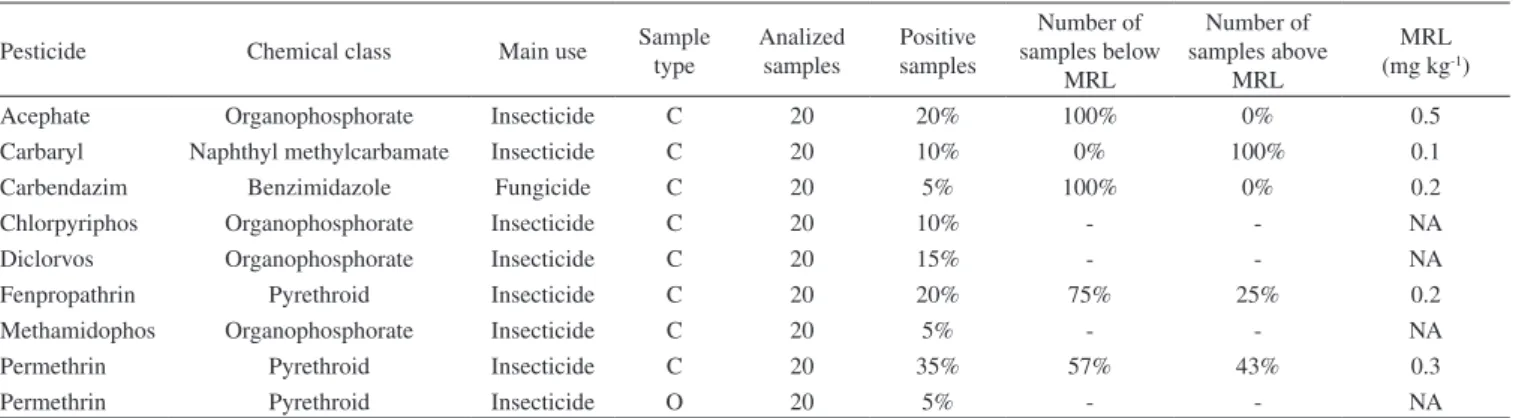
The analysis are shown in Table 2. Organophosphates insecticides followed by pyrethroids insecticides were found as the main contami-nant present in the samples analyzed. Of the 20 conventionally grown tomatoes samples analyzed the acephate was found in four samples, all below the maximum residue limit (MRL). Chlorpyriphos was detected in two samples at concentrations of 0.1 and 0.08 mg kg-1; diclorvos was present in three samples at concentrations of 0.1, 0.05 and 0.18 mg kg-1, and methamidophos was quantified in one sample at concentration of 0.12 mg kg-1.
Previous study showed similar contamination percentages to those reported here. In Santa Catarina State, South Brazil, a total of 32 tomatoes were evaluated, since 17 (53.1%) tomato samples presented at least one pesticide, and 35.3% of irregular samples (presence of non-authorized active ingredient or residue levels higher than the Brazilian MRL).12
Organophosphate insecticides have been used widely in agri-culture and in household applications as pesticides due to their high insecticidal activity and relatively low persistence. Their mechanism of action is the irreversible inhibition of acetyl cholinesterase (AchE), a key enzyme in the recycling of the neurotransmitter acetylcholine (Ach).13 The organophosphate methamidophos exhibit toxicological classification I (highly hazardous), whereas chlorpyrifos and dichlor-vos display toxicological classification II (moderately hazardous). Chlorpyrifos and dichlorvos are broad-spectrum insecticide which kills insects upon contact by affecting the normal function of the nervous system. All these three organophosphates affect the nervous system by inhibiting the breakdown of acetylcholine (ACh), a neu-rotransmitter.14 Besides, acute (short-term) and chronic (long-term) exposures of humans results in the inhibition of ACh, with neurotoxic effects including perspiration, vomiting, diarrhea, drowsiness, fatigue, headache, and at high concentrations, convulsions, and coma.15
The pyrethroid insecticide permethrin exhibited the highest incident rate been found in 7 samples of conventional tomatoes, re-presenting 35% of the total analyzed samples, of which 4 had values
Table 2. Pesticides found in conventional and organic tomatoes, chemical class and main use
Pesticide Chemical class Main use Sample type
Analized samples
Positive samples
Number of samples below
MRL
Number of samples above
MRL
MRL (mg kg-1)
Acephate Organophosphorate Insecticide C 20 20% 100% 0% 0.5
Carbaryl Naphthyl methylcarbamate Insecticide C 20 10% 0% 100% 0.1
Carbendazim Benzimidazole Fungicide C 20 5% 100% 0% 0.2
Chlorpyriphos Organophosphorate Insecticide C 20 10% - - NA
Diclorvos Organophosphorate Insecticide C 20 15% - - NA
Fenpropathrin Pyrethroid Insecticide C 20 20% 75% 25% 0.2
Methamidophos Organophosphorate Insecticide C 20 5% - - NA
Permethrin Pyrethroid Insecticide C 20 35% 57% 43% 0.3
Permethrin Pyrethroid Insecticide O 20 5% - - NA
C - Conventional tomato; O - organic tomato; MRL - maximum residue limit; NA - banned for tomato.
Table 1. Molecular weight, GC/MS single ion monitoring, LC-MS/MS precursor ion (Q1) and product ions (Q3), parameters of linearity range, coeficient of
determination (R), precision, recovery and limits of detection (LOD) an quantification (LOQ) to pesticides investigate
Pesticide MW Q1
(m/z) Q3 (m/z)
Linearity Range (mg L-1) R
Intra-day precision Inter-day precision Recovery rates (%) Limits (mg kg-1)
I II III I II III I II III LD LQ
LC-MS/MS
Acephate 183 184 113
95
0.01-0.5 0.9987 7.2 6.3 6.1 9.3 8.9 9.1 91 94 98 0.002 0.004
Carbaryl 201 202 145
127
0.05-1.0 0.9921 10.3 9.4 9.5 12.7 10.2 9.3 110 102 97 0.003 0.006
Carbendazim 191 192 160
132
0.05-1.0 0.9998 5.4 4.9 5.1 7.1 5.1 4.1 89 98 91 0.009 0.018
Chlorpyriphos 349 350 189
97
0.05-1.0 0.9991 7.7 6.7 6.7 9.5 6.6 6.2 123 101 111 0.004 0.008
Diclorvos 220 221 109
127
0.01-0.5 0.9954 7.9 2.1 2.4 6.3 8.3 8.5 93 92 90 0.002 0.004
Methamidophos 141 142 94
112
0.01-0.5 0.9990 10.1 6.6 6.9 9.9 12.2 10.1 117 123 115 0.002 0.005
GC-MS MW SIM mode
Fenpropathrin 349 181 - 0.05-1.0 0.9994 11.3 3.8 3.1 10.4 5.0 9.9 109 114 121 0.004 0.008
Permethrin 390 183 - 0.05-1.0 0.9976 4.3 3.9 3.1 6.4 6.4 7.3 110 107 103 0.008 0.015
Pesticide residues in conventionally and organically grown tomatoes in Espírito Santo (Brazil) 851
Vol. 38, No. 6
below the MRL (0.1, 0.08, 0.15 and 0.07 mg kg-1) and 3 samples above the MRL (0.31, 0.42 and 0.51 mg kg-1). According to the National Pesticide Information Center,16 permethrin acts on the nervous system of insects. It interferes with sodium channels to disrupt the neurons function, causes muscles to spasm, culminating in paralysis and death. Fenpropathrin, another pyrethroid pesticide, was found in 4 samples of conventional tomatoes, with three samples below the MRL, and one sample with concentration (0.41 mg kg-1) above the MRL. Carbaryl was also found in two samples of conventional tomatoes and in both cases the detectable amount (0.18 and 0.23 mg kg-1) were above the MRL. Carbaryl, category II: moderately hazar-dous,17 can cause ACh inhibition in humans; that can over stimulate the nervous system causing nausea, dizziness, confusion, and at high exposures, respiratory paralysis, and death. Another pesticide found in the conventional tomatoes was the fungicide carbendazim that was present in one sample at 0.11 mg kg-1 concentration below the MRL. Of the 20 organic tomatoes samples investigated, only one exhibited the presence of a pyrethroid pesticide, permethrin (0.21 mg kg-1). Despite banning the use of synthetic pesticides in organic farming, organic food products can still contain pesticide residues. Soil, rain, and ground water can carry all these substances to crops growing on organic farms. Environmental conditions and nearby conventional farms can also influence the presence of pesticides in organic food products.18
In terms of food safety, this study shows that commercially available tomatoes in Espírito Santo State, Brazil, in the period between May 2012 and April 2013 are not a safer choice in terms of human health. Many facts can affect the levels of pesticide residues in foods that can be summarized in three categories, (1) related to application techniques, as the excessive number of applications, the inappropriate equipment used and disregard the safety periods; (2) related to the environmental factors and (3) related to the particular chemical characteristics of the active ingredients.19 Therefore, the presence of pesticide residues in food may be the result of the sum of the factors, such as the inappropriate application and disregard the safety period of the pesticide, for example.
CONCLUSION
The study concluded that about 50% of the market tomatoes in Espírito Santo State, Brazil, in the period between May 2012 and April 2013 showed irregularities, and at least one of the organic tomatoes fruits, which should be free of pesticide, was also detected the presence of pesticide residues. The main pesticides in tomatoes consumed in the Espírito Santo state were organophosphates and pyrethroids insecticides. Pesticides are known to provoke serious toxic effects; therefore, our results emphasize the need of public actions to reduce the level of contamination that has been repeated for years,
ensuring food security to consumers and free of contaminants, thus contributing to the health and quality of life of the population and the environmental.
ACKNOWLEDGMENTS
The authors thank the Espírito Santo Research Foundation (FAPES) for financial aid (Processo nº 60769270), Quimiplan labo-ratory (Vila Velha, ES, Brazil), and Tommasi Analítica LTDA (Vila Velha, ES, Brazil) for chromatographic analysis support.
REFERENCES
1. Instituto Brasileiro de Geografia e Estatística (IBGE); Levantamento Sistemático da Produção Agrícola, 24:1-124, Brasil, 2014.
2. Zhang, Z.; Liu, L.; Zhang, M.; Zhang, Y.; Wang, Q.; Food Chem.2014,
153, 157.
3. Barkai-Golan, R.; Paster, N.; World Mycotoxin J. 2008, 1, 147. 4. http://www.anvisa.gov.br/toxicologia/monografias/ index.htm. Accessed
in July 2014.
5. Agência Nacional de Vigilância Sanitária. Programa de Análise de Resíduos de Agrotóxicos em Alimentos (PARA): relatório de atividades de 2012-2013, ANVISA: Brasil, 2013.
6. http://www.agricultura.gov.br/vegetal/qualidade-seguranca-alimentos-bebidas/alimentos/residuos-e-contaminantes. Accessed in July 2014. 7. Jardim, A. N. O.; Caldas, E. D.; Food Control2012, 25, 607.
8. Codex Alimentarius; Methods of Analysis and Sampling, Pesticides Residues in Food, 2nd ed., Vol. 2A, Part 1, 2000.
9. Association of Official Agricultural Chemists; Official Method 2007.01: Pesticide Residues in Foods by Acetonitrile Extraction and Partitioning with Magnesium Sulfate, 2007.
10. Instituto Nacional de Metrologia, Qualidade e Tecnologia (INMETRO). DOQ-CGCRE-008 rev.04 - Orientação sobre validação de métodos analíticos, INMETRO: Brasil, 2011.
11. Agência Nacional de Vigilância Sanitária. Resolução - RE nº 899, de 29 de maio de 2003.
12. Lorenz, J. G.; Costa, L. L. F.; Suchara, E. A.; Sant’Anna, E. S.; J. Braz. Chem. Soc. 2014, 25, 1583.
13. Rosenstock, L.; Keifer, M.; Daniell, W. E.; Lancet1991, 338, 223. 14. http://www.epa.gov/ttn/atw/hlthef/dichlorv.html. Accessed in July 2014. 15. Food and Agriculture Organization. Pesticide Residues in Food, Toxi-cological Evaluations; Food and Agriculture Organization of the United Nations and World Health Organization: Rome, 1999.
16. http://npic.orst.edu/factsheets/Permtech.pdf. Accessed in July 2014. 17. http://whqlibdoc.who.int/hq/2002/a76526.pdf Accessed in July 2014. 18. Gonzalez, M.; Miglioranza, K. S. B.; Aizpul de Moreno, J. E.; Moreno,
V. J.; Food Chem. Toxicol. 2005, 43, 261.