Adjusting to external imbalances within the
EMU, the case of Portugal
Francesco Franco
∗27-4-2011 (First version 10-2010)
The Portuguese economy is in serious trouble: Productivity
growth is anemic. Growth is very low. The budget deficit is large.
The current account deficit is very large.
Olivier Blanchard (2007)
Abstract
From 1995 to 2010 Portugal has accumulated a negative
interna-tional asset position of 110 percent of GDP. In a developed and aging
economy the number is astonishing and any argument to consider it
sustainable must rely on extremely favorable forecasts on growth.
Por-tuguese policy options are reduced in number: no autonomous
mone-tary policy, no currency to devaluate, and limited discretion in
chang-∗Faculdade de Economia, Universidade Nova de Lisboa. Contact: [email protected]. I
ing fiscal deficits and government debt. To start the necessary
delever-aging a remaining possible policy is a budget-neutral change of the tax
structure that increases private saving and net exports. An increase in
the VAT and a decrease in the employer’s social security contribution
tax can achieve the desired outcome in the short run if they are
comple-mented with wage moderation. To obtain a substantial improvement
in competitiveness and a large decrease in consumption, the changes
in the tax rates have to be large. While a precise quantitative
assess-ment is difficult, the initial increase in the effective VAT rate needed to
allow the social security tax to decrease by 16 percentage points (pp)
is approximately 10 pp. Such a large increase in the effective VAT rate
could be obtained by raising most of the reduced VAT rates to the new
general VAT rate of 23 percent. The empirical analysis shows that over
time the suggested tax swap could generate surpluses and improve the
trade balance. A temporary version of the suggested tax-swap has
the attractiveness to achieve a sharper increase in the private saving
rate maintaining the short run gains in competitiveness. Finally, the
temporary version of the fiscal devaluation could be the basis for an
-1.5
-1.5
-1.5 -1
-1
-1 -.5
-.5
-.5 0
0
0 1995q1
1995q1 1995q1 2000q1
2000q1 2000q1
2005q1
2005q1 2005q1
2010q1
2010q1 2010q1
Accumulated current account
Accumulated current account Accumulated current account
NIIP
NIIP NIIP
The data are shown as a percentage of GDP.Sources:Banco de Portugal and Eurostat
The data are shown as a percentage of GDP.Sources:Banco de Portugal and Eurostat The data are shown as a percentage of GDP.Sources:Banco de Portugal and Eurostat
Net External Position
Net External Position
Net External Position
Figure 1: Net International Investment Position
Portugal has been running large current account deficits every year since
1995. These deficits have accumulated to an astonishing 110 percent of GDP
negative external asset position.
The sustainability of such a large external position is questionable and
must rely on fantastic productivity growth expectations. The recent global
financial crisis appears to have anticipated the international investors
real-ity check on those future expectations with the result of a large increase in
the cost of external financing. Today the rebalancing of the current account
through an increase in national savings and an improvement in
competitive-ness must be at the top of the Portuguese authorities “to do” list as the cost
external rebalancing is difficult as the degrees of freedom of the Portuguese
authorities are limited in number: they have no autonomous monetary
pol-icy, no currency to devaluate, and little discretion in fiscal policy as deficit
limits and debt targets are set by the Stability Growth Pact and the
post-crisis consensus on medium-term fiscal consolidation. One possibility that
remains is to change the fiscal policy mix for a given budget deficit. The
purpose of this paper is to explore the effects of a “fiscal devaluation”1
ob-tained through a tax swap between employers’ social security contributions
and taxes on consumption2
. The paper begins by illustrating Portugal’s
cur-rent account evolution during the euro period. The second section section
lays out a model to offer a qualitative assessment of the dynamic outcomes of
the the tax swap. I show that the suggested tax swap can in theory achieve
the desired outcomes in terms of competitiveness and consumption if
com-plemented with moderation (stickiness) in wages. I also study the effects of
a temporary version of the tax swap and show that it achieves a sharper
im-provement in the current account that accelerate the rebalancing. The third
section moves to the empirical analysis and estimates the likely effects of the
tax swap for the Portuguese economy. The fourth section concludes.
1
See Domingo and Cottani (2010) for a recent proposal of fiscal devaluation in Portugal, Greece and Spain.
2
.62 .6 2 .62 .64 .6 4 .64 .66 .6 6 .66 .68 .6 8 .68 Private consumption P ri v a te c on s u mp ti on Private consumption 2000 2000 2000 2002 2002 2002 2004 2004 2004 2006 2006 2006 2008 2008 2008 2010 2010 2010 date date date .18 .1 8 .18 .2 .2 .2 .22 .2 2 .22 .24 .2 4 .24 .26 .2 6 .26 .28 .2 8 .28 Private investment P ri v a te i n v e s tme n t Private investment 2000 2000 2000 2002 2002 2002 2004 2004 2004 2006 2006 2006 2008 2008 2008 2010 2010 2010 date date date -.14 -.14 -.14 -.12 -.12 -.12 -.1 -.1 -.1 -.08 -.08 -.08 -.06 -.06 -.06
Current Account & Net Exports
C u rr e n t A c c ou n t & N e t E x p or ts
Current Account & Net Exports 2000 2000 2000 2002 2002 2002 2004 2004 2004 2006 2006 2006 2008 2008 2008 2010 2010 2010 date date date CA CA CA TB TB TB .19 .1 9 .19 .2 .2 .2 .21 .2 1 .21 .22 .2 2 .22 Government consumption G ov e rn me n t c on s u mp ti on Government consumption 2000 2000 2000 2002 2002 2002 2004 2004 2004 2006 2006 2006 2008 2008 2008 2010 2010 2010 date date date
The data are shown as a percentage of GDP. Source:Eurostat
The data are shown as a percentage of GDP. Source:Eurostat The data are shown as a percentage of GDP. Source:Eurostat
The evolution of aggregate demand in Portugal.
The evolution of aggregate demand in Portugal.
The evolution of aggregate demand in Portugal.
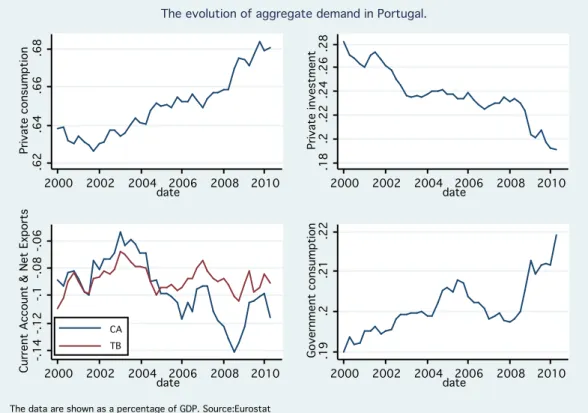
Figure 2: Aggregate demand in Portugal
Portugal in the Euro
Figure 2 shows the evolution of Portugal’s aggregate demand since the launch
of the Euro.
In words, it shows that private consumption as a share of GDP increased
from 63 to 68 percent, private investment decreased from 28 to 19 percent, net
exports oscillated around -9 percent and Government consumption went from
19 to 22 percent. The latter declined from 2005-6 but then started to increase
again in 2008. The accumulated deficit of the last 15 years is reflected in the
large negative net external position3
shown in Figure 1, which, according
3
to the IMF, reached the all time record of 113 percent of GDP in 2009. A
lucid and prescient account on the Portuguese economy evolution is given by
Blanchard (2007), from which I took the introductory citation, and can be
synthesized as follows:
• from 1995 to 2001 (not shown) the participation in the ERM and the buildup of the euro caused a nominal convergence (inflation, interest
rates, country risk not decoupling from currency risk) coupled with
expectations of real convergence (productivity). The result was an
increase in both consumption and investment. The expectations of
real convergence justified a benign interpretation of the current account
deficit increase.
• from 2001 to 2007 real convergence did not occur and the boom turned into a bust. The current account continued to increase as the real
ex-change rate appreciated and competitiveness plummeted. The reality
check on real convergence expectations shifted the interpretation of the
current account deficits from benign to malign but Euro membership
shielded Portugal from a refusal to finance additional increases in debt
as the spreads with the core euro zone countries were almost
nonexis-tent.
An intuitive reading of Figure 2 suggests thatPortugal must increase private
saving by decreasing consumption and improve its net exports. It is worth
noting that the statements on saving and net exports are conditional on
the hypothesis that Portugal current external position is not following an
equilibrium path. To see this more formally consider the following thought
experiment. First describe the process that brought Portugal to its current
state with a non identified and unexpected reduced form aggregate shock.
Second compute the equilibrium responses of a canonical small-open economy
that belongs to a monetary union. For simplicity I assume that the long-run
equilibrium (steady state) of the economy has a balanced current account and
net foreign asset position but suddenly (shock) founds itself with a negative
NIIP of 110 percent of GDP and a current account deficit of 10 percent of
Figure 3 shows that after such a shock the economy response is to
re-duce consumption and increase saving. The decrease in demand deflates the
economy which in turn increases competitiveness and allow to run a positive
trade balance. Net foreign debt is repaid in time with the generated trade
balance surpluses. In reality, there was no such shock but a lengthy process,
illustrated in Figure 2, that brought the economy to the current position, and
in particular this process has been characterized by the absence of the
theo-retical adjustment (equilibrium responses) illustrated in Figure 3. This last
observation suggests that the “self equilibrating” forces in the economy are
at best slow in Portugal and that a policy that accelerates or even initiates
the required adjustment is necessary. In the pre-EMU era, the natural policy
to help the adjustment was to devalue the currency. Today Portugal must
find policies that permit a “synthetic” devaluation. In the current limited
policy option framework, this could be achieved with a decrease in wages
and/or a tax swap from employers’ contributions to social security to VAT.
The former solution is politically difficult and possibly unconstitutional in
Portugal. The latter can achieve an increase in saving by reducing the
at-tractiveness of consumption and an increase in competitiveness by decreasing
labor costs. I now turn to the description of the model underlying Figure 3
and the implementation of a fiscal devaluation within that model.
A framework
The traditional objective of a currency devaluation is to achieve an
in this way, stimulate the economy. A fiscal devaluation corresponds to a
change in the fiscal structure of a country without its own currency aimed at
achieving similar4
objectives. Several authors have studied different aspects
of the question. The classical paper on the effects of a VAT on
competitive-ness for a small price-taking neoclassical economy is Feldstein and Krugman
(1989). These authors find that “the substitution of value-added taxation for
income taxation is likely to have an uncertain short-run effect on a nation’s
net exports but is likely to reduce net exports in the longer term”. In their
framework, the decrease in the income tax has a substitution effect that
fa-vors saving, and therefore the trade balance, in the first period. However
when VAT is selective and fall more heavily on traded goods, it will
dis-tort demand towards nontradables pulling out resources from the tradable
sector and decreasing net exports in the second period. A more recent and
closely related study, is a ECB working paper by Lipinska and Von Thadden
(2009). These authors use a two-country monetary union DSGE model to
study unilateral shifts that direct the tax structure more strongly toward
in-direct taxes5
. They find that the effects following such a shift are very small.
Implicitly many recent papers that contain open economy models with taxes
are related to this work. Most of these works introduce into an economy
that is neoclassical in nature in the long-run, some new-Keynesian feature
in the short run. The choice of which feature to introduce in the model
4
The aim of this paper is purely applied, namely to study alternative policy to nominal devaluation to improve Portugal external position. Recently Adino, Correia and Teles (2009) perform the more theoretically oriented exercise to find a set of tax instruments that allow to replicate the allocation achieved by a nominal devaluation.
5
obviously has important consequences. For example, the cited Lipinska and
Von Thadden (2009) which explicitly study the effects of a fiscal devaluation
though a tax swap between VAT and labor income taxes use a model with
price rigidities but competitive labor markets with flexible wages. Below I
show that the flexible nominal wage assumption has important consequence
as it neutralizes the demand side effects for the fiscal devaluation. In other
words with flexible nominal wage the effects of a fiscal devaluation are purely
neoclassical in nature. To organize thoughts I present in the next section a
canonical New Keynesian small open economy used to obtain Figure 3. I
have left the detailed microfounded description of the economy to an
ap-pendix and show a convenient and more intuitive log-linear approximation of
the model. Finally I present the model’s features in sequential steps to better
identify the role of each assumption discuss their plausibility in describing
the Portuguese reality.
A benchmark
Households consume and supply labor. Given that the objective is to
un-derstand the effects of a fiscal devaluation on competitiveness I start by
describing the labor-production side of the economy. In their role of
work-ers, households have some monopoly power (maybe through a union), which
allows them to set the wage, wt, for the labor services they supply, as a
mark-up µw over their marginal rate of substitutionmrst
6
6
mrst=
1
σct+φnt+τc,t (1)
where ct is consumption, nt is labour, τc,t is the effective consumption tax,
σ is the intertemporal elasticity of substitution and φ is the labor supply
elasticity. Domestic firms produce using only labor and have market power
in the goods market which allows them to set the price of the good they
produce, pH, as a mark-up,µp, over their marginal cost, mct
7
mct=τw,t+wt+
a
1−ayt−log(1−a) (2)
where τw,t is the social security contribution tax rate, yt is output and
a ∈ [0,1] parametrizes the degree of decreasing returns in labor. These
two equations are key to the fiscal devaluation. Consider a decrease in the
social security contributions tax rate∆τw,t<0, where∆is the first difference
operator. Other things equal, the marginal cost of the firm decreases, which
allows the firm to lower its price. This is the channel through which the
fis-cal devaluation improves competitiveness. Second consider an increase in the
consumption tax∆τc,t>0. Other things equal, the marginal rate of
substitu-tion increases pushing the worker/union to ask for a higher wage. Combining
the two changes in taxes it is immediate to see that if∆τc,t =−∆τw,t,call it a
proportional tax swap, the lower taxes effect on the marginal cost is exactly
offset by the increase in the nominal wage, leaving the initial price set by
the firm unchanged. In terms of competitiveness, when prices and wages are
7
I present the economy average marginal cost of substitution to keep the exposition simple. Formally (see the Appendix) each firm sets its own price pH(i) over its own
flexible, this proportional tax swap is neutral on unit labor costs and only
increases the real wage.
Firms are assumed to adjust their prices following a model due to Calvo
(1983) characterized by random price durations which leads to a New
Key-nesian Phillips Curve for domestic price inflation
πHt =βEtπtH+1+κ
pmc
t (3)
whereβis the discount factor andκp the elasticity of domestic inflation to
the marginal cost. Nominal price rigidity does not alter the neutral outcome
of the proportional tax swap: as marginal costs did not change, there is no
incentive for firms to change prices so that any impediment to price
adjust-ment is irrelevant. Workers also face Calvo-type constraints on the frequency
with which they can adjust wages and this leads to a New Keynesian Phillips
Curve for domestic wage inflation
πWt =βEtπWt+1+κw(mrst−wt) (4)
whereπWt is wage inflation andκwthe elasticity of domestic wage inflation
to the gap between the marginal rate of substitution and the nominal wage.
Now wage setters want to ask a higher nominal wage after the increase in
τc,t, but nominal wage rigidity implies that nominal wage will fully reflect the
increase in the marginal rate of substitution only after a period of adjustment.
During the time when nominal wages adjust to their higher level, the decrease
in the social security contribution decreases the marginal cost of the firm
irrelevant while nominal wage rigidity is necessary for the proportional tax
swap to affect competitiveness.
The intertemporal consumption-saving decision is described by a standard
intertemporal condition
ct=Etct+1−σ(it−Et[πt+1+ ∆τc,t+1]−ρ) (5)
where it is the one period run nominal interest rate, πt is the CPI rate
of inflation (net of VAT taxes), and Et is the mathematical expectation
conditional on information at time t. The relevant CPI inflation rate is given
by
πt =πtH +α∆st (6)
where πH
t =pHt −pHt−1 is the domestic goods inflation, st ≡ pF
t
pH
t is the terms of trade (ratio of the foreign goods price index over the domestic goods price
index) andα ∈[0,1]is the weight of foreign goods in domestic consumption.
The international asset market is restricted to a one-period nominal bond
with a debt-elastic interest-rate premium on the rest of the union interest
rate8
it=i ∗
t +ρ(bt) (7)
wherei∗
t is the EMU one period nominal interest rate andρ(bt)is the
do-mestic risk premium that depends on the level in real terms of the net external
8
position bt. A permanent tax swap does not affect the saving-consumption
decision given that ∆τc,t+1 = 0 in equation 5. However an expected
tran-sitory increase in the consumption tax creates an expected negative step in
the relevant interest rateit−Et[πt+1+ ∆τc,t+1]for the household
intertempo-ral decisions, increasing the attractiveness of future (post tax swap reversal)
consumption relative to current consumption.
The equilibrium in the goods market requires
yt=χst+χFst+ζct+ζFc ∗
t (8)
wherec∗
t is the EMU consumption,χis the elasticity of domestic demand
to the terms of trade, χF is the elasticity of exports to the terms of trade,
ζ is the elasticity of output to domestic demand and ζF is the elasticity of
output to foreign demand.
Fiscal devaluation as a proportional tax swap
I have described a fiscal devaluation as a proportional tax swap, namely a
precise change in the two tax rates such that ∆τc,t = −∆τw,t, and argued
that when such a swap is permanent the final outcome of the policy is neutral
on allocations and only results in a higher real wage. This neutrality is
ob-viously a particular case but is appealing as it permits to compare the fiscal
devaluation to a classical nominal devaluation which is also neutral on
allo-cations in the long run. In other words, in the model above, the proportional
tax swap only affects the allocations through demand channels, just like a
allocations through well understood neoclassical supply channels, which in
the case of the suggested tax swap tend to offset each other. I choose to
maintain the proportional tax swap as a benchmark for the fiscal
devalua-tion as demand forces should be more relevant in the short run, the frequency
of interest of this work. A nominal devaluation is also usually implemented
to reduce unit labour costs relative to foreign competitors, expand exports
and reduce imports, i.e. to increase in competitiveness9
. Both devaluations
can only achieve those objectives if the switching-expenditure towards
do-mestic goods is strong enough. In the benchmark model the latter requires
the elasticity of substitution between domestic and foreign goods to be large
enough. In the model net exports in terms of consumption, nxt, are
nxt =shx((λ−1)st+c ∗
t)−shm((1−λ)qt+ct) (9)
where λ is the elasticity of substitution between foreign and domestic
goods, qt ≡ P∗
t
Pt is the real exchange rate, shx is the share of exports in the trade balance and shm is the share of imports in the trade balance. To
recapitulate the proportional tax swap, when nominal wages are sticky,
im-proves external competitiveness by allowing producers to lower their prices,
increases foreign demand and can provoke an expenditure switching towards
domestic goods that lowers imports if the elasticity of substitution between
foreign and domestic goods is sufficiently large and the increase in domestic
9
demand is sufficiently low. The last two qualifications might appear
restric-tive but they are essentially the same restrictions for a nominal devaluation
having a positive effect on the trade balance. Finally, an important aspect
is the duration of the tax swap. A permanent tax swap, only affects the
competitiveness of the economy while a transitory tax swap also distorts the
intertemporal choice by favoring saving and achieves a sharper improvement
in the current account.
Extending the benchmark
Is the benchmark model adequate to study the first order qualitative effects
of the tax swap for the Portuguese economy? I will focus on two departures
from the above benchmark. First the assumption that export firms have some
degree of monopolistic competition in foreign markets may be unrealistic.
Second a large fraction of the economy consists of a non-tradable sector. I
will first consider them separately and then combine them.
The small open economy as a price-taker
The classical notion of a small open economy was once associated with
price-taking firms in international markets. In this case, χF is zero in equation 8
and the domestic economy cannot affect nor the quantity nor the value of
ex-ports. If producers have market power in the domestic economy, the decrease
in the marginal cost allows to decrease their prices and substitute foreign
im-ported goods with domestically produced goods. Again if the elasticity of
increases, which combined with constant exports improves the trade balance
which is now given
nxt=shxc ∗
t −shm((1−λ)qt+ct) (10)
If producers are also price takers domestically,χ is also zero in equation
8 and the temporary decrease in the marginal cost of production, increases
only imports worsening the trade balance. This latter case appears
exces-sively restrictive but highlights the difficulty of a pure price taker small open
economy in a monetary union: the only channel left to improve the trade
balance is to reduce consumption or an increase in foreign consumption.
Nontradable sector
The presence of a nontradable sector in the benchmark model also makes it
more difficult for the suggested tax-swap to improve the trade balance. The
details of how the nontradable sector is added to the benchmark model are
important. For example the degree of labor mobility across the two sectors
will matter for the pace of the short run adjustment. Here for simplicity I
assume there is perfect mobility, but this assumption is not innocuous.
Gen-erally, with a nontradable sector, part of the deflationary forces unleashed by
the fiscal devaluation end up in favoring the domestic demand of
nontrad-ables relative to the demand of tradnontrad-ables. The labor costs decrease for firms
in both sectors pushes price setters to decrease their price. However because
of the price of imports does not change, the relative price of nontradables in
from home produced and foreign produced tradables towards nontradables.
In this case, all other things equal, the elasticity of substitution between
domestic and foreign tradable goods must be higher than in the benchmark
case for the trade balance to improve. The trade balance is now
nxt =shx((λ−1)st+c ∗
t)−shm
�
(1−λ)qt+ (λ−ξ)pTt +ct
�
(11)
whereξ is the elasticity of substitution between tradables and non
trad-ables and pT
Figure 4: Barriers to the fiscal devaluation: 1. price taker, 2. non tradable sector.
Figure 4 shows the response to a proportional tax swap in three different
cases10
. In the first case the tradable and nontradable sectors have the same
size (symmetric), in the second case the two sector have the same size but
the tradable sector in a price taker on foreign markets and in the third
case the non tradable sector is small relative to the tradable. The latter
case corresponds to the benchmark while the other two show how the fiscal
devaluation has a lower effect on the trade balance when the nontradable is
large and/or the tradable is a price taker on foreign markets.
Implications
In light of Figure 4, the degree of market power on foreign markets and the
size of the non tradable sector are most important to evaluate the efficacy
of the fiscal devaluation. Is Portugal a price taker on foreign markets? On
one hand the very small size of the Portuguese economy would suggest an
affirmative answer, on the other hand the degree of specialization in
produc-tion in advanced economies is such that most producproduc-tion units might have
some degree of market power. In practical terms the critical question is if
Portuguese exporters will decrease their prices in face of a decrease in unit
costs of production. The size of the nontradable sector is also difficult to
measure. The old dichotomy between manufacturing (tradables) and
ser-vices (nontradables) is not anymore relevant11
and the identification of non
10
The model is calibrated using standard values for all parameters: calibrated param-eters for the Portuguese economy have very similar values to those of other economies which is somewhat surprising (not to say disturbing). In the appendix I report a table with the value of the parameters.
11
tradables has shifted towards national network industries such as the
dis-tribution sector, i.e. retail/wholesale trade. However every sector is likely
to have an output with some tradables and non tradables elements. One
criteria adopted in the literature (see Bems (2008)) is to define the nature
of the output of relevant sectors according to its tradability relative to the
retail/wholesale trade sector, where tradability is measured as the sum of
a sector’s exports and imports over the gross output. A sufficiently precise
identification of the tradable and nontradable setors could permit to
imple-ment a targeted fiscal devaluation by lowering the social security contribution
only to tradables industries shutting down the dilution of the deflationary
forces by the non tradable industries12
. However such an identification is
difficult, for example according to the previous criteria the “Real estate and
business services sector” is a tradable sector in Portugal. Finally while the
differentiation between tradables and non tradables might be important for
the success of the fiscal devaluation on competitiveness, such a policy would
not be anymore neutral on the supply of the economy as it distorts allocations
towards tradables. The latter distortion might be desirable but it belongs to
the long-run-supply side policies while the proportional tax swap suggested
belongs to the short-run-demand side policies13
.
12
A cruder and somewhat heterodox alternative would be to control prices in the non-tradable sector
13
A transitory tax swap
As I mentioned above, a transitory tax swap also affects the relative price of
future consumption (the relevant real interest rate). This additional channel
is decoupled from competitiveness considerations but can achieve a much
stronger improvement of the current account by increasing the household
incentives to save. The saving channel might result important in light of
the implications of the presence of large nontradable sector and absence of
market power in foreign markets for the competitiveness channel. Figure 5
shows the theoretical adjustment paths after an initial “Portuguese shock”
in the case of no-policy and in the case of a permanent and a transitory (8
The Government budget
In the model I have abstracted from government budget considerations14
as
tax revenues are rebated to the households in a lump sum manner. In order
for the shift from labor taxes to consumption taxes to be revenue-neutral I
could introduce government debt dynamics, endogenize one of the tax rates,
say τc, and impose a fiscal rule that maintains the budget balanced as in
Lipinska and Von Thadden (2009). While the neutrality on the budget is
practically desirable, in the model it would cause allocationals effects as the
tax rates would not move proportionally. Again the focus of the theory
section is to isolate the short run effects of the fiscal devaluation15
. To have
a sense of the empirical magnitudes involved in the effective tax rates swap,
both on the external balance and on the government budget, I depart from
the precise but necessarily over simplistic model presented above and turn
to a more reduced form empirical analysis.
Portugal data
Portugal tax revenue
A desirable aspect for the suggested policy would be to maintain as much as
possible the tax revenue unchanged. In Portugal the general VAT tax rate is
21 percent and will soon be increased to 23 percent and the employer’s social
14
The model is too stylized to provide reliable indications on the revenue dimension. One reason is that, because I have abstracted from other factors such as capital, the labor income share in the model is too large.
15
Table 1: VAT and ESSC in Portugal, year 2007
Tax Basis Tax rate Revenue Effective tax rate
Consumption 65% 21% 8.79% 10.81%
Gross Wages s.t. Tax 40.4% 23.7% 8.68% 21%
security contribution tax rate is 23.75 percent of the gross wage. These two
taxes generate a revenue of approximately 8.6 percent of GDP each. Table
1 shows the tax basis, tax rates, and effective tax rate, defined below, for
2007.16
A simple back-of-the-envelope calculation, keeping the tax basis fixed,
indicates that for each percentage point increase in the effective VAT rate,
the Government can decrease the ESSC rate by 1.6 pp and keep the revenue
unchanged. Equivalently a 2.47 pp of effective ESSC or a 1.53 pp of effective
VAT generate 1 pp of GDP of tax revenues. Of course the basis will change
after the tax swap and I have shown their qualitative path in the model
simulations. To quantify the effects of the proportional tax swap on the tax
basis and the trade balance, I estimate two Structural Vector Autoregression
to find the elasticities of private consumption and of the wage bill (the two
tax basis), and of exports and import (the trade balance), to a shock to the
16
effective VAT rate,τc in the model above, and to a shock to the effective social
security tax rate,τw in the model above. I estimate two distinct statistical
models, one for each tax rate shock, because Portuguese quarterly data only
exist since 1995 so that the number of observations is relatively small and
does not allow to estimate large models.
A shock to
τ
cEmpirically the effective tax rate on consumption is defined as
τc ≡
V AT P C =
�nc
s=1τspcscs+
�ni
s=1τspisis+
�ng
s=1τspgsgs
P C (12)
wherenj is the number categories in each type of expenditurej =c, i, g
(con-sumption, investment and government expenditure, see footnote 14), subject
to possibly different tax rates and pj is the price index of each category. A
change in any of the terms of 12 leads to a change inτc. I definea shock to the
effective rate any shock that changes τc but does not change
contemporane-ously the nominal expenditures in consumption, investment and government
consumption (and imports)17
. There are potential issues in the suggested
identification procedure. First I am not identifying the anticipated
com-ponent of the tax rate change but only the unexpected part of the shock.
Second total nominal expenditure in each aggregate demand component is
different from the nominal expenditure subject to taxation: about two-third
of consumption and only a small fraction of private investment and
govern-17
.17 .1 7 .17 .18 .1 8 .18 .19 .1 9 .19 .2 .2 .2 .21 .2 1 .21 vatrate vatrate vatrate .08 .0 8 .08 .1 .1 .1 .12 .1 2 .12 .14 .1 4 .14 .16 .1 6 .16 tc_sa tc_ sa tc_sa 1995q1 1995q1 1995q1 2000q1 2000q1 2000q1 2005q1 2005q1 2005q1 2010q1 2010q1 2010q1 quarter quarter quarter Effective rate Effective rate Effective rate General rate General rate General rate
Source: Eurostat, 2010
Source: Eurostat, 2010 Source: Eurostat, 2010 Effective and general VAT rates
Effective and general VAT rates
Effective and general VAT rates
Figure 6: Effective and general VAT rates in Portugal. Source: Eurostat
ment expenditure are subject to VAT. Equation 12 also shows that to change
the effective rate the government can change the tax rates τs and/or change
the basis, nj 18. Figure 6 shows the seasonally adjusted effective VAT rate
together with the general rate.
The figure shows that when the general rate changes, the effective rates
changes in the same direction. However the effective rate exhibits a much
more volatile pattern characterized by a few large spikes. Some of the largest
spikes can be explained by a change in VAT legislation that did not alter the
18
Define the difference between nominal expenditure and the actual expenditure subject to the VAT as�j. For example in the case of consumption�c≡�
nc
s=1pcscs−P C. Therefore
the shock the effective rate will contain both changes in the different τs and changes in
Table 2: VAT history in Portugal
General Intermediate Reduced Effective tax rate
01.01.1995 – 30.06.1996 17% - 5% 10.9%
01.07.1996 – 04.06.2002 17% 12% 5% 12.3%
05.06.2002 – 30.06.2005 19% 12% 5% 13.45%
01.07.2005 – 30.06.2008 21% 12% 5% 14.7%
01.07.2008 – 30.06.2010 20% 12% 5% 12.3%
01.07.2010 - 31.12.2010 21% 13% 6% 12.9%
general rate. For example Table 2shows that the first large spike is in 1996q3
corresponds to the year in which an intermediate VAT rate of 12 percent was
introduced.
The previous discussion suggests that a careful narrative approach to the
VAT legislation in Portugal could be followed to construct a time series for
the effective VAT shock. Here I rely on the identification scheme suggested
above. For robustness, I estimate two SVAR, VAR 1 and VAR 2, containing,
real imports, nominal private investment, nominal government consumption,
nominal private consumption and the empirically measured effective tax rate
(VAR 1), or the actual general VAT rate (VAR 2). All variables except the
tax are in annual growth rates. The sample is 1996q3-2010q3, the VARs are
estimated with two lags and a dummy for the global financial crisis period.
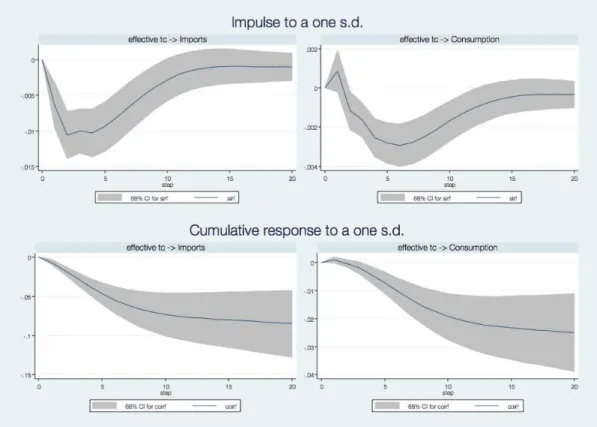
Figure 7 shows both the impulse and the cumulated responses of consumption
and imports to a one standard deviation of the identified VAT shocks together
with 68% confidence intervals for VAR 1.
The two shocks identified with the two alternative measures of VAT tax
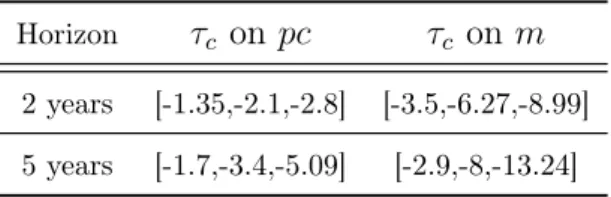
Table 3: Percentage response to a one standard deviation increase inτc, CI 68%
Horizon τc onpc τc on m
2 years [-1.35,-2.1,-2.8] [-3.5,-6.27,-8.99]
5 years [-1.7,-3.4,-5.09] [-2.9,-8,-13.24]
itive shock, consistently with the benchmark model, decreases persistently
both consumption and imports. The results of VAR 2 are less precise
there-fore in the rest of the paper I use the results of VAR 1. The cumulative
responses show that a one standard deviation shock in effective VAT rate
decreases the level of nominal consumption (the VAT approximate basis) by
2 percent after 2 years and by 3.2 percent after 5 years. The same shock
ap-pears to have an even stronger effect on the real level of imports: 6 percent
after 2 years and 8 percent after 5 years. These elasticities appear to be very
large. Notice that the uncertainty on the effect is also large and that the
standard deviation of the shock is not identified. The lack of identification
of the structural shock standard deviation is common to the SVAR
litera-ture and does not allow to rescale the elasticities in terms of more practical
percentage change in the shock. Table 3 summarizes the results.
A shocks to
τ
wEvidence on the effects of a change in τw is somewhat harder to identify as
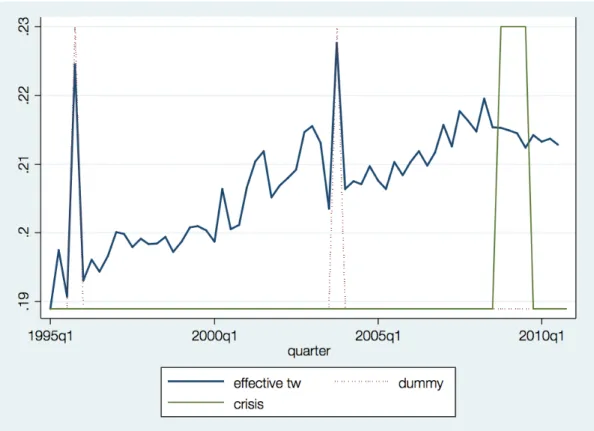
Figure 8: Effective SSC rate in Portugal. Source: Eurostat
the social security general rate19
. Figure shows the effective tax rate defined
as follows
τw ≡
SSC
Compensation−SSC =
�nw
s=1τwsWs
W (13)
where SSC are the social security contributions paid by the employers
and Compensation is the total compensation paid by the employers
inclu-sive of social security contributions. The effective τw exhibits an increasing
trend and two evident spikes. The trend corresponds to the widening of the
social security during the sample. The two spikes are due to above average
revenues in social security contributions during in the fourth quarter of 1995
19
and the fourth quarter of 2003. Again, following a narrative approach, these
two increases could be explained by new legislation passed at that time such
a more punitive stance towards evasion and the creation of a “revenue
min-imum d’insertion”. I nevertheless decide to control for the two spikes with
a dummy but results are not significantly affected by this choice. I define
a shock to the effective rate any shock that changes τw but does not change
contemporaneously the nominal wage bill W. The identification assumption
is subject to similar caveats than those expressed for the VAT shock. The
estimated VAR contains real exports, the nominal wage bill and the
effec-tive social security tax rate. Again all variables except the tax are in annual
growth rates. The sample is again 1996q3-2010q3, the VAR is estimated with
two lags, the dummy for the two spikes of 1995q4 and 2003q4 and a dummy
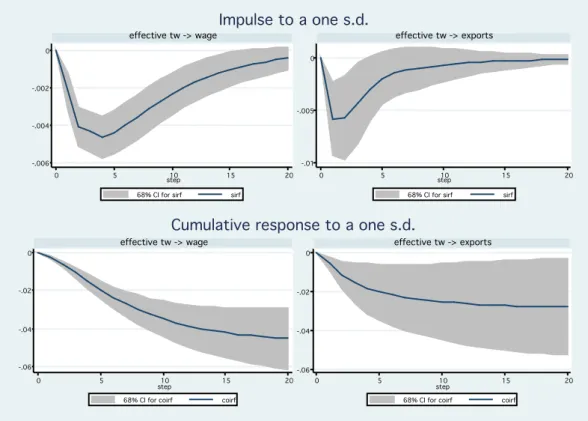
for the global financial crisis period. Figure 9 shows both the impulse and the
cumulated responses of the nominal wage bill and exports to a one standard
deviation of the identified τw shock together with 68% confidence intervals.
A positive shock decreases persistently both the wage bill and exports.
The cumulative responses show that a one standard deviation shock in
ef-fective social security tax rate decrease the level of the nominal wage bill
(maybe through lower employment) by 3 percent after 2 years and by 4.5
percent after 5 years. The same shock decreases the real level of exports by
2.3 percent after 2 years and 2.79 percent after 5 years. Again the confidence
intervals are large and the standard deviation of the shock is left unidentified.
-.006 -.006 -.006 -.004 -.004 -.004 -.002 -.002 -.002 0 0 0 0 0 0 5 5 5 10 10 10 15 15 15 20 20 20 step step step
68% CI for sirf
68% CI for sirf 68% CI for sirf
sirf
sirf sirf
effective tw -> wage
effective tw -> wage effective tw -> wage
-.01 -.01 -.01 -.005 -.005 -.005 0 0 0 0 0 0 5 5 5 10 10 10 15 15 15 20 20 20 step step step
68% CI for sirf
68% CI for sirf 68% CI for sirf
sirf
sirf sirf
effective tw -> exports
effective tw -> exports effective tw -> exports
Impulse to a one s.d.
Impulse to a one s.d.
Impulse to a one s.d.
-.06 -.06 -.06 -.04 -.04 -.04 -.02 -.02 -.02 0 0 0 0 0 0 5 5 5 10 10 10 15 15 15 20 20 20 step step step
68% CI for coirf
68% CI for coirf 68% CI for coirf
coirf
coirf coirf
effective tw -> wage
effective tw -> wage effective tw -> wage
-.06 -.06 -.06 -.04 -.04 -.04 -.02 -.02 -.02 0 0 0 0 0 0 5 5 5 10 10 10 15 15 15 20 20 20 step step step
68% CI for coirf
68% CI for coirf 68% CI for coirf
coirf
coirf coirf
effective tw -> exports
effective tw -> exports effective tw -> exports
Cumulative response to a one s.d.
Cumulative response to a one s.d.
Cumulative response to a one s.d.
Figure 9: The effect of a shock to the effective social security rate on wages and exports.
Table 4: Percentage response to a standard deviation shock inτw, CI 68%
Horizon τw onγx τw onγw
2 years [-0.6,-2.38,-4.17] [-2.52,-3.01,-3.77]
Discussion
I mentioned above that a better empirical model would estimate and
iden-tify the two shocks in a single statistical model. Typically the omission of
relevant information tends to bias estimates, and this is a serious concern
for what regards the magnitude of the estimated elasticities. Unfortunately,
leaving aside complications on the identification procedure, the number of
observations, 59 data points, is too small to obtain meaningful results from
the larger model. I also mentioned that the size of the identified shock is
left unidentified which does not allow to quantify the effect of a 1 percent
increase in the effective VAT rate on consumption and exports but only the
effect of a standard deviation increase. A narrative approach to the
construc-tion of the shocks would be useful to measure their size. Here I have to take
a stand on the relative size of the two shocks to be able to continue
meaning-fully the analysis. Figure 10 shows the first difference of the two empirically
measures effective rate. Their change (and their standard deviations) have
similar magnitude. I do not have a better metric than Figure 10 , therefore
I choose to assume that the two structural shocks have the same standard
deviation.
The empirical effects of the fiscal devaluation
Consider a 1 pp increase in τc. According to the simple back of the envelope
calculation to keep the tax revenue unchanged on impact τw can decrease
by 1.6 pp. Accordingly with the assumption that the two structural shocks
-.03
-.03
-.03 -.02
-.02
-.02 -.01
-.01
-.01 0
0
0 .01
.0
1
.01 .02
.0
2
.02 1996q3
1996q3 1996q3 2000q1
2000q1 2000q1
2003q3
2003q3 2003q3
2007q1
2007q1 2007q1
2010q3
2010q3 2010q3
quarter
quarter quarter
D.tc
D.tc D.tc
D.tw
D.tw D.tw
crisis
crisis crisis
dummy_tw
dummy_tw dummy_tw
0 0 0 50 50 50 100 100 100 150 150 150 million euro mi lli on e u ro million euro 0 0 0 5 5 5 10 10 10 15 15 15 20 20 20 quarter quarter quarter
Revenue balance after 1X tax swap
Revenue balance after 1X tax swap
Revenue balance after 1X tax swap
-2500 -2500 -2500 -2000 -2000 -2000 -1500 -1500 -1500 -1000 -1000 -1000 -500 -500 -500 0 0 0 million euro mi lli on e u ro million euro 0 0 0 5 5 5 10 10 10 15 15 15 20 20 20 quarter quarter quarter
Revenue balance after 10X tax swap
Revenue balance after 10X tax swap
Revenue balance after 10X tax swap
250 250 250 300 300 300 350 350 350 400 400 400 450 450 450 million euro mi lli on e u ro million euro 0 0 0 5 5 5 10 10 10 15 15 15 20 20 20 quarter quarter quarter
VAT revenues after 1x standard shock in tc
VAT revenues after 1x standard shock in tc
VAT revenues after 1x standard shock in tc
0 0 0 1000 1000 1000 2000 2000 2000 3000 3000 3000 million euro mi lli on e u ro million euro 0 0 0 5 5 5 10 10 10 15 15 15 20 20 20 quarter quarter quarter
VAT revenues after 10x standard shock in tc
VAT revenues after 10x standard shock in tc
VAT revenues after 10x standard shock in tc
-500 -500 -500 -400 -400 -400 -300 -300 -300 -200 -200 -200 -100 -100 -100 million euro mi lli on e u ro million euro 0 0 0 5 5 5 10 10 10 15 15 15 20 20 20 quarter quarter quarter
SSC revenues after 1.6x standard shock in tw
SSC revenues after 1.6x standard shock in tw
SSC revenues after 1.6x standard shock in tw
-3000 -3000 -3000 -2800 -2800 -2800 -2600 -2600 -2600 -2400 -2400 -2400 -2200 -2200 -2200 million euro mi lli on e u ro million euro 0 0 0 5 5 5 10 10 10 15 15 15 20 20 20 quarter quarter quarter
SSC revenues after 16x standard shock in tw
SSC revenues after 16x standard shock in tw
SSC revenues after 16x standard shock in tw
-.04 -.04 -.04 -.02 -.02 -.02 0 0 0 .02 .0 2 .02 .04 .0 4 .04 percentage percentage percentage 0 0 0 5 5 5 10 10 10 15 15 15 20 20 20 quarter quarter quarter Exp Exp Exp Imp Imp Imp
External balance after 1 standard tax swap
External balance after 1 standard tax swap
External balance after 1 standard tax swap
-.4 -.4 -.4 -.2 -.2 -.2 0 0 0 .2 .2 .2 .4 .4 .4 percentage percentage percentage 0 0 0 5 5 5 10 10 10 15 15 15 20 20 20 quarter quarter quarter Exp Exp Exp Imp Imp Imp
External balance after 10 standard tax swap
External balance after 10 standard tax swap
External balance after 10 standard tax swap
Figure 11: The empirical effects of a fiscal devaluation on tax revenues and the external balance.
the first consider the increase in 1 standard deviation of the effective VAT
shock coupled with a decrease of 1.6 standard deviation in the effective social
security tax shock, the second a 10 standard deviation increase in the VAT
shock coupled with a 16 standard deviation decrease in the social security
tax shock.
The estimated effect of τw on its own basis (wage) is relatively larger
than the effect of τc on its own basis (consumption), therefore Figure 11
shows that a fiscal devaluation that would maintain the tax revenue balanced
maintaining the tax basis unchanged, has a positive effect on the budget
the trade balance each standard deviation of the VAT shock decreases real
imports by 3.4 percent so that a 10 standard deviation increase is estimated
to decrease the level of imports by 34 percent. Further each 1.6 standard
deviation decrease in the SSC shock improves the level of real exports by
4.4 percent so that a 16 standard deviation decrease would increase exports
by 44 percent. Overall the empirical analysis appears to support both the
efficacy and the feasibility of a fiscal devaluation. Finally, to depart from
the quantification in terms of standard deviations I further assume that the
standard deviation of the two structural shocks is 1 pp (which corresponds to
effective rate standard deviation, but this is a poor justification) and consider
a decrease of the ESSC from 23.75 percent to 7.75 percent. In theory this
would achieve an instantaneous decrease of the labor costs of 16%. Tax
revenues would fall on impact by almost 7 percent of GDP. To keep the
revenue unchanged, the effective VAT rate should increase by 10 pp. This
increase in the effective rate is massive, but so too is the reduction in the cost
of labor. Table 2 suggests that the effective VAT rate could be increased from
11.4 percent to 21.4 percent by using the new general VAT rate on almost
every good. Considering the recent increase of the general rate from 21 to
23 percent, an almost uniform application of the latter rate could increase
the effective VAT rate by the order of magnitude required. The estimated
tax basis elasticities suggest that over time the revenue generated by the two
taxes will not deteriorate but actually improve. It is important to understand
that these numbers are conditional on the size of the shocks so that in practice
the uncertainty on the estimates of the relevant elasticities involved in the
0 0 0 .05 .05 .05 .1 .1 .1 IRL IRL IRL NLD NLD NLD LUX LUX LUX DEU DEU DEU AUT AUT AUT PRT PRT PRT SVK SVK SVK BEL BEL BEL ITA ITA ITA ESP ESP ESP FIN FIN FIN FRA FRA FRA DNK DNK DNK
Source: Eurostat, 2010
Source: Eurostat, 2010 Source: Eurostat, 2010
Payroll as a share of GDP
Payroll as a share of GDP Payroll as a share of GDP
0 0 0 .02 .02 .02 .04 .04 .04 .06 .06 .06 .08 .08 .08 .1 .1 .1 LUX LUX LUX ESP ESP ESP ITA ITA ITA DEU DEU DEU BEL BEL BEL IRL IRL IRL FRA FRA FRA NLD NLD NLD SVK SVK SVK AUT AUT AUT PRT PRT PRT FIN FIN FIN DNK DNK DNK
Source: Eurostat, 2010
Source: Eurostat, 2010 Source: Eurostat, 2010
VAT as a share of GDP
VAT as a share of GDP VAT as a share of GDP
Tax structure: average during 2000-2007
Tax structure: average during 2000-2007
Tax structure: average during 2000-2007
Figure 12: Tax revenues as a share of total tax revenues for VAT and payroll tax collection. The numbers shows are average shares from 2000 to 2007.
on the trade balance. Undoubtedly a permanent tax swap, as opposed to a
transitory one, would transform the tax structure of Portugal pushing it far
from the average European model, and make it similar regarding VAT and
ESSC to Denmark, where payroll taxes are around 3 percent and there is a
single VAT rate of 25 percent on virtually all goods and services20
.
To illustrate this point, Figure 12 shows that Portugal’s reliance on payroll
tax for generating tax revenue is just above the European average while VAT
appears to be more important than for the rest of the European countries for
20
generating tax revenues. The latter observation can only partly be explained
by a high general VAT in Portugal relative to the other countries: first,
Portugal does not have the highest VAT rate, and second, several reduced
VAT rates on relevant goods and services appear to be below other European
rate. For example, Figure 13 shows the rates on electricity and natural gas,
which appear to be much lower than in the rest of Europe.
In fact, I interpret part of the high dependence of Portugal on VAT
rev-enues as another symptom of excessive Portuguese consumption. Again the
departure from a “European model” would not happen in the transitory
ver-sion of the policy.
Conclusion
In this work I study the short run effects of a swap between a consumption tax
and a labor tax within a monetary union and perform an empirical analysis
of the tax swap on Portuguese data. The suggested tax swap is one of the few
policy left to individual EMU members to engineer a synthetic devaluation.
A transitory version of the tax swap has some attractiveness. A temporary
uniformization of the different VAT rates21
to the general rate, say for two
to four years, could generate the revenues to finance the initial cut in the
ESSC rate and allow the dynamic adjustment of lower consumption, higher
competitiveness, and higher employment to take place. If the policy is
suc-cessful, the larger ESSC tax basis would help to compensate the reduction in
consumption and probably allow again reducing the VAT rates on particular
21
0 0 0 .05 .05 .05 .1 .1 .1 .15 .15 .15 .2 .2 .2 .25 .25 .25 VAT VAT VAT Cyprus Cyprus Cyprus Luxembourg Luxembourg Luxembourg Malta Malta Malta Spain Spain Spain Germany Germany Germany Netherlands Netherlands Netherlands Slovak Republic Slovak Republic Slovak Republic France France France Austria Austria Austria Italy Italy Italy Slovenia Slovenia Slovenia Belgium Belgium Belgium Ireland Ireland Ireland Portugal Portugal Portugal Finland Finland Finland Greece Greece Greece Denmark Denmark Denmark
Source: Eurostat, 2010
Source: Eurostat, 2010 Source: Eurostat, 2010
VAT general rate
VAT general rate
VAT general rate
0 0 0 .05 .05 .05 .1 .1 .1 .15 .15 .15 .2 .2 .2 .25 .25 .25 PetrolVAT PetrolVAT PetrolVAT Cyprus Cyprus Cyprus Luxembourg Luxembourg Luxembourg Malta Malta Malta Spain Spain Spain Germany Germany Germany Netherlands Netherlands Netherlands Slovak Republic Slovak Republic Slovak Republic France France France Austria Austria Austria Italy Italy Italy Slovenia Slovenia Slovenia Belgium Belgium Belgium Ireland Ireland Ireland Portugal Portugal Portugal Finland Finland Finland Greece Greece Greece Denmark Denmark Denmark
Source: Eurostat, 2010
Source: Eurostat, 2010 Source: Eurostat, 2010
VAT on Petrol 2010
VAT on Petrol 2010
VAT on Petrol 2010
(a) VAT rates in Europe, general rate and petrol.
0 0 0 .05 .05 .05 .1 .1 .1 .15 .15 .15 .2 .2 .2 .25 .25 .25 NaturalgasVAT NaturalgasVAT NaturalgasVAT Luxembourg Luxembourg Luxembourg Portugal Portugal Portugal Italy Italy Italy Greece Greece Greece Ireland Ireland Ireland Cyprus Cyprus Cyprus Malta Malta Malta Spain Spain Spain Germany Germany Germany Netherlands Netherlands Netherlands Slovak Republic Slovak Republic Slovak Republic France France France Austria Austria Austria Slovenia Slovenia Slovenia Belgium Belgium Belgium Finland Finland Finland Denmark Denmark Denmark
Source: Eurostat, 2010
Source: Eurostat, 2010 Source: Eurostat, 2010
VAT on gas 2010
VAT on gas 2010
VAT on gas 2010
0 0 0 .05 .05 .05 .1 .1 .1 .15 .15 .15 .2 .2 .2 .25 .25 .25 ElectricityVAT ElectricityVAT ElectricityVAT Luxembourg Luxembourg Luxembourg Portugal Portugal Portugal Italy Italy Italy Greece Greece Greece Ireland Ireland Ireland Cyprus Cyprus Cyprus Malta Malta Malta Spain Spain Spain Germany Germany Germany Netherlands Netherlands Netherlands Slovak Republic Slovak Republic Slovak Republic France France France Austria Austria Austria Slovenia Slovenia Slovenia Belgium Belgium Belgium Finland Finland Finland Denmark Denmark Denmark
Source: Eurostat, 2010
Source: Eurostat, 2010 Source: Eurostat, 2010
VAT on electricity 2010
VAT on electricity 2010
VAT on electricity 2010
goods and services. Most importantly, the sharper reduction in consumption
would allow the Portuguese economy to start the much needed deleveraging.
On a broader note, I see the sophisticated use of the tax structure by
individ-ual EMU members as a possible substitute for more conventional automatic
stabilizers to external imbalances. The creation of fiscal tax rules in the spirit
of the “budget neutral” temporary tax swap described here could facilitate
and accelerate external adjustments with the eurozone as the prospects of a
deeper fiscal integration appear remote. Certainly the construction of these
new automatic stabilizers requires a great research effort in order to have a
more precise comprehension of their effectiveness and feasibility.
Appendix A
Model
Assume an economy with two countries in a monetary union, home (H) and
foreign (F). The home country is of sizen, while the foreign country is of size
1−n. The small open economy version of the model is obtained by taking
the limit n →0 after having solved the model. Technology and preferences
are the same across countries. In the following I describe the home economy
while the foreign which is completely symmetric is omitted. All foreign
vari-ables are denoted with an asterisk. The next two subsections describe the
firms and households problems together with the intratemporal optimality
conditions. The third subsection presents the intertemporal optimality
market clearing conditions.
Firms
The economy is composed of two two sectors, a tradable sector denoted by
T and a non tradable sector denoted by N. Workers are perfectly mobile
across sectors. Assume a continuum of firms indexed by i ∈ [0,1], each of
which produces a differentiated good with the following technology
Ytx(i) =AtNtx(i)1 −a
, x=N, T (14)
whereYx
t (i)denotes the output of goodi, At is an exogenous technology
parameter, and Nx
t(i) is an index of labor input used by firm i and defined
by
Ntx(i) =
�ˆ 1
0
Ntx(i, h)
σw−1 σw dh
�σwσw−1
, x=N, T (15)
whereNtx(i, h)is the quantity of type-hlabor employed by firmiin sector
x in period t. The parameter σw represents the elasticity of substitution
among labor varieties. The demand schedule for each labor type is obtained
by cost minimization
Ntx(i, h) =
�
Wt(h)
Wt
�−σw
Ntx(i), x=N, T (16)
for all i, h ∈ [0,1], where Wt(h) is the nominal wage for type h labor,
Wt =
�
´1
0 Wt(h)
1−σw
dh�
1 1−σw
is an aggregate wage index and Nx
t is firm’s
total employment. All firms face an isoelastic demand schedule (specified
given period independently of the time elapsed since the last adjustment.
Firms must pay a social contribution in the form of a proportional tax, τw,t,
on their wage bill.
Households
Assume a continuum of households indexed by h ∈ [0,1]. The household
seeks to maximize
Et
� ∞
�
s=t
U(Ct+s(h), Nt+s(h))
�
(17)
where Nt(h) is the quantity of labor supplied. Each household is
as-sumed to specialize in the supply of a different type of labor, also indexed
by h∈[0,1]. Furthermore, each household has some monopoly power in the
labor market, and posts the (nominal) wage at which it is willing to supply
specialized labor services to firms that demand them. Assume that for each
period only a fraction 1−θw of household, drawn randomly from the
popu-lation, reoptimize their posted nominal wage. Under the assumption of full
consumption risk sharing across households, all households resetting their
wage in any given period will choose the same wage, because they face an
identical problem. Ct(h) is a composite consumption index
Ct(h) =
�
(1−γ)1s �CN
t (h)
�s−s1
+γ1s �CT
t (h)
�s−s1�
s s−1
(18)
where CN
given by a constant substitution elasticity aggregator
CtN(h) =
� �
1
n
�σn1 ˆ n
0
(cNt (h, i))σ−σ1di
�σnσn−1
(19)
where cNt (h, i) denotes the consumption by household h of good i ∈ [0,1]
denotes the good variety,n ∈[0,1]denotes the size of the domestic economy
(which corresponds to the type of goods it produces) andσn>1the elasticity
of substitutions between goods. In equation 18, the parameter s denotes the
elasticity of substitution between non traded and traded goods, γ denotes
the share of consumption allocate to traded goods and CT
t (h)is a composite
index of consumption of traded goods
CtT(h) =�νλ1 �CH
t (h)
�λ−λ1
+ (1−ν)λ1 �CF
t (h)
�λ−λ1�
λ λ−1
(20)
whereCH
t (h) andCtF(h)are respectively an index of consumption of
do-mestic goods and foreign goods given by a constant elasticity of substitution
aggregator
CtH(h) =
� �
1
n
�σn1 ˆ n
0
(cHt (h, i))σ−σ1di
�σnσn−1
(21)
CtF(h) =
� �
1 1−n
�σn1 ˆ 1
n
(cFt (h, i))σnσn−1di
�σnσn−1
(22)
In equation 20 ν = 1 −(1− n)α where α ∈ [0,1] denotes the degree of
openness. The parameter σn > 1 denotes the elasticity of substitution
constraints of the form
(1 +τc,t)
�ˆ n
0
pHt (i)cHt (h, i)di+ ˆ n
0
pNt (i)cNt (h, i)di+
ˆ 1
n
pFt (i)cFt (h, i)di
�
+Bt+1(h)+Et{Qt,t+1Dt+1(h)}+Mt+1(h)≤RtBt(h)+Dt(h)+Mt(h)+Wt(h)Nt(h)+Πt(h)+Tt(h)
(23)
whereτc,tis a proportional tax on on consumption, pxt(i), x=H, N, F are
the individual prices of each good,Dt+1 is the nominal payoff in periodt+1of
the portfolio of financial assets held at the end of period t (domestic financial
markets are complete to simplify the introduction of nominal wage rigidities
which requires insurance between workers to avoid income heterogeneity and
the departure from the representative agent),Bt+1is a nominal riskless bond,
Mt+1 is the quantity of money, Rt is the nominal gross interest rate on the
nominal bond, Wtis the nominal wage, Πt are the profits of the firms andTt
denotes lump-sum transfers/taxes. Qt,t+1 is the stochastic discount factor for
one-period-ahead nominal payoffs relevant to the domestic household. The
optimal allocation of any given expenditure within each category off goods
yields the demand functions
cHt (h, i) =
1
n
�
pHt (i)
PH
t
�−σn
CtH(h) (24)
cNt (h, i) = 1
n
�
pN t (i)
PN
t
�−σn
CtN(h) (25)
cFt(h, i) = 1 1−n
�
pF t (i)
PF t
�−σn
for allh, i∈[0,1],PH t = � 1 n ´n 0 � pH t (i)
�1−σn
di�
1 1−σn
,PN
t = � 1 n ´n 0 � pN t (i)
�1−σn
di�
1 1−σn
andPtF =
�
1
1−n
´1 n
�
pFt(i)
�1−σn
di�
1 1−σn
are the price indexes for each category
of good. The optimal allocation of expenditure in tradable goods between
domestic and foreign implies
CtH =ν
� PT t PH t �λ
CtT (27)
CtF = (1−ν)
� PT t PF t �λ
CtT (28)
where PT = �ν�PtH
�1−λ
+ (1−ν)�
PtF
�1−λ�
1 1−λ
is a price index of
trad-able goods. Finally the optimal allocation of expenditure between tradtrad-ables
and non tradables is given by
CtN =
�
Pt
PN
t
�s
(1−γ)Ct (29)
CtT =
�
Pt
PT t
�s
γCt (30)
where P = �(1−γ)�
PtN
�1−s
+γ�PtT
�1−s�
1 1−s
is the consumer price index
(CPI).
Intertemporal conditions
A firm reoptimizing in period t will choose the price p∗
t(i) (I have omitted
the superscript of the sector) that maximizes the current market value of the
associated with the problem above takes the form
∞
�
k=0
(ϑp) k
Et{Qt,t+kYt+k(i) (p ∗
t(i)−µpψt+k(i))}= 0 (31)
whereψt+k(i)≡ (1+τ
W t )Wt
(1−α)AtNt(i)−α is the nominal marginal cost andµp ≡
σ σ−1
is the desired firm’s markup in absence of of nominal rigidities. A household
resetting its wage W∗
t(h) in period t, maximize its utility while the wage
remains effective. The first order condition associated with the problem
above takes the form
∞
�
k=0
(βϑw)kEt
�
Nt+k(h)Uc(Ct+k(h), Nt+k(h))
�
W∗
t(h)
Pt+k
−µwM RSt+k(h)
��
= 0
(32)
where M RSt(h)≡ −(1+τUc,tc()CUtn(h(C),Nt(ht()h,N))t(h)) is the marginal rate of
substitu-tion between consumpsubstitu-tion and work and µw ≡ σσww−1 is the desired worker’s
markup in absence of of nominal rigidities. In addition to the wage setting
condition, the household’s problem also yields a conventional set of Euler
equations
Uc(Ct(h), Nt(h)) =βEt
�
Q−1 t,t+1
1 +τc,t
1 +τc,t+1 Pt
Pt+1
Uc(Ct+1(h), Nt+1(h))
�
(33)
Et{Qt,t+1}=
1
Rt
International prices
I assume the law of one price for tradables
PtF(i) = PtF∗(i);PtH(i) =PtH∗(i)
The real exchange rate
Qt=
P∗ t
Pt
and the terms of trade
St=
PF t
PH
t
Aggregate conditions
Given the assumed wage setting structure, the evolution of the aggregate
wage index is given by
Wt=
�
ϑwW1 −σw
t−1 + (1−ϑw)(W ∗ t)
1−σw�1−1σw
while the assumed price setting structure implies
Pt =
�
ϑpP
1−σp
t−1 + (1−ϑp)(P ∗ t)
1−σp�
1 1−σp
Market clearing in the nontradables goods market requires
YtN(i) = CtN(i) =
ˆ 1
0
cNt (h, i)dh
requires
YtH(i) =CtH(i) +CtH∗(i) =
ˆ 1
0
cHt (h, i)dh+
ˆ 1
0
cHt ∗(h, i)dh
Letting aggregate output in each sector be defined asYx
t ≡
�
´n
0 Y
x t (i)
σp−1 σp di
�σpσp−1
it follows thatYN
t =CtN andYH =
�
ν�PtT
PH t
�λ�
Pt
PT t
�s
γCt+ 1 −n
n ν ∗
�PT∗
t
PH∗
t
�λ� P∗
t
PT∗
t
�s
γC∗ t
�
holds
for all t.
Market clearing in the labor market requires
Nt=
ˆ n
0
ˆ 1
0
NtN(h, i)dhdi+
ˆ n
0
ˆ 1
0
NtH(h, i)dhdi
The foreign country (rest of the union) is represented by a symmetric set
of equations.
Fiscal Policy
The fiscal authority is assumed to rebate tax income to households
τc,tCt+τw,tWtNt=Tt = ˆ 1
0
Tt(h)dh
Monetary policy
The central bank runs a common monetary policy for the two countries,
responding only to aggregate union-wide variables (U) that is represented by
a Taylor Rule
Rt= ¯R
�
PU
t
PU
t−1
�φp
whereφp denotes the feedback coefficient associated with the union wide
inflation gap (where the target is assumed to be zero) and �m
t is an iid
mon-etary policy shock.
Utility is assumed to have the following functional form
Ut=
C1−1σ
t
1− 1
σ
−χN
1+φ
t
1 +φ
The small open economy
The small open economy is derived taking the limn→0. The advantage of the
limit economy is to shut down all strategic interactions and allow to consider
Foreign (rest of the monetary union) variables as exogenous. The cost of
the limit economy is that with incomplete asset markets the steady-state
that depends on initial conditions (the initial net asset position) and the
equilibrium dynamics possess a random walk component. The assumption
of net foreign debt elastic interest rate allows to close the model.
References
[1] Vat rates applied in the member states of the european union. pages
1–27, Oct 2010.
[2] Bernardino Adao, Isabel Correia, and Pedro Teles. On the relevance
of exchange rate regimes for stabilization policy. Journal of Economic