The world has entered into a phase of mass extinctions (MYERS 1990), and up to 50% of its species are predicted to be lost in the next 50 years (PIMM & RAVEN 2000, THOMASet al. 2004).
Rapid population declines and extinctions following the wide-spread destruction of natural habitats have been reported across the globe (BROOKet al. 2003). Humans have altered roughly
half of the habitable surface of the Earth, impairing and de-stroying several ecosystems (DAILY 1995). The majority of the
species that have not gone extinct yet will either lose popula-tions, or will experience a decrease in their geographical range (e.g., CEBALLOS & EHRLICH 2002).
The establishment and effective management of com-prehensive protected-area networks is vital for the protection of biodiversity (PIMMet al. 1995, BRUNERet al. 2001, BALMFORDet al. 2002, RODRIGUESet al. 2004a, b). Historically, protected areas have been the backbone of biodiversity conservation actions and strategies (RODRIGUESet al. 2004a, b, CHAPEet al. 2005, LOUCKS et al. 2008), and they are effective even in the face of
anthro-pogenic pressures (BRUNERet al. 2001). According to the Con-vention on Biological Diversity, at least 17% of the world’s terrestrial ecosystems should be conserved through effective protected area networks (CBD 2010). In the last three decades, there has been an increase in the establishment of protected
areas around the world (ZIMMERERet al. 2004, NAUGHTON-TREVES et al. 2005, JENKINS & JOPPA 2009, WDPA 2012), and the total terrestrial area protected has increased from approximately 3.5% in 1985 (ZIMMERERet al. 2004) to approximately 12.2% in 2008 (WDPA 2012).
Brazil has three Wilderness Areas (MITTERMEIERet al. 2003a,
b) and two Biodiversity Hotspots (MYERSet al. 2000, MITTERMEIER et al. 2005a) within its borders, and it harbors approximately 14% of the world’s known biota (LEWINSOHN & PRADO 2005).
Therefore, it is no surprise that it is listed as a megadiverse country (MITTERMEIERet al. 2005b) and it is always in the
fore-front of global biodiversity issues. Brazil alone is responsible for the great majority (approximately 75%) of new protected areas created since 2003 (JENKINS & JOPPA 2009). Given the
country’s importance in the biodiversity scenario and its glo-bal leadership in the establishment of protected areas, our ob-jective is to analyze Brazil’s temporal and spatial investments on a nationally protected area network. More specifically, we want to identify biases and trends in the coverage and estab-lishment of protected areas, and help guide future decisions to maximize the representation and preservation of the country’s biodiversity. To achieve this goal we will address the following issues: 1) what is the temporal and spatial investment of the
Temporal and spatial investments in the protected area network of a
megadiverse country
Rodolfo Cabral
1,2& Daniel Brito
11 Programa de Pós-Graduação em Ecologia e Evolução, Departamento de Ecologia, Instituto de Ciências Biológicas,
Universidade Federal de Goiás. Caixa Postal 131, 74001-970 Goiânia, Goiás, Brazil.
2 Corresponding author. E-mail: [email protected]
ABSTRACT. Protected area networks are the cornerstone strategy for biodiversity conservation worldwide. They are efficient even in the face of human pressures. Brazil is a megadiverse country and for this reason it should not be left out of discussions on biodiversity conservation. Here we present a temporal and spatial analysis of the historical national investments in the country’s protected area network. We compare this investment in the light of international biodiversity agreements (e.g., CBD), and evaluate trends and biases in the establishment of protected areas. We obtained the following data from a database maintained by the Brazilian government: the number of protected areas, the dates when they were established, their size and category (strict protection or sustainable use). Our results show that Brazil does not meet the recommended international levels of protection, that its network coverage favors a few of its biomes only, and that the temporal flow of investments has varied greatly. Even though there is a tendency for an increase in the estab-lishment of protected areas, there has been a noteworthy change in the categories more recent protected areas are inserted. Until the 1980’s the network was comprised mostly of strict protection sites, whereas the newly created sites are mostly intended for sustainable use. This reflects a serious philosophical and practical change in the role of the national protected area network, and may affect its objectives in preserving the biodiversity of a country that plays a key role in the global biodiversity conservation scenario.
Brazilian government in the establishment of protected areas? 2) Are there differences in investments between strict protec-tion and sustainable use protected areas in Brazil?
MATERIAL AND METHODS
Brazil has a national agency responsible for the national protected areas network (Instituto Chico Mendes de Proteção a Biodiversidade). This agency manages a database on the na-tionally protected areas (ICMBIO 2012). Using it, we compiled the following data for each protected area: 1) year it was cre-ated; 2) total area; 3) classification of its terrestrial biome (Ama-zon, Atlantic Forest, Caatinga, Cerrado, Pampa and Pantanal); and 4) management category (strict protection or sustainable use). We analyzed the temporal establishment of protected ar-eas (both in number and in total area) countrywide and on a biome level per decade, according to the date each protected area was created. We also included analyses separating the pro-tected areas among their management categories in order to evaluate if there is a temporal or spatial difference in the allo-cation of national resources among these categories of use, which would reflect a philosophical/strategic societal change on the role of protected areas within the country’s develop-ment strategies.
RESULTS
National-level investments in protected areas
Brazil has 300 national protected areas (Fig. 1), protect-ing a total of 73,211,483 ha (Fig. 2), coverprotect-ing 9.1% of the country’s territory (Fig. 3). The first protected areas in Brazil were created in the 1930’s, but the investment in the national network was timid until the 1960’s, both in number of sites and in total area under protection (Figs 1 and 2). From the 1970’s on, we observed a marked increase in the creation and implementation of protected areas. (Fig. 1).Biome-level investments in protected areas
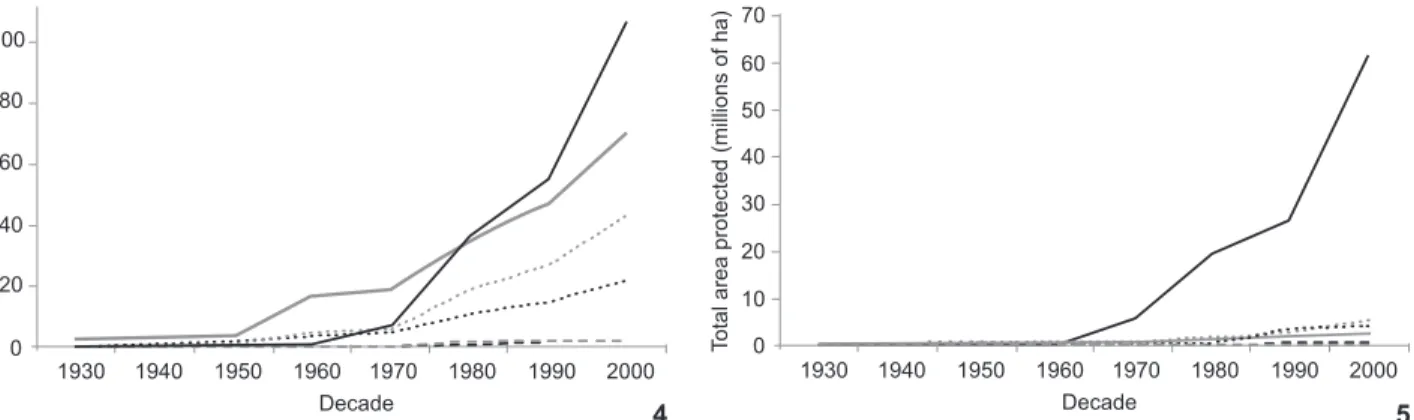
The Brazilian biomes are unevenly protected (Figs 4-6). The Amazon, which has the largest area, is also the best pro-tected, with 106 protected areas (Fig. 4) covering 14.8% of its area (Fig. 6). Even thought the number of strict protection areas is relatively small (37), they correspond to the majority of the area under legal protection in the biome (10.0% out of the 14.8%). The Amazon has the largest mean size for protected ar-eas (Figs 7 and 8). The Pampa has 8.4% of its area protected (Fig. 6). However, there is not a single strict protection site within the biome. The only two protected areas for sustainable use were established in the 1980’s and 1990’s, and the conservation in-vestments on this biome have stalled in the last decade (Figs 4-6). The Caatinga has 22 protected areas (Fig. 4), half of which represent strict protection sites. However, the protected areas in the Caatinga are relatively small and cover only 4.2% of the biome (1.8% under strict protection) (Fig. 6). The Cerrado hasonly 3.9% of its area under legal protection (Fig. 6), but most of it (3.2%) corresponds to strict protection areas. The Cerrado network is comprised of 43 protected areas (20 under the strict protection category) (Fig. 4). The Atlantic Forest has a total of 70 protected areas, 38 of which under strict protection catego-ries (Fig. 4). However, the majority of these protected areas are small (Figs 7 and 8) and this confers only 2.4% of its original cover under protection (0.9% of which under strict protection) (Fig. 6). The Atlantic Forest is the biome that has the network with the smallest mean size for the existing protected areas (Figs
Figures 1-3. Temporal investments in the Brazilian protected areas network: (1) number of protected areas; (2) total area protected; and (3) percentage of the national territory under protection. Black bars represent strict protection protected areas and grey bars rep-resent sustainable use protected areas.
1
2
7 and 8). Similar to the Pampa, the Pantanal also has only two protected areas (Fig. 4), and as a consequence it has a small area under protection (1.0%) (Fig. 6), but in this case the two sites are strict protection areas. The Pampa and the Pantanal need ur-gent investment in their protected networks, both in the num-ber of protected areas and biome coverage.
Strict protection vs sustainable use
Even though the national investment in the establish-ment of protected areas shows a steady increase, we have ob-served a shift in the management categories that sustain this growth (Figs 1-5). Until the 1980’s, most protected areas cre-ated in Brazil were strict protection sites, but from 1990’s on, the government continued to increase the national protected areas network mainly through the establishment of sustain-able use sites (Figs 1-5). This represents a change in the phi-losophy behind the role of protected areas, and a strategic change in how environmental issues relate to the development agenda of the country.
DISCUSSION
Globally, the spatial distribution of protected areas is un-even, particularly in the case of strict protection areas (CHAPEet al. 2005, BROOKSet al. 2004, HOEKSTRAet al. 2005, SOUTULLOet al.
2008, JENKINS & JOPPA 2009). Brazil is no exception, suggesting that the establishment of the national protected areas network has been historically driven by opportunity rather than by stra-tegic planning. Even though the national temporal investments in the protected areas network has increased over time, Brazil is still far from the international targets established by the Con-vention on Biological Diversity, according to which 17% of a country/biome should be formally and legally protected (CBD 2010). Brazil is far from achieving that target. Also, there is not a single biome under the level of protection recommended by the CBD (CBD 2010).
Most countries fail to protect their biodiversity efficiently, and Brazil is no exception (BROOKSet al. 2004, CBD 2010). The global protected area network is far from complete (BROOKSet al. 2004), as is the national network of Brazil. The 17%
na-tional goal for protected areas may turn out to be impossible to achieve in the face of recent changes in the national politics regarding biodiversity (e.g., METZGERet al. 2010, MARTINELLI 2011,
NAZARENO & LOVEJOY 2011, TOLLEFSON 2011), when even existing
protected areas are ignored, downsized or downgraded (from strict protection to sustainable use) to give way to develop-ment. For example, the shift in the types of protected area that are created (strict protection before the1980’s and sustainable use from the1990’s on) represents a change in the philosophi-cal role of protected areas and a strategic change in how envi-ronmental issues fit in the development agenda of the country. Originally, the main objective of the network was biodiversity protection, whereas now it is part of the country’s develop-ment strategy. Economic and social roles have been also intro-duced into the network, a trend that is also observed worldwide (DEARDENet al. 2005). The alarming issue is that areas in the
sustainable use categories are usually closer to and more prone
Figures 4-5. Temporal dynamics in the establishment of protected areas per biome in Brazil: Amazon (solid black line), Atlantic Forest (solid grey line), Caatinga (dotted black line), Cerrado (dotted grey line), Pampa (dashed black line) and Pantanal (dashed grey line).
Figure 6. Temporal dynamics in the percentage of area protected in each biome. Amazon (solid black line), Atlantic Forest (solid grey line), Caatinga (dotted black line), Cerrado (dotted grey line), Pampa (dashed black line) and Pantanal (dashed grey line).
to threats than strict protection (LOCKE & DEARDEN 2005, NAUGHTON-TREVESet al. 2005).
The establishment of protected areas is only the first step towards an effective network. After that, funding, infrastruc-ture and personnel must be secured on a long-term basis, oth-erwise the parks composing the network remain only on paper.
There is evidence that globally, the funding of protected areas has increased (DEARDEN 2005). Some of it is due to the growing
participation of the private sector and Non-profit organizations (DEARDEN 2005). However, the budget is still below the basic
needs for approximately 66% of the protected areas (DEARDEN et al. 2005), and in Brazil particularly, governmental
invest-ment is usually limited to the delimitation of new sites. The consequence is that much of the country’s current network has remained only on paper and their true effectiveness for biodiversity conservation is uncertain. Protected areas are con-sidered the backbone of conservation strategies. Brazil needs to seriously plan and manage its network, which is actually an important component of the global network, since Brazil is a megadiverse country.
ACKNOWLEDGEMENTS
We thank Guilherme de Oliveira and Danielle O. Moreira for valuable suggestions in an earlier draft of the manuscript. Lucas M. de Camargos helped with figures 7 and 8. Rodolfo Cabral thanks CAPES for his M.Sc. scholarship. Daniel Brito’s research is supported by the Conselho Nacional de Desenvolvimento Científico e Tecnológico (CNPq) (project #305631/2009-8).
LITERATURE CITED
BALMFORD, A.; A. BRUNER; P. COOPER; R. COSTANZA; S. FARBER; R.E. GREEN; M. JENKINS; P. JEFFERISS; V. JESSAMY; J. MADDEN; K. MUNRO;
N. MYERS; S. NAEEM; J. PAAVOLA; M. RAYMENT; S. ROSENDO; J.
ROUGHGARDEN; K. TRUMPER R.K. & TURNER. 2002. Economic
reasons for conserving wild nature. Science 297: 950-953. BROOK, B.W.; N.S. SODHI & P.K.L. NG. 2003. Catastrophic extinctions
follow deforestation in Singapore. Nature 424: 420-426. BROOKS, T.M.; M.I. BAKARR; T. BOUCHER; G.A.B. DA FONSECA; C. HILTON
-TAYLOR; J.M. HOEKSTRA; T. MORITZ; S. OLIVIERI; J. PARRISH; R.L. PRESSEY;
A.S.L. RODRIGUES; W. SECHREST; A. STATTERSFIELD; W. STRAHM & S.N. STUART. 2004. Coverage provided by the global protected-area system: is it enough? BioScience 54: 1081-1091.
BRUNER, A.G.; R.E. GULLISON; R.E. RICE & G.A.B. DA FONSECA. 2001.
Effectiveness of parks in protecting tropical biodiversity.
Science 291: 125-128.
CBD. 2010.CoP10 decision X2: strategic plan for biodiversity
2011-2020. Available online at: http://www.cbd.int/
decision/cop/?id = 12268 [Accessed: 09.IV.2012].
CEBALLOS, G. & P.R. EHRLICH. 2002. Mammal population losses
and the extinction crisis. Science 296: 904-907.
CHAPE, S.; J. HARRISON; M. SPALDING & I. LYSENKO. 2005. Measuring the extent and effectiveness of protected areas as an indicator for meeting global biodiversity targets. Philosophical
Tran-sactions of the Royal Society, Biological Sciences 360:
443-455.
DAILY, G.C. 1995. Restoring value to the world’s degraded lands.
Science 269: 350-354.
Figures 7-8. Size distribution for: (7) all protected areas in each biome; and for (8) strict protection protected areas in each biome.
7
DEARDEN, P.; M. BENNETT & J. JOHNSTON. 2005. Trends in global
protected area governance. Environmental Management 36: 89-100.
HOEKSTRA, J.M.; T.M. BOUCHER; T.H. RICKETTS & C. ROBERTS. 2005.
Confronting a biome crisis: global disparities of habitat loss and protection. Ecology Letters 8: 23-29.
ICMBIO. 2012. Unidades de Conservação. Available online at: http://www.icmbio.gov.br/portal/biodiversidade/unidades-de-conservacao/biomas-brasileiros.html [Acessed: 09.IV.2012]. JENKINS, C.N. & L. JOPPA. 2009.Expansion of the global terrestrial
protected area system. Biological Conservation 142: 2166-2174.
LEWINSOHN, T.M. & P.I. PRADO. 2005. How many species are there in Brazil? Conservation Biology 19: 619-624.
LOCKE, H. & P. DEARDEN. 2005. Rethinking protected area
categories and the new paradigm. Environmental
Conservation 32: 1-10.
LOUCKS, C.; T.H. RICKETS; R. NAIDOO; J. LAMOREUX & J. HOEKSTRA. 2008. Explaining the global pattern of protected area coverage: relative importance of vertebrate biodiversity, human activities and agricultural suitability. Journal of
Biogeography 35: 1337-1348.
MARTINELLI, L.A. 2011. Block changes to Brazil’s forest code.
Nature 474: 579.
METZGER, J.P.; T.M LEWINSOHN; C.A. JOLY; L.M VERDADE; L.A.
MARTINELLI & P.R. RODRIGUES. 2010. Brazilian law: full speed
in reverse? Science 329: 276-277.
MITTERMEIER, R.; C.G. MITTERMEIER; T. BROOKS; J. PILGRIM; W.R. KONSTANT; G.A.B. DA FONSECA & C. KORMOS. 2003a. Wilderness
and biodiversity conservation. Proceedings of the Natural Academy of Natural Sciences of the United States of
America 100: 10309-10313.
MITTERMEIER, R.; C.G. MITTERMEIER; P.R. GIL; J. PILGRIM; G.A.B. DA
FONSECA; T. BROOKS & W.R. KONSTANT. 2003b. Wilderness:
Earth’s last wild places. Mexico, CEMEX, 576p.
MITTERMEIER, R.; P.R. GIL; M. HOFFMAN; J. PILGRIM; T. BROOKS; C.G.
MITTERMEIER; J. LAMOREUX; G.A.B. DA FONSECA. 2005a. Hotspots revisited: Earth’s biologically richest and most threatened
terrestrial ecoregions. Mexico, CEMEX, 392p.
MITTERMEIER, R.; C.G. MITTERMEIER; P.R. GIL; G.A.B. DA FONSECA; T. BROOKS;
J. PILGRIM & W.R. KONSTANT. 2005b. Megadiversity: Earth’s
biologically wealthiest nations. Mexico, CEMEX, 501p.
MYERS, N. 1990. Mass extinctions: what can the past tell us about the present and the future? Global Planetary Change 2: 175-185.
MYERS, N.; R. MITTERMEIER; C.G. MITTERMEIER; G.A.B. DA FONSECA &
J. KENT. 2000. Biodiversity Hotspots for conservation
priorities. Nature 403: 853-858.
NAUGHTON-TREVES, L.; M.B. HOLLAND & K. BRANDON. 2005.The role
of protected areas in conserving biodiversity and sustaining local livelihoods. Annual Review of Environment and
Resources 30: 219-252.
NAZARENO, A.G. & T.E. LOVEJOY. 2011. Energy production: giant dam threatens Brazilian rainforest. Nature 478: 37. PIMM, S.L. & P. RAVEN. 2000. Extinction by numbers. Nature
403: 843-845.
PIMM, S.L.; G.J. RUSSELL; J.L. GITTLEMANN & T.M. BROOKS. 1995. The future of biodiversity. Science 269: 347-350.
RODRIGUES, A.S.L; H.R. AKÇAKAYA; S.J. ANDELMAN; M.I. BAKARR; L.
BOITANI; T.M. BROOKS; J.S. CHANSON; L.D.C. FISHPOOL; G.A.B DA
FONSECA; K.J. GASTON; M. HOFFMANN; P.A. MARQUET; J.D. PILGRIM;
R.L. PRESSEY; J. SCHIPPER; W. SECHREST; S.N. STUART; L.G. UNDERHILL;
R.W. WALLER; M.E.J. WATTS & X. YAN. 2004a. Global gap analysis: priority regions for expanding the global protected-area network. BioScience 54: 1092-1100.
RODRIGUES, A.S.L.; S.J. S.J. ANDELMAN; M.I. BAKARR; L. BOITANI; T.M.
BROOKS; R.M. COWLING; L.D.C. FISHPOOL; G.A.B. DA FONSECA; K.J. GASTON; M. HOFFMANN; J.S. LONG; P.A. MARQUET; J.D. PILGRIM; R.L. PRESSEY; J. SCHIPPER; W. SECHREST; S.N. STUART; L.G. UNDERHILL;
R.W.WALLER; M.E.J. WATTS & X. YAN. 2004b. Effectiveness of
the global protected area network in representing species diversity. Nature 428: 640-643.
SOUTULLO, A.; M. DE CASTRO & V. URIOS. 2008. Linking political and scientifically derived targets for global biodiversity conservation: implications for the expansion of the global network of protected areas. Diversity and Distributions 14: 604-613.
THOMAS, J.A.; M.G. TELFER; D.B. ROY; C.D. PRESTON; J.J.D. GREENWOOD; J. ASHER; R. FOX; R.T. CLARKE & J.H. LAWTON. 2004.
Comparative losses of British butterflies, birds and plants and the global extinction crisis. Science 303: 1879-1881. TOLLEFSON, J. 2011. Brazil revisits forest code: changes to
legislation could undermine authorities power to halt deforestation. Nature 476: 259-260.
WDPA. 2012. Growth in number of nationally and internationally designated protected areas (1911-2011). Available online at: http://www.wdpa.org/Statistics.aspx [Accessed: 09.IV.2012]. ZIMMERER, K.S.; R.E. GALT & M.V. BUCK. 2004. Globalization and multi-spatial trends in the coverage of protected-area conservation (1980-2000). Ambio 33: 520-529.